- Market Value (2025): USD 1.77 Bn
- Estimated Value (2026): USD 2.11 Bn
- Forecast Value (2036): USD 12.3 Bn
- CAGR (2026-2036): 19.3%
What is the Cloud Management for the OpenStack Market forecast to be worth by 2036?
USD 2.11 billion in 2026 to USD 12.3 billion by 2036 at a 19.3% CAGR.
- In 2025, the cloud management for the OpenStack market was worth USD 1.77 billion, with private clouds at telecom operators and large enterprises making up most orders.
- The market will expand from USD 2.11 billion in 2026 to USD 12.3 billion by 2036 as enterprises move virtual machines off proprietary hypervisors and onto open infrastructure.
- OpenStack management revenue will compound at a 19.3% CAGR from 2026 to 2036, since data sovereignty rules and AI workloads both push compute back under the owner’s control.
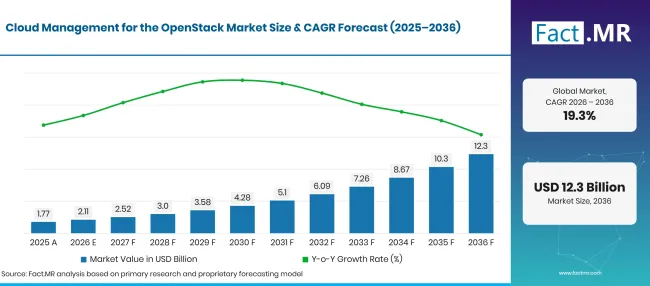
Cloud Management For The Openstack Market Forecast Global | Source: Fact.MR
| Year | Basis | Market Value (USD billion) |
|---|---|---|
| 2025 | Actual | 1.77 |
| 2026 | Estimate | 2.11 |
| 2036 | Forecast | 12.3 |
| CAGR 2026 to 2036 | Forecast period | 19.3% |
Source: Fact.MR analysis. Updated Oct 22, 2026
What are the defining numbers behind Cloud Management for the OpenStack Market growth?
USD 10.2 billion of additional revenue will be generated between 2026 and 2036, led by private cloud software in large enterprises.
- Demand Drivers in the Market
- Enterprise cloud adoption in Europe keeps widening the pool of OpenStack buyers. Eurostat reported that 52.74% of EU enterprises used paid cloud computing services in 2025 [1]. Firms that start with hosted email and storage often move core workloads next, and some choose to run them on an open private cloud.
- Cloud switching rules favor open APIs. The European Commission’s Data Act has applied since 12 September 2025 and sets a framework for customers to switch between providers of data-processing services [2]. OpenStack gives providers and users a shared, documented API that eases moves between clouds.
- Virtualization licensing changes are sending IT teams to look for alternatives. Many operators now test OpenStack with KVM as a path for existing virtual machine estates, and management vendors offer migration tools to move workloads in stages.
- Private AI infrastructure adds GPU clusters that need scheduling and multi-tenant control. The International Energy Agency reported that data centers used about 415 TWh of electricity in 2024, around 1.5% of global consumption, and projected about 945 TWh by 2030 [3]. Owners who build this capacity want an open control plane for it.
- Kubernetes-based delivery is cutting OpenStack’s operating effort. Vendors now package OpenStack services as containers, so upgrades and scaling follow the same tools that platform teams already use for applications.
- Key Segments Analyzed
- By Component: Software will account for 62.3% share in 2026, as subscriptions for supported distributions and lifecycle tooling are renewed every year.
- By Deployment Mode: Private Cloud will command 43.7% share in 2026, given that regulated buyers keep sensitive workloads on hardware they own.
- By Organization Size: Large Enterprises will hold 71.4% share in 2026 through in-house platform teams that can run multi-site clouds.
- By End-User: IT and Telecommunications will capture 27.8% share in 2026, reflecting operator demand for open infrastructure that hosts network functions.
- Analyst Opinion at Fact.MR
- Shambhu Nath Jha, Principal Consultant at Fact.MR, states, “OpenStack is no longer a science project for most buyers, it is the fallback when they want control over cost, data location and hardware choice. The vendors that win will be the ones that make upgrades boring and migrations predictable. Managed service offers will gain most with firms that want the control of a private cloud without hiring a large operations team.”
- Strategic Implications
- OpenStack distribution vendors should ship tested migration paths for virtual machines, networks and storage volumes, since most new buyers arrive with an existing hypervisor estate.
- Managed service providers should offer fixed-price private cloud tiers with clear support terms, given that mid-sized firms lack staff to run OpenStack around the clock.
- Telecom operators should align their OpenStack platforms with container network functions, so that one control plane serves both legacy and cloud-native workloads.
- Hardware partners should certify GPU servers and high-speed fabrics with major distributions before AI projects reach the tender stage.
At 22.1% CAGR, Germany will move ahead of the group as firms and public bodies favor clouds they can host locally. The United Kingdom follows at 15.8%, where security incidents keep boards focused on infrastructure control. Japan will post 15.2%, helped by near-universal corporate cloud use. Growth of 14.9% in the United States will rest on a deep pool of cloud engineers. Brazil rounds out the five at 13.6%, with internet access now reaching most households.
How does the Cloud Management for the OpenStack Market break down by segment?
Software will lead Component at 62.3%; Private Cloud will top Deployment Mode at 43.7%; Large Enterprises will hold first place in Organization Size at 71.4%; IT and Telecommunications will head End-User at 27.8%.
Which Component dominates?
Software takes 62.3% of 2026 sales.
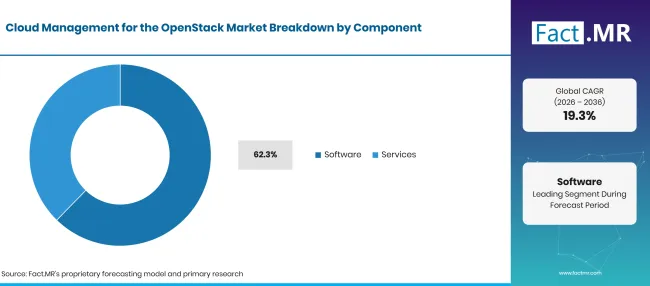
Cloud Management For The Openstack Market Breakdown Component | Source: Fact.MR
| Component | Share (2026) |
|---|---|
| Software (Leading segment) | 62.3% |
| Other segments combined | 37.7%* |
| Total | 100.0% |
Source: Fact.MR analysis. Updated Oct 22, 2026
OpenStack software spending is driven by the need for a supported, tested release over raw upstream code. Buyers pay for long-term security patches, certified drivers and an upgrade tool that moves a cloud from one release to the next without downtime. Many platforms run on top of server virtualization software layers such as KVM, which the distribution bundles and maintains. OpenStack consulting and managed services cover design, deployment, migration and round-the-clock operation. Demand for services rises when a firm moves a large virtual machine estate, because each workload needs testing and cutover planning. Services also fill skill gaps in firms that cannot staff a dedicated cloud team.
What leads the Deployment Mode segment?
Private Cloud holds 43.7% of 2026 sales.
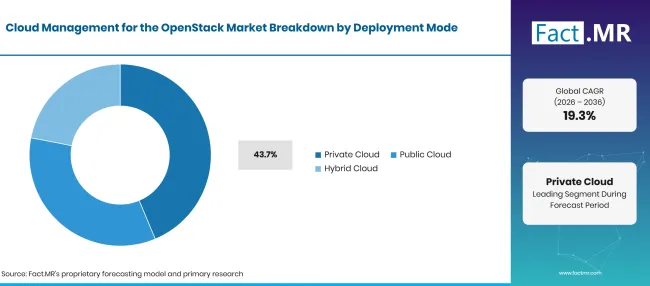
Cloud Management For The Openstack Market Breakdown Deployment Mode | Source: Fact.MR
| Deployment Mode | Share (2026) |
|---|---|
| Private Cloud (Leading segment) | 43.7% |
| Other segments combined | 56.3%* |
| Total | 100.0% |
Source: Fact.MR analysis. Updated Oct 22, 2026
Banks, hospitals, ministries and operators keep sensitive data on hardware they own or lease, with clear control over location and access. Private OpenStack clouds give them self-service provisioning while staying inside their own security perimeter. Many are deployed on hyper-converged systems that merge compute and storage in one rack. Public OpenStack clouds are run by regional providers that sell capacity with open APIs. Hybrid deployments link an on-premises OpenStack cloud with public capacity, and tools for multi-cloud management help teams place workloads across both.
How does Organization Size shape demand?
Large Enterprises represent 71.4% of 2026 sales.
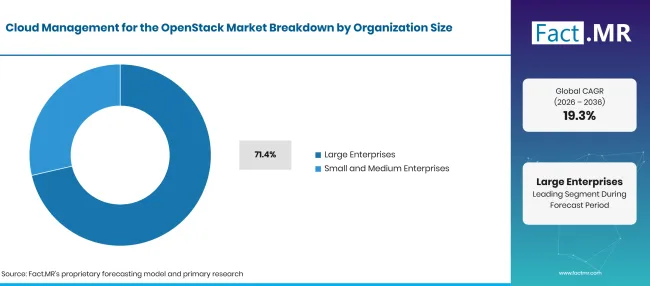
Cloud Management For The Openstack Market Breakdown Organization Size | Source: Fact.MR
| Organization Size | Share (2026) |
|---|---|
| Large Enterprises (Leading segment) | 71.4% |
| Other segments combined | 28.6%* |
| Total | 100.0% |
Source: Fact.MR analysis. Updated Oct 22, 2026
Multi-site enterprises run thousands of virtual machines and have the budget for dedicated platform engineers. They gain the most from replacing per-socket licenses with open software. Across the EU, 84.67% of large enterprises purchased cloud computing services in 2025, according to Eurostat [1]. Small and medium enterprises reach OpenStack mainly through managed private clouds and public OpenStack providers. Lighter installers and single-node editions now lower the entry point for smaller IT teams.
What supports IT and Telecommunications within End-User?
IT and Telecommunications buyers make up 27.8% of 2026 sales.
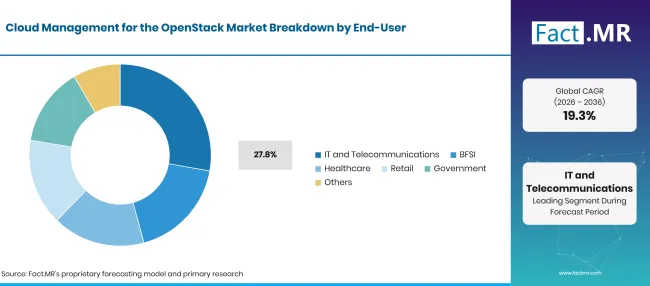
Cloud Management For The Openstack Market Breakdown End User | Source: Fact.MR
| End-User | Share (2026) |
|---|---|
| IT and Telecommunications (Leading segment) | 27.8% |
| Other segments combined | 72.2%* |
| Total | 100.0% |
Source: Fact.MR analysis. Updated Oct 22, 2026
Mobile operators run virtualized core and edge functions on OpenStack, and 5G rollout keeps that footprint growing. ITU reported that 5G networks covered 55% of the world’s population in 2025 [4]. Many operators host network function virtualization workloads on OpenStack across central and regional sites. In the EU, 82.92% of firms in the information and communication sector used paid cloud services in 2025 [1]. BFSI buyers use OpenStack for regulated workloads that must stay in approved locations. Healthcare providers apply it to imaging archives and records systems, often next to healthcare cloud computing services. Retail and government users favor it for cost control and data residency.
What is accelerating Cloud Management for the OpenStack Market adoption, and what is holding it back?
Adoption will gain from cloud switching rules, virtualization license changes and private AI clusters. Growth is held back by a shortage of OpenStack skills and by the effort of moving large legacy estates.
Drivers Impact Analysis
| DRIVER | (~) % IMPACT ON CAGR | GEOGRAPHIC RELEVANCE | IMPACT TIMELINE |
|---|---|---|---|
| Migration of virtual machine estates away from proprietary hypervisors | +3.8% | North America, Western Europe | Short term (<= 2 years) |
| Data sovereignty and cloud switching rules | +3.2% | Western Europe, East Asia | Medium term (2-4 years) |
| Telecom network function and 5G core virtualization | +2.6% | East Asia, North America, Western Europe | Medium term (2-4 years) |
| Private AI and GPU cluster build-outs | +2.2% | North America, East Asia | Short term (<= 2 years) |
| Kubernetes-based packaging of OpenStack services | +1.4% | Global | Medium term (2-4 years) |
Source: Fact.MR analysis. Updated Oct 22, 2026
Opportunity Impact Analysis
| OPPORTUNITY | (~) % IMPACT ON CAGR | GEOGRAPHIC RELEVANCE | IMPACT TIMELINE |
|---|---|---|---|
| Managed private cloud tiers for mid-sized firms | +1.3% | Global | Short term (<= 2 years) |
| Sovereign public clouds from regional providers | +1.1% | Western Europe, Latin America | Medium term (2-4 years) |
| Edge OpenStack sites for operators and retailers | +0.8% | East Asia, North America | Long term (>= 4 years) |
Source: Fact.MR analysis. Updated Oct 22, 2026
Restraints Impact Analysis
| RESTRAINT | (~) % IMPACT ON CAGR | GEOGRAPHIC RELEVANCE | IMPACT TIMELINE |
|---|---|---|---|
| Shortage of engineers with OpenStack operations skills | -1.2% | Global | Short term (<= 2 years) |
| Complexity of upgrades across large multi-site clouds | -0.8% | Global | Medium term (2-4 years) |
| Competition from hyperscale public cloud services | -0.7% | North America, Latin America | Long term (>= 4 years) |
Source: Fact.MR analysis. Updated Oct 22, 2026
Which countries are scaling the Cloud Management for the OpenStack Market through 2036?
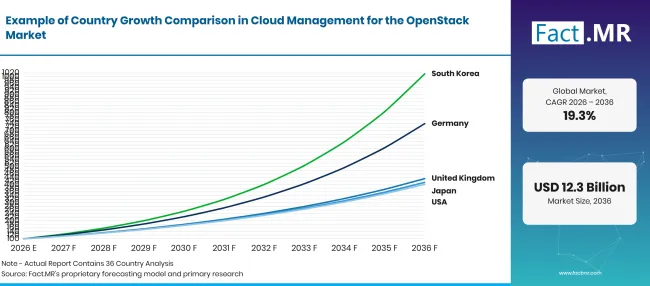
Cloud Management For The Openstack Market Growth Index | Source: Fact.MR
| Country | CAGR (2026 to 2036) |
|---|---|
| Germany | 22.1% |
| United Kingdom | 15.8% |
| Japan | 15.2% |
| United States | 14.9% |
| Brazil | 13.6% |
Source: Fact.MR analysis. Updated Oct 22, 2026
What supports Germany’s adoption?
22.1% CAGR, driven by demand for locally hosted clouds under European data rules.
OpenStack demand in Germany builds on broad cloud use across firms. Destatis reported that 54% of German companies with at least 10 employees used paid cloud services in 2025 [5]. The share reached 88% in the information and communication sector [5]. German buyers often require domestic hosting, which favors private and regional OpenStack clouds.
How is the United Kingdom scaling demand?
15.8% CAGR, backed by security priorities that keep infrastructure under direct control.
UK firms weigh cloud choices against a steady flow of cyber incidents. The Department for Science, Innovation and Technology reported that 43% of UK businesses identified a breach or attack in the 12 months before its 2025 survey [6]. Large businesses reported a rate of 74% [6]. Private OpenStack clouds let these firms set their own controls.
What is supporting Japan’s adoption?
15.2% CAGR, helped by near-universal cloud use among Japanese companies.
Japanese companies already treat cloud as standard IT. The Ministry of Internal Affairs and Communications reported in May 2025 that the share of companies using cloud services had passed 80% [7]. The same survey found that 88.2% of cloud users reported benefits [7]. Telecom operators in Japan also run large OpenStack estates for network functions.
How does the United States perform?
14.9% CAGR, reflecting a large base of cloud and platform engineers.
OpenStack teams in the United States can draw on a deep labor pool. The Bureau of Labor Statistics projects about 280,000 openings each year in computer and information technology occupations from 2025 to 2035 [8]. It reported a median annual wage of $109,470 for this group in May 2025 [8]. Hosting firms and research centers are frequent private cloud buyers.
How is Brazil developing demand?
13.6% CAGR, as rising connectivity widens the market for local cloud services.
Brazil’s digital base is expanding. IBGE reported that 74.9 million households, or 93.6% of permanent private households, had internet access in 2024 [9]. Higher connectivity raises demand for local hosting. Public data centers and regional providers are adding open cloud capacity to keep data in the country.
Who leads the Cloud Management for the OpenStack Market?
Supply falls into two groups. Distribution vendors sell supported OpenStack builds and lifecycle tools. Red Hat offers Red Hat OpenStack Services on OpenShift, which uses a containerized control plane on OpenShift. Canonical marked 15 years of OpenStack in October 2025 and said over 500 clouds run its distribution in production under Ubuntu Pro [13]. Mirantis launched Rockoon in January 2025, an open source controller for OpenStack on Kubernetes that anchors Mirantis OpenStack for Kubernetes [10].
Platform9 sells Private Cloud Director to virtualization teams and released a free Community Edition of it in March 2025 [11]. Operators and managed providers form the second group. Rackspace Technology launched OpenStack Business in July 2025, a fully managed, dedicated private cloud [12]. OVHcloud builds its public cloud on open standards such as OpenStack, with an OpenStack API for automation. Upgrade reliability, migration tooling and round-the-clock support will separate vendors as buyers shift workloads at scale.
Which companies are the key providers?
Key companies include Red Hat, Inc.; Canonical Ltd.; Mirantis, Inc.; Platform9 Systems, Inc.; Rackspace Technology, Inc.; and OVHcloud.
- Red Hat, Inc.
- Canonical Ltd.
- Mirantis, Inc.
- Platform9 Systems, Inc.
- Rackspace Technology, Inc.
- OVHcloud
Bibliography
- [1] Eurostat. (2026, January). Cloud computing - statistics on the use by enterprises.
- [2] European Commission. (2026, July 2). Data Act.
- [3] International Energy Agency. (2025). Energy and AI: Executive summary.
- [4] International Telecommunication Union. (2025, October 15). Facts and Figures 2025: Mobile network coverage.
- [5] Statistisches Bundesamt (Destatis). (2025, November 24). Jedes zweite Unternehmen nutzt kostenpflichtige Cloud-Services [Every second company uses paid cloud services].
- [6] Department for Science, Innovation and Technology. (2025, June 19). Cyber security breaches survey 2025.
- [7] Ministry of Internal Affairs and Communications, Japan. (2025, May 30).[Results of the 2024 Communications Usage Trend Survey].
- [8] U.S. Bureau of Labor Statistics. (2026, August 27). Computer and Information Technology Occupations.
- [9] Instituto Brasileiro de Geografia e Estatística (IBGE). (2025, July 24). Internet chega a 74,9 milhões de domicílios do país em 2024 [Internet reaches 74.9 million households in 2024].
- [10] Mirantis. (2025, January 28). Mirantis Launches Open Source Software that Streamlines OpenStack Management on Kubernetes.
- [11] Platform9. (2025, March 31). Platform9 Releases Free Community Edition so All Virtualization Practitioners Can Experience the Easiest Private Cloud.
- [12] Rackspace Technology. (2025, July 8). Enterprises Enhance Privacy, Security and Control with Rackspace Technology’s OpenStack Business Private Cloud.
- [13] Canonical. (2025, October 7). OpenStack cloud - happy 15th anniversary!.
This Report Answers
- OpenStack management revenue is split between software and services, with values tracked through 2036.
- Which deployment modes, company sizes and end-users account for the leading share, and why they buy.
- Germany, the United Kingdom, Japan, the United States and Brazil are compared on cloud use, security pressure and skills.
- Distribution vendors and managed providers are profiled with their current OpenStack products.
- Hypervisor migration, sovereignty rules and AI clusters are weighed against skill shortages and upgrade effort.
What does the Cloud Management for the OpenStack Market cover?
OpenStack cloud management covers the tools and services that install, run and update an OpenStack cloud. This includes supported distributions, deployment and upgrade tooling, monitoring, and the operating work done by managed providers.
Revenue is tracked by component, deployment mode, organization size and end-user. Values reflect what buyers pay to vendors and service firms, not the cost of the servers underneath.
What is included in the scope?
Subscriptions for OpenStack distributions, lifecycle managers and Kubernetes-based OpenStack controllers are included. Consulting, migration, training and managed operation of OpenStack clouds are counted as services.
Public OpenStack capacity is counted at the management and service layer. Tools for budgeting and chargeback within OpenStack clouds are included when sold with the platform, while stand-alone cloud FinOps tools are tracked elsewhere.
What is excluded from the scope?
Server, storage and network hardware sold under separate contracts is excluded. Hyperscale public cloud services that do not run on OpenStack fall outside the revenue boundary.
Stand-alone cloud data security products and general Kubernetes platforms without OpenStack management are also excluded.
How Was the Analysis Built?
The analysis draws on 120+ sources, 35+ company portfolios, 25+ countries, and more than 20 industry interviews.
- Primary Research: Primary research includes discussions with manufacturers, service providers, technology developers, distributors, end users, and subject-matter experts. These conversations examine purchasing priorities, product adoption, operational challenges, approval requirements, competitive positioning, and the factors that influence wider market acceptance.
- Desk Research: Desk research covers government statistics, regulatory publications, company filings, trade data, technical studies, industry associations, standards, public policy, and other authoritative sources. Every source used in the analysis is documented in the bibliography.
- Market Sizing and Forecasting: Market estimates combine historical performance, demand indicators, pricing and volume trends, segment shares, company participation, country-level growth, adoption patterns, investment activity, and barriers to market expansion.
- Data Validation and Update Cycle: Findings are validated by comparing primary interviews with public data, company activity, regulatory changes, trade patterns, and industry developments. Regular updates review new product launches, capacity changes, partnerships, approvals, and shifts in commercial adoption.
Segmentation
What is the report’s scope and coverage?
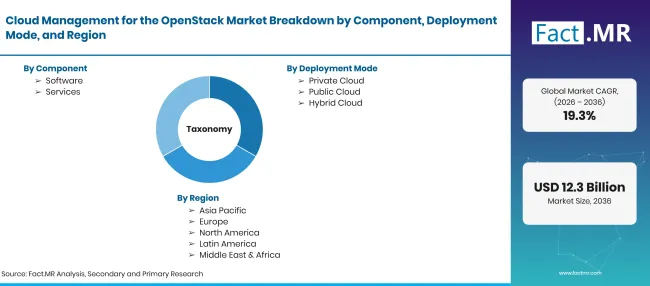
Cloud Management For The Openstack Market Taxonomy | Source: Fact.MR
| Attribute | Details |
|---|---|
| Quantitative Units | USD billion |
| Market Definition | Software and services used to deploy, operate, upgrade and govern clouds built on OpenStack. It counts supported distributions, lifecycle management tools, consulting and managed operation. |
| Component | Software; Services |
| Deployment Mode | Private Cloud; Public Cloud; Hybrid Cloud |
| Organization Size | Large Enterprises; Small and Medium Enterprises |
| End-User | IT and Telecommunications; BFSI; Healthcare; Retail; Government; Others |
| Regions Covered | North America; Latin America; Western Europe; Eastern Europe; East Asia; South Asia & Pacific; Middle East & Africa |
| Countries Covered | Germany; United Kingdom; Japan; United States; Brazil |
| Companies Profiled | Red Hat, Inc.; Canonical Ltd.; Mirantis, Inc.; Platform9 Systems, Inc.; Rackspace Technology, Inc.; OVHcloud |
| Forecast Period | 2026 to 2036 |
| Approach | Hybrid top-down and bottom-up approach using OpenStack core counts in production; subscription and support pricing per node; managed service contract values; deployment and end-user splits by country; and vendor portfolio review. |
Source: Fact.MR analysis. Updated Oct 22, 2026
How is the market segmented?
-
By Component
- Software
- Services
-
By Deployment Mode
- Private Cloud
- Public Cloud
- Hybrid Cloud
-
By Organization Size
- Large Enterprises
- Small and Medium Enterprises
-
By End-User
- IT and Telecommunications
- BFSI
- Healthcare
- Retail
- Government
- Others
-
By Region
- North America
- Latin America
- Western Europe
- Eastern Europe
- East Asia
- South Asia & Pacific
- Middle East & Africa
Frequently Asked Questions
How big is the cloud management for the OpenStack market in 2026?
What is the CAGR of the cloud management for the OpenStack market from 2026 to 2036?
Which component leads the cloud management for the OpenStack market?
Which deployment mode leads the cloud management for the OpenStack market?
Which organization size leads the cloud management for the OpenStack market?
Which end-user leads the cloud management for the OpenStack market?
Which country will grow the most in the cloud management for the OpenStack market?
Who are the main companies in the cloud management for the OpenStack market?
Who worked on this report


Preview the report firsthand - request a free sample
Free SampleGet the brochure for pricing and purchase details
Download PDF