- Market Value (2025): USD 11.6 Bn
- Estimated Value (2026): USD 12.9 Bn
- Forecast Value (2036): USD 38.7 Bn
- CAGR (2026-2036): 11.6%
What is the Cloud Data Security Market forecast to be worth by 2036?
USD 12.9 billion in 2026 to USD 38.7 billion by 2036 at 11.6% CAGR.
- The cloud data security market reached USD 11.6 billion in 2025 as cloud security teams, CISOs, financial institutions and enterprise software buyers increased spending to protect sensitive data moving across public cloud, SaaS applications and hybrid work environments.
- Demand is projected to increase from USD 12.9 billion in 2026 to USD 38.7 billion by 2036.
- The market is forecast to record an 11.6% CAGR from 2026 to 2036.
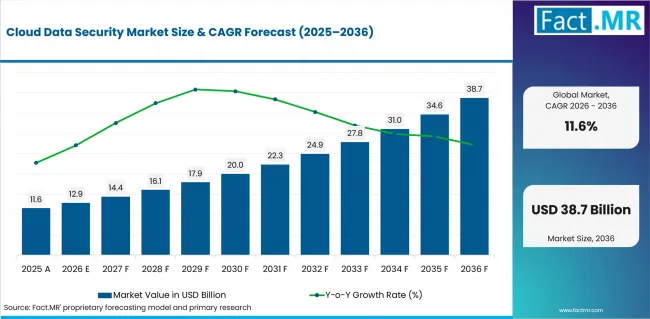
Cloud Data Security Market Value Analysis | Source: Fact.MR
What are the defining numbers behind Cloud Data Security Market growth?
USD 25.8 billion absolute opportunity is expected by 2036.
- Demand Drivers in the Market
- CASB demand remains strong because enterprises need visibility into SaaS use, shadow IT and data movement across cloud services.
- Public cloud adoption increases the need for controls that follow data across storage, applications and user access points.
- Large enterprises lead because they carry more identities, workloads, regions and compliance obligations than smaller buyers.
- BFSI buyers keep data protection spending high because regulated customer data, fraud risk and audit scrutiny make cloud controls a board-level issue.
- Key Segments Analyzed
- By Solution: Cloud Access Security Broker (CASB) is expected to hold 37.1% share in 2026 because enterprises need policy enforcement and visibility across SaaS and public-cloud use.
- By Deployment Model: Public Cloud is expected to hold 53.1% share in 2026 because more sensitive workloads are being placed in shared cloud environments.
- By Enterprise Size: Large Enterprises are expected to hold 58.8% share in 2026 because large organizations manage more identities, cloud accounts and compliance checks.
- By End User: BFSI is expected to hold 32.0% share in 2026 because banks and insurers face high data-risk exposure and strict audit requirements.
- By Security Type: Data Protection is expected to hold 37.5% share in 2026 because buyers still rank data loss, exposure and misuse as the core cloud-security problem.
- Analyst Opinion at Fact.MR
- Shambhu Nath Jha, Sr. Consultant at Fact.MR, states, "Cloud data security is no longer a narrow tool purchase. Buyers want proof that data discovery, access control, encryption and incident response work across the cloud services they already use."
- Strategic Implications
- Vendors should show how CASB, data protection and identity controls work together instead of selling each control as a separate console.
- Enterprise buyers need integration plans that cover SaaS, IaaS, endpoint and identity environments before expansion.
- Providers that simplify policy management and audit reporting can reduce security-team workload and win larger deployments.
- South Korea is projected at 12.4%; USA is projected at 11.9%; UK is projected at 11.6%; Australia is projected at 11.5%; Germany is projected at 11.3%; Canada is projected at 11.1%; Japan is projected at 10.7% during 2026 to 2036. Country analysis is shaped by cloud migration, regulatory scrutiny and enterprise security maturity.
How does the Cloud Data Security Market break down by segment?
Cloud Access Security Broker (CASB) leads Solution at 37.1% share in 2026, while Public Cloud leads Deployment Model at 53.1% share.
Why does Cloud Access Security Broker (CASB) lead Solution?
Cloud Access Security Broker (CASB) is expected to account for 37.1% share in 2026.
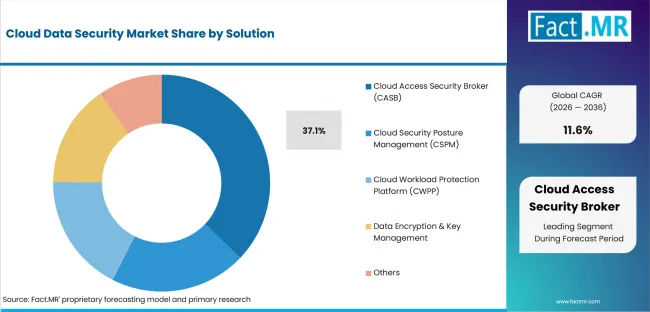
Cloud Data Security Market Analysis By Solution | Source: Fact.MR
Cloud Access Security Broker (CASB) leads the solution segment because enterprises need policy enforcement and visibility across SaaS and public-cloud use.
Why does Public Cloud lead Deployment Model?
Public Cloud is expected to account for 53.1% share in 2026.
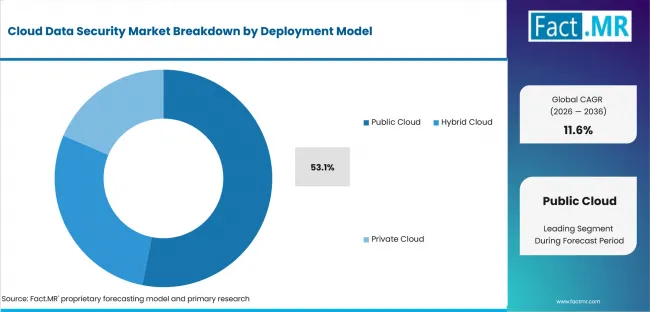
Cloud Data Security Market Analysis By Deployment Model | Source: Fact.MR
Public Cloud leads the deployment model segment because more sensitive workloads are being placed in shared cloud environments.
Why do Large Enterprises lead the Enterprise Size segment?
Large Enterprises are expected to account for 58.8% share in 2026.
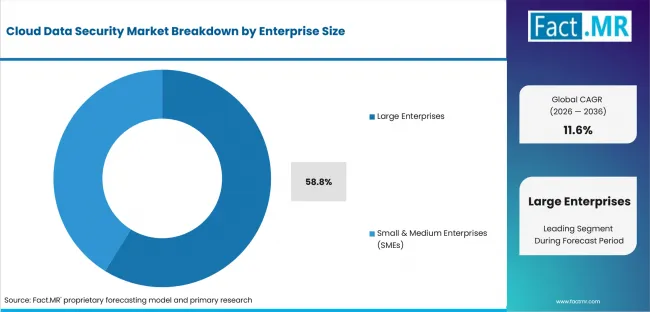
Cloud Data Security Market Analysis By Enterprise Size | Source: Fact.MR
Large Enterprises lead the enterprise size segment because large organizations manage more identities, cloud accounts and compliance checks.
Why does BFSI lead End User?
BFSI is expected to account for 32.0% share in 2026.
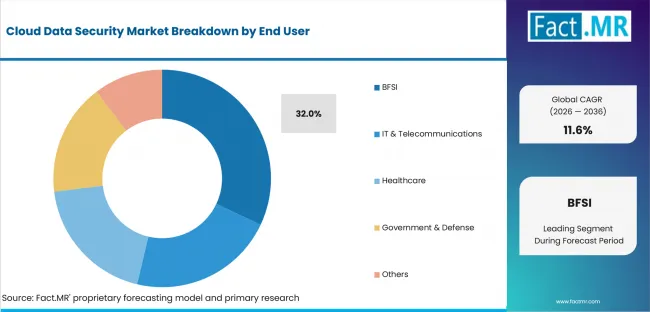
Cloud Data Security Market Analysis By End User | Source: Fact.MR
BFSI leads the end user segment because banks and insurers face high data-risk exposure and strict audit requirements.
Why does Data Protection lead Security Type?
Data Protection is expected to account for 37.5% share in 2026.
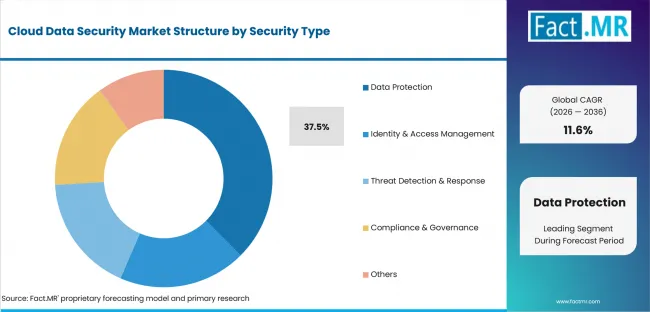
Cloud Data Security Market Analysis By Security Type | Source: Fact.MR
Data Protection leads the security type segment because buyers still rank data loss, exposure and misuse as the core cloud-security problem.
What is accelerating Cloud Data Security Market adoption, and what is holding it back?
Demand is supported by public cloud migration, SaaS sprawl and regulated data exposure. Adoption is held back by tool overlap, integration complexity and shortage of cloud-security skills.
| DRIVER | QUALITATIVE RELEVANCE | GEOGRAPHIC RELEVANCE | IMPACT TIMELINE |
|---|---|---|---|
| CASB adoption | High | South Korea | Short term (<=2 years) |
| Public cloud workloads | High | USA | Short term (<=2 years) |
| Large enterprise complexity | Moderate | UK | Medium term (2-4 years) |
| BFSI compliance | Selective | Australia | Medium term (2-4 years) |
Source: Fact.MR analysis. Updated Jul 29, 2026
- CASB adoption: Enterprises use CASB tools to find risky cloud activity, apply data policies and control SaaS access.
- Public cloud workloads: More production data in public cloud increases demand for encryption, monitoring and access governance.
- Large enterprise complexity: Large buyers need consistent data-security controls across business units, regions and cloud providers.
- BFSI compliance: Financial institutions must show stronger control over customer data, third-party access and audit trails.
Opportunity Impact Analysis
| OPPORTUNITY | QUALITATIVE RELEVANCE | GEOGRAPHIC RELEVANCE | IMPACT TIMELINE |
|---|---|---|---|
| Unified cloud data security platforms | High | South Korea | Medium term (2-4 years) |
| Data discovery and classification | Moderate | USA | Medium term (2-4 years) |
| Managed cloud-security services | Selective | UK | Medium term (2-4 years) |
Source: Fact.MR analysis. Updated Jul 29, 2026
- Unified cloud data security platforms can reduce tool sprawl for security teams.
- Data discovery and classification can open budgets where buyers need to understand exposure before enforcing policy.
- Managed cloud-security services can help enterprises that lack internal specialists.
Restraints Impact Analysis
| RESTRAINT | QUALITATIVE RELEVANCE | GEOGRAPHIC RELEVANCE | IMPACT TIMELINE |
|---|---|---|---|
| Integration with legacy systems | High | South Korea | Short term (<=2 years) |
| Overlapping security tools | Moderate | USA | Medium term (2-4 years) |
| Data residency and privacy rules | Selective | UK | Medium term (2-4 years) |
Source: Fact.MR analysis. Updated Jul 29, 2026
- Integration with legacy systems slows deployment in complex enterprises.
- Overlapping security tools make buyers question whether another platform is necessary.
- Data residency and privacy rules raise configuration and governance costs.
Which countries are scaling Cloud Data Security Market fastest?
The global CAGR is 11.6%. Country rates show how cloud migration, regulatory scrutiny and enterprise security maturity change the adoption route by market.
- South Korea records the highest listed CAGR at 12.4% from 2026 to 2036.
- USA and UK also sit close to the upper end of the comparison where local demand conditions are stronger.
- Australia, Germany, Canada, and Japan grow more steadily as buyers weigh cost, availability and adoption risk.
The full regional view covers North America, Latin America, Europe, East Asia, South Asia and Oceania, and the Middle East and Africa.
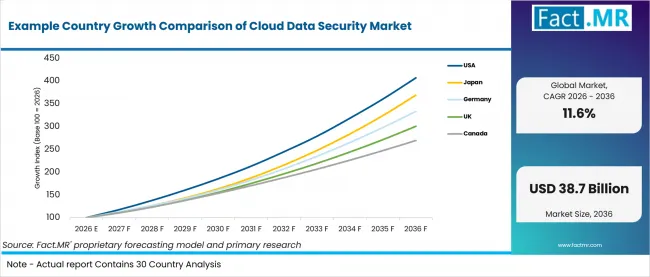
Example Country Growth Comparison Of Cloud Data Security Market | Source: Fact.MR
| COUNTRY | CAGR, 2026 to 2036 |
|---|---|
| South Korea | 12.4% |
| USA | 11.9% |
| UK | 11.6% |
| Australia | 11.5% |
| Germany | 11.3% |
| Canada | 11.1% |
| Japan | 10.7% |
Source: Fact.MR analysis. Updated Jul 29, 2026
What is shaping South Korea's outlook through 2036?
South Korea is projected at 12.4% CAGR during 2026 to 2036, above the global 11.6% trajectory. Digital enterprises and financial institutions are expanding cloud controls around regulated data.
What is shaping USA's outlook through 2036?
USA is projected at 11.9% CAGR during 2026 to 2036, above the global 11.6% trajectory. Large cloud estates, active breach response budgets and strong SaaS adoption support faster spending.
What is shaping UK's outlook through 2036?
UK is projected at 11.6% CAGR during 2026 to 2036, in line with the global 11.6% trajectory. Financial-services and public-sector cloud programs keep audit-ready security controls in focus.
What is shaping Australia's outlook through 2036?
Australia is projected at 11.5% CAGR during 2026 to 2036, below the global 11.6% trajectory. Cloud migration and data-breach awareness support demand for stronger governance.
What is shaping Germany's outlook through 2036?
Germany is projected at 11.3% CAGR during 2026 to 2036, below the global 11.6% trajectory. Privacy expectations and data-residency concerns make proof of control central to adoption.
What is shaping Canada's outlook through 2036?
Canada is projected at 11.1% CAGR during 2026 to 2036, below the global 11.6% trajectory. Banks, insurers and public-sector users drive demand, though procurement cycles remain measured.
What is shaping Japan's outlook through 2036?
Japan is projected at 10.7% CAGR during 2026 to 2036, below the global 11.6% trajectory. Large enterprises adopt carefully as they align cloud security with existing IT governance.
Who leads the Cloud Data Security Market?
Microsoft Corporation, Amazon Web Services, Inc. (AWS), Palo Alto Networks, Inc. and Cisco Systems, Inc. are active providers in the cloud data security market.
Competition is shaped by cloud coverage, data discovery, policy enforcement, identity integration and audit reporting.
Through 2036, competitive gains are expected to come from clearer positioning around Cloud Access Security Broker (CASB) and stronger execution in the highest-growth country markets.
Which companies are the key providers?
Key companies include Microsoft Corporation; Amazon Web Services, Inc. (AWS); Palo Alto Networks, Inc.; Cisco Systems, Inc.; International Business Machines Corporation (IBM); Broadcom Inc.; Fortinet, Inc.; Trend Micro Incorporated; Check Point Software Technologies Ltd.; Oracle Corporation.
- Microsoft Corporation
- Amazon Web Services, Inc. (AWS)
- Palo Alto Networks, Inc.
- Cisco Systems, Inc.
- International Business Machines Corporation (IBM)
- Broadcom Inc.
- Fortinet, Inc.
- Trend Micro Incorporated
- Check Point Software Technologies Ltd.
- Oracle Corporation
Bibliography
This Report Addresses
- The report evaluates the Cloud Data Security Market through Solution and Deployment Model choices that define the 2026 market structure.
- Segment analysis covers Cloud Access Security Broker (CASB) and Public Cloud as the leading 2026 positions.
- Country outlook compares the listed markets by CAGR and explains how cloud migration, regulatory scrutiny and enterprise security maturity shape local demand.
- Competitive analysis profiles the named providers and evaluates competition around cloud coverage, data discovery, policy enforcement, identity integration and audit reporting.
What does the Cloud Data Security Market cover?
The Cloud Data Security Market covers software and services that protect data stored, processed or shared in cloud environments, including CASB, data protection, access control, encryption and monitoring.
The market boundary is tied to paid products, services and channels that directly support this use case. Adjacent spending is included only when it is part of the same purchase or operating decision.
What is included in the scope?
The scope includes solution type, deployment model, enterprise size, end user, security type and regional demand for cloud data-security controls.
Coverage also includes adjacent segment options when they are purchased for the same defined market use.
What is excluded from the scope?
The scope excludes general IT infrastructure, endpoint-only security and cloud services that do not include data-security functionality.
How Was the Analysis Built?
The analysis combines primary research with desk research focused on the cloud data security market, its segment structure and country-level demand.
- Primary Research: Interviews and validation discussions test buyer priorities, adoption barriers, pricing logic and operating requirements.
- Desk Research: The assessment reviews company disclosures, public datasets, regulatory material, technical literature and industry records relevant to the market.
- Market Sizing and Forecasting: Estimates combine top-down and bottom-up checks across demand signals, segment shares, country activity, company participation and adoption constraints.
Segmentation
What is the report's scope and coverage?
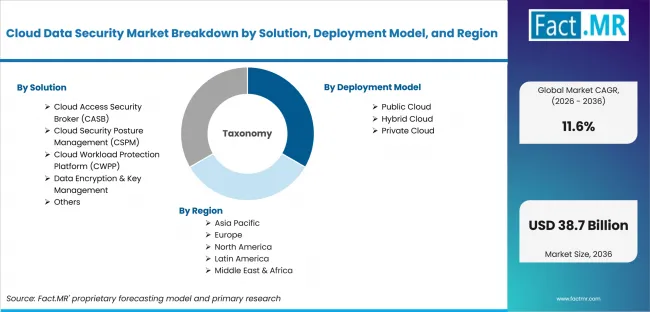
Cloud Data Security Market Breakdown By Solution, Deployment Model, And Region | Source: Fact.MR
| Attribute | Details |
|---|---|
| Quantitative Units | USD 12.9 billion in 2026 to USD 38.7 billion by 2036 at 11.6% CAGR |
| Market Definition | The Cloud Data Security Market covers software and services that protect data stored, processed or shared in cloud environments, including CASB, data protection, access control, encryption and monitoring. |
| Solution | Cloud Access Security Broker (CASB); Shadow IT Management; Data Loss Prevention; Cloud Security Posture Management (CSPM); Compliance Monitoring; Misconfiguration Detection; Cloud Workload Protection Platform (CWPP); Runtime Protection; Container Security; Data Encryption & Key Management; Encryption Services; Key Lifecycle Management; Others; Identity & Access Security; Security Information & Event Management |
| Deployment Model | Public Cloud; AWS Cloud; Microsoft Azure; Hybrid Cloud; On-Premises Integration; Multi-Cloud Deployment; Private Cloud; Enterprise Private Cloud; Government Private Cloud |
| Enterprise Size | Large Enterprises; Multinational Enterprises; Public Sector Organizations; Small & Medium Enterprises (SMEs); Small Businesses; Mid-Sized Enterprises |
| End User | BFSI; Banking; Insurance; IT & Telecommunications; Cloud Service Providers; Telecommunication Companies; Healthcare; Hospitals; Life Sciences; Government & Defense; Federal Agencies; Public Administration; Others; Retail; Manufacturing |
| Security Type | Data Protection; Data Encryption; Data Loss Prevention; Identity & Access Management; Multi-Factor Authentication; Privileged Access Management; Threat Detection & Response; AI-Based Threat Detection; Incident Response; Compliance & Governance; Regulatory Compliance; Risk Assessment; Others; Backup & Recovery; Security Analytics |
| Regions Covered | North America; Latin America; Europe; East Asia; South Asia and Oceania; Middle East and Africa |
| Countries Covered | South Korea; USA; UK; Australia; Germany; Canada; Japan |
| Key Companies Profiled | Microsoft Corporation; Amazon Web Services, Inc. (AWS); Palo Alto Networks, Inc.; Cisco Systems, Inc.; International Business Machines Corporation (IBM); Broadcom Inc.; Fortinet, Inc.; Trend Micro Incorporated; Check Point Software Technologies Ltd.; Oracle Corporation |
| Forecast Period | 2026 to 2036 |
| Approach | Hybrid top-down and bottom-up assessment using demand indicators, segment mix, country growth, company participation and public evidence relevant to the category. |
Source: Fact.MR analysis. Updated Jul 29, 2026
How is the market segmented?
-
By Solution:
- Cloud Access Security Broker (CASB)
- Shadow IT Management
- Data Loss Prevention
- Cloud Security Posture Management (CSPM)
- Compliance Monitoring
- Misconfiguration Detection
- Cloud Workload Protection Platform (CWPP)
- Runtime Protection
- Container Security
- Data Encryption & Key Management
- Encryption Services
- Key Lifecycle Management
- Others
- Identity & Access Security
- Security Information & Event Management
-
By Deployment Model:
- Public Cloud
- AWS Cloud
- Microsoft Azure
- Hybrid Cloud
- On-Premises Integration
- Multi-Cloud Deployment
- Private Cloud
- Enterprise Private Cloud
- Government Private Cloud
-
By Enterprise Size:
- Large Enterprises
- Multinational Enterprises
- Public Sector Organizations
- Small & Medium Enterprises (SMEs)
- Small Businesses
- Mid-Sized Enterprises
-
By End User:
- BFSI
- Banking
- Insurance
- IT & Telecommunications
- Cloud Service Providers
- Telecommunication Companies
- Healthcare
- Hospitals
- Life Sciences
- Government & Defense
- Federal Agencies
- Public Administration
- Others
- Retail
- Manufacturing
-
By Security Type:
- Data Protection
- Data Encryption
- Data Loss Prevention
- Identity & Access Management
- Multi-Factor Authentication
- Privileged Access Management
- Threat Detection & Response
- AI-Based Threat Detection
- Incident Response
- Compliance & Governance
- Regulatory Compliance
- Risk Assessment
- Others
- Backup & Recovery
- Security Analytics
-
By Region:
- North America
- Latin America
- Europe
- East Asia
- South Asia and Oceania
- Middle East and Africa
Frequently Asked Questions
Which Solution leads the Cloud Data Security Market?
Which Deployment Model leads the Cloud Data Security Market?
Which Enterprise Size leads the Cloud Data Security Market?
Which End User leads the Cloud Data Security Market?
Which Security Type leads the Cloud Data Security Market?
How does South Korea perform in the Cloud Data Security Market?
How does USA perform in the Cloud Data Security Market?
How does UK perform in the Cloud Data Security Market?
What is the primary driver in the Cloud Data Security Market?
What is the main restraint in the Cloud Data Security Market?
Who worked on this report


Preview the report firsthand - request a free sample
Free SampleGet the brochure for pricing and purchase details
Download PDF