- Base Value(2026): 319.00 Mn
- Estimated Value(2026): 319.0 Mn
- Forecast Value (2036): 560.6 Mn
- CAGR (2026 - 2036): 5.8%
Green Release Agents for Construction Formwork Market Forecast and Outlook 2026 to 2036
The global green release agents for construction formwork market is projected to reach USD 560.59 million by 2036. The market is valued at USD 319.00 million in 2026 and is set to rise at a CAGR of 5.8% during the assessment period.
By release agent chemistry, water-based, low-VOC bio-emulsion release agents hold a leading 34% share. Timber & plywood formwork represents the dominant formwork material at 32%, while precast concrete manufacturing is the primary application at 30.00%. Large contractors & infrastructure developers are the leading end-user category, accounting for 38.0% market share.
Key Takeaways from the Green Release Agents for Construction Formwork Market
- Market Value for 2026: USD 319.00 Million
- Market Value for 2036: USD 560.59 Million
- Forecast CAGR (2026-2036): 5.8%
- Leading Release Agent Chemistry Share (2026): Water-based, low-VOC bio-emulsion release agents (34%)
- Leading Formwork Material Share (2026): Timber & plywood formwork (32%)
- Leading Application Share (2026): Precast concrete manufacturing (30.00%)
- Leading End-User Category Share (2026): Large Contractors & Infrastructure Developers (38.0%)
- Key Players in the Market: Sika AG, BASF (Master Builders Solutions), Fosroc International, Mapei, WR Meadows, Fuchs Lubricants

Green Release Agents Or Construction Formwork Market Market Value Analysis | Source: Fact.MR
Defining trends involve the formulation of high-performance, plant-derived emulsions that match or exceed the release efficiency of traditional solvent-based or mineral oil products. Innovation is focused on achieving superior surface finish quality for architectural concrete, preventing staining, and ensuring compatibility with subsequent treatments like paints or coatings. Integration of these agents into contractors' overall environmental product declaration (EPD) and green building certification (e.g., LEED, BREEAM) strategies is becoming a key purchasing criterion.
Regulatory frameworks strictly limiting volatile organic compound (VOC) emissions on construction sites and in manufacturing facilities are the primary market driver. Additionally, policies promoting sustainable construction materials and safer working conditions by reducing exposure to hazardous chemicals are accelerating the mandatory shift. Green release agents are increasingly specified in tender documents for public infrastructure and commercial projects.
Green Release Agents for Construction Formwork Market
| Metric | Value |
|---|---|
| Market Value (2026) | USD 319.00 Million |
| Market Forecast Value (2036) | USD 560.59 Million |
| Forecast CAGR (2026-2036) | 5.8% |
Source: Fact.MR analysis. Updated Dec 24, 2025
Category
| Category | Segments |
|---|---|
| Release Agent Chemistry | Water-based, low-VOC bio-emulsion release agents, Vegetable-oil & ester-based green release agents, Rapeseed & soy & palm-free high-sustainability blends, Hybrid semi-synthetic low-VOC release agents, Solvent-free polymer-modified formulations, Silicone-free environmentally benign agents, Specialty biodegradable agents (premium) |
| Formwork Material | Timber & plywood formwork, Steel formwork, Aluminum formwork systems, Plastic & polymer formwork, Fiberglass & composite formwork, Modular formwork systems (mixed materials) |
| Application | Precast concrete manufacturing, On-site vertical formwork (columns, walls), On-site horizontal formwork (slabs, beams), Architectural concrete (high-finish surfaces), Infrastructure (bridges, tunnels, viaducts) |
| End-User Category | Large Contractors & Infrastructure Developers, Precast Concrete Manufacturers, Formwork Rental & System Providers, Small & Mid-size Contractors |
| Region | North America, Latin America, Western Europe, Eastern Europe, East Asia, South Asia & Pacific, MEA |
Source: Fact.MR analysis. Updated Dec 24, 2025
Segmental Analysis
By Release Agent Chemistry, Which Formulation Balances Regulatory Compliance with Effective Performance?
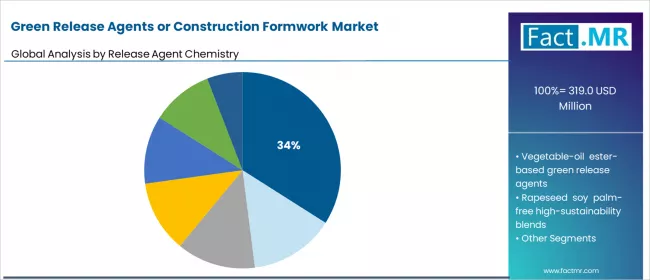
Green Release Agents Or Construction Formwork Market Analysis By Release Agent Chemistry | Source: Fact.MR
Water-based, low-VOC bio-emulsion release agents lead the segment with a 34% share. This dominance is due to their dual advantage: they virtually eliminate hazardous VOC emissions, ensuring compliance with strict indoor air quality and jobsite regulations, while the bio-based components provide excellent release and formwork protection. Their ease of cleanup and reduced fire hazard compared to solvent-based alternatives makes them the default choice for most general construction and precast applications.
By Formwork Material, Which Substrate is Most Prevalent and Demanding for Gentle, Effective Release?

Green Release Agents Or Construction Formwork Market Analysis By Formwork Material | Source: Fact.MR
Timber & plywood formwork commands the largest material share at 32%. Despite the rise of metal and plastic systems, timber remains ubiquitous due to its low cost, flexibility, and ease of use, especially for complex shapes and on smaller sites. Timber is particularly susceptible to damage from harsh release agents, which cause swelling, warping, or resin can bleed. Green agents formulated to protect and extend the life of wooden forms are therefore in high demand.
By Application, Which Setting Demands the Highest Consistency and Surface Finish Quality?

Green Release Agents Or Construction Formwork Market Analysis By Application | Source: Fact.MR
Precast concrete manufacturing represents the leading application at 30.00%. In a controlled factory environment, achieving a flawless, consistent surface finish is critical for product value and aesthetics. The high-frequency reuse of steel or polymer forms requires a release agent that performs reliably every time without buildup (formwork fouling). Green agents that provide a clean release, prevent staining, and are easy to apply automatically are essential for efficient, high-quality precast production.
By End-User Category, Who Drives Specification Based on Project Scale and Sustainability Goals?
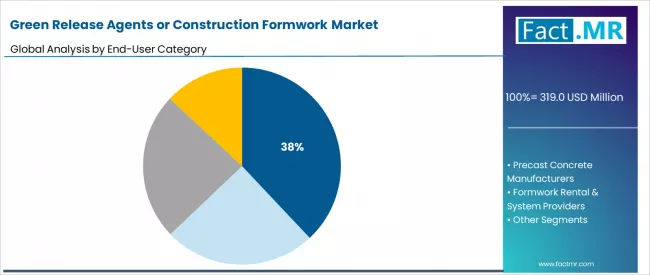
Green Release Agents Or Construction Formwork Market Analysis By End User Category | Source: Fact.MR
Large Contractors & Infrastructure Developers are the dominant end-user category at 38.0%. These entities manage major projects where environmental compliance, worker safety, and corporate sustainability targets are paramount. They possess the purchasing power and technical oversight to specify green release agents across entire projects, driving volume demand. Their preference is often for certified, system-compatible products that contribute to earning green building credits.
What are the Drivers, Restraints, and Key Trends of the Green Release Agents for Construction Formwork Market?
Market growth is driven by the global enforcement of stringent VOC regulations in construction and manufacturing. The pursuit of green building certifications (LEED, BREEAM) mandates the use of low-emitting materials. Growing awareness of worker health and safety promotes safer, less toxic site materials. Furthermore, the desire to protect and extend the lifespan of expensive formwork systems, especially aluminum and composite, creates a performance-based demand for high-quality, non-damaging release agents.
A significant restraint is the perception of higher upfront cost compared to conventional diesel-based or mineral oil release agents. Performance concerns in extreme weather conditions (very low or high temperatures) for some water-based formulations can deter users. A lack of skilled knowledge on proper application techniques for new green chemistries can lead to poor results. In some regions, inconsistent enforcement of VOC rules also slows adoption.
Key trends include the development of "universal" agents compatible with all major formwork materials (timber, steel, aluminum, plastic). There is a strong push towards 100% bio-based, readily biodegradable, and even edible-oil-derived formulations. The market is seeing growth in pre-applied, cured film-forming agents for architectural concrete. Additionally, integration of release agents into formwork system supplier recommendations and rental packages is becoming common.
Analysis of the Green Release Agents for Construction Formwork Market by Key Countries
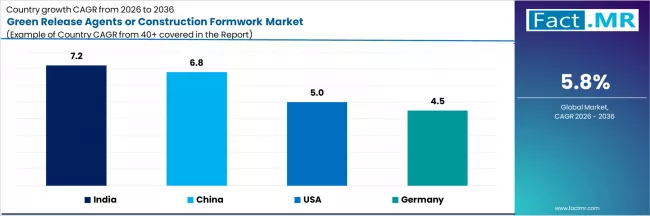
Green Release Agents Or Construction Formwork Market Cagr Analysis By Country | Source: Fact.MR
| Country | CAGR (2026-2036) |
|---|---|
| India | 7.20% |
| China | 6.80% |
| USA | 5.00% |
| Germany | 4.50% |
| Brazil | 5.50% |
Source: Fact.MR analysis. Updated Dec 24, 2025
How does India's Construction Boom and Emerging Green Building Standards Drive High Growth?
India leads with a 7.20% CAGR, fueled by an unprecedented infrastructure and urban development boom. The rapid adoption of green building standards (e.g., IGBC) in major commercial and public projects, combined with increasing regulatory attention to construction site emissions and worker welfare, is forcing a shift away from traditional, polluting release agents. The vast scale of ongoing work creates massive volume potential for compliant products.
Why is China's Massive Construction Volume and Environmental Policy Push a Key Driver?
China's 6.80% growth is anchored in its continuous, large-scale construction activity and the stringent enforcement of its environmental protection laws. Blue Sky campaigns target pollution from all industrial sources, including construction. The precast concrete sector is modernizing rapidly, demanding high-performance, environmentally acceptable production aids. Domestic production capabilities for green chemicals support widespread adoption.
What Role does the USA's Mature Green Building Ecosystem and Regulatory Framework Play?
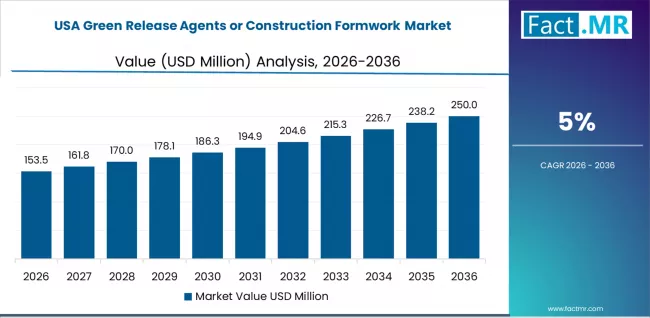
Green Release Agents Or Construction Formwork Market Country Value Analysis | Source: Fact.MR
The USA's 5.00% growth is underpinned by a mature market where LEED certification is widespread and VOC regulations such as SCAQMD rules are strictly enforced. Large contractors and precasters have largely transitioned to low-VOC solutions. Growth is driven by performance innovation for architectural concrete, the need for agents compatible with high-RAP (recycled aggregate) concrete, and the expansion of the precast sector.
How does Germany's Engineering Precision and Circular Economy Focus Influence the Market?
Germany's 4.50% growth reflects its focus on high-quality engineering, durability, and the circular economy. German construction standards demand high-finish concrete and long-lasting formwork. Green release agents are valued not only for low emissions but also for their role in protecting formwork assets (enabling more reuses) and ensuring concrete surfaces are clean for optimal recycling at end-of-life, aligning with strict sustainability protocols.
What Factors Underpin Brazil's Focus on Sustainable Sourcing and Industrial Agriculture By-Products?
Brazil's 5.50% growth is motivated by its strong bio-economy and focus on sustainable sourcing. The availability of local vegetable oil feedstocks (e.g., soy, rapeseed) drives the development and adoption of high-sustainability, bio-based release agent blends. The growing formal construction sector and investments in infrastructure ahead of major events create a conducive environment for adopting modern, green construction chemicals.
Competitive Landscape of the Green Release Agents for Construction Formwork Market
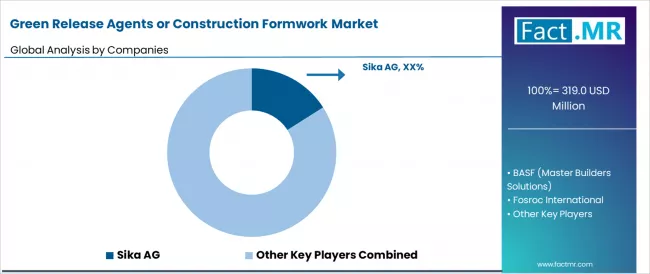
Green Release Agents Or Construction Formwork Market Analysis By Company | Source: Fact.MR
Global construction chemical specialists who are integrating green release agents into their broader concrete admixture and repair systems portfolios dominate the competitive landscape. Leaders like Sika AG, BASF (Master Builders Solutions), and Fosroc International compete by offering comprehensive technical support and system solutions, ensuring their release agents are compatible with their other products like curing compounds and surface treatments.
Companies like Mapei and WR Meadows compete with strong regional distribution networks and expertise in concrete technology. Fuchs Lubricants brings specialized lubrication chemistry expertise. Competition intensifies around product certification (e.g., environmental product declarations), proven performance data on formwork protection and concrete finish quality, and the ability to provide tailored solutions for specific formwork systems or architectural requirements.
Key Players in the Green Release Agents for Construction Formwork Market
- Sika AG
- BASF (Master Builders Solutions)
- Fosroc International
- Mapei
- WR Meadows
- Fuchs Lubricants
Segmentation
Scope of Report
| Items | Values |
|---|---|
| Quantitative Units | USD Million |
| Release Agent Chemistry | Water-based, low-VOC bio-emulsion, Vegetable-oil & ester-based, Rapeseed & soy & palm-free blends, Hybrid semi-synthetic, Solvent-free polymer-modified, Silicone-free, Specialty biodegradable |
| Formwork Material | Timber & plywood, Steel, Aluminum systems, Plastic & polymer, Fiberglass & composite, Modular systems |
| Application | Precast concrete manufacturing, On-site vertical formwork, On-site horizontal formwork, Architectural concrete, Infrastructure |
| End-User Category | Large Contractors & Infrastructure Developers, Precast Concrete Manufacturers, Formwork Rental & System Providers, Small & Mid-size Contractors |
| Key Countries | India, China, USA, Germany, Brazil |
| Key Companies | Sika AG, BASF (Master Builders Solutions), Fosroc International, Mapei, WR Meadows, Fuchs Lubricants |
| Additional Analysis | Analysis of VOC content testing, impact on concrete surface absorption & paint adhesion, formwork cleaning frequency & lifespan extension, biodegradability testing, and total cost-in-use analysis versus conventional agents. |
Source: Fact.MR analysis. Updated Dec 24, 2025
Green Release Agents for Construction Formwork Market by Segments
-
Release Agent Chemistry :
- Water-based, low-VOC bio-emulsion release agents
- Vegetable-oil & ester-based green release agents
- Rapeseed & soy & palm-free high-sustainability blends
- Hybrid semi-synthetic low-VOC release agents
- Solvent-free polymer-modified formulations
- Silicone-free environmentally benign agents
- Specialty biodegradable agents (premium)
-
Formwork Material :
- Timber & plywood formwork
- Steel formwork
- Aluminum formwork systems
- Plastic & polymer formwork
- Fiberglass & composite formwork
- Modular formwork systems (mixed materials)
-
Application :
- Precast concrete manufacturing
- On-site vertical formwork (columns, walls)
- On-site horizontal formwork (slabs, beams)
- Architectural concrete (high-finish surfaces)
- Infrastructure (bridges, tunnels, viaducts)
-
End-User Category :
- Large Contractors & Infrastructure Developers
- Precast Concrete Manufacturers
- Formwork Rental & System Providers
- Small & Mid-size Contractors
-
Region :
-
North America
- USA
- Canada
-
Latin America
- Brazil
- Mexico
- Rest of Latin America
-
Western Europe
- Germany
- France
- UK
- Italy
- Spain
- BENELUX
- Rest of Western Europe
-
Eastern Europe
- Russia
- Poland
- Rest of Eastern Europe
-
East Asia
- China
- Japan
- South Korea
- Rest of East Asia
-
South Asia & Pacific
- India
- Indonesia
- Australia
- Rest of South Asia & Pacific
-
MEA
- GCC Countries
- South Africa
- Rest of MEA
-
Frequently Asked Questions
How big is the green release agents or construction formwork market in 2026?
What will be the size of green release agents or construction formwork market in 2036?
How much will be the green release agents or construction formwork market growth between 2026 and 2036?
What are the key product types in the green release agents or construction formwork market?
Which formwork material segment to contribute significant share in the green release agents or construction formwork market in 2026?
Who worked on this report


Preview the report firsthand - request a free sample
Free SampleGet the brochure for pricing and purchase details
Download PDF