- Estimated Value(2026): 52.5 Bn
- Forecast Value (2036): 83.9 Bn
- CAGR (2026 - 2036): 4.8%
Coated Fabrics Market Forecast and Outlook 2026 to 2036
In 2025, the coated fabrics market surpassed a valuation of USD 50.1 billion. Based on Fact.MR analysis, demand for coated fabrics is estimated to grow to USD 52.5 billion in 2026 and USD 83.9 billion by 2036. FACT.MR projects a CAGR of 4.8% during the forecast period.
Between 2026 and 2036, the coated fabrics market is projected to generate an absolute dollar opportunity of USD 31.4 billion, reflecting a transformational expansion driven by simultaneous demand acceleration across transportation, protective clothing, and infrastructure fabric applications. This sustained growth is anchored by automotive interior electrification requiring advanced technical textile upgrades, defence sector procurement of flame-retardant and chemical-protective coated fabrics, and the rapid expansion of tensile architecture and commercial membrane structures across Asia Pacific and the Middle East.
Benoit Bazin, Chairman & CEO of Saint-Gobain said, "As the worldwide leader in light and sustainable construction, Saint-Gobain is best positioned to address the key challenges... thanks to its full suite of innovative and sustainable solutions. With our 'Lead & Grow' plan, the Group further elevates its trajectory for growth, profitability, and value creation... seizing major opportunities in Asia and high-growth countries driven by demographics and urbanization."
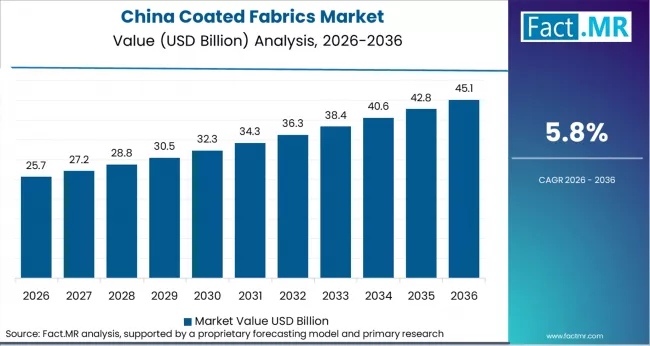
Country growth is driven by automotive expansion, defence procurement, infrastructure textiles, and protective clothing mandates. China leads at 5.8% CAGR due to automotive and export textile dominance. India follows at 5.2% supported by defence manufacturing. The United States grows at 4.8% on defence and infrastructure demand, Japan 4.4% on EV transition, Germany 4.2% on REACH compliance, South Korea 4.0% on tensile structures, and the United Kingdom 3.9% on defence replacement demand.
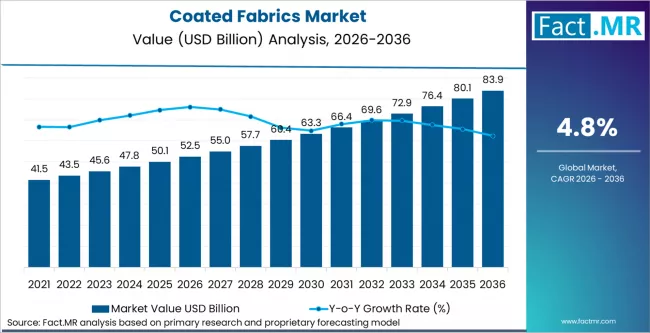
Coated Fabrics Market Market Value Analysis | Source: Fact.MR
| Metric | Value |
|---|---|
| Estimated Value in 2026 | USD 52.5 billion |
| Forecast Value in 2036 | USD 83.9 billion |
| Forecast CAGR (2026 to 2036) | 4.8% |
Source: Fact.MR analysis. Updated Mar 2, 2026
Market Definition
Market Definition
The coated fabrics market includes textile substrates treated with polymer, rubber, silicone, or fluoropolymer coatings to provide waterproofing, chemical resistance, flame retardancy, UV stability, and strength. Applications span automotive interiors, protective clothing, military gear, industrial covers, and architectural membrane structures. Substrates include polyester, nylon, fiberglass, cotton blends, and aramid fibres selected for performance compatibility.
Market Inclusions
This report provides global and regional forecasts from 2026 to 2036 by application, material type, and substrate. It covers transportation, protective clothing, industrial uses, tents and structures, and upholstery. Country analysis includes China, India, the United States, Germany, Japan, South Korea, and the United Kingdom.
Market Exclusions
The scope excludes uncoated textiles, non-coated geotextiles, and standalone polymer films. Finished garments are excluded unless coating defines primary value. Rubber compounding without fabric integration is not covered.
Research Methodology
- Primary Research: Interviews were conducted with manufacturers, automotive suppliers, defence buyers, membrane contractors, distributors, and coating chemical providers across major regions.
- Desk Research: Sources included REACH dossiers, NATO standards, defence tenders, OEM material bulletins, ASTM and EN standards, and company reports.
- Market Sizing and Forecasting: A hybrid model combined technical textile revenue data and defence budgets with coating prices, substrate volumes, and replacement cycle inputs.
- Data Validation and Update Cycle: Outputs were validated using machinery shipment data, raw material trade statistics, and architectural project databases. Forecasts are updated annually.
Summary
- Market Definition
- Coated fabrics are polymer, rubber, silicone, or fluoropolymer-treated textiles engineered for waterproofing, chemical resistance, flame retardancy, and structural reinforcement across transportation, defence, industrial, and architectural uses.
- Demand Drivers
- EV interior specifications are driving demand for flame-retardant and low-VOC coated fabrics beyond standard PVC systems.
- Defence modernisation programmes are replacing legacy protective fabrics with CBRN-rated coated systems under NATO-aligned standards.
- Growth in tensile architecture is boosting demand for PVC and fluoropolymer-coated membranes in stadiums, airports, and commercial projects.
- Key Segments Analyzed
- By Application: Transportation holds about 32% share in 2026, led by automotive seating, interiors, and marine upholstery demand.
- By Material: Polymer-coated fabrics account for roughly 28% share, with rising shift toward silicone and fluoropolymer systems.
- By Fabric Substrate: Polyester leads due to cost efficiency, UV stability, and coating compatibility.
- By Geography: Asia Pacific shows the strongest growth, driven by China’s exports, India’s defence localisation, and regional infrastructure expansion.
- Analyst Opinion at FACT.MR
- Shambhu Nath Jha, Principal Consultant at FACT.MR, opines, “CXOs will find this report critical as coated fabrics shift from commodity PVC and rubber toward silicone, fluoropolymer, and sustainable systems. Companies investing early in REACH compliance and aligning with defence and EV interior specifications are positioned to capture premium growth through 2036.”
- Strategic Implications / Executive Takeaways
- Manufacturers should fast-track REACH-compliant polyurethane and silicone alternatives to PVC, targeting European automotive and protective clothing buyers ahead of 2026-2027 deadlines to secure premium supplier status.
- Defence-focused suppliers must build NATO STANAG-qualified CBRN production in the United States, Germany, and India to meet tightening domestic content rules.
- Architectural membrane producers should expand fluoropolymer-coated fiberglass and high-tenacity polyester capacity to capture the USD 4.2 billion tensile pipeline through 2030.
- Methodology
- Market sizing used automotive spend, defence budgets, and membrane project databases, validated against coating capacity and substrate consumption data.
- Segment shares confirmed through company revenues, qualification records, and OEM and defence specification reviews.
- Country forecasts based on vehicle output, defence timelines, infrastructure spending, and supplier interview inputs.
Segmental Analysis
Coated Fabrics Market Analysis by Application
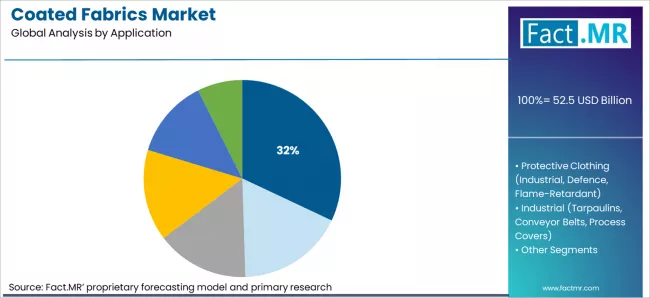
Coated Fabrics Market Analysis By Application | Source: Fact.MR
Transportation is projected to hold 32% share in 2026, driven by OEM seating, dashboards, roofs, and marine upholstery tied to global vehicle output.
- Continental AG Automotive Interior Fabric Investment: Continental committed EUR 85 million in 2024 to upgrade TPU and silicone-coated lines in Germany and China for EV interior programmes. [5]
- Haartz Corporation TPU Convertible Roof Fabric Launch: In 2024, Haartz launched Twillast TPU roof fabric for halogen-free EV platforms, approved by a German OEM. [6]
- Marine and Commercial Vehicle Upholstery Replacement Trend: The 2024 NMMA report cited 247,000 US boat units, supporting a USD 380 million upholstery fabric market. Spradling expanded PERMABLOK3 marine vinyl output. [7]
Coated Fabrics Market Analysis by Material
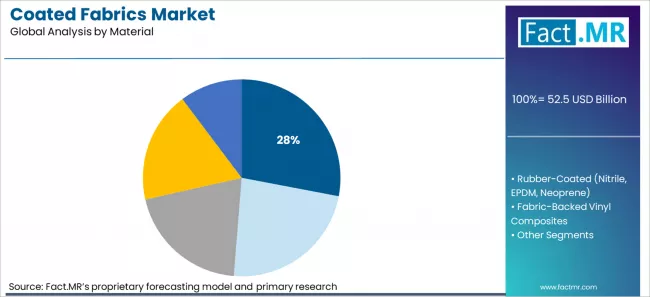
Coated Fabrics Market Analysis By Material | Source: Fact.MR
Polymer-coated fabrics hold 28% share in 2026, led by PVC and PU systems serving transportation and industrial demand.
- Sioen Industries Sustainable PU Coating Line Expansion: Sioen invested EUR 42 million in 2024 to expand waterborne PU coating capacity, eliminating DMF solvent use. [8]
- Trelleborg Silicone-Coated Fiberglass Technology Development: In 2025, Trelleborg launched silicone-coated fiberglass fabrics rated up to 550°C for industrial applications. [9]
- Fluoropolymer Coated Fabric Demand in Chemical Processing: The 2024 American Chemistry Council reported USD 28 billion in chemical plant capex, with PTFE fabrics specified in about 35% of projects. [10]
Drivers, Restraints, and Opportunities
FACT.MR notes the market combines stable commodity demand with rapid material disruption. While automotive upholstery and tarpaulins remain steady, premium growth is driven by EV interiors, defence CBRN fabrics, and architectural membranes.
PVC supply chains face pressure from REACH restrictions and OEM sustainability targets. Silicone and TPU coatings cost 30-80% more but meet VOC, flame, and recyclability standards, sustaining value growth despite PVC volume decline.
- EU REACH Plasticiser Restrictions Accelerating Reformulation: ECHA’s 2024 SVHC update added more PVC plasticisers with 2026 sunset dates, forcing reformulation. BASF and Evonik expanded REACH-compliant alternatives in 2024. [2]
- Defence CBRN Fabric Procurement Expansion: NATO’s 2024 2% GDP pledge boosted CBRN procurement. The U.S. DLA awarded USD 340 million in FY2024 protective fabric contracts, with Trelleborg and Sioen participating. [3]
- Asia Pacific Architectural Membrane Construction Boom: China’s infrastructure plan and Saudi Vision 2030 specified over 4.2 million m² of membrane fabric since 2023. Serge Ferrari and Saint-Gobain expanded PTFE and PVC membrane capacity in 2024. [4]
Regional Analysis
The coated fabrics market is analysed across North America, Latin America, Europe, East Asia, South Asia, Oceania and Middle East & Africa across 40+ countries. The full report also offers market attractiveness analysis based on regional trends.
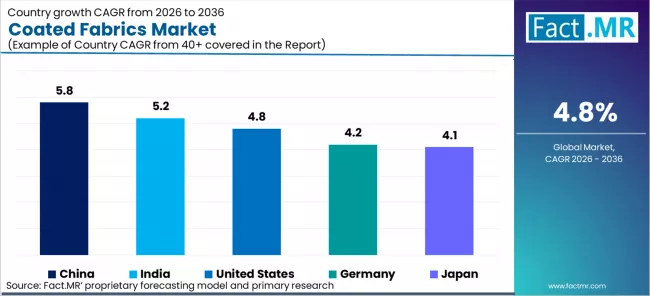
Coated Fabrics Market Cagr Analysis By Country | Source: Fact.MR
| Country | CAGR (2026-2036) |
|---|---|
| China | 5.8% |
| India | 5.2% |
| United States | 4.8% |
| Germany | 4.2% |
| Japan | 4.1% |
Source: Fact.MR analysis. Updated Mar 2, 2026
Source: Fact.MR (FACT.MR) analysis, based on proprietary forecasting model and primary research
Asia Pacific Coated Fabrics Market Analysis
Coated Fabrics Market Country Value Analysis | Source: Fact.MR
Asia Pacific is the largest production hub and fastest-growing demand region, supported by technical textile exports, automotive growth, defence localisation, and infrastructure expansion. Key players include SRF Limited in India and major Chinese polyester and PU coating manufacturers across Jiangsu and Guangdong.
- China: Demand is projected to grow at 5.8% CAGR through 2036. Growth is driven by over 30 million annual vehicle production and rising EV interior material upgrades. MIIT NEV targets and CNTAC’s 2024 technical textile standards are accelerating flame-retardant and low-VOC coating adoption. Yantai Tayho announced a CNY 1.2 billion expansion in 2024 targeting automotive and defence demand.
- India: Demand is projected to grow at 5.2% CAGR through 2036. Defence localisation under Aatmanirbhar Bharat is reducing import dependence, boosting domestic coating capacity. SRF invested INR 480 crore in FY2024-25 to expand technical fabrics. Rising automotive localisation, reaching 64% domestic textile content by 2024, is further supporting demand.
- Japan: Japan is projected to grow at 4.1% CAGR through 2036. Growth is supported by its advanced automotive manufacturing base. The shift toward electric vehicles is driving demand for flame-retardant and low-VOC coated interior fabrics. Domestic OEM sustainability targets are accelerating adoption of high-performance silicone and polyurethane coatings.
Europe Coated Fabrics Market Analysis
Europe sets performance and compliance standards under REACH, EN norms, and OEM sustainability mandates. Leading producers include Sioen Industries, Serge Ferrari Group, and Continental AG, focusing on advanced coating chemistries.
- Germany: Demand is projected to grow at 4.2% CAGR through 2036. EV transition and OEM sustainability targets are phasing out PVC interiors by 2030. Updated BAuA solvent limits in 2024 are tightening compliance. Continental confirmed ISO 14001 certification across German coating lines in 2024.
North America Coated Fabrics Market Analysis
North America leads in premium coated fabrics driven by defence CBRN procurement, EV interior upgrades, and marine upholstery demand. Key players include Haartz, Seaman Corporation, Cooley Group, and Spradling International.
- United States: Demand is projected to grow at 4.8% CAGR through 2036. Defence procurement under a USD 895 billion FY2025 budget includes USD 340 million in textile contracts. The Berry Amendment protects domestic suppliers. Updated FMVSS 302 fire standards are driving EV interior material upgrades. Seaman expanded Ohio capacity in 2025 by 12 million square yards.
Competitive Landscape for Market Players
The global coated fabrics market is moderately fragmented, with no single company dominating across all materials and applications. Leading players such as Continental AG, Trelleborg, Sioen Industries, Serge Ferrari, and Saint Gobain Performance Fabrics together account for roughly 25 to 30 percent of global revenue. Their strength lies in higher value segments including automotive interiors, defence protective fabrics, and architectural membranes, where technical qualification and proprietary coating expertise create strong competitive differentiation. In contrast, commodity segments such as PVC coated tarpaulins and furniture upholstery are highly price competitive, particularly across China, India, and Southeast Asia.
In premium applications, competitive advantage depends on proprietary coating technology, established OEM approvals, and certified defence standards. These qualifications require years of testing and significant investment, creating durable barriers to entry. In commodity segments, scale, raw material sourcing leverage, and geographic proximity to manufacturing hubs determine competitiveness.
Large buyers such as automotive OEMs and defence agencies operate approved supplier systems with strict certification requirements, which protect incumbent suppliers and provide pricing stability once qualification is secured.
Key Players
- Continental AG (ContiTech Surface Solutions)
- Serge Ferrari Group SA
- Trelleborg AB
- Sioen Industries NV
- Saint-Gobain Performance Fabrics
- Seaman Corporation
- Spradling International Inc.
- Haartz Corporation
- Cooley Group
- SRF Limited
Bibliography
- [1] Serge Ferrari Group SA. (2024). Fiscal Year 2024 Investor Communication: Composite Materials Division Order Intake and Architectural Membrane Backlog.
- [2] European Chemicals Agency (ECHA). (2024). Authorisation List Update: Substances of Very High Concern.
- [3] Defense Logistics Agency, U.S. Department of Defense. (2024). FY2024 Textile and Apparel Procurement Contract Awards: Chemical Protective Overgarment Fabric Systems. DLA Troop Support.
- [4] International Association for Shell and Spatial Structures (IASS). (2024-2025). Project Tracking Database: Tensile Architecture and Membrane Structure Awards, Middle East and China. IASS.
- [5] Continental AG ContiTech Surface Solutions. (Q3 2024). Investor Briefing Q3 2024: EUR 85 Million Automotive Interior Coated Fabric Line Investment, Northeim and Changshu Facilities.
- [6] Haartz Corporation. (Q4 2024). Haartz Twillast TPU Convertible Roof Fabric System Product Approval by European Premium OEM: Press Release.
- [7] National Marine Manufacturers Association (NMMA). (2024). 2024 Statistical Abstract of U.S. Recreational Boating: Production Volumes and Upholstery Material Procurement Estimates. NMMA.
- [8] Sioen Industries NV. (2024). FY2024 Annual Report: EUR 42 Million Waterborne Polyurethane Coating Capacity Investment, Ardooie Manufacturing Campus.
This Report Addresses
- Strategic intelligence on REACH-driven material substitution, defence CBRN procurement, EV interior upgrades, and architectural membrane demand trends.
- Market size and forecast: USD 52.5 billion in 2026, reaching USD 83.9 billion by 2036 at 4.8% CAGR, segmented by application, material, substrate, and region.
- Growth opportunities in silicone and fluoropolymer coatings, defence localisation in India and South Korea, and tensile membrane expansion in Asia Pacific and the Middle East.
- Regional outlook with CAGR for China 5.8%, India 5.2%, United States 4.8%, Japan 4.4%, Germany 4.2%, South Korea 4.0%, and United Kingdom 3.9%, with detailed sub-segment forecasts.
- Competitive assessment of Continental AG, Trelleborg AB, Sioen Industries, Serge Ferrari Group, and Saint-Gobain across IP, OEM qualification, defence certification, and manufacturing footprint.
- Product tracking of plasticiser-free PVC, waterborne PU, silicone fiberglass, Précontraint membranes, and TPU EV interior fabrics.
- Regulatory analysis covering EU REACH, EN and NFPA standards, Berry Amendment, NATO STANAG, and China MIIT NEV material rules.
- Delivery in PDF, Excel, PowerPoint, and interactive dashboard formats with verified source citations.
Segmentation
Scope of Report
| Items | Values |
|---|---|
| Quantitative Units | USD 52.5 billion (2026) to USD 83.9 billion (2036), at a CAGR of 4.8% |
| Market Definition | The coated fabrics market covers textile substrates treated with polymer, rubber, silicone, or fluoropolymer coating systems to impart waterproofing, chemical resistance, flame retardancy, UV stability, and mechanical reinforcement for transportation, protective clothing, industrial, architectural, and furniture applications. |
| Application | Transportation (32%), Protective Clothing, Industrial, Commercial Tents and Structures, Furniture and Upholstery, Others |
| Material | Polymer-Coated Fabrics (28%), Rubber-Coated, Fabric-Backed Vinyl Composites, Silicone-Coated, Fluoropolymer-Coated (PTFE, PVDF) |
| Fabric Substrate | Polyester (PET), Nylon (PA6/PA66), Cotton and Blends, Fiberglass, Aramid and High-Modulus Fibers |
| Regions Covered | Asia Pacific, Europe, North America, Latin America, Middle East and Africa |
| Countries Covered | China, Japan, South Korea, India, Australia and New Zealand, ASEAN, Rest of Asia Pacific, Germany, United Kingdom, France, Italy, Spain, Netherlands, Nordics, Rest of Europe, United States, Canada, Mexico, Brazil, Chile, Colombia, Rest of Latin America, Kingdom of Saudi Arabia, United Arab Emirates, South Africa, Turkey, Rest of Middle East and Africa |
| Key Companies Profiled | Continental AG (ContiTech Surface Solutions), Serge Ferrari Group SA, Trelleborg AB, Sioen Industries NV, Saint-Gobain Performance Fabrics, Seaman Corporation, Spradling International Inc., Haartz Corporation, Cooley Group, SRF Limited |
| Forecast Period | 2026 to 2036 |
| Approach | A hybrid top-down and bottom-up model was applied. Top-down inputs included global automotive interior material expenditure, defence fabric procurement budgets, and architectural membrane project databases. |
Source: Fact.MR analysis. Updated Mar 2, 2026
Coated Fabrics Market by Segment
-
By Application :
- Transportation (32%)
- Protective Clothing (Industrial, Defence, Flame-Retardant)
- Industrial (Tarpaulins, Conveyor Belts, Process Covers)
- Commercial Tents and Structures
- Furniture and Upholstery
- Other Applications
-
By Material :
- Polymer-Coated Fabrics (28%)
- Rubber-Coated (Nitrile, EPDM, Neoprene)
- Fabric-Backed Vinyl Composites
- Silicone-Coated
- Fluoropolymer-Coated (PTFE, PVDF)
-
By Fabric Substrate :
- Polyester (PET)
- Nylon (PA6/PA66)
- Cotton and Blends
- Fiberglass
- Aramid and High-Modulus Fibers
-
By Region :
- North America
- United States
- Canada
- Mexico
- Europe
- Germany
- United Kingdom
- France
- Italy
- Spain
- Netherlands
- Nordics
- Rest of Europe
- Asia Pacific
- China
- Japan
- South Korea
- India
- Australia and New Zealand
- ASEAN
- Rest of Asia Pacific
- Latin America
- Brazil
- Chile
- Colombia
- Rest of Latin America
- Middle East and Africa
- Kingdom of Saudi Arabia
- United Arab Emirates
- South Africa
- Turkey
- Rest of Middle East and Africa
- North America
Frequently Asked Questions
How large is the coated fabrics market in 2025?
What will the market size be in 2026?
What is the projected market size by 2036?
What is the expected CAGR for the forecast period 2026 to 2036?
Which application segment is poised to lead the coated fabrics market?
Which material segment holds the largest share?
Which country shows the fastest growth rate?
What growth rate is expected for India's coated fabrics market?
What is the forecast CAGR for Germany's coated fabrics market?
How is the United States coated fabrics market expected to grow?
Who worked on this report


Preview the report firsthand - request a free sample
Free SampleGet the brochure for pricing and purchase details
Download PDF