- Base Value(2025): 36.00 Bn
- Estimated Value(2026): 37.44 Bn
- Forecast Value (2036): 55.42 Bn
- CAGR (2026 - 2036): 4.0%
Coated Glass Market Size, Market Forecast and Outlook By Fact.MR
The coated glass market was valued at USD 36.00 billion in 2025, projected to reach USD 37.44 billion in 2026, and is forecast to expand to USD 55.42 billion by 2036 at a 4.0% CAGR. Tightening building energy performance standards and expanding automotive glazing specification requirements are sustaining consistent demand growth for coated glass products across construction and transportation supply chains. Architects and building envelope engineers treat coated glass selection as a direct energy compliance mechanism where low-emissivity coating solar heat gain coefficients and visible light transmittance values determine building permit qualification in regulated jurisdictions.
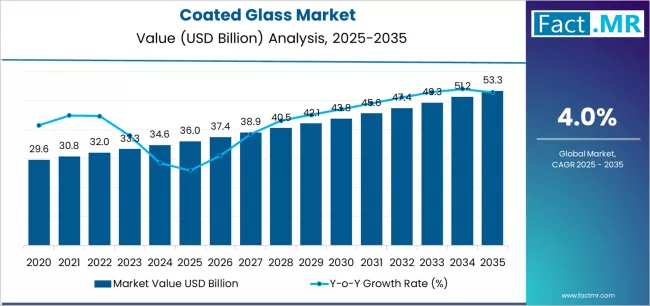
Coated Glass Market Market Value Analysis | Source: Fact.MR
Summary of Coated Glass Market
- Market Overview
- The coated glass market is valued at USD 36.00 billion in 2025 and is projected to reach USD 55.42 billion by 2036.
- The industry is expected to grow at a 4.0% CAGR from 2026 to 2036, creating an incremental opportunity of USD 17.98 billion.
- The market operates as an energy performance-driven building material category where low-emissivity coating thermal transmittance values, solar heat gain coefficient documentation, and building energy code compliance determine specification selection across commercial construction and automotive glazing applications.
- Demand and Growth Drivers
- Demand is sustained by tightening building energy performance codes that mandate low-E coated glazing with documented U-value and solar heat gain coefficient data matching regional climate zone requirements for commercial building permit qualification.
- Automotive OEM glazing specification programs are driving solar control coated glass adoption where interior cabin temperature management directly reduces HVAC load and improves electric vehicle driving range calculations.
- Green building certification programs (LEED, BREEAM) are creating specification-level demand for high-performance coated glass as commercial developers target energy efficiency credits through documented glazing thermal performance.
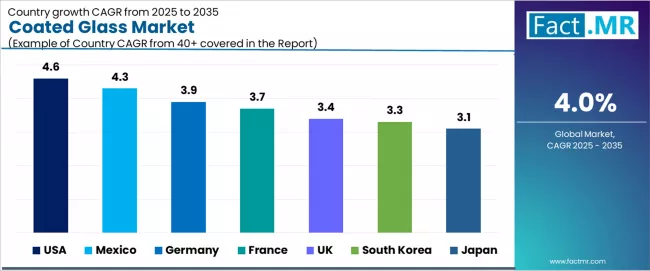
- Among tracked countries, USA leads at 4.6% CAGR, followed by Mexico at 4.3%, Germany at 3.9%, France at 3.7%, UK at 3.4%, South Korea at 3.3%, and Japan at 3.1%.
- Product and Segment View
- Coated glass encompasses flat glass substrates with functional thin-film deposits that modify thermal, optical, or reflective properties for building energy management, automotive glazing, and specialty electronics applications.
- Primary coating types include low-emissivity (low-E) for thermal insulation, solar control for heat rejection, and mirror/specialty coatings for reflective and electronic display applications.
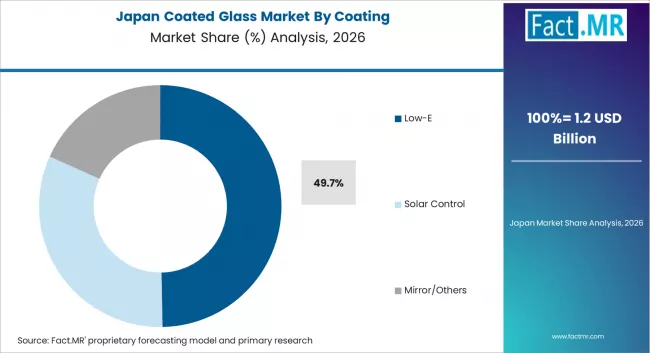
- Low-E leads by coating with 48% share in 2026, reflecting the dominant specification volume from commercial and residential building glazing programs where energy code compliance mandates documented thermal transmittance performance.
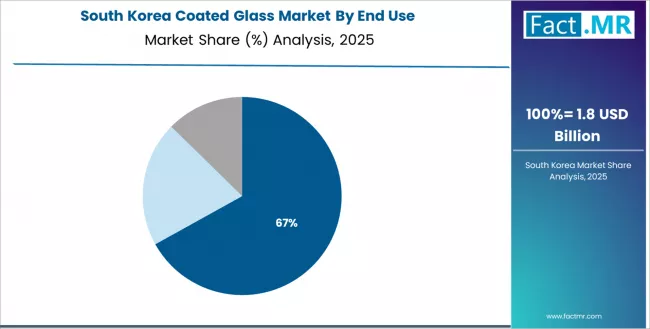
- Building and Construction leads by end use with 67% share in 2026, driven by the global building energy performance standard enforcement that makes high-performance coated glazing a mandatory specification for new construction and major renovation projects.
- Scope includes low-E, solar control, and mirror/specialty coatings on float and laminated glass substrates across building, automotive, and electronics applications, excluding uncoated flat glass, tempered-only glass, and window frame/curtain wall hardware.
- Geography and Competitive Outlook
- USA and Mexico are the fastest-growing markets at 4.6% and 4.3% CAGR respectively, supported by updated commercial building energy codes mandating high-performance glazing and construction investment expansion driving coated glass specification adoption.
- Germany and France represent regulation-driven European demand bases where building energy performance directive compliance and renovation energy efficiency requirements sustain consistent low-E and solar control coated glass procurement across commercial and residential construction.
- Competition is shaped by coating technology capability, energy code compliance documentation, and float glass substrate integration, with NSG Group, Saint-Gobain S.A., Guardian Glass LLC, AGC Inc., Vitro S.A.B. de C.V., Xinyi Glass Holdings Limited, Cardinal Glass Industries Inc. among the tracked participants.
- Analyst Opinion at Fact.MR
- Shambhu Nath Jha , Principal Consultant at Fact.MR, opines: 'In my analysis, I have observed that the procurement decision in architectural glazing is not glass price but energy compliance documentation. Architects specifying coated glass for commercial projects in code-enforced jurisdictions reject glazing options lacking documented U-value and solar heat gain coefficient data matching the specific climate zone requirements their building permit applications reference. Developers who delay coated glass specification to the construction phase will find their building permit timelines extended by the energy modeling revisions that late-stage glazing changes require. Establishing early-stage coated glass specification with documented energy performance data now determines whether a project meets or misses its permit submission deadline.
- Strategic Implications / Executive Takeaways
- Glass producers must invest in advanced low-E and solar control coating technology platforms with documented energy performance data spanning multiple climate zone requirements to qualify across the broadest range of commercial building energy code compliance programs.
- Architects and building envelope consultants should establish early-stage coated glass specification protocols that generate energy modeling documentation before permit application submission to avoid the timeline extensions that late-stage glazing changes create.
- Automotive glazing suppliers must develop solar control coating capability with documented cabin temperature reduction performance to support EV range optimization calculations that OEM thermal management engineering teams increasingly require.
Coated Glass Market Key Takeaways
| Metric | Details |
|---|---|
| Industry Size (2026) | USD 37.44 billion |
| Industry Value (2036) | USD 55.42 billion |
| CAGR (2026 to 2036) | 4.0% |
Source: Fact.MR analysis. Updated Apr 1, 2026
Commercial building developers targeting LEED, BREEAM, or equivalent green certification specify low-E coated glass with documented U-value and solar heat gain coefficient performance data matching regional climate zone energy code requirements. Automotive OEM glazing engineers specify solar control coated glass for windshield and sidelite applications where interior cabin temperature management directly reduces HVAC system load and improves electric vehicle driving range calculations. Smart glass and electrochromic coating technologies represent an emerging specification niche where dynamic tinting capability documentation commands project-specific premium pricing.
Regional demand patterns track construction activity and building energy regulation enforcement. USA leads with a 4.6% CAGR, supported by updated commercial building energy codes mandating high-performance glazing specifications. Mexico follows at 4.3% as construction investment expansion drives coated glass specification adoption. Germany registers 3.9% growth tied to stringent European building energy performance directive compliance. France advances at 3.7%, driven by renovation energy efficiency requirements. UK tracks at 3.4% reflecting building regulation updates. South Korea maintains 3.3% growth supported by green building certification programs. Japan records 3.1% expansion anchored by its established energy-efficient building material specification standards.
Imperatives for Stakeholders in Coated Glass Market
Design for energy versatility, not just optical properties
- Offer complete glazing packages: coated glass + installation support + documentation + performance testing + technical guidance.
- Preconfigured construction workflows: glazing protocols, sealing procedures, quality records, and digital tracking on building operations.
Technology readiness for smart buildings
- Real-time performance monitoring analytics, predictive energy capabilities, and smart building integration (IoT connectivity, climate tracking systems).
Performance-by-design approach
- Automated manufacturing systems, real-time quality mechanisms, statistical energy monitoring integration, and paperless construction documentation.
Value-based glazing models
- Clear base glass price + transparent service tiers (installation support, technical availability, performance guarantees); subscriptions for digital services and analytics.
Segmental Analysis
Primary Classification: The market segments by coating type into Low-E, solar control, and mirror/others variants, representing the evolution from basic glass products to specialized coatings for comprehensive building energy and architectural optimization.
Secondary Classification: End use segmentation divides the market into building and construction (67.0%), automotive (21.0%), and electronics/others (12.0%) sectors, reflecting distinct requirements for energy performance, safety standards, and functional capabilities.
Substrate Classification: Substrate segmentation covers float (76.0%) and laminated (24%) categories, addressing different structural requirements from standard glazing applications to safety and security installations.
The segmentation structure reveals technology progression from standard glass products toward specialized coating systems with enhanced energy consistency and building capabilities, while application diversity spans from architectural glazing to automotive products requiring precise thermal management solutions.
By Coating, the Low-E Segment Accounts for Dominant Market Share
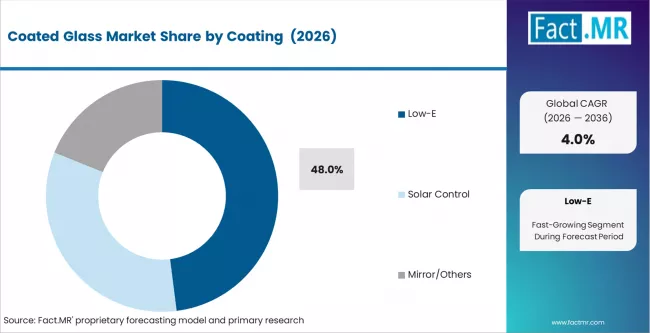
Coated Glass Market Analysis By Coating | Source: Fact.MR
Market Position: Low-E coating systems command the leading position in the coated glass market with 48% market share through advanced energy efficiency characteristics, including superior thermal insulation, visible light transmission, and building optimization that enable construction operators to achieve optimal energy performance across diverse architectural and glazing applications.
Value Drivers: The segment benefits from architect preference for reliable coating systems that provide consistent thermal performance, reduced energy complexity, and building optimization without requiring significant design modifications. Advanced Low-E features enable automated manufacturing systems, energy control, and integration with existing glazing equipment, where operational performance and efficiency compliance represent critical construction requirements.
Competitive Advantages: Low-E coating systems differentiate through proven energy reliability, consistent thermal characteristics, and integration with automated building systems that enhance construction effectiveness while maintaining optimal efficiency standards for diverse architectural and commercial applications.
Key market characteristics:
- Advanced coating designs with optimized thermal configuration and energy efficiency capabilities
- Enhanced building effectiveness, enabling 70-80% energy savings with reliable performance
- Construction compatibility, including automated manufacturing systems, monitoring integration, and process optimization for coating performance
Solar Control Systems Show Strong Climate Focus
Solar control coatings maintain a 33% market position in the coated glass market due to their proven heat rejection and climate characteristics. These systems appeal to builders requiring thermal performance with targeted positioning for hot climate and high-performance applications. Market growth is driven by climate adaptation segment expansion, emphasizing reliable thermal solutions and comfort optimization through proven technologies.
Mirror/Others Systems Serve Specialty Applications
Mirror/others coatings account for 19.0% market share, serving decorative applications requiring specialized optical performance and aesthetic characteristics for architectural and specialty requirements.
By End Use, the Building and Construction Segment Shows Market Leadership
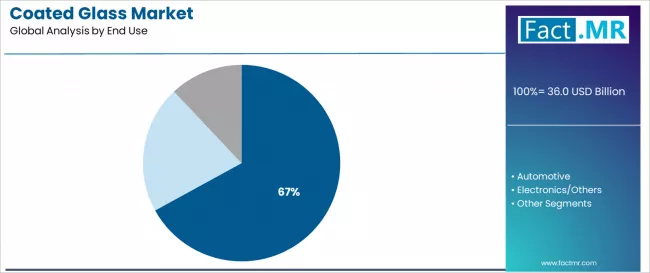
Coated Glass Market Analysis By End Use | Source: Fact.MR
Market Context: Building and construction applications demonstrate market leadership in the coated glass market with 67% share due to widespread adoption of energy-efficient glazing systems and increasing focus on green building optimization, thermal efficiency, and sustainability enhancement that maximize building performance while maintaining comfort standards.
Appeal Factors: Construction operators prioritize coating consistency, energy efficiency, and integration with existing building infrastructure that enables coordinated glazing operations across multiple building systems. The segment benefits from substantial construction investment and green building programs that emphasize the acquisition of advanced coating systems for energy optimization and sustainability enhancement applications.
Growth Drivers: Green building programs incorporate coated glass as standard components for construction operations, while sustainability development growth increases demand for consistent energy capabilities that comply with efficiency standards and minimize operational costs.
Application dynamics include:
- Strong growth in green construction requiring advanced energy capabilities
- Increasing adoption in efficiency optimization and sustainability applications for building manufacturers
- Rising integration with automated building systems for operational optimization and energy assurance
Automotive Applications Maintain Strong Safety Focus
Automotive applications capture 21.0% market share through comprehensive safety requirements in vehicle operations, automotive manufacturing, and transportation projects. These applications demand reliable coating systems capable of operating in mobile conditions while providing effective thermal protection and visibility capabilities.
Electronics/Others Applications Show Technology Growth
Electronics/others applications account for 12.0% market share, including display manufacturing, electronic components, and specialty requiring efficient coating solutions for performance optimization and functionality enhancement.
By Substrate, the Float Segment Leads Market Share
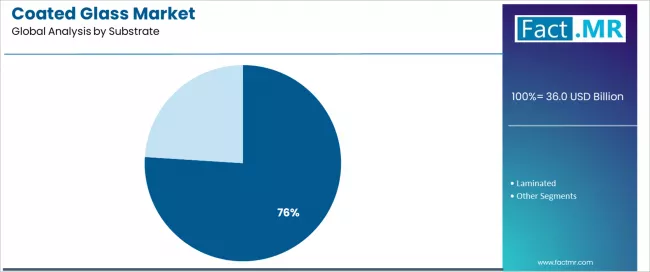
Coated Glass Market Analysis By Substrate | Source: Fact.MR
The float segment commands 76% market share through widespread adoption in standard glazing applications, architectural projects, and commercial installations. These substrates provide advanced glass solutions for complex glazing requirements while maintaining manufacturing flexibility and cost reliability.
Laminated Applications Show Safety Focus
Laminated substrates capture 24% market share, serving safety glazing, security applications, and installations requiring enhanced structural capabilities for protection optimization and safety performance.
What are the Drivers, Restraints, and Key Trends of the Coated Glass Market?
| Category | Factor | Impact | Why It Matters |
|---|---|---|---|
| Driver | Green building growth & energy efficiency regulations (LEED standards, building codes) | ★★★★★ | Large-scale construction shift requires efficient, high-performance coating solutions with consistent quality and energy integration across building applications. |
| Driver | Climate change awareness & thermal management (energy costs, comfort demands) | ★★★★★ | Drives demand for efficient coating solutions and energy-compliant capabilities; suppliers providing thermal features gain competitive advantage. |
| Driver | Urbanization expansion & architectural innovation (modern designs, smart buildings) | ★★★★☆ | Building manufacturers need advanced, architecturally-focused coating solutions; demand for innovative design features expanding addressable market segments. |
| Restraint | High technology costs & manufacturing complexity | ★★★★☆ | Small manufacturers face cost pressure; increases price sensitivity and affects adoption in cost-sensitive segments with limited production budgets. |
| Restraint | Installation challenges & technical requirements | ★★★☆☆ | Quality-focused operations face challenges with installation complexity and specialized handling requirements, limiting adoption in resource-constrained segments. |
| Trend | Smart glass integration & dynamic coatings | ★★★★★ | Growing demand for intelligent coating solutions; responsive technology becomes core value proposition in advanced building segments. |
| Trend | Automotive electrification & thermal management | ★★★★☆ | Regional development drives demand for automotive coating solutions; thermal capabilities drive competition toward vehicle optimization. |
Source: Fact.MR analysis. Updated Apr 1, 2026
Analysis of the Coated Glass Market by Key Country
The coated glass market demonstrates varied regional dynamics with growth leaders including USA (4.6% growth rate) and Mexico (4.3% growth rate) driving expansion through construction modernization initiatives and green building development. Strong Performers encompass Germany (3.9% growth rate), France (3.7% growth rate), and UK (3.4% growth rate), benefiting from established construction industries and advanced glazing adoption. Mature Markets feature South Korea (3.3% growth rate) and Japan (3.1% growth rate), where architectural innovation and energy standardization requirements support consistent growth patterns.
Regional synthesis reveals North American markets leading adoption through green building expansion and energy efficiency development, while European countries maintain steady expansion supported by sustainability advancement and regulatory compliance requirements. Emerging markets show strong growth driven by construction applications and energy integration trends.
.webp "Top Country Growth Comparison Coated Glass Market Cagr (2026 2036)")
Top Country Growth Comparison Coated Glass Market Cagr (2026 2036) | Source: Fact.MR
| Region/Country | 2026-2036 Growth | How to win | What to watch out |
|---|---|---|---|
| USA | 4.6% | Focus on energy efficiency-focused building solutions | Regulatory complexity; installation requirements |
| Mexico | 4.3% | Lead with cost-effective construction models | Economic dependencies; technology access |
| Germany | 3.9% | Value-oriented sustainability models | Over-engineering; regulatory compliance |
| France | 3.7% | Offer premium architectural systems | Market maturity; building regulations |
| UK | 3.4% | Provide advanced energy integration | Market maturity; construction standards |
| South Korea | 3.3% | Push architectural innovation applications | Technology costs; domestic competition |
| Japan | 3.1% | Premium quality positioning | Market maturity; precision requirements |
Source: Fact.MR analysis. Updated Apr 1, 2026
Coated Glass Market Cagr Analysis By Country | Source: Fact.MR
USA Drives Fastest Market Growth
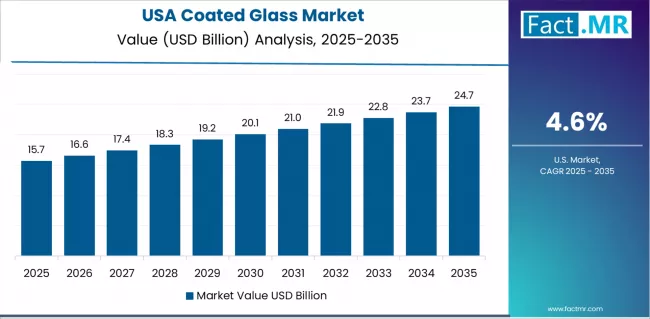
USA establishes fastest market growth through aggressive green building programs and comprehensive energy efficiency development, integrating advanced coated glass systems as standard components in commercial construction, residential building, and architectural applications. The country's 4.6% growth rate reflects industry initiatives promoting sustainable construction and energy efficiency development capabilities that mandate the use of advanced coating systems in building projects. Growth concentrates in major construction centers, including California, Texas, and New York, where building technology development showcases integrated coated glass systems that appeal to developers seeking advanced energy optimization capabilities and green building applications.
Coated Glass Market Country Value Analysis | Source: Fact.MR
American manufacturers are developing energy efficiency-focused coating solutions that combine domestic innovation advantages with advanced glazing features, including Low-E coating systems and enhanced thermal capabilities. Distribution channels through construction suppliers and glazing distributors expand market access, while industry support for green building supports adoption across diverse construction segments.
Strategic Market Indicators:
- Green building facilities leading adoption with 94% deployment rate in commercial and residential construction sectors
- Construction industry programs providing substantial demand for domestic building technology development
- Local coating manufacturers capturing 72% market share through competitive pricing and localized technical support
- Export market development for energy efficiency-focused coated glass solutions targeting emerging construction markets
Mexico Emerges as High-Growth Market
Mexico's market expansion benefits from diverse construction development demand, including building growth in Mexico City and Guadalajara, infrastructure upgrades, and construction programs that increasingly incorporate coated glass systems for energy optimization applications. The country maintains a 4.3% growth rate, driven by rising construction activity and increasing recognition of advanced coating benefits, including enhanced energy performance and improved building functionality.
Market dynamics focus on cost-effective coated glass solutions that balance advanced energy performance with affordability considerations important to Mexican construction operators. Growing building development creates continued demand for coating systems in construction infrastructure and energy enhancement projects.
Strategic Market Indicators:
- Construction facilities leading adoption with 82% deployment rate in building and infrastructure sectors
- Government construction initiatives providing substantial support for domestic building technology development
- Regional manufacturers capturing 55% market share through competitive pricing and localized support
- Growing export opportunities for cost-effective coated glass solutions targeting Latin American construction markets
Germany Shows Technology Leadership
Germany's advanced building technology market demonstrates sophisticated coated glass system deployment with documented operational effectiveness in sustainable construction applications and architectural projects through integration with existing building systems and construction infrastructure. The country leverages engineering expertise in coating technology and building systems integration to maintain a 3.9% growth rate. Construction centers, including Bavaria, North Rhine-Westphalia, and Baden-Württemberg, showcase premium installations where coated glass systems integrate with comprehensive building platforms and sustainability management systems to optimize construction operations and energy effectiveness.
German manufacturers prioritize system precision and EU compliance in coating development, creating demand for premium systems with advanced features, including energy monitoring integration and automated manufacturing systems. The market benefits from established building technology infrastructure and willingness to invest in advanced coating technologies that provide long-term energy benefits and compliance with international sustainability standards.
Strategic Market Indicators:
- Premium construction facilities leading adoption with 88% deployment rate in sustainable and commercial building sectors
- EU energy compliance programs driving substantial investment in advanced coating technology development
- Local technology manufacturers capturing 62% market share through engineering excellence and regulatory expertise
- Export leadership in high-quality coated glass solutions targeting developed European construction markets
France Shows Advanced Architectural Integration
France establishes advanced architectural integration through comprehensive construction industry modernization and technology development, integrating coated glass systems across building facilities and architectural operations. The country's 3.7% growth rate reflects mature construction industry relationships and established sustainability adoption that supports widespread use of coating systems in commercial and residential facilities. Growth concentrates in major construction centers, including Île-de-France, Auvergne-Rhône-Alpes, and Provence-Alpes-Côte d'Azur, where building technology showcases mature coated glass deployment that appeals to operators seeking proven energy capabilities and construction efficiency applications.
French manufacturers leverage established distribution networks and comprehensive construction processing capabilities, including system integration programs and technical support that create customer relationships and operational advantages. The market benefits from mature building standards and energy requirements that mandate coating system use while supporting technology advancement and construction optimization.
Strategic Market Indicators:
- Architectural facilities leading adoption with 85% deployment rate in premium and commercial building sectors
- National construction innovation programs providing substantial funding for coating technology development
- Domestic manufacturers capturing 58% market share through architectural expertise and sustainability positioning
- Strong export presence in premium coated glass solutions targeting global construction markets
United Kingdom Shows Energy Development
United Kingdom establishes energy development through comprehensive construction modernization and efficiency integration, integrating coated glass systems across building operations and architectural applications. The country's 3.4% growth rate reflects growing efficiency investment and increasing adoption of coating technology that supports expanding use of energy systems in British construction facilities. Growth concentrates in major regions, including London, South East, and North West, where building technology development showcases integrated coated glass systems that appeal to British operators seeking advanced efficiency solutions with energy compatibility.
British manufacturers focus on maintaining quality standards while adopting energy efficiency, creating demand for systems that balance thermal performance with operational advantages. The market benefits from strong construction infrastructure and growing sustainability consciousness that support coating technology adoption while maintaining quality standards important to British building applications.
Strategic Market Indicators:
- Energy-focused construction facilities leading adoption with 78% deployment rate in commercial and sustainable building sectors
- Government energy initiatives providing substantial support for construction innovation and coating development
- Local manufacturers capturing 52% market share through energy-focused positioning and quality standards
- Growing export opportunities in coated glass solutions targeting Commonwealth and European markets
South Korea Shows Architectural Innovation Development
Coated Glass Market South Korea Market Share Analysis By End Use | Source: Fact.MR
South Korea establishes architectural innovation development through comprehensive construction modernization and technology integration, integrating coated glass systems across building and urban development applications. The country's 3.3% growth rate reflects growing innovation investment and increasing adoption of coating technology that supports expanding use of advanced systems in Korean construction facilities. Growth concentrates in major urban areas, including Seoul metropolitan area, Busan, and Incheon, where building technology development showcases integrated coated glass systems that appeal to Korean operators seeking advanced architectural solutions with innovation compatibility.
Korean manufacturers focus on maintaining quality standards while adopting architectural innovation, creating demand for systems that balance energy performance with technological advantages. The market benefits from strong construction infrastructure and growing export opportunities that support coating technology adoption while maintaining quality standards important to Korean building applications.
Strategic Market Indicators:
- Technology-advanced construction facilities leading adoption with 75% deployment rate in innovation and smart building sectors
- Government innovation programs providing substantial investment in construction-focused technology development
- Local manufacturers capturing 48% market share through technological advancement and export excellence
- Strong export growth in premium coated glass solutions targeting Asian and global construction markets
Japan Demonstrates Premium Building Focus
Coated Glass Market Japan Market Share Analysis By Coating | Source: Fact.MR
Japan's advanced building technology market demonstrates sophisticated coated glass system deployment with documented operational effectiveness in premium construction applications and architectural innovation projects through integration with existing quality systems and building infrastructure. The country maintains a 3.1% growth rate, leveraging traditional quality expertise and precision systems integration in coating technology. Construction centers, including Tokyo, Osaka, and Nagoya, showcase premium installations where coated glass systems integrate with traditional quality platforms and modern building systems to optimize construction operations and maintain architectural quality profiles.
Japanese manufacturers prioritize building precision and quality consistency in coating development, creating demand for premium systems with advanced features, including quality monitoring and automated construction systems. The market benefits from established quality infrastructure and commitment to building standards that provide long-term operational benefits and compliance with traditional quality construction methods.
Strategic Market Indicators:
- Premium quality construction facilities leading adoption with 72% deployment rate in high-end architectural and traditional building sectors
- Traditional quality programs combined with modern innovation driving substantial investment in precision coating technology
- Domestic manufacturers capturing 45% market share through quality excellence and precision manufacturing
- Export leadership in ultra-premium coated glass solutions targeting global premium and luxury construction markets
Europe Market Split by Country
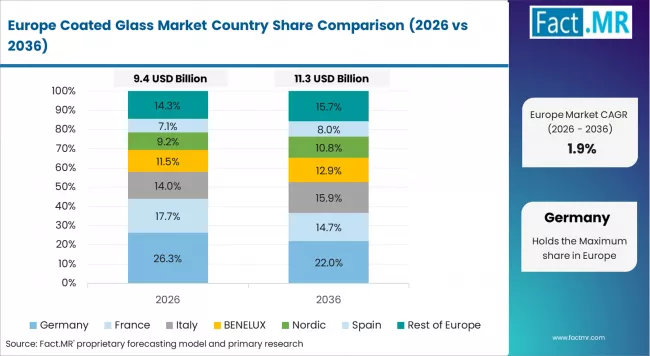
Coated Glass Market Europe Country Market Share Analysis, 2026 & 2036 | Source: Fact.MR
The coated glass market in Europe is projected to grow from USD 10.8 billion in 2026 to USD 15.5 billion by 2036, registering a CAGR of 3.7% over the forecast period. Germany is expected to maintain its leadership position with a 32.4% market share in 2026, growing to 33.1% by 2036, supported by its advanced construction infrastructure and major building centers including Bavaria and North Rhine-Westphalia.
France follows with a 24.1% share in 2026, projected to reach 24.6% by 2036, driven by comprehensive architectural programs and coating innovation development. The United Kingdom holds a 18.5% share in 2026, expected to maintain 18.0% by 2036 despite market adjustments. Italy commands a 15.7% share, while Spain accounts for 9.3% in 2026. The Rest of Europe region is anticipated to gain momentum, maintaining its collective share at approximately 10.0% by 2036, attributed to increasing coated glass adoption in Nordic countries and emerging construction facilities implementing energy-focused programs.
Competitive Landscape of the Coated Glass Market
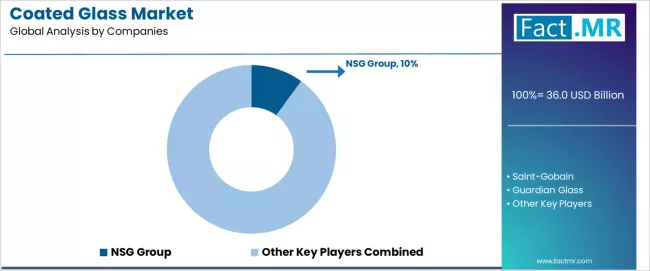
Coated Glass Market Analysis By Company | Source: Fact.MR
- Structure: ~20-25 credible players; top 5 hold ~45-50% by revenue.
- Leadership is maintained through: coating expertise, energy innovation, and performance reliability (thermal consistency + optical properties + building integration).
- What's commoditizing: standard Low-E coatings and basic solar control configurations.
- Margin Opportunities: specialized smart glass solutions, dynamic coating integration, and comprehensive building packages (energy services, installation support, performance monitoring).
| Stakeholder | What they actually control | Typical strengths | Typical blind spots |
|---|---|---|---|
| Global platforms | Glass reach, deep coating catalogs, production facilities | Broad availability, proven reliability, multi-region projects | Technology refresh cycles; application dependency management |
| Technology innovators | R&D capabilities; advanced coating systems; smart interfaces | Latest technology first; attractive ROI on large projects | Service density outside core regions; customization complexity |
| Regional specialists | Local sourcing, fast delivery, nearby production support | "Close to site" support; pragmatic pricing; local building codes | Technology gaps; talent retention in glass engineering |
| Quality-focused ecosystems | Production consistency, technical support, material sourcing | Lowest performance variation; comprehensive support | Production costs if overpromised; technology obsolescence |
| Application specialists | Specialized configurations, custom solutions, architectural development | Win specialized projects; flexible engineering | Scalability limitations; narrow market focus |
Source: Fact.MR analysis. Updated Apr 1, 2026
Key Players in the Coated Glass Market
- NSG Group
- Saint-Gobain
- Guardian Glass
- AGC
- Vitro
- Xinyi Glass
- Cardinal Glass
- Pilkington
- Sisecam
- Fuyao Glass
Bibliography
- 1. International Organization for Standardization. (2024). ISO 10292:1994, Glass in Building, Calculation of Steady-State U Values of Glazing. ISO.
- 2. European Committee for Standardization. (2024). EN 1096:2012, Glass in Building, Coated Glass. CEN.
- 3. National Fenestration Rating Council. (2024). NFRC 100, Procedure for Determining Fenestration Product U-Factors. NFRC.
- 4. U.S. Department of Energy. (2024). Building Energy Codes Program Update. DOE.
- 5. European Commission. (2024). Energy Performance of Buildings Directive (EPBD) Recast Implementation Guidance. European Commission.
This bibliography is provided for reader reference. The full Fact.MR report contains the complete reference list with primary research documentation.
This Report Addresses
- Market sizing and quantitative forecast metrics detailing functional glazing material expenditure dedicated to coated glass across building, automotive, and electronics applications through 2036.
- Segmentation analysis mapping coating technology distribution and evaluating energy code compliance documentation requirements driving specification selection in regulated construction markets.
- Regional deployment intelligence comparing building energy code enforcement intensity in North America and Europe against construction expansion-driven coated glass adoption in emerging markets.
- Regulatory compliance assessment analyzing building energy performance directive implementation, automotive glazing specification standards, and green building certification requirements across tracked jurisdictions.
- Competitive posture evaluation tracking coating technology capability, energy performance documentation, and float glass substrate integration across tracked producers.
- Custom data delivery formats encompassing interactive dashboards, raw Excel datasets, and PDF narrative reports.
Coated Glass Market Definition
Coated glass encompasses flat glass substrates with functional thin-film deposits applied through magnetron sputtering, chemical vapor deposition, or pyrolytic processes. Low-emissivity coatings reduce thermal transmittance for building energy management, solar control coatings reject solar heat for comfort and EV range optimization, and mirror/specialty coatings serve reflective and electronic display applications. Architects, automotive OEM glazing engineers, and building developers specify coated glass based on documented U-value, solar heat gain coefficient, and visible light transmittance performance.
Coated Glass Market Inclusions
Market scope includes low-E, solar control, and mirror/specialty coatings on float and laminated glass substrates. Coverage spans global and regional market sizes, forecast period 2026 to 2036, segmentation by coating, end use (building/construction, automotive, electronics/others), substrate, and region.
Coated Glass Market Exclusions
The scope excludes uncoated flat glass, tempered-only glass, window frame and curtain wall hardware, and insulating glass unit assembly. Smart glass electrochromic devices are excluded as distinct product categories.
Coated Glass Market Research Methodology
- Primary Research: Analysts engaged with building envelope specification engineers, automotive OEM glazing program managers, and commercial developer energy compliance directors to map energy code documentation and coating performance requirements.
- Desk Research: Data collection aggregated building energy code revision schedules, automotive glazing specification standard updates, and green building certification program publications across tracked jurisdictions.
- Market-Sizing and Forecasting: Baseline values derive from bottom-up aggregation of coated glass production line capacities, applying construction activity intensity and automotive production volume coefficients to project demand.
- Data Validation and Update Cycle: Projections tested against publicly reported flat glass and building products segment revenue data from producers with documented coating technology and commercial glazing manufacturing operations.
Segmentation
Scope of the Report
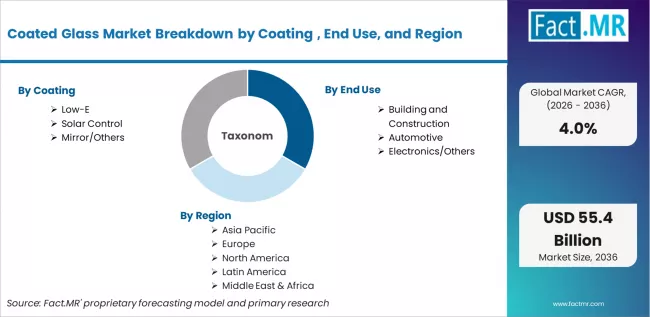
Coated Glass Market Breakdown By Coating , End Use, And Region | Source: Fact.MR
| Metric | Value |
|---|---|
| Quantitative Units | USD 37.44 billion to USD 55.42 billion, at a CAGR of 4.0% |
| Market Definition | Coated glass encompasses flat glass substrates with functional thin-film deposits modifying thermal, optical, or reflective properties for building energy management, automotive glazing, and specialty electronics applications. |
| Coating Segmentation | Low-E, Solar Control, Mirror/Others |
| End Use Segmentation | Building and Construction, Automotive, Electronics/Others |
| Substrate Segmentation | Float, Laminated |
| Regions Covered | North America, Latin America, Europe, East Asia, South Asia, Oceania, Middle East and Africa |
| Countries Covered | USA, Mexico, Germany, France, UK, South Korea, Japan, and 40 plus countries |
| Key Companies Profiled | NSG Group, Saint-Gobain S.A., Guardian Glass LLC, AGC Inc., Vitro S.A.B. de C.V., Xinyi Glass Holdings Limited, Cardinal Glass Industries Inc., Pilkington Group Limited |
| Forecast Period | 2026 to 2036 |
| Approach | Forecasting models apply a bottom-up methodology starting with global coated glass production line capacities and projecting construction activity intensity and automotive production volume coefficients. |
Source: Fact.MR analysis. Updated Apr 1, 2026
Coated Glass Market by Segments
-
Coating :
- Low-E
- Solar Control
- Mirror/Others
-
End Use :
- Building and Construction
- Automotive
- Electronics/Others
-
Substrate :
- Float
- Laminated
-
Region :
- North America
- USA
- Canada
- Mexico
- Europe
- Germany
- France
- United Kingdom
- Italy
- Spain
- Rest of Europe
- Asia Pacific
- China
- Japan
- South Korea
- India
- ASEAN
- Australia & New Zealand
- Rest of Asia Pacific
- South America
- Brazil
- Rest of South America
- Middle East & Africa
- GCC Countries
- South Africa
- Rest of Middle East & Africa
- North America
Frequently Asked Questions
How large is the demand for Coated Glass in the global market in 2026?
What will be the market size of Coated Glass in the global market by 2036?
What is the expected demand growth for Coated Glass in the global market between 2026 and 2036?
Which Coating is poised to lead global sales by 2026?
How significant is the role of Building and Construction in driving Coated Glass adoption in 2026?
What is the USA growth outlook in this report?
What is Coated Glass and what is it mainly used for?
What is included in the scope of this Coated Glass Market report?
Who worked on this report


Preview the report firsthand - request a free sample
Free SampleGet the brochure for pricing and purchase details
Download PDF