- Market Value (2025): USD 11.3 Bn
- Estimated Value (2026): USD 11.8 Bn
- Forecast Value (2036): USD 18.7 Bn
- CAGR (2026-2036): 4.7%
What is the Coated White Board Paper Market forecast to be worth by 2036?
USD 18.7 billion by 2036 at a 4.7% CAGR.
- The coated white board paper market reached USD 11.3 billion in 2025.
- Demand is projected to increase from USD 11.8 billion in 2026 to USD 18.7 billion by 2036.
- The market is projected to expand at a 4.7% CAGR from 2026 to 2036.
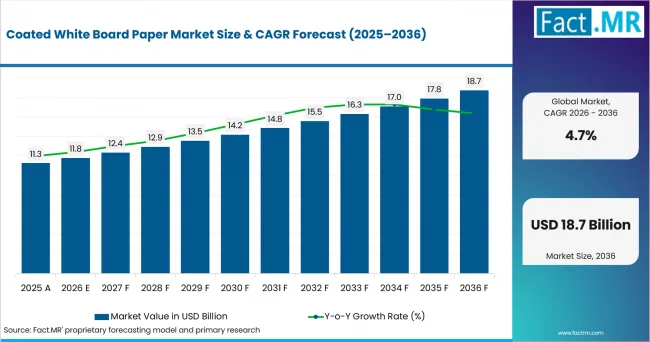
Coated White Board Paper Market Value Analysis | Source: Fact.MR
What are the defining numbers behind Coated White Board Paper Market growth?
An absolute opportunity of USD 6.9 billion is expected between 2026 and 2036.
- Demand Drivers in the Market
- Packaging recyclability rules are changing how coated board is specified. Regulation (EU) 2025/40 requires packaging placed on the EU market to meet recyclability requirements from 2030, while the European Commission is implementing design-for-recycling rules. This raises the commercial value of coated board structures whose coating, ink and fiber layers can move through established paper-recovery systems.
- Folding-carton demand supports coated board because food, beverage, pharmaceutical, personal-care and consumer-goods packs need a smooth printable surface while retaining stiffness for die cutting, creasing and filling. This demand mechanism sits directly alongside the Fact.MR folding carton market, where board performance is tied to printing and conversion as well as package protection.
- Food-contact requirements are pushing coating reformulation rather than reducing the need for coated board. The U.S. FDA recognizes coatings and additives used on paper and paperboard food packaging, while its phase-out of PFAS grease-proofing agents has shifted attention toward alternative mineral, polymer and water-based barrier systems that can meet food-contact and recovery requirements.
- The paper industry is also benefiting from substitution toward fiber-based packaging in applications that can move away from harder-to-recycle materials. Cepi reported that European packaging paper and board production was comparatively stable in 2025 even as graphic papers declined, supporting a more resilient demand base for packaging-oriented coated grades and related paper packaging formats.
- Brand presentation keeps surface finish and coating quality commercially important. Coated white board is purchased not simply for sheet area but for brightness, smoothness, color holdout, runnability and fold performance, particularly where cartons carry dense graphics, regulatory information, barcodes or premium point-of-sale presentation.
- Key Segments Analyzed
- Clay Coated Board accounts for 58.7% of Coating Material in 2026 because the mineral coating gives paperboard a smoother surface for printing while retaining a fiber-based structure. This makes it suitable for cartons that need clear graphics and can still move through established paper-recovery systems.
- Medium Weight Board represents 49.8% of Basis Weight in 2026 because it offers enough stiffness for carton performance without using more material than necessary. That balance makes it practical across a wide range of folding cartons and other consumer-packaging formats.
- Packaging holds 82.6% of Application in 2026 because coated white board is widely converted into cartons and sleeves where appearance and structural strength matter together. Demand spans food, beverage, personal care, pharmaceutical and other consumer products that rely on printed packaging at the point of sale.
- Food And Beverage Industry accounts for 36.9% of End Use in 2026 because packaged food and drink products require a steady supply of printed cartons. Suppliers also need coatings and board structures that can handle food-contact requirements as well as exposure to moisture or grease in selected applications.
- Virgin Fiber Board represents 63.4% of Fiber Source in 2026 because converters value its consistent brightness and strength, especially where print quality and reliable high-speed processing are important. Cleaner fiber characteristics also help maintain a uniform appearance across large packaging runs.
- Gloss Finish accounts for 34.8% of Finish in 2026 because it improves ink contrast and gives printed graphics greater visual impact on shelf-facing packaging. Matte, silk and cast-coated finishes remain relevant where brands want a softer appearance or a more distinctive surface feel.
- Analyst Opinion at Fact.MR
- Shambhu Nath Jha, Principal Consultant, Fact.MR, states, “The commercial test for coated white board is moving beyond brightness alone. Converters increasingly need a board that prints cleanly, creases without cracking, runs consistently at filling speed and still fits the recovery route required by the brand owner or regulator. That makes coating chemistry, fiber furnish, basis weight and finish part of one qualification decision. Suppliers that can hold those variables steady across large production runs will be better placed to win repeat carton programmes.”
- Strategic Implications
- Mills should develop coating packages around end-of-life performance as well as print quality. The shift toward recyclable coatings means pigment, binder and barrier choices must be evaluated for repulpability, food contact, drying demand and compatibility with existing coating lines.
- Converters should qualify basis weight by packed-product performance rather than reducing grammage in isolation. A lower basis weight can reduce material use, but insufficient stiffness or poor crease behavior can increase rejects, line stops or damage during distribution.
- Coating suppliers can create value by helping mills move from fluorinated or difficult-to-recycle barriers toward mineral, aqueous and other qualified alternatives. This broadens the commercial role of coating materials beyond appearance into recyclability and functional barrier performance.
- Board producers serving consumer brands should maintain tight control over surface smoothness, shade, caliper and ink holdout because shorter campaigns and digitally enhanced cartons increase sensitivity to visual variation. The related printed cartons segment is making print consistency more visible to buyers that run multiple SKUs on the same packaging platform.
How does the Coated White Board Paper Market break down by segment?
The market is segmented by Coating Material, Basis Weight, Application, End Use, Fiber Source and Finish.
Why does Clay Coated Board lead Coating Material?
Clay Coated Board is projected to account for a 58.7% share in 2026.
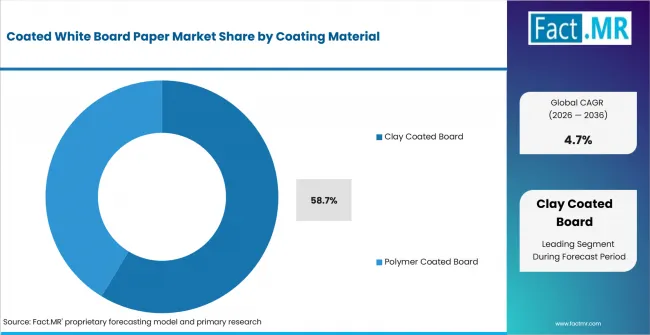
Coated White Board Paper Market Analysis By Coating Material | Source: Fact.MR
Clay coating improves the surface of paperboard by making it smoother and more consistent for printing. This helps converters achieve sharper graphics, better ink control and a more uniform appearance across carton panels. Mills can also adjust the coating formulation with minerals such as calcium carbonate to manage properties including brightness and opacity.
Its use also fits within existing paper-recycling frameworks when the coating does not interfere with fiber recovery. The UK Recyclability Assessment Methodology allows paper and board packaging to contain clay or colour coatings and binders while remaining within the paper-and-board category, provided the pack is mainly natural fibre and meets the relevant recyclability criteria.
Clay-based coatings also have an established role in food-contact paperboard. The U.S. FDA recognizes mineral coatings such as clay and ground calcium carbonate for applicable food-contact uses. This gives clay-coated board a broad technical base across printed carton applications, while polymer-coated structures remain more suitable where stronger moisture, grease or other barrier performance is required.
Why does Medium Weight Board lead Basis Weight?
Medium Weight Board is projected to account for a 49.8% share in 2026.
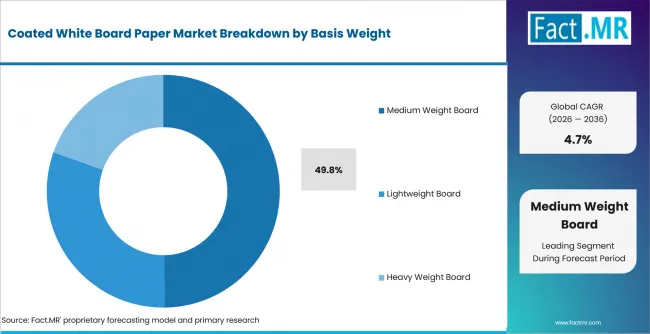
Coated White Board Paper Market Analysis By Basis Weight | Source: Fact.MR
Medium-weight grades offer a practical balance between material use and carton strength. Folding cartons need enough stiffness and thickness to move through printing, creasing and filling equipment while still protecting the product during stacking and distribution. Using heavier board than necessary raises material cost, while very light grades may not provide enough structural support.
That balance is becoming more relevant as packaging regulation places greater emphasis on material efficiency. Regulation (EU) 2025/40 requires packaging weight and volume to be reduced as far as possible without compromising functionality. For converters, this encourages closer optimization of board weight rather than automatically choosing either the lightest or the heaviest available grade.
Lightweight board remains suitable for smaller packs with limited load requirements, while heavier grades are used where greater rigidity is needed. Medium Weight Board works across a wider range of food, healthcare and consumer-goods cartons, which supports its 49.8% share.
Why does Packaging lead Application?
Packaging is projected to account for an 82.6% share in 2026.
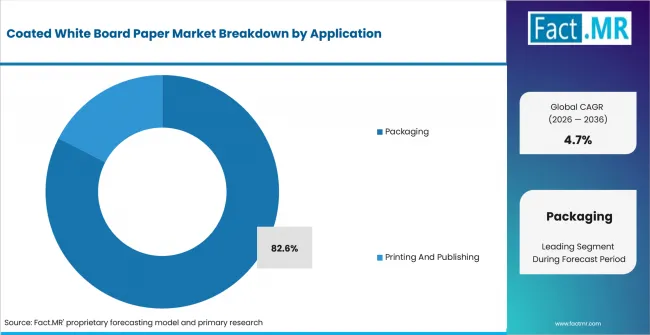
Coated White Board Paper Market Analysis By Application | Source: Fact.MR
Packaging dominates because coated white board combines two requirements in one material: a printable surface for branding and product information, and enough structure to form cartons and sleeves. This makes it useful across food, beverage, personal care, pharmaceutical and other consumer-goods packaging where the board must perform well during printing, converting and distribution.
Demand is also supported by the recurring nature of packaged-goods consumption. Cepi reported that European packaging paper and board production remained comparatively stable in 2025 even as graphic paper production declined. For coated white board, that distinction matters because most packaged products require a new carton for every unit sold, creating a steady replacement cycle.
Printing And Publishing still uses coated board for applications such as covers and promotional materials, but demand is less closely linked to continuous product throughput. Packaging therefore provides the broader and more consistent consumption base.
Why does Food and Beverage Industry lead End Use?
Food and Beverage Industry is projected to account for a 36.9% share in 2026.
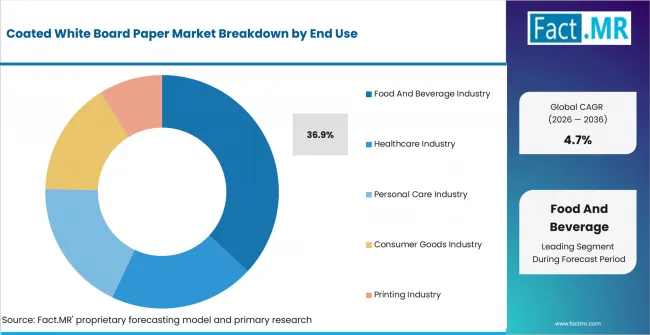
Coated White Board Paper Market Analysis By End Use | Source: Fact.MR
Food and beverage packaging creates steady demand because cartons are consumed with every product sold. These packs also need to do more than carry branding. They must display ingredients and nutrition information, support date coding and handling instructions, while maintaining enough stiffness for filling and distribution. Some formats also need added resistance to grease or moisture.
Barrier performance is especially important in food packaging. The U.S. FDA identifies paper and cardboard as major food-contact packaging materials and notes that coatings can help prevent grease from passing through the pack. At the same time, the phase-out of PFAS-based grease-proofing substances in the USA is pushing suppliers to qualify alternative coating systems that can maintain the required barrier performance.
Other sectors such as pharmaceuticals and personal care also use coated board, but food and beverage demand benefits from higher purchase frequency. Applications span dry foods, frozen products, snacks, confectionery and secondary beverage cartons, giving the segment a broad and recurring consumption base.
Why does Virgin Fiber Board lead Fiber Source?
Virgin Fiber Board is projected to account for a 63.4% share in 2026.
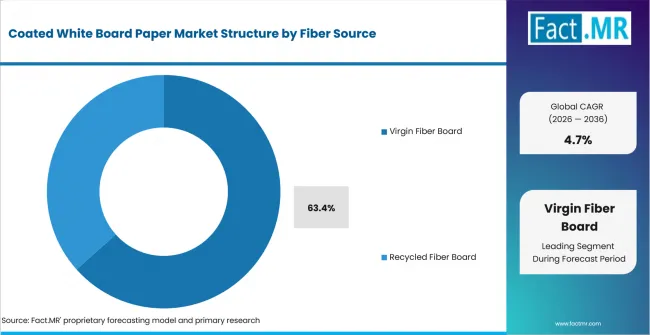
Coated White Board Paper Market Analysis By Fiber Source | Source: Fact.MR
Virgin fiber gives paperboard producers greater control over brightness, cleanliness and fiber strength. This consistency becomes important when coated board is used for detailed graphics or light-colored packaging, where variations in the sheet are easier to notice. It also helps converters maintain reliable performance during high-speed printing, cutting and folding.
Recycled Fiber Board continues to play an important role, particularly as packaging policies place more emphasis on recovered materials. The EU packaging framework encourages high-quality recycling so that secondary raw materials can replace primary materials where the required technical performance can still be achieved.
The choice between virgin and recycled fiber therefore depends on the performance required from the finished board. Recycled furnish can reduce reliance on primary fiber and support circularity goals, while virgin fiber remains widely used where buyers place greater importance on surface consistency, stiffness and tight production tolerances.
Why does Gloss Finish lead Finish?
Gloss Finish is projected to account for a 34.8% share in 2026.
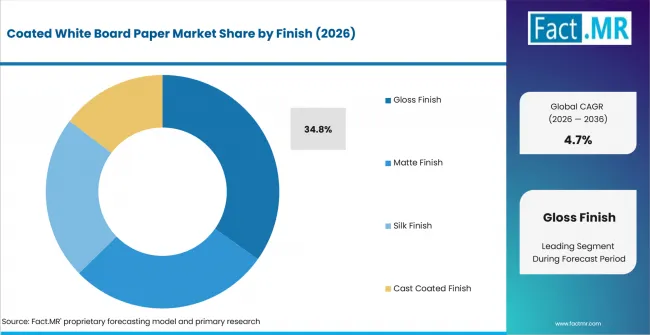
Coated White Board Paper Market Analysis By Finish | Source: Fact.MR
Gloss surfaces increase visual contrast and color saturation, helping graphics, product photography and brand elements stand out on retail cartons. The finish is especially useful where the package must communicate quickly from a shelf or display and where a smooth surface supports fine print and barcode clarity.
The finish also works across clay-coated and polymer-coated constructions, allowing mills and converters to tune appearance without changing the core carton format. Matte and silk finishes are chosen when glare reduction or a softer visual effect is preferred, while cast-coated finishes serve more specialized high-gloss applications.
Gloss therefore holds a broad middle ground: it provides a readily recognizable premium surface without requiring the more specialized production and handling associated with cast-coated board.
What is accelerating Coated White Board Paper Market adoption, and what is holding it back?
Demand is rising with recyclable paper packaging, steady food and healthcare carton use, higher print requirements and coating reformulation. Growth is constrained by pulp and energy costs, coating qualification expenses and weaker demand from printing applications.
Drivers Impact Analysis
| Factor | (~) % Impact on CAGR | Geographic Relevance | Impact Timeline |
|---|---|---|---|
| Shift toward recyclable paperboard packaging | +1.0% | Europe, UK, USA, Japan and Brazil | Medium term (2-4 years) |
| Packaged food, beverage and healthcare carton demand | +0.9% | Global | Short term (≤ 2 years) |
| Higher print and shelf-presentation requirements | +0.7% | Global consumer-goods markets | Short term (≤ 2 years) |
| Coating reformulation for food-contact and recovery performance | +0.6% | USA, UK, Europe and Japan | Medium term (2-4 years) |
| E-commerce and multi-SKU retail packaging activity | +0.5% | USA, UK, Germany, Brazil and Japan | Long term (≥ 4 years) |
Source: Fact.MR analysis. Updated Aug 26, 2026
Opportunity Impact Analysis
| Factor | (~) % Impact on CAGR | Geographic Relevance | Impact Timeline |
|---|---|---|---|
| Water-based and mineral barrier coating upgrades | +0.8% | Europe, UK, USA and Japan | Medium term (2-4 years) |
| Basis-weight optimization | +0.6% | Global | Medium term (2-4 years) |
| Recycled-fiber quality upgrades | +0.5% | Germany, UK, Japan and USA | Long term (≥ 4 years) |
| Brazil paperboard and converting capacity | +0.4% | Brazil and Latin America | Long term (≥ 4 years) |
Source: Fact.MR analysis. Updated Aug 26, 2026
Restraints Impact Analysis
| Factor | (~) % Impact on CAGR | Geographic Relevance | Impact Timeline |
|---|---|---|---|
| Pulp, energy and coating-input cost volatility | -0.8% | Global | Short term (≤ 2 years) |
| Cartonboard demand softness and mill utilization pressure | -0.6% | Europe, USA and Japan | Short term (≤ 2 years) |
| Qualification cost for new recyclable or food-contact coatings | -0.5% | USA, UK, Europe and Japan | Medium term (2-4 years) |
| Digital substitution in printing and publishing uses | -0.3% | Global | Long term (≥ 4 years) |
Source: Fact.MR analysis. Updated Aug 26, 2026
Which countries are scaling the Coated White Board Paper Market through 2036?
- Germany: Germany’s established paper and board industry supports coated-board production, while high paper-packaging recycling rates favor grades designed for both print performance and fiber recovery.
- Brazil: Domestic pulp and paper production gives coated-board mills access to local fiber, while growing paperboard output and packaged-goods demand support conversion activity.
- USA: Carton demand is supported by e-commerce and packaged consumer goods. FDA food-contact requirements and the move away from PFAS-based grease barriers are also changing coating specifications.
- UK: Extended producer responsibility and recyclability assessment rules are pushing packaging buyers toward coated paperboard structures that can still move through established recovery systems.
- Japan: Paper-packaging collection under the Containers and Packaging Recycling Act supports fiber recovery, while domestic paper and paperboard production supplies converters with specialized coated grades.
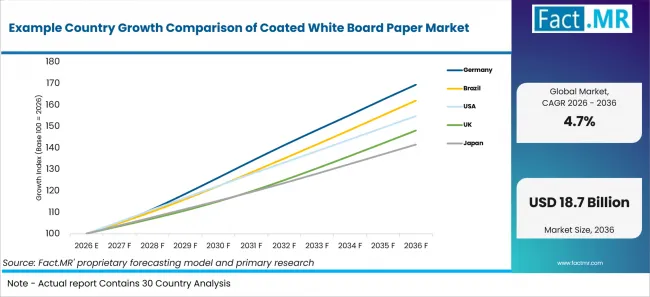
Example Country Growth Comparison Of Coated White Board Paper Market | Source: Fact.MR
Country CAGR (2026-2036)
| Country | CAGR, 2026-2036 |
|---|---|
| Germany | 5.4% |
| Brazil | 4.9% |
| USA | 4.5% |
| UK | 4.0% |
| Japan | 3.5% |
Source: Fact.MR analysis. Updated Aug 26, 2026
What is driving Germany's growth through 2036?
Germany is forecast to expand at a 5.4% CAGR from 2026 to 2036.
Germany combines substantial paper and board manufacturing capacity with a mature recovery system. Cepi’s 2024 Key Statistics showed Germany accounting for 24.4% of paper and board production across Cepi member countries. That production base gives coated-board converters access to established papermaking, coating, finishing and downstream packaging capabilities.
Recovery performance is equally important. The German Environment Agency reported that paper and cardboard packaging achieved an 86.6% recycling rate in 2023 and that paper, cardboard or carton was the most frequently used packaging material by companies. As EU packaging rules move toward design-for-recycling requirements, this infrastructure favors coated white board constructions that preserve fiber recoverability while delivering the surface demanded by consumer cartons.
What is driving Brazil's growth through 2036?
Brazil is forecast to expand at a 4.9% CAGR from 2026 to 2036.
Brazil has a growing domestic paperboard supply base. The Brazilian Tree Industry’s 2025 Annual Report states that packaging papers accounted for 56.8% of national paper production and that paperboard output increased by about 14% in 2024. This supports local availability of fiber-based substrates and gives converters more scope to serve food, beverage, personal-care and other consumer packaging applications.
Demand is also supported by recurring retail turnover. IBGE reported that Brazilian retail sales increased 1.6% in 2025, while pharmaceutical, medical, orthopedic and perfumery retail rose 4.5% over the year and food, beverage and tobacco retail also recorded growth. These categories are intensive users of printed cartons and sleeves, reinforcing demand for coated board that can carry high-quality graphics and product information.
What is driving USA's growth through 2036?
The USA is forecast to expand at a 4.5% CAGR from 2026 to 2036.
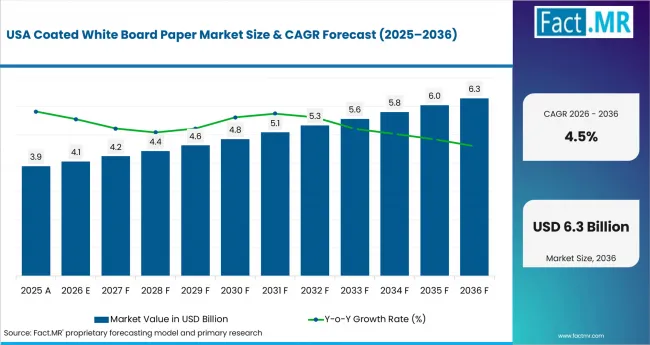
Coated White Board Paper Market Country Value Analysis | Source: Fact.MR
U.S. carton demand is supported by a large packaged-goods economy and continued online retail activity. The U.S. Census Bureau reported USD 300.2 billion in seasonally adjusted retail e-commerce sales in the first quarter of 2025, up 6.1% from a year earlier. E-commerce does not use coated white board in every shipment, but it expands the number of branded cartons, retail-ready packs and secondary packs moving through distribution networks.
The material also fits an established paper-recovery system. EPA reports that paper and paperboard containers and packaging had an 80.9% recycling rate in its 2018 materials figures, with folding cartons included among the paperboard packaging categories. At the specification level, FDA food-contact rules recognize coatings on paper and paperboard, and the agency’s PFAS grease-proofing phase-out is increasing the need to qualify alternative barrier chemistries for food packaging.
What is driving UK's growth through 2036?
The UK is forecast to expand at a 4.0% CAGR from 2026 to 2036.
The UK is moving packaging procurement toward measurable recyclability. Under extended producer responsibility, large producers have had to assess the recyclability of relevant household packaging, and PackUK’s methodology specifically classifies paperboard packaging such as cereal and tissue boxes within the paper-and-board stream. The guidance also allows paperboard to contain clay or colour coatings and binders, which is directly relevant to coated white board design.
The policy signal is strengthening. PackUK’s 2027 methodology states that less recyclable packaging can incur higher disposal costs under the EPR scheme, giving brand owners and converters a financial reason to examine coating type, attachments and board construction before qualification. This supports investment in coated grades that can meet print and barrier needs without moving the pack out of an efficient paper-recycling route.
What is driving Japan's growth through 2036?
Japan is forecast to expand at a 3.5% CAGR from 2026 to 2036.
Japan has an established municipal framework for paper-container recovery. The Ministry of the Environment reported that, for fiscal 2024 results published in 2026, municipalities collected 81,757 tonnes of paper containers and packaging under the Containers and Packaging Recycling Act framework, with 78,090 tonnes meeting the relevant handover or quality categories. This keeps recyclability and material identification visible in paper-package design.
The ministry’s next five-year municipal collection plans also show paper packaging remaining a defined collection stream, with 904 municipalities planning separate collection in fiscal 2026. On the supply side, METI’s Current Survey of Production continues to track pulp, paper and paper products as a dedicated manufacturing category, reflecting the domestic production and converting infrastructure available to support specialized coated board grades.
Who Leads the Coated White Board Paper Market?
Key players in the Coated White Board Paper Market include Sappi Limited, Stora Enso Oyj, Venkraft Paper Mills Pvt. Ltd., Emami Paper Mills Ltd., International Paper, Magnum Ventures Ltd., UPM, West Coast Paper Mills Limited, El-Salam PaperMill and Millennium Overseas.
Competition is shaped by coating consistency, board brightness and shade control, caliper tolerance, stiffness, printability, crease performance and the ability to supply qualified food-contact or recyclable structures. Large carton programmes can expose small variations in sheet surface or moisture profile, so buyers place value on repeatability across production lots as well as nominal basis weight.
Fiber access and integrated manufacturing also influence positioning. Producers with control over pulp, board making, coating and finishing can coordinate surface quality with mechanical performance, while regional mills can compete through shorter lead times, local specifications and flexible order sizes.
The commercial contest is therefore broader than price per tonne. Converters and brand owners weigh runnability, reject rates, print quality, sustainability documentation, certification, supply continuity and the speed at which a supplier can qualify a revised coating or basis weight for an existing carton line.
Which companies are the key providers?
Sappi Limited, Stora Enso Oyj, Venkraft Paper Mills Pvt. Ltd., Emami Paper Mills Ltd., International Paper, Magnum Ventures Ltd., UPM, West Coast Paper Mills Limited, El-Salam PaperMill and Millennium Overseas.
- Sappi Limited
- Stora Enso Oyj
- Venkraft Paper Mills Pvt. Ltd.
- Emami Paper Mills Ltd.
- International Paper
- Magnum Ventures Ltd.
- UPM
- West Coast Paper Mills Limited
- El-Salam PaperMill
- Millennium Overseas
Bibliography
- Confederation of European Paper Industries. (2025). Cepi Key Statistics 2024. Cepi.
- Confederation of European Paper Industries. (2026). Cepi Preliminary Statistics 2025. Cepi.
- European Commission. (2025). Packaging and Packaging Waste Regulation. Directorate-General for Environment.
- European Union. (2025). Regulation (EU) 2025/40 on Packaging and Packaging Waste. Official Journal of the European Union.
- U.S. Food and Drug Administration. (2024). Food Packaging and Other Substances that Come in Contact with Food: Information for Consumers. U.S. Department of Health and Human Services.
- U.S. Food and Drug Administration. (2025). Market Phase-Out of Grease-Proofing Substances Containing PFAS. U.S. Department of Health and Human Services.
- U.S. Food and Drug Administration. (2014). Inventory of Effective Food Contact Substance Notifications: FCN No. 1347. U.S. Department of Health and Human Services.
- U.S. Census Bureau. (2025). Quarterly Retail E-Commerce Sales, First Quarter 2025. U.S. Department of Commerce.
- U.S. Environmental Protection Agency. (2025). Containers and Packaging: Product-Specific Data. U.S. Environmental Protection Agency.
- German Environment Agency. (2026). Packaging Waste. Umweltbundesamt.
- PackUK. (2025). Recyclability Assessment Methodology: Assessing Materials. Government of the United Kingdom.
- PackUK and Department for Environment, Food and Rural Affairs. (2026). Assess Packaging Recyclability: Recyclability Assessment Methodology 2027. Government of the United Kingdom.
- Brazilian Tree Industry. (2025). 2025 Annual Report. Ibá.
- Brazilian Institute of Geography and Statistics. (2026). Retail Sales Close 2025 with Rise of 1.6%. IBGE.
- Ministry of Economy, Trade and Industry, Japan. (2026). Current Survey of Production: 2025 Interim Total Computation. Government of Japan.
- Ministry of the Environment, Japan. (2026). Fiscal 2024 Municipal Separate Collection Results under the Containers and Packaging Recycling Act. Government of Japan.
- Ministry of the Environment, Japan. (2026). Forecast Separate Collection Volumes from Fiscal 2026 under the Containers and Packaging Recycling Act. Government of Japan.
This Report Answers
- How are recyclability rules changing coating and fiber choices for coated white board paper?
- Why do clay coatings and medium-weight board retain broad use across folding-carton applications?
- Why does packaging account for most coated white board demand compared with printing and publishing?
- How do food-contact requirements, basis weight and finish influence converter qualification decisions?
- Which supply, recycling and packaged-goods factors are shaping demand across Germany, Brazil, the USA, the UK and Japan?
What does the Coated White Board Paper Market cover?
The Coated White Board Paper Market covers coated paperboard supplied with a white printable surface for packaging and selected printing applications. Revenue is counted at the board-material level before conversion into finished cartons, sleeves, covers or other printed formats.
The assessment covers Coating Material, Basis Weight, Application, End Use, Fiber Source and Finish across the specified taxonomy and the five country markets used for detailed growth analysis.
What is included in the scope?
The scope includes Clay Coated Board and Polymer Coated Board, together with the specified calcium-carbonate, latex, polyethylene and water-based polymer coating variants. Lightweight, Medium Weight and Heavy Weight Board are included across the listed GSM ranges.
Applications include Packaging and Printing And Publishing. End users include Food And Beverage Industry, Healthcare Industry, Personal Care Industry, Consumer Goods Industry and Printing Industry. Virgin Fiber Board and Recycled Fiber Board are included, together with Gloss, Matte, Silk and Cast Coated finishes.
What is excluded from the scope?
The scope excludes uncoated paperboard, corrugated containerboard, kraft liner, flexible paper packaging, molded fiber, plastic sheet and metal packaging. Finished converted cartons are excluded when their selling price includes printing, die cutting, gluing, filling or other conversion value beyond the coated board substrate itself.
Standalone coating chemicals sold to paper mills are treated as an adjacent input market rather than coated white board paper revenue. Graphic paper grades outside the specified board applications are also excluded.
How Was the Analysis Built?
The analysis draws on more than 120 sources, over 35 company portfolios and more than 20 industry interviews across at least 25 countries. The model focuses on coated board revenue and avoids mixing substrate value with the downstream value of finished converted cartons.
- Primary Research: Interviews with paperboard manufacturers, coating suppliers, folding-carton converters, printers, food and beverage packaging buyers, pharmaceutical and personal-care packaging teams, distributors and procurement managers examine board qualification, basis-weight selection, print performance, coating choice, fiber furnish, rejection rates and contract purchasing.
- Desk Research: The review covers paper and board production, packaging and recycling regulation, food-contact requirements, retail and e-commerce activity, municipal recovery data, company product portfolios and technical material guidance. External institutional sources used in the article are recorded in the bibliography.
- Market Sizing and Forecasting: Estimates combine coated-board production and trade, folding-carton conversion intensity, packaged-goods demand, basis-weight mix, coating mix, virgin and recycled fiber use, print and finish requirements, price realization and country-level regulatory or recycling conditions. Segment and country forecasts are reconciled with the market total.
- Data Validation and Update Cycle: Findings are cross-checked against mill and converter activity, coating qualification changes, packaging regulation, paper-recovery trends and end-use demand indicators. Updates focus on changes that can alter actual coated-board consumption, including packaging redesign, basis-weight reduction, coating substitution, mill capacity and packaged-goods volumes.
Segmentation
What is the report's scope and coverage?
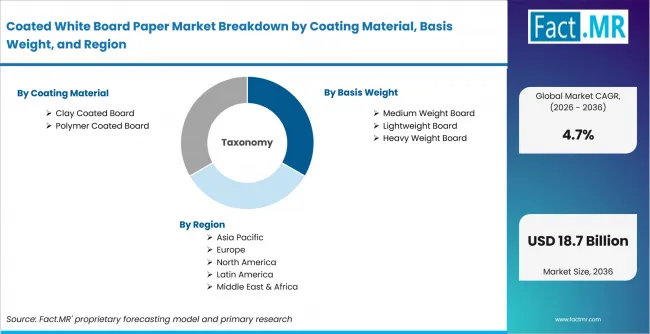
Coated White Board Paper Market Breakdown By Coating Material, Basis Weight, And Region | Source: Fact.MR
| Attribute | Details |
|---|---|
| Quantitative Units | USD billion |
| Market Definition | Coated white paperboard substrate supplied for packaging and selected printing applications, measured before finished-carton conversion value |
| Segments Covered | Coating Material; Basis Weight; Application; End Use; Fiber Source; Finish |
| Regions Covered | North America; Latin America; Europe; East Asia; South Asia and Pacific; Middle East and Africa |
| Countries Covered | Germany; Brazil; USA; UK; Japan |
| Key Companies Profiled | Sappi Limited, Stora Enso Oyj, Venkraft Paper Mills Pvt. Ltd., Emami Paper Mills Ltd., International Paper, Magnum Ventures Ltd., UPM, West Coast Paper Mills Limited, El-Salam PaperMill and Millennium Overseas. |
| Forecast Period | 2026 to 2036 |
| Base Year | 2025 |
| Market Value, 2026 | USD 11.8 billion |
| Market Value, 2036 | USD 18.7 billion |
| CAGR, 2026-2036 | 4.7% |
| Absolute Opportunity | USD 6.9 billion |
| Approach | Hybrid supply- and demand-side analysis using coated-board output, conversion intensity, end-use packaging demand, coating and fiber mix, price realization and regulatory validation inputs |
Source: Fact.MR analysis. Updated Aug 26, 2026
How is the market segmented?
-
By Coating Material:
- Clay Coated Board
- Calcium Carbonate Coated
- Latex Coated
- Polymer Coated Board
- Polyethylene Coated
- Water Based Polymer Coated
- Clay Coated Board
-
By Basis Weight:
- Medium Weight Board
- 200 To 275 GSM
- 275 To 350 GSM
- Lightweight Board
- Below 150 GSM
- 150 To 200 GSM
- Heavy Weight Board
- 350 To 450 GSM
- Above 450 GSM
- Medium Weight Board
-
By Application:
- Packaging
- Food Packaging
- Beverage Packaging
- Personal Care Packaging
- Pharmaceutical Packaging
- Consumer Goods Packaging
- Printing And Publishing
- Cover Pages
- Promotional Materials
- Packaging
-
By End Use:
- Food And Beverage Industry
- Packaged Food Manufacturers
- Beverage Manufacturers
- Healthcare Industry
- Prescription Drug Packaging
- Over The Counter Packaging
- Personal Care Industry
- Skincare Products
- Beauty Products
- Consumer Goods Industry
- Electronics Manufacturers
- Household Product Manufacturers
- Printing Industry
- Offset Printing
- Digital Printing
- Food And Beverage Industry
-
By Fiber Source:
- Virgin Fiber Board
- Hardwood Pulp
- Softwood Pulp
- Recycled Fiber Board
- Post Consumer Recycled Fiber
- Pre Consumer Recycled Fiber
- Virgin Fiber Board
-
By Finish:
- Gloss Finish
- Matte Finish
- Silk Finish
- Cast Coated Finish
Frequently Asked Questions
What is the Coated White Board Paper Market value in 2026?
At what CAGR is the market projected to grow?
What is the projected market value by 2036?
Which Coating Material segment leads the market?
Which Basis Weight segment leads the market?
Which Application segment leads the market?
Which End Use segment leads the market?
Which Fiber Source segment leads the market?
Which Finish segment leads the market?
What is Germany’s CAGR through 2036?
Which companies are included in the market assessment?
Who worked on this report


Preview the report firsthand - request a free sample
Free SampleGet the brochure for pricing and purchase details
Download PDF