Commercial HVAC Equipment Market Size, Share, Growth and Forecast (2026 - 2036)

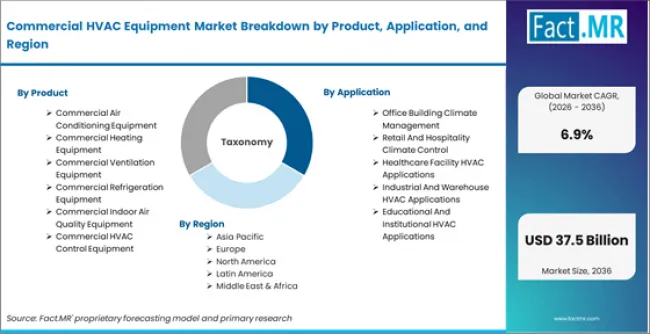
Commercial HVAC Equipment Market is segmented by Product (Commercial Air Conditioning Equipment, Commercial Heating Equipment, Commercial Ventilation Equipment, Commercial Refrigeration Equipment, Commercial Indoor Air Quality Equipment, Commercial HVAC Control Equipment), Application (Office Building Climate Management, Retail And Hospitality Climate Control, Healthcare Facility HVAC Applications, Industrial And Warehouse HVAC Applications, Educational And Institutional HVAC Applications), End Use (Commercial Real Estate Companies, Healthcare Organizations, Industrial Companies, Educational Institutions, Hospitality Companies), and Region, with forecasts covering the period from 2026 to 2036.

Commercial HVAC Equipment Market Analysis and Forecast by Fact.MR

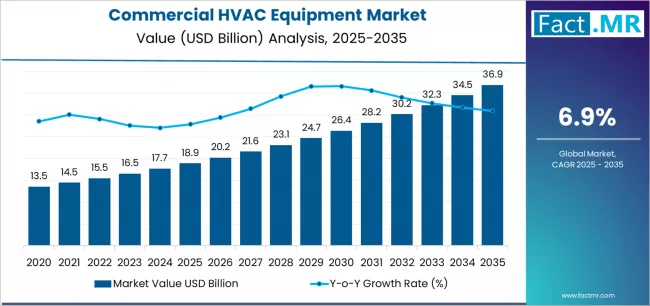
  • The global market for commercial HVAC equipment is estimated to be around US$ 19.24 billion in 2026 and has been forecast to expand at a CAGR of 6.9% to end up at US$ 37.50 billion by 2036.
  • Commercial HVAC equipment covers heating, ventilation, and air conditioning systems designed for office buildings, retail spaces, hospitality properties, healthcare facilities, and institutional campuses.
  • Product categories include air conditioning, heating, and ventilation equipment across packaged rooftop, split, chiller, VRF, and air handling configurations.
  • Growth is supported by commercial construction activity, equipment replacement cycles, energy efficiency mandates, refrigerant transition requirements, and expanding data center cooling demand.
Commercial Hvac Equipment Market Market Value Analysis

Summary of Commercial HVAC Equipment Market

  • Market Snapshot
    • In 2025, the global Commercial HVAC Equipment Market was valued at approximately USD 19.24 Billion.
    • The market is estimated to reach USD 19.24 Billion in 2026 and is projected to attain USD 37.50 Billion by 2036.
    • The commercial HVAC equipment market is likely to expand at a CAGR of 6.9% during the forecast period.
    • The market is anticipated to create an absolute dollar opportunity of USD 16.93 Billion between 2026 and 2036.
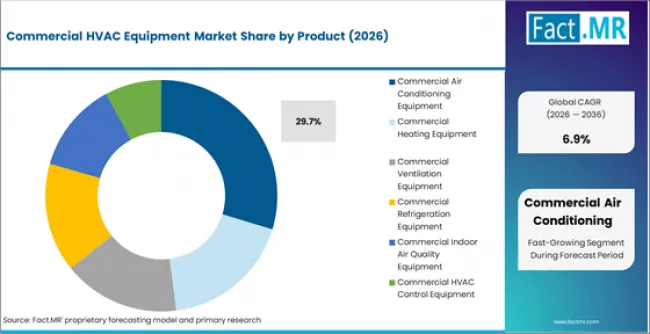
    • Commercial air conditioning equipment accounts for 29.7% of product segment share in 2026.
    • India (9.6%) and China (9.2%) are the key growth markets during the forecast period.
  • Demand and Growth Drivers
    • Commercial floor space expansion in developing economies, particularly India, China, and Southeast Asia, is generating sustained procurement of HVAC equipment for new office, retail, hospitality, and institutional building construction.
    • Equipment replacement cycles for aging rooftop units and chiller systems installed 15 to 20 years ago are creating recurring procurement demand across the existing commercial building stock in North America and Europe.
    • Energy efficiency mandates, including ASHRAE 90.1 updates and EU Ecodesign minimum efficiency requirements, are pushing specification toward higher-efficiency equipment that commands premium pricing.
    • Refrigerant transition from R-410A to R-454B and other low-GWP alternatives is creating a product replacement cycle as manufacturers introduce next-generation equipment compliant with AIM Act, EU F-gas regulation, and Kigali Amendment timelines.
    • Data center cooling demand is a fast-growing application vertical, with hyperscale and colocation facilities requiring precision cooling systems that maintain tight temperature and humidity conditions across high-density server environments.
  • Product and Segment View
    • Commercial air conditioning equipment accounts for 29.7% of the product segment in 2026, reflecting the concentration of HVAC procurement in cooling-dominated applications across commercial office, retail, and hospitality buildings.
    • Office building climate management represents 26.4% of the application segment in 2026, driven by commercial floor space expansion, tenant comfort requirements, and building energy performance compliance.
    • Retrofit deployment holds 28.9% of the deployment segment, reflecting the large installed base of aging equipment entering replacement age across commercial building portfolios in developed markets.
    • Key segmentation includes:
      • Product Type: Commercial Air Conditioning Equipment, Commercial Heating Equipment, Commercial Ventilation Equipment
      • Application: Office Building Climate Management, Retail And Hospitality Climate Control, Healthcare Facility Climate Systems, Data Center Cooling
      • End Use: Commercial Real Estate Companies, Healthcare Operators, Retail And Hospitality Companies
    • These systems enable:
      • Controlled indoor climate across commercial buildings with documented temperature, humidity, and air quality performance
      • Energy-efficient heating and cooling that meets building energy code requirements and reduces operating costs for building owners
      • Precision cooling for data center and mission-critical environments with high-density heat loads and tight environmental specifications
  • Geography and Competitive Outlook
    • India at 9.6% CAGR reflects commercial construction growth, urbanization, and rising adoption of VRF and chiller systems in new office, retail, and hospitality developments.
    • China at 9.2% is supported by commercial floor space expansion, government energy efficiency standards, and domestic manufacturer strength in VRF and chiller product categories.
    • Brazil at 8.9% reflects commercial construction activity, rising cooling demand driven by urbanization, and growing adoption of energy-efficient split and VRF systems.
    • Key companies include Daikin Industries, Carrier Global Corporation, Trane Technologies, Mitsubishi Electric, LG Electronics, Johnson Controls, Lennox International, Gree Electric, Midea Group, and Samsung HVAC.
  • Analyst Opinion
    • Shambhu Nath Jha, Principal Consultant at Fact.MR, says 'The commercial HVAC equipment market is being driven by the convergence of commercial construction growth in developing economies, aging equipment replacement in mature markets, and regulatory pressure from both energy efficiency mandates and refrigerant transition timelines. The competitive leverage is shifting toward manufacturers that can deliver next-generation equipment with low-GWP refrigerants, higher seasonal efficiency ratings, and IoT-connected controls under shorter product introduction cycles. Data center cooling is emerging as a distinct high-growth vertical where precision, redundancy, and energy efficiency specifications exceed those of conventional commercial comfort cooling.'

Key Growth Drivers, Constraints, and Opportunities
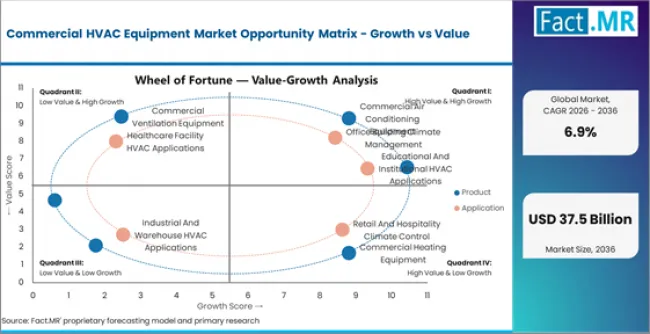
Commercial Hvac Equipment Market Opportunity Matrix Growth Vs Value

Key Factors Driving Growth

  • Commercial floor space expansion in India, China, and Southeast Asia generates new-construction HVAC equipment procurement at rates proportional to office, retail, and hospitality building completion volumes.
  • Refrigerant transition from R-410A to R-454B creates a product replacement cycle across the installed base of commercial HVAC equipment, as manufacturers introduce compliant models and building owners upgrade systems.
  • Data center construction across hyperscale, colocation, and edge facilities creates a fast-growing cooling equipment demand vertical with precision temperature and humidity specifications.

Key Market Constraints

  • Supply chain constraints for compressors, electronic controls, and specialty materials create lead time variability that affects equipment delivery schedules and project completion timelines.
  • Skilled mechanical contractor availability limits installation capacity, particularly during peak construction seasons when new-build and replacement projects compete for labor.
  • Higher equipment costs for next-generation low-GWP refrigerant models create near-term procurement resistance among cost-sensitive building owners, particularly in developing markets.

Key Opportunity Areas

  • VRF system adoption in commercial buildings is expanding beyond Asia into North American and European markets, capturing share from conventional rooftop and chiller configurations through zoning flexibility and energy efficiency.
  • Heat pump heating systems for commercial buildings are growing as electrification mandates and gas phase-out timelines create demand for electric-only HVAC configurations that replace fossil fuel boilers.
  • IoT-connected HVAC equipment with built-in monitoring, fault detection, and remote management capability creates recurring service revenue and differentiation for manufacturers beyond commodity equipment supply.

Segment-wise Analysis of the Commercial HVAC Equipment Market

  • Commercial air conditioning equipment holds 29.7% of the product segment in 2026, anchored by cooling-dominated demand across commercial buildings in tropical and temperate climate zones.
  • Office building climate management represents 26.4% of the application segment, driven by commercial floor space growth and tenant comfort expectations.
  • Commercial real estate companies account for 31.2% of the end-use segment, reflecting concentrated HVAC procurement across office, retail, and mixed-use property portfolios.

The market is segmented by product type, application, end use, technology, and deployment type. Air conditioning leads by value in cooling-dominated markets. VRF is the fastest-growing configuration category driven by zoning flexibility and energy efficiency.

Which Product Type Segment Dominates the Commercial HVAC Equipment Market?
Commercial Hvac Equipment Market Analysis By Product

Commercial air conditioning equipment accounts for 29.7% of the product segment in 2026. Its leadership reflects the global concentration of commercial building cooling demand in tropical, subtropical, and temperate climate zones where air conditioning is the primary HVAC function. Product configurations range from packaged rooftop units and split systems to large-scale chillers and VRF systems serving multi-zone commercial buildings.

The segment benefits from the broadest installed base, the largest number of OEM product offerings, and well-established mechanical contractor installation and service networks. As energy efficiency ratings tighten and refrigerant transition accelerates, the replacement market for aging air conditioning equipment provides sustained procurement volume alongside new construction demand.

Which Technology Segment Dominates the Commercial HVAC Equipment Market?
Commercial Hvac Equipment Market Analysis By Technology

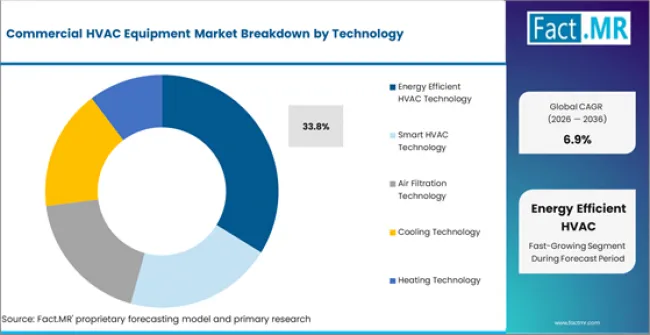
Energy efficient HVAC technology accounts for 33.8% of the technology segment in 2026. Demand reflects tightening building energy codes that mandate minimum seasonal efficiency ratings for commercial equipment. SEER2, IEER, and COP metrics are increasingly used in procurement specifications, with higher efficiency thresholds required by ASHRAE 90.1, EU Ecodesign, and equivalent national standards.

The segment is supported by heat pump technology advancement that delivers both heating and cooling from a single system, variable-speed compressor technology that improves part-load efficiency, and smart controls that optimize system operation based on occupancy and weather conditions. Manufacturers that achieve the highest published efficiency ratings capture specification preference in competitive procurement processes.

Which Product Trend is Shaping the Next Phase of Growth in the Commercial HVAC Equipment Market?

VRF (variable refrigerant flow) systems are the fastest-growing commercial HVAC equipment configuration, driven by zoning flexibility, simultaneous heating and cooling capability, and energy efficiency advantages over conventional unitary systems. VRF market penetration, which has been strongest in Asia and Europe, is accelerating in North America as contractors and consulting engineers gain familiarity with system design and installation requirements.

The trend is supported by heat recovery VRF systems that transfer heat between zones requiring heating and zones requiring cooling, delivering efficiency improvements of 30 to 50% compared to conventional heat pump systems. As commercial buildings become more complex in their zoning requirements and as electrification mandates eliminate gas heating, VRF systems paired with DOAS for ventilation are becoming a preferred HVAC architecture for new construction and major renovation projects.

Regional Outlook Across Key Markets

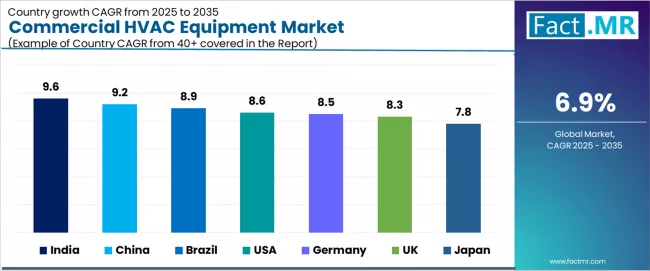
  • India at 9.6% CAGR reflects commercial construction growth, urbanization, and rising cooling demand across office, retail, healthcare, and hospitality building segments.
  • China at 9.2% is supported by the largest commercial construction market globally, domestic manufacturer strength in VRF and chiller systems, and energy efficiency standard tightening.
  • Brazil at 8.9% reflects commercial floor space expansion, rising cooling demand driven by urbanization, and growing adoption of split and VRF systems in new office and retail construction.

Top Country Growth Comparison Commercial Hvac Equipment Market Cagr (2026 2036)

CAGR Table

Country CAGR (%)
India 9.6%
China 9.2%
Brazil 8.9%

Source: Fact MR (FMR) analysis, based on proprietary forecasting model and primary research.
Commercial Hvac Equipment Market Cagr Analysis By Country

Commercial HVAC Equipment Demand Trends in India

Commercial construction growth driven by IT/ITES office expansion, organized retail development, and hospitality sector investment is generating large-volume HVAC equipment procurement. VRF adoption is growing in mid-rise and high-rise commercial buildings where zoning flexibility and floor-by-floor control are valued. Daikin, Mitsubishi Electric, and LG Electronics maintain strong positions through local manufacturing, distributor networks, and consulting engineer specification support. Rising ambient temperatures and urbanization are structurally increasing cooling load intensity across Indian commercial buildings.

  • IT/ITES office campus expansion creates concentrated VRF and chiller procurement across Bangalore, Hyderabad, Pune, and Chennai commercial corridors.
  • Rising ambient temperatures and urbanization structurally increase cooling load intensity and equipment specification requirements across commercial buildings.

China Commercial HVAC Equipment Growth Assessment

Domestic manufacturers Gree Electric, Midea Group, and Haier maintain strong market positions through manufacturing scale, cost competitiveness, and extensive distribution networks across Chinese commercial construction. Government energy efficiency standards and green building requirements are driving specification toward higher-efficiency equipment in new commercial developments. Data center construction in major metropolitan areas creates a distinct high-value cooling equipment demand vertical with precision temperature and humidity specifications.

  • Domestic manufacturers benefit from manufacturing scale and cost positions that dominate the mid-market commercial HVAC equipment segment.
  • Data center construction across tier-1 cities creates precision cooling demand that exceeds standard commercial comfort cooling specifications.

Brazil Commercial HVAC Equipment Market Opportunity Analysis

Commercial construction activity in Sao Paulo, Rio de Janeiro, and Brasilia, combined with rising cooling demand driven by urbanization and economic growth, supports HVAC equipment procurement expansion. Split system and VRF adoption is growing in new office and retail construction. Import dependency for premium chiller and VRF systems positions international manufacturers as key suppliers to Brazilian mechanical contractors and consulting engineers.

  • Commercial office and retail construction growth in major metropolitan areas drives procurement of split, VRF, and chiller systems for new-build projects.
  • Rising urbanization and ambient temperature trends structurally increase cooling equipment demand across Brazilian commercial building segments.

Competitive Benchmarking and Company Positioning
Commercial Hvac Equipment Market Analysis By Company

Commercial HVAC Equipment Market Analysis By Company

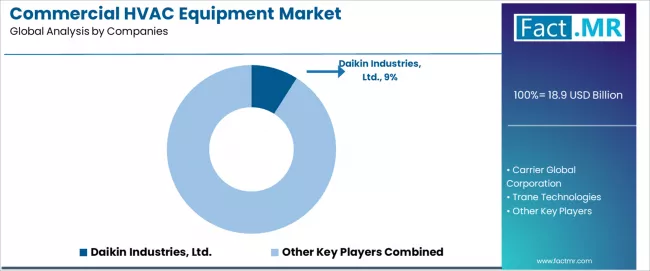
  • Daikin Industries, Carrier Global, and Trane Technologies hold the strongest global positions through comprehensive commercial HVAC portfolios spanning air conditioning, heating, ventilation, chillers, VRF, and building controls with established distribution and service networks.
  • Mitsubishi Electric and LG Electronics compete through VRF and multi-split system expertise, with growing positions in commercial building applications where zoning flexibility and energy efficiency are primary specification criteria.
  • Competition is shaped by energy efficiency ratings, refrigerant compliance timeline, product breadth, contractor network density, and the ability to offer integrated building climate solutions that combine HVAC hardware with connected controls and energy management software.

The competitive landscape is moderately concentrated, with Daikin, Carrier, Trane, Mitsubishi Electric, and LG accounting for a large combined share of the global commercial HVAC equipment market. Chinese manufacturers Gree and Midea dominate the domestic market and are expanding internationally.

Competition is increasingly shaped by VRF product range, heat pump heating capability, next-generation refrigerant compliance, and IoT-connected equipment with built-in diagnostics and remote management capability.

Key Companies in the Commercial HVAC Equipment Market

Daikin Industries, Carrier Global, Trane Technologies, Mitsubishi Electric, and LG Electronics are the leading global players, supported by comprehensive commercial HVAC portfolios and established contractor networks.

Johnson Controls, Lennox International, Gree Electric, Midea Group, and Samsung HVAC hold positions across specific product categories, price tiers, and regional markets.

Recent Industry Developments

  • Johnson Controls, Strategic Divestiture, Residential/Light Commercial HVAC to Bosch (April 2025): Johnson Controls divested its residential and light commercial HVAC business to Bosch for USD 8 billion, sharpening commercial building systems focus and enabling Bosch to nearly double its HVAC sales and strengthen US and Asia presence.
  • Daikin Industries, Manufacturing Investment, Global Production Capacity (2025): Daikin continued expanding its global manufacturing network with capacity additions across multiple geographies to meet growing VRF and commercial system demand, reinforcing its position as the largest HVAC manufacturer globally.
  • Trane Technologies, Product Platform, Horizon DOAS and Mitsubishi HVRF (2025): Trane expanded its commercial product ecosystem with Horizon DOAS integration alongside the Trane/Mitsubishi Electric HVRF hybrid VRF system, offering paired ventilation and comfort solutions for energy-efficient commercial building design.
  • Greenheck, Product Launch, RV-220 DOAS With R-454B (July 2025): Greenheck expanded its commercial ventilation portfolio with the RV-220 DOAS unit featuring R-454B refrigerant compliance, up to 29,200 CFM airflow, and packaged cooling and heating capability for standard shipping configuration.

Leading Companies Shaping the Commercial HVAC Equipment Market

  • Daikin Industries, Ltd.
  • Carrier Global Corporation
  • Trane Technologies
  • Mitsubishi Electric
  • LG Electronics
  • Johnson Controls
  • Lennox International
  • Gree Electric
  • Midea Group
  • Samsung HVAC

Sources and Research References

  • Daikin Industries. Global HVAC product portfolio and manufacturing capacity expansion updates.
  • Trane Technologies. Commercial HVAC product platforms and energy efficiency technology updates.
  • ASHRAE. Standard 90.1 commercial building energy code and equipment efficiency provisions.
  • Air-Conditioning, Heating, and Refrigeration Institute (AHRI). Equipment certification and performance rating data.
  • HVAC trade publications, mechanical contractor databases, commercial construction databases, and company annual reports.
  • Primary interviews with HVAC manufacturers, mechanical contractors, building owners, consulting engineers, and data center operators.

This bibliography is provided for reader reference and is not exhaustive. The full report contains the complete reference list and detailed citations.

Key Questions This Report Addresses

  • What is the current and future size of the Commercial HVAC Equipment Market?
  • How fast is the market expected to grow between 2026 and 2036?
  • Which product type is likely to lead the market by 2026?
  • Which application segment is expected to account for the highest demand?
  • What factors are driving demand globally?
  • How is VRF adoption influencing market growth?
  • Why are India, China, and Brazil the fastest-growing markets?
  • How are refrigerant transition and energy codes supporting demand?
  • Which countries are projected to show the fastest growth through 2036?
  • Who are the key companies active in this market?
  • How does Fact.MR estimate and validate the market forecast?

Commercial HVAC Equipment Market Definition

The commercial HVAC equipment market covers heating, ventilation, and air conditioning systems for commercial buildings. It includes air conditioning, heating, and ventilation equipment across packaged, split, chiller, VRF, and air handling configurations for new construction and replacement applications.

Commercial HVAC Equipment Market Inclusions

  • The scope covers global and regional market size and forecasts for 2026 to 2036 across product type, application, end use, technology, deployment type, and region.
  • It includes demand analysis based on commercial construction permits, equipment replacement cycles, energy code timelines, refrigerant regulation schedules, and data center capacity additions.
  • The report covers technology trends, pricing analysis, competitive dynamics, and product portfolio benchmarking.

Commercial HVAC Equipment Market Exclusions

  • The scope excludes residential HVAC equipment, portable air conditioners, and window units not classified as commercial-grade systems.
  • It excludes industrial process cooling, refrigeration for food storage, and specialized manufacturing environment climate systems outside of commercial building HVAC classification.
  • The report excludes HVAC ductwork, controls, and building automation systems sold separately from primary HVAC equipment.

Commercial HVAC Equipment Market Research Methodology

  • The methodology combines secondary research, primary interviews, and forecast modelling.
  • It draws on 140+ secondary sources and benchmarks 65+ company product portfolios.
  • Market sizing covers 30+ countries through a demand-side model, supported by top-down validation.
  • Key inputs include commercial construction permits, equipment shipment data, energy code timelines, refrigerant regulation schedules, and data center capacity additions.
  • Primary validation includes 30+ interviews across HVAC manufacturers, mechanical contractors, building owners, and consulting engineers.

Scope of Analysis

Commercial Hvac Equipment Market Breakdown By Product, Application, And Region

Parameter Details
Quantitative Units USD 20.57 Billion to USD 37.50 Billion, at a CAGR of 6.9%
Market Definition The Commercial HVAC Equipment Market covers heating, ventilation, and air conditioning systems for commercial buildings across packaged, split, chiller, VRF, and air handling configurations.
Regions Covered North America, Latin America, Europe, East Asia, South Asia and Pacific, Middle East and Africa
Countries Covered India, China, Brazil, USA, Germany, Japan, 30 plus countries
Key Companies Daikin, Carrier Global, Trane Technologies, Mitsubishi Electric, LG Electronics, Johnson Controls, Lennox, Gree Electric, Midea Group, Samsung HVAC
Forecast Period 2026 to 2036
Approach Hybrid demand-side and top-down methodology built on commercial construction data, equipment shipment statistics, energy code timelines, refrigerant schedules, and primary interviews

Commercial HVAC Equipment Market Segmentation

  • Commercial HVAC Equipment Market Segmented by Product:

    • Commercial Air Conditioning Equipment
      • Rooftop Air Conditioning Units
        • Office Building Cooling Systems
        • Retail Facility Climate Control
      • Variable Refrigerant Flow Systems
        • Hospitality Building Air Conditioning
        • Mixed Use Infrastructure Cooling
    • Commercial Heating Equipment
      • Commercial Boilers
        • Institutional Heating Applications
        • Industrial Facility Heat Supply
      • Furnace Heating Systems
        • Warehouse Heating Operations
        • Commercial Space Heating
    • Commercial Ventilation Equipment
      • Air Handling Units
        • Healthcare Facility Ventilation
        • Educational Building Air Distribution
      • Dedicated Outdoor Air Systems
        • Indoor Air Quality Management
        • Energy Efficient Ventilation Applications
    • Commercial Refrigeration Equipment
      • Chiller Systems
        • Data Center Cooling Applications
        • Large Commercial Building Cooling
      • Cooling Towers
        • Industrial Heat Rejection Systems
        • District Cooling Infrastructure
    • Commercial Indoor Air Quality Equipment
      • Air Filtration Systems
        • Clean Room Air Purification
        • Commercial Indoor Air Management
      • Humidity Control Systems
        • Museum Climate Preservation
        • Pharmaceutical Facility Air Control
    • Commercial HVAC Control Equipment
      • Building Automation Systems
        • Smart Building Climate Management
        • Energy Optimization Applications
      • Smart Thermostat Systems
        • Remote HVAC Monitoring
        • Occupancy Based Climate Control
  • Commercial HVAC Equipment Market Segmented by Application:

    • Office Building Climate Management
      • Corporate Office HVAC Systems
        • Employee Comfort Optimization
        • Energy Efficient Workplace Operations
      • Mixed Use Commercial Infrastructure
        • Integrated Climate Management
        • Urban Commercial Developments
    • Retail And Hospitality Climate Control
      • Shopping Mall HVAC Systems
        • Large Space Air Distribution
        • Retail Energy Management
      • Hotel And Resort HVAC Systems
        • Guest Comfort Optimization
        • Hospitality Indoor Air Quality
    • Healthcare Facility HVAC Applications
      • Hospital Air Management Systems
        • Critical Care Ventilation
        • Infection Control Applications
      • Laboratory HVAC Systems
        • Clean Room Climate Control
        • Research Facility Ventilation
    • Industrial And Warehouse HVAC Applications
      • Manufacturing Facility Climate Systems
        • Industrial Ventilation Operations
        • Process Cooling Applications
      • Logistics And Warehouse HVAC Systems
        • Large Space Heating And Cooling
        • Cold Storage Air Management
    • Educational And Institutional HVAC Applications
      • School Building HVAC Systems
        • Classroom Ventilation Applications
        • Campus Energy Management
      • University And Research Facility HVAC
        • Large Building Climate Control
        • Institutional Indoor Air Quality
  • Commercial HVAC Equipment Market Segmented by End Use:

    • Commercial Real Estate Companies
      • Office Building Operators
        • Corporate Infrastructure Climate Systems
        • Commercial Property Energy Management
      • Retail Property Owners
        • Shopping Center HVAC Infrastructure
        • Mixed Use Building Climate Operations
    • Healthcare Organizations
      • Hospitals And Clinics
        • Critical HVAC Infrastructure
        • Patient Safety Ventilation Systems
      • Research Laboratories
        • Controlled Environment HVAC
        • Healthcare Air Quality Management
    • Industrial Companies
      • Manufacturing Enterprises
        • Factory Ventilation And Cooling
        • Industrial Process Climate Control
      • Logistics And Warehouse Operators
        • Large Facility Air Management
        • Distribution Center HVAC Systems
    • Educational Institutions
      • Schools
        • Classroom Climate Management
        • Student Comfort Infrastructure
      • Universities
        • Campus HVAC Networks
        • Research Facility Climate Systems
    • Hospitality Companies
      • Hotel Operators
        • Guest Room Climate Systems
        • Hospitality Energy Optimization
      • Event Venue Operators
        • Large Space Ventilation
        • Commercial Comfort Management
  • Commercial HVAC Equipment Market Segmented by Technology:

    • Energy Efficient HVAC Technology
      • Inverter Compressor Systems
        • Variable Speed Cooling Operations
        • Commercial Energy Savings
      • Heat Recovery Systems
        • Waste Heat Utilization
        • Sustainable Building Operations
    • Smart HVAC Technology
      • IoT Enabled HVAC Systems
        • Remote Equipment Monitoring
        • Predictive Maintenance Applications
      • AI Based Climate Control
        • Automated Energy Optimization
        • Occupancy Based HVAC Operations
    • Air Filtration Technology
      • HEPA Filtration Systems
        • Healthcare Air Purification
        • Clean Environment Applications
      • Electrostatic Air Filtration
        • Commercial Indoor Air Quality
        • Industrial Dust Management
    • Cooling Technology
      • Variable Refrigerant Flow Technology
        • Multi Zone Climate Management
        • Commercial Cooling Efficiency
      • Chilled Water Cooling Systems
        • Large Infrastructure Cooling
        • District Cooling Applications
    • Heating Technology
      • Condensing Boiler Technology
        • High Efficiency Heating Operations
        • Commercial Building Heat Supply
      • Hybrid Heating Systems
        • Integrated Heating And Cooling
        • Energy Optimized HVAC Applications
  • Commercial HVAC Equipment Market Segmented by Deployment:

    • Retrofit Deployment
      • Existing Building HVAC Modernization
        • Energy Efficiency Upgrades
        • Indoor Air Quality Improvements
      • HVAC Replacement Projects
        • Commercial Infrastructure Renovation
        • Building Compliance Modernization
    • New Construction Deployment
      • Commercial Building HVAC Installation
        • Office Infrastructure Development
        • Retail Facility Construction
      • Healthcare Infrastructure HVAC Deployment
        • Hospital Construction Projects
        • Laboratory Climate System Installation
    • Centralized HVAC Deployment
      • District Cooling Systems
        • Urban Infrastructure Cooling Networks
        • Large Campus Climate Management
      • Central Plant HVAC Systems
        • Integrated Building Operations
        • High Capacity Climate Infrastructure
    • Decentralized HVAC Deployment
      • Zone Based HVAC Systems
        • Independent Building Climate Control
        • Flexible Commercial Air Management
      • Modular HVAC Systems
        • Scalable Climate Infrastructure
        • Distributed Air Handling Operations
  • Commercial HVAC Equipment Market by Region:

    • North America
      • USA
      • Canada
      • Mexico
    • Latin America
      • Brazil
      • Chile
      • Rest of Latin America
    • Western Europe
      • Germany
      • UK
      • Italy
      • Spain
      • France
      • Nordic
      • BENELUX
      • Rest of Western Europe
    • Eastern Europe
      • Russia
      • Poland
      • Hungary
      • Balkan & Baltic
      • Rest of Eastern Europe
    • East Asia
      • China
      • Japan
      • South Korea
    • South Asia and Pacific
      • India
      • ASEAN
      • Australia & New Zealand
      • Rest of South Asia and Pacific
    • Middle East & Africa
      • Kingdom of Saudi Arabia
      • Other GCC Countries
      • Turkiye
      • South Africa
      • Other African Union
      • Rest of Middle East & Africa

- Frequently Asked Questions -

How big is the commercial hvac equipment market in 2026?

The global commercial hvac equipment market is estimated to be valued at USD 19.2 billion in 2026.

What will be the size of commercial hvac equipment market in 2036?

The market size for the commercial hvac equipment market is projected to reach USD 37.5 billion by 2036.

How much will be the commercial hvac equipment market growth between 2026 and 2036?

The commercial hvac equipment market is expected to grow at a 6.9% CAGR between 2026 and 2036.

What are the key product types in the commercial hvac equipment market?

The key product types in commercial hvac equipment market are commercial air conditioning equipment, commercial heating equipment, commercial ventilation equipment, commercial refrigeration equipment, commercial indoor air quality equipment, and commercial hvac control equipment.

Which application segment is expected to contribute significant share in the commercial hvac equipment market in 2026?

In terms of application, office building climate management segment is expected to command 26.4% share in the commercial hvac equipment market in 2026.

Table of Content

  1. Executive Summary
    • Global Market Outlook
    • Demand to side Trends
    • Supply to side Trends
    • Technology Roadmap Analysis
    • Analysis and Recommendations
  2. Market Overview
    • Market Coverage / Taxonomy
    • Market Definition / Scope / Limitations
  3. Research Methodology
    • Chapter Orientation
    • Analytical Lens and Working Hypotheses
      • Market Structure, Signals, and Trend Drivers
      • Benchmarking and Cross-market Comparability
      • Market Sizing, Forecasting, and Opportunity Mapping
    • Research Design and Evidence Framework
      • Desk Research Programme (Secondary Evidence)
        • Company Annual and Sustainability Reports
        • Peer-reviewed Journals and Academic Literature
        • Corporate Websites, Product Literature, and Technical Notes
        • Earnings Decks and Investor Briefings
        • Statutory Filings and Regulatory Disclosures
        • Technical White Papers and Standards Notes
        • Trade Journals, Industry Magazines, and Analyst Briefs
        • Conference Proceedings, Webinars, and Seminar Materials
        • Government Statistics Portals and Public Data Releases
        • Press Releases and Reputable Media Coverage
        • Specialist Newsletters and Curated Briefings
        • Sector Databases and Reference Repositories
        • Fact.MR Internal Proprietary Databases and Historical Market Datasets
        • Subscription Datasets and Paid Sources
        • Social Channels, Communities, and Digital Listening Inputs
        • Additional Desk Sources
      • Expert Input and Fieldwork (Primary Evidence)
        • Primary Modes
          • Qualitative Interviews and Expert Elicitation
          • Quantitative Surveys and Structured Data Capture
          • Blended Approach
        • Why Primary Evidence is Used
        • Field Techniques
          • Interviews
          • Surveys
          • Focus Groups
          • Observational and In-context Research
          • Social and Community Interactions
        • Stakeholder Universe Engaged
          • C-suite Leaders
          • Board Members
          • Presidents and Vice Presidents
          • R&D and Innovation Heads
          • Technical Specialists
          • Domain Subject-matter Experts
          • Scientists
          • Physicians and Other Healthcare Professionals
        • Governance, Ethics, and Data Stewardship
          • Research Ethics
          • Data Integrity and Handling
      • Tooling, Models, and Reference Databases
    • Data Engineering and Model Build
      • Data Acquisition and Ingestion
      • Cleaning, Normalisation, and Verification
      • Synthesis, Triangulation, and Analysis
    • Quality Assurance and Audit Trail
  4. Market Background
    • Market Dynamics
      • Drivers
      • Restraints
      • Opportunity
      • Trends
    • Scenario Forecast
      • Demand in Optimistic Scenario
      • Demand in Likely Scenario
      • Demand in Conservative Scenario
    • Opportunity Map Analysis
    • Product Life Cycle Analysis
    • Supply Chain Analysis
    • Investment Feasibility Matrix
    • Value Chain Analysis
    • PESTLE and Porter’s Analysis
    • Regulatory Landscape
    • Regional Parent Market Outlook
    • Production and Consumption Statistics
    • Import and Export Statistics
  5. Global Market Analysis 2021 to 2025 and Forecast, 2026 to 2036
    • Historical Market Size Value (USD Million) Analysis, 2021 to 2025
    • Current and Future Market Size Value (USD Million) Projections, 2026 to 2036
      • Y to o to Y Growth Trend Analysis
      • Absolute $ Opportunity Analysis
  6. Global Market Pricing Analysis 2021 to 2025 and Forecast 2026 to 2036
  7. Global Market Analysis 2021 to 2025 and Forecast 2026 to 2036, By Product
    • Introduction / Key Findings
    • Historical Market Size Value (USD Million) Analysis By Product, 2021 to 2025
    • Current and Future Market Size Value (USD Million) Analysis and Forecast By Product, 2026 to 2036
      • Commercial Air Conditioning Equipment
        • Rooftop Air Conditioning Value (USD Million)s
        • Office Building Cooling Systems
        • Retail Facility Climate Control
        • Variable Refrigerant Flow Systems
        • Hospitality Building Air Conditioning
        • Mixed Use Infrastructure Cooling
      • Commercial Heating Equipment
        • Commercial Boilers
        • Institutional Heating Applications
        • Industrial Facility Heat Supply
        • Furnace Heating Systems
        • Warehouse Heating Operations
      • Commercial Ventilation Equipment
        • Air Handling Value (USD Million)s
        • Healthcare Facility Ventilation
        • Educational Building Air Distribution
        • Dedicated Outdoor Air Systems
        • Indoor Air Quality Management
      • Commercial Refrigeration Equipment
        • Chiller Systems
        • Data Center Cooling Applications
        • Large Commercial Building Cooling
        • Cooling Towers
        • Industrial Heat Rejection Systems
      • Commercial Indoor Air Quality Equipment
        • Air Filtration Systems
        • Clean Room Air Purification
        • Commercial Indoor Air Management
        • Humidity Control Systems
        • Museum Climate Preservation
      • Commercial HVAC Control Equipment
        • Building Automation Systems
        • Smart Building Climate Management
        • Energy Optimization Applications
        • Smart Thermostat Systems
        • Remote HVAC Monitoring
    • Y to o to Y Growth Trend Analysis By Product, 2021 to 2025
    • Absolute $ Opportunity Analysis By Product, 2026 to 2036
  8. Global Market Analysis 2021 to 2025 and Forecast 2026 to 2036, By Application
    • Introduction / Key Findings
    • Historical Market Size Value (USD Million) Analysis By Application, 2021 to 2025
    • Current and Future Market Size Value (USD Million) Analysis and Forecast By Application, 2026 to 2036
      • Office Building Climate Management
        • Corporate Office HVAC Systems
        • Employee Comfort Optimization
        • Energy Efficient Workplace Operations
        • Mixed Use Commercial Infrastructure
        • Integrated Climate Management
        • Urban Commercial Developments
      • Retail And Hospitality Climate Control
        • Shopping Mall HVAC Systems
        • Large Space Air Distribution
        • Retail Energy Management
        • Hotel And Resort HVAC Systems
        • Guest Comfort Optimization
      • Healthcare Facility HVAC Applications
        • Hospital Air Management Systems
        • Critical Care Ventilation
        • Infection Control Applications
        • Laboratory HVAC Systems
        • Clean Room Climate Control
      • Industrial And Warehouse HVAC Applications
        • Manufacturing Facility Climate Systems
        • Industrial Ventilation Operations
        • Process Cooling Applications
        • Logistics And Warehouse HVAC Systems
        • Large Space Heating And Cooling
      • Educational And Institutional HVAC Applications
        • School Building HVAC Systems
        • Classroom Ventilation Applications
        • Campus Energy Management
        • University And Research Facility HVAC
        • Large Building Climate Control
    • Y to o to Y Growth Trend Analysis By Application, 2021 to 2025
    • Absolute $ Opportunity Analysis By Application, 2026 to 2036
  9. Global Market Analysis 2021 to 2025 and Forecast 2026 to 2036, By End Use
    • Introduction / Key Findings
    • Historical Market Size Value (USD Million) Analysis By End Use, 2021 to 2025
    • Current and Future Market Size Value (USD Million) Analysis and Forecast By End Use, 2026 to 2036
      • Commercial Real Estate Companies
        • Office Building Operators
        • Corporate Infrastructure Climate Systems
        • Commercial Property Energy Management
        • Retail Property Owners
        • Shopping Center HVAC Infrastructure
        • Mixed Use Building Climate Operations
      • Healthcare Organizations
        • Hospitals And Clinics
        • Critical HVAC Infrastructure
        • Patient Safety Ventilation Systems
        • Research Laboratories
        • Controlled Environment HVAC
      • Industrial Companies
        • Manufacturing Enterprises
        • Factory Ventilation And Cooling
        • Industrial Process Climate Control
        • Logistics And Warehouse Operators
        • Large Facility Air Management
      • Educational Institutions
        • Schools
        • Classroom Climate Management
        • Student Comfort Infrastructure
        • Universities
        • Campus HVAC Networks
      • Hospitality Companies
        • Hotel Operators
        • Guest Room Climate Systems
        • Hospitality Energy Optimization
        • Event Venue Operators
        • Large Space Ventilation
    • Y to o to Y Growth Trend Analysis By End Use, 2021 to 2025
    • Absolute $ Opportunity Analysis By End Use, 2026 to 2036
  10. Global Market Analysis 2021 to 2025 and Forecast 2026 to 2036, By Technology
    • Introduction / Key Findings
    • Historical Market Size Value (USD Million) Analysis By Technology, 2021 to 2025
    • Current and Future Market Size Value (USD Million) Analysis and Forecast By Technology, 2026 to 2036
      • Energy Efficient HVAC Technology
        • Inverter Compressor Systems
        • Variable Speed Cooling Operations
        • Commercial Energy Savings
        • Heat Recovery Systems
        • Waste Heat Utilization
        • Sustainable Building Operations
      • Smart HVAC Technology
        • IoT Enabled HVAC Systems
        • Remote Equipment Monitoring
        • Predictive Maintenance Applications
        • AI Based Climate Control
        • Automated Energy Optimization
      • Air Filtration Technology
        • HEPA Filtration Systems
        • Healthcare Air Purification
        • Clean Environment Applications
        • Electrostatic Air Filtration
        • Commercial Indoor Air Quality
      • Cooling Technology
        • Variable Refrigerant Flow Technology
        • Multi Zone Climate Management
        • Commercial Cooling Efficiency
        • Chilled Water Cooling Systems
        • Large Infrastructure Cooling
      • Heating Technology
        • Condensing Boiler Technology
        • High Efficiency Heating Operations
        • Commercial Building Heat Supply
        • Hybrid Heating Systems
        • Integrated Heating And Cooling
    • Y to o to Y Growth Trend Analysis By Technology, 2021 to 2025
    • Absolute $ Opportunity Analysis By Technology, 2026 to 2036
  11. Global Market Analysis 2021 to 2025 and Forecast 2026 to 2036, By Deployment
    • Introduction / Key Findings
    • Historical Market Size Value (USD Million) Analysis By Deployment, 2021 to 2025
    • Current and Future Market Size Value (USD Million) Analysis and Forecast By Deployment, 2026 to 2036
      • Retrofit Deployment
        • Existing Building HVAC Modernization
        • Energy Efficiency Upgrades
        • Indoor Air Quality Improvements
        • HVAC Replacement Projects
        • Commercial Infrastructure Renovation
        • Building Compliance Modernization
      • New Construction Deployment
        • Commercial Building HVAC Installation
        • Office Infrastructure Development
        • Retail Facility Construction
        • Healthcare Infrastructure HVAC Deployment
        • Hospital Construction Projects
      • Centralized HVAC Deployment
        • District Cooling Systems
        • Urban Infrastructure Cooling Networks
        • Large Campus Climate Management
        • Central Plant HVAC Systems
        • Integrated Building Operations
      • Decentralized HVAC Deployment
        • Zone Based HVAC Systems
        • Independent Building Climate Control
        • Flexible Commercial Air Management
        • Modular HVAC Systems
        • Scalable Climate Infrastructure
    • Y to o to Y Growth Trend Analysis By Deployment, 2021 to 2025
    • Absolute $ Opportunity Analysis By Deployment, 2026 to 2036
  12. Global Market Analysis 2021 to 2025 and Forecast 2026 to 2036, By Region
    • Introduction
    • Historical Market Size Value (USD Million) Analysis By Region, 2021 to 2025
    • Current Market Size Value (USD Million) Analysis and Forecast By Region, 2026 to 2036
      • North America
      • Latin America
      • Western Europe
      • Eastern Europe
      • East Asia
      • South Asia and Pacific
      • Middle East & Africa
    • Market Attractiveness Analysis By Region
  13. North America Market Analysis 2021 to 2025 and Forecast 2026 to 2036, By Country
    • Historical Market Size Value (USD Million) Trend Analysis By Market Taxonomy, 2021 to 2025
    • Market Size Value (USD Million) Forecast By Market Taxonomy, 2026 to 2036
      • By Country
        • USA
        • Canada
        • Mexico
      • By Product
      • By Application
      • By End Use
      • By Technology
      • By Deployment
    • Market Attractiveness Analysis
      • By Country
      • By Product
      • By Application
      • By End Use
      • By Technology
      • By Deployment
    • Key Takeaways
  14. Latin America Market Analysis 2021 to 2025 and Forecast 2026 to 2036, By Country
    • Historical Market Size Value (USD Million) Trend Analysis By Market Taxonomy, 2021 to 2025
    • Market Size Value (USD Million) Forecast By Market Taxonomy, 2026 to 2036
      • By Country
        • Brazil
        • Chile
        • Rest of Latin America
      • By Product
      • By Application
      • By End Use
      • By Technology
      • By Deployment
    • Market Attractiveness Analysis
      • By Country
      • By Product
      • By Application
      • By End Use
      • By Technology
      • By Deployment
    • Key Takeaways
  15. Western Europe Market Analysis 2021 to 2025 and Forecast 2026 to 2036, By Country
    • Historical Market Size Value (USD Million) Trend Analysis By Market Taxonomy, 2021 to 2025
    • Market Size Value (USD Million) Forecast By Market Taxonomy, 2026 to 2036
      • By Country
        • Germany
        • UK
        • Italy
        • Spain
        • France
        • Nordic
        • BENELUX
        • Rest of Western Europe
      • By Product
      • By Application
      • By End Use
      • By Technology
      • By Deployment
    • Market Attractiveness Analysis
      • By Country
      • By Product
      • By Application
      • By End Use
      • By Technology
      • By Deployment
    • Key Takeaways
  16. Eastern Europe Market Analysis 2021 to 2025 and Forecast 2026 to 2036, By Country
    • Historical Market Size Value (USD Million) Trend Analysis By Market Taxonomy, 2021 to 2025
    • Market Size Value (USD Million) Forecast By Market Taxonomy, 2026 to 2036
      • By Country
        • Russia
        • Poland
        • Hungary
        • Balkan & Baltic
        • Rest of Eastern Europe
      • By Product
      • By Application
      • By End Use
      • By Technology
      • By Deployment
    • Market Attractiveness Analysis
      • By Country
      • By Product
      • By Application
      • By End Use
      • By Technology
      • By Deployment
    • Key Takeaways
  17. East Asia Market Analysis 2021 to 2025 and Forecast 2026 to 2036, By Country
    • Historical Market Size Value (USD Million) Trend Analysis By Market Taxonomy, 2021 to 2025
    • Market Size Value (USD Million) Forecast By Market Taxonomy, 2026 to 2036
      • By Country
        • China
        • Japan
        • South Korea
      • By Product
      • By Application
      • By End Use
      • By Technology
      • By Deployment
    • Market Attractiveness Analysis
      • By Country
      • By Product
      • By Application
      • By End Use
      • By Technology
      • By Deployment
    • Key Takeaways
  18. South Asia and Pacific Market Analysis 2021 to 2025 and Forecast 2026 to 2036, By Country
    • Historical Market Size Value (USD Million) Trend Analysis By Market Taxonomy, 2021 to 2025
    • Market Size Value (USD Million) Forecast By Market Taxonomy, 2026 to 2036
      • By Country
        • India
        • ASEAN
        • Australia & New Zealand
        • Rest of South Asia and Pacific
      • By Product
      • By Application
      • By End Use
      • By Technology
      • By Deployment
    • Market Attractiveness Analysis
      • By Country
      • By Product
      • By Application
      • By End Use
      • By Technology
      • By Deployment
    • Key Takeaways
  19. Middle East & Africa Market Analysis 2021 to 2025 and Forecast 2026 to 2036, By Country
    • Historical Market Size Value (USD Million) Trend Analysis By Market Taxonomy, 2021 to 2025
    • Market Size Value (USD Million) Forecast By Market Taxonomy, 2026 to 2036
      • By Country
        • Kingdom of Saudi Arabia
        • Other GCC Countries
        • Turkiye
        • South Africa
        • Other African Union
        • Rest of Middle East & Africa
      • By Product
      • By Application
      • By End Use
      • By Technology
      • By Deployment
    • Market Attractiveness Analysis
      • By Country
      • By Product
      • By Application
      • By End Use
      • By Technology
      • By Deployment
    • Key Takeaways
  20. Key Countries Market Analysis
    • USA
      • Pricing Analysis
      • Market Share Analysis, 2025
        • By Product
        • By Application
        • By End Use
        • By Technology
        • By Deployment
    • Canada
      • Pricing Analysis
      • Market Share Analysis, 2025
        • By Product
        • By Application
        • By End Use
        • By Technology
        • By Deployment
    • Mexico
      • Pricing Analysis
      • Market Share Analysis, 2025
        • By Product
        • By Application
        • By End Use
        • By Technology
        • By Deployment
    • Brazil
      • Pricing Analysis
      • Market Share Analysis, 2025
        • By Product
        • By Application
        • By End Use
        • By Technology
        • By Deployment
    • Chile
      • Pricing Analysis
      • Market Share Analysis, 2025
        • By Product
        • By Application
        • By End Use
        • By Technology
        • By Deployment
    • Germany
      • Pricing Analysis
      • Market Share Analysis, 2025
        • By Product
        • By Application
        • By End Use
        • By Technology
        • By Deployment
    • UK
      • Pricing Analysis
      • Market Share Analysis, 2025
        • By Product
        • By Application
        • By End Use
        • By Technology
        • By Deployment
    • Italy
      • Pricing Analysis
      • Market Share Analysis, 2025
        • By Product
        • By Application
        • By End Use
        • By Technology
        • By Deployment
    • Spain
      • Pricing Analysis
      • Market Share Analysis, 2025
        • By Product
        • By Application
        • By End Use
        • By Technology
        • By Deployment
    • France
      • Pricing Analysis
      • Market Share Analysis, 2025
        • By Product
        • By Application
        • By End Use
        • By Technology
        • By Deployment
    • India
      • Pricing Analysis
      • Market Share Analysis, 2025
        • By Product
        • By Application
        • By End Use
        • By Technology
        • By Deployment
    • ASEAN
      • Pricing Analysis
      • Market Share Analysis, 2025
        • By Product
        • By Application
        • By End Use
        • By Technology
        • By Deployment
    • Australia & New Zealand
      • Pricing Analysis
      • Market Share Analysis, 2025
        • By Product
        • By Application
        • By End Use
        • By Technology
        • By Deployment
    • China
      • Pricing Analysis
      • Market Share Analysis, 2025
        • By Product
        • By Application
        • By End Use
        • By Technology
        • By Deployment
    • Japan
      • Pricing Analysis
      • Market Share Analysis, 2025
        • By Product
        • By Application
        • By End Use
        • By Technology
        • By Deployment
    • South Korea
      • Pricing Analysis
      • Market Share Analysis, 2025
        • By Product
        • By Application
        • By End Use
        • By Technology
        • By Deployment
    • Russia
      • Pricing Analysis
      • Market Share Analysis, 2025
        • By Product
        • By Application
        • By End Use
        • By Technology
        • By Deployment
    • Poland
      • Pricing Analysis
      • Market Share Analysis, 2025
        • By Product
        • By Application
        • By End Use
        • By Technology
        • By Deployment
    • Hungary
      • Pricing Analysis
      • Market Share Analysis, 2025
        • By Product
        • By Application
        • By End Use
        • By Technology
        • By Deployment
    • Kingdom of Saudi Arabia
      • Pricing Analysis
      • Market Share Analysis, 2025
        • By Product
        • By Application
        • By End Use
        • By Technology
        • By Deployment
    • Turkiye
      • Pricing Analysis
      • Market Share Analysis, 2025
        • By Product
        • By Application
        • By End Use
        • By Technology
        • By Deployment
    • South Africa
      • Pricing Analysis
      • Market Share Analysis, 2025
        • By Product
        • By Application
        • By End Use
        • By Technology
        • By Deployment
  21. Market Structure Analysis
    • Competition Dashboard
    • Competition Benchmarking
    • Market Share Analysis of Top Players
      • By Regional
      • By Product
      • By Application
      • By End Use
      • By Technology
      • By Deployment
  22. Competition Analysis
    • Competition Deep Dive
      • Daikin Industries, Ltd.
        • Overview
        • Product Portfolio
        • Profitability by Market Segments (Product/Age /Sales Channel/Region)
        • Sales Footprint
        • Strategy Overview
          • Marketing Strategy
          • Product Strategy
          • Channel Strategy
      • Carrier Global Corporation
      • Trane Technologies
      • Mitsubishi Electric
      • LG Electronics
      • Samsung Electronics
      • Johnson Controls
      • Midea Group
      • Panasonic Corporation
      • Fujitsu General
      • Haier Group
      • Lennox International
      • GREE Comfort
      • Voltas Ltd.
      • AAON Inc.
  23. Assumptions & Acronyms Used

List Of Table

  • Table 1: Global Market Value (USD Million) Forecast by Region, 2021 to 2036
  • Table 2: Global Market Value (USD Million) Forecast by Product, 2021 to 2036
  • Table 3: Global Market Value (USD Million) Forecast by Application, 2021 to 2036
  • Table 4: Global Market Value (USD Million) Forecast by End Use, 2021 to 2036
  • Table 5: Global Market Value (USD Million) Forecast by Technology, 2021 to 2036
  • Table 6: Global Market Value (USD Million) Forecast by Deployment, 2021 to 2036
  • Table 7: North America Market Value (USD Million) Forecast by Country, 2021 to 2036
  • Table 8: North America Market Value (USD Million) Forecast by Product, 2021 to 2036
  • Table 9: North America Market Value (USD Million) Forecast by Application, 2021 to 2036
  • Table 10: North America Market Value (USD Million) Forecast by End Use, 2021 to 2036
  • Table 11: North America Market Value (USD Million) Forecast by Technology, 2021 to 2036
  • Table 12: North America Market Value (USD Million) Forecast by Deployment, 2021 to 2036
  • Table 13: Latin America Market Value (USD Million) Forecast by Country, 2021 to 2036
  • Table 14: Latin America Market Value (USD Million) Forecast by Product, 2021 to 2036
  • Table 15: Latin America Market Value (USD Million) Forecast by Application, 2021 to 2036
  • Table 16: Latin America Market Value (USD Million) Forecast by End Use, 2021 to 2036
  • Table 17: Latin America Market Value (USD Million) Forecast by Technology, 2021 to 2036
  • Table 18: Latin America Market Value (USD Million) Forecast by Deployment, 2021 to 2036
  • Table 19: Western Europe Market Value (USD Million) Forecast by Country, 2021 to 2036
  • Table 20: Western Europe Market Value (USD Million) Forecast by Product, 2021 to 2036
  • Table 21: Western Europe Market Value (USD Million) Forecast by Application, 2021 to 2036
  • Table 22: Western Europe Market Value (USD Million) Forecast by End Use, 2021 to 2036
  • Table 23: Western Europe Market Value (USD Million) Forecast by Technology, 2021 to 2036
  • Table 24: Western Europe Market Value (USD Million) Forecast by Deployment, 2021 to 2036
  • Table 25: Eastern Europe Market Value (USD Million) Forecast by Country, 2021 to 2036
  • Table 26: Eastern Europe Market Value (USD Million) Forecast by Product, 2021 to 2036
  • Table 27: Eastern Europe Market Value (USD Million) Forecast by Application, 2021 to 2036
  • Table 28: Eastern Europe Market Value (USD Million) Forecast by End Use, 2021 to 2036
  • Table 29: Eastern Europe Market Value (USD Million) Forecast by Technology, 2021 to 2036
  • Table 30: Eastern Europe Market Value (USD Million) Forecast by Deployment, 2021 to 2036
  • Table 31: East Asia Market Value (USD Million) Forecast by Country, 2021 to 2036
  • Table 32: East Asia Market Value (USD Million) Forecast by Product, 2021 to 2036
  • Table 33: East Asia Market Value (USD Million) Forecast by Application, 2021 to 2036
  • Table 34: East Asia Market Value (USD Million) Forecast by End Use, 2021 to 2036
  • Table 35: East Asia Market Value (USD Million) Forecast by Technology, 2021 to 2036
  • Table 36: East Asia Market Value (USD Million) Forecast by Deployment, 2021 to 2036
  • Table 37: South Asia and Pacific Market Value (USD Million) Forecast by Country, 2021 to 2036
  • Table 38: South Asia and Pacific Market Value (USD Million) Forecast by Product, 2021 to 2036
  • Table 39: South Asia and Pacific Market Value (USD Million) Forecast by Application, 2021 to 2036
  • Table 40: South Asia and Pacific Market Value (USD Million) Forecast by End Use, 2021 to 2036
  • Table 41: South Asia and Pacific Market Value (USD Million) Forecast by Technology, 2021 to 2036
  • Table 42: South Asia and Pacific Market Value (USD Million) Forecast by Deployment, 2021 to 2036
  • Table 43: Middle East & Africa Market Value (USD Million) Forecast by Country, 2021 to 2036
  • Table 44: Middle East & Africa Market Value (USD Million) Forecast by Product, 2021 to 2036
  • Table 45: Middle East & Africa Market Value (USD Million) Forecast by Application, 2021 to 2036
  • Table 46: Middle East & Africa Market Value (USD Million) Forecast by End Use, 2021 to 2036
  • Table 47: Middle East & Africa Market Value (USD Million) Forecast by Technology, 2021 to 2036
  • Table 48: Middle East & Africa Market Value (USD Million) Forecast by Deployment, 2021 to 2036

List Of Figures

  • Figure 1: Global Market Pricing Analysis
  • Figure 2: Global Market Value (USD Million) Forecast 2021 to 2036
  • Figure 3: Global Market Value Share and BPS Analysis by Product, 2026 and 2036
  • Figure 4: Global Market Y-o-Y Growth Comparison by Product, 2026 to 2036
  • Figure 5: Global Market Attractiveness Analysis by Product
  • Figure 6: Global Market Value Share and BPS Analysis by Application, 2026 and 2036
  • Figure 7: Global Market Y-o-Y Growth Comparison by Application, 2026 to 2036
  • Figure 8: Global Market Attractiveness Analysis by Application
  • Figure 9: Global Market Value Share and BPS Analysis by End Use, 2026 and 2036
  • Figure 10: Global Market Y-o-Y Growth Comparison by End Use, 2026 to 2036
  • Figure 11: Global Market Attractiveness Analysis by End Use
  • Figure 12: Global Market Value Share and BPS Analysis by Technology, 2026 and 2036
  • Figure 13: Global Market Y-o-Y Growth Comparison by Technology, 2026 to 2036
  • Figure 14: Global Market Attractiveness Analysis by Technology
  • Figure 15: Global Market Value Share and BPS Analysis by Deployment, 2026 and 2036
  • Figure 16: Global Market Y-o-Y Growth Comparison by Deployment, 2026 to 2036
  • Figure 17: Global Market Attractiveness Analysis by Deployment
  • Figure 18: Global Market Value (USD Million) Share and BPS Analysis by Region, 2026 and 2036
  • Figure 19: Global Market Y-o-Y Growth Comparison by Region, 2026 to 2036
  • Figure 20: Global Market Attractiveness Analysis by Region
  • Figure 21: North America Market Incremental Dollar Opportunity, 2026 to 2036
  • Figure 22: Latin America Market Incremental Dollar Opportunity, 2026 to 2036
  • Figure 23: Western Europe Market Incremental Dollar Opportunity, 2026 to 2036
  • Figure 24: Eastern Europe Market Incremental Dollar Opportunity, 2026 to 2036
  • Figure 25: East Asia Market Incremental Dollar Opportunity, 2026 to 2036
  • Figure 26: South Asia and Pacific Market Incremental Dollar Opportunity, 2026 to 2036
  • Figure 27: Middle East & Africa Market Incremental Dollar Opportunity, 2026 to 2036
  • Figure 28: North America Market Value Share and BPS Analysis by Country, 2026 and 2036
  • Figure 29: North America Market Value Share and BPS Analysis by Product, 2026 and 2036
  • Figure 30: North America Market Y-o-Y Growth Comparison by Product, 2026 to 2036
  • Figure 31: North America Market Attractiveness Analysis by Product
  • Figure 32: North America Market Value Share and BPS Analysis by Application, 2026 and 2036
  • Figure 33: North America Market Y-o-Y Growth Comparison by Application, 2026 to 2036
  • Figure 34: North America Market Attractiveness Analysis by Application
  • Figure 35: North America Market Value Share and BPS Analysis by End Use, 2026 and 2036
  • Figure 36: North America Market Y-o-Y Growth Comparison by End Use, 2026 to 2036
  • Figure 37: North America Market Attractiveness Analysis by End Use
  • Figure 38: North America Market Value Share and BPS Analysis by Technology, 2026 and 2036
  • Figure 39: North America Market Y-o-Y Growth Comparison by Technology, 2026 to 2036
  • Figure 40: North America Market Attractiveness Analysis by Technology
  • Figure 41: North America Market Value Share and BPS Analysis by Deployment, 2026 and 2036
  • Figure 42: North America Market Y-o-Y Growth Comparison by Deployment, 2026 to 2036
  • Figure 43: North America Market Attractiveness Analysis by Deployment
  • Figure 44: Latin America Market Value Share and BPS Analysis by Country, 2026 and 2036
  • Figure 45: Latin America Market Value Share and BPS Analysis by Product, 2026 and 2036
  • Figure 46: Latin America Market Y-o-Y Growth Comparison by Product, 2026 to 2036
  • Figure 47: Latin America Market Attractiveness Analysis by Product
  • Figure 48: Latin America Market Value Share and BPS Analysis by Application, 2026 and 2036
  • Figure 49: Latin America Market Y-o-Y Growth Comparison by Application, 2026 to 2036
  • Figure 50: Latin America Market Attractiveness Analysis by Application
  • Figure 51: Latin America Market Value Share and BPS Analysis by End Use, 2026 and 2036
  • Figure 52: Latin America Market Y-o-Y Growth Comparison by End Use, 2026 to 2036
  • Figure 53: Latin America Market Attractiveness Analysis by End Use
  • Figure 54: Latin America Market Value Share and BPS Analysis by Technology, 2026 and 2036
  • Figure 55: Latin America Market Y-o-Y Growth Comparison by Technology, 2026 to 2036
  • Figure 56: Latin America Market Attractiveness Analysis by Technology
  • Figure 57: Latin America Market Value Share and BPS Analysis by Deployment, 2026 and 2036
  • Figure 58: Latin America Market Y-o-Y Growth Comparison by Deployment, 2026 to 2036
  • Figure 59: Latin America Market Attractiveness Analysis by Deployment
  • Figure 60: Western Europe Market Value Share and BPS Analysis by Country, 2026 and 2036
  • Figure 61: Western Europe Market Value Share and BPS Analysis by Product, 2026 and 2036
  • Figure 62: Western Europe Market Y-o-Y Growth Comparison by Product, 2026 to 2036
  • Figure 63: Western Europe Market Attractiveness Analysis by Product
  • Figure 64: Western Europe Market Value Share and BPS Analysis by Application, 2026 and 2036
  • Figure 65: Western Europe Market Y-o-Y Growth Comparison by Application, 2026 to 2036
  • Figure 66: Western Europe Market Attractiveness Analysis by Application
  • Figure 67: Western Europe Market Value Share and BPS Analysis by End Use, 2026 and 2036
  • Figure 68: Western Europe Market Y-o-Y Growth Comparison by End Use, 2026 to 2036
  • Figure 69: Western Europe Market Attractiveness Analysis by End Use
  • Figure 70: Western Europe Market Value Share and BPS Analysis by Technology, 2026 and 2036
  • Figure 71: Western Europe Market Y-o-Y Growth Comparison by Technology, 2026 to 2036
  • Figure 72: Western Europe Market Attractiveness Analysis by Technology
  • Figure 73: Western Europe Market Value Share and BPS Analysis by Deployment, 2026 and 2036
  • Figure 74: Western Europe Market Y-o-Y Growth Comparison by Deployment, 2026 to 2036
  • Figure 75: Western Europe Market Attractiveness Analysis by Deployment
  • Figure 76: Eastern Europe Market Value Share and BPS Analysis by Country, 2026 and 2036
  • Figure 77: Eastern Europe Market Value Share and BPS Analysis by Product, 2026 and 2036
  • Figure 78: Eastern Europe Market Y-o-Y Growth Comparison by Product, 2026 to 2036
  • Figure 79: Eastern Europe Market Attractiveness Analysis by Product
  • Figure 80: Eastern Europe Market Value Share and BPS Analysis by Application, 2026 and 2036
  • Figure 81: Eastern Europe Market Y-o-Y Growth Comparison by Application, 2026 to 2036
  • Figure 82: Eastern Europe Market Attractiveness Analysis by Application
  • Figure 83: Eastern Europe Market Value Share and BPS Analysis by End Use, 2026 and 2036
  • Figure 84: Eastern Europe Market Y-o-Y Growth Comparison by End Use, 2026 to 2036
  • Figure 85: Eastern Europe Market Attractiveness Analysis by End Use
  • Figure 86: Eastern Europe Market Value Share and BPS Analysis by Technology, 2026 and 2036
  • Figure 87: Eastern Europe Market Y-o-Y Growth Comparison by Technology, 2026 to 2036
  • Figure 88: Eastern Europe Market Attractiveness Analysis by Technology
  • Figure 89: Eastern Europe Market Value Share and BPS Analysis by Deployment, 2026 and 2036
  • Figure 90: Eastern Europe Market Y-o-Y Growth Comparison by Deployment, 2026 to 2036
  • Figure 91: Eastern Europe Market Attractiveness Analysis by Deployment
  • Figure 92: East Asia Market Value Share and BPS Analysis by Country, 2026 and 2036
  • Figure 93: East Asia Market Value Share and BPS Analysis by Product, 2026 and 2036
  • Figure 94: East Asia Market Y-o-Y Growth Comparison by Product, 2026 to 2036
  • Figure 95: East Asia Market Attractiveness Analysis by Product
  • Figure 96: East Asia Market Value Share and BPS Analysis by Application, 2026 and 2036
  • Figure 97: East Asia Market Y-o-Y Growth Comparison by Application, 2026 to 2036
  • Figure 98: East Asia Market Attractiveness Analysis by Application
  • Figure 99: East Asia Market Value Share and BPS Analysis by End Use, 2026 and 2036
  • Figure 100: East Asia Market Y-o-Y Growth Comparison by End Use, 2026 to 2036
  • Figure 101: East Asia Market Attractiveness Analysis by End Use
  • Figure 102: East Asia Market Value Share and BPS Analysis by Technology, 2026 and 2036
  • Figure 103: East Asia Market Y-o-Y Growth Comparison by Technology, 2026 to 2036
  • Figure 104: East Asia Market Attractiveness Analysis by Technology
  • Figure 105: East Asia Market Value Share and BPS Analysis by Deployment, 2026 and 2036
  • Figure 106: East Asia Market Y-o-Y Growth Comparison by Deployment, 2026 to 2036
  • Figure 107: East Asia Market Attractiveness Analysis by Deployment
  • Figure 108: South Asia and Pacific Market Value Share and BPS Analysis by Country, 2026 and 2036
  • Figure 109: South Asia and Pacific Market Value Share and BPS Analysis by Product, 2026 and 2036
  • Figure 110: South Asia and Pacific Market Y-o-Y Growth Comparison by Product, 2026 to 2036
  • Figure 111: South Asia and Pacific Market Attractiveness Analysis by Product
  • Figure 112: South Asia and Pacific Market Value Share and BPS Analysis by Application, 2026 and 2036
  • Figure 113: South Asia and Pacific Market Y-o-Y Growth Comparison by Application, 2026 to 2036
  • Figure 114: South Asia and Pacific Market Attractiveness Analysis by Application
  • Figure 115: South Asia and Pacific Market Value Share and BPS Analysis by End Use, 2026 and 2036
  • Figure 116: South Asia and Pacific Market Y-o-Y Growth Comparison by End Use, 2026 to 2036
  • Figure 117: South Asia and Pacific Market Attractiveness Analysis by End Use
  • Figure 118: South Asia and Pacific Market Value Share and BPS Analysis by Technology, 2026 and 2036
  • Figure 119: South Asia and Pacific Market Y-o-Y Growth Comparison by Technology, 2026 to 2036
  • Figure 120: South Asia and Pacific Market Attractiveness Analysis by Technology
  • Figure 121: South Asia and Pacific Market Value Share and BPS Analysis by Deployment, 2026 and 2036
  • Figure 122: South Asia and Pacific Market Y-o-Y Growth Comparison by Deployment, 2026 to 2036
  • Figure 123: South Asia and Pacific Market Attractiveness Analysis by Deployment
  • Figure 124: Middle East & Africa Market Value Share and BPS Analysis by Country, 2026 and 2036
  • Figure 125: Middle East & Africa Market Value Share and BPS Analysis by Product, 2026 and 2036
  • Figure 126: Middle East & Africa Market Y-o-Y Growth Comparison by Product, 2026 to 2036
  • Figure 127: Middle East & Africa Market Attractiveness Analysis by Product
  • Figure 128: Middle East & Africa Market Value Share and BPS Analysis by Application, 2026 and 2036
  • Figure 129: Middle East & Africa Market Y-o-Y Growth Comparison by Application, 2026 to 2036
  • Figure 130: Middle East & Africa Market Attractiveness Analysis by Application
  • Figure 131: Middle East & Africa Market Value Share and BPS Analysis by End Use, 2026 and 2036
  • Figure 132: Middle East & Africa Market Y-o-Y Growth Comparison by End Use, 2026 to 2036
  • Figure 133: Middle East & Africa Market Attractiveness Analysis by End Use
  • Figure 134: Middle East & Africa Market Value Share and BPS Analysis by Technology, 2026 and 2036
  • Figure 135: Middle East & Africa Market Y-o-Y Growth Comparison by Technology, 2026 to 2036
  • Figure 136: Middle East & Africa Market Attractiveness Analysis by Technology
  • Figure 137: Middle East & Africa Market Value Share and BPS Analysis by Deployment, 2026 and 2036
  • Figure 138: Middle East & Africa Market Y-o-Y Growth Comparison by Deployment, 2026 to 2036
  • Figure 139: Middle East & Africa Market Attractiveness Analysis by Deployment
  • Figure 140: Global Market - Tier Structure Analysis
  • Figure 141: Global Market - Company Share Analysis

Commercial HVAC Equipment Market

About The Report

down arrow