- Base Value(2025): 2.2 Bn
- Estimated Value(2026): 2.3 Bn
- Forecast Value (2036): 3.4 Bn
- CAGR (2026 - 2036): 4.1%
HVAC Industrial Filtration Market Analysis and Forecast by Fact.MR
- The global HVAC industrial filtration market is estimated at USD 2.29 billion in 2026 and is forecast to expand at a CAGR of 4.1% to reach USD 3.42 billion by 2036.
- HVAC industrial filtration encompasses mechanical, electrostatic, adsorption, and high-efficiency air and liquid filtration systems used to maintain air quality, process cleanliness, and equipment protection in manufacturing plants, cleanrooms, power generation facilities, food processing operations, and healthcare environments.
- The market is driven by tightening indoor air quality regulations, growing semiconductor and pharmaceutical cleanroom capacity, industrial dust and fume extraction requirements, and the post-pandemic emphasis on improved ventilation and filtration performance in occupied industrial and commercial spaces.
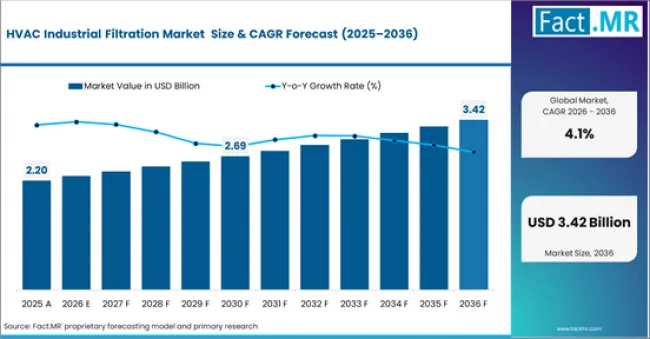
Hvac Industrial Filtration Market Value Analysis | Source: Fact.MR
Summary of HVAC Industrial Filtration Market
- Market Snapshot
- In 2025, the global HVAC Industrial Filtration Market was valued at approximately USD 2.2 billion.
- The market is estimated to reach USD 2.29 billion in 2026 and is projected to attain USD 3.42 billion by 2036.
- The HVAC industrial filtration market is likely to expand at a CAGR of 4.1% during the forecast period.
- The market is anticipated to create an absolute dollar opportunity of USD 1.13 billion between 2026 and 2036.
- Synthetic media accounts for 40% of filter media share in 2026.
- China (5.4%) and India (5.1%) are the key growth markets during the forecast period.
- Demand and Growth Drivers
- Tightening indoor air quality regulations and occupational exposure limits are driving higher-efficiency filtration specification across manufacturing, healthcare, and commercial HVAC systems.
- Semiconductor cleanroom expansion driven by global chip manufacturing investment is creating demand for HEPA and ULPA filtration systems maintaining ISO Class 1 to 5 environments.
- Pharmaceutical and biotechnology facility construction is driving demand for validated filtration systems supporting GMP cleanroom environments and sterile manufacturing areas.
- Industrial dust and fume extraction requirements in automotive paint shops, metalworking, and chemical processing are sustaining demand for mechanical and electrostatic filtration.
- Post-pandemic emphasis on improved ventilation and filtration in occupied spaces continues to influence building codes and HVAC filtration specification standards.
- Product and Segment View
- Air filters account for 75% of the filter type segment in 2026, encompassing mechanical, HEPA, ULPA, and carbon filtration serving the majority of HVAC industrial applications.
- Mechanical filtration holds 40% of the technology segment in 2026, with depth and surface filtration methods serving general industrial air quality and equipment protection applications.
- New installations account for 55% of the installation type segment, driven by new industrial plant construction, cleanroom commissioning, and data center development.
- Key segmentation includes:
- Filter Type: Air filters (mechanical, HEPA/ULPA, carbon), Liquid filters (coolant, water)
- Technology: Mechanical filtration, Electrostatic filtration, Adsorption filtration, High-efficiency filtration
- Application: Industrial facilities, Cleanrooms, Power generation, Food and beverage, Healthcare
- End Use Industry: Manufacturing, Pharmaceutical, Energy and utilities, Food and beverage, Healthcare
- Filter Media: Synthetic, Fiberglass, Carbon, Metal media
- Installation Type: New installations, Retrofit and replacement
- These systems enable:
- Indoor air quality maintenance meeting ISO, ASHRAE, and GMP standards across industrial and commercial environments
- Contamination control in semiconductor and pharmaceutical cleanrooms where particulate counts determine product yield and quality
- Equipment and process protection through consistent removal of dust, fumes, and airborne contaminants
- Geography and Competitive Outlook
- Asia Pacific leads growth through China and India, driven by manufacturing expansion, semiconductor fab construction, pharmaceutical facility development, and air quality regulations.
- Europe sustains demand through Germany, driven by stringent environmental regulations, automotive manufacturing filtration needs, and pharmaceutical cleanroom requirements.
- North America maintains demand through the USA, supported by semiconductor manufacturing investment, pharmaceutical production, and updated building ventilation codes.
- China (5.4%) and India (5.1%) lead growth, while Germany (4.6%), the USA (4.5%), Brazil (4.3%), Saudi Arabia (4.0%), and the UK (3.7%) sustain demand.
- Major players include Honeywell International Inc., 3M Company, Trane Technologies plc, and Lennox International Inc.
- Analyst Opinion
- Shambhu Nath Jha, Principal Consultant at Fact.MR, says 'The HVAC industrial filtration market is being reshaped by two converging forces: the semiconductor and pharmaceutical sectors' expanding cleanroom capacity, and tightening air quality regulations across manufacturing and commercial environments. HEPA and ULPA filter demand is growing at approximately twice the rate of general industrial filtration as chip manufacturing investment drives ISO Class 1 to 5 cleanroom construction. Companies offering validated filtration systems with digital pressure monitoring and filter lifecycle management are capturing specification advantages in pharmaceutical and semiconductor projects, while general industrial filter manufacturers compete on cost per unit of air cleaned. The replacement filter aftermarket represents over 40% of total revenue and provides recurring income streams that offset new installation cyclicality.'
Key Growth Drivers, Constraints, and Opportunities
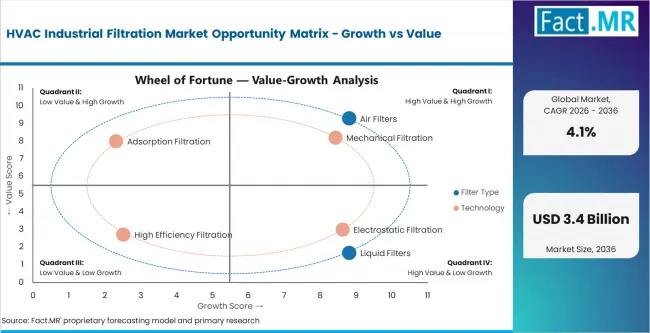
Hvac Industrial Filtration Market Opportunity Matrix Growth Vs Value | Source: Fact.MR
Key Factors Driving Growth
- Semiconductor and pharmaceutical cleanroom construction is driving growing demand for HEPA and ULPA filtration systems meeting ISO Class 1 to 5 specifications.
- Tightening air quality regulations and occupational exposure limits are raising the minimum filtration efficiency required across industrial and commercial HVAC systems.
- Post-pandemic building ventilation code updates continue to influence higher-MERV filter specification in industrial and commercial facilities.
Key Market Constraints
- Price sensitivity in general industrial filtration creates margin pressure as customers evaluate cost per unit of air cleaned rather than filtration performance alone.
- Energy consumption impact of high-efficiency filters, which increase HVAC system pressure drop and fan energy requirements, creates specification trade-offs in energy-conscious facilities.
- Replacement filter procurement decisions are often driven by lowest-cost-per-change rather than total lifecycle performance, limiting premium product adoption.
Key Opportunity Areas
- Smart filter monitoring systems with digital pressure sensors and IoT connectivity enable predictive replacement scheduling that optimizes filter lifecycle and reduces facility downtime.
- Growing semiconductor manufacturing investment across the USA, Europe, and India is creating long-term HEPA and ULPA filter demand tied to government-supported chip fabrication programs.
- Sustainable filter media manufactured from recycled or bio-based materials creates product differentiation aligned with corporate environmental procurement policies.
Segment-wise Analysis of the HVAC Industrial Filtration Market
- Air filters hold 75% of the filter type segment in 2026, encompassing mechanical, HEPA, ULPA, and activated carbon filtration serving HVAC air quality applications.
- Manufacturing accounts for 35% of the end use industry segment, driven by automotive paint shops, metalworking, chemical processing, and general industrial air quality requirements.
- Synthetic media accounts for 40% of the filter media segment, driven by polyester and polypropylene durability, moisture resistance, and consistent performance.
The market is segmented by filter type, technology, application, end use industry, filter media, installation type, and region. Air filters dominate by filter type. Mechanical filtration leads by technology. Industrial facilities lead by application, and synthetic media leads by filter media type.
Which Filter Type Segment Dominates the HVAC Industrial Filtration Market?

Hvac Industrial Filtration Market Analysis By Filter Type | Source: Fact.MR
Air filters account for 75% of the filter type segment in 2026. Mechanical filters including fiberglass and pleated designs serve general industrial air quality and equipment protection. HEPA and ULPA filters serve cleanroom and critical environment applications where particulate control at 0.3 micron and below is required. Carbon filters address volatile organic compound and odor control requirements.
Liquid filters serve coolant filtration, metalworking fluid management, and cooling water treatment within HVAC-integrated industrial systems. While smaller in share, liquid filtration is growing through manufacturing process optimization and water reuse requirements.
Which Application Segment Dominates the HVAC Industrial Filtration Market?
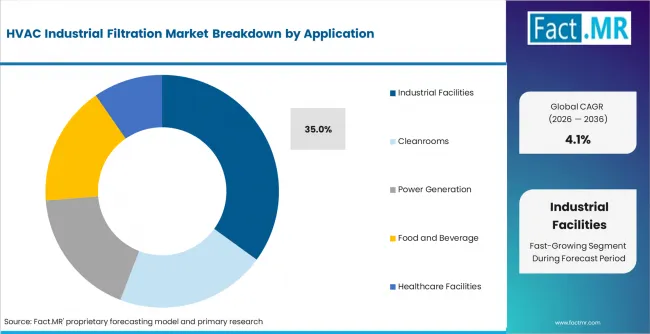
Hvac Industrial Filtration Market Analysis By Application | Source: Fact.MR
Industrial facilities account for 35% of the application segment in 2026. Manufacturing plants, workshops, and processing facilities require filtration for dust control, fume extraction, and general air quality maintenance. Automotive paint shops and metalworking operations are among the most filtration-intensive industrial applications.
Cleanrooms are the second-largest application and the fastest-growing segment, driven by semiconductor fabrication and pharmaceutical manufacturing expansion. Power generation facilities require air intake filtration protecting turbine and cooling equipment. Food and beverage and healthcare applications sustain demand through hygiene and sterility requirements.
Which Technology Segment Dominates the HVAC Industrial Filtration Market?
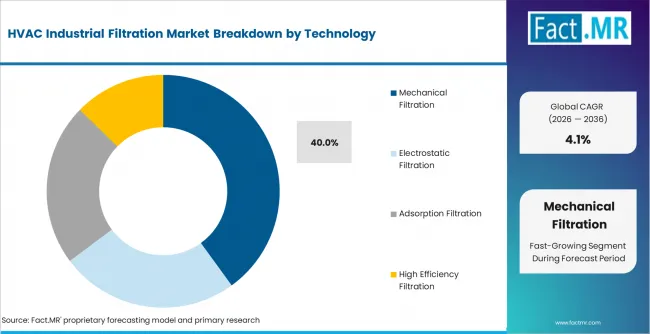
Hvac Industrial Filtration Market Analysis By Technology | Source: Fact.MR
Mechanical filtration accounts for 40% of the technology segment in 2026. Depth filtration using layered media and surface filtration using membrane-type media serve the broadest range of industrial HVAC applications. Pleated filter designs maximize surface area within standard HVAC frames, improving dirt-holding capacity and service life.
High-efficiency filtration (HEPA and ULPA) is the fastest-growing technology segment, driven by cleanroom expansion. Electrostatic filtration serves applications where reusable filters and low pressure drop are priorities. Adsorption filtration using activated carbon addresses gas-phase contaminant and odor control.
Which Product Trend is Shaping the Next Phase of Growth in the HVAC Industrial Filtration Market?
Smart filtration systems with IoT-enabled monitoring and predictive replacement scheduling are the defining trend. Digital pressure sensors embedded in filter housings track real-time pressure differential, enabling facility managers to replace filters based on actual loading rather than fixed time intervals. This approach optimizes filter lifecycle, reduces unnecessary replacements, and prevents performance degradation from overloaded filters.
The combination of HEPA-grade filtration with energy-efficient filter media designs is also reshaping specification practices. New synthetic media formulations deliver equivalent particle capture efficiency at lower pressure drop, reducing the energy penalty traditionally associated with high-efficiency filtration. This performance improvement is critical for semiconductor and pharmaceutical cleanrooms where air changes per hour and filtration efficiency must be maintained without proportional increases in fan energy consumption.
Regional Outlook Across Key Markets
.webp "Top Country Growth Comparison Hvac Industrial Filtration Market Cagr (2026 2036)")
Top Country Growth Comparison Hvac Industrial Filtration Market Cagr (2026 2036) | Source: Fact.MR
- China leads growth at 5.4%, driven by manufacturing expansion, semiconductor fab construction, pharmaceutical facility development, and air quality regulation enforcement.
- India follows at 5.1%, supported by industrial growth, pharmaceutical manufacturing expansion, and tightening air quality standards.
- Germany grows at 4.6%, driven by automotive manufacturing filtration needs, pharmaceutical cleanroom requirements, and environmental regulations.
- The USA sustains growth at 4.5% through semiconductor manufacturing investment, pharmaceutical production, and updated ventilation codes.
| Country | CAGR (%) |
|---|---|
| China | 5.4% |
| India | 5.1% |
| Germany | 4.6% |
| USA | 4.5% |
| Brazil | 4.3% |
| Saudi Arabia | 4.0% |
| UK | 3.7% |
Source: Fact.MR analysis. Updated May 25, 2026
Source: Fact MR (FMR) analysis, based on proprietary forecasting model and primary research.
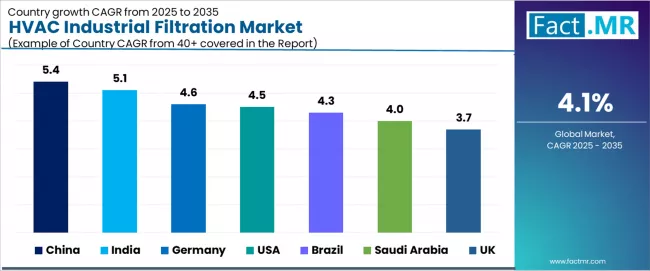
Hvac Industrial Filtration Market Cagr Analysis By Country | Source: Fact.MR
Market Outlook for HVAC Industrial Filtration in China
The China market is projected to grow at a CAGR of 5.4% through 2036. Demand is driven by manufacturing expansion, semiconductor fab construction, pharmaceutical development, and air quality regulation enforcement.
- Manufacturing expansion drives industrial air filtration procurement.
- Semiconductor fab construction creates HEPA and ULPA filter demand.
- Air quality regulations raise minimum filtration efficiency standards.
HVAC Industrial Filtration Demand Trends in India
The India market is projected to grow at a CAGR of 5.1% through 2036. Growth is supported by industrial growth, pharmaceutical manufacturing expansion, automotive factory construction, and tightening air quality standards.
- Pharmaceutical manufacturing drives cleanroom filtration demand.
- Industrial growth sustains general HVAC filtration requirements.
- Air quality standards raise filtration specification levels.
Germany HVAC Industrial Filtration Market Growth Assessment
The Germany market is projected to grow at a CAGR of 4.6% through 2036. Demand is shaped by automotive paint shop filtration, pharmaceutical cleanroom standards, environmental regulations, and energy-efficient filter specification.
- Automotive paint shops drive high-specification filtration demand.
- Pharmaceutical cleanrooms sustain HEPA filter procurement.
- Energy-efficient filter designs align with sustainability targets.
United States HVAC Industrial Filtration Market Demand Analysis
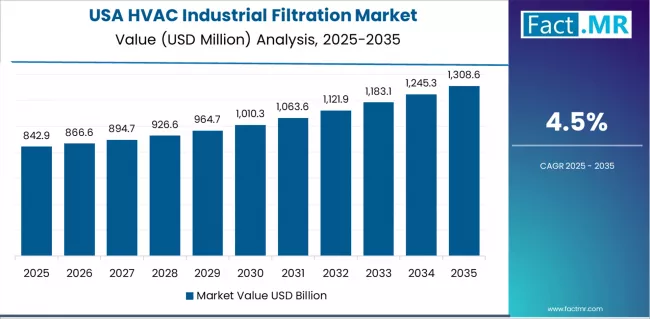
Hvac Industrial Filtration Market Country Value Analysis | Source: Fact.MR
The U.S. market is projected to grow at a CAGR of 4.5% through 2036. Demand is driven by CHIPS Act semiconductor investment, pharmaceutical production, updated building codes, and replacement filter aftermarket consumption.
- CHIPS Act investment drives semiconductor cleanroom filtration demand.
- Pharmaceutical production sustains validated filter system procurement.
- Updated building codes raise minimum MERV rating requirements.
Saudi Arabia HVAC Industrial Filtration Market Opportunity Outlook
The Saudi Arabia market is projected to grow at a CAGR of 4.0% through 2036. Demand is supported by Vision 2030 industrial diversification, pharmaceutical manufacturing development, and dust-intensive environmental conditions.
- Industrial diversification creates new manufacturing filtration demand.
- Pharmaceutical manufacturing development drives cleanroom filtration.
- Desert conditions intensify outdoor air pre-filtration requirements.
Competitive Benchmarking and Company Positioning
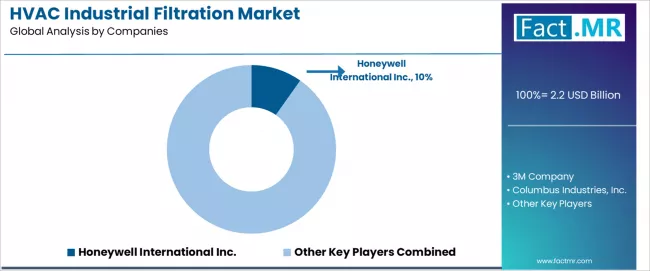
Hvac Industrial Filtration Market Analysis By Company | Source: Fact.MR
HVAC Industrial Filtration Market Analysis By Company
- Honeywell International Inc. holds approximately 10% market share through broad HVAC filtration portfolios, smart building integration, and global distribution.
- 3M Company and Trane Technologies compete through filter media technology, system integration, and sustainability-focused product development.
- Filter media technology, HEPA certification capability, digital monitoring integration, and distribution network strength are primary differentiators.
The competitive landscape is moderately fragmented. Honeywell International Inc. holds approximately 10% market share through its broad HVAC filtration portfolio, smart building platform integration, and global service network. Honeywell's position is built on system-level integration combining filtration with building management and indoor air quality monitoring.
3M Company competes through proprietary filter media technology and brand recognition. Trane Technologies and Lennox International serve HVAC system-level filtration through integrated equipment platforms. Glasfloss Industries and Columbus Industries serve replacement filter markets with broad product ranges and competitive pricing.
Rensa Filtration, Kleanland, and Good Filter Company serve specialized segments and regional markets. Air Purification Inc. serves industrial air cleaning applications requiring custom filtration solutions.
Strategic priorities include expanding HEPA and ULPA product lines, developing IoT-enabled filter monitoring, improving energy efficiency of high-performance media, and building certified cleanroom filtration capabilities.
Key Companies in the HVAC Industrial Filtration Market
Honeywell International Inc., 3M Company, and Trane Technologies plc lead through technology, system integration, and global distribution.
Lennox International Inc., Glasfloss Industries, and Columbus Industries Inc. hold established positions through product breadth and replacement filter market strength.
Kleanland, Good Filter Company, Rensa Filtration, and Air Purification Inc. compete through specialized applications and regional expertise.
Recent Industry Developments
- Honeywell International Inc. - Platform Enhancement / Smart Building Air Quality Integration (2025)
- Honeywell continued expanding its smart building platform with integrated air quality monitoring and filtration management, enabling predictive filter replacement and real-time indoor air quality optimization across industrial and commercial facilities.
- 3M Company - Product Innovation / Low-Pressure-Drop HEPA Media (2025)
- 3M expanded its high-efficiency filter media portfolio with low-pressure-drop designs that deliver HEPA-grade particle capture at reduced energy consumption, addressing growing demand for energy-efficient cleanroom filtration.
- Trane Technologies plc - System Integration / Integrated Filtration and HVAC Management (2025)
- Trane Technologies enhanced its commercial HVAC platform with integrated filtration monitoring and lifecycle management, supporting facility managers in optimizing air quality performance and filter replacement scheduling.
Leading Companies Shaping the HVAC Industrial Filtration Market
- Honeywell International Inc.
- 3M Company
- Columbus Industries, Inc.
- Lennox International Inc.
- Trane Technologies plc
- Glasfloss Industries
- Kleanland
- Good Filter Company
- Rensa Filtration
- Air Purification Inc.
Sources and Research References
- Honeywell International Inc. Smart building air quality platform and filtration management documentation.
- 3M Company. High-efficiency filter media technology and product portfolio documentation.
- ASHRAE filtration standards, ISO cleanroom classification databases, and air quality regulation timelines.
- Semiconductor fab construction databases, pharmaceutical facility pipelines, and manufacturing expansion statistics.
- Primary interviews with filter manufacturers, HVAC integrators, cleanroom contractors, and facility managers.
This bibliography is provided for reader reference and is not exhaustive. The full report contains the complete reference list and detailed citations.
Key Questions This Report Addresses
- What is the current and future size of the HVAC Industrial Filtration market?
- How fast is the market expected to grow between 2026 and 2036?
- Which filter type leads in 2026?
- Which application holds highest share?
- What drives demand?
- How is semiconductor cleanroom growth influencing the market?
- Why is China the fastest-growing market?
- How are smart monitoring systems shaping demand?
- Which countries show fastest growth?
- Who are the key companies?
- How does Fact.MR validate the forecast?
HVAC Industrial Filtration Market Definition
The HVAC industrial filtration market covers air and liquid filtration systems used to maintain air quality, process cleanliness, and equipment protection in industrial manufacturing, cleanroom, power generation, food processing, and healthcare HVAC applications.
HVAC Industrial Filtration Market Inclusions
- The scope covers global and regional market size and forecasts for 2026 to 2036 across filter type, technology, application, end use industry, filter media, installation type, and region.
- It includes analysis of cleanroom construction pipelines, air quality regulation timelines, manufacturing capacity expansion, and HVAC system upgrade requirements.
- The report covers pricing and cost analysis across filtration categories including initial equipment, replacement filter, and lifecycle costs.
- It covers technology trends, market drivers, and competitive landscape including product portfolios and certification capabilities of leading manufacturers.
HVAC Industrial Filtration Market Exclusions
- The scope excludes residential HVAC filters and consumer-grade air purification devices.
- It excludes industrial process gas filtration, exhaust emission control, and baghouse dust collection systems classified separately.
- The report excludes liquid process filtration for water treatment, chemical processing, and oil refining not integrated with HVAC systems.
- It also excludes filtration testing equipment and air quality monitoring instruments sold independently.
HVAC Industrial Filtration Market Research Methodology
- The methodology combines secondary research, primary interviews, and forecast modelling.
- It draws on 50+ secondary sources and benchmarks 20+ manufacturer product portfolios.
- Market sizing covers 20+ countries through a demand-side model, supported by top-down validation.
- Key inputs include cleanroom construction data, manufacturing facility expansion, air quality regulation updates, and replacement filter consumption rates.
- The model cross-checks demand with filter manufacturing capacity, media pricing, and distribution volumes.
- Primary validation includes 15+ interviews across filter manufacturers, HVAC system integrators, and facility managers.
- Final estimates go through cleanroom-pipeline checks, replacement-cycle analysis, and sensitivity testing.
Segmentation
Scope of Analysis
| Parameter | Details |
|---|---|
| Quantitative Units | USD 2.29 billion to USD 3.42 billion, at a CAGR of 4.1% |
| Market Definition | The market covers air and liquid filtration systems for HVAC-integrated industrial, cleanroom, power generation, food processing, and healthcare air quality applications. |
| Regions Covered | North America, Latin America, Europe, East Asia, South Asia and Pacific, Middle East and Africa |
| Countries Covered | China, India, Germany, USA, Brazil, Saudi Arabia, UK, 20 plus countries |
| Key Companies | Honeywell, 3M, Columbus Industries, Lennox International, Trane Technologies, Glasfloss, Kleanland, Good Filter, Rensa Filtration, Air Purification Inc. |
| Forecast Period | 2026 to 2036 |
| Approach | Hybrid demand-side and top-down methodology built on cleanroom construction, manufacturing expansion, air quality regulation analysis, and primary interviews across filter manufacturers, HVAC integrators, and facility managers |
Source: Fact.MR analysis. Updated May 25, 2026
HVAC Industrial Filtration Market Segmentation
-
HVAC Industrial Filtration Market Segmented by Filter Type:
- Air Filters
- Mechanical Filters
- Fiberglass Filters
- Pleated Filters
- HEPA and ULPA Filters
- HEPA Filters
- ULPA Filters
- Carbon Filters
- Activated Carbon Filters
- Odor Control Filters
- Mechanical Filters
- Liquid Filters
- Coolant Filters
- Oil Coolant Filtration
- Metalworking Fluids
- Water Filters
- Cooling Water Filtration
- Process Water Treatment
- Coolant Filters
- Air Filters
-
HVAC Industrial Filtration Market Segmented by Technology:
- Mechanical Filtration
- Depth Filtration
- Layered Media
- High Dust Holding
- Surface Filtration
- Membrane Filters
- Fine Particle Removal
- Depth Filtration
- Electrostatic Filtration
- Electrostatic Precipitators
- Industrial Emissions
- Air Purification
- Electrostatic Filters
- Reusable Filters
- Low Pressure Drop
- Electrostatic Precipitators
- Adsorption Filtration
- Activated Carbon Adsorption
- Gas Removal
- Odor Control
- Chemical Adsorption
- Toxic Gas Removal
- Industrial Applications
- Activated Carbon Adsorption
- High Efficiency Filtration
- HEPA Technology
- Cleanrooms
- Healthcare
- ULPA Technology
- Ultra-clean Environments
- Semiconductor Industry
- HEPA Technology
- Mechanical Filtration
-
HVAC Industrial Filtration Market Segmented by Application:
- Industrial Facilities
- Manufacturing Plants
- Dust Control
- Air Quality
- Workshops
- Fume Extraction
- Particle Removal
- Manufacturing Plants
- Cleanrooms
- Pharmaceutical Cleanrooms
- Sterile Environments
- Drug Manufacturing
- Semiconductor Cleanrooms
- Wafer Fabrication
- Contamination Control
- Pharmaceutical Cleanrooms
- Power Generation
- Thermal Plants
- Air Intake Filtration
- Cooling Systems
- Renewable Energy
- Wind Turbines
- Solar Facilities
- Thermal Plants
- Food and Beverage
- Processing Units
- Air Filtration
- Hygiene Control
- Storage Facilities
- Cold Storage
- Contamination Prevention
- Processing Units
- Healthcare Facilities
- Hospitals
- Operation Theaters
- ICU Filtration
- Laboratories
- Research Labs
- Diagnostic Centers
- Hospitals
- Industrial Facilities
-
HVAC Industrial Filtration Market Segmented by End Use Industry:
- Manufacturing Industry
- Automotive Manufacturing
- Paint Shops
- Assembly Lines
- Metals and Mining
- Dust Control
- Fume Extraction
- Automotive Manufacturing
- Pharmaceutical Industry
- Drug Manufacturing
- Cleanrooms
- Sterile Production
- Biotech Facilities
- Research Labs
- Controlled Environments
- Drug Manufacturing
- Energy and Utilities
- Power Plants
- Thermal
- Hydropower
- Renewable Energy
- Wind Farms
- Solar Plants
- Power Plants
- Food and Beverage Industry
- Food Processing
- Hygiene Control
- Air Quality
- Beverage Production
- Bottling
- Packaging
- Food Processing
- Healthcare Industry
- Hospitals
- Surgical Rooms
- Patient Areas
- Laboratories
- Testing Facilities
- Research Centers
- Hospitals
- Manufacturing Industry
-
HVAC Industrial Filtration Market Segmented by Filter Media:
- Synthetic Media
- Polyester
- Durable
- Moisture Resistant
- Polypropylene
- Chemical Resistance
- Industrial Use
- Polyester
- Fiberglass Media
- Standard Fiberglass
- Low Cost
- General Filtration
- High-efficiency Fiberglass
- Fine Particle Capture
- HVAC Systems
- Standard Fiberglass
- Carbon Media
- Activated Carbon
- Odor Removal
- Gas Filtration
- Impregnated Carbon
- Chemical Removal
- Industrial Applications
- Activated Carbon
- Metal Media
- Aluminum Mesh
- Reusable Filters
- Grease Filtration
- Stainless Steel Mesh
- High Temperature
- Industrial Environments
- Aluminum Mesh
- Synthetic Media
-
HVAC Industrial Filtration Market Segmented by Installation Type:
- New Installations
- Greenfield Projects
- New Industrial Plants
- Infrastructure Development
- System Integration
- HVAC Systems
- Turnkey Projects
- Greenfield Projects
- Retrofit and Replacement
- Filter Replacement
- Routine Maintenance
- Performance Improvement
- System Upgrades
- Energy Efficiency
- Compliance Requirements
- Filter Replacement
- New Installations
-
HVAC Industrial Filtration Market by Region:
- North America
- USA
- Canada
- Mexico
- Latin America
- Brazil
- Chile
- Rest of Latin America
- Western Europe
- Germany
- UK
- Italy
- Spain
- France
- Nordic
- BENELUX
- Rest of Western Europe
- Eastern Europe
- Russia
- Poland
- Hungary
- Balkan & Baltic
- Rest of Eastern Europe
- East Asia
- China
- Japan
- South Korea
- South Asia and Pacific
- India
- ASEAN
- Australia & New Zealand
- Rest of South Asia and Pacific
- Middle East & Africa
- Kingdom of Saudi Arabia
- Other GCC Countries
- Turkiye
- South Africa
- Other African Union
- Rest of Middle East & Africa
- North America
Frequently Asked Questions
What are the key packaging types in the Cement Packaging Market?
Which application holds the highest share in the Cement Packaging Market in 2026?
Which are the fastest-growing countries in the Cement Packaging Market?
What are the key filter types?
Which application holds highest share in 2026?
What will be the size of the Gas Turbine Market in 2036?
Who worked on this report


Preview the report firsthand - request a free sample
Free SampleGet the brochure for pricing and purchase details
Download PDF