- Base Value(2025): 8.8 Bn
- Estimated Value(2026): 9.4 Bn
- Forecast Value (2036): 18.3 Bn
- CAGR (2026 - 2036): 6.9%
Commercial Water Heater Market Forecast and Outlook 2026 to 2036
In 2025, the commercial water heater market was valued at USD 8.8 billion. Based on FACT.MR analysis, demand for commercial water heaters is estimated to grow to USD 9.4 billion in 2026 and USD 18.3 billion by 2036. FACT.MR projects a CAGR of 6.9% during the forecast period.
The projected absolute growth of USD 8.9 billion from 2026 to 2036 reflects a market that is transitioning from steady replacement-cycle growth to structurally accelerated expansion driven by commercial building electrification mandates, healthcare and hospitality sector construction pipelines in Asia-Pacific, and government energy efficiency incentive programmes that are accelerating heat pump water heater replacement cycles beyond their natural ten to fifteen-year equipment lifetimes.
Paolo Merloni, Executive Chairman of Ariston Group states, "This joint venture allows us to add to our existing commercial presence and brands an alliance with a strong partner. We are proud to be the technology provider behind high-efficiency solutions that will carry the Lennox brands." Growth is moderated by the higher upfront capital cost of heat pump and solar commercial water heater systems relative to incumbent gas units, and by the complexity of retrofitting high-capacity hot water infrastructure in existing commercial buildings without major mechanical room renovation.
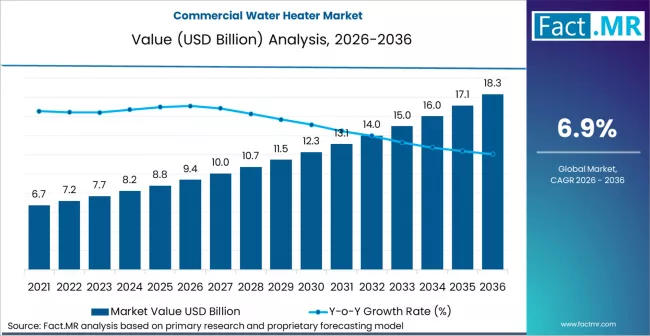
Commercial Water Heater Market Market Value Analysis | Source: Fact.MR
Market Definition
The commercial water heater market includes electric, gas, oil, solar thermal, heat pump, and hybrid systems installed in commercial buildings to provide high-volume, continuous hot water. These systems are used for sanitation, food preparation, laundry, process support, and occupant comfort. Unlike residential units, commercial water heaters have larger storage capacities, higher power ratings, and are built for continuous-duty operation. Key end users include hospitals, hotels, restaurants, schools, offices, and other facilities that require reliable hot water supply meeting health and safety standards.
Market Inclusions
The report covers global and regional market sizing from 2026 to 2036, segmented by storage capacity, power rating, fuel type, and application sector. It evaluates new construction demand, replacement cycles driven by efficiency regulations, heat pump and solar incentive programs, and competitive positioning of major manufacturers across North America, Europe, Asia-Pacific, Latin America, and the Middle East and Africa.
Market Exclusions
The scope excludes residential water heaters, industrial process heating systems used in manufacturing, small point-of-use heaters below five litres, and standalone swimming pool heating systems not integrated into building hot water infrastructure.
Research Methodology
- Primary Research: Primary research involved structured interviews with commercial building facility managers, HVAC and plumbing engineers at commercial construction firms, energy efficiency compliance consultants, and commercial water heater product managers at leading manufacturers including A.O. Smith, Rheem, and Rinnai across North America, Europe, and Asia-Pacific.
- Desk Research: Desk research synthesized data from U.S. Department of Energy appliance efficiency standard rulemaking dockets, EU Ecodesign Regulation impact assessments for water heating products, national building code databases, utility energy efficiency programme participation statistics, and annual report segment disclosures from publicly listed water heater manufacturers.
- Market-Sizing and Forecasting: Market sizing employed a hybrid top-down and bottom-up approach, combining commercial building stock estimates by sector and country with average water heater replacement cycle lengths and new construction attachment rates, calibrated against disclosed commercial segment revenues from A.O. Smith, Rinnai Corporation, and Rheem Manufacturing investor communications and trade association shipment data.
- Data Validation and Update Cycle: Outputs were cross-validated against annual commercial water heater shipment data published by the Air-Conditioning, Heating, and Refrigeration Institute (AHRI) for North America and equivalent trade association data for European and Asian markets, reconciled semi-annually with new product launches, regulatory standard updates, and utility rebate programme changes.
Summary
- Market Definition
- The commercial water heater market covers electric, gas, oil, solar, heat pump, and hybrid hot water systems installed in hospitals, restaurants, hotels, schools, offices, and other commercial buildings to deliver continuous large-volume hot water for sanitation, food service, and occupant comfort in compliance with public health and energy efficiency regulations.
- Demand Drivers
- U.S. Department of Energy commercial water heater efficiency standards, updated through the Energy Policy and Conservation Act rulemaking and effective from 2024 for units above 75 gallons, are mandating replacement of non-compliant gas storage water heaters across the 700,000 estimated commercial facilities in the United States that operate units below the new efficiency threshold, creating a mandatory replacement demand wave independent of natural equipment lifecycle timing.
- Healthcare facility construction and renovation spending, which the American Hospital Association estimates will exceed USD 200 billion cumulatively in the United States through 2030, is generating sustained new installation demand for high-capacity commercial electric water heaters that must meet NSF 5 and NSF 372 standards for potable water contact materials while delivering the 60 degrees’ Celsius minimum temperature required for Legionella prevention in hospital hot water systems.
- South Korea's Green Remodeling Programme, administered by the Korea Land and Housing Corporation, provides commercial building owners with low-interest loans covering up to 80% of energy upgrade costs including commercial water heater replacement, creating a subsidized demand channel that is accelerating heat pump water heater adoption in the commercial hospitality and educational facility segments at a pace that unsubsidized market economics would not support.
- Key Segments Analyzed
- By Fuel Type, Electric water heaters hold 67.8% share, reflecting the combination of electrification mandates in new commercial construction codes across the United States, European Union, and Japan, the operational simplicity advantage of electric resistance and heat pump units in buildings without gas connections, and the growing cost competitiveness of heat pump technology as coefficient of performance improvements reduce effective operating cost versus gas alternatives.
- By Application, Healthcare leads at 32% share, anchored by hospitals' non-discretionary requirement for continuous high-temperature hot water at regulated minimum temperatures for sterilization, surgical scrub, and Legionella control purposes, generating the highest per-facility water heater capital expenditure of any commercial application and the most demanding performance specification requirements that favor established suppliers with proven commercial healthcare references.
- By Storage Capacity, below 500 L units lead at 29.5% share, reflecting their compatibility with smaller commercial applications including restaurants, small offices, and retail facilities that represent the largest segment by facility count even if mid-range and large healthcare and hotel installations dominate revenue per unit.
- Analyst Opinion at FACT.MR
- Shambhu Nath Jha, Principal Consultant at Fact.MR, opines, 'CXOs will find this report essential for understanding how the confluence of commercial building electrification mandates, healthcare facility construction pipelines, and utility heat pump rebate programmes is reshaping the commercial water heater market's technology mix and revenue architecture, and which fuel type and application segments offer the highest near-term margin expansion opportunity as gas unit volumes decline in regulated markets.'
- Strategic Implications / Executive Takeaways
- Commercial water heater manufacturers should prioritize high-capacity heat pump systems above 100 kW, especially for hospitals and large hotels. Supply at this capacity level is still limited, creating a strong first-mover opportunity for companies that can meet healthcare procurement standards early.
- HVAC distributors and contractors need to strengthen their expertise in heat pump water heater design, installation, and lifecycle cost analysis. As building codes shift away from gas systems, contractors who can clearly demonstrate long-term energy savings will gain competitive advantage.
- Companies targeting Asia-Pacific growth should consider local manufacturing or assembly in South Korea, Japan, and China. Local production helps avoid import duties and improves eligibility for government-backed energy efficiency upgrade programs.
- Methodology
- Market size estimates were developed using commercial building stock data, construction permits, and typical water heater replacement cycles, cross-checked with industry shipment and revenue data.
- Fuel transition forecasts were based on government efficiency standards, heat pump incentive programs, and regional gas restriction timelines.
- Application-level projections were validated using healthcare and hotel construction pipelines, along with commercial energy efficiency reporting databases.
Segmental Analysis
Commercial Water Heater Market by Storage Capacity
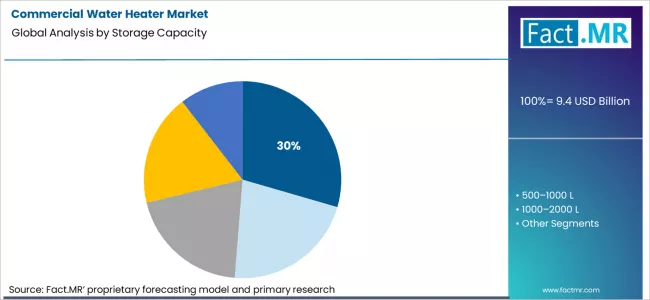
Commercial Water Heater Market Analysis By Storage Capacity | Source: Fact.MR
Units below 500 litres are expected to hold about 29.5% share in 2026. These systems serve restaurants, offices, retail stores, and smaller facilities. Growing interest in compact heat pump systems within the 150 to 300 litre range is strengthening this segment.
- A.O. Smith expanded its commercial heat pump offerings in 2023 to target this replacement segment. [1]
- Rheem adapted its ProTerra platform for small commercial applications. [5]
- AHRI shipment data confirms steady growth in smaller-capacity commercial units. [6]
Commercial Water Heater Market by Power Rating
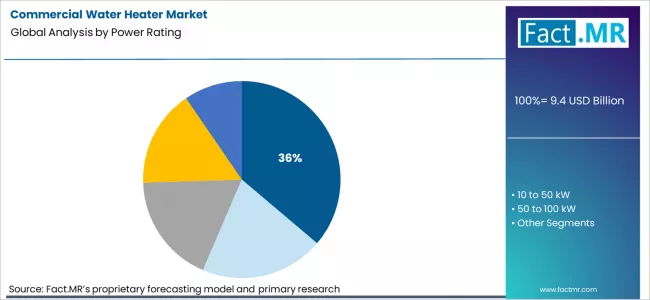
Commercial Water Heater Market Analysis By Power Rating | Source: Fact.MR
Units in the 0 to 10 kW range are projected to hold 36.2% share in 2026. These are widely used in smaller commercial spaces because they work with existing electrical systems and require minimal infrastructure upgrades.
- Hubbell expanded its commercial electric range in 2023 with improved durability features. [7]
- Nibe introduced higher-power heat pump systems for larger commercial needs. [8]
- DOE audit programs show strong returns for high-capacity system upgrades in hospitals and hotels.
Drivers, Restraints, and Opportunities
For years, the commercial water heater market has been driven by predictable replacement cycles. Most systems last 10 to 15 years, creating steady demand as units reach end of life. The USD 8.8 billion market value in 2025 reflects a turning point. Governments are now accelerating replacements through stricter efficiency rules, electrification mandates, and financial incentives, pushing many facilities to upgrade earlier than planned.
The key tension in the market lies in cost. Heat pump water heaters can cost two to four times more upfront than gas or electric resistance systems. However, new building codes and gas restrictions are gradually removing gas as an option in many regions. While this reduces gas unit sales, it benefits manufacturers that have invested in heat pump technology, since these systems command premium pricing and higher long-term value.
- U.S. DOE standards updated in 2024 have eliminated low-efficiency commercial units, creating mandatory replacement demand across hundreds of thousands of facilities. [2]
- EU Ecodesign regulations are driving similar transitions toward heat pump and solar systems across member states. [3]
- South Korea’s Green Remodeling Programme is supporting large-scale heat pump adoption in public and institutional buildings. [4]
Regional Analysis
The commercial water heater market is analyzed across North America, Europe, Asia-Pacific, Latin America, and Middle East and Africa. Regional adoption patterns are shaped by commercial building construction activity, energy efficiency regulation intensity, utility incentive programme availability, and the pace of commercial building electrification policy implementation. The full report offers detailed market attractiveness analysis comparing regulatory environment, technology adoption curves, and competitive intensity by region.
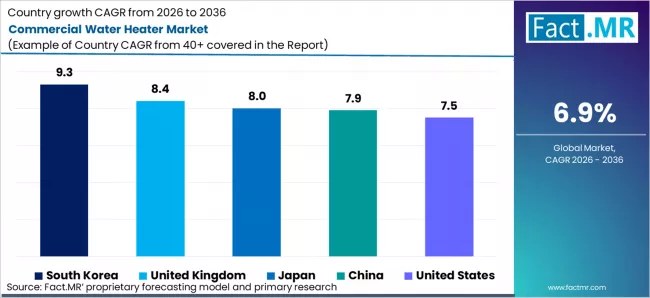
Commercial Water Heater Market Cagr Analysis By Country | Source: Fact.MR
| Country | CAGR% |
|---|---|
| South Korea | 9.3% |
| United Kingdom | 8.4% |
| Japan | 8.0% |
| China | 7.9% |
| United States | 7.5% |
Source: Fact.MR analysis. Updated Feb 20, 2026
Source: Fact.MR (FACT.MR) analysis, based on proprietary forecasting model and primary research
North America Commercial Water Heater Market Analysis
North America is one of the most policy-driven markets for commercial water heaters. Stricter DOE efficiency standards, city-level gas bans, and strong utility rebates are accelerating the shift from gas to electric and heat pump systems. A.O. Smith, Rheem, and Bradford White lead the U.S. market through strong contractor networks and broad product portfolios.
- United States: Demand is projected to grow at 7.5% CAGR through 2036. Updated DOE standards effective January 2024 have phased out low-efficiency gas units, triggering mandatory upgrades across thousands of facilities. The Inflation Reduction Act’s Section 179D tax incentives further encourage building owners to invest in high-efficiency heat pump or solar systems. Manufacturers are already reporting strong commercial heat pump sales growth.
Europe Commercial Water Heater Market Analysis
Europe is at the forefront of commercial heat pump adoption. EU Eco-design rules and national subsidy programs are pushing commercial buildings toward electric and renewable-based water heating. Nibe, Vaillant, and Ariston Thermo are key players in the region.
- United Kingdom: The market is expected to grow at 8.4% CAGR through 2036. Updated building regulations and clean heat grants are gradually phasing out gas systems in new commercial buildings. Engineers increasingly specify heat pump or solar systems to meet Part L compliance, supporting steady demand growth.
Asia-Pacific Commercial Water Heater Market Analysis
Asia-Pacific is the fastest-growing region, supported by strong construction activity and green building programs. Daikin, Rinnai, and Midea are major regional suppliers.
- South Korea: Projected to grow at 9.3% CAGR through 2036, South Korea’s market is strongly supported by the government’s Green Remodeling Programme, which offers low-interest financing for commercial building energy upgrades, including heat pump water heaters. Stricter building energy efficiency ratings now require higher-performing hot water systems in new and renovated properties, particularly in public buildings, offices, and healthcare facilities.
- Japan: Expected to expand at 8.0% CAGR, Japan remains a global leader in CO₂ heat pump water heater technology. Long-standing energy efficiency initiatives under the Top Runner Programme and the national Zero Energy Building policy are pushing commercial developers to adopt heat pump-based systems. Hospitality, healthcare, and institutional buildings continue to drive steady demand for advanced, high-efficiency solutions.
- China: Forecast to grow at 7.9% CAGR, China benefits from one of the world’s largest commercial construction pipelines. National green building mandates and renewable energy integration policies are encouraging the use of heat pump and solar thermal water heating systems in hotels, hospitals, and large public buildings. Domestic manufacturers are scaling production to meet growing demand.
Key Players
- A.O. Smith Corporation
- Rinnai Corporation
- Rheem Manufacturing Company
- Ariston Thermo S.p.A
- Racold
- Midea Group
- Nibe Corporation
- Noritz Corporation
- Hubbell Water Heaters
- Vaillant Group
- Bradford White Corporation
- Flexiheat UK Ltd
- Daikin Industries Ltd
Bibliography
- [1] A.O. Smith Corporation, Annual Report 2023, February 2024.
- [2] U.S. Department of Energy, Energy Conservation Standards for Commercial Water Heaters, Final Rule, 10 CFR Part 431, Federal Register, January 2024.
- [3] European Commission, Ecodesign Regulation (EU) 2013/813 for Water Heaters and Hot Water Storage Tanks, updated 2021.
- [4] Korea Land and Housing Corporation, Green Remodeling Programme Annual Report 2023, March 2024.
- [5] Rheem Manufacturing Company, Sustainability Report 2023, May 2024.
- [6] Air-Conditioning, Heating, and Refrigeration Institute (AHRI), 2023 AHRI Trends in Certification, December 2023.
- [7] Hubbell Water Heaters, Commercial Electric Product Catalogue Update 2023, Company Publication, October 2023.
- [8] Nibe Corporation, Annual Report 2023-Commercial Water Heating Products Division, March 2024.
This Report Addresses
- Market intelligence for strategic planning with analysis of commercial water heater technology migration from gas storage and electric resistance toward heat pump and solar thermal platforms driven by efficiency regulations and electrification mandates.
- Market size and forecast showing global valuation of USD 8.8 billion in 2025 and projected USD 18.3 billion by 2036 at 6.9% CAGR.
- Growth opportunity mapping across commercial heat pump water heater above-50-kW segments, solar thermal commercial preheat systems, and healthcare and hospitality application sector investment pipelines.
- Segment and regional forecasts covering all major countries with storage capacity, power rating, fuel type, and application sector breakdowns.
- Competition strategy assessment of leading commercial water heater manufacturers including heat pump product line investment status, utility rebate programme participation, and major application sector reference installation networks.
- Product and compliance tracking of U.S. DOE 10 CFR Part 431 efficiency standard updates, EU Ecodesign Regulation water heating provisions, UK Building Regulations Part L commercial requirements, and South Korea Building Energy Efficiency Rating System water heating criteria.
- Utility rebate programme analysis comparing commercial heat pump water heater incentive structures across major U.S., European, and Asian utility jurisdictions and their impact on payback period economics for commercial building owner investment decisions.
- Report delivery in Excel, PowerPoint, and PDF formats with fully validated data, primary research evidence, and verified regulatory and company source documentation.
Segmentation
Scope of Report
| Items | Values |
|---|---|
| Quantitative Units | USD 9.4 billion (2026) to USD 18.3 billion (2036), at a CAGR of 6.9% |
| Market Definition | The commercial water heater market encompasses electric, gas, oil, solar, and hybrid hot water heating units with storage capacities above residential scale, installed in healthcare facilities, restaurants, hotels, educational institutions, offices, and other commercial buildings to supply continuous hot water for sanitation, process, and occupant comfort requirements. |
| Storage Capacity | Below 500 L, 500-1000 L, 1000-2000 L, 2000-3000 L, More than 3000 L |
| Power Rating | 0 to 10 kW, 10 to 50 kW, 50 to 100 kW, 100 to 300 kW, More than 300 kW |
| Fuel Type | Electric, Gas, Oil, Solar, Hybrid, Others |
| Application | Healthcare, Restaurants, Institutes, Offices, Others |
| Regions Covered | Asia Pacific, Europe, North America, Latin America, Middle East & Africa |
| Countries Covered | China, Japan, South Korea, Australia & New Zealand, India, ASEAN, Rest of Asia Pacific, Norway, Germany, United Kingdom, France, Spain, Netherlands, Nordics, Rest of Europe, United States, Canada, Mexico, Brazil, Chile, Ecuador, Rest of Latin America, Kingdom of Saudi Arabia, United Arab Emirates, South Africa, Turkey, Rest of Middle East & Africa |
| Key Companies Profiled | A.O. Smith, Rinnai Corporation, Rheem Manufacturing, Ariston Thermo S.p.A, Racold, Midea Group, Nibe Corporation, Noritz Corporation, Hubbell, Vaillant, Bradford White Corporation, Flexiheat UK Ltd, Daikin Industries |
| Forecast Period | 2026 to 2036 |
| Approach | Top down and bottom up market modeling validated through primary interviews with commercial building owners, HVAC contractors, water heater manufacturers, mechanical distributors, and energy efficiency consultants, supported by building construction statistics, government efficiency regulation databases, utility rebate programme data, trade association shipment reports, and company disclosed revenue and production capacity information. |
Source: Fact.MR analysis. Updated Feb 20, 2026
Commercial Water Heater Market by Segment
-
By Storage Capacity
- Below 500 L
- 500-1000 L
- 1000-2000 L
- 2000-3000 L
- More than 3000 L
-
By Power Rating
- 0 to 10 kW
- 10 to 50 kW
- 50 to 100 kW
- 100 to 300 kW
- More than 300 kW
-
By Fuel Type
- Electric
- Gas
- Oil
- Solar
- Hybrid
- Others
-
By Application
- Healthcare
- Restaurants
- Institutes
- Offices
- Others
-
Region
- Asia Pacific
- China
- Japan
- South Korea
- Australia & New Zealand
- India
- ASEAN
- Rest of Asia Pacific
- Europe
- Norway
- Germany
- United Kingdom
- France
- Spain
- Netherlands
- Nordics
- Rest of Europe
- North America
- United States
- Canada
- Mexico
- Latin America
- Brazil
- Chile
- Ecuador
- Rest of Latin America
- Middle East & Africa
- Kingdom of Saudi Arabia
- United Arab Emirates
- South Africa
- Turkey
- Rest of Middle East & Africa
- Asia Pacific
Frequently Asked Questions
How large is the commercial water heater market in 2025?
What will the market size be in 2026?
What is the projected market size by 2036?
What is the expected CAGR for the forecast period 2026 to 2036?
Which Fuel Type segment holds the largest market share?
Which Application segment leads the commercial water heater market?
Which Storage Capacity segment dominates in 2026?
Which country shows the fastest CAGR?
What is the absolute dollar growth from 2026 to 2036?
How significant is the United States commercial water heater market?
Who worked on this report


Preview the report firsthand - request a free sample
Free SampleGet the brochure for pricing and purchase details
Download PDF