Water Soluble Packaging Market Size, Share, Growth and Forecast (2026 - 2036)
Water Soluble Packaging Market is segmented by Material Type (Polyvinyl Alcohol (PVA/PVOH), Blended Polymers, Other Materials), Product Type (Films, Bags and Pouches, Capsules and Pods), Solubility Type (Cold Water Soluble, Hot Water Soluble), and Region, with forecasts covering the period from 2026 to 2036.
Water Soluble Packaging Market Analysis and Forecast by Fact.MR
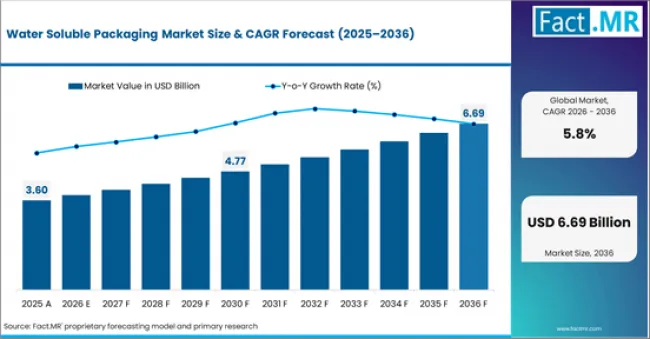
- The global water soluble packaging market is estimated at USD 3.81 billion in 2026 and is forecast to expand at a CAGR of 5.8% to reach USD 6.69 billion by 2036.
- Water soluble packaging encompasses films, bags, pouches, capsules, and pods manufactured primarily from polyvinyl alcohol (PVA/PVOH) and blended polymers that dissolve completely in water, leaving no harmful residue.
- The market is shaped by accelerating demand for single-dose detergent and dishwasher pods, growing adoption in agrochemical and pharmaceutical unit-dose packaging, tightening regulations on single-use plastic waste, and consumer preference for convenient, pre-measured product delivery formats.
- Material innovation is expanding the performance range of water soluble films to include enhanced barrier properties, controlled dissolution rates, and multi-layer structures compatible with both cold and hot water applications.
Summary of Water Soluble Packaging Market
- Market Snapshot
- In 2025, the global Water Soluble Packaging Market was valued at approximately USD 3.6 billion.
- The market is estimated to reach USD 3.81 billion in 2026 and is projected to attain USD 6.69 billion by 2036.
- The water soluble packaging market is likely to expand at a CAGR of 5.8% during the forecast period.
- The market is anticipated to create an absolute dollar opportunity of USD 2.88 billion between 2026 and 2036.
- PVA/PVOH accounts for 65% of material type share in 2026.
- India (6.4%) and China (6.1%) are the key growth markets during the forecast period.
- Demand and Growth Drivers
- Growing consumer adoption of single-dose detergent pods and dishwasher capsules is driving volume demand for cold water soluble PVA films that dissolve reliably at ambient temperatures.
- Expanding use of water soluble packaging in agrochemical applications, including pesticide and fertilizer sachets, is driven by worker safety benefits and precise dosage control requirements.
- Tightening regulations on single-use plastic packaging waste across the EU, North America, and parts of Asia Pacific are creating regulatory tailwinds for biodegradable and dissolvable packaging alternatives.
- Growing demand for unit-dose pharmaceutical packaging, including oral dissolving films and single-dose sachets, is expanding the high-value application range for water soluble films.
- Innovation in multi-layer PVA films with enhanced barrier properties and controlled dissolution rates is broadening the range of products that can be packaged in water soluble formats.
- Product and Segment View
- PVA/PVOH accounts for 65% of the material type segment in 2026, reflecting the established dominance of polyvinyl alcohol as the primary material platform for water soluble film production across detergent, agrochemical, and pharmaceutical applications.
- Films hold 45% of the product type segment in 2026, sustained by broad use of mono-layer and multi-layer water soluble films across pod, pouch, and sachet packaging formats.
- Cold water soluble formulations account for 60% of the solubility type segment, driven by household detergent and dishwasher pod applications where dissolution at low temperatures is a functional requirement.
- Key segmentation includes:
- Material Type: PVA/PVOH, Blended polymers, Other materials (cellulose-based, gelatin-based)
- Product Type: Films, Bags and pouches, Capsules and pods
- Solubility Type: Cold water soluble, Hot water soluble
- Application: Detergents, Agrochemicals, Food and beverage, Healthcare and pharmaceuticals, Industrial applications
- End Use Industry: Household care, Agriculture, Pharmaceuticals, Food industry, Industrial sector
- Thickness: Thin films (below 100 microns), Medium thickness (100-300 microns), Thick films (above 300 microns)
- These systems enable:
- Complete water dissolution with no harmful residue, supporting zero-waste and biodegradable packaging objectives
- Pre-measured, single-dose product delivery that improves consumer convenience and reduces product waste
- Worker safety improvement in agrochemical handling through elimination of direct contact with concentrated chemicals
- Geography and Competitive Outlook
- North America leads by market size through established household pod adoption, strong agrochemical packaging demand, and advancing pharmaceutical unit-dose applications.
- Europe sustains demand through the UK, Germany, and France, driven by single-use plastic regulations, household care pod penetration, and growing sustainable packaging mandates.
- Asia Pacific is the fastest-growing region, with India and China expanding production capacity and adoption across household care, agriculture, and food packaging applications.
- India (6.4%) and China (6.1%) lead growth, while the USA (5.8%), Germany (4.9%), the UK (4.6%), Japan (4.3%), and Canada (3.9%) sustain steady demand across established applications.
- Some of the major players in this market include Kuraray, Mondi Group, SEKISUI Chemical Co. Ltd., Mitsubishi Chemical Corporation, Aquapak Polymers Ltd., and AICELLO Corporation.
- Analyst Opinion
- Shambhu Nath Jha, Principal Consultant at Fact.MR, says 'Water soluble packaging is evolving from a niche format for detergent pods into a platform technology serving multiple industries. The growth drivers are structural: consumers want pre-measured convenience, regulators want plastic waste reduction, and chemical handlers want worker safety improvement. PVA remains the dominant material platform, but innovation in blended polymers, starch-based films, and cellulose alternatives is creating competition at the material level. Companies with vertically integrated PVA production and broad application expertise are best positioned, while those dependent on commodity film supply face margin pressure as the market scales and buyer expectations around performance and customization increase.'
Key Growth Drivers, Constraints, and Opportunities
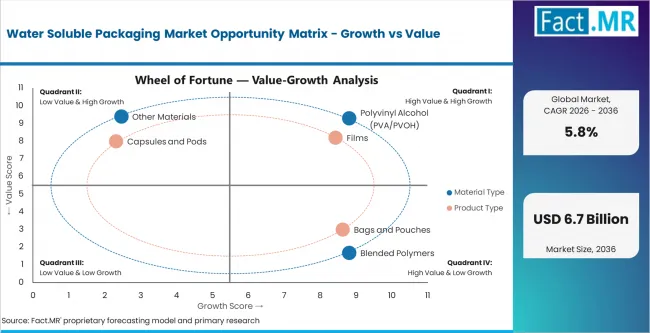
Key Factors Driving Growth
- Consumer adoption of single-dose detergent pods and dishwasher capsules continues to accelerate in mature markets and is expanding into emerging markets, driving volume demand for cold water soluble PVA films.
- Worker safety regulations in agrochemical handling are pushing adoption of water soluble sachets and pouches that eliminate direct contact with concentrated pesticides and fertilizers.
- Single-use plastic regulations across the EU, UK, and parts of Asia Pacific are creating regulatory preference for biodegradable and dissolvable packaging alternatives that leave no persistent waste.
Key Market Constraints
- Moisture sensitivity of PVA films during storage and transportation requires controlled humidity environments and specialized handling that increase logistics costs compared to conventional packaging materials.
- Limited dissolution reliability in cold water for certain heavy-duty applications creates performance concerns among some consumer and industrial buyers, constraining adoption in specific product categories.
- Higher material costs for PVA-based films relative to conventional plastic packaging restrict adoption speed in price-sensitive markets and high-volume commodity applications.
Key Opportunity Areas
- Pharmaceutical unit-dose packaging, including oral dissolving films and single-dose sachets, represents a high-value growth opportunity with premium pricing and strong IP protection potential.
- Development of enhanced multi-layer PVA films with improved barrier properties, controlled dissolution timing, and temperature-specific performance is expanding the addressable application range.
- Emerging markets in India, China, Southeast Asia, and Latin America present volume growth opportunities as household pod adoption, agrochemical safety regulations, and plastic waste awareness increase.
Segment-wise Analysis of the Water Soluble Packaging Market
- PVA/PVOH holds 65% of the material type segment in 2026, reflecting the dominant position of polyvinyl alcohol as the most established, commercially proven, and performance-validated material for water soluble packaging.
- Detergents account for 40% of the application segment in 2026, driven by the continued expansion of laundry pods, dishwasher capsules, and cleaning product sachets across mature and emerging markets.
- Household care accounts for 35% of the end use industry segment, encompassing laundry, dishwashing, and cleaning product applications where single-dose convenience drives consumer adoption.
The water soluble packaging market is segmented by material type, product type, solubility type, application, end use industry, thickness, and region. PVA/PVOH dominates by material type due to established production infrastructure and broad application validation. Films lead by product type through their use across pod, pouch, and sachet formats. Cold water soluble formulations dominate by solubility type, and detergent applications lead by end-use application.
Which Material Type Segment Dominates the Water Soluble Packaging Market?
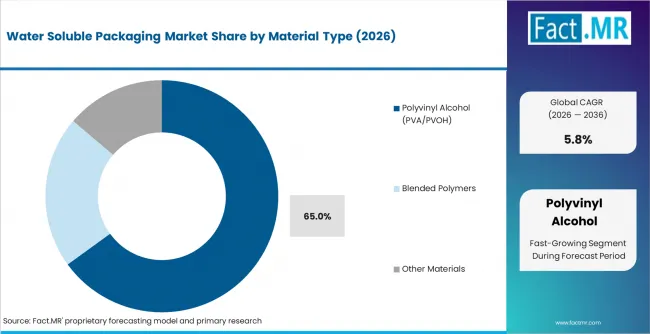
PVA/PVOH accounts for 65% of the material type segment in 2026. This commanding share reflects the deeply established position of polyvinyl alcohol as the primary material platform for water soluble film production. PVA offers a combination of water solubility, film-forming capability, mechanical strength, and biodegradability that has been validated across decades of commercial use in detergent pods, agrochemical sachets, and pharmaceutical packaging. Cold water soluble and hot water soluble PVA grades provide formulators with dissolution control across the full temperature range required by different applications.
Blended polymers, including PVA blends with enhanced flexibility and starch-based biodegradable blends, are growing as material alternatives. Other materials such as cellulose-based and gelatin-based films serve niche applications in edible and compostable packaging. However, the scale advantages, performance track record, and application breadth of PVA make it difficult for alternative materials to achieve comparable market penetration in the near term.
Which Application Segment Dominates the Water Soluble Packaging Market?
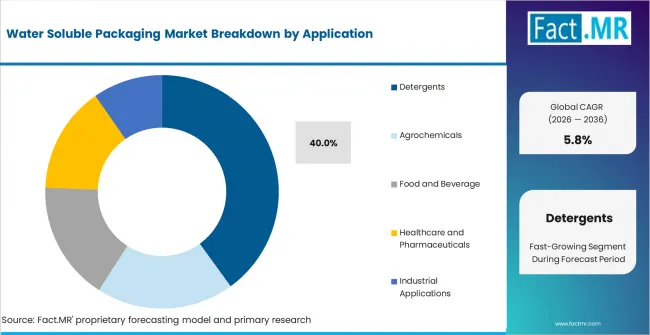
Detergents account for 40% of the application segment in 2026. Laundry pods and dishwasher capsules represent the largest single demand driver for water soluble packaging, with established consumer adoption in North America and Europe and accelerating penetration in Asia Pacific and Latin America. The convenience of pre-measured dosing, combined with brand differentiation through pod format innovation, continues to shift household care consumption from traditional liquid and powder formats toward water soluble pod delivery.
Agrochemicals represent the second-largest application, driven by worker safety mandates and precision dosing requirements in pesticide and fertilizer handling. Healthcare and pharmaceutical applications are the fastest-growing segment, with oral dissolving films, unit-dose sachets, and hospital laundry bags creating high-value niches with premium pricing. Food and beverage applications, including portion-controlled ingredient packaging and dissolvable beverage sachets, represent an emerging opportunity.
Which Solubility Type Segment Dominates the Water Soluble Packaging Market?
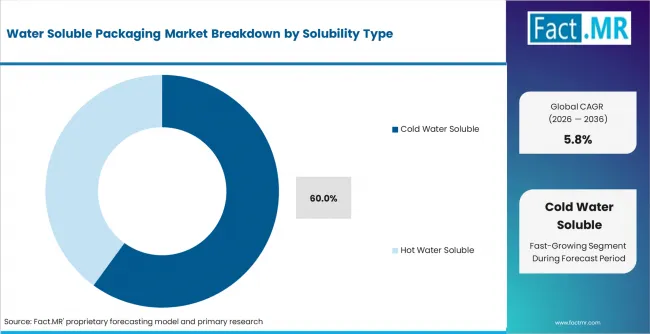
Cold water soluble formulations account for 60% of the solubility type segment in 2026. This dominance is driven by household detergent pods and dishwasher capsules that must dissolve reliably at ambient or low water temperatures to meet consumer convenience expectations. Cold water solubility is a non-negotiable performance requirement in these applications, as consumers expect pods to dissolve completely during standard wash cycles without requiring elevated water temperatures.
Hot water soluble formulations serve industrial applications, specialty chemical packaging, and hospital laundry bags where controlled dissolution at elevated temperatures provides containment during storage and handling, with release triggered only upon contact with hot water during processing. The development of medium-temperature dissolution grades is expanding the range of applications between the cold and hot extremes.
Which Product Trend is Shaping the Next Phase of Growth in the Water Soluble Packaging Market?
Multi-functional PVA films with application-specific performance engineering are emerging as the defining product trend in the water soluble packaging market. Manufacturers are moving beyond standard commodity film grades to develop multi-layer structures with tailored dissolution timing, enhanced moisture barriers for storage stability, and mechanical properties optimized for specific filling and sealing processes. This shift from generic water soluble films to application-engineered material platforms is enabling new product formats and opening higher-value market segments.
Kuraray, the market leader with approximately 15% share through its MonoSol subsidiary, exemplified this trend at K 2025 by showcasing its expanded portfolio of PVOH-based materials including KURARAY POVAL, EXCEVAL, ELVANOL, and MOWIFLEX grades designed for recyclable and compostable packaging applications. SEKISUI Chemical is competing through patent-protected PVB interlayer technology, having enforced a patent injunction against Kuraray Europe in November 2025 regarding PVB interlayer products in Germany. This intensifying IP competition reflects the premium value that proprietary material platforms command in the water soluble packaging market.
Regional Outlook Across Key Markets
.webp)
- North America leads by absolute market size through established household pod adoption, strong agrochemical packaging demand, and advancing pharmaceutical unit-dose applications in the USA and Canada.
- Asia Pacific is the fastest-growing region, with India at 6.4% and China at 6.1%, driven by expanding household care consumption, agrochemical safety regulation adoption, and growing PVA film production capacity.
- Europe sustains steady demand through the UK (4.6%) and Germany (4.9%), supported by single-use plastic regulations, mature pod markets, and expanding sustainable packaging mandates.
- Japan (4.3%) maintains demand through strong environmental regulation compliance, consumer preference for minimal-waste packaging, and established positions in cosmetic and personal care applications.
| Country | CAGR (%) |
|---|---|
| India | 6.4% |
| China | 6.1% |
| USA | 5.8% |
| Germany | 4.9% |
| UK | 4.6% |
| Japan | 4.3% |
| Canada | 3.9% |
Source: Fact MR (FMR) analysis, based on proprietary forecasting model and primary research.

Market Outlook for Water Soluble Packaging in the United States
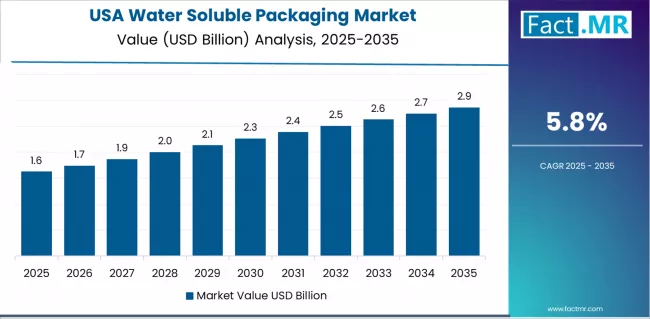
The U.S. water soluble packaging market is projected to grow at a CAGR of 5.8% through 2036. Demand is supported by established household pod adoption, strong agrochemical packaging requirements, expanding pharmaceutical unit-dose applications, and product innovation by leading brand owners.
- Household pod adoption continues to deepen with format innovation driving category growth.
- Agrochemical safety packaging sustains demand for water soluble sachets and pouches.
- Pharmaceutical unit-dose applications create premium-priced growth opportunities.
Water Soluble Packaging Demand Trends in India
The India water soluble packaging market is projected to grow at a CAGR of 6.4% through 2036. Growth is driven by expanding household care consumption, agrochemical safety regulation adoption, growing awareness of sustainable packaging alternatives, and emerging domestic PVA film production capacity.
- Household care market expansion drives growing pod and sachet format adoption.
- Agrochemical worker safety regulations push adoption of dissolvable pesticide sachets.
- Emerging domestic PVA production capacity reduces import dependency and cost.
China Water Soluble Packaging Market Growth Assessment
The China water soluble packaging market is projected to grow at a CAGR of 6.1% through 2036. Demand is supported by growing household care consumption, expanding agrochemical packaging demand, domestic PVA production capacity, and increasing regulatory attention to plastic waste reduction.
- Domestic PVA production capacity supports cost-competitive water soluble film supply.
- Household pod adoption accelerates as consumer convenience preferences develop.
- Agrochemical packaging demand grows alongside crop protection chemical market expansion.
Germany Water Soluble Packaging Market Demand Analysis
The Germany water soluble packaging market is projected to grow at a CAGR of 4.9% through 2036. Demand is driven by established pod markets, single-use plastic regulations, pharmaceutical packaging innovation, and the presence of leading chemical and packaging companies with PVA expertise.
- Established pod market sustains stable base demand for cold water soluble films.
- Single-use plastic regulations create preference for dissolvable packaging alternatives.
- Pharmaceutical unit-dose innovation creates high-value application growth.
United Kingdom Water Soluble Packaging Market Opportunity Outlook
The UK water soluble packaging market is projected to grow at a CAGR of 4.6% through 2036. Demand is supported by mature household pod adoption, plastic packaging tax incentives, retailer sustainability commitments, and expanding use of water soluble formats in personal care and cleaning products.
- Mature pod market generates stable base demand with incremental format expansion.
- Plastic packaging tax creates cost incentive for biodegradable packaging adoption.
- Retailer sustainability commitments drive specification of dissolvable packaging formats.
Competitive Benchmarking and Company Positioning

Water Soluble Packaging Market Analysis By Company
- Kuraray (including MonoSol), SEKISUI Chemical Co. Ltd., and Mitsubishi Chemical Corporation dominate the market through vertically integrated PVA production, broad application expertise, and strong IP portfolios.
- Mondi Group, Aquapak Polymers Ltd., and AICELLO Corporation compete through format specialization, regional distribution strength, and innovation in alternative material platforms.
- Vertically integrated PVA production capability, application engineering expertise, and IP portfolio strength are the primary competitive differentiators across the market.
The competitive landscape is moderately consolidated, with the top five manufacturers accounting for over 25% of market share. Kuraray holds approximately 15% market share through its MonoSol subsidiary, which operates the largest dedicated water soluble film production capacity globally. Kuraray's competitive position is built on vertically integrated PVA production, broad application coverage across detergent, agrochemical, and pharmaceutical packaging, and continuous material innovation including cold water soluble and biocircular ISCC PLUS-certified grades.
SEKISUI Chemical Co. Ltd. and Mitsubishi Chemical Corporation maintain strong positions through their own PVA production capabilities, technology-differentiated products, and established customer relationships in Japan and globally. SEKISUI has demonstrated willingness to enforce IP protection aggressively, as evidenced by its successful patent injunction against Kuraray Europe regarding PVB interlayer technology in Germany in November 2025.
Mondi Group offers customizable water soluble packaging solutions for diverse industrial needs, while Aquapak Polymers is gaining recognition for biodegradable polymer innovation. Solubag, Soltec Development, and Soluble Technology serve emerging niches with specialty material approaches. AICELLO Corporation and Rovi Packaging maintain positions in specific application and regional segments.
Strategic priorities across the market include expanding PVA film production capacity, developing application-specific film grades with enhanced performance, securing IP protection for proprietary material platforms, and building technical service capabilities that support customer product development and format innovation.
Key Companies in the Water Soluble Packaging Market
Kuraray (including MonoSol) and SEKISUI Chemical Co. Ltd. are the dominant players in the water soluble packaging market, supported by vertically integrated PVA production, broad application portfolios, and strong IP positions.
Mondi Group, Mitsubishi Chemical Corporation, and AICELLO Corporation hold established positions through material expertise, regional distribution networks, and application-specific product development.
Solubag, Aquapak Polymers Ltd., Soltec Development, Soluble Technology Limited, and Rovi Packaging S.A. compete through focused innovation, alternative material platforms, and specialized regional or application-level market positions.
Recent Industry Developments
- Kuraray Co., Ltd. - Product Showcase / Sustainable PVA Materials at K 2025 (October 2025)
- Kuraray presented its expanded portfolio of PVOH-based sustainable packaging materials at K 2025 in Dusseldorf, including KURARAY POVAL, EXCEVAL, ELVANOL, and MOWIFLEX grades for recyclable and compostable packaging. The company also introduced ISCC PLUS-certified biocircular versions produced at its Antwerp facility.
- SEKISUI Chemical Co., Ltd. - IP Enforcement / Patent Injunction Against Kuraray Europe (November 2025)
- SEKISUI Chemical enforced a patent injunction granted by the Munich District Court against Kuraray Europe, effective November 5, 2025, prohibiting manufacturing and sale of certain PVB interlayer products in Germany. The Federal Patent Court issued a positive preliminary opinion on the patent validity in October 2025.
- SK Capital Partners - Strategic Acquisition / Ecopol SpA Investment (2023-2024)
- SK Capital Partners acquired a majority interest in Ecopol SpA, a water soluble film manufacturer, and formed a new board of directors with industry leaders in sustainable materials and consumer packaged goods, signaling private equity interest in consolidating the water soluble packaging supply chain.
Leading Companies Shaping the Water Soluble Packaging Market
- Kuraray
- Mondi Group
- SEKISUI CHEMICAL CO., LTD.
- Mitsubishi Chemical Corporation
- Solubag
- Aquapak Polymers Ltd.
- Soltec Development
- Soluble Technology Limited
- AICELLO CORPORATION
- Rovi Packaging, S.A.
Sources and Research References
- Kuraray Co., Ltd. PVOH-based sustainable packaging material portfolio and K 2025 showcase documentation.
- SEKISUI Chemical Co., Ltd. Patent injunction enforcement announcement against Kuraray Europe regarding PVB interlayer products in Germany.
- SK Capital Partners. Ecopol SpA acquisition and strategic investment documentation.
- Household care market penetration data, agrochemical safety regulation databases, PVA production capacity statistics, and single-use plastic legislation timelines.
- Primary interviews with PVA film manufacturers, pod converters, brand owners, agrochemical companies, pharmaceutical packaging specialists, and industry consultants.
This bibliography is provided for reader reference and is not exhaustive. The full report contains the complete reference list and detailed citations.
Key Questions This Report Addresses
- What is the current and future size of the Water Soluble Packaging market?
- How fast is the water soluble packaging market expected to grow between 2026 and 2036?
- Which material type is likely to lead the market by 2026?
- Which application segment is expected to account for the highest share by 2026?
- What factors are driving demand for water soluble packaging globally?
- How is innovation in multi-layer PVA films influencing the market?
- Why is India emerging as the fastest-growing market?
- How are single-use plastic regulations shaping demand?
- Which countries are projected to show the fastest growth through 2036?
- Who are the key companies active in the water soluble packaging market?
- How does Fact.MR estimate and validate the market forecast?
Water Soluble Packaging Market Definition
The water soluble packaging market covers films, bags, pouches, capsules, and pods manufactured from polyvinyl alcohol, blended polymers, and other water-soluble materials that dissolve completely in water for use in detergent, agrochemical, pharmaceutical, food, and industrial packaging applications.
Water Soluble Packaging Market Inclusions
- The scope covers global and regional market size and forecasts for 2026 to 2036 across material type, product type, solubility type, application, end use industry, thickness, and region.
- It includes analysis of household care pod penetration, agrochemical packaging regulations, pharmaceutical unit-dose trends, and food industry adoption patterns that influence water soluble packaging demand.
- The report covers pricing and cost analysis across PVA-based and alternative material platforms, including raw material costs, film production economics, and conversion costs for pod and sachet formats.
- It covers technology trends, market drivers and constraints, and the competitive landscape, including material innovation, production capacity, geographic reach, and application expertise of leading players.
Water Soluble Packaging Market Exclusions
- The scope excludes conventional water-resistant and water-proof packaging materials that do not dissolve in water, including standard plastic films, foils, and coated papers.
- It excludes PVA and PVOH materials sold for non-packaging applications such as textile sizing, paper coating, adhesives, and construction chemicals.
- The report excludes packaging machinery and pod-filling equipment not directly related to water soluble packaging material production and sales.
- It also excludes informal or unlabeled dissolvable packaging without verifiable material composition or commercial traceability.
Water Soluble Packaging Market Research Methodology
- The methodology combines secondary research, primary interviews, and forecast modelling.
- It draws on 60+ secondary sources and benchmarks 25+ manufacturer product portfolios.
- Market sizing covers 20+ countries through a demand-side model, supported by top-down validation.
- Key inputs include household care pod penetration rates, agrochemical packaging regulations, pharmaceutical unit-dose adoption, PVA production capacity, and single-use plastic legislation timelines.
- The model cross-checks demand with PVA film production capacity, material pricing, conversion volumes, and new application development timelines.
- Primary validation includes 20+ interviews across PVA film manufacturers, pod converters, brand owners, agrochemical companies, and pharmaceutical packaging specialists.
- Final estimates go through material-balance checks, production-capacity review, and sensitivity testing.
Scope of Analysis

| Parameter | Details |
|---|---|
| Quantitative Units | USD 3.81 billion to USD 6.69 billion, at a CAGR of 5.8% |
| Market Definition | The water soluble packaging market covers PVA-based and alternative polymer films, bags, pouches, capsules, and pods that dissolve in water for detergent, agrochemical, pharmaceutical, food, and industrial applications. |
| Regions Covered | North America, Latin America, Europe, East Asia, South Asia and Pacific, Middle East and Africa |
| Countries Covered | India, China, USA, Germany, UK, Japan, Canada, 20 plus countries |
| Key Companies | Kuraray, Mondi Group, SEKISUI Chemical Co. Ltd., Mitsubishi Chemical Corporation, Solubag, Aquapak Polymers Ltd., Soltec Development, Soluble Technology Limited, AICELLO Corporation, Rovi Packaging S.A. |
| Forecast Period | 2026 to 2036 |
| Approach | Hybrid demand-side and top-down methodology built on pod penetration analysis, agrochemical packaging regulation tracking, PVA production capacity, and primary interviews across film manufacturers, pod converters, brand owners, and end-use industry specialists |
Water Soluble Packaging Market Segmentation
-
Water Soluble Packaging Market Segmented by Material Type:
- Polyvinyl Alcohol (PVA/PVOH)
- Cold Water Soluble PVA
- Low Temperature Dissolution
- Household Applications
- Hot Water Soluble PVA
- High Strength Films
- Industrial Applications
- Cold Water Soluble PVA
- Blended Polymers
- PVA Blends
- Improved Flexibility
- Enhanced Strength
- Starch-based Blends
- Biodegradable Films
- Eco-friendly Packaging
- PVA Blends
- Other Materials
- Cellulose-based Films
- Natural Polymers
- Compostable Packaging
- Gelatin-based Films
- Edible Packaging
- Food-grade Applications
- Cellulose-based Films
- Polyvinyl Alcohol (PVA/PVOH)
-
Water Soluble Packaging Market Segmented by Product Type:
- Films
- Mono-layer Films
- Standard Solubility
- Flexible Packaging
- Multi-layer Films
- High Barrier Properties
- Improved Durability
- Mono-layer Films
- Bags and Pouches
- Single-use Pouches
- Detergent Pods
- Agrochemical Packaging
- Bulk Bags
- Industrial Chemicals
- Powder Packaging
- Single-use Pouches
- Capsules and Pods
- Detergent Pods
- Laundry Applications
- Dishwashing Pods
- Agrochemical Capsules
- Pesticides
- Fertilizers
- Detergent Pods
- Films
-
Water Soluble Packaging Market Segmented by Solubility Type:
- Cold Water Soluble
- Low Temperature Dissolution
- Below 20°C
- Household Products
- Medium Temperature Dissolution
- 20–40°C
- General Use
- Low Temperature Dissolution
- Hot Water Soluble
- High Temperature Dissolution
- Above 40°C
- Industrial Use
- Controlled Dissolution
- Delayed Release
- Special Applications
- High Temperature Dissolution
- Cold Water Soluble
-
Water Soluble Packaging Market Segmented by Application:
- Detergents
- Laundry Detergents
- Pods and Sachets
- Powder Packaging
- Dishwashing
- Dishwasher Pods
- Liquid Capsules
- Laundry Detergents
- Agrochemicals
- Pesticides
- Water-soluble Sachets
- Safe Handling
- Fertilizers
- Nutrient Delivery
- Controlled Release
- Pesticides
- Food and Beverage
- Ingredients Packaging
- Portion Control
- Edible Films
- Beverage Additives
- Instant Mixes
- Dissolvable Sachets
- Ingredients Packaging
- Healthcare and Pharmaceuticals
- Medication Packaging
- Unit Dose Packaging
- Dissolvable Films
- Medical Applications
- Hospital Use
- Sterile Packaging
- Medication Packaging
- Industrial Applications
- Chemical Packaging
- Dyes
- Cleaning Agents
- Textile Industry
- Dye Packaging
- Process Chemicals
- Chemical Packaging
- Detergents
-
Water Soluble Packaging Market Segmented by End Use Industry:
- Household Care
- Cleaning Products
- Laundry
- Dishwashing
- Personal Care
- Bath Products
- Cosmetics
- Cleaning Products
- Agriculture
- Crop Protection
- Pesticides
- Herbicides
- Fertilizer Use
- Water-soluble Nutrients
- Soil Treatment
- Crop Protection
- Pharmaceuticals
- Drug Packaging
- Unit Dose
- Oral Films
- Hospital Use
- Sterile Applications
- Medical Supplies
- Drug Packaging
- Food Industry
- Ingredient Packaging
- Flavorings
- Additives
- Convenience Food
- Instant Products
- Ready Mixes
- Ingredient Packaging
- Industrial Sector
- Chemical Industry
- Bulk Chemicals
- Process Materials
- Textile Industry
- Dyes
- Auxiliaries
- Chemical Industry
- Household Care
-
Water Soluble Packaging Market Segmented by Thickness:
- Thin Films
- Below 50 microns
- Fast Dissolution
- Lightweight Packaging
- 50–100 microns
- Standard Applications
- Balanced Strength
- Below 50 microns
- Medium Thickness
- 100–200 microns
- Improved Durability
- Industrial Use
- 200–300 microns
- Bulk Packaging
- Heavy-duty Use
- 100–200 microns
- Thick Films
- Above 300 microns
- High Strength
- Specialty Applications
- Ultra-thick Films
- Industrial Bulk Handling
- Custom Packaging
- Above 300 microns
- Thin Films
-
Water Soluble Packaging Market by Region:
- North America
- USA
- Canada
- Mexico
- Latin America
- Brazil
- Chile
- Rest of Latin America
- Western Europe
- Germany
- UK
- Italy
- Spain
- France
- Nordic
- BENELUX
- Rest of Western Europe
- Eastern Europe
- Russia
- Poland
- Hungary
- Balkan & Baltic
- Rest of Eastern Europe
- East Asia
- China
- Japan
- South Korea
- South Asia and Pacific
- India
- ASEAN
- Australia & New Zealand
- Rest of South Asia and Pacific
- Middle East & Africa
- Kingdom of Saudi Arabia
- Other GCC Countries
- Turkiye
- South Africa
- Other African Union
- Rest of Middle East & Africa
- North America
- Frequently Asked Questions -
Which are the fastest-growing countries in the Carbon Steel Market?
India (6.8%) and China (6.6%) are the fastest-growing countries during the forecast period.
What will be the size of the water soluble packaging market in 2036?
The market size for water soluble packaging is projected to reach USD 6.69 billion by 2036.
How much will the water soluble packaging market grow between 2026 and 2036?
The water soluble packaging market is expected to grow at a 5.8% CAGR between 2026 and 2036.
What will be the size of the Copper Market in 2036?
The Copper Market is projected to reach USD 511.78 billion by 2036.
How much will the Copper Market grow between 2026 and 2036?
The copper market is expected to grow at a 6.8% CAGR between 2026 and 2036.
What are the key product types in the Copper Market?
The key product types are primary copper (refined cathodes, wire bars) and secondary copper (recycled copper).
Table of Content
- Executive Summary
- Global Market Outlook
- Demand to side Trends
- Supply to side Trends
- Technology Roadmap Analysis
- Analysis and Recommendations
- Market Overview
- Market Coverage / Taxonomy
- Market Definition / Scope / Limitations
- Research Methodology
- Chapter Orientation
- Analytical Lens and Working Hypotheses
- Market Structure, Signals, and Trend Drivers
- Benchmarking and Cross-market Comparability
- Market Sizing, Forecasting, and Opportunity Mapping
- Research Design and Evidence Framework
- Desk Research Programme (Secondary Evidence)
- Company Annual and Sustainability Reports
- Peer-reviewed Journals and Academic Literature
- Corporate Websites, Product Literature, and Technical Notes
- Earnings Decks and Investor Briefings
- Statutory Filings and Regulatory Disclosures
- Technical White Papers and Standards Notes
- Trade Journals, Industry Magazines, and Analyst Briefs
- Conference Proceedings, Webinars, and Seminar Materials
- Government Statistics Portals and Public Data Releases
- Press Releases and Reputable Media Coverage
- Specialist Newsletters and Curated Briefings
- Sector Databases and Reference Repositories
- Fact.MR Internal Proprietary Databases and Historical Market Datasets
- Subscription Datasets and Paid Sources
- Social Channels, Communities, and Digital Listening Inputs
- Additional Desk Sources
- Expert Input and Fieldwork (Primary Evidence)
- Primary Modes
- Qualitative Interviews and Expert Elicitation
- Quantitative Surveys and Structured Data Capture
- Blended Approach
- Why Primary Evidence is Used
- Field Techniques
- Interviews
- Surveys
- Focus Groups
- Observational and In-context Research
- Social and Community Interactions
- Stakeholder Universe Engaged
- C-suite Leaders
- Board Members
- Presidents and Vice Presidents
- R&D and Innovation Heads
- Technical Specialists
- Domain Subject-matter Experts
- Scientists
- Physicians and Other Healthcare Professionals
- Governance, Ethics, and Data Stewardship
- Research Ethics
- Data Integrity and Handling
- Primary Modes
- Tooling, Models, and Reference Databases
- Desk Research Programme (Secondary Evidence)
- Data Engineering and Model Build
- Data Acquisition and Ingestion
- Cleaning, Normalisation, and Verification
- Synthesis, Triangulation, and Analysis
- Quality Assurance and Audit Trail
- Market Background
- Market Dynamics
- Drivers
- Restraints
- Opportunity
- Trends
- Scenario Forecast
- Demand in Optimistic Scenario
- Demand in Likely Scenario
- Demand in Conservative Scenario
- Opportunity Map Analysis
- Product Life Cycle Analysis
- Supply Chain Analysis
- Investment Feasibility Matrix
- Value Chain Analysis
- PESTLE and Porter’s Analysis
- Regulatory Landscape
- Regional Parent Market Outlook
- Production and Consumption Statistics
- Import and Export Statistics
- Market Dynamics
- Global Market Analysis 2021 to 2025 and Forecast, 2026 to 2036
- Historical Market Size Value (USD Million) Analysis, 2021 to 2025
- Current and Future Market Size Value (USD Million) Projections, 2026 to 2036
- Y to o to Y Growth Trend Analysis
- Absolute $ Opportunity Analysis
- Global Market Pricing Analysis 2021 to 2025 and Forecast 2026 to 2036
- Global Market Analysis 2021 to 2025 and Forecast 2026 to 2036, By Material Type
- Introduction / Key Findings
- Historical Market Size Value (USD Million) Analysis By Material Type, 2021 to 2025
- Current and Future Market Size Value (USD Million) Analysis and Forecast By Material Type, 2026 to 2036
- Polyvinyl Alcohol (PVA/PVOH)
- Cold Water Soluble PVA
- Low Temperature Dissolution
- Household Applications
- Hot Water Soluble PVA
- High Strength Films
- Industrial Applications
- Blended Polymers
- PVA Blends
- Improved Flexibility
- Enhanced Strength
- Starch-based Blends
- Biodegradable Films
- Other Materials
- Cellulose-based Films
- Natural Polymers
- Compostable Packaging
- Gelatin-based Films
- Edible Packaging
- Polyvinyl Alcohol (PVA/PVOH)
- Bags and Pouches
- Single-use Pouches
- Detergent Pods
- Agrochemical Packaging
- Bulk Bags
- Industrial Chemicals
- Capsules and Pods
- Detergent Pods
- Laundry Applications
- Dishwashing Pods
- Agrochemical Capsules
- Pesticides
- Y to o to Y Growth Trend Analysis By Product Type, 2021 to 2025
- Absolute $ Opportunity Analysis By Product Type, 2026 to 2036
- Global Market Analysis 2021 to 2025 and Forecast 2026 to 2036, By Solubility Type
- Introduction / Key Findings
- Historical Market Size Value (USD Million) Analysis By Solubility Type, 2021 to 2025
- Current and Future Market Size Value (USD Million) Analysis and Forecast By Solubility Type, 2026 to 2036
- Cold Water Soluble
- Low Temperature Dissolution
- Below 20°C
- Household Products
- Medium Temperature Dissolution
- 20–40°C
- General Use
- Hot Water Soluble
- High Temperature Dissolution
- Above 40°C
- Industrial Use
- Controlled Dissolution
- Delayed Release
- Cold Water Soluble
- Y to o to Y Growth Trend Analysis By Solubility Type, 2021 to 2025
- Absolute $ Opportunity Analysis By Solubility Type, 2026 to 2036
- Global Market Analysis 2021 to 2025 and Forecast 2026 to 2036, By Application
- Introduction / Key Findings
- Historical Market Size Value (USD Million) Analysis By Application, 2021 to 2025
- Current and Future Market Size Value (USD Million) Analysis and Forecast By Application, 2026 to 2036
- Detergents
- Laundry Detergents
- Pods and Sachets
- Powder Packaging
- Dishwashing
- Dishwasher Pods
- Liquid Capsules
- Agrochemicals
- Pesticides
- Water-soluble Sachets
- Safe Handling
- Fertilizers
- Nutrient Delivery
- Food and Beverage
- Ingredients Packaging
- Portion Control
- Edible Films
- Beverage Additives
- Instant Mixes
- Healthcare and Pharmaceuticals
- Medication Packaging
- Value (USD Million) Dose Packaging
- Dissolvable Films
- Medical Applications
- Hospital Use
- Industrial Applications
- Chemical Packaging
- Dyes
- Cleaning Agents
- Textile Industry
- Dye Packaging
- Detergents
- Y to o to Y Growth Trend Analysis By Application, 2021 to 2025
- Absolute $ Opportunity Analysis By Application, 2026 to 2036
- Global Market Analysis 2021 to 2025 and Forecast 2026 to 2036, By End Use Industry
- Introduction / Key Findings
- Historical Market Size Value (USD Million) Analysis By End Use Industry, 2021 to 2025
- Current and Future Market Size Value (USD Million) Analysis and Forecast By End Use Industry, 2026 to 2036
- Household Care
- Cleaning Products
- Laundry
- Dishwashing
- Personal Care
- Bath Products
- Cosmetics
- Agriculture
- Crop Protection
- Pesticides
- Herbicides
- Fertilizer Use
- Water-soluble Nutrients
- Pharmaceuticals
- Drug Packaging
- Value (USD Million) Dose
- Oral Films
- Hospital Use
- Sterile Applications
- Food Industry
- Ingredient Packaging
- Flavorings
- Additives
- Convenience Food
- Instant Products
- Industrial Sector
- Chemical Industry
- Bulk Chemicals
- Process Materials
- Textile Industry
- Dyes
- Household Care
- Y to o to Y Growth Trend Analysis By End Use Industry, 2021 to 2025
- Absolute $ Opportunity Analysis By End Use Industry, 2026 to 2036
- Global Market Analysis 2021 to 2025 and Forecast 2026 to 2036, By Thickness
- Introduction / Key Findings
- Historical Market Size Value (USD Million) Analysis By Thickness, 2021 to 2025
- Current and Future Market Size Value (USD Million) Analysis and Forecast By Thickness, 2026 to 2036
- Thin Films
- Below 50 microns
- Fast Dissolution
- Lightweight Packaging
- 50–100 microns
- Standard Applications
- Balanced Strength
- Medium Thickness
- 100–200 microns
- Improved Durability
- Industrial Use
- 200–300 microns
- Bulk Packaging
- Thick Films
- Above 300 microns
- High Strength
- Specialty Applications
- Ultra-thick Films
- Industrial Bulk Handling
- Thin Films
- Y to o to Y Growth Trend Analysis By Thickness, 2021 to 2025
- Absolute $ Opportunity Analysis By Thickness, 2026 to 2036
- Global Market Analysis 2021 to 2025 and Forecast 2026 to 2036, By Region
- Introduction
- Historical Market Size Value (USD Million) Analysis By Region, 2021 to 2025
- Current Market Size Value (USD Million) Analysis and Forecast By Region, 2026 to 2036
- North America
- Latin America
- Western Europe
- Eastern Europe
- East Asia
- South Asia and Pacific
- Middle East & Africa
- Market Attractiveness Analysis By Region
- North America Market Analysis 2021 to 2025 and Forecast 2026 to 2036, By Country
- Historical Market Size Value (USD Million) Trend Analysis By Market Taxonomy, 2021 to 2025
- Market Size Value (USD Million) Forecast By Market Taxonomy, 2026 to 2036
- By Country
- USA
- Canada
- Mexico
- By Material Type
- By Product Type
- By Solubility Type
- By Application
- By End Use Industry
- By Thickness
- By Country
- Market Attractiveness Analysis
- By Country
- By Material Type
- By Product Type
- By Solubility Type
- By Application
- By End Use Industry
- By Thickness
- Key Takeaways
- Latin America Market Analysis 2021 to 2025 and Forecast 2026 to 2036, By Country
- Historical Market Size Value (USD Million) Trend Analysis By Market Taxonomy, 2021 to 2025
- Market Size Value (USD Million) Forecast By Market Taxonomy, 2026 to 2036
- By Country
- Brazil
- Chile
- Rest of Latin America
- By Material Type
- By Product Type
- By Solubility Type
- By Application
- By End Use Industry
- By Thickness
- By Country
- Market Attractiveness Analysis
- By Country
- By Material Type
- By Product Type
- By Solubility Type
- By Application
- By End Use Industry
- By Thickness
- Key Takeaways
- Western Europe Market Analysis 2021 to 2025 and Forecast 2026 to 2036, By Country
- Historical Market Size Value (USD Million) Trend Analysis By Market Taxonomy, 2021 to 2025
- Market Size Value (USD Million) Forecast By Market Taxonomy, 2026 to 2036
- By Country
- Germany
- UK
- Italy
- Spain
- France
- Nordic
- BENELUX
- Rest of Western Europe
- By Material Type
- By Product Type
- By Solubility Type
- By Application
- By End Use Industry
- By Thickness
- By Country
- Market Attractiveness Analysis
- By Country
- By Material Type
- By Product Type
- By Solubility Type
- By Application
- By End Use Industry
- By Thickness
- Key Takeaways
- Eastern Europe Market Analysis 2021 to 2025 and Forecast 2026 to 2036, By Country
- Historical Market Size Value (USD Million) Trend Analysis By Market Taxonomy, 2021 to 2025
- Market Size Value (USD Million) Forecast By Market Taxonomy, 2026 to 2036
- By Country
- Russia
- Poland
- Hungary
- Balkan & Baltic
- Rest of Eastern Europe
- By Material Type
- By Product Type
- By Solubility Type
- By Application
- By End Use Industry
- By Thickness
- By Country
- Market Attractiveness Analysis
- By Country
- By Material Type
- By Product Type
- By Solubility Type
- By Application
- By End Use Industry
- By Thickness
- Key Takeaways
- East Asia Market Analysis 2021 to 2025 and Forecast 2026 to 2036, By Country
- Historical Market Size Value (USD Million) Trend Analysis By Market Taxonomy, 2021 to 2025
- Market Size Value (USD Million) Forecast By Market Taxonomy, 2026 to 2036
- By Country
- China
- Japan
- South Korea
- By Material Type
- By Product Type
- By Solubility Type
- By Application
- By End Use Industry
- By Thickness
- By Country
- Market Attractiveness Analysis
- By Country
- By Material Type
- By Product Type
- By Solubility Type
- By Application
- By End Use Industry
- By Thickness
- Key Takeaways
- South Asia and Pacific Market Analysis 2021 to 2025 and Forecast 2026 to 2036, By Country
- Historical Market Size Value (USD Million) Trend Analysis By Market Taxonomy, 2021 to 2025
- Market Size Value (USD Million) Forecast By Market Taxonomy, 2026 to 2036
- By Country
- India
- ASEAN
- Australia & New Zealand
- Rest of South Asia and Pacific
- By Material Type
- By Product Type
- By Solubility Type
- By Application
- By End Use Industry
- By Thickness
- By Country
- Market Attractiveness Analysis
- By Country
- By Material Type
- By Product Type
- By Solubility Type
- By Application
- By End Use Industry
- By Thickness
- Key Takeaways
- Middle East & Africa Market Analysis 2021 to 2025 and Forecast 2026 to 2036, By Country
- Historical Market Size Value (USD Million) Trend Analysis By Market Taxonomy, 2021 to 2025
- Market Size Value (USD Million) Forecast By Market Taxonomy, 2026 to 2036
- By Country
- Kingdom of Saudi Arabia
- Other GCC Countries
- Turkiye
- South Africa
- Other African Union
- Rest of Middle East & Africa
- By Material Type
- By Product Type
- By Solubility Type
- By Application
- By End Use Industry
- By Thickness
- By Country
- Market Attractiveness Analysis
- By Country
- By Material Type
- By Product Type
- By Solubility Type
- By Application
- By End Use Industry
- By Thickness
- Key Takeaways
- Key Countries Market Analysis
- USA
- Pricing Analysis
- Market Share Analysis, 2025
- By Material Type
- By Product Type
- By Solubility Type
- By Application
- By End Use Industry
- By Thickness
- Canada
- Pricing Analysis
- Market Share Analysis, 2025
- By Material Type
- By Product Type
- By Solubility Type
- By Application
- By End Use Industry
- By Thickness
- Mexico
- Pricing Analysis
- Market Share Analysis, 2025
- By Material Type
- By Product Type
- By Solubility Type
- By Application
- By End Use Industry
- By Thickness
- Brazil
- Pricing Analysis
- Market Share Analysis, 2025
- By Material Type
- By Product Type
- By Solubility Type
- By Application
- By End Use Industry
- By Thickness
- Chile
- Pricing Analysis
- Market Share Analysis, 2025
- By Material Type
- By Product Type
- By Solubility Type
- By Application
- By End Use Industry
- By Thickness
- Germany
- Pricing Analysis
- Market Share Analysis, 2025
- By Material Type
- By Product Type
- By Solubility Type
- By Application
- By End Use Industry
- By Thickness
- UK
- Pricing Analysis
- Market Share Analysis, 2025
- By Material Type
- By Product Type
- By Solubility Type
- By Application
- By End Use Industry
- By Thickness
- Italy
- Pricing Analysis
- Market Share Analysis, 2025
- By Material Type
- By Product Type
- By Solubility Type
- By Application
- By End Use Industry
- By Thickness
- Spain
- Pricing Analysis
- Market Share Analysis, 2025
- By Material Type
- By Product Type
- By Solubility Type
- By Application
- By End Use Industry
- By Thickness
- France
- Pricing Analysis
- Market Share Analysis, 2025
- By Material Type
- By Product Type
- By Solubility Type
- By Application
- By End Use Industry
- By Thickness
- India
- Pricing Analysis
- Market Share Analysis, 2025
- By Material Type
- By Product Type
- By Solubility Type
- By Application
- By End Use Industry
- By Thickness
- ASEAN
- Pricing Analysis
- Market Share Analysis, 2025
- By Material Type
- By Product Type
- By Solubility Type
- By Application
- By End Use Industry
- By Thickness
- Australia & New Zealand
- Pricing Analysis
- Market Share Analysis, 2025
- By Material Type
- By Product Type
- By Solubility Type
- By Application
- By End Use Industry
- By Thickness
- China
- Pricing Analysis
- Market Share Analysis, 2025
- By Material Type
- By Product Type
- By Solubility Type
- By Application
- By End Use Industry
- By Thickness
- Japan
- Pricing Analysis
- Market Share Analysis, 2025
- By Material Type
- By Product Type
- By Solubility Type
- By Application
- By End Use Industry
- By Thickness
- South Korea
- Pricing Analysis
- Market Share Analysis, 2025
- By Material Type
- By Product Type
- By Solubility Type
- By Application
- By End Use Industry
- By Thickness
- Russia
- Pricing Analysis
- Market Share Analysis, 2025
- By Material Type
- By Product Type
- By Solubility Type
- By Application
- By End Use Industry
- By Thickness
- Poland
- Pricing Analysis
- Market Share Analysis, 2025
- By Material Type
- By Product Type
- By Solubility Type
- By Application
- By End Use Industry
- By Thickness
- Hungary
- Pricing Analysis
- Market Share Analysis, 2025
- By Material Type
- By Product Type
- By Solubility Type
- By Application
- By End Use Industry
- By Thickness
- Kingdom of Saudi Arabia
- Pricing Analysis
- Market Share Analysis, 2025
- By Material Type
- By Product Type
- By Solubility Type
- By Application
- By End Use Industry
- By Thickness
- Turkiye
- Pricing Analysis
- Market Share Analysis, 2025
- By Material Type
- By Product Type
- By Solubility Type
- By Application
- By End Use Industry
- By Thickness
- South Africa
- Pricing Analysis
- Market Share Analysis, 2025
- By Material Type
- By Product Type
- By Solubility Type
- By Application
- By End Use Industry
- By Thickness
- USA
- Market Structure Analysis
- Competition Dashboard
- Competition Benchmarking
- Market Share Analysis of Top Players
- By Regional
- By Material Type
- By Product Type
- By Solubility Type
- By Application
- By End Use Industry
- By Thickness
- Competition Analysis
- Competition Deep Dive
- Kuraray
- Overview
- Product Portfolio
- Profitability by Market Segments (Product/Age /Sales Channel/Region)
- Sales Footprint
- Strategy Overview
- Marketing Strategy
- Product Strategy
- Channel Strategy
- Mondi Group
- SEKISUI CHEMICAL CO., LTD.
- Mitsubishi Chemical Corporation
- Solubag
- Aquapak Polymers Ltd.
- Soltec Development
- Soluble Technology Limited
- AICELLO CORPORATION
- Rovi Packaging, S.A.
- Kuraray
- Competition Deep Dive
- Assumptions & Acronyms Used
List Of Table
- Table 1: Global Market Value (USD Million) Forecast by Region, 2021 to 2036
- Table 2: Global Market Value (USD Million) Forecast by Material Type, 2021 to 2036
- Table 3: Global Market Value (USD Million) Forecast by Product Type, 2021 to 2036
- Table 4: Global Market Value (USD Million) Forecast by Solubility Type, 2021 to 2036
- Table 5: Global Market Value (USD Million) Forecast by Application, 2021 to 2036
- Table 6: Global Market Value (USD Million) Forecast by End Use Industry, 2021 to 2036
- Table 7: Global Market Value (USD Million) Forecast by Thickness, 2021 to 2036
- Table 8: North America Market Value (USD Million) Forecast by Country, 2021 to 2036
- Table 9: North America Market Value (USD Million) Forecast by Material Type, 2021 to 2036
- Table 10: North America Market Value (USD Million) Forecast by Product Type, 2021 to 2036
- Table 11: North America Market Value (USD Million) Forecast by Solubility Type, 2021 to 2036
- Table 12: North America Market Value (USD Million) Forecast by Application, 2021 to 2036
- Table 13: North America Market Value (USD Million) Forecast by End Use Industry, 2021 to 2036
- Table 14: North America Market Value (USD Million) Forecast by Thickness, 2021 to 2036
- Table 15: Latin America Market Value (USD Million) Forecast by Country, 2021 to 2036
- Table 16: Latin America Market Value (USD Million) Forecast by Material Type, 2021 to 2036
- Table 17: Latin America Market Value (USD Million) Forecast by Product Type, 2021 to 2036
- Table 18: Latin America Market Value (USD Million) Forecast by Solubility Type, 2021 to 2036
- Table 19: Latin America Market Value (USD Million) Forecast by Application, 2021 to 2036
- Table 20: Latin America Market Value (USD Million) Forecast by End Use Industry, 2021 to 2036
- Table 21: Latin America Market Value (USD Million) Forecast by Thickness, 2021 to 2036
- Table 22: Western Europe Market Value (USD Million) Forecast by Country, 2021 to 2036
- Table 23: Western Europe Market Value (USD Million) Forecast by Material Type, 2021 to 2036
- Table 24: Western Europe Market Value (USD Million) Forecast by Product Type, 2021 to 2036
- Table 25: Western Europe Market Value (USD Million) Forecast by Solubility Type, 2021 to 2036
- Table 26: Western Europe Market Value (USD Million) Forecast by Application, 2021 to 2036
- Table 27: Western Europe Market Value (USD Million) Forecast by End Use Industry, 2021 to 2036
- Table 28: Western Europe Market Value (USD Million) Forecast by Thickness, 2021 to 2036
- Table 29: Eastern Europe Market Value (USD Million) Forecast by Country, 2021 to 2036
- Table 30: Eastern Europe Market Value (USD Million) Forecast by Material Type, 2021 to 2036
- Table 31: Eastern Europe Market Value (USD Million) Forecast by Product Type, 2021 to 2036
- Table 32: Eastern Europe Market Value (USD Million) Forecast by Solubility Type, 2021 to 2036
- Table 33: Eastern Europe Market Value (USD Million) Forecast by Application, 2021 to 2036
- Table 34: Eastern Europe Market Value (USD Million) Forecast by End Use Industry, 2021 to 2036
- Table 35: Eastern Europe Market Value (USD Million) Forecast by Thickness, 2021 to 2036
- Table 36: East Asia Market Value (USD Million) Forecast by Country, 2021 to 2036
- Table 37: East Asia Market Value (USD Million) Forecast by Material Type, 2021 to 2036
- Table 38: East Asia Market Value (USD Million) Forecast by Product Type, 2021 to 2036
- Table 39: East Asia Market Value (USD Million) Forecast by Solubility Type, 2021 to 2036
- Table 40: East Asia Market Value (USD Million) Forecast by Application, 2021 to 2036
- Table 41: East Asia Market Value (USD Million) Forecast by End Use Industry, 2021 to 2036
- Table 42: East Asia Market Value (USD Million) Forecast by Thickness, 2021 to 2036
- Table 43: South Asia and Pacific Market Value (USD Million) Forecast by Country, 2021 to 2036
- Table 44: South Asia and Pacific Market Value (USD Million) Forecast by Material Type, 2021 to 2036
- Table 45: South Asia and Pacific Market Value (USD Million) Forecast by Product Type, 2021 to 2036
- Table 46: South Asia and Pacific Market Value (USD Million) Forecast by Solubility Type, 2021 to 2036
- Table 47: South Asia and Pacific Market Value (USD Million) Forecast by Application, 2021 to 2036
- Table 48: South Asia and Pacific Market Value (USD Million) Forecast by End Use Industry, 2021 to 2036
- Table 49: South Asia and Pacific Market Value (USD Million) Forecast by Thickness, 2021 to 2036
- Table 50: Middle East & Africa Market Value (USD Million) Forecast by Country, 2021 to 2036
- Table 51: Middle East & Africa Market Value (USD Million) Forecast by Material Type, 2021 to 2036
- Table 52: Middle East & Africa Market Value (USD Million) Forecast by Product Type, 2021 to 2036
- Table 53: Middle East & Africa Market Value (USD Million) Forecast by Solubility Type, 2021 to 2036
- Table 54: Middle East & Africa Market Value (USD Million) Forecast by Application, 2021 to 2036
- Table 55: Middle East & Africa Market Value (USD Million) Forecast by End Use Industry, 2021 to 2036
- Table 56: Middle East & Africa Market Value (USD Million) Forecast by Thickness, 2021 to 2036
List Of Figures
- Figure 1: Global Market Pricing Analysis
- Figure 2: Global Market Value (USD Million) Forecast 2021 to 2036
- Figure 3: Global Market Value Share and BPS Analysis by Material Type, 2026 and 2036
- Figure 4: Global Market Y-o-Y Growth Comparison by Material Type, 2026 to 2036
- Figure 5: Global Market Attractiveness Analysis by Material Type
- Figure 6: Global Market Value Share and BPS Analysis by Product Type, 2026 and 2036
- Figure 7: Global Market Y-o-Y Growth Comparison by Product Type, 2026 to 2036
- Figure 8: Global Market Attractiveness Analysis by Product Type
- Figure 9: Global Market Value Share and BPS Analysis by Solubility Type, 2026 and 2036
- Figure 10: Global Market Y-o-Y Growth Comparison by Solubility Type, 2026 to 2036
- Figure 11: Global Market Attractiveness Analysis by Solubility Type
- Figure 12: Global Market Value Share and BPS Analysis by Application, 2026 and 2036
- Figure 13: Global Market Y-o-Y Growth Comparison by Application, 2026 to 2036
- Figure 14: Global Market Attractiveness Analysis by Application
- Figure 15: Global Market Value Share and BPS Analysis by End Use Industry, 2026 and 2036
- Figure 16: Global Market Y-o-Y Growth Comparison by End Use Industry, 2026 to 2036
- Figure 17: Global Market Attractiveness Analysis by End Use Industry
- Figure 18: Global Market Value Share and BPS Analysis by Thickness, 2026 and 2036
- Figure 19: Global Market Y-o-Y Growth Comparison by Thickness, 2026 to 2036
- Figure 20: Global Market Attractiveness Analysis by Thickness
- Figure 21: Global Market Value (USD Million) Share and BPS Analysis by Region, 2026 and 2036
- Figure 22: Global Market Y-o-Y Growth Comparison by Region, 2026 to 2036
- Figure 23: Global Market Attractiveness Analysis by Region
- Figure 24: North America Market Incremental Dollar Opportunity, 2026 to 2036
- Figure 25: Latin America Market Incremental Dollar Opportunity, 2026 to 2036
- Figure 26: Western Europe Market Incremental Dollar Opportunity, 2026 to 2036
- Figure 27: Eastern Europe Market Incremental Dollar Opportunity, 2026 to 2036
- Figure 28: East Asia Market Incremental Dollar Opportunity, 2026 to 2036
- Figure 29: South Asia and Pacific Market Incremental Dollar Opportunity, 2026 to 2036
- Figure 30: Middle East & Africa Market Incremental Dollar Opportunity, 2026 to 2036
- Figure 31: North America Market Value Share and BPS Analysis by Country, 2026 and 2036
- Figure 32: North America Market Value Share and BPS Analysis by Material Type, 2026 and 2036
- Figure 33: North America Market Y-o-Y Growth Comparison by Material Type, 2026 to 2036
- Figure 34: North America Market Attractiveness Analysis by Material Type
- Figure 35: North America Market Value Share and BPS Analysis by Product Type, 2026 and 2036
- Figure 36: North America Market Y-o-Y Growth Comparison by Product Type, 2026 to 2036
- Figure 37: North America Market Attractiveness Analysis by Product Type
- Figure 38: North America Market Value Share and BPS Analysis by Solubility Type, 2026 and 2036
- Figure 39: North America Market Y-o-Y Growth Comparison by Solubility Type, 2026 to 2036
- Figure 40: North America Market Attractiveness Analysis by Solubility Type
- Figure 41: North America Market Value Share and BPS Analysis by Application, 2026 and 2036
- Figure 42: North America Market Y-o-Y Growth Comparison by Application, 2026 to 2036
- Figure 43: North America Market Attractiveness Analysis by Application
- Figure 44: North America Market Value Share and BPS Analysis by End Use Industry, 2026 and 2036
- Figure 45: North America Market Y-o-Y Growth Comparison by End Use Industry, 2026 to 2036
- Figure 46: North America Market Attractiveness Analysis by End Use Industry
- Figure 47: North America Market Value Share and BPS Analysis by Thickness, 2026 and 2036
- Figure 48: North America Market Y-o-Y Growth Comparison by Thickness, 2026 to 2036
- Figure 49: North America Market Attractiveness Analysis by Thickness
- Figure 50: Latin America Market Value Share and BPS Analysis by Country, 2026 and 2036
- Figure 51: Latin America Market Value Share and BPS Analysis by Material Type, 2026 and 2036
- Figure 52: Latin America Market Y-o-Y Growth Comparison by Material Type, 2026 to 2036
- Figure 53: Latin America Market Attractiveness Analysis by Material Type
- Figure 54: Latin America Market Value Share and BPS Analysis by Product Type, 2026 and 2036
- Figure 55: Latin America Market Y-o-Y Growth Comparison by Product Type, 2026 to 2036
- Figure 56: Latin America Market Attractiveness Analysis by Product Type
- Figure 57: Latin America Market Value Share and BPS Analysis by Solubility Type, 2026 and 2036
- Figure 58: Latin America Market Y-o-Y Growth Comparison by Solubility Type, 2026 to 2036
- Figure 59: Latin America Market Attractiveness Analysis by Solubility Type
- Figure 60: Latin America Market Value Share and BPS Analysis by Application, 2026 and 2036
- Figure 61: Latin America Market Y-o-Y Growth Comparison by Application, 2026 to 2036
- Figure 62: Latin America Market Attractiveness Analysis by Application
- Figure 63: Latin America Market Value Share and BPS Analysis by End Use Industry, 2026 and 2036
- Figure 64: Latin America Market Y-o-Y Growth Comparison by End Use Industry, 2026 to 2036
- Figure 65: Latin America Market Attractiveness Analysis by End Use Industry
- Figure 66: Latin America Market Value Share and BPS Analysis by Thickness, 2026 and 2036
- Figure 67: Latin America Market Y-o-Y Growth Comparison by Thickness, 2026 to 2036
- Figure 68: Latin America Market Attractiveness Analysis by Thickness
- Figure 69: Western Europe Market Value Share and BPS Analysis by Country, 2026 and 2036
- Figure 70: Western Europe Market Value Share and BPS Analysis by Material Type, 2026 and 2036
- Figure 71: Western Europe Market Y-o-Y Growth Comparison by Material Type, 2026 to 2036
- Figure 72: Western Europe Market Attractiveness Analysis by Material Type
- Figure 73: Western Europe Market Value Share and BPS Analysis by Product Type, 2026 and 2036
- Figure 74: Western Europe Market Y-o-Y Growth Comparison by Product Type, 2026 to 2036
- Figure 75: Western Europe Market Attractiveness Analysis by Product Type
- Figure 76: Western Europe Market Value Share and BPS Analysis by Solubility Type, 2026 and 2036
- Figure 77: Western Europe Market Y-o-Y Growth Comparison by Solubility Type, 2026 to 2036
- Figure 78: Western Europe Market Attractiveness Analysis by Solubility Type
- Figure 79: Western Europe Market Value Share and BPS Analysis by Application, 2026 and 2036
- Figure 80: Western Europe Market Y-o-Y Growth Comparison by Application, 2026 to 2036
- Figure 81: Western Europe Market Attractiveness Analysis by Application
- Figure 82: Western Europe Market Value Share and BPS Analysis by End Use Industry, 2026 and 2036
- Figure 83: Western Europe Market Y-o-Y Growth Comparison by End Use Industry, 2026 to 2036
- Figure 84: Western Europe Market Attractiveness Analysis by End Use Industry
- Figure 85: Western Europe Market Value Share and BPS Analysis by Thickness, 2026 and 2036
- Figure 86: Western Europe Market Y-o-Y Growth Comparison by Thickness, 2026 to 2036
- Figure 87: Western Europe Market Attractiveness Analysis by Thickness
- Figure 88: Eastern Europe Market Value Share and BPS Analysis by Country, 2026 and 2036
- Figure 89: Eastern Europe Market Value Share and BPS Analysis by Material Type, 2026 and 2036
- Figure 90: Eastern Europe Market Y-o-Y Growth Comparison by Material Type, 2026 to 2036
- Figure 91: Eastern Europe Market Attractiveness Analysis by Material Type
- Figure 92: Eastern Europe Market Value Share and BPS Analysis by Product Type, 2026 and 2036
- Figure 93: Eastern Europe Market Y-o-Y Growth Comparison by Product Type, 2026 to 2036
- Figure 94: Eastern Europe Market Attractiveness Analysis by Product Type
- Figure 95: Eastern Europe Market Value Share and BPS Analysis by Solubility Type, 2026 and 2036
- Figure 96: Eastern Europe Market Y-o-Y Growth Comparison by Solubility Type, 2026 to 2036
- Figure 97: Eastern Europe Market Attractiveness Analysis by Solubility Type
- Figure 98: Eastern Europe Market Value Share and BPS Analysis by Application, 2026 and 2036
- Figure 99: Eastern Europe Market Y-o-Y Growth Comparison by Application, 2026 to 2036
- Figure 100: Eastern Europe Market Attractiveness Analysis by Application
- Figure 101: Eastern Europe Market Value Share and BPS Analysis by End Use Industry, 2026 and 2036
- Figure 102: Eastern Europe Market Y-o-Y Growth Comparison by End Use Industry, 2026 to 2036
- Figure 103: Eastern Europe Market Attractiveness Analysis by End Use Industry
- Figure 104: Eastern Europe Market Value Share and BPS Analysis by Thickness, 2026 and 2036
- Figure 105: Eastern Europe Market Y-o-Y Growth Comparison by Thickness, 2026 to 2036
- Figure 106: Eastern Europe Market Attractiveness Analysis by Thickness
- Figure 107: East Asia Market Value Share and BPS Analysis by Country, 2026 and 2036
- Figure 108: East Asia Market Value Share and BPS Analysis by Material Type, 2026 and 2036
- Figure 109: East Asia Market Y-o-Y Growth Comparison by Material Type, 2026 to 2036
- Figure 110: East Asia Market Attractiveness Analysis by Material Type
- Figure 111: East Asia Market Value Share and BPS Analysis by Product Type, 2026 and 2036
- Figure 112: East Asia Market Y-o-Y Growth Comparison by Product Type, 2026 to 2036
- Figure 113: East Asia Market Attractiveness Analysis by Product Type
- Figure 114: East Asia Market Value Share and BPS Analysis by Solubility Type, 2026 and 2036
- Figure 115: East Asia Market Y-o-Y Growth Comparison by Solubility Type, 2026 to 2036
- Figure 116: East Asia Market Attractiveness Analysis by Solubility Type
- Figure 117: East Asia Market Value Share and BPS Analysis by Application, 2026 and 2036
- Figure 118: East Asia Market Y-o-Y Growth Comparison by Application, 2026 to 2036
- Figure 119: East Asia Market Attractiveness Analysis by Application
- Figure 120: East Asia Market Value Share and BPS Analysis by End Use Industry, 2026 and 2036
- Figure 121: East Asia Market Y-o-Y Growth Comparison by End Use Industry, 2026 to 2036
- Figure 122: East Asia Market Attractiveness Analysis by End Use Industry
- Figure 123: East Asia Market Value Share and BPS Analysis by Thickness, 2026 and 2036
- Figure 124: East Asia Market Y-o-Y Growth Comparison by Thickness, 2026 to 2036
- Figure 125: East Asia Market Attractiveness Analysis by Thickness
- Figure 126: South Asia and Pacific Market Value Share and BPS Analysis by Country, 2026 and 2036
- Figure 127: South Asia and Pacific Market Value Share and BPS Analysis by Material Type, 2026 and 2036
- Figure 128: South Asia and Pacific Market Y-o-Y Growth Comparison by Material Type, 2026 to 2036
- Figure 129: South Asia and Pacific Market Attractiveness Analysis by Material Type
- Figure 130: South Asia and Pacific Market Value Share and BPS Analysis by Product Type, 2026 and 2036
- Figure 131: South Asia and Pacific Market Y-o-Y Growth Comparison by Product Type, 2026 to 2036
- Figure 132: South Asia and Pacific Market Attractiveness Analysis by Product Type
- Figure 133: South Asia and Pacific Market Value Share and BPS Analysis by Solubility Type, 2026 and 2036
- Figure 134: South Asia and Pacific Market Y-o-Y Growth Comparison by Solubility Type, 2026 to 2036
- Figure 135: South Asia and Pacific Market Attractiveness Analysis by Solubility Type
- Figure 136: South Asia and Pacific Market Value Share and BPS Analysis by Application, 2026 and 2036
- Figure 137: South Asia and Pacific Market Y-o-Y Growth Comparison by Application, 2026 to 2036
- Figure 138: South Asia and Pacific Market Attractiveness Analysis by Application
- Figure 139: South Asia and Pacific Market Value Share and BPS Analysis by End Use Industry, 2026 and 2036
- Figure 140: South Asia and Pacific Market Y-o-Y Growth Comparison by End Use Industry, 2026 to 2036
- Figure 141: South Asia and Pacific Market Attractiveness Analysis by End Use Industry
- Figure 142: South Asia and Pacific Market Value Share and BPS Analysis by Thickness, 2026 and 2036
- Figure 143: South Asia and Pacific Market Y-o-Y Growth Comparison by Thickness, 2026 to 2036
- Figure 144: South Asia and Pacific Market Attractiveness Analysis by Thickness
- Figure 145: Middle East & Africa Market Value Share and BPS Analysis by Country, 2026 and 2036
- Figure 146: Middle East & Africa Market Value Share and BPS Analysis by Material Type, 2026 and 2036
- Figure 147: Middle East & Africa Market Y-o-Y Growth Comparison by Material Type, 2026 to 2036
- Figure 148: Middle East & Africa Market Attractiveness Analysis by Material Type
- Figure 149: Middle East & Africa Market Value Share and BPS Analysis by Product Type, 2026 and 2036
- Figure 150: Middle East & Africa Market Y-o-Y Growth Comparison by Product Type, 2026 to 2036
- Figure 151: Middle East & Africa Market Attractiveness Analysis by Product Type
- Figure 152: Middle East & Africa Market Value Share and BPS Analysis by Solubility Type, 2026 and 2036
- Figure 153: Middle East & Africa Market Y-o-Y Growth Comparison by Solubility Type, 2026 to 2036
- Figure 154: Middle East & Africa Market Attractiveness Analysis by Solubility Type
- Figure 155: Middle East & Africa Market Value Share and BPS Analysis by Application, 2026 and 2036
- Figure 156: Middle East & Africa Market Y-o-Y Growth Comparison by Application, 2026 to 2036
- Figure 157: Middle East & Africa Market Attractiveness Analysis by Application
- Figure 158: Middle East & Africa Market Value Share and BPS Analysis by End Use Industry, 2026 and 2036
- Figure 159: Middle East & Africa Market Y-o-Y Growth Comparison by End Use Industry, 2026 to 2036
- Figure 160: Middle East & Africa Market Attractiveness Analysis by End Use Industry
- Figure 161: Middle East & Africa Market Value Share and BPS Analysis by Thickness, 2026 and 2036
- Figure 162: Middle East & Africa Market Y-o-Y Growth Comparison by Thickness, 2026 to 2036
- Figure 163: Middle East & Africa Market Attractiveness Analysis by Thickness
- Figure 164: Global Market - Tier Structure Analysis
- Figure 165: Global Market - Company Share Analysis