Confectioneries Market Size, Share, Growth and Forecast (2026 - 2036)
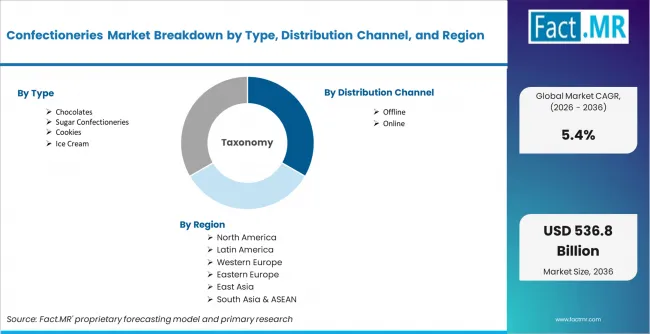
The Confectioneries Market is segmented by Type (Chocolates, Sugar Confectioneries, Cookies, Ice Cream); by Distribution Channel (Offline, Online); by Product Positioning (Regular, Reduced Sugar, Organic, Functional); by Packaging Format (Single-serve Packs, Multipacks, Gift Packs, Seasonal Packs); by Consumption Occasion (Everyday Snacking, Gifting, Festive Consumption, Impulse Purchase), and Region. Forecast for 2026 to 2036.
Confectioneries Market Size, Market Forecast and Outlook by Fact.MR
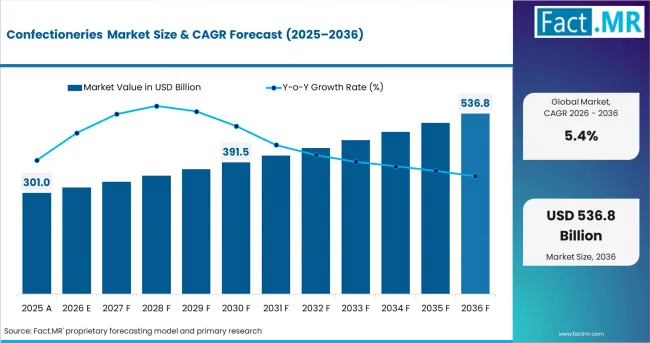
- The confectioneries market crossed a valuation of USD 301.0 billion in 2025.
- Demand is estimated to reach USD 317.3 billion in 2026 and is projected to rise to USD 536.8 billion by 2036.
- The market is forecast to record 5.4% CAGR from 2026 to 2036 as portioned indulgence and premium sweet products support demand.
| Metric | Details |
|---|---|
| Industry Size (2026) | USD 317.3 billion |
| Industry Value (2036) | USD 536.8 billion |
| CAGR (2026 to 2036) | 5.4% |
Summary of Confectioneries Market
- Demand Drivers in the Market
- Small Indulgence: Consumers use confectionery as an affordable treat. This keeps chocolate and candy demand steady.
- Seasonal Rotation: Retailers use confectionery packs during festive and gifting periods. Seasonal displays help increase basket value.
- Label Awareness: Product managers need clear sugar and ingredient details. This helps brands address health-aware shoppers.
- Key Segments Analyzed
- By Type: Chocolates are projected to record 42.5% share in 2026 as familiar taste and premium formats support repeat purchase.
- By Distribution Channel: Offline retail leads because confectionery depends on shelf visibility and impulse purchase. The channel is estimated to hold 78.0% share in 2026.
- By Product Positioning: Regular confectioneries are projected to account for 66.0% share in 2026 because mainstream taste still drives most purchases.
- By Packaging Format: Single-serve packs lead because confectionery buying often starts at checkout and convenience shelves. The format is expected to hold 36.5% share in 2026.
- By Consumption Occasion: Everyday snacking is anticipated to represent 39.0% share in 2026 because confectionery is often bought as a small personal treat.
- By Geography: China confectionery demand is forecast to grow at 5.8% CAGR from 2026 to 2036 as premium chocolate and online snack channels expand.
- Analyst Opinion at Fact.MR
- Shambhu Nath Jha, Senior Analyst at Fact.MR, states, “Confectionery demand is becoming more disciplined. Consumers still want indulgence, but they are paying closer attention to portion size and label details. Brands that protect taste while improving pack clarity will defend stronger shelf rotation.”
- Strategic Implications
- Ingredient Planning: Chocolate manufacturers need better cocoa cost management. Price changes can affects margins quickly.
- Pack Discipline: Retail brands should match pack size with the use occasion. Poor pack design can reduce impulse sales.
- Sugar Positioning: Product managers need clear reduced-sugar claims. Weak taste can lower repeat demand.
Confectionery demand is rising as shoppers continue to treat chocolate and sugar sweet as small indulgence. Fact.MR identifies chocolates as the leading product segment. Brands are shifting from premium and portioned formats. Reduced-sugar options are also gaining attention. Pack clarity and sugar positioning matter because brands need to protect taste while meeting health-aware needs.
China is forecast to grow at 5.8% CAGR from 2026 to 2036 as premium chocolate and online snack channels expand. South Korea is projected to record 5.1% CAGR as novelty flavors and convenience retail support trial. United States demand is set to rise at 4.9% CAGR through seasonal candy and premium chocolate sales. France follows at 4.6% CAGR through premium and artisanal confectionery. Australia is likely to post 4.5% CAGR through healthier indulgence and retail depth.
Segmental Analysis
Confectioneries Market Analysis by Type
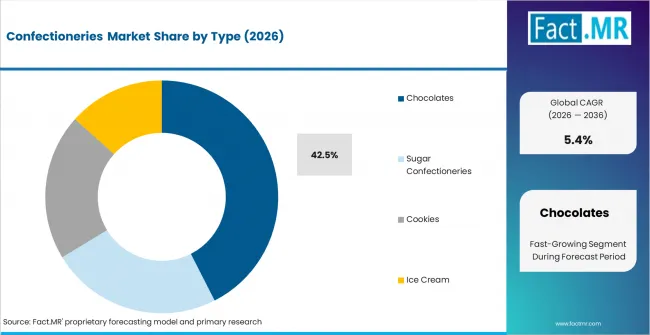
Chocolates are projected to record 42.5% share in 2026 because the format combines taste familiarity with gifting and seasonal use. Sugar confectionery stays important through gums and chewy candies. Cookies and ice cream support adjacent confectionery occasions. The Hershey Company reported in July 2025 that seasonal consumption supported candy and gum performance, while higher commodity and manufacturing costs pressured margin. [1] Chocolate leads because it works across impulse bars and premium gift packs.
- Chocolate Pull: Chocolate supports daily treats and premium gifting. Brand trust helps protect repeat purchase.
- Candy Reach: Sugar confectioneries serve gums and chewy formats. Low-priced items keep the segment active.
- Frozen Treats: Ice cream supports confectionery-style indulgence. It depends more on cold-chain access than shelf candy.
Confectioneries Market Analysis by Distribution Channel
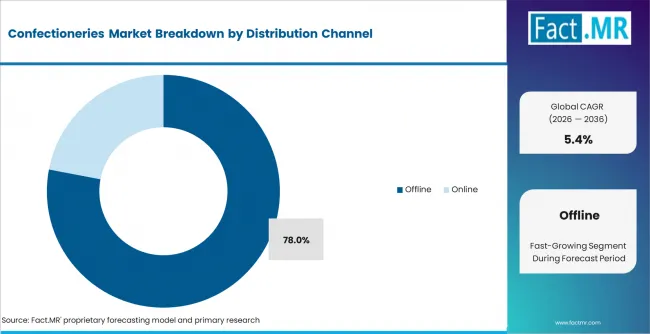
Offline retail still leads because confectionery sales depends on shelf visibility and checkout placement. Online channels support premium bundles and niche products. Offline distribution is estimated to hold 78.0% share in 2026 as supermarkets and convenience stores drive chocolate and candy sales. Acosta Group reported in October 2025 that 63.0% of convenience store shoppers purchase candy on impulse, making candy the second leading impulse category in the channel. [2] Store placement matters because confectionery often converts through quick visual cues. Online channels work well for gifting and imported products. Brands that depend only on digital discovery may miss impulse sales in stores.
- Shelf Impact: Offline retail gives brands visibility near checkout. This supports unplanned candy and chocolate sales.
- Gift Bundles: Online channels help premium confectionery reach planned gifting demand. Digital sales work best for known brands.
- Store Rotation: Retailers use seasonal displays to refresh confectionery demand. Poor placement can reduce trial.
Confectioneries Market Analysis by Product Positioning
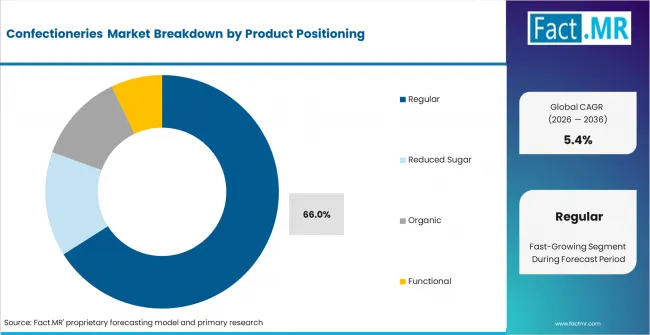
Regular confectioneries are projected to hold 66.0% share in 2026 because familiar taste still drives the huge sales. Reduced-sugar and organic products are gaining attention as shoppers check labels. Functional confectionery serves smaller premium demand. Mondelēz International reported in June 2025 that 81.0% of consumers pay attention to the sensory experience of snacks, including flavor and texture cues. [3] Reduced-sugar formats need good taste because shoppers rarely accept weak flavor in sweets.
- Taste Base: Regular products keep broad retail demand. Familiar chocolate and candy flavors support repeat sales.
- Sugar Control: Reduced-sugar products need clear claims and stable taste. Weak flavor can limit repeat sales.
- Premium Signals: Organic and functional ranges serve smaller premium demand. Ingredient trust matters more than novelty.
Confectioneries Market Analysis by Packaging Format
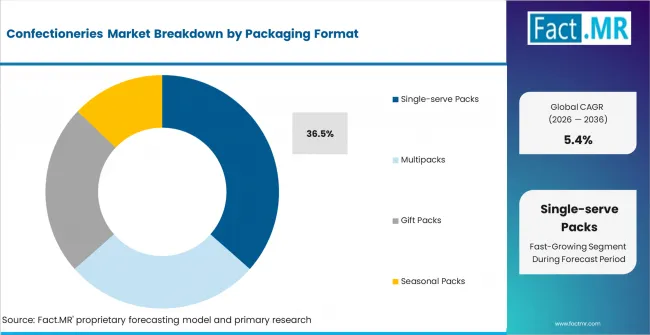
Single-serve packs lead because confectionery is often picked for quick eating. Multipacks support households and lunchboxes. Gift packs serve festive and premium purchases. Seasonal packs help retailers create display-led sales peaks. Single-serve packs are expected to hold 36.5% share in 2026 because portioned treats work well in convenience stores and checkout shelves. Hershey introduced a consumer-focused packaging strategy at the 2025 NCA Sweets & Snacks Expo to support easier snacking moments. [4] Single-serve packs help brands manage price points and portion control. Large packs need clearer value positioning.
- Portion Ease: Single-serve packs support quick snacking. They help shoppers manage treat size.
- Household Use: Multipacks suit planned pantry use. Retailers use them for value offers.
- Gifting Role: Gift packs support festive demand. Premium packaging can improve price realization.
Confectioneries Market Analysis by Consumption Occasion
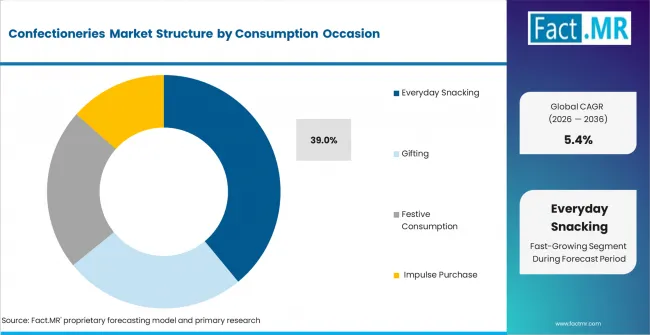
Everyday snacking is anticipated to hold 39.0% share in 2026 because confectionery works as a small personal treat. Gifting supports premium chocolate and boxed assortments. Festive use drives seasonal sales. Impulse purchase supports checkout demand. Everyday snacking leads because confectionery is easy to eat and has a low price barrier. Brands must manage price and pack value carefully because routine snacking can slow when prices rise too much.
- Daily Treats: Everyday snacking supports frequent purchase. Price points must stay accessible.
- Festive Peaks: Seasonal consumption lifts demand during holidays. Retailers need reliable display packs.
- Gift Demand: Boxed chocolates serve planned purchases. Premium cues and brand trust shape selection.
Confectioneries Market Drivers, Restraints, and Opportunities
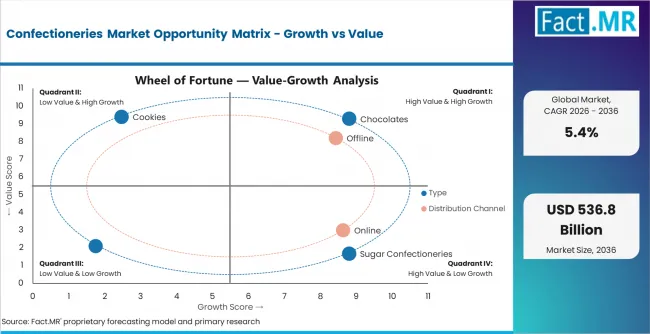
Small indulgence and seasonal demand are the main demand drivers. Confectionery products work well as quick treats and gifts. Checkout shelves and display packs give brands another sales route. Product refresh helps brands keep shopper interest without changing the main role of confectionery as a sweet treat.
Ingredient cost and nutrition concerns are the main restraints. Cocoa prices are a major issue for chocolate makers. Sugar labels can affect repeat demand among health-aware shoppers. Brands need careful pack sizing and clear claims to protect taste and margins.
Opportunities in the Confectioneries Market
- Reduced-Sugar Treats: Brands can target shoppers who still want candy and chocolate with clearer sugar control. Taste quality remains the main test.
- Premium Gifting: Chocolate brands can lift value through gift boxes and seasonal packs.
- Online Specialty Packs: E-commerce can support imported products and curated confectionery boxes.
Regional Analysis
- Based on regional analysis, the confectioneries market is segmented into North America, Latin America, Europe, East Asia, South Asia and Oceania, and Middle East and Africa.
.webp)
| Country | CAGR |
|---|---|
| China | 5.8% |
| South Korea | 5.1% |
| United States | 4.9% |
| France | 4.6% |
| Australia | 4.5% |
Source: Fact.MR analysis based on forecast model and primary research.
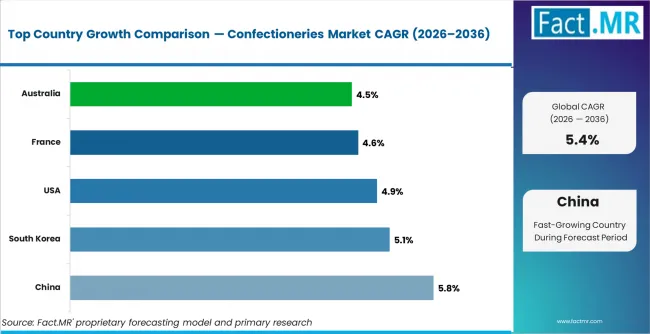
East Asia Confectioneries Market Analysis
East Asia demand comes from premium chocolate and convenience retail. China leads because online channels and rising interest in international brands support higher-value confectionery sales. South Korea supports demand through fast flavor turnover and convenience store activity. Regional demand depends on how well brands combine novelty with price access.
- China: China is forecast to grow at 5.8% CAGR from 2026 to 2036 as premium chocolate and online snack channels expand. Urban households are more open to gifting packs and international confectionery brands. E-commerce improves access to seasonal ranges and imported products. Suppliers that localize flavors without weakening global brand cues can gain stronger trial.
- South Korea: Convenience retail and snacking trends support confectionery demand in South Korea. The country is projected to record 5.1% CAGR over the study period as novelty formats and compact packs gain shelf space. Young shoppers respond well to seasonal flavors. Brands can improve retailer support when they refresh products and control inventory risk.
North America Confectioneries Market Analysis
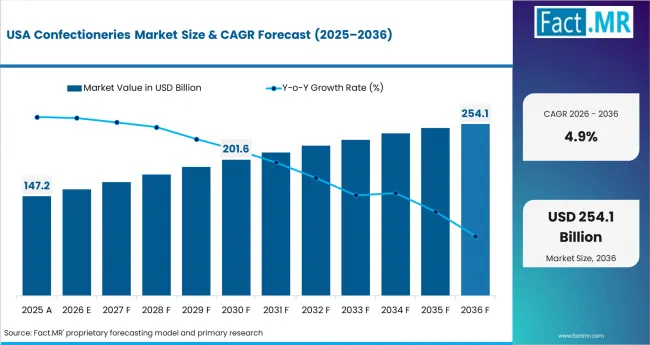
North America demand is supported by seasonal candy and chocolate bar sales. The United States is the key market because major brands compete through checkout placement and holiday programs. Sugar labeling and cocoa price pressure affect brand strategy. Retailers need products that balance price and pack size without reducing shelf appeal.
- United States: Seasonal candy programs and premium chocolate keep the United States central to demand. The U.S. confectioneries market is set to expand at 4.9% CAGR from 2026 to 2036. Reuters reported in July 2025 that Hershey beat quarterly estimates due to strong Easter demand and early Halloween shipments, while pricing was used to offset high cocoa costs and tariff pressure. [5] Brands need careful pricing because cocoa and tariff costs can affect consumer response.
Europe Confectioneries Market Analysis
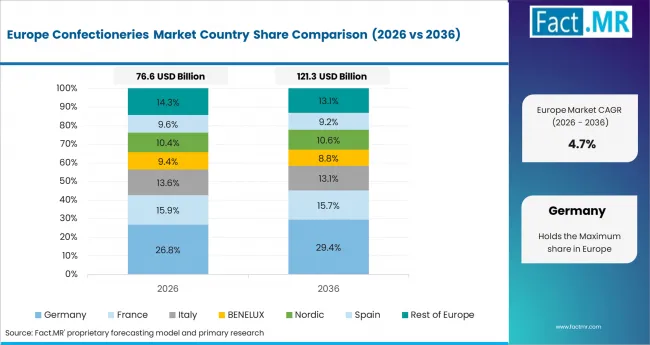
Europe demand comes from chocolate heritage and premium formats. France supports premium and artisanal chocolate demand.
- France: Premium chocolate and artisanal sweets support French confectionery demand. France is estimated to grow at 4.6% CAGR over the forecast period. Retailers benefit from gift boxes and seasonal chocolate programs. Local flavor matters because shoppers connect confectionery with craft and gifting. Brands with strong ingredient claims can protect premium shelf space.
Oceania Confectioneries Market Analysis
Oceania demand is supported by developed retail channels and interest in healthier indulgence. Australia leads the regional outlook because supermarkets and convenience stores support chocolate and sugar confectionery sales. Premium and lower-sugar products can gain attention, but mainstream taste remains the main driver.
- Australia: Australia is likely to post 4.5% CAGR by 2036 as healthier treats and wide retail access support confectionery sales. Shoppers are open to low-sugar and premium products, but price still matters. Retailers need packs for household use and quick snacking. Brands with good taste and clear labels can improve repeat demand.
Competitive Aligners for Market Players
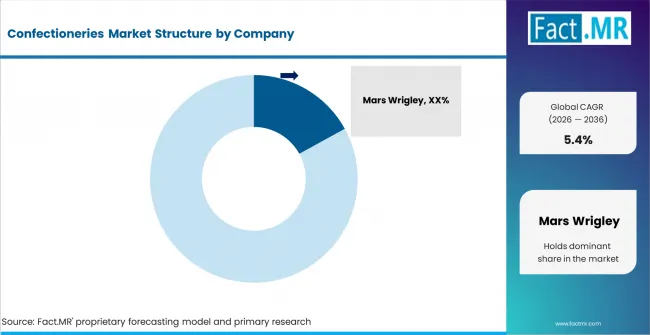
The confectioneries market includes global chocolate groups and sweet snack companies. Mondelēz International, Inc. supports the market through Cadbury, Toblerone and wider snacking brands. Nestlé S.A. has confectionery strength through KitKat and selected chocolate products. The Hershey Company holds a strong position in North America through chocolate and candy brands. Ferrero Group supports premium confectionery through chocolate and packaged sweet products. Lindt & Sprüngli focuses on premium chocolate and gifting ranges.
Supplier position through 2036 will depend on pricing discipline and pack innovation. Chocolate makers need stronger cocoa cost planning. Sugar confectionery brands need clearer label strategies. Retailers need reliable seasonal ranges. Companies that combine brand strength with portion control and format refresh can protect repeat demand.
Key Players in Confectioneries Market
- Mars Wrigley
- Mondelēz International, Inc.
- Nestlé S.A.
- The Hershey Company
- Ferrero Group
- Lindt & Sprüngli
Bibliography
- [1] The Hershey Company. (2025, July 30). Hershey reports second-quarter 2025 financial results.
- [2] Acosta Group. (2025, October 7). The ongoing evolution of convenience store shoppers: Loyal, frequent and looking for more, according to Acosta Group.
- [3] Mondelēz International. (2025, June 17). Mondelēz International State of Snacking survey: Global consumers prioritize portions and snacking mindfully.
- [4] The Hershey Company. (2025, May 8). The Hershey Company introduces innovation and consumer-focused packaging strategy at 2025 NCA Sweets & Snacks Expo.
- [5] Reuters. (2025, July 30). Hershey beats quarterly estimates on strong Easter demand.
This Report Addresses
- Strategic intelligence on confectionery demand across chocolate and sugar confectioneries.
- Growth opportunity mapping across China and South Korea plus the United States and France.
- Segment analysis by type, distribution channel, product positioning, packaging format and consumption occasion.
- Regional outlook covering premium chocolate, sugar moderation and seasonal retail demand.
- Competitive analysis of Mars Wrigley, Mondelēz International, Nestlé, Hershey, Ferrero and Pladis.
- Product assessment covering chocolates, sugar confectioneries, single-serve packs and reduced-sugar products.
- Market forecast built from Fact.MR’s baseline model with a revised 2026 to 2036 CAGR.
- Primary interviews, supplier checks and confectionery source review support validation.
Confectioneries Market Definition
The confectioneries market covers sweet food products sold for indulgence and gifting. The scope includes sugar confectioneries and ice cream products used in confectionery consumption. The market differs from general snack foods because purchase decisions rely strongly on taste trust and occasion-led consumption.
Confectioneries Market Inclusions
The scope includes chocolate bars and sugar confectioneries. Gums and chewy candies are counted. Cookies and ice cream are included when sold as confectionery products. Regular, reduced sugar and organic formats are covered. Gift packs and seasonal packs are counted because they support confectionery-led occasions.
Confectioneries Market Exclusions
The scope excludes bakery products without confectionery positioning. Savory snacks are outside scope. Sweeteners sold as ingredients are excluded. Cocoa powder and chocolate ingredients sold to processors are not counted as finished confectioneries. Nutritional bars are excluded unless confectionery taste and retail placement define the product.
Confectioneries Market Research Methodology
- Primary Research
- Primary research includes interviews with confectionery category managers and retail buying heads. Brand portfolio managers were reviewed for flavor and pack strategy. Ingredient heads were checked for cocoa and sugar cost assumptions.
- Desk Research
- Desk research reviewed company filings and official brand information. Public nutrition label sources supported sugar-positioning analysis. Cocoa market data supported ingredient cost pressure logic.
- Market-Sizing and Forecasting
- Forecasting uses product type demand and channel movement. Packaging estimates reflect impulse sales and gifting use. Product positioning estimates are linked to regular and reduced-sugar confectionery adoption.
- Data Validation and Update Cycle
- Forecasts were validated through company portfolio checks and retail channel evidence. Regional assumptions were reviewed with country-level consumption patterns from the Fact.MR baseline. Ingredient cost assumptions were checked against cocoa market signals.
Scope of the Report

| Attribute | Details |
|---|---|
| Quantitative Units | USD 317.3 billion in 2026 to USD 536.8 billion by 2036 at 5.40% CAGR |
| Market Definition | Sweet food products sold for indulgence, snacking and gifting across chocolate, candy and related formats. |
| Type | Chocolates , Sugar Confectioneries , Cookies , Ice Cream |
| Distribution Channel | Offline , Online |
| Product Positioning | Regular , Reduced Sugar , Organic , Functional |
| Packaging Format | Single-serve Packs , Multipacks , Gift Packs , Seasonal Packs |
| Consumption Occasion | Everyday Snacking , Gifting , Festive Consumption , Impulse Purchase |
| Regions Covered | North America , Latin America , Europe , East Asia , South Asia and Oceania , Middle East and Africa |
| Countries Covered | China , South Korea , United States , France , Australia |
| Key Companies Profiled | Mondelēz International, Inc., Nestlé S.A., The Hershey Company, Ferrero Group, Lindt & Sprüngli |
| Forecast Period | 2026 to 2036 |
| Approach | Hybrid top-down and bottom-up model using type demand, channel movement, pack format trends and supplier validation. |
Confectioneries Market Analysis by Segments
-
By Type:
- Chocolates
- Sugar Confectioneries
- Cookies
- Ice Cream
-
By Distribution Channel:
- Offline
- Online
-
By Product Positioning:
- Regular
- Reduced Sugar
- Organic
- Functional
-
By Packaging Format:
- Single-serve Packs
- Multipacks
- Gift Packs
- Seasonal Packs
-
By Consumption Occasion:
- Everyday Snacking
- Gifting
- Impulse Purchase
-
Region:
- North America
- United States
- Canada
- Europe
- Germany
- United Kingdom
- France
- Italy
- Spain
- East Asia
- China
- Japan
- South Korea
- South Asia and Oceania
- India
- Australia
- New Zealand
- Latin America
- Brazil
- Mexico
- Middle East and Africa
- GCC Countries
- South Africa
- North America
- Frequently Asked Questions -
How large is the confectioneries market in 2025?
The confectioneries market was valued at USD 301.0 billion in 2025.
What is the expected value of the confectioneries market in 2026?
The confectioneries market is estimated to reach USD 317.3 billion in 2026.
What is the forecast value of the confectioneries market by 2036?
The confectioneries market is forecast to reach USD 536.8 billion by 2036 as premium and portioned snacking expands.
What CAGR is projected for the confectioneries market from 2026 to 2036?
Fact.MR’s forecast projects 5.40% CAGR for the confectioneries market from 2026 to 2036.
Which type leads the confectioneries market?
Chocolates lead with 42.5% share in 2026 because familiar taste and gifting demand support repeat purchase.
Why do chocolates lead confectionery demand?
Chocolates lead because they work across impulse bars, gift boxes and seasonal retail displays.
Which distribution channel leads the confectioneries market?
Offline retail leads with 78.0% share in 2026 because shelf visibility and checkout placement drive impulse sales.
Which product positioning leads the confectioneries market?
Regular confectioneries lead with 66.0% share in 2026 because mainstream taste still drives most category volume.
Which packaging format leads the confectioneries market?
Single-serve packs lead with 36.5% share in 2026 because confectionery often depends on portioned and impulse purchases.
Which consumption occasion leads the confectioneries market?
Everyday snacking leads with 39.0% share in 2026 because confectionery is often bought as a small personal treat.
Which country grows fastest in the confectioneries market?
China is forecast to grow fastest at 5.8% CAGR from 2026 to 2036.
Why is South Korea important in the confectioneries market?
South Korea is important because convenience retail and novelty flavors support frequent product trials.
Why does the United States support confectionery demand?
The United States supports demand through seasonal candy programs and strong chocolate brand presence.
What drives confectioneries market demand?
Small indulgence, seasonal buying and product refresh drive confectionery demand.
What restrains confectioneries market demand?
Cocoa cost movement and added sugar scrutiny restrain pricing and product positioning.
How do reduced-sugar confectioneries support future demand?
Reduced-sugar confectioneries help brands serve health-aware shoppers without leaving the indulgence space.
How do gift packs support confectionery sales?
Gift packs lift value during holidays and planned occasions.
What is included in the confectioneries market scope?
The scope includes chocolates, sugar confectioneries, cookies, ice cream and confectionery-led packs.
What is excluded from the confectioneries market scope?
Savory snacks, plain bakery products and ingredient-only cocoa products are excluded.
How does Fact.MR forecast confectionery demand?
Fact.MR forecasts demand using product type demand, channel movement, pack format trends and supplier validation.
Table of Content
- Executive Summary
- Global Market Outlook
- Demand to side Trends
- Supply to side Trends
- Technology Roadmap Analysis
- Analysis and Recommendations
- Market Overview
- Market Coverage / Taxonomy
- Market Definition / Scope / Limitations
- Research Methodology
- Chapter Orientation
- Analytical Lens and Working Hypotheses
- Market Structure, Signals, and Trend Drivers
- Benchmarking and Cross-market Comparability
- Market Sizing, Forecasting, and Opportunity Mapping
- Research Design and Evidence Framework
- Desk Research Programme (Secondary Evidence)
- Company Annual and Sustainability Reports
- Peer-reviewed Journals and Academic Literature
- Corporate Websites, Product Literature, and Technical Notes
- Earnings Decks and Investor Briefings
- Statutory Filings and Regulatory Disclosures
- Technical White Papers and Standards Notes
- Trade Journals, Industry Magazines, and Analyst Briefs
- Conference Proceedings, Webinars, and Seminar Materials
- Government Statistics Portals and Public Data Releases
- Press Releases and Reputable Media Coverage
- Specialist Newsletters and Curated Briefings
- Sector Databases and Reference Repositories
- Fact.MR Internal Proprietary Databases and Historical Market Datasets
- Subscription Datasets and Paid Sources
- Social Channels, Communities, and Digital Listening Inputs
- Additional Desk Sources
- Expert Input and Fieldwork (Primary Evidence)
- Primary Modes
- Qualitative Interviews and Expert Elicitation
- Quantitative Surveys and Structured Data Capture
- Blended Approach
- Why Primary Evidence is Used
- Field Techniques
- Interviews
- Surveys
- Focus Groups
- Observational and In-context Research
- Social and Community Interactions
- Stakeholder Universe Engaged
- C-suite Leaders
- Board Members
- Presidents and Vice Presidents
- R&D and Innovation Heads
- Technical Specialists
- Domain Subject-matter Experts
- Scientists
- Physicians and Other Healthcare Professionals
- Governance, Ethics, and Data Stewardship
- Research Ethics
- Data Integrity and Handling
- Primary Modes
- Tooling, Models, and Reference Databases
- Desk Research Programme (Secondary Evidence)
- Data Engineering and Model Build
- Opportunity
- Trends
- Scenario Forecast
- Demand in Optimistic Scenario
- Demand in Likely Scenario
- Demand in Conservative Scenario
- Opportunity Map Analysis
- Product Life Cycle Analysis
- Supply Chain Analysis
- Investment Feasibility Matrix
- Value Chain Analysis
- PESTLE and Porter’s Analysis
- Regulatory Landscape
- Regional Parent Market Outlook
- Production and Consumption Statistics
- Import and Export Statistics
- Global Market Analysis 2021 to 2025 and Forecast, 2026 to 2036
- Historical Market Size Value (USD Million) Analysis, 2021 to 2025
- Current and Future Market Size Value (USD Million) Projections, 2026 to 2036
- Y to o to Y Growth Trend Analysis
- Absolute $ Opportunity Analysis
- Global Market Pricing Analysis 2021 to 2025 and Forecast 2026 to 2036
- Global Market Analysis 2021 to 2025 and Forecast 2026 to 2036, By Type
- Introduction / Key Findings
- Historical Market Size Value (USD Million) Analysis By Type , 2021 to 2025
- Current and Future Market Size Value (USD Million) Analysis and Forecast By Type , 2026 to 2036
- Chocolates
- Sugar Confectioneries
- Cookies
- Ice Cream
- Chocolates
- Y to o to Y Growth Trend Analysis By Type , 2021 to 2025
- Absolute $ Opportunity Analysis By Type , 2026 to 2036
- Global Market Analysis 2021 to 2025 and Forecast 2026 to 2036, By Distribution Channel
- Introduction / Key Findings
- Historical Market Size Value (USD Million) Analysis By Distribution Channel, 2021 to 2025
- Current and Future Market Size Value (USD Million) Analysis and Forecast By Distribution Channel, 2026 to 2036
- Offline
- Online
- Offline
- Y to o to Y Growth Trend Analysis By Distribution Channel, 2021 to 2025
- Absolute $ Opportunity Analysis By Distribution Channel, 2026 to 2036
- Global Market Analysis 2021 to 2025 and Forecast 2026 to 2036, By Product Positioning
- Introduction / Key Findings
- Historical Market Size Value (USD Million) Analysis By Product Positioning, 2021 to 2025
- Current and Future Market Size Value (USD Million) Analysis and Forecast By Product Positioning, 2026 to 2036
- Regular
- Reduced Sugar
- Organic
- Functional
- Regular
- Y to o to Y Growth Trend Analysis By Product Positioning, 2021 to 2025
- Absolute $ Opportunity Analysis By Product Positioning, 2026 to 2036
- Global Market Analysis 2021 to 2025 and Forecast 2026 to 2036, By Packaging Format
- Introduction / Key Findings
- Historical Market Size Value (USD Million) Analysis By Packaging Format, 2021 to 2025
- Current and Future Market Size Value (USD Million) Analysis and Forecast By Packaging Format, 2026 to 2036
- Single-serve Packs
- Multipacks
- Gift Packs
- Seasonal Packs
- Single-serve Packs
- Y to o to Y Growth Trend Analysis By Packaging Format, 2021 to 2025
- Absolute $ Opportunity Analysis By Packaging Format, 2026 to 2036
- Global Market Analysis 2021 to 2025 and Forecast 2026 to 2036, By Consumption Occasion
- Introduction / Key Findings
- Historical Market Size Value (USD Million) Analysis By Consumption Occasion, 2021 to 2025
- Current and Future Market Size Value (USD Million) Analysis and Forecast By Consumption Occasion, 2026 to 2036
- Everyday Snacking
- Gifting
- Festive Consumption
- Impulse Purchase
- Everyday Snacking
- Y to o to Y Growth Trend Analysis By Consumption Occasion, 2021 to 2025
- Absolute $ Opportunity Analysis By Consumption Occasion, 2026 to 2036
- Global Market Analysis 2021 to 2025 and Forecast 2026 to 2036, By Region
- Introduction
- Historical Market Size Value (USD Million) Analysis By Region, 2021 to 2025
- Current Market Size Value (USD Million) Analysis and Forecast By Region, 2026 to 2036
- North America
- Latin America
- Western Europe
- Eastern Europe
- East Asia
- South Asia and Pacific
- Middle East & Africa
- Market Attractiveness Analysis By Region
- North America Market Analysis 2021 to 2025 and Forecast 2026 to 2036, By Country
- Historical Market Size Value (USD Million) Trend Analysis By Market Taxonomy, 2021 to 2025
- Market Size Value (USD Million) Forecast By Market Taxonomy, 2026 to 2036
- By Country
- USA
- Canada
- Mexico
- By Type
- By Distribution Channel
- By Product Positioning
- By Packaging Format
- By Consumption Occasion
- By Country
- Market Attractiveness Analysis
- By Country
- By Type
- By Distribution Channel
- By Product Positioning
- By Packaging Format
- By Consumption Occasion
- Key Takeaways
- Latin America Market Analysis 2021 to 2025 and Forecast 2026 to 2036, By Country
- Historical Market Size Value (USD Million) Trend Analysis By Market Taxonomy, 2021 to 2025
- Market Size Value (USD Million) Forecast By Market Taxonomy, 2026 to 2036
- By Country
- Brazil
- Chile
- Rest of Latin America
- By Type
- By Distribution Channel
- By Product Positioning
- By Packaging Format
- By Consumption Occasion
- By Country
- Market Attractiveness Analysis
- By Country
- By Type
- By Distribution Channel
- By Product Positioning
- By Packaging Format
- By Consumption Occasion
- Key Takeaways
- Western Europe Market Analysis 2021 to 2025 and Forecast 2026 to 2036, By Country
- Historical Market Size Value (USD Million) Trend Analysis By Market Taxonomy, 2021 to 2025
- Market Size Value (USD Million) Forecast By Market Taxonomy, 2026 to 2036
- By Country
- Germany
- UK
- Italy
- Spain
- France
- Nordic
- BENELUX
- Rest of Western Europe
- By Type
- By Distribution Channel
- By Product Positioning
- By Packaging Format
- By Consumption Occasion
- By Country
- Market Attractiveness Analysis
- By Country
- By Type
- By Distribution Channel
- By Product Positioning
- By Packaging Format
- By Consumption Occasion
- Key Takeaways
- Eastern Europe Market Analysis 2021 to 2025 and Forecast 2026 to 2036, By Country
- Historical Market Size Value (USD Million) Trend Analysis By Market Taxonomy, 2021 to 2025
- Market Size Value (USD Million) Forecast By Market Taxonomy, 2026 to 2036
- By Country
- Russia
- Poland
- Hungary
- Balkan & Baltic
- Rest of Eastern Europe
- By Type
- By Distribution Channel
- By Product Positioning
- By Packaging Format
- By Consumption Occasion
- By Country
- Market Attractiveness Analysis
- By Country
- By Type
- By Distribution Channel
- By Product Positioning
- By Packaging Format
- By Consumption Occasion
- Key Takeaways
- East Asia Market Analysis 2021 to 2025 and Forecast 2026 to 2036, By Country
- Historical Market Size Value (USD Million) Trend Analysis By Market Taxonomy, 2021 to 2025
- Market Size Value (USD Million) Forecast By Market Taxonomy, 2026 to 2036
- By Country
- China
- Japan
- South Korea
- By Type
- By Distribution Channel
- By Product Positioning
- By Packaging Format
- By Consumption Occasion
- By Country
- Market Attractiveness Analysis
- By Country
- By Type
- By Distribution Channel
- By Product Positioning
- By Packaging Format
- By Consumption Occasion
- Key Takeaways
- South Asia and Pacific Market Analysis 2021 to 2025 and Forecast 2026 to 2036, By Country
- Historical Market Size Value (USD Million) Trend Analysis By Market Taxonomy, 2021 to 2025
- Market Size Value (USD Million) Forecast By Market Taxonomy, 2026 to 2036
- By Country
- India
- ASEAN
- Australia & New Zealand
- Rest of South Asia and Pacific
- By Type
- By Distribution Channel
- By Product Positioning
- By Packaging Format
- By Consumption Occasion
- By Country
- Market Attractiveness Analysis
- By Country
- By Type
- By Distribution Channel
- By Product Positioning
- By Packaging Format
- By Consumption Occasion
- Key Takeaways
- Middle East & Africa Market Analysis 2021 to 2025 and Forecast 2026 to 2036, By Country
- Historical Market Size Value (USD Million) Trend Analysis By Market Taxonomy, 2021 to 2025
- Market Size Value (USD Million) Forecast By Market Taxonomy, 2026 to 2036
- By Country
- Kingdom of Saudi Arabia
- Other GCC Countries
- Turkiye
- South Africa
- Other African Union
- Rest of Middle East & Africa
- By Type
- By Distribution Channel
- By Product Positioning
- By Packaging Format
- By Consumption Occasion
- By Country
- Market Attractiveness Analysis
- By Country
- By Type
- By Distribution Channel
- By Product Positioning
- By Packaging Format
- By Consumption Occasion
- Key Takeaways
- Key Countries Market Analysis
- USA
- Pricing Analysis
- Market Share Analysis, 2025
- By Type
- By Distribution Channel
- By Product Positioning
- By Packaging Format
- By Consumption Occasion
- Canada
- Pricing Analysis
- Market Share Analysis, 2025
- By Type
- By Distribution Channel
- By Product Positioning
- By Packaging Format
- By Consumption Occasion
- Mexico
- Pricing Analysis
- Market Share Analysis, 2025
- By Type
- By Distribution Channel
- By Product Positioning
- By Packaging Format
- By Consumption Occasion
- Brazil
- Pricing Analysis
- Market Share Analysis, 2025
- By Type
- By Distribution Channel
- By Product Positioning
- By Packaging Format
- By Consumption Occasion
- Chile
- Pricing Analysis
- Market Share Analysis, 2025
- By Type
- By Distribution Channel
- By Product Positioning
- By Packaging Format
- By Consumption Occasion
- Germany
- Pricing Analysis
- Market Share Analysis, 2025
- By Type
- By Distribution Channel
- By Product Positioning
- By Packaging Format
- By Consumption Occasion
- UK
- Pricing Analysis
- Market Share Analysis, 2025
- By Type
- By Distribution Channel
- By Product Positioning
- By Packaging Format
- By Consumption Occasion
- Italy
- Pricing Analysis
- Market Share Analysis, 2025
- By Type
- By Distribution Channel
- By Product Positioning
- By Packaging Format
- By Consumption Occasion
- Spain
- Pricing Analysis
- Market Share Analysis, 2025
- By Type
- By Distribution Channel
- By Product Positioning
- By Packaging Format
- By Consumption Occasion
- France
- Pricing Analysis
- Market Share Analysis, 2025
- By Type
- By Distribution Channel
- By Product Positioning
- By Packaging Format
- By Consumption Occasion
- India
- Pricing Analysis
- Market Share Analysis, 2025
- By Type
- By Distribution Channel
- By Product Positioning
- By Packaging Format
- By Consumption Occasion
- ASEAN
- Pricing Analysis
- Market Share Analysis, 2025
- By Type
- By Distribution Channel
- By Product Positioning
- By Packaging Format
- By Consumption Occasion
- Australia & New Zealand
- Pricing Analysis
- Market Share Analysis, 2025
- By Type
- By Distribution Channel
- By Product Positioning
- By Packaging Format
- By Consumption Occasion
- China
- Pricing Analysis
- Market Share Analysis, 2025
- By Type
- By Distribution Channel
- By Product Positioning
- By Packaging Format
- By Consumption Occasion
- Japan
- Pricing Analysis
- Market Share Analysis, 2025
- By Type
- By Distribution Channel
- By Product Positioning
- By Packaging Format
- By Consumption Occasion
- South Korea
- Pricing Analysis
- Market Share Analysis, 2025
- By Type
- By Distribution Channel
- By Product Positioning
- By Packaging Format
- By Consumption Occasion
- Russia
- Pricing Analysis
- Market Share Analysis, 2025
- By Type
- By Distribution Channel
- By Product Positioning
- By Packaging Format
- By Consumption Occasion
- Poland
- Pricing Analysis
- Market Share Analysis, 2025
- By Type
- By Distribution Channel
- By Product Positioning
- By Packaging Format
- By Consumption Occasion
- Hungary
- Pricing Analysis
- Market Share Analysis, 2025
- By Type
- By Distribution Channel
- By Product Positioning
- By Packaging Format
- By Consumption Occasion
- Kingdom of Saudi Arabia
- Pricing Analysis
- Market Share Analysis, 2025
- By Type
- By Distribution Channel
- By Product Positioning
- By Packaging Format
- By Consumption Occasion
- Turkiye
- Pricing Analysis
- Market Share Analysis, 2025
- By Type
- By Distribution Channel
- By Product Positioning
- By Packaging Format
- By Consumption Occasion
- South Africa
- Pricing Analysis
- Market Share Analysis, 2025
- By Type
- By Distribution Channel
- By Product Positioning
- By Packaging Format
- By Consumption Occasion
- USA
- Market Structure Analysis
- Competition Dashboard
- Competition Benchmarking
- Market Share Analysis of Top Players
- By Regional
- By Type
- By Distribution Channel
- By Product Positioning
- By Packaging Format
- By Consumption Occasion
- Competition Analysis
- Competition Deep Dive
- Mars Wrigley
- Overview
- Product Portfolio
- Profitability by Market Segments (Product/Age /Sales Channel/Region)
- Sales Footprint
- Strategy Overview
- Marketing Strategy
- Product Strategy
- Channel Strategy
- Mondelēz International, Inc.
- Nestlé S.A.
- The Hershey Company
- Ferrero Group
- Lindt & Sprüngli
- Mars Wrigley
- Competition Deep Dive
- Assumptions & Acronyms Used
List Of Table
- Table 1: Global Market Value (USD Million) Forecast by Region, 2021 to 2036
- Table 2: Global Market Value (USD Million) Forecast by Type, 2021 to 2036
- Table 3: Global Market Value (USD Million) Forecast by Distribution Channel, 2021 to 2036
- Table 4: Global Market Value (USD Million) Forecast by Product Positioning, 2021 to 2036
- Table 5: Global Market Value (USD Million) Forecast by Packaging Format, 2021 to 2036
- Table 6: Global Market Value (USD Million) Forecast by Consumption Occasion, 2021 to 2036
- Table 7: North America Market Value (USD Million) Forecast by Country, 2021 to 2036
- Table 8: North America Market Value (USD Million) Forecast by Type, 2021 to 2036
- Table 9: North America Market Value (USD Million) Forecast by Distribution Channel, 2021 to 2036
- Table 10: North America Market Value (USD Million) Forecast by Product Positioning, 2021 to 2036
- Table 11: North America Market Value (USD Million) Forecast by Packaging Format, 2021 to 2036
- Table 12: North America Market Value (USD Million) Forecast by Consumption Occasion, 2021 to 2036
- Table 13: Latin America Market Value (USD Million) Forecast by Country, 2021 to 2036
- Table 14: Latin America Market Value (USD Million) Forecast by Type, 2021 to 2036
- Table 15: Latin America Market Value (USD Million) Forecast by Distribution Channel, 2021 to 2036
- Table 16: Latin America Market Value (USD Million) Forecast by Product Positioning, 2021 to 2036
- Table 17: Latin America Market Value (USD Million) Forecast by Packaging Format, 2021 to 2036
- Table 18: Latin America Market Value (USD Million) Forecast by Consumption Occasion, 2021 to 2036
- Table 19: Western Europe Market Value (USD Million) Forecast by Country, 2021 to 2036
- Table 20: Western Europe Market Value (USD Million) Forecast by Type, 2021 to 2036
- Table 21: Western Europe Market Value (USD Million) Forecast by Distribution Channel, 2021 to 2036
- Table 22: Western Europe Market Value (USD Million) Forecast by Product Positioning, 2021 to 2036
- Table 23: Western Europe Market Value (USD Million) Forecast by Packaging Format, 2021 to 2036
- Table 24: Western Europe Market Value (USD Million) Forecast by Consumption Occasion, 2021 to 2036
- Table 25: Eastern Europe Market Value (USD Million) Forecast by Country, 2021 to 2036
- Table 26: Eastern Europe Market Value (USD Million) Forecast by Type, 2021 to 2036
- Table 27: Eastern Europe Market Value (USD Million) Forecast by Distribution Channel, 2021 to 2036
- Table 28: Eastern Europe Market Value (USD Million) Forecast by Product Positioning, 2021 to 2036
- Table 29: Eastern Europe Market Value (USD Million) Forecast by Packaging Format, 2021 to 2036
- Table 30: Eastern Europe Market Value (USD Million) Forecast by Consumption Occasion, 2021 to 2036
- Table 31: East Asia Market Value (USD Million) Forecast by Country, 2021 to 2036
- Table 32: East Asia Market Value (USD Million) Forecast by Type, 2021 to 2036
- Table 33: East Asia Market Value (USD Million) Forecast by Distribution Channel, 2021 to 2036
- Table 34: East Asia Market Value (USD Million) Forecast by Product Positioning, 2021 to 2036
- Table 35: East Asia Market Value (USD Million) Forecast by Packaging Format, 2021 to 2036
- Table 36: East Asia Market Value (USD Million) Forecast by Consumption Occasion, 2021 to 2036
- Table 37: South Asia and Pacific Market Value (USD Million) Forecast by Country, 2021 to 2036
- Table 38: South Asia and Pacific Market Value (USD Million) Forecast by Type, 2021 to 2036
- Table 39: South Asia and Pacific Market Value (USD Million) Forecast by Distribution Channel, 2021 to 2036
- Table 40: South Asia and Pacific Market Value (USD Million) Forecast by Product Positioning, 2021 to 2036
- Table 41: South Asia and Pacific Market Value (USD Million) Forecast by Packaging Format, 2021 to 2036
- Table 42: South Asia and Pacific Market Value (USD Million) Forecast by Consumption Occasion, 2021 to 2036
- Table 43: Middle East & Africa Market Value (USD Million) Forecast by Country, 2021 to 2036
- Table 44: Middle East & Africa Market Value (USD Million) Forecast by Type, 2021 to 2036
- Table 45: Middle East & Africa Market Value (USD Million) Forecast by Distribution Channel, 2021 to 2036
- Table 46: Middle East & Africa Market Value (USD Million) Forecast by Product Positioning, 2021 to 2036
- Table 47: Middle East & Africa Market Value (USD Million) Forecast by Packaging Format, 2021 to 2036
- Table 48: Middle East & Africa Market Value (USD Million) Forecast by Consumption Occasion, 2021 to 2036
List Of Figures
- Figure 1: Global Market Pricing Analysis
- Figure 2: Global Market Value (USD Million) Forecast 2021-2036
- Figure 3: Global Market Value Share and BPS Analysis by Type, 2026 and 2036
- Figure 4: Global Market Y-o-Y Growth Comparison by Type, 2026 to 2036
- Figure 5: Global Market Attractiveness Analysis by Type
- Figure 6: Global Market Value Share and BPS Analysis by Distribution Channel, 2026 and 2036
- Figure 7: Global Market Y-o-Y Growth Comparison by Distribution Channel, 2026 to 2036
- Figure 8: Global Market Attractiveness Analysis by Distribution Channel
- Figure 9: Global Market Value Share and BPS Analysis by Product Positioning, 2026 and 2036
- Figure 10: Global Market Y-o-Y Growth Comparison by Product Positioning, 2026 to 2036
- Figure 11: Global Market Attractiveness Analysis by Product Positioning
- Figure 12: Global Market Value Share and BPS Analysis by Packaging Format, 2026 and 2036
- Figure 13: Global Market Y-o-Y Growth Comparison by Packaging Format, 2026 to 2036
- Figure 14: Global Market Attractiveness Analysis by Packaging Format
- Figure 15: Global Market Value Share and BPS Analysis by Consumption Occasion, 2026 and 2036
- Figure 16: Global Market Y-o-Y Growth Comparison by Consumption Occasion, 2026 to 2036
- Figure 17: Global Market Attractiveness Analysis by Consumption Occasion
- Figure 18: Global Market Value (USD Million) Share and BPS Analysis by Region, 2026 and 2036
- Figure 19: Global Market Y-o-Y Growth Comparison by Region, 2026 to 2036
- Figure 20: Global Market Attractiveness Analysis by Region
- Figure 21: North America Market Incremental Dollar Opportunity, 2026 to 2036
- Figure 22: Latin America Market Incremental Dollar Opportunity, 2026 to 2036
- Figure 23: Western Europe Market Incremental Dollar Opportunity, 2026 to 2036
- Figure 24: Eastern Europe Market Incremental Dollar Opportunity, 2026 to 2036
- Figure 25: East Asia Market Incremental Dollar Opportunity, 2026 to 2036
- Figure 26: South Asia and Pacific Market Incremental Dollar Opportunity, 2026 to 2036
- Figure 27: Middle East & Africa Market Incremental Dollar Opportunity, 2026 to 2036
- Figure 28: North America Market Value Share and BPS Analysis by Country, 2026 and 2036
- Figure 29: North America Market Value Share and BPS Analysis by Type, 2026 and 2036
- Figure 30: North America Market Y-o-Y Growth Comparison by Type, 2026 to 2036
- Figure 31: North America Market Attractiveness Analysis by Type
- Figure 32: North America Market Value Share and BPS Analysis by Distribution Channel, 2026 and 2036
- Figure 33: North America Market Y-o-Y Growth Comparison by Distribution Channel, 2026 to 2036
- Figure 34: North America Market Attractiveness Analysis by Distribution Channel
- Figure 35: North America Market Value Share and BPS Analysis by Product Positioning, 2026 and 2036
- Figure 36: North America Market Y-o-Y Growth Comparison by Product Positioning, 2026 to 2036
- Figure 37: North America Market Attractiveness Analysis by Product Positioning
- Figure 38: North America Market Value Share and BPS Analysis by Packaging Format, 2026 and 2036
- Figure 39: North America Market Y-o-Y Growth Comparison by Packaging Format, 2026 to 2036
- Figure 40: North America Market Attractiveness Analysis by Packaging Format
- Figure 41: North America Market Value Share and BPS Analysis by Consumption Occasion, 2026 and 2036
- Figure 42: North America Market Y-o-Y Growth Comparison by Consumption Occasion, 2026 to 2036
- Figure 43: North America Market Attractiveness Analysis by Consumption Occasion
- Figure 44: Latin America Market Value Share and BPS Analysis by Country, 2026 and 2036
- Figure 45: Latin America Market Value Share and BPS Analysis by Type, 2026 and 2036
- Figure 46: Latin America Market Y-o-Y Growth Comparison by Type, 2026 to 2036
- Figure 47: Latin America Market Attractiveness Analysis by Type
- Figure 48: Latin America Market Value Share and BPS Analysis by Distribution Channel, 2026 and 2036
- Figure 49: Latin America Market Y-o-Y Growth Comparison by Distribution Channel, 2026 to 2036
- Figure 50: Latin America Market Attractiveness Analysis by Distribution Channel
- Figure 51: Latin America Market Value Share and BPS Analysis by Product Positioning, 2026 and 2036
- Figure 52: Latin America Market Y-o-Y Growth Comparison by Product Positioning, 2026 to 2036
- Figure 53: Latin America Market Attractiveness Analysis by Product Positioning
- Figure 54: Latin America Market Value Share and BPS Analysis by Packaging Format, 2026 and 2036
- Figure 55: Latin America Market Y-o-Y Growth Comparison by Packaging Format, 2026 to 2036
- Figure 56: Latin America Market Attractiveness Analysis by Packaging Format
- Figure 57: Latin America Market Value Share and BPS Analysis by Consumption Occasion, 2026 and 2036
- Figure 58: Latin America Market Y-o-Y Growth Comparison by Consumption Occasion, 2026 to 2036
- Figure 59: Latin America Market Attractiveness Analysis by Consumption Occasion
- Figure 60: Western Europe Market Value Share and BPS Analysis by Country, 2026 and 2036
- Figure 61: Western Europe Market Value Share and BPS Analysis by Type, 2026 and 2036
- Figure 62: Western Europe Market Y-o-Y Growth Comparison by Type, 2026 to 2036
- Figure 63: Western Europe Market Attractiveness Analysis by Type
- Figure 64: Western Europe Market Value Share and BPS Analysis by Distribution Channel, 2026 and 2036
- Figure 65: Western Europe Market Y-o-Y Growth Comparison by Distribution Channel, 2026 to 2036
- Figure 66: Western Europe Market Attractiveness Analysis by Distribution Channel
- Figure 67: Western Europe Market Value Share and BPS Analysis by Product Positioning, 2026 and 2036
- Figure 68: Western Europe Market Y-o-Y Growth Comparison by Product Positioning, 2026 to 2036
- Figure 69: Western Europe Market Attractiveness Analysis by Product Positioning
- Figure 70: Western Europe Market Value Share and BPS Analysis by Packaging Format, 2026 and 2036
- Figure 71: Western Europe Market Y-o-Y Growth Comparison by Packaging Format, 2026 to 2036
- Figure 72: Western Europe Market Attractiveness Analysis by Packaging Format
- Figure 73: Western Europe Market Value Share and BPS Analysis by Consumption Occasion, 2026 and 2036
- Figure 74: Western Europe Market Y-o-Y Growth Comparison by Consumption Occasion, 2026 to 2036
- Figure 75: Western Europe Market Attractiveness Analysis by Consumption Occasion
- Figure 76: Eastern Europe Market Value Share and BPS Analysis by Country, 2026 and 2036
- Figure 77: Eastern Europe Market Value Share and BPS Analysis by Type, 2026 and 2036
- Figure 78: Eastern Europe Market Y-o-Y Growth Comparison by Type, 2026 to 2036
- Figure 79: Eastern Europe Market Attractiveness Analysis by Type
- Figure 80: Eastern Europe Market Value Share and BPS Analysis by Distribution Channel, 2026 and 2036
- Figure 81: Eastern Europe Market Y-o-Y Growth Comparison by Distribution Channel, 2026 to 2036
- Figure 82: Eastern Europe Market Attractiveness Analysis by Distribution Channel
- Figure 83: Eastern Europe Market Value Share and BPS Analysis by Product Positioning, 2026 and 2036
- Figure 84: Eastern Europe Market Y-o-Y Growth Comparison by Product Positioning, 2026 to 2036
- Figure 85: Eastern Europe Market Attractiveness Analysis by Product Positioning
- Figure 86: Eastern Europe Market Value Share and BPS Analysis by Packaging Format, 2026 and 2036
- Figure 87: Eastern Europe Market Y-o-Y Growth Comparison by Packaging Format, 2026 to 2036
- Figure 88: Eastern Europe Market Attractiveness Analysis by Packaging Format
- Figure 89: Eastern Europe Market Value Share and BPS Analysis by Consumption Occasion, 2026 and 2036
- Figure 90: Eastern Europe Market Y-o-Y Growth Comparison by Consumption Occasion, 2026 to 2036
- Figure 91: Eastern Europe Market Attractiveness Analysis by Consumption Occasion
- Figure 92: East Asia Market Value Share and BPS Analysis by Country, 2026 and 2036
- Figure 93: East Asia Market Value Share and BPS Analysis by Type, 2026 and 2036
- Figure 94: East Asia Market Y-o-Y Growth Comparison by Type, 2026 to 2036
- Figure 95: East Asia Market Attractiveness Analysis by Type
- Figure 96: East Asia Market Value Share and BPS Analysis by Distribution Channel, 2026 and 2036
- Figure 97: East Asia Market Y-o-Y Growth Comparison by Distribution Channel, 2026 to 2036
- Figure 98: East Asia Market Attractiveness Analysis by Distribution Channel
- Figure 99: East Asia Market Value Share and BPS Analysis by Product Positioning, 2026 and 2036
- Figure 100: East Asia Market Y-o-Y Growth Comparison by Product Positioning, 2026 to 2036
- Figure 101: East Asia Market Attractiveness Analysis by Product Positioning
- Figure 102: East Asia Market Value Share and BPS Analysis by Packaging Format, 2026 and 2036
- Figure 103: East Asia Market Y-o-Y Growth Comparison by Packaging Format, 2026 to 2036
- Figure 104: East Asia Market Attractiveness Analysis by Packaging Format
- Figure 105: East Asia Market Value Share and BPS Analysis by Consumption Occasion, 2026 and 2036
- Figure 106: East Asia Market Y-o-Y Growth Comparison by Consumption Occasion, 2026 to 2036
- Figure 107: East Asia Market Attractiveness Analysis by Consumption Occasion
- Figure 108: South Asia and Pacific Market Value Share and BPS Analysis by Country, 2026 and 2036
- Figure 109: South Asia and Pacific Market Value Share and BPS Analysis by Type, 2026 and 2036
- Figure 110: South Asia and Pacific Market Y-o-Y Growth Comparison by Type, 2026 to 2036
- Figure 111: South Asia and Pacific Market Attractiveness Analysis by Type
- Figure 112: South Asia and Pacific Market Value Share and BPS Analysis by Distribution Channel, 2026 and 2036
- Figure 113: South Asia and Pacific Market Y-o-Y Growth Comparison by Distribution Channel, 2026 to 2036
- Figure 114: South Asia and Pacific Market Attractiveness Analysis by Distribution Channel
- Figure 115: South Asia and Pacific Market Value Share and BPS Analysis by Product Positioning, 2026 and 2036
- Figure 116: South Asia and Pacific Market Y-o-Y Growth Comparison by Product Positioning, 2026 to 2036
- Figure 117: South Asia and Pacific Market Attractiveness Analysis by Product Positioning
- Figure 118: South Asia and Pacific Market Value Share and BPS Analysis by Packaging Format, 2026 and 2036
- Figure 119: South Asia and Pacific Market Y-o-Y Growth Comparison by Packaging Format, 2026 to 2036
- Figure 120: South Asia and Pacific Market Attractiveness Analysis by Packaging Format
- Figure 121: South Asia and Pacific Market Value Share and BPS Analysis by Consumption Occasion, 2026 and 2036
- Figure 122: South Asia and Pacific Market Y-o-Y Growth Comparison by Consumption Occasion, 2026 to 2036
- Figure 123: South Asia and Pacific Market Attractiveness Analysis by Consumption Occasion
- Figure 124: Middle East & Africa Market Value Share and BPS Analysis by Country, 2026 and 2036
- Figure 125: Middle East & Africa Market Value Share and BPS Analysis by Type, 2026 and 2036
- Figure 126: Middle East & Africa Market Y-o-Y Growth Comparison by Type, 2026 to 2036
- Figure 127: Middle East & Africa Market Attractiveness Analysis by Type
- Figure 128: Middle East & Africa Market Value Share and BPS Analysis by Distribution Channel, 2026 and 2036
- Figure 129: Middle East & Africa Market Y-o-Y Growth Comparison by Distribution Channel, 2026 to 2036
- Figure 130: Middle East & Africa Market Attractiveness Analysis by Distribution Channel
- Figure 131: Middle East & Africa Market Value Share and BPS Analysis by Product Positioning, 2026 and 2036
- Figure 132: Middle East & Africa Market Y-o-Y Growth Comparison by Product Positioning, 2026 to 2036
- Figure 133: Middle East & Africa Market Attractiveness Analysis by Product Positioning
- Figure 134: Middle East & Africa Market Value Share and BPS Analysis by Packaging Format, 2026 and 2036
- Figure 135: Middle East & Africa Market Y-o-Y Growth Comparison by Packaging Format, 2026 to 2036
- Figure 136: Middle East & Africa Market Attractiveness Analysis by Packaging Format
- Figure 137: Middle East & Africa Market Value Share and BPS Analysis by Consumption Occasion, 2026 and 2036
- Figure 138: Middle East & Africa Market Y-o-Y Growth Comparison by Consumption Occasion, 2026 to 2036
- Figure 139: Middle East & Africa Market Attractiveness Analysis by Consumption Occasion
- Figure 140: Global Market - Tier Structure Analysis
- Figure 141: Global Market - Company Share Analysis