- Market Value (2025): USD 15.7 Bn
- Estimated Value (2026): USD 17.0 Bn
- Forecast Value (2036): USD 37.5 Bn
- CAGR (2026-2036): 8.2%
What is the Congestive Heart Failure (CHF) Treatment Devices Market forecast to be worth by 2036?
USD 17.0 billion in 2026 to USD 37.5 billion by 2036 at an 8.2% CAGR.
- As per Fact.MR analysis, the congestive heart failure (CHF) treatment devices market reached USD 15.7 billion in 2025.
- Demand will increase from USD 17.0 billion in 2026 to USD 37.5 billion by 2036.
- The congestive heart failure (CHF) treatment devices market will record 8.2% CAGR from 2026 to 2036.
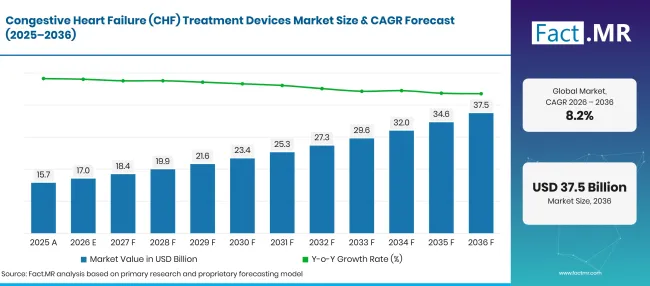
Factmr Congestive Heart Failure Chf Treatment Devices Market Forecast Global | Source: Fact.MR
| Year | Basis | Market Value (USD Billion) |
|---|---|---|
| 2025 | Actual | 15.7 |
| 2026 | Estimate | 17.0 |
| 2036 | Forecast | 37.5 |
| CAGR 2026 to 2036 | Forecast period | 8.2% |
Source: Fact.MR analysis. Updated Oct 13, 2026
What are the defining numbers behind Congestive Heart Failure (CHF) Treatment Devices Market growth?
An absolute opportunity of USD 20.5 billion will be created between 2026 and 2036.
- Demand Drivers in the Market
- The patient base for heart failure is large and expanding. An estimated 64 million people live with heart failure worldwide, and prevalence increases with age [1]. A larger population of long-term patients will require device-based care.
- Clinical guidelines endorse device therapy. The 2022 AHA/ACC/HFSA guideline recommends implantable cardioverter-defibrillators and cardiac resynchronization therapy for eligible patients with reduced ejection fraction [2]. The European Society of Cardiology guideline issues comparable recommendations [3].
- Remote monitoring adoption is increasing. Implantable pulmonary artery pressure sensors and connected implants allow clinicians to adjust therapy before symptoms worsen, which reduces the risk of readmission.
- Treatment options for patients with persistent symptoms despite medication are expanding. Cardiac contractility modulation, baroreflex activation therapy and interatrial shunts serve patients for whom drug therapy alone has proved insufficient.
- Key Segments Analyzed
- By Product Type: Implantable Devices will command 42.3% share in 2026 since defibrillators, resynchronization systems and ventricular assist devices treat the main risks in advanced heart failure.
- By End-User: Hospitals will represent 56.8% share in 2026, supported by the need for catheterization labs, surgical teams and intensive care for implantation.
- By Distribution Channel: Direct Sales will secure 48.2% share in 2026 owing to manufacturers selling to hospitals with clinical specialists and training.
- Analyst Opinion at Fact.MR
- Shambhu Nath Jha, Principal Consultant at Fact.MR, states, “Congestive heart failure devices are now purchased as a measurable tool for reducing readmissions in value-based cardiac care programs. Clinicians will favor connected systems with long-term outcome data and remote monitoring that detects clinical deterioration before hospitalization is required. Manufacturers that pair implantable devices with data services and dedicated clinical support will gain the most from hospitals and integrated health systems through 2036.”
- Strategic Implications
- Device manufacturers will need to report clinical outcomes on hospital admissions and survival, since payers and hospital buyers benchmark therapies against the cost per avoided admission.
- Monitoring and implant suppliers are advised to embed remote data within clinical workflows and electronic health records, so that alerts prompt timely action without adding administrative burden.
- Hospital systems are encouraged to establish outpatient and home-based follow-up pathways for implanted patients, given that capacity constraints favor earlier intervention.
The United Kingdom is projected to head the group at 10.5% CAGR as health services scale remote monitoring and virtual ward care. Japan is expected to come next at 9.3% on the strength of the world’s oldest population. The United States is anticipated to deliver 8.7% on a large base of implanted patients and early uptake of new therapies. Brazil is forecast to expand at 8.2% as access to cardiac care improves, while Germany is set to conclude the range at 7.2% on an already mature device market.
How does the Congestive Heart Failure (CHF) Treatment Devices Market break down by segment?
Implantable Devices will lead Product Type at 42.3%; Hospitals will lead End-User at 56.8%; Direct Sales will lead Distribution Channel at 48.2%.
Which Product Type dominates?
Implantable Devices will hold 42.3% share in 2026.
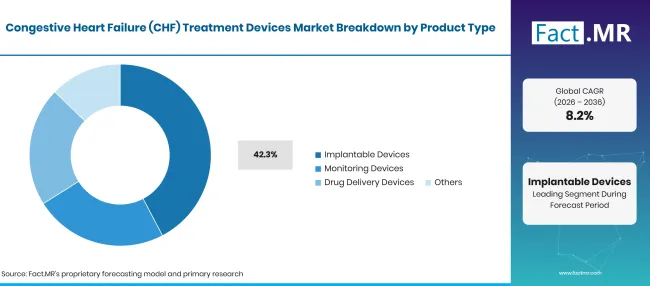
Factmr Congestive Heart Failure Chf Treatment Devices Market Breakdown Product Type | Source: Fact.MR
| Product Type | Share (2026) |
|---|---|
| Implantable Devices (Leading segment) | 42.3% |
| Other segments combined | 57.7% |
| Total | 100.0% |
Source: Fact.MR analysis. Updated Oct 13, 2026
Implantable devices will lead because they are addressing the two main risks in advanced heart failure: life-threatening arrhythmias and dyssynchronous ventricular contraction. Implantable cardioverter-defibrillators, cardiac resynchronization therapy devices and ventricular assist devices are forming the core of this group, alongside newer systems for cardiac contractility modulation and baroreflex activation therapy.
Monitoring devices encompass implantable pulmonary artery pressure sensors, wearables and connected scales that are enabling congestion tracking between visits. Drug delivery devices comprise on-body infusors that administer subcutaneous diuretics, which is allowing selected decongestion treatment outside hospitals. The Others group covers external support systems and wearable defibrillators.
What supports Hospitals within End-User?
Hospitals will account for 56.8% share in 2026.
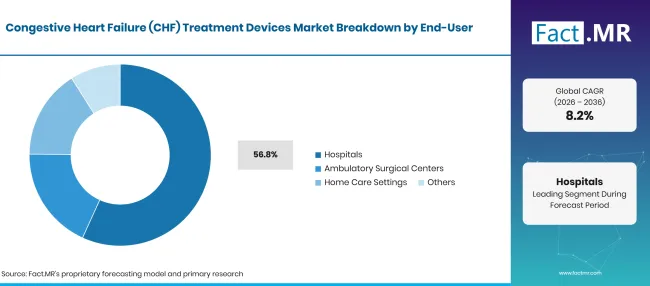
Factmr Congestive Heart Failure Chf Treatment Devices Market Breakdown End User | Source: Fact.MR
| End-User | Share (2026) |
|---|---|
| Hospitals (leading segment) | 56.8% |
| Other segments combined | 43.2% |
| Total | 100.0% |
Source: Fact.MR analysis. Updated Oct 13, 2026
Hospitals will lead since implantation, ventricular assist device surgery and advanced heart failure programs are relying on catheterization labs, surgical teams and intensive care support. Hospitals are also serving as the point of care where most patients first receive device therapy after a decompensation event.
Ambulatory surgical centers are handling selected lower-risk device procedures. Home care settings are applying remote monitoring and infusion devices to manage patients between clinic visits, and will gain importance as follow-up care moves outside hospitals.
What leads the Distribution Channel segment?
Direct Sales will capture 48.2% share in 2026.
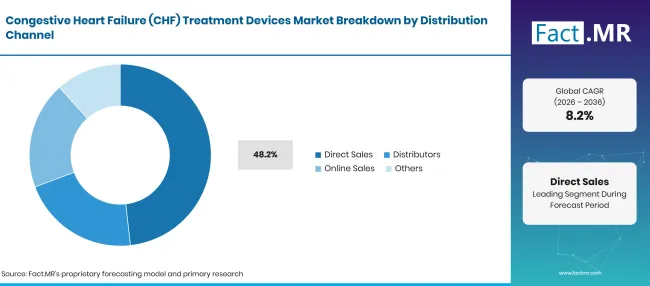
Factmr Congestive Heart Failure Chf Treatment Devices Market Breakdown Distribution Channel | Source: Fact.MR
| Distribution Channel | Share (2026) |
|---|---|
| Direct Sales (leading segment) | 48.2% |
| Other segments combined | 51.8% |
| Total | 100.0% |
Source: Fact.MR analysis. Updated Oct 13, 2026
Direct sales will lead as manufacturers are supplying implants and ventricular assist systems straight to hospitals, supported by clinical specialists in the procedure room and training for care teams. Contracts are frequently bundling devices, programmers and remote monitoring services.
Distributors are serving smaller hospitals and regions where manufacturers lack a local presence. Online sales will remain modest and are concentrating on home monitoring accessories and consumables.
What is accelerating Congestive Heart Failure (CHF) Treatment Devices Market adoption, and what is holding it back?
Demand will strengthen on the back of population ageing, guideline endorsement and expanding remote monitoring. Growth is constrained by high device and procedure costs and restricted access to specialized care in lower-income regions.
Drivers Impact Analysis
| DRIVER | (~) % IMPACT ON CAGR | GEOGRAPHIC RELEVANCE | IMPACT TIMELINE |
|---|---|---|---|
| Population ageing and rising heart failure prevalence | +2.0% | Global | Long term (>= 4 years) |
| Clinical guideline endorsement of implantable defibrillators and resynchronization therapy | +1.6% | North America, Western Europe | Medium term (2-4 years) |
| Expanding adoption of remote patient monitoring | +1.2% | North America, Western Europe, East Asia | Short term (<= 2 years) |
| Improving access to cardiac care in emerging economies | +0.8% | Latin America, South Asia & Pacific | Long term (>= 4 years) |
Source: Fact.MR analysis. Updated Oct 13, 2026
Opportunity Impact Analysis
| OPPORTUNITY | (~) % IMPACT ON CAGR | GEOGRAPHIC RELEVANCE | IMPACT TIMELINE |
|---|---|---|---|
| Implantable sensors and connected devices for early detection of congestion | +1.2% | Global | Medium term (2-4 years) |
| Device-based therapies for heart failure with preserved ejection fraction | +0.9% | North America, Western Europe | Long term (>= 4 years) |
| Home-based monitoring and subcutaneous drug delivery systems | +0.6% | North America, Western Europe | Medium term (2-4 years) |
| Analytics-based risk prediction from connected device data | +0.4% | North America, East Asia | Short term (<= 2 years) |
Source: Fact.MR analysis. Updated Oct 13, 2026
Restraints Impact Analysis
| RESTRAINT | (~) % IMPACT ON CAGR | GEOGRAPHIC RELEVANCE | IMPACT TIMELINE |
|---|---|---|---|
| High device and implantation procedure costs | -0.9% | Global | Short term (<= 2 years) |
| Procedural risks and device-related complications, including infections | -0.6% | Global | Medium term (2-4 years) |
| Limited availability of specialized heart failure centers and trained clinicians | -0.4% | Latin America, South Asia & Pacific, Middle East & Africa | Long term (>= 4 years) |
Source: Fact.MR analysis. Updated Oct 13, 2026
Which countries are scaling the Congestive Heart Failure (CHF) Treatment Devices Market through 2036?
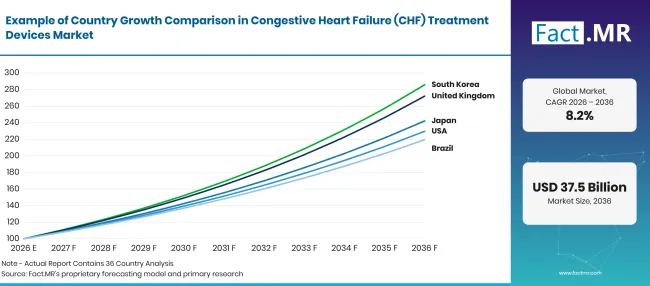
Factmr Congestive Heart Failure Chf Treatment Devices Market Growth Index | Source: Fact.MR
| Country | CAGR (2026-2036) |
|---|---|
| United Kingdom | 10.5% |
| Japan | 9.3% |
| United States | 8.7% |
| Brazil | 8.2% |
| Germany | 7.2% |
Source: Fact.MR analysis. Updated Oct 13, 2026
What supports United Kingdom adoption?
10.5% CAGR, supported by expanding remote monitoring and virtual ward care.
The National Health Service is expanding virtual wards and remote monitoring so that patients with heart failure can be managed at home. NICE guidance already supports implantable defibrillators and resynchronization therapy for eligible patients, and hospitals will add connected implants and pressure sensors as these pathways mature.
How is Japan scaling demand?
9.3% CAGR, driven by the world’s oldest population.
Japan has among the highest shares of people aged 65 and over of any major economy, and heart failure admissions rise steeply with age. Chronic donor heart shortages sustain demand for ventricular assist programs, while universal health insurance supports access to resynchronization therapy.
What supports United States adoption?
8.7% CAGR, supported by a large base of implanted patients and early adoption of new therapies.
The United States is home to many leading device makers and a large population of patients with heart failure. The U.S. Food and Drug Administration approved cardiac contractility modulation and baroreflex activation therapy in 2019 and pulmonary artery pressure monitoring in 2014, while Medicare coverage for implantable defibrillators sustains procedure volumes.
How is Brazil developing demand?
8.2% CAGR, backed by wider access to cardiac care.
Chagas disease remains a notable cause of heart failure in Brazil, alongside hypertension and ischemic heart disease, sustaining demand for rhythm and resynchronization devices. Private hospitals in major cities are adopting advanced devices faster than the public Unified Health System, while ANVISA registration governs market entry.
How does Germany perform?
7.2% CAGR, shaped by an already mature device base.
Germany has a large ageing population, a dense network of cardiology centers and statutory health insurance covering device therapy, so device use is already widespread. Growth will come mainly from device renewal cycles, upgrades to connected systems and newer therapies, which leaves less room for first-time implant growth.
Who leads the Congestive Heart Failure (CHF) Treatment Devices Market?
Competition falls into two groups. Large diversified medical device groups compete on portfolio breadth, hospital contracts and service networks: Medtronic offers Claria MRI Quad CRT-D systems with OptiVol monitoring, Abbott sells the CardioMEMS HF System and HeartMate 3, Boston Scientific markets Resonate defibrillators and HeartLogic, and Biotronik supplies Rivacor defibrillators with Home Monitoring.
Johnson & Johnson MedTech, which acquired Abiomed in 2022, supplies Impella heart pumps, while Zoll Medical Corporation offers the LifeVest wearable defibrillator. Edwards Lifesciences competes through transcatheter structural heart therapies, including PASCAL and EVOQUE. Specialist innovators compete on new therapy categories. CVRx sells Barostim, Impulse Dynamics offers the Optimizer system, and Corvia Medical develops an interatrial shunt. Clinical trial evidence, reimbursement coverage and remote monitoring integration will decide competition through 2036.
Which companies are the key providers?
Key companies include Medtronic plc; Abbott Laboratories; Boston Scientific Corporation; Biotronik SE & Co. KG; Johnson & Johnson (Abiomed Impella); Zoll Medical Corporation; Edwards Lifesciences Corporation; CVRx, Inc.; Impulse Dynamics; and Corvia Medical, Inc.
- Medtronic plc
- Abbott Laboratories
- Boston Scientific Corporation
- Biotronik SE & Co. KG
- Johnson & Johnson (Abiomed Impella)
- Zoll Medical Corporation
- Edwards Lifesciences Corporation
- CVRx, Inc.
- Impulse Dynamics
- Corvia Medical, Inc..
Bibliography
- [1] American Heart Association. (2025, January 27). 2025 Heart Disease and Stroke Statistics: A report of US and global data from the American Heart Association. Circulation, 151(8), e41–e660.
- [2] U.S. Food and Drug Administration. (2022, February 18). CardioMEMS HF System—P100045/S056.
- [3] Heidenreich, P. A., Bozkurt, B., Aguilar, D., Allen, L. A., Byun, J. J., Colvin, M. M., Deswal, A., Drazner, M. H., Dunlay, S. M., Evers, L. R., Fang, J. C., Fedson, S. E., Fonarow, G. C., Hayek, S. S., Hernandez, A. F., Khazanie, P., Kittleson, M. M., Lee, C. S., Link, M. S., ... Yancy, C. W. (2022). 2022 AHA/ACC/HFSA guideline for the management of heart failure: A report of the American College of Cardiology/American Heart Association Joint Committee on Clinical Practice Guidelines. Circulation, 145(18), e895–e1032.
- [4] McDonagh, T. A., Metra, M., Adamo, M., Gardner, R. S., Baumbach, A., Böhm, M., Burri, H., Butler, J., Čelutkienė, J., Chioncel, O., Cleland, J. G. F., Coats, A. J. S., Crespo-Leiro, M. G., Farmakis, D., Gilard, M., Heymans, S., Hoes, A. W., Jaarsma, T., Jankowska, E. A., ... Skibelund, A. K. (2021). 2021 ESC guidelines for the diagnosis and treatment of acute and chronic heart failure. European Heart Journal, 42(36), 3599–3726.
- [5] U.S. Food and Drug Administration. (n.d.). Clinical outcome assessments inform indications for use in breakthrough heart failure symptoms device.
This Report Answers
- The report explains how congestive heart failure treatment devices are used across product types, end-users and distribution channels.
- Segment analysis identifies the subsegment that leads each segment and the clinical and purchasing needs behind its 2026 share.
- Country analysis compares the five listed countries through patient demographics, care delivery models and device adoption.
- Competitive analysis reviews large medical device groups and specialist therapy developers.
- Regulatory analysis tracks device approvals, clinical guidelines and reimbursement coverage for heart failure therapies.
What does the Congestive Heart Failure (CHF) Treatment Devices Market cover?
The Congestive Heart Failure (CHF) Treatment Devices Market is covering medical devices that are treating heart failure or supporting clinicians in managing it. Implantable cardioverter-defibrillators and resynchronization systems are anchoring established demand, while ventricular assist devices and implantable pressure sensors are gaining ground among high-risk patients. Newer categories, including cardiac contractility modulation, baroreflex activation therapy and interatrial shunts, are expanding steadily and are expected to widen options for patients responding poorly to conventional therapy.
What is included in the scope?
The scope is including implantable devices for rhythm control, resynchronization, mechanical circulatory support and hemodynamic monitoring. It is also covering external monitoring devices and on-body drug delivery devices intended for heart failure care. Implantable categories are projected to demand closer clinical supervision and longer approval pathways than external categories, which are likely to reach patients faster.
Combination products are being included when the device is serving as the main component of the therapy. Programmers, accessories and remote monitoring software are being counted only when they are being sold with a covered device.
What is excluded from the scope?
The scope is excluding heart failure drugs that are being sold without a delivery device, such as beta-blockers, ACE inhibitors, angiotensin receptor-neprilysin inhibitors and SGLT2 inhibitors. Unlike device-led therapies, which are being tracked through procedures and unit sales, these drugs are following pharmaceutical revenue models and are staying outside the assessment. Heart transplantation services and donor organ logistics are also being excluded.
Standalone pacemakers for slow heart rhythms, heart valve devices without a heart failure indication, and consumer fitness wearables are staying outside the revenue boundary. Hospital services, clinic fees and revenue from drugs alone are likewise being excluded.
How Was the Analysis Built?
The analysis is drawing on 120+ sources, 35+ company portfolios, 25+ countries, and more than 20 industry interviews.
- Primary Research: Primary research is including discussions with manufacturers, service providers, technology developers, distributors, end users, and subject-matter experts. These conversations are examining purchasing priorities, product adoption, operational challenges, approval requirements, competitive positioning, and the factors that are shaping wider market acceptance. Views from manufacturers and clinical users are being compared to show where supplier expectations and real-world adoption are diverging.
- Desk Research: Desk research is covering government statistics, regulatory publications, company filings, trade data, technical studies, industry associations, standards, public policy, and other authoritative sources. Every source being used in the analysis is being documented in the bibliography, and new publications are going to be added as they appear.
- Market Sizing and Forecasting: Market estimates are combining historical performance, demand indicators, pricing and volume trends, segment shares, company participation, country-level growth, adoption patterns, investment activity, and barriers to market expansion. Established segments are being weighed against emerging ones, and mature regions against faster-moving ones, so that forecasts are reflecting the different pace of growth across the market.
- Data Validation and Update Cycle: Findings are being validated by comparing primary interviews with public data, company activity, regulatory changes, trade patterns, and industry developments. Regular updates are scheduled to review new product launches, capacity changes, partnerships, approvals, and shifts in commercial adoption, and the estimates are going to be revised whenever new evidence is changing the outlook.
Segmentation
What is the report’s scope and coverage?
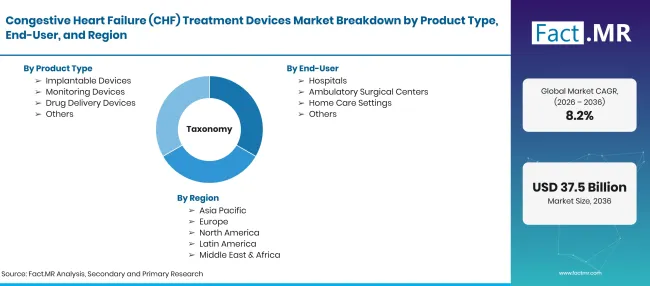
Factmr Congestive Heart Failure Chf Treatment Devices Market Taxonomy 2 | Source: Fact.MR
| Attribute | Details |
|---|---|
| Quantitative Units | USD 17.0 billion in 2026 to USD 37.5 billion by 2036 at an 8.2% CAGR |
| Market Definition | Medical devices that treat or help manage congestive heart failure, such as implantable defibrillators, cardiac resynchronization systems, ventricular assist devices, implantable and wearable monitoring systems, and on-body drug delivery devices used in hospitals, ambulatory surgical centers and home care settings. |
| Product Type | Implantable Devices; Monitoring Devices; Drug Delivery Devices; Others |
| End-User | Hospitals; Ambulatory Surgical Centers; Home Care Settings; Others |
| Distribution Channel | Direct Sales; Distributors; Online Sales; Others |
| Regions Covered | North America; Latin America; Western Europe; Eastern Europe; East Asia; South Asia & Pacific; Middle East & Africa |
| Countries Covered | United Kingdom; Japan; United States; Brazil; Germany |
| Key Companies Profiled | Medtronic plc; Abbott Laboratories; Boston Scientific Corporation; Biotronik SE & Co. KG; Johnson & Johnson (Abiomed Impella); Zoll Medical Corporation; Edwards Lifesciences Corporation; CVRx, Inc.; Impulse Dynamics; Corvia Medical, Inc. |
| Forecast Period | 2026 to 2036 |
| Approach | Hybrid top-down and bottom-up approach using heart failure patient populations; device implantation rates; clinical guideline and reimbursement review; end-user and channel mix; country growth; and supplier portfolio review. |
Source: Fact.MR analysis. Updated Oct 13, 2026
How is the market segmented?
-
By Product Type
- Implantable Devices
- Monitoring Devices
- Drug Delivery Devices
- Others
-
By End-User
- Hospitals
- Ambulatory Surgical Centers
- Home Care Settings
- Others
-
By Distribution Channel
- Direct Sales
- Distributors
- Online Sales
- Others
-
By Region
- North America
- Latin America
- Western Europe
- Eastern Europe
- East Asia
- South Asia & Pacific
- Middle East & Africa
Frequently Asked Questions
How big is the congestive heart failure (CHF) treatment devices market in 2026?
What is the CAGR of the congestive heart failure (CHF) treatment devices market from 2026 to 2036?
Which product type leads the congestive heart failure (CHF) treatment devices market?
Which end-user leads the congestive heart failure (CHF) treatment devices market?
Which distribution channel leads the congestive heart failure (CHF) treatment devices market?
Which country is expected to grow the most in the congestive heart failure (CHF) treatment devices market?
Who are the main companies in the congestive heart failure (CHF) treatment devices market?
Who worked on this report


Preview the report firsthand - request a free sample
Free SampleGet the brochure for pricing and purchase details
Download PDF