- Market Value (2025): USD 8.56 Bn
- Estimated Value (2026): USD 9.09 Bn
- Forecast Value (2036): USD 16.6 Bn
- CAGR (2026-2036): 6.2%
What is the Neurodiagnostic and Monitoring Devices Market forecast to be worth by 2036?
USD 9.1 billion in 2026 to USD 16.6 billion by 2036 at a 6.2% CAGR.
- As per Fact.MR analysis, the neurodiagnostic and monitoring devices market reached USD 8.56 billion in 2025.
- Demand will increase from USD 9.09 billion in 2026 to USD 16.6 billion by 2036.
- The neurodiagnostic and monitoring devices market will record a 6.2% CAGR from 2026 to 2036.
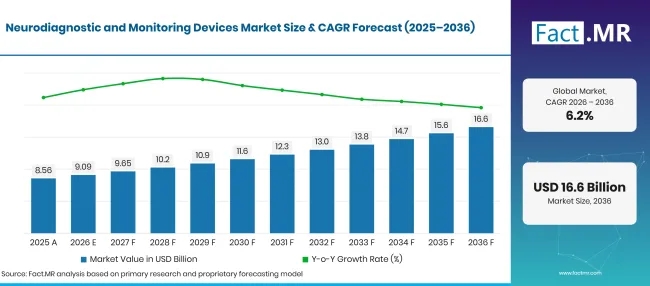
Factmr Neurodiagnostic And Monitoring Devices Market Forecast Global | Source: Fact.MR
| Year | Basis | Market value (USD Billion) |
|---|---|---|
| 2025 | Actual | 8.56 |
| 2026 | Estimate | 9.09 |
| 2036 | Forecast | 16.6 |
| CAGR 2026 to 2036 | Forecast period | 6.2% |
Source: Fact.MR analysis. Updated Oct 13, 2026
What are the defining numbers behind Neurodiagnostic and Monitoring Devices Market growth?
An absolute opportunity of USD 7.5 billion is expected to be created between 2026 and 2036.
- Demand Drivers in the Market
- Neurological conditions are affecting a growing share of the global population. A study published in The Lancet Neurology and summarized by the World Health Organization found that more than 3 billion people were living with a neurological condition in 2021, making these disorders the leading cause of ill health and disability [1]. This patient base will require sustained assessment and long-term monitoring.
- Populations are ageing across the largest healthcare markets. Japan’s population aged 65 and over reached a record 29.6% in September 2026, the highest share among 39 countries with 40 million or more people, while Germany ranked third at 24.2% [2]. Advancing age is raising the risk of stroke, dementia, and other neurological conditions, which will lift testing volumes.
- Improved delivery systems are broadening adoption. Portable EEG units and AI-assisted interpretation are shortening the interval between recording and reporting. In September 2025, Natus acquired the remaining shares of Holberg EEG, adding an FDA-cleared AI model for EEG interpretation to its NeuroWorks software [3].
- Critical care and surgical settings are generating additional demand for continuous monitoring. Intracranial pressure monitors and cerebral oximeters are helping clinical teams detect shifts in pressure and oxygen supply during intensive care and surgery, and hospitals will continue to retain these devices in routine use.
- Key Segments Analyzed
- By Product Type: Electroencephalography devices are forecast to hold 38.5% share in 2026, as EEG stays the first-line test for seizures, sleep disorders, and altered consciousness.
- By Application: Hospitals are likely to capture 52.4% share in 2026, owing to the concentration of neurological testing, intensive care, and surgery within hospital settings.
- By Modality: Portable and standalone systems are poised to record 56.8% share in 2026, with bedside, ward, and clinic deployments favoring compact units.
- By End-User: Hospitals are slated to command 52.4% share in 2026, reflecting their standing as the main buyers of capital equipment and monitoring systems.
- Analyst Opinion at Fact.MR
- Shambhu Nath Jha, Principal Consultant at Fact.MR, states, “Neurodiagnostic devices will increasingly be purchased as workflow tools rather than standalone instruments. Hospitals will favor portable systems that connect to reporting software, and suppliers pairing validated hardware with software support and technologist training will capture the greatest gains from ageing populations and wider neurological testing.”
- Strategic Implications
- Device manufacturers will need to publish clinical validation data for portable systems, since buyers are comparing them with fixed laboratory equipment on signal quality and diagnostic yield.
- Software developers and device makers will have to embed interpretation tools and cloud reporting within recording hardware, so that scarce specialist time will be directed to the cases that require it.
- Suppliers serving emerging markets will be expected to bundle training and service support with hardware, given that access to neurological professionals will continue to vary widely between countries.
Brazil is projected to lead at 7.9% CAGR as its population ages quickly. Japan is expected to follow at 7.1% on the oldest population among large countries. The United Kingdom is anticipated to reach 5.9% as waiting-list pressure builds demand for faster diagnostics, while Germany is forecast at 5.6% on an aged but mature market. The United States is set to close the range at 4.5% from a mature installed base.
How does the Neurodiagnostic and Monitoring Devices Market break down by segment?
Electroencephalography Devices are expected to lead Product Type at 38.5%; Hospitals are set to lead Application at 52.4%; Portable and Standalone systems are projected to lead Modality at 56.8%; Hospitals are anticipated to lead End-User at 52.4%.
Which Product Type dominates?
Electroencephalography Devices are expected to hold 38.5% share in 2026.
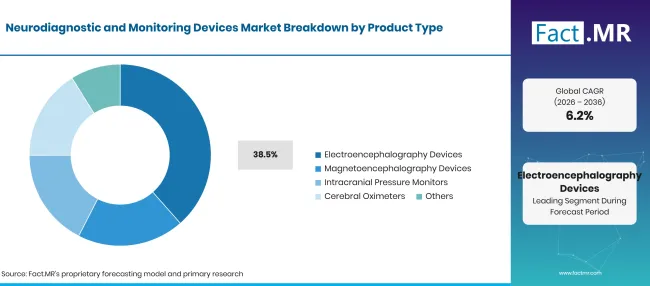
Factmr Neurodiagnostic And Monitoring Devices Market Breakdown Product Type | Source: Fact.MR
| Product Type | Share (2026) |
|---|---|
| Electroencephalography Devices (Leading segment) | 38.5% |
| Other segments combined | 61.5% |
| Total | 100.0% |
Source: Fact.MR analysis. Updated Oct 13, 2026
EEG devices are projected to lead because they will continue to record brain activity at the bedside, serve epilepsy, sleep, and critical care testing, and carry lower cost and setup requirements than magnetoencephalography. Software for automated review is adding value to the installed base. Magnetoencephalography devices are serving specialist centers that map brain function before surgery and support research, while conventional systems requiring magnetically shielded rooms will keep limiting wider placement. Intracranial pressure monitors and cerebral oximeters are supporting intensive care and surgical teams that track pressure and oxygen supply over time.
What supports Hospitals within Application?
Hospitals are set to capture 52.4% share in 2026.
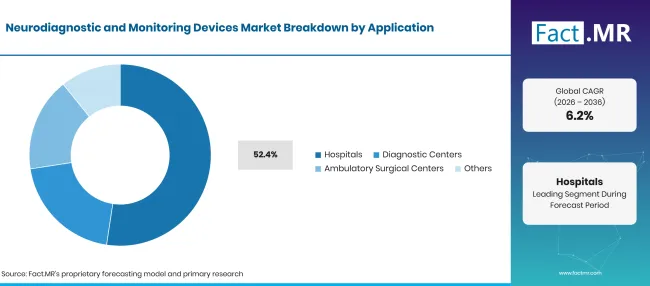
Factmr Neurodiagnostic And Monitoring Devices Market Breakdown Application | Source: Fact.MR
| Application | Share (2026) |
|---|---|
| Hospitals (leading segment) | 52.4% |
| Other segments combined | 47.6% |
| Total | 100.0% |
Source: Fact.MR analysis. Updated Oct 13, 2026
Hospitals are projected to lead since inpatient wards, emergency departments, intensive care units, and operating rooms are generating most neurological testing and monitoring needs. Epilepsy monitoring units, stroke pathways, and neurocritical care will continue to depend on continuous recording and trained clinical staff. Diagnostic centers and ambulatory surgical centers are handling outpatient recordings and selected procedures, where compact portable systems will keep fitting smaller facility footprints.
What leads the Modality segment?
Portable and Standalone systems are projected to represent 56.8% share in 2026.
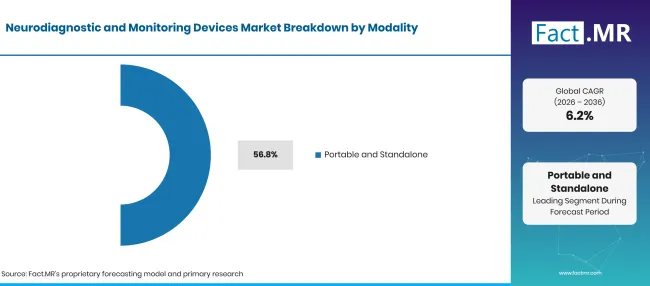
Factmr Neurodiagnostic And Monitoring Devices Market Breakdown Modality | Source: Fact.MR
| Material Type | Share (2026) |
|---|---|
| Portable and Standalone (leading segment) | 56.8% |
| Other segments combined | 43.2% |
| Total | 100.0% |
Source: Fact.MR analysis. Updated Oct 13, 2026
Portable and standalone systems are set to lead as care teams shift recordings to the bedside, ward, and clinic rather than transferring patients to dedicated rooms. Compact amplifiers, wireless sensors, and battery operation will shorten setup time, improve workflow efficiency, and support faster clinical decisions. Standalone units are also suiting smaller facilities that lack integrated monitoring networks, since these systems will require limited infrastructure and lower capital commitment. Adoption is therefore expected to widen across community hospitals and outpatient settings.
How does End-User shape demand?
Hospitals are anticipated to command 52.4% share in 2026.
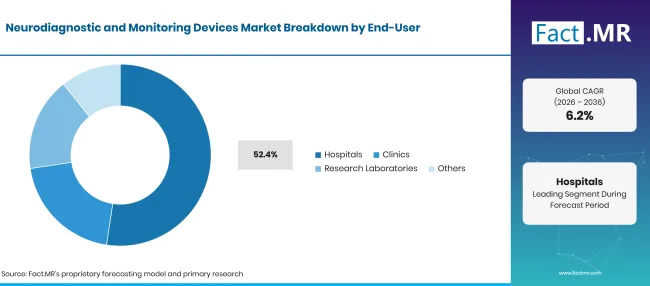
Factmr Neurodiagnostic And Monitoring Devices Market Breakdown End User | Source: Fact.MR
| End-User | Share (2026) |
|---|---|
| Hospitals (leading segment) | 52.4% |
| Other segments combined | 47.6% |
| Total | 100.0% |
Source: Fact.MR analysis. Updated Oct 13, 2026
Hospitals are expected to lead because they procure capital equipment across several departments and employ the specialized staff required to operate it. Clinics are purchasing smaller systems for outpatient testing, where compact configurations and lower acquisition costs are shaping decisions. Research laboratories will continue to deploy higher-specification equipment for studies of brain function, where signal quality and analytical depth will remain priorities. Together, these buyer groups are defining distinct demand patterns across the market.
What is accelerating Neurodiagnostic and Monitoring Devices Market adoption, and what is holding it back?
Demand is projected to strengthen on the back of a rising neurological disease burden, ageing populations, and the spread of portable, software-assisted systems. Expansion is being constrained by high equipment costs and a shortage of trained interpreters, which will continue to limit access in resource-constrained settings.
Drivers Impact Analysis
| Driver | (~) % Impact on CAGR | Geographic Relevance | Impact Timeline |
|---|---|---|---|
| Rising neurological disease burden driving higher testing and monitoring volumes | +1.6% | Global | Short term (<= 2 years) |
| Ageing populations in major healthcare markets raising stroke and dementia incidence | +1.2% | North America, Europe, East Asia | Medium term (2-4 years) |
| Adoption of portable and software-assisted systems across hospital, clinic and research workflows | +0.9% | Global | Medium term (2-4 years) |
| Expanding continuous monitoring in intensive care and surgical settings | +0.6% | Global | Long term (>= 4 years) |
Source: Fact.MR analysis. Updated Oct 13, 2026
Opportunity Impact Analysis
| Opportunity | Geographic Relevance | Impact Timeline |
|---|---|---|
| Integration of automated interpretation and cloud reporting with recording hardware | Global | Medium term (2-4 years) |
| Bundled training and service support for buyers in emerging markets | Latin America, South Asia & Pacific, Middle East & Africa | Long term (>= 4 years) |
| Clinical validation of portable systems for outpatient and community settings | North America, Europe | Short term (<= 2 years) |
Source: Fact.MR analysis. Updated Oct 13, 2026
Restraints Impact Analysis
| Restraint | (~) % Impact on CAGR | Geographic Relevance | Impact Timeline |
|---|---|---|---|
| High equipment and installation costs limiting purchases by smaller facilities | -0.5% | Latin America, South Asia & Pacific, Middle East & Africa | Medium term (2-4 years) |
| Shortage of trained technologists and interpreters restricting testing capacity | -0.4% | Global | Long term (>= 4 years) |
Source: Fact.MR analysis. Updated Oct 13, 2026
Which countries are scaling the Neurodiagnostic and Monitoring Devices Market through 2036?
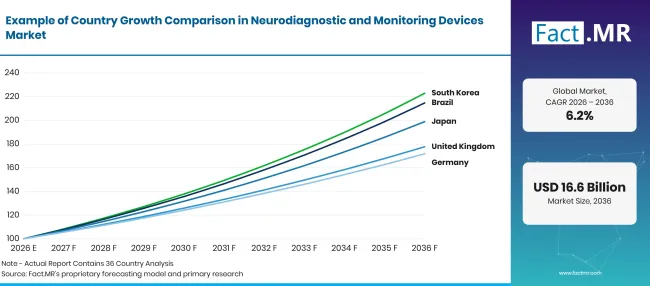
Factmr Neurodiagnostic And Monitoring Devices Market Growth Index | Source: Fact.MR
| Country | CAGR (2026-2036) |
|---|---|
| Brazil | 7.9% |
| Japan | 7.1% |
| United Kingdom | 5.9% |
| Germany | 5.6% |
| United States | 4.5% |
Source: Fact.MR analysis. Updated Oct 13, 2026
What supports Brazil adoption?
7.9% CAGR, supported by a fast-ageing population.
IBGE reported that people aged 65 and over numbered 22.17 million in the 2022 census, or 10.9% of the population, up from 7.4% in 2010 [4]. Rising age is raising demand for stroke, dementia and epilepsy assessment, which will lift neurodiagnostic equipment purchases in hospitals, including the public Unified Health System (SUS) network. (53 words)
How is Japan scaling demand?
7.1% CAGR, driven by the oldest population among large countries.
Japan’s population aged 65 and over reached a record 29.6% in 2026, or 36.24 million people, the highest share among 39 countries with 40 million or more people [2]. Older patients will keep testing and monitoring volumes high, while hospitals are adopting efficient bedside systems to manage demand with a constrained clinical workforce. (52 words)
How does the United Kingdom perform?
5.9% CAGR, supported by pressure to shorten neurology waits.
The Department of Health and Social Care reported nearly 214,700 pathways on the neurology waiting list at the end of May 2026, with 61.4% waiting within 18 weeks for first treatment [6]. Providers are looking to faster diagnostic tools, including portable systems, and NHS community diagnostic centres will keep supporting earlier testing outside acute hospitals. (55 words)
What is supporting Germany’s adoption?
5.6% CAGR, shaped by an aged but mature market.
Germany ranks third among 39 countries with 40 million or more people, with 24.2% of its population aged 65 and over [2]. A large older population supports steady testing volumes, though a mature installed base limits faster expansion. Demand is therefore shifting toward replacement cycles and software upgrades, including automated interpretation, rather than new capacity. (55 words)
What supports United States adoption?
4.5% CAGR, shaped by a mature installed base.
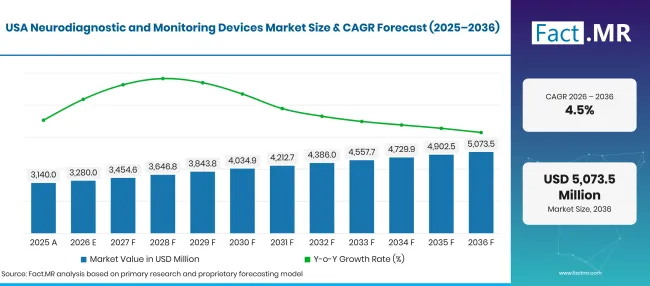
Factmr Neurodiagnostic And Monitoring Devices Market Forecast Usa | Source: Fact.MR
The CDC reports that more than 795,000 people in the United States have a stroke each year, with about 610,000 of these being first or new strokes [5]. Steady stroke and critical care demand supports routine monitoring, while a mature market will moderate growth. Stroke centers and neurocritical care units will continue to anchor replacement demand. (56 words)
Who leads the Neurodiagnostic and Monitoring Devices Market?
Competition falls into two groups. Broad medical technology groups compete on global reach and hospital-wide platforms: Philips Healthcare offers IntelliVue patient monitoring, GE HealthCare Technologies Inc. supplies CARESCAPE monitors, Siemens Healthineers markets MAGNETOM MRI systems, and Medtronic plc sells INVOS cerebral oximetry. Specialist neurodiagnostic suppliers compete on recording quality and software depth. Natus Medical Incorporated offers NeuroWorks EEG software, and in September 2025 it added an FDA-cleared AI model for EEG interpretation through Holberg EEG [3].
Compumedics Limited markets Grael EEG amplifiers, Nihon Kohden Corporation supplies EEG systems, and Cadwell Industries sells Easy III EEG platforms. Neurosoft provides EEG and EMG devices, while Advanced Brain Monitoring offers B-Alert wireless EEG headsets. Validated signal quality, software-assisted interpretation and service support will decide competition through 2036.
Which companies are the key providers?
Key companies include Compumedics Limited; Natus Medical Incorporated; Nihon Kohden Corporation; Philips Healthcare; GE HealthCare Technologies Inc.; Masimo Corporation; Medtronic plc; Cadwell Industries; Neurosoft; and Advanced Brain Monitoring.
- Compumedics Limited
- Natus Medical Incorporated
- Nihon Kohden Corporation
- Philips Healthcare
- GE HealthCare Technologies Inc.
- Masimo Corporation
- Medtronic plc
- Cadwell Industries
- Neurosoft
- Advanced Brain Monitoring
Bibliography
- [1] World Health Organization. (2024, March 14). Over 1 in 3 people affected by neurological conditions, the leading cause of illness and disability worldwide.
- [2] Jiji Press. (2026, September 20). Proportion of elderly population in Japan hits record high near 30 pct.
- [3] Natus Medical Incorporated. (2025, September 30). Natus acquires Holberg EEG, expanding innovation in neurodiagnostic AI solutions.
- [4] Instituto Brasileiro de Geografia e Estatística. (2023, October 27). Censo 2022: Número de pessoas com 65 anos ou mais de idade cresceu 57,4% em 12 anos.
- [5] Centers for Disease Control and Prevention. (2024, October 24). Stroke facts.
- [6] UK Parliament. (2026, July 17). Headaches: Health services—Written question 18270.
- [7] World Health Organization. (2025, October 12). Global status report on neurology.
- [8] World Health Organization. (2025, October 14). 11 million lives lost each year: Urgent action needed on neurological care.
- [9] World Health Organization. (2026, May 4). Global status report on neurology: Executive summary.
- [10] Manohara, N., Ferrari, A., Greenblatt, A., Berardino, A., Peixoto, C., Duarte, F., Moyiaeri, Z., Robba, C., Nascimento, F. A., Kreuzer, M., Vacas, S., & Lobo, F. A. (2025). Electroencephalogram monitoring during anesthesia and critical care: A guide for the clinician. Journal of Clinical Monitoring and Computing, 39(2), 315–348.
- [11] U.S. Food and Drug Administration. (n.d.). Product classification: Neuropsychiatric interpretative electroencephalograph assessment aid.
- [12] U.S. Food and Drug Administration. (n.d.). Product classification: Sub-scalp implanted electroencephalogram system for remote patient monitoring.
This Report Answers
- The report explains how neurodiagnostic and monitoring devices are used by product type, application, modality and end-user.
- Segment analysis identifies the subsegment that leads each segment and the clinical needs behind its 2026 share.
- Country analysis compares the five listed countries through population ageing, neurological disease burden and care capacity.
- Competitive analysis reviews neurophysiology specialists and broad healthcare technology groups.
- Regulatory analysis tracks device clearances and reimbursement conditions that influence adoption.
What does the Neurodiagnostic and Monitoring Devices Market cover?
The Neurodiagnostic and Monitoring Devices Market covers medical devices that record and monitor brain and nervous system function. Electroencephalography captures the brain’s electrical activity, while magnetoencephalography measures the magnetic fields generated by that activity. Intracranial pressure monitors track pressure inside the skull, and cerebral oximeters estimate oxygen levels in brain tissue.
The assessment tracks portable and standalone systems used across hospitals, diagnostic centers, ambulatory surgical centers, clinics, and research laboratories. Neurodiagnostic devices rely on the wider patient monitoring and medical imaging industries for components and clinical evidence.
What is included in the scope?
The scope includes electroencephalography, magnetoencephalography, intracranial pressure monitoring, and cerebral oximetry systems sold for the diagnosis and monitoring of neurological conditions.
Electrodes, sensors, amplifiers, and analysis software are included only when sold together with a covered device. Combination products are counted when a covered neurodiagnostic or monitoring function forms the main component of the system.
What is excluded from the scope?
The scope excludes standalone imaging systems, such as magnetic resonance imaging, computed tomography, and positron emission tomography scanners. Therapeutic neurostimulation devices and neurosurgical instruments are also excluded.
Consumer wellness headbands and fitness wearables sit outside the revenue boundary. Hospital services, clinic fees, and software or data services sold without a covered device are likewise excluded.
How Was the Analysis Built?
The analysis draws on 120+ sources, 35+ company portfolios, 25+ countries, and more than 20 industry interviews.
- Primary Research: Primary research includes discussions with manufacturers, service providers, technology developers, distributors, end users, and subject-matter experts. These conversations explore purchasing priorities, product adoption, operational challenges, approval requirements, competitive positioning, and the factors shaping wider market acceptance.
- Desk Research: Desk research covers government statistics, regulatory publications, company filings, trade data, technical studies, industry associations, standards, public policy, and other authoritative sources. Every source used in the analysis is documented in the bibliography.
- Market Sizing and Forecasting: Market estimates combine historical performance, demand indicators, pricing and volume trends, segment shares, company participation, country-level growth, adoption patterns, investment activity, and barriers to market expansion.
- Data Validation and Update Cycle: Findings are validated by cross-checking primary interviews against public data, company activity, regulatory changes, trade patterns, and industry developments. Regular updates review new product launches, capacity changes, partnerships, approvals, and shifts in commercial adoption.
Segmentation
What is the report’s scope and coverage?
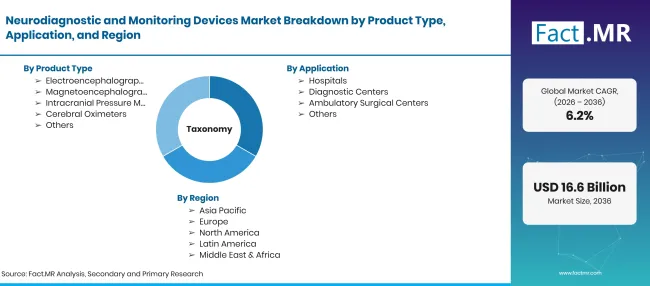
Factmr Neurodiagnostic And Monitoring Devices Market Taxonomy | Source: Fact.MR
| Attribute | Details |
|---|---|
| Quantitative Units | USD 9.1 billion in 2026 to USD 16.6 billion by 2036 at a 6.2% CAGR |
| Market Definition | Medical devices that record, measure and monitor brain activity, intracranial pressure and cerebral oxygenation, such as electroencephalography, magnetoencephalography, intracranial pressure monitoring and cerebral oximetry systems, used to diagnose and manage neurological conditions. |
| Product Type | Electroencephalography Devices; Magnetoencephalography Devices; Intracranial Pressure Monitors; Cerebral Oximeters; Others |
| Application | Hospitals; Diagnostic Centers; Ambulatory Surgical Centers; Others |
| Modality | Portable and Standalone |
| End-User | Hospitals; Clinics; Research Laboratories; Others |
| Regions Covered | North America; Latin America; Western Europe; Eastern Europe; East Asia; South Asia & Pacific; Middle East & Africa |
| Countries Covered | Brazil; Japan; United Kingdom; Germany; United States |
| Key Companies Profiled | Compumedics Limited; Natus Medical Incorporated; Nihon Kohden Corporation; Philips Healthcare; GE HealthCare Technologies Inc.; Masimo Corporation; Medtronic plc; Cadwell Industries; Neurosoft; Advanced Brain Monitoring |
| Forecast Period | 2026 to 2036 |
| Approach | Hybrid top-down and bottom-up approach using installed base and procedure volumes; device pricing; neurological disease prevalence; end-user mix; country growth; and supplier portfolio review. |
Source: Fact.MR analysis. Updated Oct 13, 2026
How is the market segmented?
-
By Product Type
- Electroencephalography Devices
- Magnetoencephalography Devices
- Intracranial Pressure Monitors
- Cerebral Oximeters
- Others
-
By Application
- Hospitals
- Diagnostic Centers
- Ambulatory Surgical Centers
- Others
-
By Modality
- Portable and Standalone
-
By End-User
- Hospitals
- Clinics
- Research Laboratories
- Others
-
By Region
- North America
- Latin America
- Western Europe
- Eastern Europe
- East Asia
- South Asia & Pacific
- Middle East & Africa
Frequently Asked Questions
How big is the neurodiagnostic and monitoring devices market in 2026?
What is the CAGR of the neurodiagnostic and monitoring devices market from 2026 to 2036?
Which product type leads the neurodiagnostic and monitoring devices market?
Which application leads the neurodiagnostic and monitoring devices market?
Which modality leads the neurodiagnostic and monitoring devices market?
Which end-user leads the neurodiagnostic and monitoring devices market?
Which country is expected to grow the most in the neurodiagnostic and monitoring devices market?
Who are the main companies in the neurodiagnostic and monitoring devices market?
Who worked on this report


Preview the report firsthand - request a free sample
Free SampleGet the brochure for pricing and purchase details
Download PDF