- Base Value(2025): 689.7 Mn
- Estimated Value(2026): 740 Mn
- Forecast Value (2036): 1497 Mn
- CAGR (2026 - 2036): 7.3%
Constrained-Layer Damping (CLD) Tiles Market Forecast 2026 to 2036
In 2025, the constrained-layer damping (CLD) tiles market was valued at USD 689.7 million. Based on Fact MR's analysis, demand for CLD tiles is estimated to grow to USD 740 million in 2026 and USD 1,497 million by 2036. FMR projects a CAGR of 7.3% during the forecast period.
The absolute dollar growth from 2026 to 2036 is USD 757 million. This growth is driven by increasing demand for noise reduction and vibration control solutions in automotive, construction, and industrial sectors. While growth is robust, challenges such as fluctuating material costs and regulatory hurdles in specific regions may moderate the pace of expansion.
India leads with a CAGR of 9.1%, driven by rapid industrial growth and infrastructure development. Vietnam follows with an 8.6% CAGR, supported by expanding manufacturing and construction sectors. Indonesia shows an 8.2% growth rate, fueled by increasing demand for sound and vibration control solutions. China grows at 7.6%, reflecting its large industrial base and demand for noise control in automotive and construction sectors. Mexico experiences 7.1% growth, spurred by growing industrialization and infrastructure projects. Brazil grows at 6.6%, supported by expanding residential and commercial markets. The USA and Germany experience slower growth at 4.4% and 3.5%, respectively, due to more mature markets and established noise control solutions.
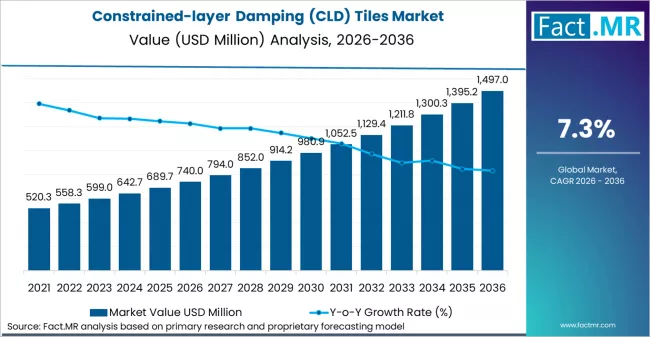
Constrained Layer Damping Cld Tiles Market Market Value Analysis | Source: Fact.MR
Constrained‑Layer Damping (CLD) Tiles Market Definition
The Constrained‑Layer Damping (CLD) Tiles Market refers to the production and sale of multilayer vibration damping tiles used to reduce noise and vibration in structures and equipment. CLD tiles consist of a viscoelastic damping layer sandwiched between stiff constraining layers. When bonded to surfaces, they convert vibrational energy into heat, lowering noise and structural vibration. Their primary function is vibration control and acoustic management. Key end users include automotive, aerospace, industrial machinery, and construction sectors where vibration reduction improves performance and comfort.
Market Inclusions
This report covers global and regional market sizes for CLD tiles with a defined forecast period. It includes segment breakdowns by material type (metal‑based, polymer‑based, composite), application (automotive body panels, aircraft cabins, machinery enclosures, building structures), and end user. Pricing trends, raw material supply analysis, and trade flow data are included to reflect comprehensive market dynamics.
Market Exclusions
The scope excludes unrelated noise control products such as acoustic foams, mass loaded vinyl, and standalone insulation. Finished vibration control systems not employing CLD tiles are not covered. Niche damping materials used exclusively in consumer electronics or micro‑scale applications are omitted to focus strictly on CLD tile products.
Research Methodology
- Primary Research: Interviews were conducted with product engineers, procurement specialists, and industry analysts.
- Desk Research: Data was sourced from industry reports, standards bodies, and trade association publications.
- Market‑Sizing and Forecasting: A hybrid model was used, combining top‑down industry demand analysis with bottom‑up shipment data.
- Data Validation and Update Cycle: Findings were validated through expert review and aligned with recent production and trade data, with periodic updates.
Constrained-Layer Damping (CLD) Tiles Market Summary
- Constrained-Layer Damping (CLD) Tiles Market Definition
- The Constrained-Layer Damping (CLD) Tiles Market refers to the production and sale of multilayer vibration damping tiles designed to reduce noise and vibrations in various applications such as automotive, construction, aerospace, and industrial machinery. CLD tiles consist of a viscoelastic damping layer sandwiched between two stiff constraining layers. These tiles are bonded to surfaces, converting vibrational energy into heat, thereby lowering noise and structural vibration. Their primary function is vibration control and acoustic management, improving performance, comfort, and safety in various industries.
- Demand Drivers in the Market
- Increased Demand for Noise and Vibration Control: The growing need for advanced noise and vibration control solutions in automotive, aerospace, industrial, and construction sectors is driving the demand for CLD tiles. These tiles are critical in meeting stringent noise, vibration, and harshness (NVH) performance requirements.
- Regulatory Pressures: Rising noise pollution regulations and environmental sustainability standards, particularly in industries like automotive and construction, are pushing for the adoption of high-performance noise control solutions, such as CLD tiles.
- Technological Advancements: Innovations in CLD tile materials, such as polymer-based, composite, and metal-based systems, are enhancing the performance and application of these tiles across different industries, boosting their market growth.
- Industrial Growth: The expansion of industries such as automotive manufacturing, construction, aerospace, and machinery is leading to an increase in demand for vibration damping solutions, which is benefiting the CLD tiles market.
- Key Segments Analyzed in the FMR Report
- Product Type: Self-adhesive CLD tiles are expected to dominate the market with a 59% share by 2026 due to their ease of installation, high demand in automotive, industrial, and consumer electronics applications, and superior performance in noise and vibration reduction.
- Material Stack: Polymer + metal constrained layers are projected to hold 49% of the market share by 2026, combining flexibility and rigidity to provide excellent vibration damping and noise insulation.
- Application: Automotive, construction, and aerospace industries are the largest contributors to the demand for CLD tiles, as these industries prioritize high-performance noise and vibration control solutions.
- Analyst Opinion at FMR
- Fact MR analyst Shambhu Nath Jha, predicts that "As NVH expectations continue to rise across industries, CLD tiles will become the go-to solution for noise and vibration management. The demand for these tiles will accelerate in emerging markets where industrialization and construction are booming, further supporting the market's robust growth."
- Strategic Implications/Executive Takeaways
- Focus on Advanced Material Technologies: Companies should continue to invest in R&D for advanced material stacks, such as polymer-metal and composite systems, to improve the damping performance and versatility of CLD tiles.
- Target Emerging Markets: Rapid industrialization in regions like India, Vietnam, and China presents significant opportunities for growth, as these markets increasingly require noise and vibration control solutions for their expanding construction and automotive sectors.
- Regulatory Compliance and Innovation: Manufacturers should align with evolving regulatory noise and vibration standards, while also focusing on developing eco-friendly and sustainable solutions to meet the growing demand for green construction and industrial processes.
- Methodology
- Primary Research: Interviews with product engineers, procurement specialists, and industry analysts provided insights into the current trends, demand drivers, and technology advancements within the CLD tiles market.
- Desk Research: Data was gathered from industry reports, trade publications, and standards bodies to assess the demand dynamics and forecast future growth in the market.
- Market Sizing and Forecasting: A hybrid model was used, combining top-down industry demand analysis with bottom-up shipment data to forecast market growth and size.
Segmental Analysis
Constrained-Layer Damping (CLD) Tiles Market Analysis by Product Format
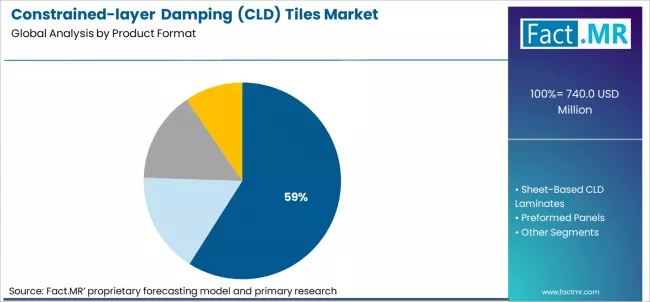
Constrained Layer Damping Cld Tiles Market Analysis By Product Format | Source: Fact.MR
- Market Overview: Self-adhesive CLD tiles are expected to capture 59% of the market share by 2026. These tiles offer ease of installation, as they can be directly applied to surfaces without the need for additional adhesives or tools. Self-adhesive CLD tiles are popular in automotive, industrial, and consumer electronics applications, where noise reduction and vibration damping are essential.
- Demand Drivers:
- Ease of Installation: The self-adhesive nature of these tiles simplifies the installation process, making them ideal for both OEM (original equipment manufacturer) and aftermarket applications where quick and hassle-free installation is needed.
- Versatility and Performance: Self-adhesive CLD tiles offer superior performance in noise and vibration reduction, making them ideal for a wide range of applications, from automotive to consumer products. Their flexibility in design and ease of use increase their adoption across industries.
- Cost and Efficiency: These tiles provide a cost-effective solution for noise control, reducing the need for additional labor or complex processes during installation. This is particularly important in industries looking to enhance soundproofing without significantly increasing production costs.
Constrained-Layer Damping (CLD) Tiles Market Analysis by Material Stack
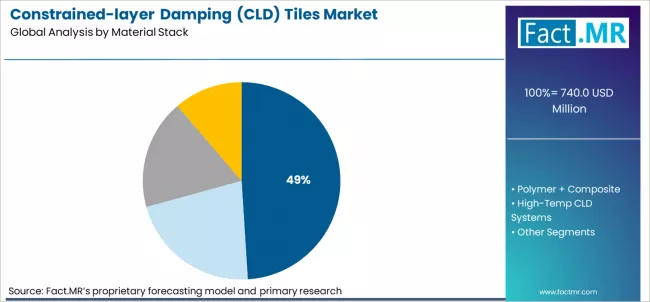
Constrained Layer Damping Cld Tiles Market Analysis By Material Stack | Source: Fact.MR
- Market Overview: Polymer + metal constrained layers are projected to hold 49% of the market share by 2026. This material stack combines the flexibility of polymer with the strength and damping performance of metal, making it a widely used solution for vibration and noise reduction across a variety of applications, including automotive and industrial machinery.
- Demand Drivers:
- Superior Vibration Damping: The combination of polymer and metal provides an excellent balance of flexibility and rigidity, allowing for superior vibration damping and sound insulation. This makes the material stack highly effective in high-performance applications where noise reduction is critical.
- Durability and Longevity: Polymer + metal CLD systems are known for their durability and long lifespan, making them a reliable choice for industries such as automotive, aerospace, and industrial machinery, where long-term performance under harsh conditions is essential.
- Wide Applicability: This material stack can be tailored to meet specific acoustic and mechanical requirements, making it suitable for a wide range of applications, including noise control in vehicles, machinery, and consumer electronics.
Constrained Layer Damping (CLD) Tiles Market Drivers, Restraints, and Opportunities
FMR analysts observe that the constrained‑layer damping (CLD) tiles market is a growing performance‑driven segment within industrial and transportation noise and vibration control. Historically, basic vibration dampers and mass‑loaded panels met early isolation needs, but as NVH (noise, vibration, harshness) performance expectations rose-especially in automotive, rail, and industrial equipment-traditional solutions proved inadequate at frequencies associated with electric and high‑speed systems. The 2026 valuation reflects this structural shift, where engineered CLD tiles are specified to meet stricter NVH targets and regulatory noise limits, replacing simpler dampers that can’t deliver equivalent transmission loss.
While demand for basic vibration materials persists in legacy applications, advanced CLD tiles with optimized material layers and geometric design are gaining share. These engineered tiles carry higher per‑unit pricing, contributing to net market value growth even as unit volumes align with broader manufacturing and electrification cycles. The market exists because manufacturers and designers increasingly treat NVH performance as a measurable requirement rather than a by‑product, driving specification of higher‑performance damping technologies.
- NVH Performance Demand: OEMs and industrial designers are specifying CLD tiles to achieve measurable vibration and noise reduction that basic damping materials cannot deliver.
- Regulatory Noise Standards: Standards like ISO 362 and local industrial noise limits push adoption of certified CLD solutions to meet defined transmission and vibration criteria.
- Regional Industrial Trends: In Europe and North America, where NVH expectations and regulatory pressure are high, uptake of advanced CLD tiles outpaces regions focused on cost‑led basic damping materials.
Regional Analysis
The market analysis covers key global regions, including South Asia and Pacific, East Asia, Latin America, North America, and Western Europe. It is segmented geographically, with specific market dynamics for each region. The full report provides a detailed market attractiveness analysis.
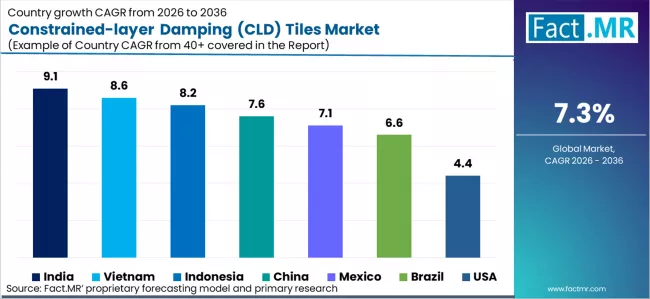
Constrained Layer Damping Cld Tiles Market Cagr Analysis By Country | Source: Fact.MR
| Country | CAGR (2026-2036) |
|---|---|
| India | 9.1% |
| Vietnam | 8.6% |
| Indonesia | 8.2% |
| China | 7.6% |
| Mexico | 7.1% |
| Brazil | 6.6% |
| USA | 4.4% |
| Germany | 3.5% |
Source: Fact.MR analysis. Updated Feb 19, 2026
Source: Fact MR (FMR) analysis, based on proprietary forecasting model and primary research.
South Asia and Pacific:
South Asia and Pacific remain "emerging markets" for CLD tiles, driven by rapid industrialization, infrastructure growth, and increasing demand for noise and vibration control solutions in construction projects.
- India: Demand for constrained-layer damping tiles in India is projected to rise at 9.1% CAGR through 2036. Urbanization and rapid infrastructure development, along with rising demand for noise reduction solutions, drive significant market growth.
- Vietnam: Demand for constrained-layer damping tiles in Vietnam is projected to rise at 8.6% CAGR through 2036. Expanding construction activities and increased awareness of soundproofing solutions in buildings contribute to the market’s growth.
- Indonesia: Demand for constrained-layer damping tiles in Indonesia is projected to rise at 8.2% CAGR through 2036. Increasing industrial and commercial construction projects support the growing demand for soundproofing and vibration damping technologies.
East Asia:
China remains a dominant player in the CLD tiles market, with substantial growth driven by the country’s industrial expansion, infrastructure development, and rising demand for noise reduction technologies.
- China: Demand for constrained-layer damping tiles in China is projected to rise at 7.6% CAGR through 2036. China’s ongoing construction boom and strong industrial sector drive the demand for advanced noise control solutions, including CLD tiles.
Latin America:
In Latin America, particularly in Mexico and Brazil, the demand for CLD tiles is growing steadily due to rising infrastructure projects and increased awareness of noise pollution control in residential and commercial buildings.
- Mexico: Demand for constrained-layer damping tiles in Mexico is projected to rise at 7.1% CAGR through 2036. The growing construction sector and increased need for effective noise control solutions in buildings drive market expansion.
- Brazil: Demand for constrained-layer damping tiles in Brazil is projected to rise at 6.6% CAGR through 2036. Brazil’s urban growth and focus on reducing noise pollution in construction contribute to growing demand for CLD tiles.
North America:
In North America, the USA remains a stable market for CLD tiles, with increasing demand for soundproofing in commercial, residential, and industrial sectors.
- USA: Demand for constrained-layer damping tiles in the U.S. is projected to rise at 4.4% CAGR through 2036. The growing emphasis on noise control in construction projects and advancements in building materials contribute to steady demand for CLD tiles.
Western Europe:
Germany represents a "mature market" for CLD tiles, with demand driven by the construction industry’s emphasis on sustainability, energy efficiency, and noise reduction technologies.
- Germany: Demand for constrained-layer damping tiles in Germany is projected to rise at 3.5% CAGR through 2036. Germany's focus on environmental and acoustic standards in construction projects supports steady growth in the market.
Fact MR's analysis of the Constrained-Layer Damping (CLD) Tiles Market in South Asia and Pacific, East Asia, Latin America, North America, and Western Europe consists of country-wise assessments that include India, Vietnam, Indonesia, China, Mexico, Brazil, the United States, and Germany. Readers can find detailed trends, regulatory updates, and company-specific investments shaping the market’s growth in these countries.
How Are Key Players Competing in the Constrained-Layer Damping (CLD) Tiles Market?
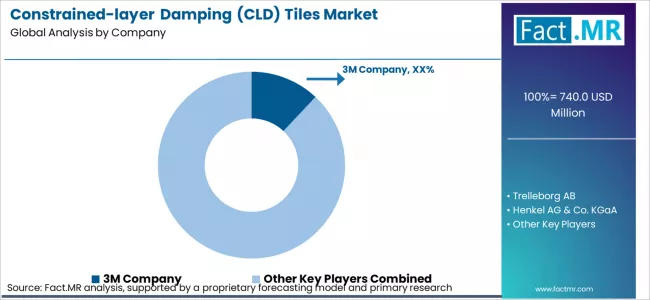
Constrained Layer Damping Cld Tiles Market Analysis By Company | Source: Fact.MR
The Constrained-Layer Damping (CLD) tiles market sees competition driven by innovations in vibration and noise control, with key players like 3M Company and Trelleborg AB leading with advanced materials that improve sound and vibration attenuation. Henkel AG & Co. KGaA and Nitto Denko Corporation offer specialized adhesive technologies that enhance the performance of CLD systems across diverse industries, including automotive and industrial applications. Hutchinson SA and Parker LORD Corporation focus on providing high-performance damping solutions tailored to specific vibration challenges. Compagnie de Saint-Gobain S.A. and Rogers Corporation deliver innovative materials that integrate seamlessly into structural designs, while Sika AG continues to build its reputation by offering tailored solutions that meet the increasing demand for sustainable and high-efficiency noise control. These companies differentiate themselves by focusing on high-quality, versatile products that meet the evolving needs of noise reduction in manufacturing, construction, and automotive industries.
Recent Industry Developments
- Patent-Multilayer constrained-layer damping (Published Aug 30, 2023): Avery Dennison received grant publication for a multilayer constrained-layer damping structure that can incorporate a ceramic layer (e.g., tile) in a layered build-up to manage vibration and noise.
- Product update-3M™ Vibration Damping Tape 435 technical data revision (Revised Apr 2025): 3M issued an updated technical data sheet for 3M™ Vibration Damping Tape 435, reaffirming a viscoelastic damping polymer on an aluminum constraining layer used for constrained-layer damping treatments.
- Product documentation-Megasorber D14 self-adhesive constrained-layer damping sheet (Published Sep 2025): Megasorber published a technical data sheet for D14, a self-adhesive constrained-layer damping product positioned for vibration mitigation on sheet metal/plastic surfaces in transport and industrial uses.
Key Players of the Constrained-layer Damping (CLD) Tiles Market
- 3M Company
- Trelleborg AB
- Henkel AG & Co. KGaA
- Nitto Denko Corporation
- Hutchinson SA
- Parker LORD Corporation
- Compagnie de Saint-Gobain S.A.
- Rogers Corporation
- Sika AG
Report Scope
| Metric | Value |
|---|---|
| Quantitative Units | USD 740 million (2026) to USD 1,497 million (2036), at a CAGR of 7.3% |
| Market Definition | The Constrained-layer Damping (CLD) Tiles Market includes products designed to reduce noise and vibration in various applications, including building, industrial, and transportation environments. |
| By Product Format | Self-Adhesive CLD Tiles, Sheet-Based CLD Laminates, Preformed Panels, Other |
| By Application | Building & Architectural Damping, Industrial Equipment Panels, Transportation Interiors, Others |
| By Material Stack | Polymer + Metal Constrained Layer, Polymer + Composite, High-Temp CLD Systems, Other |
| By Sales Channel | Industrial Distributors, Direct Manufacturer Sales, Contractors/Installers, Other |
| Regions Covered | North America, Latin America, Europe, East Asia, South Asia, Oceania, Middle East and Africa |
| Countries Covered | United States, Canada, Mexico, Brazil, Argentina, Germany, France, United Kingdom, Italy, Spain, China, India, Japan, South Korea, Indonesia, Australia, and 40+ countries |
| Key Companies Profiled | 3M Company, Trelleborg AB, Henkel AG & Co. KGaA, Nitto Denko Corporation, Hutchinson SA, Parker LORD Corporation, Compagnie de Saint-Gobain S.A., Rogers Corporation, Sika AG |
| Forecast Period | 2026 to 2036 |
| Approach | Hybrid top-down and bottom-up market modeling validated through primary interviews with manufacturers and supported by trade data benchmarking and market research. |
Source: Fact.MR analysis. Updated Feb 19, 2026
Bibliographies
- Patent-Multilayer Constrained-Layer Damping: Avery Dennison. (2023, August 30). Multilayer constrained-layer damping. Google Patents. [1]
- Product Update-3M™ Vibration Damping Tape 435 Technical Data Revision: 3M. (2025, April). 3M™ Vibration Damping Tape 435 technical data revision. 3M Multimedia. [2]
- Product Documentation-Megasorber D14 Self-Adhesive Constrained-Layer Damping Sheet: Megasorber. (2025, September). Megasorber D14 self-adhesive constrained-layer damping sheet. Megasorber. [3]
Segmentation
Constrained-layer Damping (CLD) Tiles Market Key Segments
-
By Product Format :
- Self-Adhesive CLD Tiles
- Sheet-Based CLD Laminates
- Preformed Panels
- Other
-
By Application :
- Building & Architectural Damping
- Industrial Equipment Panels
- Transportation Interiors
- Others
-
By Material Stack :
- Polymer + Metal Constrained Layer
- Polymer + Composite
- High-Temp CLD Systems
- Other
-
By Sales Channel :
- Industrial Distributors
- Direct Manufacturer Sales
- Contractors/Installers
- Other
-
Region :
- North America
- USA
- Canada
- Mexico
- Europe
- Germany
- UK
- France
- Italy
- Spain
- Nordic Countries
- BENELUX
- Rest of Europe
- Asia Pacific
- China
- Japan
- South Korea
- India
- Australia
- Rest of Asia Pacific
- Latin America
- Brazil
- Argentina
- Rest of Latin America
- Middle East and Africa
- Kingdom of Saudi Arabia
- United Arab Emirates
- South Africa
- Rest of Middle East and Africa
- Other Regions
- Oceania
- Central Asia
- Other Markets
- North America
Frequently Asked Questions
How large is the demand for Constrained-layer Damping (CLD) Tiles in the global market in 2026?
What will be the market size of Constrained-layer Damping (CLD) Tiles in the global market by 2036?
What is the expected demand growth for Constrained-layer Damping (CLD) Tiles in the global market between 2026 and 2036?
Which product format is expected to dominate the market?
Which region is expected to show the highest growth rate for Constrained-layer Damping (CLD) Tiles?
How significant is the growth outlook for Vietnam in this market?
What is the growth outlook for the United States in this report?
What is the growth forecast for China in the Constrained-layer Damping (CLD) Tiles market?
Which European market is highlighted in this analysis?
Which company is identified as a leading player in the Constrained-layer Damping (CLD) Tiles market?
What are Constrained-layer Damping (CLD) Tiles used for?
What does the Constrained-layer Damping (CLD) Tiles market include in this report?
How is the market forecast developed in this report?
What is meant by the Constrained-layer Damping (CLD) Tiles market in this report?
Who worked on this report


Preview the report firsthand - request a free sample
Free SampleGet the brochure for pricing and purchase details
Download PDF