PFAS Replacement Chemistries for Textiles Market

PFAS Replacement Chemistries for Textiles Market Size and Share Forecast Outlook 2026 to 2036

Pfas replacement chemistries for textiles market is projected to grow from USD 0.7 billion in 2026 to USD 1.8 billion by 2036, at a CAGR of 9.8%. Silicone-Based Repellents will dominate with a 28.0% market share, while apparel & outdoor fabrics will lead the application segment with a 30.0% share.

PFAS Replacement Chemistries for Textiles Market Forecast and Outlook 2026 to 2036

The global market for PFAS replacement chemistries in textiles is undergoing rapid transformation, driven by stringent regulatory bans and a significant shift toward sustainable chemistry in the apparel and industrial fabrics sectors. Projected to grow from USD 0.69 billion in 2026 to USD 1.76 billion by 2036, the market will expand at a 9.8% CAGR.

Key Takeaways from the PFAS Replacement Chemistries for Textiles Market

  • Market Value for 2026: USD 0.69 Billion
  • Market Value for 2036: USD 1.76 Billion
  • Forecast CAGR (2026-2036): 9.8%
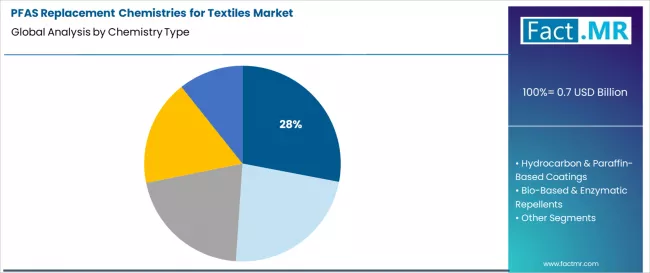
  • Leading Chemistry Type Share (2026): Silicone-Based Repellents (28%)
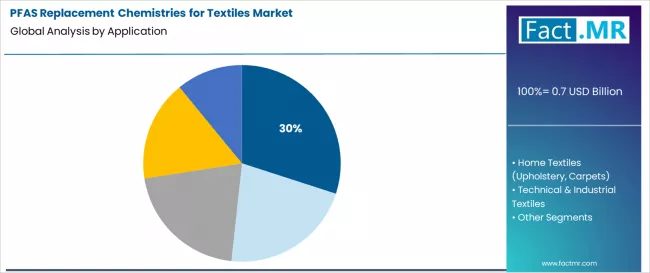
  • Leading Application Share (2026): Apparel & Outdoor Fabrics (30%)
  • Leading Functionality Share (2026): Water Repellency (34%)
  • Key Players in the Market: Chemours (PFAS Alternatives), Huntsman Corporation, Archroma, Dow Inc., Rudolf Group
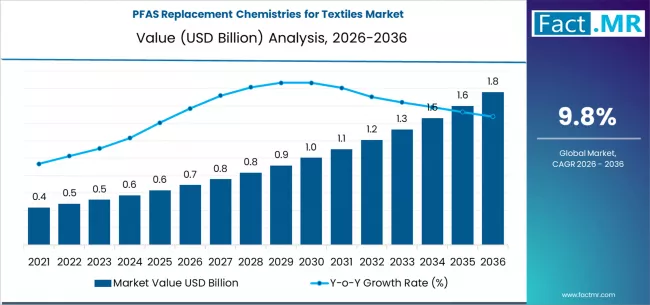
Pfas Replacement Chemistries For Textiles Market Market Value Analysis

Silicone-based repellents currently represent the leading alternative chemistry, capturing a 28% market share. Apparel and outdoor fabrics constitute the primary application segment, accounting for 30% of demand. Water repellency remains the most critical functionality, driving 34% of the market, as brands seek to maintain performance while eliminating "forever chemicals."

This accelerated growth is a direct response to global regulatory action against per- and polyfluoroalkyl substances (PFAS) due to their persistence, bioaccumulation, and toxicity. Major brands and textile manufacturers are actively reformulating products to meet compliance deadlines and consumer demand for safer, eco-conscious materials. Alternative chemistries must replicate the exceptional oil, water, and stain resistance of PFAS without the associated environmental and health liabilities, presenting a substantial technical and commercial challenge.

Innovation is centered on developing high-performance, durable finishes derived from silicone, bio-based, and advanced polymer chemistries. The success of these alternatives hinges on achieving comparable functionality across diverse textile applications from waterproof outdoor gear to stain-resistant upholstery while ensuring circularity and end-of-life safety. This market's evolution is critical for the textile industry's sustainable transition.

Metric

Metric Value
Market Value (2026) USD 0.69 Billion
Market Forecast Value (2036) USD 1.76 Billion
Forecast CAGR (2026-2036) 9.8%

Category

Category Segments
Chemistry Type Silicone-Based Repellents, Hydrocarbon & Paraffin-Based Coatings, Bio-Based & Enzymatic Repellents, Polyurethane Dispersions (PUDs), Other PFAS-Free Textile Chemistries
Application Apparel & Outdoor Fabrics, Home Textiles (Upholstery, Carpets), Technical & Industrial Textiles, Medical & Hygiene Textiles, Automotive & Transport Fabrics
Functionality Water Repellency, Oil & Stain Resistance, Anti-Soiling & Easy-Clean Coatings, Breathable Protective Finishes, Hybrid Performance Coatings
Region North America, Latin America, Western Europe, Eastern Europe, East Asia, South Asia & Pacific, MEA

Segmental Analysis

By Chemistry Type, Which Alternative Currently Offers the Best Performance Balance?
Pfas Replacement Chemistries For Textiles Market Analysis By Chemistry Type

Silicone-based repellents lead the market with a 28% share. Their position is attributed to a strong balance of water repellency, durability through washes, and relatively well-understood environmental profile compared to PFAS. Silicone chemistry creates a low-surface-energy barrier on fibers, effectively beadling water.

While not always matching PFAS in oil repellency, ongoing advancements in hybrid silicone-organic formulations are closing the performance gap, making it the most adopted drop-in alternative for many water-repellent apparel applications.

By Application, Which Segment is driving the Most Urgent Reformulation?
Pfas Replacement Chemistries For Textiles Market Analysis By Application

Apparel and outdoor fabrics represent the largest application segment, holding a 30% share. This sector faces intense consumer scrutiny and brand-led commitments to eliminate PFAS from waterproof jackets, hiking gear, and fashion items.

The performance requirements are high, but the direct consumer-facing nature of these products makes compliance and marketing of "PFAS-free" attributes a powerful driver, accelerating R&D and adoption of alternative chemistries across global supply chains.

By Functionality, Which Performance Attribute is Non-Negotiable?

Pfas Replacement Chemistries For Textiles Market Analysis By Functionality

Water repellency is the leading functionality, commanding a 34% share. Durable water repellent (DWR) finishes based on long-chain PFAS, dominantly served this core performance characteristic, critical for outdoor, workwear, and many home textiles.

Replicating this functionality, especially durability to washing and abrasion, without fluorochemistry is the central technical challenge. Success in this area defines the commercial viability of most alternative chemistries, concentrating development efforts here.

What are the Drivers, Restraints, and Key Trends of the PFAS Replacement Chemistries Market?

The primary market driver is the expanding web of binding regulations phasing out PFAS in textiles across the United States, European Union, and Asia-Pacific. States like California and Maine have enacted strict bans, with the EU's REACH restriction proposal setting a broad precedent. Concurrently, major apparel brands and retailers have publicly committed to PFAS-free supply chains, creating top-down pressure on chemical suppliers and mills to deliver certified alternatives that meet performance and sustainability standards.

A significant market restraint is the technical performance gap, particularly in achieving simultaneous oil and water repellency (dual repellency) and long-term durability comparable to C8 or C6 PFAS chemistries. Some alternatives may also raise new concerns, such as the potential environmental impact of certain silicone degradation products or the use of non-renewable hydrocarbons. Higher costs and the need for new application machinery or processes can also slow adoption, especially among smaller manufacturers.

Key trends include the rapid innovation in bio-based and renewable carbon chemistries derived from plant oils, waxes, and polysaccharides that offer inherently biodegradable profiles. There is a strong move toward multi-functional hybrid systems that combine, for example, silicone for water repellency with a novel polymer for stain release. The market is also seeing the rise of digital and AI-driven formulation platforms to accelerate the discovery and optimization of new, high-performance non-fluorinated polymer architectures tailored to specific fiber types and end-uses.

Analysis of the PFAS Replacement Chemistries Market by Key Countries
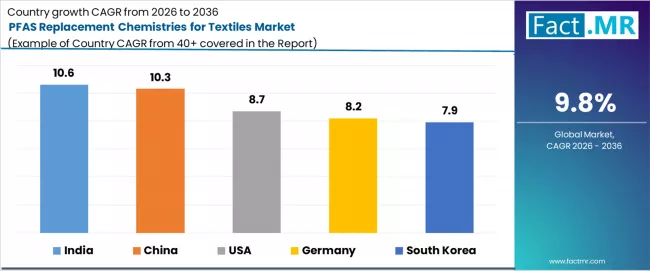
Pfas Replacement Chemistries For Textiles Market Cagr Analysis By Country

Country CAGR (2026-2036)
India 10.60%
China 10.30%
USA 8.70%
Germany 8.20%
South Korea 7.90%

How do India’s Textile Export Economy and Regulatory Alignment Drive Change?

India’s leading CAGR of 10.60% is fueled by its massive textile export industry, which must comply with the destination market regulations of the EU and USA. The need to maintain market access is compelling Indian mills and chemical suppliers to rapidly adopt certified PFAS-free alternatives. Domestic regulatory momentum and a strong base in specialty chemical manufacturing position India to become both a major consumer and an innovator in cost-effective, high-performance replacement chemistries.

What is the Impact of China’s Dual Role as Manufacturer and Regulatory Follower?

China’s 10.30% growth stems from its position as the world’s textile manufacturing hub and its evolving chemical management policies. While producing for global brands demanding PFAS-free goods, China is also developing its own regulatory framework for persistent chemicals. This dual pressure is driving substantial investment in R&D and production capacity for silicone-based and other alternative finishes within its integrated chemical and textile ecosystem.

How does the USA’s State-Level Leadership and Brand Activism Shape the Market?
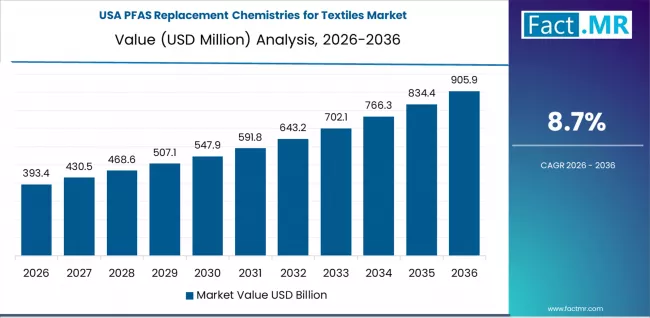
Pfas Replacement Chemistries For Textiles Market Country Value Analysis

The USA’s 8.70% CAGR is propelled by pioneering state-level legislation and aggressive corporate sustainability commitments from outdoor apparel giants and major retailers. This regulatory and market pressure creates a clear demand signal for compliant chemistries. The presence of innovative chemical companies and a robust outdoor industry fosters a dynamic environment for developing and commercializing next-generation, high-performance alternatives, particularly for demanding applications.

Why is Germany a Hub for High-Performance and Sustainable Textile Chemistry?

Germany’s 8.20% growth reflects its leadership in high-performance chemical engineering and its stringent regulatory stance within the EU. German textile chemical companies are at the forefront of developing advanced bio-based and durable non-fluorinated finishes. The market demand is for solutions that not only match PFAS performance but also excel in lifecycle assessments, aligning with the circular economy principles dominant in the European textile strategy.

What Role does South Korea’s Technical Textile and Innovation Focus Play?

South Korea’s 7.90% growth is anchored in its advanced technical textiles sector (e.g., for automotive, electronics) and government-led innovation programs. The need for high-functionality finishes in these niche applications, combined with global supply chain requirements, drives targeted R&D into specialized PFAS-free solutions like advanced polyurethane dispersions (PUDs) and nanocomposite coatings, positioning the country as a developer of premium alternative chemistries.

Competitive Landscape of the PFAS Replacement Chemistries Market
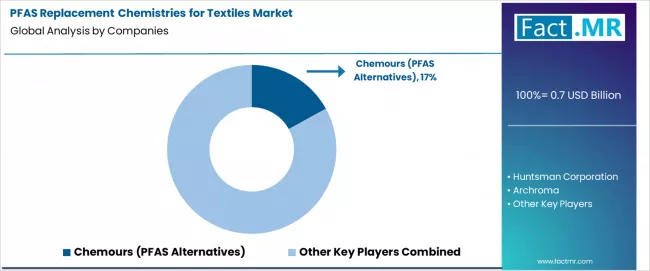
Pfas Replacement Chemistries For Textiles Market Analysis By Company

The competitive landscape features established specialty chemical companies and former PFAS producers pivoting their portfolios. Leaders like Chemours (with its non-fluorinated alternatives) and Archroma compete based on proprietary polymer technologies, extensive textile application expertise, and the ability to provide globally consistent, compliant products.

Competition centers on securing third-party certifications (e.g., Bluesign, ZDHC), demonstrating durability and performance through independent testing, and offering comprehensive technical support for mills transitioning their finishing processes. A key differentiator is providing a complete "drop-in solution" that requires minimal change for textile manufacturers while guaranteeing performance parity.

Key Players in the PFAS Replacement Chemistries for Textiles Market

  • Chemours (PFAS Alternatives)
  • Huntsman Corporation
  • Archroma
  • Dow Inc.
  • Rudolf Group

Scope of Report

Items Values
Quantitative Units USD Billion
Chemistry Type Silicone-Based, Hydrocarbon/Paraffin, Bio-Based/Enzymatic, Polyurethane Dispersions (PUDs), Other PFAS-Free
Application Apparel/Outdoor, Home Textiles, Technical/Industrial, Medical/Hygiene, Automotive
Functionality Water Repellency, Oil/Stain Resistance, Anti-Soiling, Breathable Protection, Hybrid Performance
Key Countries India, China, USA, Germany, South Korea
Key Companies Chemours (PFAS Alternatives), Huntsman Corporation, Archroma, Dow Inc., Rudolf Group
Additional Analysis Analysis of repellency mechanisms (surface energy, roughness); durability testing to washing and abrasion; environmental fate and biodegradability of alternatives; analytical methods for verifying PFAS-free status; total cost of ownership comparison including application efficiency and durability.

Market by Segments

  • Chemistry Type :

    • Silicone-Based Repellents
    • Hydrocarbon & Paraffin-Based Coatings
    • Bio-Based & Enzymatic Repellents
    • Polyurethane Dispersions (PUDs)
    • Other PFAS-Free Textile Chemistries
  • Application :

    • Apparel & Outdoor Fabrics
    • Home Textiles (Upholstery, Carpets)
    • Technical & Industrial Textiles
    • Medical & Hygiene Textiles
    • Automotive & Transport Fabrics
  • Functionality :

    • Water Repellency
    • Oil & Stain Resistance
    • Anti-Soiling & Easy-Clean Coatings
    • Breathable Protective Finishes
    • Hybrid Performance Coatings
  • Region :

    • North America

      • USA
      • Canada
    • Latin America

      • Brazil
      • Mexico
      • Argentina
      • Rest of Latin America
    • Western Europe

      • Germany
      • UK
      • France
      • Spain
      • Italy
      • BENELUX
      • Rest of Western Europe
    • Eastern Europe

      • Russia
      • Poland
      • Czech Republic
      • Rest of Eastern Europe
    • East Asia

      • China
      • Japan
      • South Korea
      • Rest of East Asia
    • South Asia & Pacific

      • India
      • ASEAN
      • Australia
      • Rest of South Asia & Pacific
    • MEA

      • Saudi Arabia
      • UAE
      • Turkiye
      • Rest of MEA

Table of Content

  1. Executive Summary
    • Global Market Outlook
    • Demand to side Trends
    • Supply to side Trends
    • Technology Roadmap Analysis
    • Analysis and Recommendations
  2. Market Overview
    • Market Coverage / Taxonomy
    • Market Definition / Scope / Limitations
  3. Market Background
    • Market Dynamics
      • Drivers
      • Restraints
      • Opportunity
      • Trends
    • Scenario Forecast
      • Demand in Optimistic Scenario
      • Demand in Likely Scenario
      • Demand in Conservative Scenario
    • Opportunity Map Analysis
    • Product Life Cycle Analysis
    • Supply Chain Analysis
    • Investment Feasibility Matrix
    • Value Chain Analysis
    • PESTLE and Porter’s Analysis
    • Regulatory Landscape
    • Regional Parent Market Outlook
    • Production and Consumption Statistics
    • Import and Export Statistics
  4. Global Market Analysis 2021 to 2025 and Forecast, 2026 to 2036
    • Historical Market Size Value (USD Million) Analysis, 2021 to 2025
    • Current and Future Market Size Value (USD Million) Projections, 2026 to 2036
      • Y to o to Y Growth Trend Analysis
      • Absolute $ Opportunity Analysis
  5. Global Market Pricing Analysis 2021 to 2025 and Forecast 2026 to 2036
  6. Global Market Analysis 2021 to 2025 and Forecast 2026 to 2036, By Chemistry Type
    • Introduction / Key Findings
    • Historical Market Size Value (USD Million) Analysis By Chemistry Type, 2021 to 2025
    • Current and Future Market Size Value (USD Million) Analysis and Forecast By Chemistry Type, 2026 to 2036
      • Silicone-Based Repellents
      • Hydrocarbon & Paraffin-Based Coatings
      • Bio-Based & Enzymatic Repellents
      • Polyurethane Dispersions (PUDs)
      • Other PFAS-Free Textile Chemistries
    • Y to o to Y Growth Trend Analysis By Chemistry Type, 2021 to 2025
    • Absolute $ Opportunity Analysis By Chemistry Type, 2026 to 2036
  7. Global Market Analysis 2021 to 2025 and Forecast 2026 to 2036, By Application
    • Introduction / Key Findings
    • Historical Market Size Value (USD Million) Analysis By Application, 2021 to 2025
    • Current and Future Market Size Value (USD Million) Analysis and Forecast By Application, 2026 to 2036
      • Apparel & Outdoor Fabrics
      • Home Textiles (Upholstery, Carpets)
      • Technical & Industrial Textiles
      • Medical & Hygiene Textiles
      • Automotive & Transport Fabrics
    • Y to o to Y Growth Trend Analysis By Application, 2021 to 2025
    • Absolute $ Opportunity Analysis By Application, 2026 to 2036
  8. Global Market Analysis 2021 to 2025 and Forecast 2026 to 2036, By Functionality
    • Introduction / Key Findings
    • Historical Market Size Value (USD Million) Analysis By Functionality, 2021 to 2025
    • Current and Future Market Size Value (USD Million) Analysis and Forecast By Functionality, 2026 to 2036
      • Water Repellency
      • Oil & Stain Resistance
      • Anti-Soiling & Easy-Clean Coatings
      • Breathable Protective Finishes
      • Hybrid Performance Coatings
    • Y to o to Y Growth Trend Analysis By Functionality, 2021 to 2025
    • Absolute $ Opportunity Analysis By Functionality, 2026 to 2036
  9. Global Market Analysis 2021 to 2025 and Forecast 2026 to 2036, By Region
    • Introduction
    • Historical Market Size Value (USD Million) Analysis By Region, 2021 to 2025
    • Current Market Size Value (USD Million) Analysis and Forecast By Region, 2026 to 2036
      • North America
      • Latin America
      • Western Europe
      • Eastern Europe
      • East Asia
      • South Asia and Pacific
      • Middle East & Africa
    • Market Attractiveness Analysis By Region
  10. North America Market Analysis 2021 to 2025 and Forecast 2026 to 2036, By Country
    • Historical Market Size Value (USD Million) Trend Analysis By Market Taxonomy, 2021 to 2025
    • Market Size Value (USD Million) Forecast By Market Taxonomy, 2026 to 2036
      • By Country
        • USA
        • Canada
        • Mexico
      • By Chemistry Type
      • By Application
      • By Functionality
    • Market Attractiveness Analysis
      • By Country
      • By Chemistry Type
      • By Application
      • By Functionality
    • Key Takeaways
  11. Latin America Market Analysis 2021 to 2025 and Forecast 2026 to 2036, By Country
    • Historical Market Size Value (USD Million) Trend Analysis By Market Taxonomy, 2021 to 2025
    • Market Size Value (USD Million) Forecast By Market Taxonomy, 2026 to 2036
      • By Country
        • Brazil
        • Chile
        • Rest of Latin America
      • By Chemistry Type
      • By Application
      • By Functionality
    • Market Attractiveness Analysis
      • By Country
      • By Chemistry Type
      • By Application
      • By Functionality
    • Key Takeaways
  12. Western Europe Market Analysis 2021 to 2025 and Forecast 2026 to 2036, By Country
    • Historical Market Size Value (USD Million) Trend Analysis By Market Taxonomy, 2021 to 2025
    • Market Size Value (USD Million) Forecast By Market Taxonomy, 2026 to 2036
      • By Country
        • Germany
        • UK
        • Italy
        • Spain
        • France
        • Nordic
        • BENELUX
        • Rest of Western Europe
      • By Chemistry Type
      • By Application
      • By Functionality
    • Market Attractiveness Analysis
      • By Country
      • By Chemistry Type
      • By Application
      • By Functionality
    • Key Takeaways
  13. Eastern Europe Market Analysis 2021 to 2025 and Forecast 2026 to 2036, By Country
    • Historical Market Size Value (USD Million) Trend Analysis By Market Taxonomy, 2021 to 2025
    • Market Size Value (USD Million) Forecast By Market Taxonomy, 2026 to 2036
      • By Country
        • Russia
        • Poland
        • Hungary
        • Balkan & Baltic
        • Rest of Eastern Europe
      • By Chemistry Type
      • By Application
      • By Functionality
    • Market Attractiveness Analysis
      • By Country
      • By Chemistry Type
      • By Application
      • By Functionality
    • Key Takeaways
  14. East Asia Market Analysis 2021 to 2025 and Forecast 2026 to 2036, By Country
    • Historical Market Size Value (USD Million) Trend Analysis By Market Taxonomy, 2021 to 2025
    • Market Size Value (USD Million) Forecast By Market Taxonomy, 2026 to 2036
      • By Country
        • China
        • Japan
        • South Korea
      • By Chemistry Type
      • By Application
      • By Functionality
    • Market Attractiveness Analysis
      • By Country
      • By Chemistry Type
      • By Application
      • By Functionality
    • Key Takeaways
  15. South Asia and Pacific Market Analysis 2021 to 2025 and Forecast 2026 to 2036, By Country
    • Historical Market Size Value (USD Million) Trend Analysis By Market Taxonomy, 2021 to 2025
    • Market Size Value (USD Million) Forecast By Market Taxonomy, 2026 to 2036
      • By Country
        • India
        • ASEAN
        • Australia & New Zealand
        • Rest of South Asia and Pacific
      • By Chemistry Type
      • By Application
      • By Functionality
    • Market Attractiveness Analysis
      • By Country
      • By Chemistry Type
      • By Application
      • By Functionality
    • Key Takeaways
  16. Middle East & Africa Market Analysis 2021 to 2025 and Forecast 2026 to 2036, By Country
    • Historical Market Size Value (USD Million) Trend Analysis By Market Taxonomy, 2021 to 2025
    • Market Size Value (USD Million) Forecast By Market Taxonomy, 2026 to 2036
      • By Country
        • Kingdom of Saudi Arabia
        • Other GCC Countries
        • Turkiye
        • South Africa
        • Other African Union
        • Rest of Middle East & Africa
      • By Chemistry Type
      • By Application
      • By Functionality
    • Market Attractiveness Analysis
      • By Country
      • By Chemistry Type
      • By Application
      • By Functionality
    • Key Takeaways
  17. Key Countries Market Analysis
    • USA
      • Pricing Analysis
      • Market Share Analysis, 2025
        • By Chemistry Type
        • By Application
        • By Functionality
    • Canada
      • Pricing Analysis
      • Market Share Analysis, 2025
        • By Chemistry Type
        • By Application
        • By Functionality
    • Mexico
      • Pricing Analysis
      • Market Share Analysis, 2025
        • By Chemistry Type
        • By Application
        • By Functionality
    • Brazil
      • Pricing Analysis
      • Market Share Analysis, 2025
        • By Chemistry Type
        • By Application
        • By Functionality
    • Chile
      • Pricing Analysis
      • Market Share Analysis, 2025
        • By Chemistry Type
        • By Application
        • By Functionality
    • Germany
      • Pricing Analysis
      • Market Share Analysis, 2025
        • By Chemistry Type
        • By Application
        • By Functionality
    • UK
      • Pricing Analysis
      • Market Share Analysis, 2025
        • By Chemistry Type
        • By Application
        • By Functionality
    • Italy
      • Pricing Analysis
      • Market Share Analysis, 2025
        • By Chemistry Type
        • By Application
        • By Functionality
    • Spain
      • Pricing Analysis
      • Market Share Analysis, 2025
        • By Chemistry Type
        • By Application
        • By Functionality
    • France
      • Pricing Analysis
      • Market Share Analysis, 2025
        • By Chemistry Type
        • By Application
        • By Functionality
    • India
      • Pricing Analysis
      • Market Share Analysis, 2025
        • By Chemistry Type
        • By Application
        • By Functionality
    • ASEAN
      • Pricing Analysis
      • Market Share Analysis, 2025
        • By Chemistry Type
        • By Application
        • By Functionality
    • Australia & New Zealand
      • Pricing Analysis
      • Market Share Analysis, 2025
        • By Chemistry Type
        • By Application
        • By Functionality
    • China
      • Pricing Analysis
      • Market Share Analysis, 2025
        • By Chemistry Type
        • By Application
        • By Functionality
    • Japan
      • Pricing Analysis
      • Market Share Analysis, 2025
        • By Chemistry Type
        • By Application
        • By Functionality
    • South Korea
      • Pricing Analysis
      • Market Share Analysis, 2025
        • By Chemistry Type
        • By Application
        • By Functionality
    • Russia
      • Pricing Analysis
      • Market Share Analysis, 2025
        • By Chemistry Type
        • By Application
        • By Functionality
    • Poland
      • Pricing Analysis
      • Market Share Analysis, 2025
        • By Chemistry Type
        • By Application
        • By Functionality
    • Hungary
      • Pricing Analysis
      • Market Share Analysis, 2025
        • By Chemistry Type
        • By Application
        • By Functionality
    • Kingdom of Saudi Arabia
      • Pricing Analysis
      • Market Share Analysis, 2025
        • By Chemistry Type
        • By Application
        • By Functionality
    • Turkiye
      • Pricing Analysis
      • Market Share Analysis, 2025
        • By Chemistry Type
        • By Application
        • By Functionality
    • South Africa
      • Pricing Analysis
      • Market Share Analysis, 2025
        • By Chemistry Type
        • By Application
        • By Functionality
  18. Market Structure Analysis
    • Competition Dashboard
    • Competition Benchmarking
    • Market Share Analysis of Top Players
      • By Regional
      • By Chemistry Type
      • By Application
      • By Functionality
  19. Competition Analysis
    • Competition Deep Dive
      • Chemours (PFAS Alternatives)
        • Overview
        • Product Portfolio
        • Profitability by Market Segments (Product/Age /Sales Channel/Region)
        • Sales Footprint
        • Strategy Overview
          • Marketing Strategy
          • Product Strategy
          • Channel Strategy
      • Huntsman Corporation
      • Archroma
      • Dow Inc.
      • Rudolf Group
  20. Assumptions & Acronyms Used
  21. Research Methodology

List Of Table

  • Table 1: Global Market Value (USD Million) Forecast by Region, 2021 to 2036
  • Table 2: Global Market Value (USD Million) Forecast by Chemistry Type, 2021 to 2036
  • Table 3: Global Market Value (USD Million) Forecast by Application, 2021 to 2036
  • Table 4: Global Market Value (USD Million) Forecast by Functionality, 2021 to 2036
  • Table 5: North America Market Value (USD Million) Forecast by Country, 2021 to 2036
  • Table 6: North America Market Value (USD Million) Forecast by Chemistry Type, 2021 to 2036
  • Table 7: North America Market Value (USD Million) Forecast by Application, 2021 to 2036
  • Table 8: North America Market Value (USD Million) Forecast by Functionality, 2021 to 2036
  • Table 9: Latin America Market Value (USD Million) Forecast by Country, 2021 to 2036
  • Table 10: Latin America Market Value (USD Million) Forecast by Chemistry Type, 2021 to 2036
  • Table 11: Latin America Market Value (USD Million) Forecast by Application, 2021 to 2036
  • Table 12: Latin America Market Value (USD Million) Forecast by Functionality, 2021 to 2036
  • Table 13: Western Europe Market Value (USD Million) Forecast by Country, 2021 to 2036
  • Table 14: Western Europe Market Value (USD Million) Forecast by Chemistry Type, 2021 to 2036
  • Table 15: Western Europe Market Value (USD Million) Forecast by Application, 2021 to 2036
  • Table 16: Western Europe Market Value (USD Million) Forecast by Functionality, 2021 to 2036
  • Table 17: Eastern Europe Market Value (USD Million) Forecast by Country, 2021 to 2036
  • Table 18: Eastern Europe Market Value (USD Million) Forecast by Chemistry Type, 2021 to 2036
  • Table 19: Eastern Europe Market Value (USD Million) Forecast by Application, 2021 to 2036
  • Table 20: Eastern Europe Market Value (USD Million) Forecast by Functionality, 2021 to 2036
  • Table 21: East Asia Market Value (USD Million) Forecast by Country, 2021 to 2036
  • Table 22: East Asia Market Value (USD Million) Forecast by Chemistry Type, 2021 to 2036
  • Table 23: East Asia Market Value (USD Million) Forecast by Application, 2021 to 2036
  • Table 24: East Asia Market Value (USD Million) Forecast by Functionality, 2021 to 2036
  • Table 25: South Asia and Pacific Market Value (USD Million) Forecast by Country, 2021 to 2036
  • Table 26: South Asia and Pacific Market Value (USD Million) Forecast by Chemistry Type, 2021 to 2036
  • Table 27: South Asia and Pacific Market Value (USD Million) Forecast by Application, 2021 to 2036
  • Table 28: South Asia and Pacific Market Value (USD Million) Forecast by Functionality, 2021 to 2036
  • Table 29: Middle East & Africa Market Value (USD Million) Forecast by Country, 2021 to 2036
  • Table 30: Middle East & Africa Market Value (USD Million) Forecast by Chemistry Type, 2021 to 2036
  • Table 31: Middle East & Africa Market Value (USD Million) Forecast by Application, 2021 to 2036
  • Table 32: Middle East & Africa Market Value (USD Million) Forecast by Functionality, 2021 to 2036

List Of Figures

  • Figure 1: Global Market Pricing Analysis
  • Figure 2: Global Market Value (USD Million) Forecast 2021 to 2036
  • Figure 3: Global Market Value Share and BPS Analysis by Chemistry Type, 2026 and 2036
  • Figure 4: Global Market Y to o to Y Growth Comparison by Chemistry Type, 2026 to 2036
  • Figure 5: Global Market Attractiveness Analysis by Chemistry Type
  • Figure 6: Global Market Value Share and BPS Analysis by Application, 2026 and 2036
  • Figure 7: Global Market Y to o to Y Growth Comparison by Application, 2026 to 2036
  • Figure 8: Global Market Attractiveness Analysis by Application
  • Figure 9: Global Market Value Share and BPS Analysis by Functionality, 2026 and 2036
  • Figure 10: Global Market Y to o to Y Growth Comparison by Functionality, 2026 to 2036
  • Figure 11: Global Market Attractiveness Analysis by Functionality
  • Figure 12: Global Market Value (USD Million) Share and BPS Analysis by Region, 2026 and 2036
  • Figure 13: Global Market Y to o to Y Growth Comparison by Region, 2026 to 2036
  • Figure 14: Global Market Attractiveness Analysis by Region
  • Figure 15: North America Market Incremental Dollar Opportunity, 2026 to 2036
  • Figure 16: Latin America Market Incremental Dollar Opportunity, 2026 to 2036
  • Figure 17: Western Europe Market Incremental Dollar Opportunity, 2026 to 2036
  • Figure 18: Eastern Europe Market Incremental Dollar Opportunity, 2026 to 2036
  • Figure 19: East Asia Market Incremental Dollar Opportunity, 2026 to 2036
  • Figure 20: South Asia and Pacific Market Incremental Dollar Opportunity, 2026 to 2036
  • Figure 21: Middle East & Africa Market Incremental Dollar Opportunity, 2026 to 2036
  • Figure 22: North America Market Value Share and BPS Analysis by Country, 2026 and 2036
  • Figure 23: North America Market Value Share and BPS Analysis by Chemistry Type, 2026 and 2036
  • Figure 24: North America Market Y to o to Y Growth Comparison by Chemistry Type, 2026 to 2036
  • Figure 25: North America Market Attractiveness Analysis by Chemistry Type
  • Figure 26: North America Market Value Share and BPS Analysis by Application, 2026 and 2036
  • Figure 27: North America Market Y to o to Y Growth Comparison by Application, 2026 to 2036
  • Figure 28: North America Market Attractiveness Analysis by Application
  • Figure 29: North America Market Value Share and BPS Analysis by Functionality, 2026 and 2036
  • Figure 30: North America Market Y to o to Y Growth Comparison by Functionality, 2026 to 2036
  • Figure 31: North America Market Attractiveness Analysis by Functionality
  • Figure 32: Latin America Market Value Share and BPS Analysis by Country, 2026 and 2036
  • Figure 33: Latin America Market Value Share and BPS Analysis by Chemistry Type, 2026 and 2036
  • Figure 34: Latin America Market Y to o to Y Growth Comparison by Chemistry Type, 2026 to 2036
  • Figure 35: Latin America Market Attractiveness Analysis by Chemistry Type
  • Figure 36: Latin America Market Value Share and BPS Analysis by Application, 2026 and 2036
  • Figure 37: Latin America Market Y to o to Y Growth Comparison by Application, 2026 to 2036
  • Figure 38: Latin America Market Attractiveness Analysis by Application
  • Figure 39: Latin America Market Value Share and BPS Analysis by Functionality, 2026 and 2036
  • Figure 40: Latin America Market Y to o to Y Growth Comparison by Functionality, 2026 to 2036
  • Figure 41: Latin America Market Attractiveness Analysis by Functionality
  • Figure 42: Western Europe Market Value Share and BPS Analysis by Country, 2026 and 2036
  • Figure 43: Western Europe Market Value Share and BPS Analysis by Chemistry Type, 2026 and 2036
  • Figure 44: Western Europe Market Y to o to Y Growth Comparison by Chemistry Type, 2026 to 2036
  • Figure 45: Western Europe Market Attractiveness Analysis by Chemistry Type
  • Figure 46: Western Europe Market Value Share and BPS Analysis by Application, 2026 and 2036
  • Figure 47: Western Europe Market Y to o to Y Growth Comparison by Application, 2026 to 2036
  • Figure 48: Western Europe Market Attractiveness Analysis by Application
  • Figure 49: Western Europe Market Value Share and BPS Analysis by Functionality, 2026 and 2036
  • Figure 50: Western Europe Market Y to o to Y Growth Comparison by Functionality, 2026 to 2036
  • Figure 51: Western Europe Market Attractiveness Analysis by Functionality
  • Figure 52: Eastern Europe Market Value Share and BPS Analysis by Country, 2026 and 2036
  • Figure 53: Eastern Europe Market Value Share and BPS Analysis by Chemistry Type, 2026 and 2036
  • Figure 54: Eastern Europe Market Y to o to Y Growth Comparison by Chemistry Type, 2026 to 2036
  • Figure 55: Eastern Europe Market Attractiveness Analysis by Chemistry Type
  • Figure 56: Eastern Europe Market Value Share and BPS Analysis by Application, 2026 and 2036
  • Figure 57: Eastern Europe Market Y to o to Y Growth Comparison by Application, 2026 to 2036
  • Figure 58: Eastern Europe Market Attractiveness Analysis by Application
  • Figure 59: Eastern Europe Market Value Share and BPS Analysis by Functionality, 2026 and 2036
  • Figure 60: Eastern Europe Market Y to o to Y Growth Comparison by Functionality, 2026 to 2036
  • Figure 61: Eastern Europe Market Attractiveness Analysis by Functionality
  • Figure 62: East Asia Market Value Share and BPS Analysis by Country, 2026 and 2036
  • Figure 63: East Asia Market Value Share and BPS Analysis by Chemistry Type, 2026 and 2036
  • Figure 64: East Asia Market Y to o to Y Growth Comparison by Chemistry Type, 2026 to 2036
  • Figure 65: East Asia Market Attractiveness Analysis by Chemistry Type
  • Figure 66: East Asia Market Value Share and BPS Analysis by Application, 2026 and 2036
  • Figure 67: East Asia Market Y to o to Y Growth Comparison by Application, 2026 to 2036
  • Figure 68: East Asia Market Attractiveness Analysis by Application
  • Figure 69: East Asia Market Value Share and BPS Analysis by Functionality, 2026 and 2036
  • Figure 70: East Asia Market Y to o to Y Growth Comparison by Functionality, 2026 to 2036
  • Figure 71: East Asia Market Attractiveness Analysis by Functionality
  • Figure 72: South Asia and Pacific Market Value Share and BPS Analysis by Country, 2026 and 2036
  • Figure 73: South Asia and Pacific Market Value Share and BPS Analysis by Chemistry Type, 2026 and 2036
  • Figure 74: South Asia and Pacific Market Y to o to Y Growth Comparison by Chemistry Type, 2026 to 2036
  • Figure 75: South Asia and Pacific Market Attractiveness Analysis by Chemistry Type
  • Figure 76: South Asia and Pacific Market Value Share and BPS Analysis by Application, 2026 and 2036
  • Figure 77: South Asia and Pacific Market Y to o to Y Growth Comparison by Application, 2026 to 2036
  • Figure 78: South Asia and Pacific Market Attractiveness Analysis by Application
  • Figure 79: South Asia and Pacific Market Value Share and BPS Analysis by Functionality, 2026 and 2036
  • Figure 80: South Asia and Pacific Market Y to o to Y Growth Comparison by Functionality, 2026 to 2036
  • Figure 81: South Asia and Pacific Market Attractiveness Analysis by Functionality
  • Figure 82: Middle East & Africa Market Value Share and BPS Analysis by Country, 2026 and 2036
  • Figure 83: Middle East & Africa Market Value Share and BPS Analysis by Chemistry Type, 2026 and 2036
  • Figure 84: Middle East & Africa Market Y to o to Y Growth Comparison by Chemistry Type, 2026 to 2036
  • Figure 85: Middle East & Africa Market Attractiveness Analysis by Chemistry Type
  • Figure 86: Middle East & Africa Market Value Share and BPS Analysis by Application, 2026 and 2036
  • Figure 87: Middle East & Africa Market Y to o to Y Growth Comparison by Application, 2026 to 2036
  • Figure 88: Middle East & Africa Market Attractiveness Analysis by Application
  • Figure 89: Middle East & Africa Market Value Share and BPS Analysis by Functionality, 2026 and 2036
  • Figure 90: Middle East & Africa Market Y to o to Y Growth Comparison by Functionality, 2026 to 2036
  • Figure 91: Middle East & Africa Market Attractiveness Analysis by Functionality
  • Figure 92: Global Market - Tier Structure Analysis
  • Figure 93: Global Market - Company Share Analysis

- FAQs -

How big is the pfas replacement chemistries for textiles market in 2026?

The global pfas replacement chemistries for textiles market is estimated to be valued at USD 0.7 billion in 2026.

What will be the size of pfas replacement chemistries for textiles market in 2036?

The market size for the pfas replacement chemistries for textiles market is projected to reach USD 1.8 billion by 2036.

How much will be the pfas replacement chemistries for textiles market growth between 2026 and 2036?

The pfas replacement chemistries for textiles market is expected to grow at a 9.8% CAGR between 2026 and 2036.

What are the key product types in the pfas replacement chemistries for textiles market?

The key product types in pfas replacement chemistries for textiles market are silicone-based repellents, hydrocarbon & paraffin-based coatings, bio-based & enzymatic repellents, polyurethane dispersions (puds) and other pfas-free textile chemistries.

Which application segment to contribute significant share in the pfas replacement chemistries for textiles market in 2026?

In terms of application, apparel & outdoor fabrics segment to command 30.0% share in the pfas replacement chemistries for textiles market in 2026.

PFAS Replacement Chemistries for Textiles Market