- Market Value (2025): USD 1.7 Bn
- Estimated Value (2026): USD 1.8 Bn
- Forecast Value (2036): USD 4.4 Bn
- CAGR (2026-2036): 9.2%
What is the Contract Dry Extrusion Services Market forecast to be worth by 2036?
USD 1.8 billion in 2026 to USD 4.4 billion by 2036 at a 9.2% CAGR.
- The Contract Dry Extrusion Services Market reached USD 1.7 billion in 2025.
- Demand is expected to increase from USD 1.8 billion in 2026 to USD 4.4 billion by 2036.
- The market is expected to record 9.2% CAGR from 2026 to 2036 as food firms use outside capacity for trials and scale-up work.
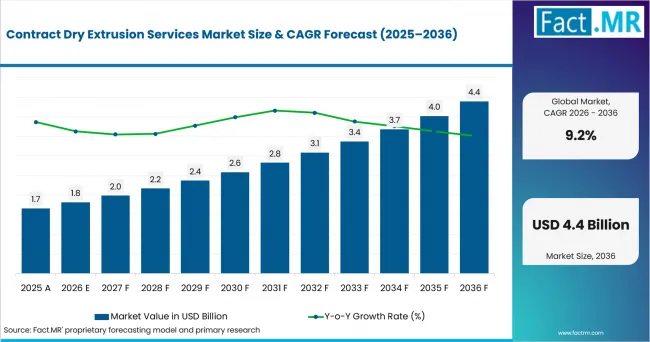
Contract Dry Extrusion Services Market Value Analysis | Source: Fact.MR
What are the defining numbers behind Contract Dry Extrusion Services Market growth?
An absolute opportunity of USD 2.6 billion is expected between 2026 and 2036.
- Demand Drivers in the Market
- Food product teams need pilot capacity before they approve a full line. The USDA Economic Research Service reported on June 11, 2026 that inflation-adjusted U.S. food spending reached USD 2.51 trillion in 2025.
- Plant-protein teams need close control of water and heat. Contract trials let them compare pea and soy recipes before a full line is set. Wheat and pulse blends can be checked in the same way.
- Food firms need scale-up proof that links a lab recipe with line output. Pilot plants help teams test the same recipe at a larger rate. Clear records can then guide setup on the final line.
- Food teams often need small batches of TVP granules and crisps for taste tests. They may also need chunks or food powders for customer samples. Dry extrusion services can make these samples before routine in-house output begins.
- Key Segments Analyzed
- By Service Scope: Pilot extrusion is expected to hold 35.0% share in 2026 because it gives teams enough material for texture tests.
- By Feedstock: Pea protein is expected to account for 38.0% share in 2026 as pea recipes are widely tested in dry textured foods.
- By Extrudate: TVP granules are expected to capture 34.0% share in 2026 owing to their shelf-stable form.
- By Scale: Lab is estimated to hold 30.0% share in 2026 since early recipe work uses little material.
- Analyst Opinion at Fact.MR
- Shambhu Nath Jha, Principal Consultant at Fact.MR and states: “Contract dry extrusion helps when customers need process proof before capital approval. Demand is expected to rise as more protein recipes move from lab work into pilot runs. Service firms should pair extrusion skill with clear scale-up records and private customer testing.”
- Strategic Implications
- Service teams should record screw setup and feed rate after each trial. Moisture and heat settings should be logged in the same process file. Die setup and drying records then give customers a clear package for line transfer.
- Ingredient brands should keep enough pilot material for texture checks and food-use tests. That step helps teams compare samples before moving into a full-scale toll run.
- Food firms should compare privacy terms and material controls before outside trials begin. This is useful when a project uses a new protein blend or a private recipe.
The USA is expected to record 10.3% CAGR through 2036 as food firms use outside pilot capacity to shorten trial work. Germany is projected at 10.0% as its crop base and extrusion skill support food trials. France is expected at 9.6% as protein crops support recipe tests. The UK is estimated at 9.3% as food firms use outside test sites. Japan is forecast at 8.1% as firms test dry formats under close cost control.
How does the Contract Dry Extrusion Services Market break down by segment?
Pilot extrusion leads Service Scope at 35.0% share in 2026; Pea protein leads Feedstock at 38.0% share.
Which Service Scope dominates?
Pilot extrusion is expected to hold 35.0% share in 2026.
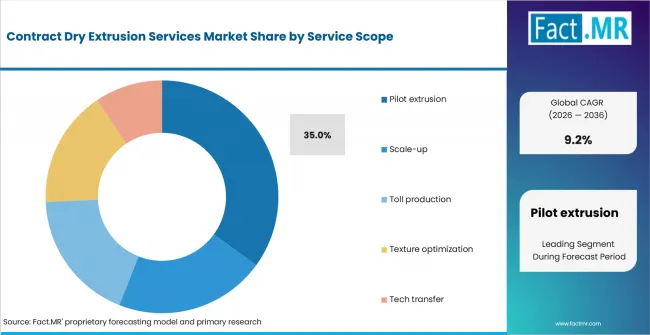
Contract Dry Extrusion Services Market Analysis By Service Scope | Source: Fact.MR
Pilot extrusion links bench work with full-scale output while keeping trial volumes manageable. It gives teams enough material for a true process test without using a full line. Scale-up follows when output rate becomes the main question for the project. Toll production then fits jobs that need repeat outside output after the trial stage.
What leads the Feedstock segment?
Pea protein is projected to account for 38.0% share in 2026.
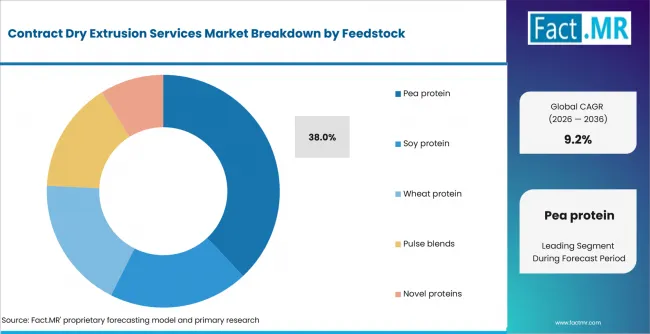
Contract Dry Extrusion Services Market Analysis By Feedstock | Source: Fact.MR
Pea protein is projected to lead Feedstock at 38.0% in 2026 because it works in many dry textured recipes. Soy and wheat remain common inputs for firms with established recipes and supply routes. Pulse blends can help teams balance bite and cost during early tests. Related feedstock work can be compared with dry extrusion proteins.
Pea trials often start with water and feed-rate checks before teams change other process settings. Teams can then adjust screw speed or die conditions in a controlled sequence. This order helps service teams track texture changes without changing several process settings at once.
How does Extrudate shape demand?
TVP granules are anticipated to capture 34.0% share in 2026.
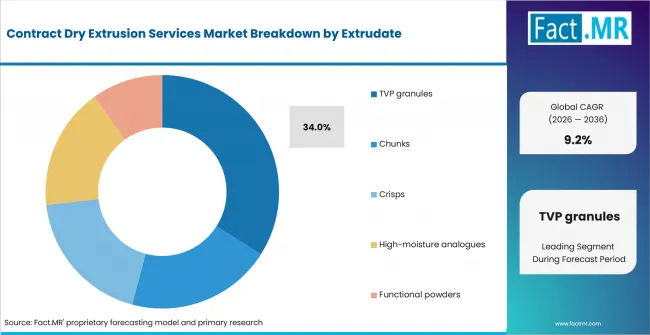
Contract Dry Extrusion Services Market Analysis By Extrudate | Source: Fact.MR
TVP granules are anticipated to lead Extrudate at 34.0% in 2026. Their dry form makes sample checks and later food use easier for product teams. Chunks and crisps fit recipes that need a larger bite or a puffed form. Food powders are used when cooking behavior or water uptake needs closer study. Related formats can be compared with dry extrusion TVP.
What supports demand for Lab within Scale?
Lab is estimated to represent 30.0% share in 2026.
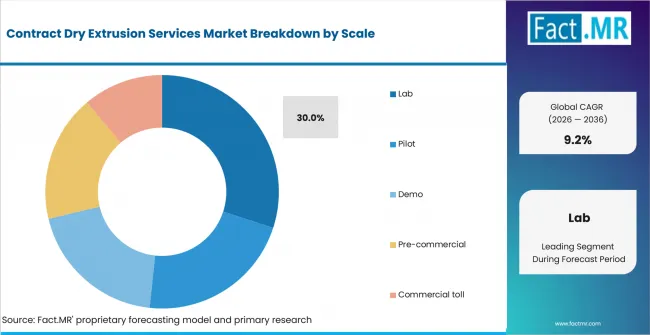
Contract Dry Extrusion Services Market Analysis By Scale | Source: Fact.MR
Lab work is estimated to lead Scale at 30.0% in 2026 because early trials use little material. Pilot runs test whether results repeat at a larger rate. Demo and pre-commercial runs can then check the path toward full-scale output.
What is accelerating Contract Dry Extrusion Services Market adoption, and what is holding it back?
Outside scale-up needs are expected to support use of contract services. Access to repeat commercial toll capacity is expected to limit some projects when customers move beyond trial work.
Drivers Impact Analysis
| DRIVER | (~) % IMPACT ON CAGR | GEOGRAPHIC RELEVANCE | IMPACT TIMELINE |
|---|---|---|---|
| Protein formulation trials | +1.6% | North America, Europe | Short term (<= 2 years) |
| Pilot-to-commercial scale-up | +1.3% | Global | Medium term (2-4 years) |
| TVP and crisp product development | +1.0% | North America, Western Europe, East Asia | Medium term (2-4 years) |
| Capital avoidance for early projects | +0.8% | Global | Short term (<= 2 years) |
Opportunity Impact Analysis
| OPPORTUNITY | (~) % IMPACT ON CAGR | GEOGRAPHIC RELEVANCE | IMPACT TIMELINE |
|---|---|---|---|
| Confidential pilot campaigns | +1.1% | Global | Short term (<= 2 years) |
| Pulse-blend optimization | +0.9% | Europe, North America | Medium term (2-4 years) |
| Pre-commercial sample production | +0.7% | Global | Medium term (2-4 years) |
Restraints Impact Analysis
| RESTRAINT | (~) % IMPACT ON CAGR | GEOGRAPHIC RELEVANCE | IMPACT TIMELINE |
|---|---|---|---|
| Limited true toll-manufacturing capacity | -0.8% | Global | Short term (<= 2 years) |
| Formula transfer risk | -0.6% | Global | Medium term (2-4 years) |
| High trial cost for repeated iterations | -0.4% | North America, Europe, Japan | Short term (<= 2 years) |
Which countries are scaling the Contract Dry Extrusion Services Market through 2036?
- The country comparison spans 2.2 percentage points from the USA at 10.3% to Japan at 8.1%.
- The USA remains 0.3 percentage point above Germany because it has a large food base and a wider set of pilot sites.
- Germany remains 0.4 percentage point above France as crop supply and extrusion skills support food trials.
- France remains 0.3 percentage point above the UK as local crops support ingredient tests and dry texturing work.
- The UK remains 1.2 percentage points above Japan as food firms use outside trial support before they add new line capacity.
- Japan closes the displayed range as food firms balance process tests with higher food costs and imported inputs.
Similar CAGRs can still create different service needs across the five countries. Feedstock supply and food output shape the type of trial work that customers request. Local skills and access to pilot equipment also affect how easily a project moves from bench work to larger runs.
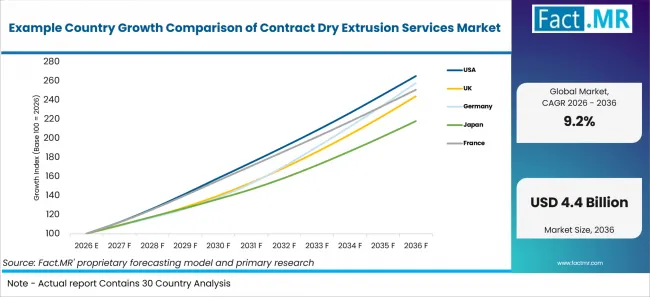
Example Country Growth Comparison Of Contract Dry Extrusion Services Market | Source: Fact.MR
| Country | CAGR (2026-2036) |
|---|---|
| United States | 10.3% |
| Germany | 10.0% |
| France | 9.6% |
| United Kingdom | 9.3% |
| Japan | 8.1% |
What supports USA adoption?
10.3% CAGR, supported by food-manufacturing depth and a wider development base.
U.S. food firms can draw on a large process workforce when they move a recipe from lab work into pilot output. U.S. Bureau of Labor Statistics data published on September 4, 2026 show preliminary, seasonally adjusted food-manufacturing employment of 1.7646 million in August 2026.
What is supporting Germany’s adoption?
10.0% CAGR, supported by crop availability and strong extrusion engineering.
Germany pairs a broad grain base with deep food-process skills. Destatis reported on May 19, 2026 that German farms were expected to cultivate 6.03 million hectares of grain for the 2026 harvest. The country is expected to sustain dry-extrusion trial work as food firms test grain and protein blends before full-scale runs.
How is France developing demand?
9.6% CAGR, reinforced by food-processing activity and diverse crop inputs.
French food teams can test cereal and pulse recipes for snacks or structured proteins. Agreste reported on April 14, 2026 that France had an estimated 7.0 million hectares of straw cereals for the 2026 crop season. That crop base is expected to support trial work where teams compare texture and drying before a larger run.
What supports the United Kingdom’s growth?
9.3% CAGR, supported by a large food-manufacturing base and external development needs.
UK food firms have a large processed-food base that can support outside extrusion work. The Office for National Statistics reported on July 24, 2026 that the manufacture of food represented 22.9% of total UK manufacturers’ product sales in 2025. The market is estimated to expand as teams use pilot sites for sample work before they fund a dedicated line.
How does Japan perform?
8.1% CAGR, supported by processed-food activity and careful formulation economics.
Japanese food firms pay close attention to input cost and product consistency when they test dry extrudates. The Statistics Bureau of Japan reported on January 23, 2026 that food prices rose 6.8% in 2025. That cost setting is expected to favor focused trials that compare protein blends before larger production runs.
Who leads the Contract Dry Extrusion Services Market?
PacMoore, Armada Ingredients, Erbacher Food Intelligence, Nutromode Snacks, and SPS Nutrifoods form the profiled provider group for contract dry extrusion services. Their relevance lies in supporting food and ingredient companies that need outside extrusion capacity for formulation trials, pilot work, scale-up, and selected toll-production requirements.
PacMoore and Armada Ingredients sit within a service landscape where customers require controlled dry-extrusion work before committing recipes to larger production lines. Providers are expected to support process development around protein-based feedstocks, texture formation, operating conditions, and the documentation needed for later line transfer.
Erbacher Food Intelligence, Nutromode Snacks, and SPS Nutrifoods broaden the competitive set across trial and scale-up requirements. The market covers work involving pea, soy, wheat, pulse blends, and novel proteins, with service output extending across TVP granules, chunks, crisps, functional powders, and related dry extrudate formats.
Which companies are the key providers?
Key companies include PacMoore; Armada Ingredients; Erbacher Food Intelligence; Nutromode Snacks; and SPS Nutrifoods.
- PacMoore
- Armada Ingredients
- Erbacher Food Intelligence
- Nutromode Snacks
- SPS Nutrifoods
Bibliography
- Zeballos, E., & Sinclair, W. (2026, June 11). Total U.S. food spending reached $2.51 trillion in 2025. U.S. Department of Agriculture, Economic Research Service.
- U.S. Bureau of Labor Statistics. (2026, September 4). The employment situation—August 2026.
- Statistisches Bundesamt (Destatis). (2026, May 19). Getreideanbaufläche 2026 hat sich nach Tiefststand von 2024 weiter stabilisiert [Grain acreage in 2026 stabilized further after the 2024 low].
- Caray, J. (2026, April 14). Grandes cultures. En 2026 : légère hausse des surfaces de céréales à paille, rebond de la sole de colza. Agreste.
- Office for National Statistics. (2026, July 24). UK manufacturers’ sales by product: 2025.
- Statistics Bureau of Japan. (2026, January 23). Japan 2025.
This Report Answers
- The report explains where contract dry extrusion is used across service scope and feedstock. It also covers the main extrudate forms and the operating scale used for trials. Specialty protein work may overlap with dry fungi mycoproteins.
- Segment analysis identifies the share leaders and explains why food teams use them during trial work. The focus includes pilot extrusion and pea protein as the leading service and feedstock choices. It also covers TVP granules and lab-scale work as the leading extrudate and scale categories.
- Country analysis compares the United States and Germany with France across the forecast period. It also covers the United Kingdom and Japan through the same market lens. The review uses crop data and food output as well as labor and cost evidence.
What does the Contract Dry Extrusion Services Market cover?
The Contract Dry Extrusion Services Market covers paid dry-extrusion work for food ingredients and structured products. It includes pilot work and scale-up support for customers moving recipes toward larger lines. Adjacent ingredient work includes protein ingredients. Service-side feedstock work can also be compared with enzyme-based plant protein. Downstream food use includes meat substitutes.
The scope focuses on dry or shelf-stable extrudates used in trial and scale-up work. Feedstocks include pea and soy protein as well as wheat and pulse blends. Novel proteins are covered when outside teams test process fit or make samples. Soy-focused work can overlap with soy protein hydrolysate.
What is included in the scope?
The scope includes lab and pilot runs as well as pre-commercial batches. Selected toll work is covered when paid outside processing forms part of the service. Process tuning and customer training are included when they support the extrusion project. Product-format links include extruded snacks. Nutrition-led tests can extend toward plant-based protein supplements.
Providers include equipment firms and test centers that perform paid trial work. Pilot plants and third-party processors are also covered when they provide a documented service. Commercial toll status requires first-party proof of repeat production beyond trials.
What is excluded from the scope?
Equipment-only sales fall outside the scope when the customer buys machinery instead of a service. In-house extrusion used only for a company’s own products also falls outside the service boundary. Pure high-moisture extrusion is outside scope when chilled output is the core service.
Ingredient extraction and fermentation fall outside the scope unless they are part of a paid extrusion trial. Wet fractionation and downstream forming follow the same rule when they stand alone. General consulting is covered only when it is tied to trial or scale-up work.
How Was the Analysis Built?
The analysis draws on 120+ sources, 35+ company portfolios, 25+ countries, and more than 20 industry interviews.
- Primary Research: Primary research includes discussions with manufacturers, service providers, technology developers, distributors, end users, and subject-matter experts. These conversations examine purchasing priorities, product adoption, operational challenges, approval requirements, competitive positioning, and the factors that influence wider market acceptance.
- Desk Research: Desk research covers government statistics, regulatory publications, company filings, trade data, technical studies, industry associations, standards, public policy, and other authoritative sources. Every source used in the analysis is documented in the bibliography.
- Market Sizing and Forecasting: Market estimates combine historical performance, demand indicators, pricing and volume trends, segment shares, company participation, country-level growth, adoption patterns, investment activity, and barriers to market expansion.
- Data Validation and Update Cycle: Findings are validated by comparing primary interviews with public data, company activity, regulatory changes, trade patterns, and industry developments. Regular updates review new product launches, capacity changes, partnerships, approvals, and shifts in commercial adoption.
What is the report’s scope and coverage?
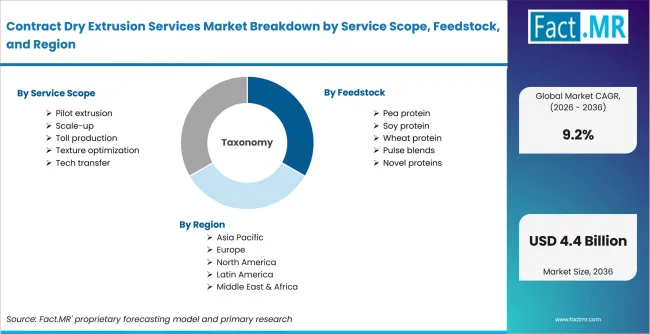
Contract Dry Extrusion Services Market Breakdown By Service Scope, Feedstock, And Region | Source: Fact.MR
| Attribute | Details |
|---|---|
| Quantitative Units | USD billion |
| Market Definition | Third-party dry extrusion development and processing services for food and ingredient applications, including formulation trials, pilot extrusion, scale-up support, selected toll production, texture optimization, and technical transfer. |
| Service Scope | Pilot extrusion; Scale-up; Toll production; Texture optimization; Tech transfer |
| Feedstock | Pea protein; Soy protein; Wheat protein; Pulse blends; Novel proteins |
| Extrudate | TVP granules; Chunks; Crisps; High-moisture analogues; Functional powders |
| Scale | Lab; Pilot; Demo; Pre-commercial; Commercial toll |
| Regions Covered | North America; Latin America; Western Europe; Eastern Europe; East Asia; South Asia & Pacific; Middle East & Africa |
| Countries Covered | United States; Germany; France; United Kingdom; Japan |
| Key Companies Profiled | PacMoore; Armada Ingredients; Erbacher Food Intelligence; Nutromode Snacks; SPS Nutrifoods |
| Forecast Period | 2026 to 2036 |
| Approach | Hybrid top-down and bottom-up assessment using food-manufacturing activity, crop and ingredient availability, extrusion service portfolios, scale-up infrastructure, and country-level operating conditions. |
How is the market segmented?
-
By Service Scope:
- Pilot extrusion
- Scale-up
- Toll production
- Texture optimization
- Tech transfer
-
By Feedstock:
- Pea protein
- Soy protein
- Wheat protein
- Pulse blends
- Novel proteins
-
By Extrudate:
- TVP granules
- Chunks
- Crisps
- High-moisture analogues
- Functional powders
-
By Scale:
- Lab
- Pilot
- Demo
- Pre-commercial
- Commercial toll
-
By Region:
- North America
- Latin America
- Western Europe
- Eastern Europe
- East Asia
- South Asia & Pacific
- Middle East & Africa