- Base Value(2025): 248.2 Bn
- Estimated Value(2026): 265.1 Bn
- Forecast Value (2036): 511.8 Bn
- CAGR (2026 - 2036): 6.8%
Copper Market Analysis and Forecast by Fact.MR
- The global copper market is estimated at USD 265.08 billion in 2026 and is forecast to expand at a CAGR of 6.8% to reach USD 511.78 billion by 2036.
- Copper is a critical industrial metal used across electrical wiring, electronics, construction, automotive, and energy infrastructure in refined, alloyed, and recycled forms.
- The market is driven by the energy transition requiring massive grid expansion and renewable energy infrastructure, electric vehicle production scaling, data center construction, urbanization in emerging economies, and the growing role of recycled copper in supply chain sustainability.
- Supply constraints from aging mines, permitting delays, and geopolitical risks are tightening the demand-supply balance, supporting prices above historical averages.
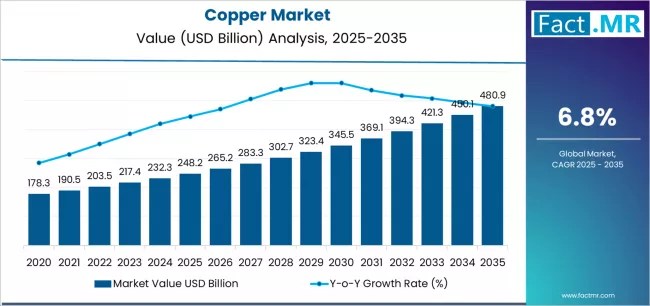
Copper Market Value Analysis | Source: Fact.MR
Summary of the Copper Market
- Market Snapshot
- In 2025, the global Copper Market was valued at approximately USD 248.2 billion.
- The market is estimated to reach USD 265.08 billion in 2026 and is projected to attain USD 511.78 billion by 2036.
- The copper market is likely to expand at a CAGR of 6.8% during the forecast period.
- The market is anticipated to create an absolute dollar opportunity of USD 246.71 billion between 2026 and 2036.
- High purity copper accounts for 60% of grade share in 2026.
- India (7.4%) and China (7.1%) are the key growth markets during the forecast period.
- Demand and Growth Drivers
- Energy transition infrastructure, including grid expansion, renewable energy connections, and EV charging networks, is creating structural copper demand growth that exceeds historical consumption trends.
- Electric vehicle production scaling, with each EV using 3 to 4 times more copper than conventional vehicles, is adding significant incremental demand across battery systems, motors, and charging infrastructure.
- Data center construction driven by AI workloads and cloud computing is creating concentrated copper demand for power distribution, cooling systems, and cabling infrastructure.
- Urbanization in India, China, Southeast Asia, and Africa is generating sustained demand for construction wiring, plumbing, and electrical infrastructure.
- Tightening mine supply due to aging deposits, declining ore grades, and extended permitting timelines is constraining production growth, supporting copper prices above USD 4.50 per pound.
- Product and Segment View
- Primary copper accounts for 75% of the product type segment in 2026, sustained by refined cathode and wire bar production from mine-based operations that serve the majority of industrial demand.
- Wires and cables hold 45% of the form segment in 2026, reflecting copper's irreplaceable role in electrical power transmission, distribution, building wiring, and telecommunications infrastructure.
- High purity copper accounts for 60% of the grade segment, driven by electrical and electronics applications where conductivity performance is a non-negotiable specification requirement.
- Key segmentation includes:
- Product Type: Primary copper (refined, blister), Secondary copper (recycled, alloyed recycled)
- Form: Wires and cables, Plates and sheets, Tubes and pipes, Rods and bars
- Grade: High purity copper (oxygen-free, ETP), Alloyed copper (brass, bronze), Specialty copper
- Application: Electrical and electronics, Construction, Automotive, Industrial machinery, Energy and power
- End Use Industry: Electrical, Construction, Automotive, Industrial, Telecommunication
- These systems enable:
- Electrical conductivity enabling efficient power generation, transmission, distribution, and end-use applications
- Heat transfer performance supporting HVAC, industrial cooling, and thermal management systems
- Corrosion resistance and antimicrobial properties serving construction plumbing, medical, and marine applications
- Geography and Competitive Outlook
- Asia Pacific dominates through China and India, driven by grid expansion, EV manufacturing, construction activity, and domestic smelting capacity.
- North America sustains demand through the USA, supported by grid modernization, EV infrastructure buildout, data center construction, and reshoring of manufacturing.
- Europe maintains demand through Germany, driven by renewable energy grid integration, automotive electrification, and green building requirements.
- India (7.4%) and China (7.1%) lead growth, while Brazil (6.6%), the USA (6.3%), Germany (5.8%), Saudi Arabia (5.1%), and Japan (4.7%) sustain demand.
- Major players include Codelco, Freeport-McMoRan Inc., Glencore plc, BHP Group, Rio Tinto, and Anglo American plc.
- Analyst Opinion
- Shambhu Nath Jha, Principal Consultant at Fact.MR, says 'The copper market is entering a structural supply deficit period where energy transition demand growth consistently outpaces new mine supply. Freeport-McMoRan's submission of a USD 7.5 billion expansion permit for El Abra in Chile and its capital expenditure increase to USD 4.3 to 4.5 billion for 2026 to 2027 signal the scale of investment required to meet growing demand. The Grasberg restart, expected to reach 85% of normal production by H2 2026, will provide temporary supply relief, but the fundamental supply-demand imbalance driven by grid expansion, EV scaling, and data center buildout is creating a multi-decade growth runway for copper that no alternative metal can substitute at scale.'
Key Growth Drivers, Constraints, and Opportunities
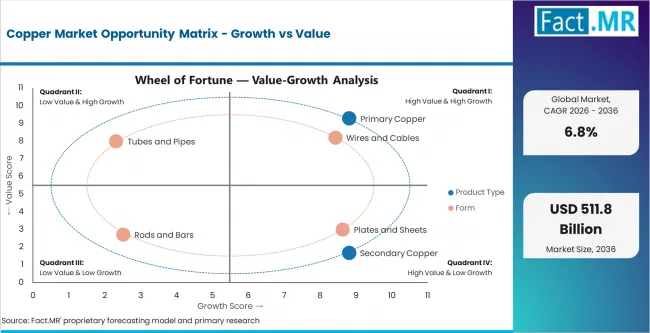
Copper Market Opportunity Matrix Growth Vs Value | Source: Fact.MR
Key Factors Driving Growth
- Energy transition infrastructure requirements, including grid expansion, renewable connections, and EV charging, are creating structural demand growth exceeding 3% annually.
- Electric vehicle production scaling adds 2 to 3 million tonnes of incremental copper demand by 2036 through battery systems, drive motors, and charging infrastructure.
- Data center construction for AI and cloud computing creates concentrated high-purity copper demand for power distribution and cabling systems.
Key Market Constraints
- Aging mine deposits with declining ore grades and extended development timelines constrain new supply additions below demand growth rates.
- Geopolitical and permitting risks in major producing countries including Chile, Peru, Indonesia, and the DRC create supply uncertainty and investment hesitancy.
- Volatile copper prices, which opened 2026 at USD 5.88 per pound, create procurement planning challenges for downstream fabricators and end users.
Key Opportunity Areas
- Recycled copper supply expansion through improved collection, sorting, and refining infrastructure offers a lower-carbon, lower-cost supplement to mine production.
- Grid modernization and smart grid deployment in the USA, EU, and India create multi-year copper procurement pipelines tied to government-funded infrastructure programs.
- Copper's critical role in EV battery systems, charging infrastructure, and renewable energy installations positions it as the defining metal of the energy transition.
Segment-wise Analysis of the Copper Market
- Primary copper holds 75% of the product type segment in 2026, sustained by mine-based refined production serving the majority of electrical, construction, and industrial demand.
- Electrical and electronics accounts for 40% of the application segment in 2026, reflecting copper's dominant role in power generation, transmission, distribution, and electronic component manufacturing.
- Wires and cables account for 45% of the form segment, driven by power cable, building wiring, and telecommunications cable demand across all end-use industries.
The copper market is segmented by product type, form, grade, application, end use industry, mining method, and region. Primary copper leads by product type. Wires and cables lead by form. High purity copper dominates by grade, and electrical and electronics leads by application.
Which Product Type Segment Dominates the Copper Market?
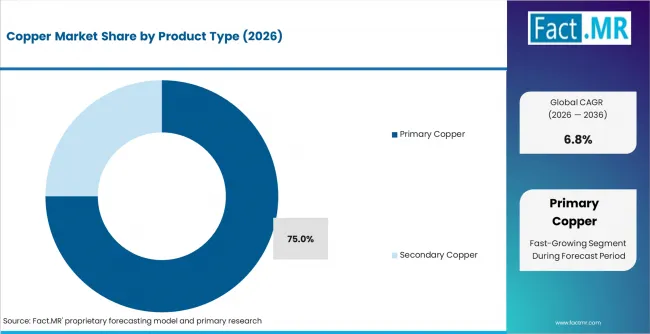
Copper Market Analysis By Product Type | Source: Fact.MR
Primary copper accounts for 75% of the product type segment in 2026. Refined copper cathodes and wire bars from mine-based production remain the foundation of global copper supply, serving electrical, construction, automotive, and industrial applications. The world's largest copper mines, including Escondida, Grasberg, and Cerro Verde, continue to anchor primary supply, though declining ore grades and extended development timelines constrain new capacity additions.
Secondary copper, produced from recycled scrap, accounts for approximately 25% of supply and is the fastest-growing segment. Recycled copper delivers comparable conductivity to primary copper at lower carbon intensity and production cost, making it increasingly attractive as sustainability requirements and carbon pricing reshape procurement decisions.
Which Application Segment Dominates the Copper Market?
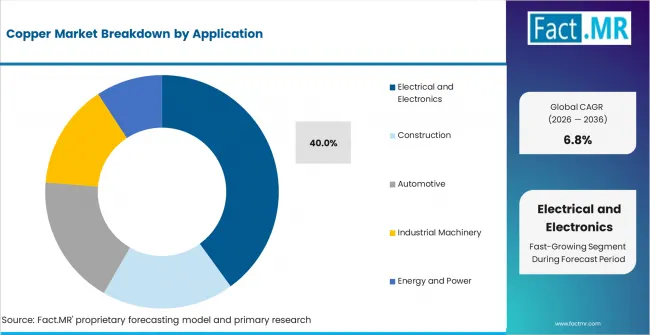
Copper Market Analysis By Application | Source: Fact.MR
Electrical and electronics accounts for 40% of the application segment in 2026. This encompasses power generation equipment, transmission and distribution cables, building wiring, transformers, motors, and electronic components. The energy transition is intensifying copper demand within this segment as grid expansion, renewable energy connections, and EV infrastructure require substantial increases in electrical copper consumption.
Construction is the second-largest application, driven by plumbing, roofing, HVAC systems, and architectural applications. Automotive is the fastest-growing application as EV production scaling multiplies per-vehicle copper content, with each EV requiring approximately 80 kg of copper compared to 20 kg for conventional vehicles.
Which Grade Segment Dominates the Copper Market?
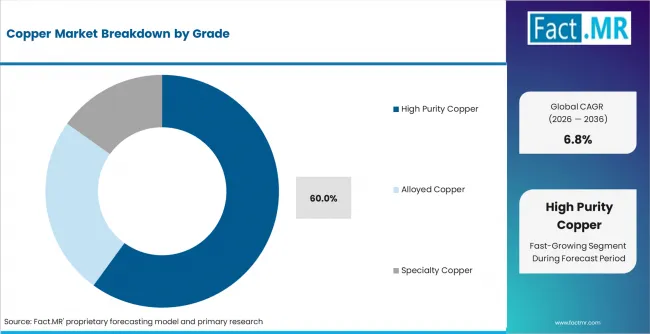
Copper Market Analysis By Grade | Source: Fact.MR
High purity copper accounts for 60% of the grade segment in 2026. Electrolytic tough pitch (ETP) and oxygen-free copper grades serve electrical and electronics applications where maximum conductivity is essential. These grades must meet stringent purity specifications, typically 99.99% or higher, to deliver the electrical performance required in power cables, transformers, and electronic components.
Alloyed copper, including brass and bronze, serves applications where mechanical strength, corrosion resistance, or specific thermal properties take priority over maximum conductivity. Specialty copper grades serve aerospace, automotive, and high-temperature industrial applications.
Which Product Trend is Shaping the Next Phase of Growth in the Copper Market?
The structural supply deficit driven by energy transition demand is the defining trend reshaping the copper market. Freeport-McMoRan began the environmental permitting process for a USD 7.5 billion expansion of its El Abra mine in Chile in March 2026, representing the largest mining investment submitted to Chile's Environmental Assessment Service since at least 1992. The expansion would increase annual output by more than 300,000 tonnes. Simultaneously, Freeport increased capital expenditure guidance to USD 4.3 to 4.5 billion for 2026 to 2027, up from USD 3.9 billion in 2025, reflecting the scale of investment required to meet growing demand.
On the demand side, copper prices opened 2026 at USD 5.88 per pound, reflecting tight supply-demand conditions. The phased restart of Grasberg's Block Cave mine, expected to reach 85% of normal production by H2 2026, will provide partial supply relief. The convergence of grid expansion, EV scaling, data center construction, and renewable energy deployment is creating a multi-decade demand growth trajectory that the mining industry's project pipeline cannot fully satisfy, supporting copper's position as the critical metal of the energy transition.
Regional Outlook Across Key Markets
.webp "Top Country Growth Comparison Copper Market Cagr (2026 2036)")
Top Country Growth Comparison Copper Market Cagr (2026 2036) | Source: Fact.MR
- India leads growth at 7.4%, driven by grid expansion, EV adoption, construction demand, and growing domestic smelting capacity.
- China follows at 7.1%, supported by the world's largest smelting base, EV manufacturing, renewable energy installations, and grid modernization.
- Brazil grows at 6.6%, driven by mining production, domestic construction demand, and industrial expansion.
- The USA sustains growth at 6.3% through grid modernization, data center construction, EV infrastructure, and reshoring of manufacturing.
| Country | CAGR (%) |
|---|---|
| India | 7.4% |
| China | 7.1% |
| Brazil | 6.6% |
| USA | 6.3% |
| Germany | 5.8% |
| Saudi Arabia | 5.1% |
| Japan | 4.7% |
Source: Fact.MR analysis. Updated May 25, 2026
Source: Fact MR (FMR) analysis, based on proprietary forecasting model and primary research.

Copper Market Cagr Analysis By Country | Source: Fact.MR
Market Outlook for Copper in India
The India copper market is projected to grow at a CAGR of 7.4% through 2036. Demand is driven by massive grid expansion programs, growing EV adoption, urbanization-driven construction, and expansion of domestic smelting capacity.
- Grid expansion programs create sustained demand for copper wiring and cables.
- EV adoption scaling multiplies per-vehicle copper consumption.
- Construction activity drives demand for plumbing, wiring, and HVAC applications.
Copper Demand Trends in China
The China copper market is projected to grow at a CAGR of 7.1% through 2036. Growth is supported by the world's largest smelting and refining base, EV manufacturing leadership, renewable energy deployment, and grid modernization investment.
- EV manufacturing leadership creates concentrated copper demand for batteries and motors.
- Renewable energy deployment drives demand for solar and wind power copper components.
- Grid modernization sustains demand for transmission and distribution cables.
United States Copper Market Growth Assessment

Copper Market Country Value Analysis | Source: Fact.MR
The U.S. copper market is projected to grow at a CAGR of 6.3% through 2036. Demand is driven by grid modernization, data center construction, EV infrastructure buildout, and manufacturing reshoring programs.
- Grid modernization creates multi-year copper cable and equipment procurement.
- Data center construction drives high-purity copper demand for power systems.
- EV infrastructure buildout expands charging network copper requirements.
Germany Copper Market Demand Analysis
The Germany copper market is projected to grow at a CAGR of 5.8% through 2036. Demand is shaped by automotive electrification, renewable energy grid integration, industrial equipment requirements, and Aurubis' position as Europe's largest copper smelter.
- Automotive electrification drives demand for EV motor and battery copper.
- Renewable energy grid integration creates cable and transformer demand.
- Aurubis smelting operations serve European fabrication and industrial markets.
Brazil Copper Market Opportunity Outlook
The Brazil copper market is projected to grow at a CAGR of 6.6% through 2036. Demand is supported by mining production growth, domestic construction expansion, industrial development, and growing renewable energy infrastructure.
- Mining production growth strengthens domestic copper supply.
- Construction expansion drives building wiring and plumbing demand.
- Renewable energy development creates new copper demand categories.
Competitive Benchmarking and Company Positioning
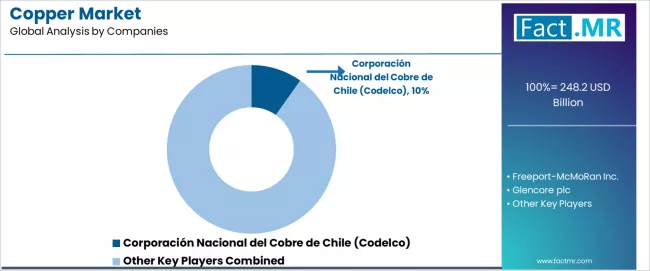
Copper Market Analysis By Company | Source: Fact.MR
Copper Market Analysis By Company
- Codelco, Freeport-McMoRan Inc., and Glencore plc dominate through mine production scale, global reserve positions, and integrated smelting and refining operations.
- BHP Group, Rio Tinto, and Anglo American compete through diversified mining portfolios, large-scale copper growth projects, and technology leadership in extraction efficiency.
- Mine production capacity, reserve life, production cost position, and growth project pipeline are the primary competitive differentiators.
The competitive landscape is moderately concentrated among a small number of global mining companies. Codelco, the Chilean state-owned producer, holds approximately 10% of global mine production and operates the world's largest underground copper mine, El Teniente. Codelco faces production challenges from aging deposits and is investing in underground extensions and new projects to sustain output.
Freeport-McMoRan holds significant positions through the Grasberg mine in Indonesia and Cerro Verde in Peru, along with growing U.S. operations. The company produced 3.4 billion pounds of copper in 2025 and has submitted a USD 7.5 billion expansion permit for El Abra in Chile. The Grasberg Block Cave restart is planned for Q2 2026.
Glencore, BHP, Rio Tinto, and Anglo American maintain diversified copper portfolios across multiple continents. Aurubis AG operates Europe's largest copper smelter. Grupo Mexico and KGHM serve regional markets through integrated mining and refining operations.
Strategic priorities include mine life extension, greenfield project development, recycled copper integration, water management in arid mining regions, and decarbonization of smelting operations.
Key Companies in the Copper Market
- Codelco, Freeport-McMoRan Inc., and Glencore plc lead global copper production through mine scale, reserve depth, and integrated operations.
- BHP Group, Rio Tinto, and Anglo American hold diversified copper portfolios with major growth projects across Chile, Peru, and Australia.
- Antofagasta plc, Aurubis AG, Grupo Mexico, Jiangxi Copper Corporation, KGHM, and Teck Resources compete through regional production, smelting capacity, and specific market expertise.
Recent Industry Developments
- Freeport-McMoRan Inc. - Expansion Permit / USD 7.5 Billion El Abra Copper Mine Expansion (March 2026)
- Freeport-McMoRan began environmental permitting for a USD 7.5 billion expansion of the El Abra copper mine in Chile, including a new concentrator, desalination plant, and expanded infrastructure. The project would increase annual output by more than 300,000 tonnes, with production targeted from 2033.
- Freeport-McMoRan Inc. - Operational Recovery / Grasberg Block Cave Phased Restart (Q2 2026)
- Freeport-McMoRan is advancing the phased restart of Grasberg's Block Cave Production Blocks 2 and 3, expected to begin in Q2 2026 following the September 2025 mud rush incident. The company expects 85% of normal production to be restored by H2 2026.
- Freeport-McMoRan Inc. - Capital Investment / Increased Capex Guidance for 2026-2027 (January 2026)
- Freeport-McMoRan projected USD 4.3 to 4.5 billion in capital expenditures for 2026 and 2027, up from USD 3.9 billion in 2025, as the company advances its global copper portfolio including U.S. operations targeting 60% production growth by 2030.
Leading Companies Shaping the Copper Market
- Corporacion Nacional del Cobre de Chile (Codelco)
- Freeport-McMoRan Inc.
- Glencore plc
- BHP Group Limited
- Rio Tinto Group
- Anglo American plc
- Antofagasta plc
- Aurubis AG
- Grupo Mexico S.A.B. de C.V.
- Jiangxi Copper Corporation Limited
- KGHM Polska Miedz S.A.
- Teck Resources Limited
Sources and Research References
- Freeport-McMoRan Inc. Q4 2025 financial results, El Abra expansion permit filing, and Grasberg restart documentation.
- Codelco. Production data and mine development program documentation.
- International Copper Study Group. Global copper supply-demand balance and production statistics.
- LME copper pricing data, mine production databases, and EV copper intensity analysis.
- Primary interviews with miners, smelters, fabricators, distributors, and end users.
This bibliography is provided for reader reference and is not exhaustive. The full report contains the complete reference list and detailed citations.
Key Questions This Report Addresses
- What is the current and future size of the Copper market?
- How fast is the copper market expected to grow between 2026 and 2036?
- Which product type leads in 2026?
- Which application holds highest share?
- What drives demand globally?
- How is the energy transition influencing demand?
- Why is India the fastest-growing market?
- How is the supply deficit reshaping the market?
- Which countries show fastest growth?
- Who are the key companies?
- How does Fact.MR validate the forecast?
Copper Market Definition
The copper market covers primary and secondary copper products including refined cathodes, wire bars, rods, tubes, sheets, and recycled copper across electrical, construction, automotive, industrial, and energy applications globally.
Copper Market Inclusions
- The scope covers global and regional market size and forecasts for 2026 to 2036 across product type, form, grade, application, end use industry, mining method, and region.
- It includes analysis of mine production, smelter capacity, recycled copper supply, and demand drivers across energy transition, construction, automotive, and industrial sectors.
- The report covers pricing and cost analysis including LME copper pricing, mine production costs, smelting and refining charges, and premium structures across product forms.
- It covers supply-demand balance, technology trends, and the competitive landscape including production capacity, reserve positions, and expansion plans of leading producers.
Copper Market Exclusions
- The scope excludes copper ore and concentrates traded before smelting and refining into finished copper products.
- It excludes copper-based chemicals, compounds, and solutions used in agricultural, pharmaceutical, and specialty chemical applications.
- The report excludes mining equipment, smelting technology, and refining machinery sold independently of copper production.
- It also excludes copper trading, financial derivatives, and commodity exchange transactions without physical delivery.
Copper Market Research Methodology
- The methodology combines secondary research, primary interviews, and forecast modelling.
- It draws on 100+ secondary sources including mine production data, smelter capacity reports, and trade flow statistics.
- Market sizing covers 30+ countries through a demand-side model, supported by top-down validation.
- Key inputs include grid expansion investment, EV production forecasts, construction output, mine production schedules, and recycled copper supply estimates.
- The model cross-checks demand with mine production, smelter output, LME pricing, and inventory data.
- Primary validation includes 25+ interviews across miners, smelters, fabricators, distributors, and end users.
- Final estimates go through supply-demand balance checks, trade-flow analysis, and sensitivity testing.
Segmentation
Scope of Analysis
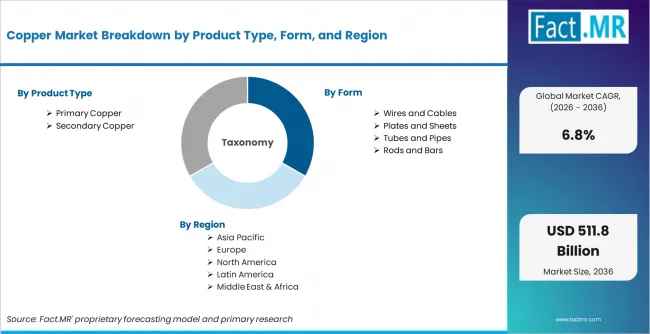
Copper Market Breakdown By Product Type, Form, And Region | Source: Fact.MR
| Parameter | Details |
|---|---|
| Quantitative Units | USD 265.08 billion to USD 511.78 billion, at a CAGR of 6.8% |
| Market Definition | The copper market covers primary and secondary copper products including refined cathodes, wire bars, rods, tubes, sheets, and recycled copper across electrical, construction, automotive, and energy applications. |
| Regions Covered | North America, Latin America, Europe, East Asia, South Asia and Pacific, Middle East and Africa |
| Countries Covered | India, China, Brazil, USA, Germany, Saudi Arabia, Japan, 30 plus countries |
| Key Companies | Codelco, Freeport-McMoRan, Glencore, BHP, Rio Tinto, Anglo American, Antofagasta, Aurubis, Grupo Mexico, Jiangxi Copper, KGHM, Teck Resources |
| Forecast Period | 2026 to 2036 |
| Approach | Hybrid demand-side and top-down methodology built on grid expansion investment, EV production forecasts, construction output, mine production schedules, and primary interviews across miners, smelters, fabricators, and end users |
Source: Fact.MR analysis. Updated May 25, 2026
Copper Market Segmentation
-
Copper Market Segmented by Product Type:
- Primary Copper
- Refined Copper
- Cathodes
- Wire Bars
- Blister Copper
- Unrefined Copper
- Intermediate Processing
- Refined Copper
- Secondary Copper
- Recycled Copper
- Scrap-based Copper
- Refined Recycled Copper
- Alloyed Recycled Copper
- Brass Scrap
- Bronze Scrap
- Recycled Copper
- Primary Copper
-
Copper Market Segmented by Form:
- Wires and Cables
- Power Cables
- Transmission Cables
- Distribution Cables
- Communication Wires
- Telecom Wires
- Data Cables
- Power Cables
- Plates and Sheets
- Thin Sheets
- Electronics
- Industrial Use
- Thick Plates
- Construction
- Machinery
- Thin Sheets
- Tubes and Pipes
- Seamless Tubes
- HVAC Systems
- Heat Exchangers
- Welded Pipes
- Plumbing
- Industrial Use
- Seamless Tubes
- Rods and Bars
- Copper Rods
- Electrical Applications
- Wire Drawing
- Copper Bars
- Busbars
- Industrial Equipment
- Copper Rods
- Wires and Cables
-
Copper Market Segmented by Grade:
- High Purity Copper
- Oxygen-free Copper
- Electronics
- Semiconductors
- Electrolytic Tough Pitch (ETP)
- Electrical Conductivity
- Wiring Applications
- Oxygen-free Copper
- Alloyed Copper
- Brass
- Plumbing
- Decorative Applications
- Bronze
- Bearings
- Marine Applications
- Brass
- Specialty Copper
- High Strength Copper
- Aerospace
- Automotive
- Heat-resistant Copper
- Industrial Furnaces
- Power Systems
- High Strength Copper
- High Purity Copper
-
Copper Market Segmented by Application:
- Electrical and Electronics
- Wiring
- Building Wiring
- Industrial Wiring
- Electronics
- PCBs
- Connectors
- Wiring
- Construction
- Plumbing
- Pipes
- Fittings
- Roofing and Cladding
- Architectural Applications
- Decorative Uses
- Plumbing
- Automotive
- Electric Vehicles
- Battery Systems
- Charging Infrastructure
- Conventional Vehicles
- Wiring Harness
- Radiators
- Electric Vehicles
- Industrial Machinery
- Heat Exchangers
- Cooling Systems
- Industrial Plants
- Equipment Manufacturing
- Heavy Machinery
- Process Equipment
- Heat Exchangers
- Energy and Power
- Renewable Energy
- Solar Panels
- Wind Turbines
- Power Generation
- Transformers
- Grid Infrastructure
- Renewable Energy
- Electrical and Electronics
-
Copper Market Segmented by End Use Industry:
- Electrical Industry
- Power Generation
- Thermal Power
- Renewable Energy
- Transmission and Distribution
- Grid Networks
- Substations
- Power Generation
- Construction Industry
- Residential Construction
- Housing
- Apartments
- Commercial Construction
- Offices
- Shopping Complexes
- Residential Construction
- Automotive Industry
- EV Manufacturing
- Electric Cars
- Charging Systems
- Traditional Automotive
- ICE Vehicles
- Components
- EV Manufacturing
- Industrial Sector
- Manufacturing
- Machinery
- Equipment
- Chemical Industry
- Process Plants
- Refineries
- Manufacturing
- Telecommunication
- Network Infrastructure
- Fiber Optics Support
- Data Centers
- Devices
- Consumer Electronics
- Communication Equipment
- Network Infrastructure
- Electrical Industry
-
Copper Market Segmented by Mining Method:
- Open Pit Mining
- Surface Mining
- Large-scale Operations
- Low Cost Extraction
- Heap Leaching
- Oxide Ores
- Cost-efficient Processing
- Surface Mining
- Underground Mining
- Block Caving
- Large Deposits
- High Efficiency
- Cut and Fill Mining
- Selective Mining
- High Grade Ores
- Block Caving
- In-situ Leaching
- Solution Mining
- Low-grade Ores
- Minimal Surface Impact
- Bioleaching
- Microbial Processing
- Eco-friendly Extraction
- Solution Mining
- Open Pit Mining
-
Copper Market by Region:
- North America
- USA
- Canada
- Mexico
- Latin America
- Brazil
- Chile
- Rest of Latin America
- Western Europe
- Germany
- UK
- Italy
- Spain
- France
- Nordic
- BENELUX
- Rest of Western Europe
- Eastern Europe
- Russia
- Poland
- Hungary
- Balkan & Baltic
- Rest of Eastern Europe
- East Asia
- China
- Japan
- South Korea
- South Asia and Pacific
- India
- ASEAN
- Australia & New Zealand
- Rest of South Asia and Pacific
- Middle East & Africa
- Kingdom of Saudi Arabia
- Other GCC Countries
- Turkiye
- South Africa
- Other African Union
- Rest of Middle East & Africa
- North America
Frequently Asked Questions
How big is the copper market in 2025?
What will be the size of the Positive Displacement Blowers Market in 2036?
How much will the Positive Displacement Blowers Market grow between 2026 and 2036?
What are the key product types in the Positive Displacement Blowers Market?
Which application holds the highest share in the Positive Displacement Blowers Market in 2026?
Which are the fastest-growing countries in the Positive Displacement Blowers Market?
Who worked on this report


Preview the report firsthand - request a free sample
Free SampleGet the brochure for pricing and purchase details
Download PDF