The Fertigation Skids Market is analyzed across its key product, application and end-use segments, with the study covering market dynamics, regional trends and demand outlook, forecast 2026 to 2036.
By Fact.MR Industrial Goods DeskLead analyst:
Shubham PatidarPublished :
Updated :
12 min read
Fact-checked under the Fact.MR editorial process
Fertigation Skids Market Forecast and Outlook 2026 to 2036
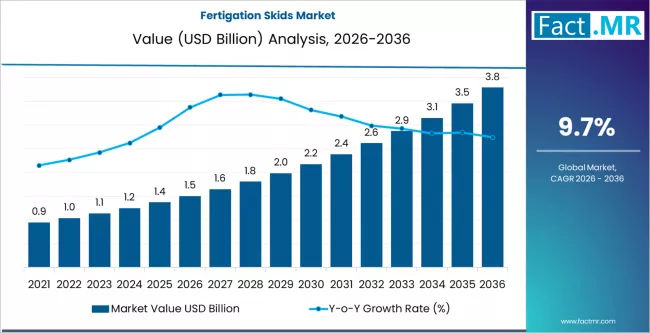
The global fertigation skids market is expected to expand from USD 1.5 billion in 2026 to USD 3.8 billion by 2036, witnessing a compound annual growth rate (CAGR) of 9.7% between 2026 and 2036.
Trade in fertigation skids is concentrated among countries with established irrigation equipment manufacturing capabilities and regions expanding precision agriculture practices.
China and India are key exporting countries, supported by large-scale production of irrigation assemblies, dosing systems, pumps, and control components supplied to markets across Asia, Africa, and the Middle East.
Israel plays an important role as a technology-oriented exporter, drawing on advanced expertise in drip irrigation and fertigation engineering.
Fertigation Skids Market Market Value Analysis | Source: Fact.MR
Summary of FertigationSkids Market
Market Snapshot
Globalfertigationskids market revenue stood atUSD 1.5 billion in 2026and is forecast to reachUSD 3.8 billion by 2036.
At a9.7%CAGRfrom 2026 to 2036, this market is set to expand~2.5x in value, addingUSD 2.3 billion in absolute opportunity.
Growth is being driven by increasing adoption ofprecision agriculture and automated irrigation systems, particularly across greenhouse farming, protected cultivation, and high-value crop production.
Fertigationskids areemergingas integrated nutrient-delivery platforms, enablingprecise fertilizer dosing, water optimization, and automated crop managementacross commercial agricultural operations.
Demand and Growth Drivers
Expansion of controlled-environment agriculture facilities is driving demand for advanced air circulation systems.
Vertical farming operators are prioritizing climate control and contamination management infrastructure.
Increasing focus on crop health and yield optimization is accelerating adoption of filtration systems.
Growth in hydroponic and indoor farming is supporting investment in air-handling technologies.
Demand for energy-efficient HVAC and air purification systems is reinforcing market expansion.
IoT-enabled monitoring, PLC automation, and integrated irrigation control systems are improving system efficiency and adoption rates.
Product and Segment View
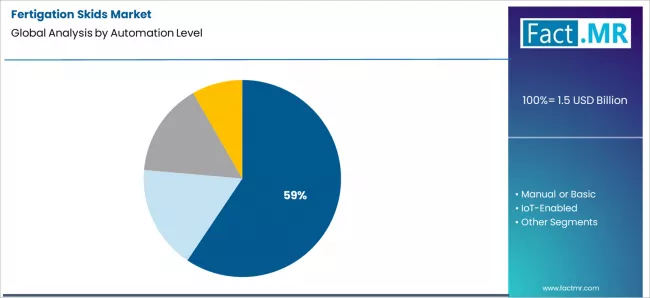
PLC-controlled systems hold 59.4% of automation-level segment share in 2026,emergingas the leading segment due to superior operational control and precision nutrient management capabilities.
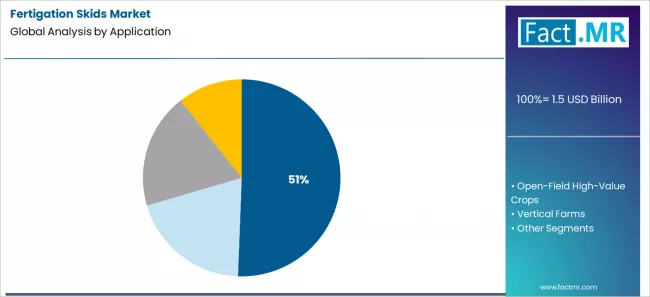
Greenhouses account for 50.6% of application segment share in 2026, positioning them as the dominant end-use segment driven by intensive cultivation requirements and automation adoption.
Key skid-type categories include:
Venturi-based skids
Proportional dosing skids
Multi-channelfertigationskids
Automation categories include:
Manual or basic
PLC-controlled
IoT-enabled systems
Sales channels include:
Irrigation OEMs
Distributors
EPC/integrators
Geography and Competitive Outlook
Asia Pacific, North America, and Europerepresent the key growth regions, supported by increasing adoption of precision irrigation and protected cultivation systems.
North America, Latin America, Western Europe, Eastern Europe, East Asia, South Asia & Pacific, Middle East & Africa
Source: Fact.MR analysis. Updated May 11, 2026
Within Europe, Spain and Italy contribute to exports, reflecting strong horticulture sectors and a mature base of agricultural equipment manufacturers serving greenhouse, orchard, and open-field applications worldwide.On the import side, demand is led by countries with intensive commercial farming and protected cultivation. The United States imports fertigation skids for large-scale agriculture, specialty crops, and greenhouse operations focused on water and nutrient efficiency. Mexico is another major importing country, driven by export-oriented horticulture and expanding greenhouse acreage. Middle Eastern countries such as Saudi Arabia and the United Arab Emirates import these systems to manage water scarcity and improve fertilizer utilization. Several countries across Africa and Southeast Asia also import fertigation skids as part of irrigation modernization and food security programs.
Category
Category
Segments
Skid Type
Venturi-Based Skids; Proportional Dosing Skids; Multi-Channel Fertigation Skids; Other
Application
Greenhouses; Open-Field High-Value Crops; Vertical Farms; Other
Automation Level
Manual or Basic; PLC-Controlled; IoT-Enabled; Other
Sales Channel
Irrigation OEMs; Distributors; EPC or Integrators; Other
Region
North America; Europe; Asia Pacific; Latin America; Middle East & Africa
Source: Fact.MR analysis. Updated May 11, 2026
Segmental Analysis
By Automation Level, Which Segment Holds the Dominant Share in the Fertigation Skids Market?
Fertigation Skids Market Analysis By Automation Level | Source: Fact.MR
In terms of automation level, the PLC-controlled segment leads the market with 59.4% share. Agricultural professionals and irrigation specialists increasingly utilize PLC-controlled fertigation skids for their superior processing control properties and operational efficiency characteristics.
Manufacturing investments in advanced irrigation technology and agricultural infrastructure continue to strengthen adoption among performance-focused agricultural facilities.
With agricultural professionals prioritizing equipment system performance and operational validation, PLC-controlled modules align with both efficiency objectives and operational requirements, making them the central component of comprehensive agricultural irrigation monitoring strategies.
By Application, Which Segment Registers the Highest Share in the Fertigation Skids Market?
Fertigation Skids Market Analysis By Application | Source: Fact.MR
By application, greenhouses dominate with 50.6% share, underscoring their critical role as the primary application category for agricultural facilities seeking superior nutrient control capabilities and enhanced operational compliance credentials. Agricultural engineers and facility operators prefer fertigation skid solutions for greenhouses due to their established performance validation requirements.
Agricultural facilities are optimizing equipment selections to support application-specific requirements and comprehensive operational control strategies.
As irrigation technology continues to advance and operators seek efficient agricultural management methods, greenhouse applications will continue to drive market growth while supporting operational performance optimization and compliance cost reduction strategies.
What are the Drivers, Restraints, and Key Trends of the Fertigation Skids Market?
Drivers: Agricultural operator demand for enhanced nutrient distribution performance and advanced production management initiatives drive mandatory adoption of high-performance fertigation skid solutions across agricultural facilities.
Restraint: High equipment costs and technical complexity of integrating specialized irrigation protocols into existing agricultural management processes limit market penetration.
Trend 1: Shift toward automated irrigation configurations that minimize operational requirements and reduce deployment costs for agricultural management.
Trend 2: Development of specialized multi-parameter compatibility systems supporting multiple agricultural applications and operational condition compatibility.
Analysis of the Fertigation Skids Market by Key Country
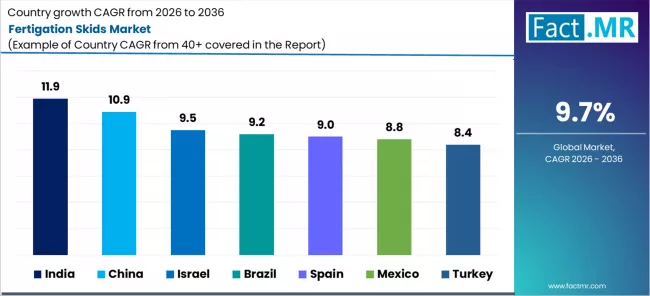
Fertigation Skids Market Cagr Analysis By Country | Source: Fact.MR
Country
CAGR 2026 to 2036
India
11.9%
China
10.9%
Israel
9.5%
Spain
9.0%
Brazil
9.2%
Mexico
8.8%
Turkey
8.4%
U.S.
6.7%
Source: Fact.MR analysis. Updated May 11, 2026
The report covers an in-depth analysis of 40+ countries; top-performing countries are highlighted below.
What Opportunities Can Fertigation Skids Manufacturers Expect in India?
Revenue from fertigation skids consumption and sales in India is projected to exhibit exceptional growth with a CAGR of 11.9% through 2036, driven by the country's rapidly expanding agricultural infrastructure, regulatory frameworks promoting irrigation efficiency initiatives, and programs supporting advanced production technologies across major agricultural regions.
Established agricultural infrastructure and expanding operational consciousness are driving demand for fertigation skid solutions across agricultural facilities, irrigation developments, and comprehensive performance systems throughout Indian agricultural markets.
Strong regulatory development and technology initiatives are supporting the rapid adoption of premium irrigation services among quality-focused operators seeking to meet evolving operational standards and performance requirements.
What is the Chinese Fertigation Skids Market Size?
Revenue from fertigation skids products in China is projected to expand at a CAGR of 10.9%, supported by rising agricultural investment, growing operational consciousness, and expanding technology service capabilities. The country's developing infrastructure and increasing investment in irrigation management technologies are driving demand for fertigation skid solutions across both traditional and modern agricultural applications.
Rising infrastructure development and expanding performance capabilities are creating opportunities for irrigation adoption across agricultural management monitoring projects.
Growing operational awareness initiatives and irrigation technology advancement are driving the adoption of specialized performance equipment and services among agricultural users.
What Opportunities Can Fertigation Skids Manufacturers Expect in Israel?
Revenue from fertigation skids products in Israel is projected to expand at a CAGR of 9.5%, supported by the country's emphasis on agricultural precision, irrigation excellence, and advanced technology integration requiring efficient production solutions. Israeli agricultural operators and technology-focused establishments prioritize precision performance and operational control, making specialized fertigation skid services essential components for both traditional and modern agricultural applications.
Advanced precision irrigation technology capabilities and growing agricultural applications are driving demand for fertigation skid services across specialty performance applications.
Strong focus on agricultural precision and irrigation excellence is encouraging users and service providers to adopt fertigation skid solutions that support operational objectives.
What is the Spanish Fertigation Skids Market Size?
Revenue from fertigation skids products in Spain is projected to grow at a CAGR of 9.0% through 2036, supported by the country's emphasis on operational precision, irrigation excellence, and advanced technology integration requiring efficient production solutions. Spanish agricultural operators and performance-focused establishments prioritize performance monitoring and cost efficiency precision, making specialized fertigation skid services essential components for both traditional and modern agricultural applications.
Advanced precision irrigation technology capabilities and growing agricultural applications are driving demand for fertigation skid services across specialty performance applications.
Strong focus on operational precision and irrigation excellence is encouraging users and service providers to adopt production solutions.
What is the Brazilian Fertigation Skids Market Size?
Revenue from fertigation skids products in Brazil is projected to expand at a CAGR of 9.2%, supported by rising agricultural investment, growing operational consciousness, and expanding technology service capabilities. The country's developing infrastructure and increasing investment in irrigation management technologies are driving demand for fertigation skid solutions across both traditional and modern agricultural applications.
Rising infrastructure development and expanding performance capabilities are creating opportunities for irrigation adoption across agricultural management monitoring projects.
Growing operational awareness initiatives and irrigation technology advancement are driving the adoption of specialized performance equipment and services among agricultural users.
What is the Mexican Fertigation Skids Market Size?
Revenue from fertigation skids products in Mexico is projected to grow at a CAGR of 8.8% through 2036, supported by the country's emphasis on operational precision, irrigation excellence, and advanced technology integration requiring efficient production solutions. Mexican agricultural operators and performance-focused establishments prioritize performance monitoring and cost efficiency precision, making specialized fertigation skid services essential components for both traditional and modern agricultural applications.
Advanced precision irrigation technology capabilities and growing agricultural applications are driving demand for fertigation skid services across specialty performance applications.
Strong focus on operational precision and irrigation excellence is encouraging users and service providers to adopt production solutions.
What Opportunities Can Fertigation Skids Manufacturers Expect in Turkey?
Revenue from fertigation skids products in Turkey is projected to grow at a CAGR of 8.4% through 2036, supported by the country's emphasis on agricultural precision, irrigation excellence, and advanced technology integration requiring efficient production solutions. Turkish agricultural operators and technology-focused establishments prioritize precision performance and operational control, making specialized fertigation skid services essential components for both traditional and modern agricultural applications.
Advanced precision technology capabilities and growing agricultural applications are driving demand for irrigation services across specialty performance applications.
Strong focus on agricultural precision and technology excellence is encouraging users and service providers to adopt fertigation skid solutions that support operational objectives.
What is the U.S. Fertigation Skids Market Size?
Revenue from fertigation skids products in the U.S. is projected to grow at a CAGR of 6.7% through 2036, supported by the country's emphasis on operational precision, irrigation excellence, and advanced technology integration requiring efficient production solutions. American agricultural operators and performance-focused establishments prioritize performance monitoring and cost efficiency precision, making specialized fertigation skid services essential components for both traditional and modern agricultural applications.
Advanced precision irrigation technology capabilities and growing agricultural applications are driving demand for fertigation skid services across specialty performance applications.
Strong focus on operational precision and irrigation excellence is encouraging users and service providers to adopt production solutions.
Competitive Landscape of the Fertigation Skids Market
The competitive landscape of the fertigation skids market comprises a mix of global agricultural equipment manufacturers, specialised irrigation solution providers, and regional system integrators competing on technology, customisation, and service support. Established irrigation and fertigation technology companies such as Lindsay Corporation, Netafim, Jain Irrigation, and Valmont Industries hold strong positions by offering comprehensive fertigation solutions that integrate pumps, dosing units, filtration systems, and automation controls tailored for commercial farms, greenhouses, and high-value crop production. These players leverage engineering expertise and global distribution networks to serve diverse crop types and climatic conditions, reinforcing credibility with agronomists and large growers.
Alongside multinational firms, regional and local manufacturers compete by providing cost-competitive fertigation skids designed for specific soil types, water qualities, and farm sizes. Smaller specialised system integrators and turnkey service providers differentiate themselves through custom configurations, installation support, and ongoing maintenance services that address unique irrigation challenges in local markets. Competition in this sector is increasingly shaped by innovation in remote monitoring, precision dosing accuracy, compatibility with smart irrigation platforms, and strong after-sales support, all of which influence procurement decisions among growers seeking to optimise water and nutrient use efficiency.
Key Players in the Fertigation Skids Market
Netafim
Rivulis
Jain Irrigation
Lindsay Corporation
Toro
Nelson Irrigation
Priva
Bermad
NaanDanJain
Grundfos
Bibliography
International Irrigation Technology Association Research Committee. (2023). Irrigation technologies and performance optimization in agricultural control systems. International Irrigation Technology Association.
International Organization for Standardization. (2023). Agricultural quality management: Assessment of irrigation technology, operational efficiency, and quality control of fertigation skid systems (ISO Technical Report). ISO.
European Committee for Standardization. (2022). Agricultural quality management: Evaluation of irrigation processing, quality control, and operational compliance in agricultural facilities (EN Technical Report). CEN.
Journal of Agricultural Irrigation Technology Editorial Board. (2024). Irrigation processing, quality control, and performance optimization in modern agricultural facilities. Journal of Agricultural Irrigation Technology, 150(4), 245-262.
Irrigation Technology Agency, Technical Committee. (2023). Advances in irrigation processing and quality control technologies for agricultural and manufacturing applications. Irrigation Technology Agency.
Market Breakdown
Segmentation
Scope of the Report
Items
Values
Quantitative Units (2026)
USD 1.5 Billion
Skid Type
Venturi-Based Skids, Proportional Dosing Skids, Multi-Channel Fertigation Skids, Other
Application
Greenhouses, Open-Field High-Value Crops, Vertical Farms, Other
Automation Level
Manual or Basic, PLC-Controlled, IoT-Enabled, Other
Sales Channel
Irrigation OEMs, Distributors, EPC or Integrators, Other
Regions Covered
North America, Europe, Asia Pacific, Latin America, Middle East & Africa
Countries Covered
India, China, Israel, Spain, Brazil, Mexico, Turkey, U.S., and other countries
Key Companies Profiled
Netafim, Rivulis, Jain Irrigation, Lindsay Corporation, Toro, and other leading irrigation companies
Additional Attributes
Dollar revenue by skid type, application, automation level, sales channel, and region; regional demand trends, competitive landscape, technological advancements in irrigation technology, operational performance optimization initiatives, agricultural enhancement programs, and premium irrigation development strategies
Source: Fact.MR analysis. Updated May 11, 2026
Fertigation Skids Market by Segments
Skid Type :
Venturi-Based Skids
Proportional Dosing Skids
Multi-Channel Fertigation Skids
Other
Application :
Greenhouses
Open-Field High-Value Crops
Vertical Farms
Other
Automation Level :
Manual or Basic
PLC-Controlled
IoT-Enabled
Other
Sales Channel :
Irrigation OEMs
Distributors
EPC or Integrators
Other
Region :
North America
U.S.
Canada
Mexico
Europe
Germany
UK
France
Italy
Spain
Nordic Countries
BENELUX
Rest of Europe
Asia Pacific
China
Japan
South Korea
India
Australia
Rest of Asia Pacific
Latin America
Brazil
Argentina
Rest of Latin America
Middle East and Africa
Kingdom of Saudi Arabia
United Arab Emirates
South Africa
Rest of Middle East and Africa
Other Regions
Oceania
Central Asia
Other Markets
Questions Answered
Frequently Asked Questions
How big is the fertigation skids market in 2026?
The global fertigation skids market is estimated to be valued at USD 1.5 billion in 2026.
What will be the size of fertigation skids market in 2036?
The market size for the fertigation skids market is projected to reach USD 3.8 billion by 2036.
How much will be the fertigation skids market growth between 2026 and 2036?
The fertigation skids market is expected to grow at a 9.7% CAGR between 2026 and 2036.
What are the key product types in the fertigation skids market?
The key product types in fertigation skids market are plc-controlled, manual or basic , iot-enabled and other .
Which application segment to contribute significant share in the fertigation skids market in 2026?
In terms of application, greenhouses segment to command 50.6% share in the fertigation skids market in 2026.