Light Scattering Systems Market
Light Scattering Systems Market Size and Share Forecast Outlook 2026 to 2036
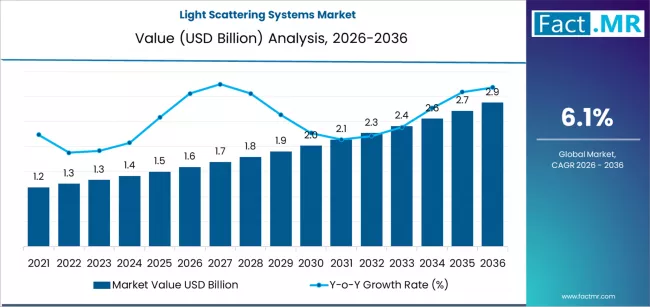
Light scattering systems market is projected to grow from USD 1.6 billion in 2026 to USD 2.9 billion by 2036, at a CAGR of 6.1%. Dynamic Light Scattering (DLS) systems will dominate with a 25.2% market share, while biopharma protein characterization will lead the application segment with a 29.4% share.
Light Scattering Systems Market Forecast and Outlook 2026 to 2036
The global light scattering systems market is projected to total USD 1.59 billion in 2026, advancing to USD 2.88 billion by 2036, progressing at a 6.1% CAGR. This growth is propelled by the indispensable role of particle characterization in research, development, and quality control across critical industries.
Key Takeaways from the Light Scattering Systems Market
- Market Value for 2026: USD 1.59 Billion
- Market Value for 2036: USD 2.88 Billion
- Forecast CAGR 2026 to 2036: 6.1%
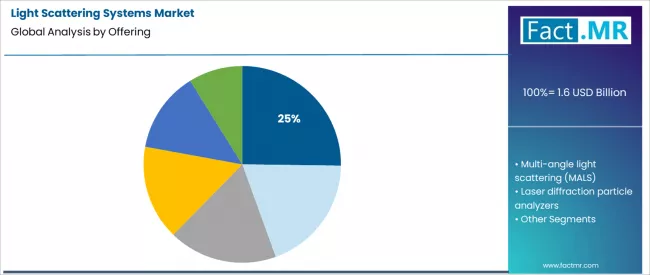
- Leading Offering Segment (2026): Dynamic Light Scattering (DLS) Systems (25.2%)
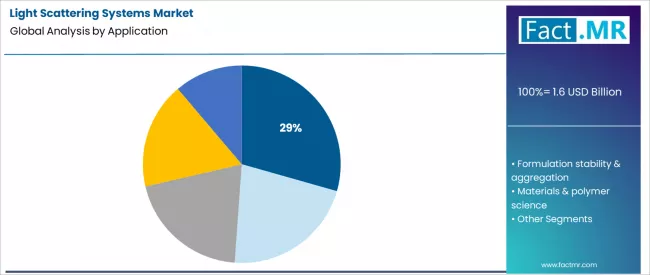
- Leading Application Segment (2026): Biopharma Protein Characterization (29.4%)
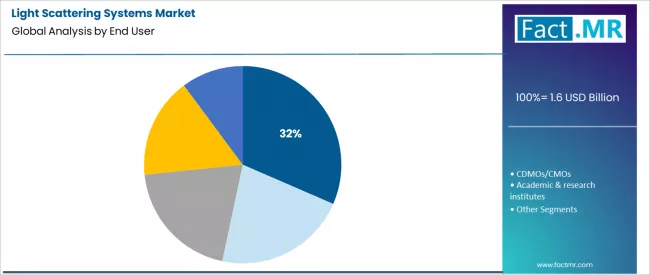
- Leading End User Segment (2026): Biopharma Manufacturers (31.5%)
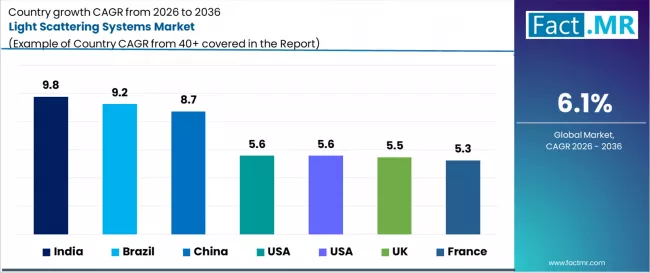
- Key Growth Countries: India (9.8% CAGR), Brazil (9.2% CAGR), China (8.7% CAGR), USA (5.6% CAGR), Germany (5.6% CAGR), UK (5.5% CAGR), France (5.3% CAGR)
- Key Players: MALVERN PANALYTICAL LIMITED, Anton Paar GmbH, HORIBA Ltd., Wyatt Technology Corporation, Beckman Coulter Inc.

Dynamic light scattering systems represent the leading offering, serving as a ubiquitous technique for measuring hydrodynamic size and stability. The primary application is within biopharmaceutical protein characterization, where precise analysis of size, aggregation, and molecular weight is non-negotiable for drug development and regulatory compliance.
Biopharma manufacturers constitute the core end-user segment, driving demand for high-throughput, compliant systems. Expansion in emerging economies is significantly influenced by the growth of their domestic pharmaceutical and materials science sectors, necessitating investments in analytical instrumentation.
Light Scattering Systems Market
| Metric | Value |
|---|---|
| Market Value (2026) | USD 1.59 Billion |
| Market Forecast Value (2036) | USD 2.88 Billion |
| Forecast CAGR 2026 to 2036 | 6.1% |
Category
| Category | Segments |
|---|---|
| Offering | Dynamic Light Scattering Systems, Multi-Angle Light Scattering, Laser Diffraction Particle Analyzers, Nanoparticle Tracking Analysis, Software & Analytics Modules, Service & Calibration Contracts |
| Application | Biopharma Protein Characterization, Formulation Stability & Aggregation, Materials & Polymer Science, Quality Control Testing, Academic & Fundamental Research |
| End User | Biopharma Manufacturers, CDMOs/CMOs, Academic & Research Institutes, Chemical & Materials Companies, Food & Environmental Labs |
| Region | North America, Latin America, Western Europe, Eastern Europe, East Asia, South Asia & Pacific, Middle East & Africa |
What Industrial and Technological Shifts are Amplifying Demand for Particle Analysis?
| Trend | Impact |
|---|---|
| Rise of Complex Biologics & Gene Therapies | Drives need for advanced MALS and DLS systems to characterize viral vectors, lipid nanoparticles, and high-concentration mAbs, where aggregation is a critical quality attribute. |
| Quality-by-Design in Manufacturing | Integrates light scattering as an essential process analytical technology for real-time monitoring of particle size and distribution in both upstream and downstream bioprocessing. |
| Nanomaterial Commercialization | Expands the application of NTA and DLS in the safety and efficacy assessment of engineered nanoparticles for drug delivery, diagnostics, and advanced materials. |
| Automation & Data Integrity Focus | Increases demand for integrated software platforms and GMP-compliant systems that ensure data traceability and reduce operator dependency in regulated QC environments. |
Segmental Analysis
By Offering, Which Technique Provides Foundational Size and Stability Data?

Dynamic Light Scattering systems command a leading 25.2% share. This segment’s prominence is due to the technique’s role as a primary, rapid method for determining hydrodynamic particle size and assessing colloidal stability.
Its speed, minimal sample preparation, and applicability across a vast range of nanoscale materials make it a first-line analytical tool in both R&D and quality control settings within biopharma and materials science, ensuring consistent, high-volume demand.
By Application, Where are Product Efficacy and Safety Directly Correlated to Particle Properties?

Biopharma protein characterization constitutes the primary application segment at 29.4%. In therapeutic protein development, attributes like aggregation state, oligomer formation, and hydrodynamic radius are critical indicators of product efficacy, stability, and immunogenic potential.
Regulatory submissions require extensive characterization data, making light scattering techniques a mandatory component of the analytical toolkit and a significant ongoing cost center in drug development.
By End User, Which Sector Operates Under the Most Stringent Analytical Requirements?

Biopharma manufacturers hold a leading 31.5% share. This segment operates under strict regulatory frameworks (FDA, EMA) that mandate rigorous particle analysis throughout the product lifecycle, from early-stage development through commercial quality control.
The need for validated, compliant instruments, associated service contracts makes biopharma the most technically demanding, and high-value customer segment for advanced light scattering systems.
Which Factors Dictate Investment and Innovation in Particle Characterization?
Stringent regulatory requirements for biopharmaceutical characterization mandate the generation of extensive particle size and aggregation data, creating non-discretionary demand for light scattering instrumentation in drug submission and manufacturing processes.
The high capital cost of advanced multi-technique or hyphenated systems (e.g., SEC-MALS) can limit accessibility for smaller research labs or start-ups, potentially slowing innovation in these segments and concentrating market ownership among larger entities.
The growing outsourcing of analytical testing to Contract Development and Manufacturing Organizations represents a parallel growth channel. CDMOs must invest in state-of-the-art characterization platforms to win contracts, driving system sales independent of pharmaceutical company capital expenditure cycles.
Instrumentation development is focused on creating more robust, automated platforms capable of handling challenging samples like high-concentration formulations or viscous polymers with minimal manual intervention, thereby improving data reliability and throughput in industrial settings.
Analysis of the Light Scattering Systems Market by Key Countries

| Country | CAGR 2026 to 2036 |
|---|---|
| USA | 5.6% |
| Germany | 5.6% |
| China | 8.7% |
| India | 9.8% |
| Brazil | 9.2% |
| France | 5.3% |
| UK | 5.5% |
How does the USA's Concentrated Biopharma Sector Influence Market Dynamics?
A 5.6% CAGR reflects a mature but steady replacement and upgrade market within a dense concentration of biopharmaceutical companies and research institutions. Demand is driven by adherence to evolving FDA guidelines, the need to characterize next-generation therapies, and the expansion of biomanufacturing capacity. Sales focus on high-end, compliant systems and long-term service agreements.
What is the Basis for Germany's Demand in Advanced Materials and Engineering?
Germany's 5.6% CAGR is underpinned by its strong industrial base in specialty chemicals, polymers, and advanced materials. German engineering and research institutions utilize light scattering for fundamental material property analysis, driving demand for precise and robust systems. The market values technical performance and durability for continuous use in industrial R&D environments.
Which Drivers are Central to China's Manufacturing and Research Expansion?
China's 8.7% CAGR is fueled by massive investment in domestic biopharma and materials science capacity. National initiatives in nanotechnology and biologics create top-down demand for analytical instrumentation. Growth is characterized by high volume purchases for new research labs and production facilities, with increasing preference for integrated, automated systems to support scaling operations.
Why does India's Growth Trajectory Link to Pharmaceutical and Academic Investment?
India's leading 9.8% CAGR is propelled by the rapid expansion of its generic pharmaceutical and emerging biopharma sector, which requires enhanced analytical capabilities for global market competition. Concurrently, substantial public and private investment in academic and national research institutes is equipping new laboratories, creating a dual-driven demand for both entry-level and advanced systems.
How is Brazil's Industrial and Agricultural Profile Reflected in Market Needs?
Brazil's 9.2% CAGR is connected to the modernization of its industrial and agricultural sectors. Applications extend beyond pharma to include characterization of polymers, food emulsions, and environmental particulates. Market growth is supported by the need for quality control instrumentation across these diverse industries, favoring versatile and robust systems.
What Characterizes France's Research-Intensive Analytical Instrumentation Market?
France's 5.3% CAGR benefits from a strong network of public research organizations and a reputable pharmaceutical sector. Academic often spearheads demand and government research institutes conducting fundamental studies in soft matter physics, polymer science, and colloidal chemistry, favoring technically sophisticated MALS and advanced DLS systems.
How does the UK's Life Sciences and Chemicals Strategy Shape Procurement?
The UK’s 5.5% CAGR is supported by national strategies promoting life sciences and advanced chemical industries. Procurement often occurs through well-funded research councils and university grants. The market is attuned to innovative, research-grade systems that push methodological boundaries, particularly in characterizing complex biologicals and novel materials.
Competitive Landscape of the Light Scattering Systems Market
Competition is centered on a group of established analytical instrumentation specialists. Companies compete on the basis of technological performance, application-specific expertise, software intelligence, and the depth of their service and support networks.
Leaders like Malvern Panalytical and HORIBA offer broad portfolios covering multiple light scattering techniques, while firms like Wyatt Technology dominate niche segments like absolute MALS detection.
Success depends on deep integration with customer workflows, providing validated methods for regulated industries, and continuously advancing sensitivity and automation to meet emerging analytical challenges in nanomedicine and complex fluids.
Key Players in the Light Scattering Systems Market
- MALVERN PANALYTICAL LIMITED
- Anton Paar GmbH
- HORIBA Ltd.
- Wyatt Technology Corporation
- Beckman Coulter Inc.
- Others
Scope of Report
| Items | Metrics |
|---|---|
| Quantitative Units | USD Billion |
| Offering | DLS Systems, MALS, Laser Diffraction Analyzers, NTA, Software, Service Contracts |
| Application | Biopharma Protein Characterization, Formulation Stability, Materials Science, QC Testing, Academic Research |
| End User | Biopharma Manufacturers, CDMOs/CMOs, Academic Institutes, Chemical Companies, Food & Environmental Labs |
| Key Countries | India, Brazil, China, USA, Germany, UK, France |
| Key Companies | MALVERN PANALYTICAL LIMITED, Anton Paar GmbH, HORIBA Ltd., Wyatt Technology Corporation, Beckman Coulter Inc. |
| Additional Analysis | Comparative analysis of technique suitability for different sample types (proteins, LNPs, polymers); impact of regulatory guidelines on system features; review of hyphenated technique trends (e.g., SEC-MALS, FFF-MALS); analysis of service contract models and their contribution to recurring revenue. |
Market by Segments
-
Offering :
- Dynamic Light Scattering (DLS) Systems
- Multi-Angle Light Scattering (MALS)
- Laser Diffraction Particle Analyzers
- Nanoparticle Tracking Analysis (NTA)
- Software & Analytics Modules
- Service & Calibration Contracts
-
Application :
- Biopharma Protein Characterization
- Formulation Stability & Aggregation
- Materials & Polymer Science
- Quality Control Testing
- Academic & Fundamental Research
-
End User :
- Biopharma Manufacturers
- CDMOs/CMOs
- Academic & Research Institutes
- Chemical & Materials Companies
- Food & Environmental Labs
-
Region :
-
North America
- USA
- Canada
-
Latin America
- Brazil
- Mexico
- Argentina
- Rest of Latin America
-
Western Europe
- Germany
- France
- UK
- Italy
- Spain
- BENELUX
- Rest of Western Europe
-
Eastern Europe
- Poland
- Russia
- Czech Republic
- Rest of Eastern Europe
-
East Asia
- China
- Japan
- South Korea
- Rest of East Asia
-
South Asia & Pacific
- India
- ASEAN
- Australia & New Zealand
- Rest of South Asia & Pacific
-
MEA
- GCC Countries
- South Africa
- Turkiye
- Rest of MEA
-
Bibliography
- International Council for Harmonisation. (2025). ICH Q12 Guideline: Analytical Procedure Development and Lifecycle Management.
- Nobbmann, U., & Morfesis, A. (2024). Light scattering and the characterization of nanoparticles and biologics: A practical guide. Journal of Pharmaceutical Sciences.
- Podzimek, S. (2023). Light Scattering, Size Exclusion Chromatography and Asymmetric Flow Field Flow Fractionation: Powerful Tools for the Characterization of Polymers, Proteins and Nanoparticles. Wiley.
- US Pharmacopeia. (2025). General Chapter <729> Globule Size Distribution in Lipid Injectable Emulsions.
- Wyatt, P. J. (2024). Multi-angle light scattering from macromolecular solutions. Annual Review of Physical Chemistry.
- Zimm, B. H. (2023). The Scattering of Light and the Radial Distribution Function of High Polymer Solutions. Journal of Chemical Physics.
Table of Content
- Executive Summary
- Global Market Outlook
- Demand to side Trends
- Supply to side Trends
- Technology Roadmap Analysis
- Analysis and Recommendations
- Market Overview
- Market Coverage / Taxonomy
- Market Definition / Scope / Limitations
- Market Background
- Market Dynamics
- Drivers
- Restraints
- Opportunity
- Trends
- Scenario Forecast
- Demand in Optimistic Scenario
- Demand in Likely Scenario
- Demand in Conservative Scenario
- Opportunity Map Analysis
- Product Life Cycle Analysis
- Supply Chain Analysis
- Investment Feasibility Matrix
- Value Chain Analysis
- PESTLE and Porter’s Analysis
- Regulatory Landscape
- Regional Parent Market Outlook
- Production and Consumption Statistics
- Import and Export Statistics
- Market Dynamics
- Global Market Analysis 2021 to 2025 and Forecast, 2026 to 2036
- Historical Market Size Value (USD Million) Analysis, 2021 to 2025
- Current and Future Market Size Value (USD Million) Projections, 2026 to 2036
- Y to o to Y Growth Trend Analysis
- Absolute $ Opportunity Analysis
- Global Market Pricing Analysis 2021 to 2025 and Forecast 2026 to 2036
- Global Market Analysis 2021 to 2025 and Forecast 2026 to 2036, By Offering
- Introduction / Key Findings
- Historical Market Size Value (USD Million) Analysis By Offering, 2021 to 2025
- Current and Future Market Size Value (USD Million) Analysis and Forecast By Offering, 2026 to 2036
- Dynamic Light Scattering (DLS) systems
- Multi-angle light scattering (MALS)
- Laser diffraction particle analyzers
- Nanoparticle tracking analysis (NTA)
- Software & analytics modules
- Service & calibration contracts
- Dynamic Light Scattering (DLS) systems
- Y to o to Y Growth Trend Analysis By Offering, 2021 to 2025
- Absolute $ Opportunity Analysis By Offering, 2026 to 2036
- Global Market Analysis 2021 to 2025 and Forecast 2026 to 2036, By Application
- Introduction / Key Findings
- Historical Market Size Value (USD Million) Analysis By Application, 2021 to 2025
- Current and Future Market Size Value (USD Million) Analysis and Forecast By Application, 2026 to 2036
- Biopharma protein characterization
- Formulation stability & aggregation
- Materials & polymer science
- Quality control testing
- Academic & fundamental research
- Biopharma protein characterization
- Y to o to Y Growth Trend Analysis By Application, 2021 to 2025
- Absolute $ Opportunity Analysis By Application, 2026 to 2036
- Global Market Analysis 2021 to 2025 and Forecast 2026 to 2036, By End User
- Introduction / Key Findings
- Historical Market Size Value (USD Million) Analysis By End User, 2021 to 2025
- Current and Future Market Size Value (USD Million) Analysis and Forecast By End User, 2026 to 2036
- Biopharma manufacturers
- CDMOs/CMOs
- Academic & research institutes
- Chemical & materials companies
- Food & environmental labs
- Biopharma manufacturers
- Y to o to Y Growth Trend Analysis By End User, 2021 to 2025
- Absolute $ Opportunity Analysis By End User, 2026 to 2036
- Global Market Analysis 2021 to 2025 and Forecast 2026 to 2036, By Region
- Introduction
- Historical Market Size Value (USD Million) Analysis By Region, 2021 to 2025
- Current Market Size Value (USD Million) Analysis and Forecast By Region, 2026 to 2036
- North America
- Latin America
- Western Europe
- Eastern Europe
- East Asia
- South Asia and Pacific
- Middle East & Africa
- Market Attractiveness Analysis By Region
- North America Market Analysis 2021 to 2025 and Forecast 2026 to 2036, By Country
- Historical Market Size Value (USD Million) Trend Analysis By Market Taxonomy, 2021 to 2025
- Market Size Value (USD Million) Forecast By Market Taxonomy, 2026 to 2036
- By Country
- USA
- Canada
- Mexico
- By Offering
- By Application
- By End User
- By Country
- Market Attractiveness Analysis
- By Country
- By Offering
- By Application
- By End User
- Key Takeaways
- Latin America Market Analysis 2021 to 2025 and Forecast 2026 to 2036, By Country
- Historical Market Size Value (USD Million) Trend Analysis By Market Taxonomy, 2021 to 2025
- Market Size Value (USD Million) Forecast By Market Taxonomy, 2026 to 2036
- By Country
- Brazil
- Chile
- Rest of Latin America
- By Offering
- By Application
- By End User
- By Country
- Market Attractiveness Analysis
- By Country
- By Offering
- By Application
- By End User
- Key Takeaways
- Western Europe Market Analysis 2021 to 2025 and Forecast 2026 to 2036, By Country
- Historical Market Size Value (USD Million) Trend Analysis By Market Taxonomy, 2021 to 2025
- Market Size Value (USD Million) Forecast By Market Taxonomy, 2026 to 2036
- By Country
- Germany
- UK
- Italy
- Spain
- France
- Nordic
- BENELUX
- Rest of Western Europe
- By Offering
- By Application
- By End User
- By Country
- Market Attractiveness Analysis
- By Country
- By Offering
- By Application
- By End User
- Key Takeaways
- Eastern Europe Market Analysis 2021 to 2025 and Forecast 2026 to 2036, By Country
- Historical Market Size Value (USD Million) Trend Analysis By Market Taxonomy, 2021 to 2025
- Market Size Value (USD Million) Forecast By Market Taxonomy, 2026 to 2036
- By Country
- Russia
- Poland
- Hungary
- Balkan & Baltic
- Rest of Eastern Europe
- By Offering
- By Application
- By End User
- By Country
- Market Attractiveness Analysis
- By Country
- By Offering
- By Application
- By End User
- Key Takeaways
- East Asia Market Analysis 2021 to 2025 and Forecast 2026 to 2036, By Country
- Historical Market Size Value (USD Million) Trend Analysis By Market Taxonomy, 2021 to 2025
- Market Size Value (USD Million) Forecast By Market Taxonomy, 2026 to 2036
- By Country
- China
- Japan
- South Korea
- By Offering
- By Application
- By End User
- By Country
- Market Attractiveness Analysis
- By Country
- By Offering
- By Application
- By End User
- Key Takeaways
- South Asia and Pacific Market Analysis 2021 to 2025 and Forecast 2026 to 2036, By Country
- Historical Market Size Value (USD Million) Trend Analysis By Market Taxonomy, 2021 to 2025
- Market Size Value (USD Million) Forecast By Market Taxonomy, 2026 to 2036
- By Country
- India
- ASEAN
- Australia & New Zealand
- Rest of South Asia and Pacific
- By Offering
- By Application
- By End User
- By Country
- Market Attractiveness Analysis
- By Country
- By Offering
- By Application
- By End User
- Key Takeaways
- Middle East & Africa Market Analysis 2021 to 2025 and Forecast 2026 to 2036, By Country
- Historical Market Size Value (USD Million) Trend Analysis By Market Taxonomy, 2021 to 2025
- Market Size Value (USD Million) Forecast By Market Taxonomy, 2026 to 2036
- By Country
- Kingdom of Saudi Arabia
- Other GCC Countries
- Turkiye
- South Africa
- Other African Union
- Rest of Middle East & Africa
- By Offering
- By Application
- By End User
- By Country
- Market Attractiveness Analysis
- By Country
- By Offering
- By Application
- By End User
- Key Takeaways
- Key Countries Market Analysis
- USA
- Pricing Analysis
- Market Share Analysis, 2025
- By Offering
- By Application
- By End User
- Canada
- Pricing Analysis
- Market Share Analysis, 2025
- By Offering
- By Application
- By End User
- Mexico
- Pricing Analysis
- Market Share Analysis, 2025
- By Offering
- By Application
- By End User
- Brazil
- Pricing Analysis
- Market Share Analysis, 2025
- By Offering
- By Application
- By End User
- Chile
- Pricing Analysis
- Market Share Analysis, 2025
- By Offering
- By Application
- By End User
- Germany
- Pricing Analysis
- Market Share Analysis, 2025
- By Offering
- By Application
- By End User
- UK
- Pricing Analysis
- Market Share Analysis, 2025
- By Offering
- By Application
- By End User
- Italy
- Pricing Analysis
- Market Share Analysis, 2025
- By Offering
- By Application
- By End User
- Spain
- Pricing Analysis
- Market Share Analysis, 2025
- By Offering
- By Application
- By End User
- France
- Pricing Analysis
- Market Share Analysis, 2025
- By Offering
- By Application
- By End User
- India
- Pricing Analysis
- Market Share Analysis, 2025
- By Offering
- By Application
- By End User
- ASEAN
- Pricing Analysis
- Market Share Analysis, 2025
- By Offering
- By Application
- By End User
- Australia & New Zealand
- Pricing Analysis
- Market Share Analysis, 2025
- By Offering
- By Application
- By End User
- China
- Pricing Analysis
- Market Share Analysis, 2025
- By Offering
- By Application
- By End User
- Japan
- Pricing Analysis
- Market Share Analysis, 2025
- By Offering
- By Application
- By End User
- South Korea
- Pricing Analysis
- Market Share Analysis, 2025
- By Offering
- By Application
- By End User
- Russia
- Pricing Analysis
- Market Share Analysis, 2025
- By Offering
- By Application
- By End User
- Poland
- Pricing Analysis
- Market Share Analysis, 2025
- By Offering
- By Application
- By End User
- Hungary
- Pricing Analysis
- Market Share Analysis, 2025
- By Offering
- By Application
- By End User
- Kingdom of Saudi Arabia
- Pricing Analysis
- Market Share Analysis, 2025
- By Offering
- By Application
- By End User
- Turkiye
- Pricing Analysis
- Market Share Analysis, 2025
- By Offering
- By Application
- By End User
- South Africa
- Pricing Analysis
- Market Share Analysis, 2025
- By Offering
- By Application
- By End User
- USA
- Market Structure Analysis
- Competition Dashboard
- Competition Benchmarking
- Market Share Analysis of Top Players
- By Regional
- By Offering
- By Application
- By End User
- Competition Analysis
- Competition Deep Dive
- MALVERN PANALYTICAL LIMITED
- Overview
- Product Portfolio
- Profitability by Market Segments (Product/Age /Sales Channel/Region)
- Sales Footprint
- Strategy Overview
- Marketing Strategy
- Product Strategy
- Channel Strategy
- Anton Paar GmbH
- HORIBA Ltd.
- Wyatt Technology Corporation
- Beckman Coulter Inc.
- Others
- MALVERN PANALYTICAL LIMITED
- Competition Deep Dive
- Assumptions & Acronyms Used
- Research Methodology
List Of Table
- Table 1: Global Market Value (USD Million) Forecast by Region, 2021 to 2036
- Table 2: Global Market Value (USD Million) Forecast by Offering, 2021 to 2036
- Table 3: Global Market Value (USD Million) Forecast by Application, 2021 to 2036
- Table 4: Global Market Value (USD Million) Forecast by End User, 2021 to 2036
- Table 5: North America Market Value (USD Million) Forecast by Country, 2021 to 2036
- Table 6: North America Market Value (USD Million) Forecast by Offering, 2021 to 2036
- Table 7: North America Market Value (USD Million) Forecast by Application, 2021 to 2036
- Table 8: North America Market Value (USD Million) Forecast by End User, 2021 to 2036
- Table 9: Latin America Market Value (USD Million) Forecast by Country, 2021 to 2036
- Table 10: Latin America Market Value (USD Million) Forecast by Offering, 2021 to 2036
- Table 11: Latin America Market Value (USD Million) Forecast by Application, 2021 to 2036
- Table 12: Latin America Market Value (USD Million) Forecast by End User, 2021 to 2036
- Table 13: Western Europe Market Value (USD Million) Forecast by Country, 2021 to 2036
- Table 14: Western Europe Market Value (USD Million) Forecast by Offering, 2021 to 2036
- Table 15: Western Europe Market Value (USD Million) Forecast by Application, 2021 to 2036
- Table 16: Western Europe Market Value (USD Million) Forecast by End User, 2021 to 2036
- Table 17: Eastern Europe Market Value (USD Million) Forecast by Country, 2021 to 2036
- Table 18: Eastern Europe Market Value (USD Million) Forecast by Offering, 2021 to 2036
- Table 19: Eastern Europe Market Value (USD Million) Forecast by Application, 2021 to 2036
- Table 20: Eastern Europe Market Value (USD Million) Forecast by End User, 2021 to 2036
- Table 21: East Asia Market Value (USD Million) Forecast by Country, 2021 to 2036
- Table 22: East Asia Market Value (USD Million) Forecast by Offering, 2021 to 2036
- Table 23: East Asia Market Value (USD Million) Forecast by Application, 2021 to 2036
- Table 24: East Asia Market Value (USD Million) Forecast by End User, 2021 to 2036
- Table 25: South Asia and Pacific Market Value (USD Million) Forecast by Country, 2021 to 2036
- Table 26: South Asia and Pacific Market Value (USD Million) Forecast by Offering, 2021 to 2036
- Table 27: South Asia and Pacific Market Value (USD Million) Forecast by Application, 2021 to 2036
- Table 28: South Asia and Pacific Market Value (USD Million) Forecast by End User, 2021 to 2036
- Table 29: Middle East & Africa Market Value (USD Million) Forecast by Country, 2021 to 2036
- Table 30: Middle East & Africa Market Value (USD Million) Forecast by Offering, 2021 to 2036
- Table 31: Middle East & Africa Market Value (USD Million) Forecast by Application, 2021 to 2036
- Table 32: Middle East & Africa Market Value (USD Million) Forecast by End User, 2021 to 2036
List Of Figures
- Figure 1: Global Market Pricing Analysis
- Figure 2: Global Market Value (USD Million) Forecast 2021 to 2036
- Figure 3: Global Market Value Share and BPS Analysis by Offering, 2026 and 2036
- Figure 4: Global Market Y to o to Y Growth Comparison by Offering, 2026 to 2036
- Figure 5: Global Market Attractiveness Analysis by Offering
- Figure 6: Global Market Value Share and BPS Analysis by Application, 2026 and 2036
- Figure 7: Global Market Y to o to Y Growth Comparison by Application, 2026 to 2036
- Figure 8: Global Market Attractiveness Analysis by Application
- Figure 9: Global Market Value Share and BPS Analysis by End User, 2026 and 2036
- Figure 10: Global Market Y to o to Y Growth Comparison by End User, 2026 to 2036
- Figure 11: Global Market Attractiveness Analysis by End User
- Figure 12: Global Market Value (USD Million) Share and BPS Analysis by Region, 2026 and 2036
- Figure 13: Global Market Y to o to Y Growth Comparison by Region, 2026 to 2036
- Figure 14: Global Market Attractiveness Analysis by Region
- Figure 15: North America Market Incremental Dollar Opportunity, 2026 to 2036
- Figure 16: Latin America Market Incremental Dollar Opportunity, 2026 to 2036
- Figure 17: Western Europe Market Incremental Dollar Opportunity, 2026 to 2036
- Figure 18: Eastern Europe Market Incremental Dollar Opportunity, 2026 to 2036
- Figure 19: East Asia Market Incremental Dollar Opportunity, 2026 to 2036
- Figure 20: South Asia and Pacific Market Incremental Dollar Opportunity, 2026 to 2036
- Figure 21: Middle East & Africa Market Incremental Dollar Opportunity, 2026 to 2036
- Figure 22: North America Market Value Share and BPS Analysis by Country, 2026 and 2036
- Figure 23: North America Market Value Share and BPS Analysis by Offering, 2026 and 2036
- Figure 24: North America Market Y to o to Y Growth Comparison by Offering, 2026 to 2036
- Figure 25: North America Market Attractiveness Analysis by Offering
- Figure 26: North America Market Value Share and BPS Analysis by Application, 2026 and 2036
- Figure 27: North America Market Y to o to Y Growth Comparison by Application, 2026 to 2036
- Figure 28: North America Market Attractiveness Analysis by Application
- Figure 29: North America Market Value Share and BPS Analysis by End User, 2026 and 2036
- Figure 30: North America Market Y to o to Y Growth Comparison by End User, 2026 to 2036
- Figure 31: North America Market Attractiveness Analysis by End User
- Figure 32: Latin America Market Value Share and BPS Analysis by Country, 2026 and 2036
- Figure 33: Latin America Market Value Share and BPS Analysis by Offering, 2026 and 2036
- Figure 34: Latin America Market Y to o to Y Growth Comparison by Offering, 2026 to 2036
- Figure 35: Latin America Market Attractiveness Analysis by Offering
- Figure 36: Latin America Market Value Share and BPS Analysis by Application, 2026 and 2036
- Figure 37: Latin America Market Y to o to Y Growth Comparison by Application, 2026 to 2036
- Figure 38: Latin America Market Attractiveness Analysis by Application
- Figure 39: Latin America Market Value Share and BPS Analysis by End User, 2026 and 2036
- Figure 40: Latin America Market Y to o to Y Growth Comparison by End User, 2026 to 2036
- Figure 41: Latin America Market Attractiveness Analysis by End User
- Figure 42: Western Europe Market Value Share and BPS Analysis by Country, 2026 and 2036
- Figure 43: Western Europe Market Value Share and BPS Analysis by Offering, 2026 and 2036
- Figure 44: Western Europe Market Y to o to Y Growth Comparison by Offering, 2026 to 2036
- Figure 45: Western Europe Market Attractiveness Analysis by Offering
- Figure 46: Western Europe Market Value Share and BPS Analysis by Application, 2026 and 2036
- Figure 47: Western Europe Market Y to o to Y Growth Comparison by Application, 2026 to 2036
- Figure 48: Western Europe Market Attractiveness Analysis by Application
- Figure 49: Western Europe Market Value Share and BPS Analysis by End User, 2026 and 2036
- Figure 50: Western Europe Market Y to o to Y Growth Comparison by End User, 2026 to 2036
- Figure 51: Western Europe Market Attractiveness Analysis by End User
- Figure 52: Eastern Europe Market Value Share and BPS Analysis by Country, 2026 and 2036
- Figure 53: Eastern Europe Market Value Share and BPS Analysis by Offering, 2026 and 2036
- Figure 54: Eastern Europe Market Y to o to Y Growth Comparison by Offering, 2026 to 2036
- Figure 55: Eastern Europe Market Attractiveness Analysis by Offering
- Figure 56: Eastern Europe Market Value Share and BPS Analysis by Application, 2026 and 2036
- Figure 57: Eastern Europe Market Y to o to Y Growth Comparison by Application, 2026 to 2036
- Figure 58: Eastern Europe Market Attractiveness Analysis by Application
- Figure 59: Eastern Europe Market Value Share and BPS Analysis by End User, 2026 and 2036
- Figure 60: Eastern Europe Market Y to o to Y Growth Comparison by End User, 2026 to 2036
- Figure 61: Eastern Europe Market Attractiveness Analysis by End User
- Figure 62: East Asia Market Value Share and BPS Analysis by Country, 2026 and 2036
- Figure 63: East Asia Market Value Share and BPS Analysis by Offering, 2026 and 2036
- Figure 64: East Asia Market Y to o to Y Growth Comparison by Offering, 2026 to 2036
- Figure 65: East Asia Market Attractiveness Analysis by Offering
- Figure 66: East Asia Market Value Share and BPS Analysis by Application, 2026 and 2036
- Figure 67: East Asia Market Y to o to Y Growth Comparison by Application, 2026 to 2036
- Figure 68: East Asia Market Attractiveness Analysis by Application
- Figure 69: East Asia Market Value Share and BPS Analysis by End User, 2026 and 2036
- Figure 70: East Asia Market Y to o to Y Growth Comparison by End User, 2026 to 2036
- Figure 71: East Asia Market Attractiveness Analysis by End User
- Figure 72: South Asia and Pacific Market Value Share and BPS Analysis by Country, 2026 and 2036
- Figure 73: South Asia and Pacific Market Value Share and BPS Analysis by Offering, 2026 and 2036
- Figure 74: South Asia and Pacific Market Y to o to Y Growth Comparison by Offering, 2026 to 2036
- Figure 75: South Asia and Pacific Market Attractiveness Analysis by Offering
- Figure 76: South Asia and Pacific Market Value Share and BPS Analysis by Application, 2026 and 2036
- Figure 77: South Asia and Pacific Market Y to o to Y Growth Comparison by Application, 2026 to 2036
- Figure 78: South Asia and Pacific Market Attractiveness Analysis by Application
- Figure 79: South Asia and Pacific Market Value Share and BPS Analysis by End User, 2026 and 2036
- Figure 80: South Asia and Pacific Market Y to o to Y Growth Comparison by End User, 2026 to 2036
- Figure 81: South Asia and Pacific Market Attractiveness Analysis by End User
- Figure 82: Middle East & Africa Market Value Share and BPS Analysis by Country, 2026 and 2036
- Figure 83: Middle East & Africa Market Value Share and BPS Analysis by Offering, 2026 and 2036
- Figure 84: Middle East & Africa Market Y to o to Y Growth Comparison by Offering, 2026 to 2036
- Figure 85: Middle East & Africa Market Attractiveness Analysis by Offering
- Figure 86: Middle East & Africa Market Value Share and BPS Analysis by Application, 2026 and 2036
- Figure 87: Middle East & Africa Market Y to o to Y Growth Comparison by Application, 2026 to 2036
- Figure 88: Middle East & Africa Market Attractiveness Analysis by Application
- Figure 89: Middle East & Africa Market Value Share and BPS Analysis by End User, 2026 and 2036
- Figure 90: Middle East & Africa Market Y to o to Y Growth Comparison by End User, 2026 to 2036
- Figure 91: Middle East & Africa Market Attractiveness Analysis by End User
- Figure 92: Global Market - Tier Structure Analysis
- Figure 93: Global Market - Company Share Analysis
- FAQs -
How big is the light scattering systems market in 2026?
The global light scattering systems market is estimated to be valued at USD 1.6 billion in 2026.
What will be the size of light scattering systems market in 2036?
The market size for the light scattering systems market is projected to reach USD 2.9 billion by 2036.
How much will be the light scattering systems market growth between 2026 and 2036?
The light scattering systems market is expected to grow at a 6.1% CAGR between 2026 and 2036.
What are the key product types in the light scattering systems market?
The key product types in light scattering systems market are dynamic light scattering (dls) systems, multi-angle light scattering (mals), laser diffraction particle analyzers, nanoparticle tracking analysis (nta), software & analytics modules and service & calibration contracts.
Which application segment to contribute significant share in the light scattering systems market in 2026?
In terms of application, biopharma protein characterization segment to command 29.4% share in the light scattering systems market in 2026.