- Market Value (2025): USD 136.4 Mn
- Estimated Value (2026): USD 145.3 Mn
- Forecast Value (2036): USD 326.8 Mn
- CAGR (2026-2036): 6.5%
What is the Corn Silk Tea Market forecast to be worth by 2036?
USD 145.3 million in 2026 to USD 326.8 million by 2036, at a 6.5% CAGR.
- The market reached USD 136.4 million in 2025.
- Demand is projected to increase from USD 145.3 million in 2026 to USD 326.8 million by 2036.
- The market is forecast to record a 6.5% CAGR from 2026 to 2036, creating an absolute opportunity of USD 181.5 million.
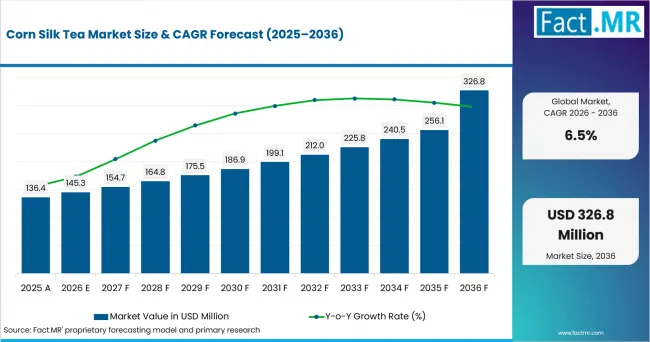
Corn Silk Tea Market Value Analysis | Source: Fact.MR
What are the defining numbers behind Corn Silk Tea Market growth?
USD 181.5 million absolute opportunity is expected between 2026 and 2036.
- Demand Drivers in the Market
- Caffeine-free positioning gives corn silk tea room in the herbal infusion aisle, especially for consumers who already rotate chamomile, peppermint as well as hibiscus and other plant infusions.
- The ingredient has a clear origin story because corn silk is the stigma and style of Zea mays. That helps brands explain the product without pretending it is conventional black or green tea.
- Online discovery matters because the category is still niche. Search-led buying, speciality tea stores and marketplace listings can carry more product education than a supermarket shelf label.
- Quality control remains central. Drying, moisture management, cut size as well as residue testing and packaging determine whether the product brews cleanly and stays credible with repeat buyers.
- Key Segments Analyzed
- By Type: Brewing Type leads with 63.1% share in 2026.
- By Sales Channel: Online Sales leads with 59.8% share in 2026.
- Analyst Opinion at Fact.MR
- Corn silk tea should be treated as a specialist botanical infusion, not as a generic tea extension. Buyers respond when suppliers make the ingredient easy to understand, keep sensory quality stable, and avoid overclaiming health benefits. The strongest suppliers will pair clean sourcing and simple brewing formats with sober language around wellness positioning. Shambhu Nath Jha, Sr. Consultant, Fact.MR.
- Strategic Implications
- Suppliers should explain ingredient identity, origin, drying method and brewing instructions clearly.
- Retail and online listings should treat corn silk tea as a caffeine-free botanical infusion rather than a commodity tea product.
- Claims need careful control in the USA, Canada, the UK and Europe because botanical products can move into regulated territory when disease or treatment language appears.
Australia records the highest country CAGR at 9.2%, followed by the UK at 8.6%. The USA is projected at 7.8%, while Canada advances at 7.9%, while Germany is forecast to expand at 6.9% through 2036.
How does the Corn Silk Tea Market break down by segment?
Why does Brewing Type lead Type?
Brewing Type is projected to account for a 63.1% share in 2026.
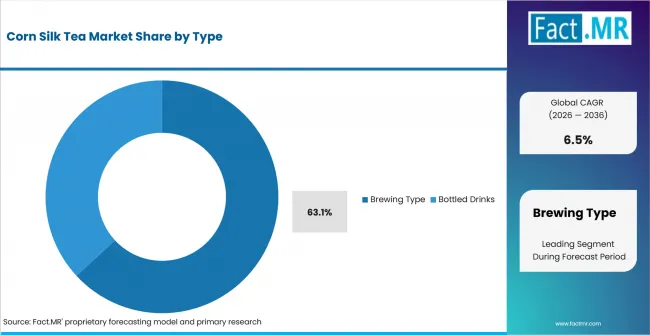
Corn Silk Tea Market Analysis By Type | Source: Fact.MR
Brewing Type leads because dried corn silk fits the established preparation method used for botanical infusions. It can be packed as loose material or portioned into tea bags and steeped directly in hot water. This gives consumers control over brew strength while keeping the product close to the familiar preparation routine used for other herbal teas.
Processing quality also matters directly to the finished drink. Research on corn silk beverages shows that drying and infusion conditions affect extraction as well as sensory characteristics, making a controlled brewing format suitable for suppliers that want to differentiate through raw-material treatment and preparation instructions.
Brewing formats also allow suppliers to commercialize corn silk without converting it into a formulated ready-to-drink beverage. This suits specialist tea companies and smaller botanical brands that can sell dried products in tea bags or resealable packs while leaving flavour strength and serving temperature to the consumer.
Why does Online Sales lead Sales Channel?
Online Sales are projected to account for a 59.8% share in 2026.
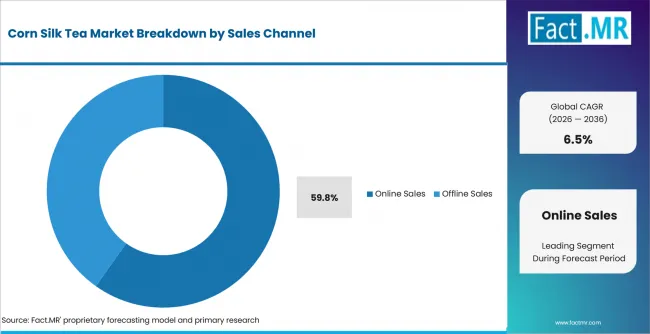
Corn Silk Tea Market Analysis By Sales Channel | Source: Fact.MR
Online Sales lead because corn silk tea remains less familiar than established herbal infusions. Buyers often need to understand what corn silk is, how it should be brewed and what the finished drink is likely to taste like before purchasing. Product pages can provide this information in considerably more detail than conventional shelf packaging.
A study specifically examining consumer cognition and demand for corn silk tea found that public awareness of the product remained relatively limited, while buyers paid attention to factors such as safety and sensory attributes. This makes product education particularly important during discovery and purchase.
Online channels also give specialist suppliers access to buyers without requiring broad physical distribution. Brands can present ingredient origin and preparation guidance alongside pack formats, helping consumers compare unfamiliar products before placing an order. Offline Sales remain relevant for herbal shops and specialist food retailers, but the information requirements of this niche category favour digital purchasing.
What is accelerating Corn Silk Tea Market adoption, and what is holding it back?
Corn silk tea adoption is being pulled by interest in caffeine-free botanical infusions, but the category still needs stronger consumer education and tighter claims discipline.
Drivers Impact Analysis
| DRIVER | (~) % IMPACT ON CAGR | GEOGRAPHIC RELEVANCE | IMPACT TIMELINE |
|---|---|---|---|
| Botanical familiarity | +1.6% | Australia, UK and Canada | Short term (<= 2 years) |
| Functional interest | +1.3% | UK, Canada and USA | Short term (<= 2 years) |
| Pack convenience | +1.0% | Canada, USA and Germany | Medium term (2-4 years) |
| Online education | +0.8% | Australia, UK and Canada | Medium term (2-4 years) |
- Botanical familiarity: Consumers already understand herbal infusions, so corn silk tea does not need to create a completely new drinking occasion.
- Functional interest: Peer-reviewed literature identifies flavonoids, polyphenols and phenolic acids in corn silk, giving brands a science-aware ingredient story without requiring medical claims.
- Pack convenience: Tea bags, sachets and resealable packs reduce the preparation barrier for a product that many consumers have not brewed before.
- Online education: Digital listings give sellers space to explain taste, preparation and ingredient origin better than a small retail pack can.
Opportunity Impact Analysis
| OPPORTUNITY | (~) % IMPACT ON CAGR | GEOGRAPHIC RELEVANCE | IMPACT TIMELINE |
|---|---|---|---|
| Origin and quality transparency | +1.1% | Australia, UK and Canada | Medium term (2-4 years) |
| Herbal blend development | +0.8% | UK, Canada and USA | Medium term (2-4 years) |
| Premium specialty formats | +0.7% | Canada, USA and Germany | Long term (>= 4 years) |
- Suppliers can build trust by showing origin, drying method, testing practices and usage directions.
- Blends with peppermint, lemongrass, ginger or roasted grains can make the drink more familiar to mainstream herbal-tea buyers.
- Premium formats can serve wellness stores, tea boutiques and cross-border online shoppers where shoppers expect ingredient detail.
Restraints Impact Analysis
| RESTRAINT | (~) % IMPACT ON CAGR | GEOGRAPHIC RELEVANCE | IMPACT TIMELINE |
|---|---|---|---|
| Low consumer awareness | -1.2% | Australia, UK and Canada | Short term (<= 2 years) |
| Wellness-claim regulation | -0.9% | Australia, UK and Canada | Short term (<= 2 years) |
| Raw-material quality variability | -0.7% | Established and price-sensitive markets | Medium term (2-4 years) |
- Low awareness limits repeat purchase when consumers do not know what the drink tastes like or how to use it.
- Uncontrolled wellness claims can slow listings or trigger regulatory review in markets that distinguish foods, supplements and natural health products.
- Raw material quality can vary with drying, handling, pesticide control and storage. This makes supplier selection important.
Which countries are scaling the Corn Silk Tea Market fastest?
Australia, the UK, the USA as well as Canada and Germany all sit above the global 6.5% CAGR. Their growth paths are not identical. Australia benefits from a strong non-alcoholic beverage base and wellness retail interest. The UK has deep tea-drinking habits, which makes new infusions easier to introduce. The USA and Canada scale through online retail, natural-products channels and foodservice breadth. Germany grows steadily because herbal and fruit infusions are already familiar, although inflation in coffee, tea and cocoa keeps price sensitivity in view.
- Australia leads the country set at 9.2% CAGR.
- The UK follows at 8.6% CAGR.
- The USA records 7.8% CAGR.
- Canada advances at 7.9% CAGR.
- Germany expands at 6.9% CAGR.
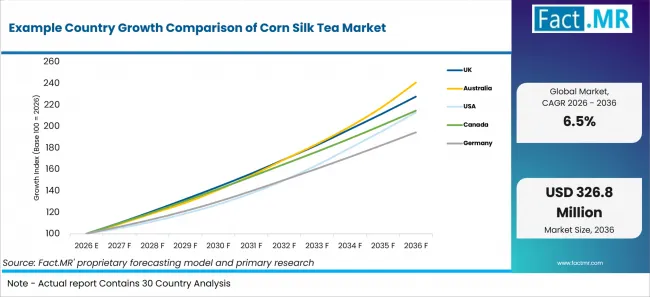
Example Country Growth Comparison Of Corn Silk Tea Market | Source: Fact.MR
| COUNTRY | CAGR, 2026 to 2036 |
|---|---|
| Australia | 9.2% |
| UK | 8.6% |
| USA | 7.8% |
| Canada | 7.9% |
| Germany | 6.9% |
What is driving Australia's growth through 2036?
Australia is forecast to grow at 9.2% CAGR through 2036, making it the fastest-growing listed country. The strongest driver is fit with the local non-alcoholic beverage and wellness retail pattern. ABS data show that per capita apparent consumption of selected non-alcoholic beverages rose in 2023-24, while Tourism Research Australia reported AUD 4.5 billion in domestic spending on takeaway and restaurant meals in the March quarter of 2026. Corn silk tea benefits from both routes: it can sell as a home-brewed herbal infusion, and it can also appear in cafes, wellness menus and speciality beverage formats when operators want caffeine-free options.
What is driving the UK's growth through 2036?
The UK is forecast to record 8.6% CAGR through 2036. The market has a useful cultural base because tea remains a daily habit, and the UK Tea & Infusions Association estimates about 100 million cups of tea are consumed in the UK each day. Corn silk tea does not need to replace black tea to grow. It needs a small share of consumers who already use fruit, herbal and caffeine-free infusions as evening drinks, wellness purchases or trial products. GOV.UK food statistics also show a large food and drink spending base, which helps speciality beverages find space through grocery, ecommerce and out-of-home channels.
What is driving the USA's growth through 2036?
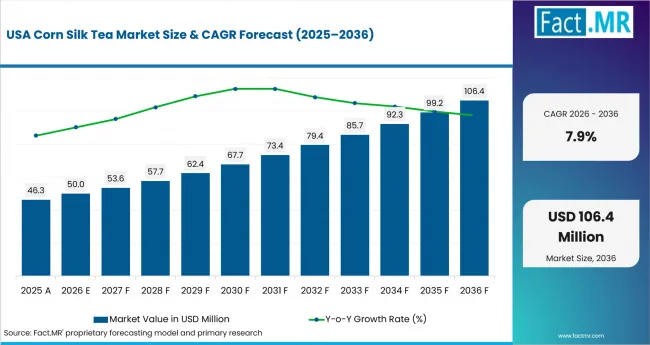
Corn Silk Tea Market Country Value Analysis | Source: Fact.MR
The USA is projected to expand at 7.8% CAGR through 2036. Growth is supported by a large food and beverage retail base, a mature supplement and natural-products culture, and online discovery. USDA ERS describes its Food Expenditure Series as measuring the value of food and beverages acquired across food-at-home and food-away-from-home channels, while NCCIH identifies herbal supplements as botanicals that contain one or more herbs. For corn silk tea, that means the opportunity sits between beverage and botanical positioning. Brands that keep claims conservative can reach shoppers looking for caffeine-free, plant-based infusions without forcing the product into a drug-like claim structure.
What is driving Canada's growth through 2036?
Canada is forecast to grow at 7.9% CAGR through 2036. The country has a clear import-and-retail route for tea products. Agriculture and Agri-Food Canada reported that Canada imported CAD 203.9 million in tea products in 2024, compared with CAD 42.5 million in exports. That import dependence matters for niche herbal infusions because foreign and private-label suppliers can place speciality products through established tea channels. At the same time, Health Canada rules for natural health products make claim discipline important. Corn silk tea can grow as a food-style infusion, but suppliers must be careful when marketing crosses into therapeutic language.
What is driving Germany's growth through 2036?
Germany is forecast to expand at 6.9% CAGR through 2036. Growth is steady because German consumers are already familiar with fruit and herbal infusions; peer-reviewed research on European tea and herbal infusion consumption notes that in Germany, fruit and herbal infusions surpass conventional tea consumption. The limiting factor is price pressure. Destatis reported that non-alcoholic beverages were up 8.7% in August 2025, including an 18.5% rise for coffee, tea and cocoa. That supports value growth, but it can also make consumers more selective. Corn silk tea therefore has room in Germany, but it needs clear quality and flavour justification to command repeat purchases.
Who leads the Corn Silk Tea Market?
Yuanqisenlin is the largest named company in the assessed set, with 11.2% share. Other listed participants include TEAZEN, LOTTE, YAMAMOTO KANPOH PHARMACEUTICAL and Buddha Teas. Competition is shaped by sourcing transparency, drying quality, flavour blending as well as compliant claims and channel reach.
Which companies are the key providers?
Key companies include Yuanqisenlin; TEAZEN; LOTTE; YAMAMOTO KANPOH PHARMACEUTICAL; Buddha Teas; DAMTUH; SURF; Sempio; and Nokchawan.
- Yuanqisenlin
- TEAZEN
- LOTTE
- YAMAMOTO KANPOH PHARMACEUTICAL
- Buddha Teas
- DAMTUH
- SURF
- Sempio
- Nokchawan
How is the market segmented?
-
By Type
- Brewing Type
- Bottled Drinks
-
By Sales Channel
- Online Sales
- Offline Sales
-
By Region
- North America
- USA
- Canada
- Latin America
- Europe
- Germany
- UK
- East Asia
- South Asia & Oceania
- Australia
- Middle East & Africa
- North America
Bibliography
- Agriculture and Agri-Food Canada. (2025, October 29). Coffee and tea, caffeine free, hot/cold drinks in Canada. Government of Canada.
- Australian Bureau of Statistics. (2025, March 28). Apparent Consumption of Selected Foodstuffs, Australia, 2023-24.
- Federal Statistical Office of Germany. (2025, September 12). Inflation rate at +2.2% in August 2025. Destatis.
- GOV.UK. (2026). Food statistics in your pocket. Department for Environment, Food & Rural Affairs.
- Health Canada. (2026). Regulating natural and non-prescription health products. Government of Canada.
- National Center for Complementary and Integrative Health. (2025). Dietary and herbal supplements. National Institutes of Health.
- Sousa, A. C., et al. (2024). Exploring tea and herbal infusions consumption patterns and health effects: A systematic review. Heliyon.
- Tourism Research Australia. (2026). Domestic tourism statistics results. Australian Trade and Investment Commission.
- UK Tea & Infusions Association. (n.d.). Frequently asked questions about tea.
- U.S. Department of Agriculture, Economic Research Service. (2026). Food Expenditure Series.
- Wang, Y., et al. (2024). An umbrella insight into the phytochemistry features and pharmacological activities of corn silk. Molecules.
This Report Answers
- The report provides strategic intelligence on the Corn Silk Tea Market across Type and Sales Channel choices that shape product selection and channel adoption.
- Segment analysis covers Brewing Type and Online Sales as the share leaders within the 2026 market.
- Country outlook evaluates the UK and Australia alongside the USA and Canada. Germany completes the growth comparison across the profiled markets.
- Competitive analysis profiles Yuanqisenlin and TEAZEN alongside LOTTE and YAMAMOTO KANPOH PHARMACEUTICAL. Buddha Teas completes the provider view.
- Channel assessment covers Online Sales and Offline Sales. Product-format review covers Brewing Type and Bottled Drinks.
What does the Corn Silk Tea Market cover?
The market covers corn silk tea products and related botanical infusion offerings across the defined type and region categories.
What is included in the scope?
The scope includes dried corn silk tea products, tea bags, loose formats and related botanical infusion products sold through retail as well as online and specialist channels.
What is excluded from the scope?
Products outside corn silk tea and directly related botanical infusion formats are excluded. Disease-treatment products, pharmaceutical preparations and unrelated maize-based foods are outside the stated market scope.
How Was the Analysis Built?
The analysis combines structured desk research, company and product mapping, expert validation. Demand-side checks across major regions.
- Primary Research: Interviews with buyers, suppliers, retailers and category specialists test purchasing criteria as well as claim sensitivity as well as adoption barriers and repeat-purchase behavior.
- Desk Research: Public regulatory material, trade information, food and beverage statistics as well as company literature and scientific publications establish market boundaries and demand context.
- Market Sizing and Forecasting: Demand indicators, channel patterns, product availability as well as country growth rates and supplier participation are reconciled across top-down and bottom-up views.
- Data Validation and Update Cycle: Findings are cross-checked across independent evidence routes and reviewed when material market, regulatory or company changes occur.
What is the report's scope and coverage?
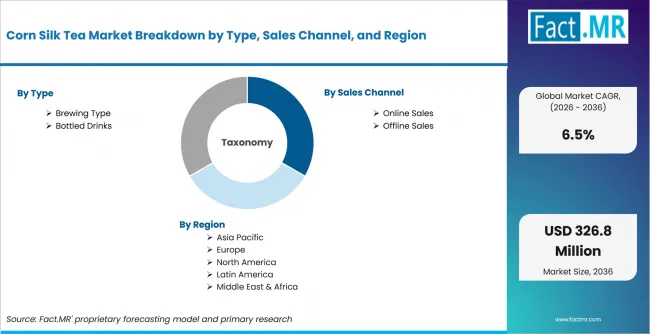
Corn Silk Tea Market Breakdown By Type, Sales Channel, And Region | Source: Fact.MR
| Attribute | Details |
|---|---|
| Quantitative Units | USD 145.3 million in 2026 to USD 326.8 million by 2036, at a 6.5% CAGR |
| Market Definition | Corn silk tea products and related botanical infusion offerings across the assessed categories |
| Type | Brewing Type; Bottled Drinks |
| Sales Channel | Online Sales; Offline Sales |
| Regions Covered | North America; Latin America; Europe; East Asia; South Asia & Oceania; Middle East & Africa |
| Countries Covered | UK; Australia; USA; Canada; Germany |
| Key Companies Profiled | Yuanqisenlin; TEAZEN; LOTTE; YAMAMOTO KANPOH PHARMACEUTICAL; Buddha Teas; DAMTUH; and others |
| Forecast Period | 2026 to 2036 |
| Approach | Hybrid top-down and bottom-up market assessment |