Tea Market
Tea Market Size and Share Forecast Outlook 2025 to 2035
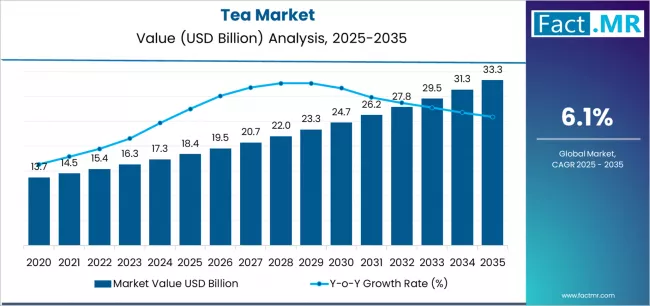
Tea market is projected to grow from USD 18.4 billion in 2025 to USD 33.3 billion by 2035, at a CAGR of 6.1%. Black Tea will dominate with a 38.8% market share, while hypermarkets & supermarkets will lead the distribution channel segment with a 37.6% share.
Tea Market Forecast and Outlook 2025 to 2035
The global tea market is projected to reach USD 33.25 billion by 2035, recording an absolute increase of USD 14.85 billion over the forecast period. The market is valued at USD 18.4 billion in 2025 and is set to rise at a CAGR of 6.1% during the assessment period.
The overall market size is expected to grow by approximately 1.8 times during the same period, supported by increasing consumer preference for natural and health-oriented beverages worldwide, driving demand for premium tea varieties and increasing investments in sustainable cultivation practices with enhanced quality standards across traditional consumption and emerging wellness applications globally.
Quick Stats for Tea Market
- Tea Market Value (2025): USD 18.4 billion
- Tea Market Forecast Value (2035): USD 33.25 billion
- Tea Market Forecast CAGR: 6.1%
- Leading Product Category in Tea Market: Black Tea (38.8%)
- Key Growth Regions in Tea Market: Asia Pacific, Middle East & Africa, and Europe
- Top Players in Tea Market: Unilever, R. Twining and Company Limited, Dilmah Ceylon Tea Company PLC, Bigelow Tea, PepsiCo, YORKSHIRE TEA, Starbucks Coffee Company, Caraway Tea, Harris Freeman, The Republic of Tea
Consumers face mounting pressure to maintain healthy lifestyles and reduce consumption of sugary beverages while addressing hydration needs and antioxidant intake requirements, with modern tea products providing documented health benefits including cardiovascular support, metabolic enhancement, and stress reduction compared to conventional soft drinks and energy beverages alone.
Rising awareness about tea's therapeutic properties and expanding specialty retail channels enabling access to diverse tea varieties create substantial opportunities for tea producers and beverage manufacturers. However, climate change impacts on tea cultivation and fluctuating commodity prices may pose obstacles to supply chain stability.
The black tea segment dominates market activity, driven by extensive cultural acceptance and established consumption patterns across traditional tea-drinking regions delivering robust flavor profiles across diverse demographic groups worldwide. Consumers increasingly recognize the versatility of black tea products, with typical product offerings providing effective caffeine delivery and antioxidant benefits at accessible price points through established retail distribution networks.
The green tea segment demonstrates robust growth potential, supported by rising health consciousness and scientific evidence supporting metabolic and cardiovascular benefits in modern wellness approaches. Hypermarkets and supermarkets emerge as the dominant distribution channel, reflecting consumer preference for convenient one-stop shopping experiences and comprehensive product assortments in daily grocery purchasing routines. Online channels represent the fastest-growing sales avenue, driven by direct-to-consumer specialty tea brands and e-commerce accessibility enabling premium product discovery.
Regional dynamics show Asia Pacific maintaining market leadership, supported by deep-rooted tea culture and massive consumption volumes across producing and consuming nations. Middle East & Africa demonstrates strong growth trajectory driven by expanding consumer base and traditional tea consumption patterns, while Europe and North America emphasize premium specialty teas and wellness-oriented product positioning.
India leads country-level growth through extensive domestic consumption expansion and production modernization, followed by China supported by traditional tea culture evolution and premiumization trends.
The competitive landscape features moderate concentration with Unilever maintaining market leadership position, while established tea brands including R. Twining and Company Limited, Dilmah Ceylon Tea Company PLC, and Bigelow Tea compete through heritage positioning and comprehensive product portfolios across diverse tea categories and price segments.
Tea Market Year-over-Year Forecast 2025 to 2035
Between 2025 and 2029, the tea market is projected to expand from USD 18.4 billion to USD 23.42 billion, resulting in a value increase of USD 5.02 billion, which represents 33.8% of the total forecast growth for the period. This phase of development will be shaped by rising demand for specialty and premium tea varieties addressing quality-conscious consumer preferences, product innovation in ready-to-drink formats and functional tea blends with enhanced convenience and wellness positioning, as well as expanding modern retail penetration across emerging markets and digital commerce platforms. Companies are establishing competitive positions through investment in sustainable sourcing initiatives, advanced processing technologies, and strategic market expansion across supermarkets, specialty tea shops, and direct-to-consumer distribution models.
From 2029 to 2035, the market is forecast to grow from USD 23.42 billion to USD 33.25 billion, adding another USD 9.83 billion, which constitutes 66.1% of the overall expansion. This period is expected to be characterized by the expansion of specialized product applications, including organic and herbal tea varieties tailored for specific health benefits and lifestyle preferences, strategic collaborations between tea producers and wellness brands, and an enhanced focus on traceability and ethical sourcing practices. The growing emphasis on experiential tea consumption and rising consumer preference for artisanal loose-leaf varieties addressing authentic taste experiences will drive demand for premium tea solutions across diverse consumer populations.
Tea Market Key Takeaways
| Metric | Value |
|---|---|
| Market Value (2025) | USD 18.4 billion |
| Market Forecast Value (2035) | USD 33.25 billion |
| Forecast CAGR (2025-2035) | 6.1% |
Why is the Tea Market Growing?
The tea market grows by enabling consumers to access natural beverage options with inherent health benefits while addressing hydration requirements and reducing dependence on artificially sweetened drinks and high-calorie beverage alternatives.
Consumers face mounting pressure to adopt healthier drinking habits and manage wellness goals while maintaining busy lifestyles, weight management priorities, and chronic disease prevention strategies, with modern tea formulations typically providing targeted health benefits including antioxidant delivery for cellular protection, polyphenol compounds for metabolic support, and natural caffeine for mental alertness compared to conventional soft drinks and processed beverages alone, making tea consumption essential for balanced beverage intake patterns.
The beverage industry's need for natural and sustainable product offerings with authentic heritage positioning creates demand for tea solutions that can provide wellness benefits, cultural authenticity, and premium consumer experiences without compromising taste quality or consumption satisfaction.
Consumer health consciousness and mounting scientific evidence supporting tea consumption benefits drive adoption in wellness environments, workplace settings, and hospitality establishments, where beverage choices have direct impact on consumer wellbeing and lifestyle satisfaction.
The increasing global awareness of sugar-related health risks and artificial ingredient concerns, affecting billions of consumers worldwide, creates expanding target populations seeking natural beverage alternatives.
Rising disposable incomes in emerging markets enable premium tea purchasing and specialty variety exploration. However, competition from coffee and functional beverages alongside generational shifts in beverage preferences may challenge traditional tea consumption patterns among younger demographic segments with different taste profiles.
Segmental Analysis
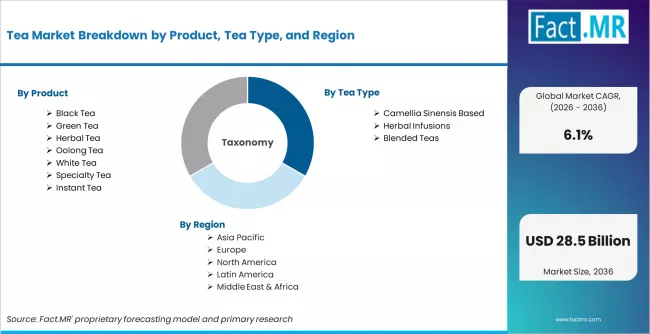
The market is segmented by product, distribution channel, and region. By product, the market is divided into black tea, green tea, oolong tea, herbal tea, and others. Based on distribution channel, the market is categorized into hypermarkets and supermarkets, convenience stores, specialty stores, online, and others. Regionally, the market is divided into Asia Pacific, Europe, North America, Latin America, and Middle East & Africa.
By Product, Which Segment Accounts for the Dominant Market Share?

Black tea represents the dominant force in the tea market, capturing approximately 38.8% of total market share in 2025. This established product category encompasses solutions featuring fully oxidized tea leaves delivering robust flavor profiles, strong caffeine content, and versatile consumption applications, including traditional loose-leaf varieties, convenient tea bags, and ready-to-drink formats that enable widespread adoption and consistent consumption across diverse cultural contexts worldwide.
The black tea segment's market leadership stems from its historical significance, with solutions capable of addressing core consumer needs including morning energy boost, afternoon refreshment, and social beverage occasions while maintaining excellent shelf stability and brewing versatility across different preparation methods.
The green tea segment maintains substantial market presence, serving health-conscious consumers who require antioxidant-rich beverage options with lower oxidation levels and delicate flavor characteristics for wellness-oriented consumption patterns.
These products offer broad-spectrum health benefits for individuals managing weight control and metabolic health while providing sufficient variety to support diverse taste preferences from traditional Japanese sencha to Chinese longjing varieties. The green tea segment demonstrates strong growth potential, driven by expanding awareness of catechin benefits and increasing emphasis on preventive health approaches.
Within the product category, oolong tea demonstrates growing adoption as the fastest-growing segment at 8.2% CAGR, driven by consumer interest in premium specialty teas and appreciation for partially oxidized processing methods delivering complex flavor profiles.
This sub-segment benefits from artisanal positioning and expanding tea culture sophistication among educated consumers. Herbal tea serves caffeine-free preferences and therapeutic applications through botanical blends addressing relaxation, digestion, and immune support needs.
Key product advantages driving the black tea segment include:
- Established cultural acceptance mechanisms with centuries-long consumption traditions across British Commonwealth nations, Middle Eastern markets, and Asian populations
- Versatile preparation capabilities allowing hot brewing, iced tea applications, and ready-to-drink formulations without extensive processing complexity
- Enhanced flavor intensity features enabling milk tea preparations and sweetened variations while maintaining tea character and consumer recognition
- Superior commercial scalability providing optimal production economics and global supply chain availability across various quality grades and price segments
By Distribution Channel, Which Segment Accounts for the Largest Market Share?

Hypermarkets and supermarkets dominate the tea distribution landscape as the market leader in 2025, accounting for a 37.6% share, reflecting the critical role of large-format retail stores in supporting extensive product variety, competitive pricing, and convenient shopping experiences across mainstream consumer populations worldwide.
The hypermarkets and supermarkets segment's market leadership is reinforced by consumer preferences for one-stop shopping convenience, visible product displays enabling informed purchasing decisions, and frequent promotional activities that reduce purchasing costs in regular household grocery routines.
Within this segment, national and international supermarket chains represent the primary format for many retailers, driven by their ability to offer comprehensive tea assortments spanning everyday brands to premium specialty varieties. This sub-segment benefits from established consumer traffic patterns and integration with complete grocery shopping missions.
The online segment represents the fastest-growing distribution category, demonstrating rapid expansion through specialized requirements for premium specialty teas, subscription-based delivery models, and direct-to-consumer brand engagement in digital commerce environments. This segment benefits from younger demographic adoption patterns that prioritize convenience, product information access, and artisanal tea discovery experiences.
The specialty stores segment maintains meaningful presence through curated tea selections and expert guidance, while convenience stores serve immediate consumption needs and impulse purchasing occasions for ready-to-drink formats.
Key market dynamics supporting distribution channel growth include:
- Hypermarket channel expansion driven by private label development and promotional pricing strategies, requiring comprehensive supplier relationships and inventory management
- Online channel modernization trends require seamless e-commerce platforms and subscription commerce capabilities enabling automated replenishment
- Integration of experiential retail concepts enabling tea tasting events and educational programming that enhance customer engagement
- Growing emphasis on omnichannel strategies driving coordinated online-offline shopping experiences without traditional retail format limitations
What are the Drivers, Restraints, and Key Trends of the Tea Market?
The market is driven by three concrete demand factors tied to consumer health outcomes. First, rising health consciousness and shift away from sugary beverages create expanding consumer populations seeking natural drink alternatives, with tea representing a critical healthy beverage option in daily hydration routines addressing wellness goals and antioxidant intake, requiring widespread product availability. Second, growing scientific evidence supporting tea health benefits drives consumer confidence and regular consumption patterns, with numerous studies demonstrating significant advantages in cardiovascular health, metabolic function, and cognitive performance through consistent tea intake by 2030. Third, increasing disposable incomes in emerging markets and expanding middle-class populations enable more premium tea purchasing approaches that improve consumption quality while supporting specialty variety exploration and authentic tea experiences.
Market restraints include competition from coffee and alternative beverages that can challenge tea market share and limit growth potential among younger consumers, particularly in markets where coffee culture dominates and energy drinks attract millennial and Gen Z demographics seeking functional beverage experiences. Climate change impacts on tea cultivation including changing rainfall patterns and temperature variations pose another significant obstacle, as tea production depends on specific agro-climatic conditions and optimal growing environments, potentially affecting crop yields and quality consistency. Commodity price volatility and labor cost increases in tea-producing regions create additional challenges for profitability margins, demanding efficient supply chain management and pricing strategies.
Key trends indicate accelerated premiumization adoption in developed markets, particularly North America and Europe, where consumers demonstrate willingness to pay premium prices for single-origin teas, organic certifications, and artisanal processing methods based on quality appreciation and ethical sourcing values. Ready-to-drink tea innovation trends toward functional ingredient additions and reduced-sugar formulations enable alignment with convenience preferences that optimize on-the-go consumption and wellness positioning. However, the market thesis could face disruption if significant advances in coffee innovation or major shifts in alternative beverage categories reduce reliance on traditional tea consumption patterns for daily beverage intake.
Analysis of the Tea Market by Key Countries

| Country | CAGR (2025 to 2035) |
|---|---|
| India | 8.5% |
| China | 7.8% |
| South Africa | 7.1% |
| USA | 6.3% |
| UK | 5.9% |
| Germany | 5.6% |
| Japan | 4.8% |
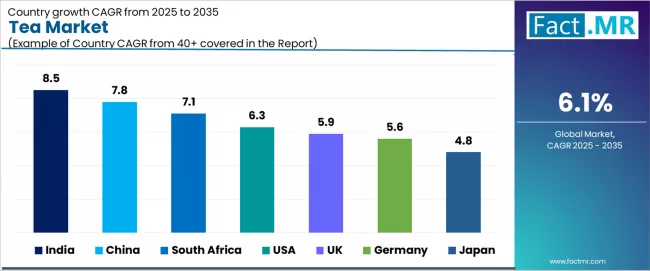
The global tea market is expanding steadily, with India leading at an 8.5% CAGR through 2035, driven by massive domestic consumption growth, expanding modern retail infrastructure, and rising per capita income supporting premium tea adoption. China follows at 7.8%, supported by traditional tea culture evolution, premiumization trends, and growing specialty tea appreciation. South Africa records 7.1%, reflecting expanding rooibos and traditional tea consumption alongside growing middle-class purchasing power.
USA advances at 6.3%, leveraging health-conscious consumer trends and specialty tea market development. UK posts 5.9%, focusing on premium tea varieties and ethical sourcing initiatives, while Germany grows at 5.6%, emphasizing organic tea adoption and herbal variety expansion. Japan demonstrates 4.8% growth, anchored by mature market dynamics and quality-focused consumption patterns.
How is India Leading Global Market Expansion?
India demonstrates the strongest growth potential in the tea market with a CAGR of 8.5% through 2035. The country's leadership position stems from rapidly expanding domestic consumption driven by rising disposable incomes, expanding urban populations, and growing preference for branded packaged tea over loose commodity varieties.
Growth is concentrated in major metropolitan areas and tier-1 cities, including Mumbai, Delhi, Kolkata, and Chennai, where consumers are increasingly purchasing premium tea brands, specialty varieties, and convenient tea bag formats for enhanced consumption experiences beyond traditional loose tea brewing methods.
Distribution channels through modern retail chains, kirana stores, and expanding e-commerce platforms increase product accessibility across urban and semi-urban consumer segments. The country's position as the world's second-largest tea producer provides strong momentum for domestic brand development, including comprehensive market penetration across income segments seeking quality tea products at competitive price points.
Key market factors:
- Massive consumer populations concentrated in urban centers and emerging cities with evolving tea consumption preferences
- Retail modernization through organized chains including Reliance Retail, Big Bazaar, and specialty tea retailers enabling branded product visibility
- Comprehensive tea culture ecosystem, including traditional chai consumption evolving toward premium and health-oriented varieties
- Local brand development featuring companies offering regionally relevant blends and competitive pricing structures for mass market penetration
Why is China Emerging as a High-Growth Market?
In major urban centers including Beijing, Shanghai, Guangzhou, and Chengdu, the adoption of premium tea varieties is accelerating across affluent consumer segments, driven by traditional tea culture revival and growing appreciation for artisanal processing methods. The market demonstrates strong growth momentum with a CAGR of 7.8% through 2035, linked to comprehensive economic development trends and increasing focus on heritage product appreciation.
Chinese consumers are implementing specialty tea purchases and traditional tea ceremony practices to enhance cultural experiences while meeting growing expectations in authentic consumption rituals. The country's expanding middle class creates ongoing demand for single-origin teas and aged varieties, while increasing emphasis on gifting culture drives adoption of premium packaging and limited-edition releases.
Key development areas:
- Urban affluent consumers leading specialty tea adoption with emphasis on authenticity and traditional processing methods
- Distribution expansion through both traditional tea houses and modern specialty retail formats
- E-commerce integration enabling direct relationships between tea gardens and urban consumers through online platforms
- Growing preference for transparent sourcing and origin verification alongside domestic premium brand emergence
What Drives South Africa’s Market Growth?
South Africa’s market expansion is driven by traditional rooibos tea consumption patterns and expanding black tea market penetration across diverse ethnic communities. The country demonstrates solid growth potential with a CAGR of 7.1% through 2035, supported by growing middle-class populations and increasing modern retail infrastructure development.
South African consumers face implementation opportunities related to indigenous tea varieties and export-oriented rooibos positioning, creating unique product differentiation in global markets. The country's rooibos industry creates stable baseline demand for caffeine-free herbal alternatives, particularly among health-conscious consumers and international export markets where unique botanical profiles drive purchasing interest and premium positioning.
Market characteristics:
- Rooibos consumption and production leadership showing robust domestic and export demand across wellness applications
- Regional preferences varying between traditional black tea in urban centers and indigenous herbal varieties in health-focused segments
- Future projections indicate continued export growth with emphasis on organic rooibos certification and sustainability credentials
- Growing emphasis on value-added processing and ready-to-drink formats supporting convenience-oriented consumption
How Does USA Demonstrate Specialty Tea Leadership?

The USA market shows progressive specialty tea segment development based on health consciousness trends and expanding consumer interest in premium loose-leaf varieties for enhanced beverage experiences. The country demonstrates steady potential with a CAGR of 6.3% through 2035, driven by wellness-oriented consumption patterns and quality appreciation in major markets, including New York, Los Angeles, San Francisco, and Seattle.
American consumers are adopting specialty teas through independent tea shops and upscale grocery retailers for comprehensive flavor exploration, particularly in health-conscious populations and professionally educated demographic segments demanding transparency and ethical sourcing credentials. Distribution channels through Whole Foods, specialty tea retailers, and subscription services expand coverage across urban centers and affluent consumer communities.
Leading market segments:
- Health-conscious millennials and Gen Z adoption in major urban centers implementing wellness-driven beverage choices
- Specialty tea shop proliferation with curated selections achieving high customer loyalty and repeat purchasing
- Strategic collaborations between tea importers and sustainability certifications expanding credibility and differentiation
- Focus on ready-to-drink tea innovation and functional ingredient additions addressing convenience and performance nutrition
What Positions UK for Heritage Tea Excellence?
In London, Manchester, Birmingham, and other major cities, consumers are maintaining traditional tea consumption patterns through afternoon tea culture and daily tea breaks, with documented consumption showing substantial per capita intake levels and brand loyalty characteristics. The market shows steady growth potential with a CAGR of 5.9% through 2035, linked to ongoing premiumization initiatives, ethical sourcing emphasis, and emerging specialty tea appreciation in major regions.
Consumers are adopting premium tea brands with fair-trade certifications to enhance ethical consumption while maintaining standards demanded by quality-conscious purchasing preferences. The country's deep-rooted tea culture creates ongoing opportunities for heritage brand reinforcement and specialty variety introduction that differentiate through origin authentication and artisanal processing credentials.
Market development factors:
- Traditional tea consumers maintaining consistent consumption habits across UK population demographics
- Ethical sourcing leadership providing competitive differentiation in premium tea segments
- Strategic partnerships between retailers and certified tea estates expanding transparency and sustainability messaging
- Emphasis on innovation in ready-to-drink formats and functional tea blends addressing contemporary lifestyle needs
How Does Germany Show Organic Tea Leadership?
Germany's tea market demonstrates sophisticated consumer preferences focused on organic certifications and herbal tea variety consumption, with documented adoption of chamomile, peppermint, and fruit-infused herbal blends achieving substantial market share in wellness-oriented beverage categories.
The country maintains steady growth momentum with a CAGR of 5.6% through 2035, driven by established organic food consumption patterns emphasizing natural ingredients and continuous quality verification standards that align with German consumer expectations applied to food and beverage products.
Major metropolitan areas, including Berlin, Munich, Hamburg, and Frankfurt, showcase advanced adoption of certified organic teas where environmental consciousness integrates seamlessly with health-oriented consumption practices and comprehensive sustainability commitments.
Key market characteristics:
- Organic certification preference driving demand for verified sustainable tea production with emphasis on environmental standards
- Herbal tea consumption leadership enabling caffeine-free wellness beverage positioning with therapeutic benefit associations
- Quality partnerships between German retailers and certified organic tea suppliers expanding compliant product availability
- Emphasis on transparent supply chains and fair-trade practices supporting ethical consumption values across consumer base
What Characterizes Japan's Market Maturity?

In major metropolitan centers including Tokyo, Osaka, Kyoto, and Nagoya, the consumption of traditional green tea varieties maintains stable patterns across aging populations, driven by cultural heritage preservation and established daily consumption rituals. The market demonstrates moderate growth potential with a CAGR of 4.8% through 2035, linked to mature market dynamics and demographic aging trends affecting overall consumption volume growth.
Japanese consumers are maintaining traditional tea ceremony practices and purchasing premium matcha products to preserve cultural traditions while adapting to contemporary convenience-oriented formats. The country's emphasis on tea quality excellence creates ongoing demand for premium cultivars and artisanal processing methods, while younger generations explore ready-to-drink formats and flavored tea innovations.
Key development areas:
- Mature consumption patterns with established per capita intake levels across Japanese population
- Premium matcha and sencha categories maintaining quality positioning and ceremonial usage applications
- Innovation in convenient formats including bottled green tea and instant matcha products addressing modern lifestyles
- Cultural preservation initiatives supporting traditional tea production methods and heritage tea garden maintenance
Europe Market Split by Country

The tea market in Europe is projected to grow from USD 4.4 billion in 2025 to USD 8.0 billion by 2035, registering a CAGR of 6.1% over the forecast period. UK is expected to maintain its leadership position with a 31.5% market share in 2025, adjusting to 31.0% by 2035, supported by its deep-rooted tea drinking culture, extensive retail distribution networks, and comprehensive heritage brand presence serving major European consumer markets.
Germany follows with a 24.0% share in 2025, projected to reach 24.5% by 2035, driven by comprehensive organic tea adoption and herbal variety consumption in major urban regions implementing wellness-oriented beverage protocols. France holds a 18.5% share in 2025, expected to maintain 18.8% by 2035 through ongoing development of specialty tea retail channels and premium product positioning.
Italy commands a 12.0% share, while Spain accounts for 9.5% in 2025. The Rest of Europe region is anticipated to gain momentum, expanding its collective share from 4.5% to 4.7% by 2035, attributed to increasing specialty tea adoption in Nordic countries and emerging Eastern European markets implementing modern beverage consumption practices and premium tea appreciation.
Competitive Landscape of the Tea Market

The tea market features approximately 30-40 meaningful players with moderate concentration, where the top three companies control roughly 30-40% of global market share through established brand portfolios, extensive plantation networks, and multi-regional distribution capabilities. Competition centers on brand heritage, quality positioning, and sustainable sourcing rather than price competition alone.
Market leaders include Unilever, R. Twining and Company Limited, and PepsiCo, which maintain competitive advantages through iconic tea brands including Lipton, Twinings, and ready-to-drink tea portfolios, comprehensive global distribution networks, and deep expertise in tea sourcing and blending addressing diverse regional taste preferences, creating high brand recognition among mainstream consumers. These companies leverage extensive marketing programs and ongoing product innovation pipelines to defend market positions while expanding into adjacent categories including functional teas, ready-to-drink formats, and specialty premium segments.
Challengers encompass heritage tea brands including Dilmah Ceylon Tea Company PLC, YORKSHIRE TEA, and Bigelow Tea, which compete through origin authentication, family-owned brand narratives, and quality-focused positioning. Diversified beverage companies, including Starbucks Coffee Company and specialty tea retailers including The Republic of Tea, focus on premium positioning and experiential retail concepts, offering differentiated capabilities in loose-leaf selections, tea education, and curated consumption experiences.
Emerging direct-to-consumer specialty brands and organic tea producers create competitive pressure through innovative subscription models and sustainability positioning, particularly in high-growth markets including USA and Germany, where wellness trends provide advantages in premium product differentiation and ethical sourcing communication.
Market dynamics favor companies that combine authentic sourcing credentials with consumer-centric brand positioning that addresses taste preferences, health benefits, and transparent supply chain practices. Strategic emphasis on traceability systems, certification programs, and sustainable farming partnerships enables differentiation in increasingly competitive beverage segments across developed and emerging consumer markets.
Global Tea Market - Stakeholder Contribution Framework
Tea represents a critical beverage product category that enables consumers to access natural hydration and wellness benefits while maintaining cultural traditions and reducing dependence on sugar-laden beverage alternatives, typically providing targeted health advantages including antioxidant delivery, metabolic support, and mental alertness compared to conventional soft drinks alone while ensuring enjoyable consumption experiences and authentic taste satisfaction.
With the market projected to grow from USD 18.4 billion in 2025 to USD 33.25 billion by 2035 at a 6.1% CAGR, these solutions offer compelling advantages for black tea applications, specialty variety development, and diverse consumer populations seeking natural beverage experiences. Scaling market penetration and sustainable growth requires coordinated action across agricultural policy, quality standards, tea producers, retailers, and consumer education initiatives.
How Could Governments Spur Local Development and Adoption?
- Tea Industry Development Programs: Include tea cultivation in agricultural development strategies, providing targeted support for smallholder farmers and supporting processing infrastructure through development funding and technology transfer initiatives.
- Tax Policy & Investment Support: Implement reduced tax rates for organic and sustainable tea production, provide tax incentives for companies investing in processing facilities and quality certification systems, and establish favorable export duty structures that encourage value-added tea product development over raw commodity exports.
- Quality Standards & Certification: Create standardized quality grading systems for tea products across domestic and export markets, establish clear pesticide residue limits and safety standards for consumer protection, and develop geographic indication protocols that protect origin-based tea varieties and traditional processing methods.
- Market Access & Trade Support: Fund participation in international tea trade events, invest in market development programs connecting tea producers with global buyers, and support certification programs that meet international market requirements for organic and fair-trade standards.
- Research & Extension Support: Establish public research institutions for tea cultivation improvement, support farmer training programs on sustainable agricultural practices and quality enhancement techniques, and create weather monitoring systems that enable climate adaptation strategies for tea-growing regions.
How Could Industry Bodies Support Market Development?
- Quality Standards & Best Practices: Define standardized grading criteria for tea quality assessment across black, green, oolong, and specialty varieties, establish universal processing protocols and safety standards, and create certification frameworks that support quality verification and consumer confidence.
- Sustainability & Ethical Sourcing: Lead initiatives promoting sustainable tea cultivation practices, emphasizing environmental conservation, fair labor standards, and transparent supply chain management compared to conventional production approaches.
- Market Intelligence & Research: Develop comprehensive market data systems tracking consumption trends, pricing dynamics, and emerging opportunities that support strategic decision-making for producers and manufacturers.
- Professional Development: Run certification programs for tea tasters, quality assessors, and retail professionals on tea evaluation methodologies, brewing techniques, and customer education approaches in diverse commercial settings.
How Could Producers and Manufacturers Strengthen the Ecosystem?
- Sustainable Cultivation Practices: Develop advanced agronomic systems with improved soil management, integrated pest control, and water conservation techniques that enhance productivity while reducing environmental impact and ensuring long-term plantation viability.
- Quality Enhancement Programs: Provide comprehensive processing training, modern manufacturing equipment, and quality control systems that support consistent product standards and premium positioning.
- Direct Trade Relationships: Establish transparent supply chain connections between tea gardens and consumers through digital platforms, farm visits, and origin storytelling that build brand authenticity and premium value recognition.
- Innovation & Product Development: Build comprehensive research capabilities for new tea varieties, processing innovations, and functional tea formulations that meet evolving consumer preferences and wellness positioning opportunities.
How Could Retailers and Distributors Navigate the Market?
- Education & Experience Programs: Incorporate tea tasting events, brewing demonstrations, and origin education into retail environments, with particular focus on specialty varieties, preparation methods, and flavor profile development for enhanced consumer engagement.
- Sustainable Sourcing Excellence: Establish comprehensive supplier partnerships addressing certification requirements, fair pricing practices, and transparent supply chain documentation through optimized procurement frameworks and long-term relationships.
- Omnichannel Integration: Implement coordinated online-offline shopping experiences combining e-commerce convenience, subscription services, physical retail discovery, and customer community building that provide comprehensive brand engagement.
- Category Management Systems: Develop optimized product assortments, promotional strategies, and inventory management approaches that balance mainstream volume brands with specialty premium offerings for diverse consumer segments.
How Could Investors and Financial Enablers Unlock Value?
- Sustainable Production Financing: Provide capital for tea estates including organic certification investments, processing facility upgrades, and sustainable farming system implementation supporting quality improvement and environmental stewardship.
- Brand Development Investment: Back specialty tea companies including heritage brands and emerging direct-to-consumer startups developing innovative product concepts, premium positioning, and digital-first customer engagement strategies.
- Infrastructure Expansion Funding: Finance retail network development for specialty tea chains establishing presence in high-growth regions including India and China, supporting localization initiatives while maintaining quality standards and brand authenticity.
- Technology Integration: Support companies developing supply chain traceability platforms, precision agriculture applications, and e-commerce capabilities that enhance operational efficiency and consumer transparency through technology-enabled solutions.
Key Players in the Tea Market
- Unilever
- R. Twining and Company Limited
- Dilmah Ceylon Tea Company PLC
- Bigelow Tea
- PepsiCo
- Yorkshire Tea
- Starbucks Coffee Company
- Caraway Tea
- Harris Freeman
- The Republic of Tea
Scope of the Report
| Items | Values |
|---|---|
| Quantitative Units | USD 18.4 Billion |
| Product | Black Tea, Green Tea, Oolong Tea, Herbal Tea, Others |
| Distribution Channel | Hypermarkets & Supermarkets, Convenience Stores, Specialty Stores, Online, Others |
| Regions Covered | Asia Pacific, Europe, North America, Latin America, Middle East & Africa |
| Country Covered | India, China, USA, UK, Germany, Japan, South Africa, and 40+ countries |
| Key Companies Profiled | Unilever, R. Twining and Company Limited, Dilmah Ceylon Tea Company PLC, Bigelow Tea, PepsiCo, YORKSHIRE TEA, Starbucks Coffee Company, Caraway Tea, Harris Freeman, The Republic of Tea |
| Additional Attributes | Dollar sales by product and distribution channel categories, regional consumption trends across Asia Pacific, Europe, and North America, competitive landscape with tea producers and beverage manufacturers, quality specifications and processing requirements, integration with retail distribution networks and e-commerce platforms, innovations in sustainable cultivation practices and specialty variety development, and advancement of premium positioning strategies with origin authentication and transparent sourcing capabilities. |
Tea Market by Segments
-
Product :
- Black Tea
- Green Tea
- Oolong Tea
- Herbal Tea
- Others
-
Distribution Channel :
- Hypermarkets & Supermarkets
- Convenience Stores
- Specialty Stores
- Online
- Others
-
Region :
- Asia Pacific
- China
- Japan
- South Korea
- India
- Australia
- Thailand
- Rest of Asia Pacific
- Europe
- Germany
- UK
- France
- Italy
- Spain
- Denmark
- Sweden
- Norway
- Rest of Europe
- North America
- USA
- Canada
- Mexico
- Latin America
- Brazil
- Argentina
- Rest of Latin America
- Middle East & Africa
- South Africa
- Saudi Arabia
- UAE
- Kuwait
- Rest of Middle East & Africa
- Asia Pacific
Table of Content
- Executive Summary
- Global Market Outlook
- Demand to side Trends
- Supply to side Trends
- Technology Roadmap Analysis
- Analysis and Recommendations
- Market Overview
- Market Coverage / Taxonomy
- Market Definition / Scope / Limitations
- Market Background
- Market Dynamics
- Drivers
- Restraints
- Opportunity
- Trends
- Scenario Forecast
- Demand in Optimistic Scenario
- Demand in Likely Scenario
- Demand in Conservative Scenario
- Opportunity Map Analysis
- Product Life Cycle Analysis
- Supply Chain Analysis
- Investment Feasibility Matrix
- Value Chain Analysis
- PESTLE and Porter’s Analysis
- Regulatory Landscape
- Regional Parent Market Outlook
- Production and Consumption Statistics
- Import and Export Statistics
- Market Dynamics
- Global Market Analysis 2020 to 2024 and Forecast, 2025 to 2035
- Historical Market Size Value (USD Million) Analysis, 2020 to 2024
- Current and Future Market Size Value (USD Million) Projections, 2025 to 2035
- Y to o to Y Growth Trend Analysis
- Absolute $ Opportunity Analysis
- Global Market Pricing Analysis 2020 to 2024 and Forecast 2025 to 2035
- Global Market Analysis 2020 to 2024 and Forecast 2025 to 2035, By Product
- Introduction / Key Findings
- Historical Market Size Value (USD Million) Analysis By Product, 2020 to 2024
- Current and Future Market Size Value (USD Million) Analysis and Forecast By Product, 2025 to 2035
- Black Tea
- Green Tea
- Oolong Tea
- Herbal Tea
- Others
- Y to o to Y Growth Trend Analysis By Product, 2020 to 2024
- Absolute $ Opportunity Analysis By Product, 2025 to 2035
- Global Market Analysis 2020 to 2024 and Forecast 2025 to 2035, By Distribution Channel
- Introduction / Key Findings
- Historical Market Size Value (USD Million) Analysis By Distribution Channel, 2020 to 2024
- Current and Future Market Size Value (USD Million) Analysis and Forecast By Distribution Channel, 2025 to 2035
- Hypermarkets & Supermarkets
- Convenience Stores
- Specialty Stores
- Online
- Others
- Y to o to Y Growth Trend Analysis By Distribution Channel, 2020 to 2024
- Absolute $ Opportunity Analysis By Distribution Channel, 2025 to 2035
- Global Market Analysis 2020 to 2024 and Forecast 2025 to 2035, By Region
- Introduction
- Historical Market Size Value (USD Million) Analysis By Region, 2020 to 2024
- Current Market Size Value (USD Million) Analysis and Forecast By Region, 2025 to 2035
- North America
- Latin America
- Western Europe
- Eastern Europe
- East Asia
- South Asia and Pacific
- Middle East & Africa
- Market Attractiveness Analysis By Region
- North America Market Analysis 2020 to 2024 and Forecast 2025 to 2035, By Country
- Historical Market Size Value (USD Million) Trend Analysis By Market Taxonomy, 2020 to 2024
- Market Size Value (USD Million) Forecast By Market Taxonomy, 2025 to 2035
- By Country
- USA
- Canada
- Mexico
- By Product
- By Distribution Channel
- By Country
- Market Attractiveness Analysis
- By Country
- By Product
- By Distribution Channel
- Key Takeaways
- Latin America Market Analysis 2020 to 2024 and Forecast 2025 to 2035, By Country
- Historical Market Size Value (USD Million) Trend Analysis By Market Taxonomy, 2020 to 2024
- Market Size Value (USD Million) Forecast By Market Taxonomy, 2025 to 2035
- By Country
- Brazil
- Chile
- Rest of Latin America
- By Product
- By Distribution Channel
- By Country
- Market Attractiveness Analysis
- By Country
- By Product
- By Distribution Channel
- Key Takeaways
- Western Europe Market Analysis 2020 to 2024 and Forecast 2025 to 2035, By Country
- Historical Market Size Value (USD Million) Trend Analysis By Market Taxonomy, 2020 to 2024
- Market Size Value (USD Million) Forecast By Market Taxonomy, 2025 to 2035
- By Country
- Germany
- UK
- Italy
- Spain
- France
- Nordic
- BENELUX
- Rest of Western Europe
- By Product
- By Distribution Channel
- By Country
- Market Attractiveness Analysis
- By Country
- By Product
- By Distribution Channel
- Key Takeaways
- Eastern Europe Market Analysis 2020 to 2024 and Forecast 2025 to 2035, By Country
- Historical Market Size Value (USD Million) Trend Analysis By Market Taxonomy, 2020 to 2024
- Market Size Value (USD Million) Forecast By Market Taxonomy, 2025 to 2035
- By Country
- Russia
- Poland
- Hungary
- Balkan & Baltic
- Rest of Eastern Europe
- By Product
- By Distribution Channel
- By Country
- Market Attractiveness Analysis
- By Country
- By Product
- By Distribution Channel
- Key Takeaways
- East Asia Market Analysis 2020 to 2024 and Forecast 2025 to 2035, By Country
- Historical Market Size Value (USD Million) Trend Analysis By Market Taxonomy, 2020 to 2024
- Market Size Value (USD Million) Forecast By Market Taxonomy, 2025 to 2035
- By Country
- China
- Japan
- South Korea
- By Product
- By Distribution Channel
- By Country
- Market Attractiveness Analysis
- By Country
- By Product
- By Distribution Channel
- Key Takeaways
- South Asia and Pacific Market Analysis 2020 to 2024 and Forecast 2025 to 2035, By Country
- Historical Market Size Value (USD Million) Trend Analysis By Market Taxonomy, 2020 to 2024
- Market Size Value (USD Million) Forecast By Market Taxonomy, 2025 to 2035
- By Country
- India
- ASEAN
- Australia & New Zealand
- Rest of South Asia and Pacific
- By Product
- By Distribution Channel
- By Country
- Market Attractiveness Analysis
- By Country
- By Product
- By Distribution Channel
- Key Takeaways
- Middle East & Africa Market Analysis 2020 to 2024 and Forecast 2025 to 2035, By Country
- Historical Market Size Value (USD Million) Trend Analysis By Market Taxonomy, 2020 to 2024
- Market Size Value (USD Million) Forecast By Market Taxonomy, 2025 to 2035
- By Country
- Kingdom of Saudi Arabia
- Other GCC Countries
- Turkiye
- South Africa
- Other African Union
- Rest of Middle East & Africa
- By Product
- By Distribution Channel
- By Country
- Market Attractiveness Analysis
- By Country
- By Product
- By Distribution Channel
- Key Takeaways
- Key Countries Market Analysis
- USA
- Pricing Analysis
- Market Share Analysis, 2024
- By Product
- By Distribution Channel
- Canada
- Pricing Analysis
- Market Share Analysis, 2024
- By Product
- By Distribution Channel
- Mexico
- Pricing Analysis
- Market Share Analysis, 2024
- By Product
- By Distribution Channel
- Brazil
- Pricing Analysis
- Market Share Analysis, 2024
- By Product
- By Distribution Channel
- Chile
- Pricing Analysis
- Market Share Analysis, 2024
- By Product
- By Distribution Channel
- Germany
- Pricing Analysis
- Market Share Analysis, 2024
- By Product
- By Distribution Channel
- UK
- Pricing Analysis
- Market Share Analysis, 2024
- By Product
- By Distribution Channel
- Italy
- Pricing Analysis
- Market Share Analysis, 2024
- By Product
- By Distribution Channel
- Spain
- Pricing Analysis
- Market Share Analysis, 2024
- By Product
- By Distribution Channel
- France
- Pricing Analysis
- Market Share Analysis, 2024
- By Product
- By Distribution Channel
- India
- Pricing Analysis
- Market Share Analysis, 2024
- By Product
- By Distribution Channel
- ASEAN
- Pricing Analysis
- Market Share Analysis, 2024
- By Product
- By Distribution Channel
- Australia & New Zealand
- Pricing Analysis
- Market Share Analysis, 2024
- By Product
- By Distribution Channel
- China
- Pricing Analysis
- Market Share Analysis, 2024
- By Product
- By Distribution Channel
- Japan
- Pricing Analysis
- Market Share Analysis, 2024
- By Product
- By Distribution Channel
- South Korea
- Pricing Analysis
- Market Share Analysis, 2024
- By Product
- By Distribution Channel
- Russia
- Pricing Analysis
- Market Share Analysis, 2024
- By Product
- By Distribution Channel
- Poland
- Pricing Analysis
- Market Share Analysis, 2024
- By Product
- By Distribution Channel
- Hungary
- Pricing Analysis
- Market Share Analysis, 2024
- By Product
- By Distribution Channel
- Kingdom of Saudi Arabia
- Pricing Analysis
- Market Share Analysis, 2024
- By Product
- By Distribution Channel
- Turkiye
- Pricing Analysis
- Market Share Analysis, 2024
- By Product
- By Distribution Channel
- South Africa
- Pricing Analysis
- Market Share Analysis, 2024
- By Product
- By Distribution Channel
- USA
- Market Structure Analysis
- Competition Dashboard
- Competition Benchmarking
- Market Share Analysis of Top Players
- By Regional
- By Product
- By Distribution Channel
- Competition Analysis
- Competition Deep Dive
- Unilever
- Overview
- Product Portfolio
- Profitability by Market Segments (Product/Age /Sales Channel/Region)
- Sales Footprint
- Strategy Overview
- Marketing Strategy
- Product Strategy
- Channel Strategy
- R. Twining and Company Limited
- Dilmah Ceylon Tea Company PLC
- Bigelow Tea
- PepsiCo
- Yorkshire Tea
- Starbucks Coffee Company
- Caraway Tea
- Harris Freeman
- The Republic of Tea
- Unilever
- Competition Deep Dive
- Assumptions & Acronyms Used
- Research Methodology
List Of Table
- Table 1: Global Market Value (USD Million) Forecast by Region, 2020 to 2035
- Table 2: Global Market Value (USD Million) Forecast by Product, 2020 to 2035
- Table 3: Global Market Value (USD Million) Forecast by Distribution Channel, 2020 to 2035
- Table 4: North America Market Value (USD Million) Forecast by Country, 2020 to 2035
- Table 5: North America Market Value (USD Million) Forecast by Product, 2020 to 2035
- Table 6: North America Market Value (USD Million) Forecast by Distribution Channel, 2020 to 2035
- Table 7: Latin America Market Value (USD Million) Forecast by Country, 2020 to 2035
- Table 8: Latin America Market Value (USD Million) Forecast by Product, 2020 to 2035
- Table 9: Latin America Market Value (USD Million) Forecast by Distribution Channel, 2020 to 2035
- Table 10: Western Europe Market Value (USD Million) Forecast by Country, 2020 to 2035
- Table 11: Western Europe Market Value (USD Million) Forecast by Product, 2020 to 2035
- Table 12: Western Europe Market Value (USD Million) Forecast by Distribution Channel, 2020 to 2035
- Table 13: Eastern Europe Market Value (USD Million) Forecast by Country, 2020 to 2035
- Table 14: Eastern Europe Market Value (USD Million) Forecast by Product, 2020 to 2035
- Table 15: Eastern Europe Market Value (USD Million) Forecast by Distribution Channel, 2020 to 2035
- Table 16: East Asia Market Value (USD Million) Forecast by Country, 2020 to 2035
- Table 17: East Asia Market Value (USD Million) Forecast by Product, 2020 to 2035
- Table 18: East Asia Market Value (USD Million) Forecast by Distribution Channel, 2020 to 2035
- Table 19: South Asia and Pacific Market Value (USD Million) Forecast by Country, 2020 to 2035
- Table 20: South Asia and Pacific Market Value (USD Million) Forecast by Product, 2020 to 2035
- Table 21: South Asia and Pacific Market Value (USD Million) Forecast by Distribution Channel, 2020 to 2035
- Table 22: Middle East & Africa Market Value (USD Million) Forecast by Country, 2020 to 2035
- Table 23: Middle East & Africa Market Value (USD Million) Forecast by Product, 2020 to 2035
- Table 24: Middle East & Africa Market Value (USD Million) Forecast by Distribution Channel, 2020 to 2035
List Of Figures
- Figure 1: Global Market Pricing Analysis
- Figure 2: Global Market Value (USD Million) Forecast 2020 to 2035
- Figure 3: Global Market Value Share and BPS Analysis by Product, 2025 and 2035
- Figure 4: Global Market Y to o to Y Growth Comparison by Product, 2025 to 2035
- Figure 5: Global Market Attractiveness Analysis by Product
- Figure 6: Global Market Value Share and BPS Analysis by Distribution Channel, 2025 and 2035
- Figure 7: Global Market Y to o to Y Growth Comparison by Distribution Channel, 2025 to 2035
- Figure 8: Global Market Attractiveness Analysis by Distribution Channel
- Figure 9: Global Market Value (USD Million) Share and BPS Analysis by Region, 2025 and 2035
- Figure 10: Global Market Y to o to Y Growth Comparison by Region, 2025 to 2035
- Figure 11: Global Market Attractiveness Analysis by Region
- Figure 12: North America Market Incremental Dollar Opportunity, 2025 to 2035
- Figure 13: Latin America Market Incremental Dollar Opportunity, 2025 to 2035
- Figure 14: Western Europe Market Incremental Dollar Opportunity, 2025 to 2035
- Figure 15: Eastern Europe Market Incremental Dollar Opportunity, 2025 to 2035
- Figure 16: East Asia Market Incremental Dollar Opportunity, 2025 to 2035
- Figure 17: South Asia and Pacific Market Incremental Dollar Opportunity, 2025 to 2035
- Figure 18: Middle East & Africa Market Incremental Dollar Opportunity, 2025 to 2035
- Figure 19: North America Market Value Share and BPS Analysis by Country, 2025 and 2035
- Figure 20: North America Market Value Share and BPS Analysis by Product, 2025 and 2035
- Figure 21: North America Market Y to o to Y Growth Comparison by Product, 2025 to 2035
- Figure 22: North America Market Attractiveness Analysis by Product
- Figure 23: North America Market Value Share and BPS Analysis by Distribution Channel, 2025 and 2035
- Figure 24: North America Market Y to o to Y Growth Comparison by Distribution Channel, 2025 to 2035
- Figure 25: North America Market Attractiveness Analysis by Distribution Channel
- Figure 26: Latin America Market Value Share and BPS Analysis by Country, 2025 and 2035
- Figure 27: Latin America Market Value Share and BPS Analysis by Product, 2025 and 2035
- Figure 28: Latin America Market Y to o to Y Growth Comparison by Product, 2025 to 2035
- Figure 29: Latin America Market Attractiveness Analysis by Product
- Figure 30: Latin America Market Value Share and BPS Analysis by Distribution Channel, 2025 and 2035
- Figure 31: Latin America Market Y to o to Y Growth Comparison by Distribution Channel, 2025 to 2035
- Figure 32: Latin America Market Attractiveness Analysis by Distribution Channel
- Figure 33: Western Europe Market Value Share and BPS Analysis by Country, 2025 and 2035
- Figure 34: Western Europe Market Value Share and BPS Analysis by Product, 2025 and 2035
- Figure 35: Western Europe Market Y to o to Y Growth Comparison by Product, 2025 to 2035
- Figure 36: Western Europe Market Attractiveness Analysis by Product
- Figure 37: Western Europe Market Value Share and BPS Analysis by Distribution Channel, 2025 and 2035
- Figure 38: Western Europe Market Y to o to Y Growth Comparison by Distribution Channel, 2025 to 2035
- Figure 39: Western Europe Market Attractiveness Analysis by Distribution Channel
- Figure 40: Eastern Europe Market Value Share and BPS Analysis by Country, 2025 and 2035
- Figure 41: Eastern Europe Market Value Share and BPS Analysis by Product, 2025 and 2035
- Figure 42: Eastern Europe Market Y to o to Y Growth Comparison by Product, 2025 to 2035
- Figure 43: Eastern Europe Market Attractiveness Analysis by Product
- Figure 44: Eastern Europe Market Value Share and BPS Analysis by Distribution Channel, 2025 and 2035
- Figure 45: Eastern Europe Market Y to o to Y Growth Comparison by Distribution Channel, 2025 to 2035
- Figure 46: Eastern Europe Market Attractiveness Analysis by Distribution Channel
- Figure 47: East Asia Market Value Share and BPS Analysis by Country, 2025 and 2035
- Figure 48: East Asia Market Value Share and BPS Analysis by Product, 2025 and 2035
- Figure 49: East Asia Market Y to o to Y Growth Comparison by Product, 2025 to 2035
- Figure 50: East Asia Market Attractiveness Analysis by Product
- Figure 51: East Asia Market Value Share and BPS Analysis by Distribution Channel, 2025 and 2035
- Figure 52: East Asia Market Y to o to Y Growth Comparison by Distribution Channel, 2025 to 2035
- Figure 53: East Asia Market Attractiveness Analysis by Distribution Channel
- Figure 54: South Asia and Pacific Market Value Share and BPS Analysis by Country, 2025 and 2035
- Figure 55: South Asia and Pacific Market Value Share and BPS Analysis by Product, 2025 and 2035
- Figure 56: South Asia and Pacific Market Y to o to Y Growth Comparison by Product, 2025 to 2035
- Figure 57: South Asia and Pacific Market Attractiveness Analysis by Product
- Figure 58: South Asia and Pacific Market Value Share and BPS Analysis by Distribution Channel, 2025 and 2035
- Figure 59: South Asia and Pacific Market Y to o to Y Growth Comparison by Distribution Channel, 2025 to 2035
- Figure 60: South Asia and Pacific Market Attractiveness Analysis by Distribution Channel
- Figure 61: Middle East & Africa Market Value Share and BPS Analysis by Country, 2025 and 2035
- Figure 62: Middle East & Africa Market Value Share and BPS Analysis by Product, 2025 and 2035
- Figure 63: Middle East & Africa Market Y to o to Y Growth Comparison by Product, 2025 to 2035
- Figure 64: Middle East & Africa Market Attractiveness Analysis by Product
- Figure 65: Middle East & Africa Market Value Share and BPS Analysis by Distribution Channel, 2025 and 2035
- Figure 66: Middle East & Africa Market Y to o to Y Growth Comparison by Distribution Channel, 2025 to 2035
- Figure 67: Middle East & Africa Market Attractiveness Analysis by Distribution Channel
- Figure 68: Global Market - Tier Structure Analysis
- Figure 69: Global Market - Company Share Analysis
- FAQs -
How big is the tea market in 2025?
The global tea market is estimated to be valued at USD 18.4 billion in 2025.
What will be the size of tea market in 2035?
The market size for the tea market is projected to reach USD 33.3 billion by 2035.
How much will be the tea market growth between 2025 and 2035?
The tea market is expected to grow at a 6.1% CAGR between 2025 and 2035.
What are the key product types in the tea market?
The key product types in tea market are black tea, green tea, oolong tea, herbal tea and others.
Which distribution channel segment to contribute significant share in the tea market in 2025?
In terms of distribution channel, hypermarkets & supermarkets segment to command 37.6% share in the tea market in 2025.