- Market Value (2025): USD 382.4 Mn
- Estimated Value (2026): USD 403.1 Mn
- Forecast Value (2036): USD 694.4 Mn
- CAGR (2026-2036): 5.4%
What is the Corn Germ Oil Market forecast to be worth by 2036?
USD 403.1 million in 2026 to USD 694.4 million by 2036, at a 5.4% CAGR.
- The market reached USD 382.4million in 2025.
- Demand is projected to increase from USD 403.1 million in 2026 to USD 694.4 million by 2036.
- The market is forecast to record a 5.4% CAGR from 2026 to 2036, creating an absolute opportunity of USD 291.4 million.
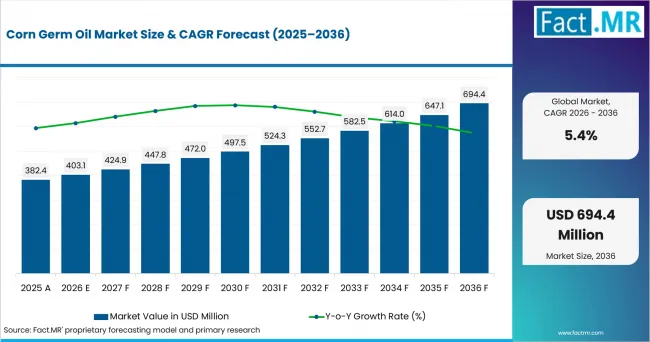
Corn Germ Oil Market Value Analysis | Source: Fact.MR
What are the defining numbers behind Corn Germ Oil Market growth?
USD 291.4 million absolute opportunity is expected between 2026 and 2036.
- Demand Drivers in the Market
- Corn germ oil demand is supported by its role as a neutral edible oil for salad oils, cooking oils, frying fats as well as margarine and prepared foods.
- Bulk procurement remains important because processors and foodservice operators usually buy edible oils by cost, consistency, delivery reliability and performance in heat-intensive applications.
- Retail and online availability broaden consumer access, but the category still competes against more familiar vegetable oils in household kitchens.
- Vegetable-oil price movement, corn processing economics, and refining capacity influence margins more directly than generic consumer preference alone.
- Key Segments Analyzed
- By Type: Bulk Corn Germ Oil is the leading type, accounting for 59.4% share in 2026.
- By Application: Salad or Cooking Oils leads with 29.8% share in 2026.
- Analyst Opinion at Fact.MR
- Buyer decisions in the corn germ oil market are practical. Food manufacturers and foodservice buyers care about dependable bulk supply, clean flavour, fry stability as well as labelling fit and delivered cost. Retail buyers care about whether bottled corn oil earns shelf space against canola, sunflower, soybean blends as well as olive oil and private-label vegetable oils. Suppliers gain preference when they make the use case clear and keep quality consistent across bulk and packaged formats. Nandini Roy, Principal Consultant, Fact.MR.
- Strategic Implications
- Suppliers should separate bulk food-manufacturing demand from bottled retail demand, because the buying criteria are different.
- Processors can strengthen positioning by documenting refining consistency, fatty-acid profile, labelling suitability and delivery reliability.
- Country expansion should follow where foodservice, packaged-food manufacturing, and edible-oil retail channels are growing as well as rather than treating all vegetable-oil demand as interchangeable.
The UK records the highest country CAGR at 6.7%, followed by Australia at 6.5%. The USA and Canada are both projected at 6.1%, while Germany is forecast to expand at 5.2% through 2036.
How does the Corn Germ Oil Market break down by segment?
Bulk Corn Germ Oil leads Type with 59.4% share and Salad or Cooking Oils leads Application with 29.8% share in 2026.
Why does Bulk Corn Germ Oil lead Type?
Bulk Corn Germ Oil is projected to account for 59.4% share in 2026.
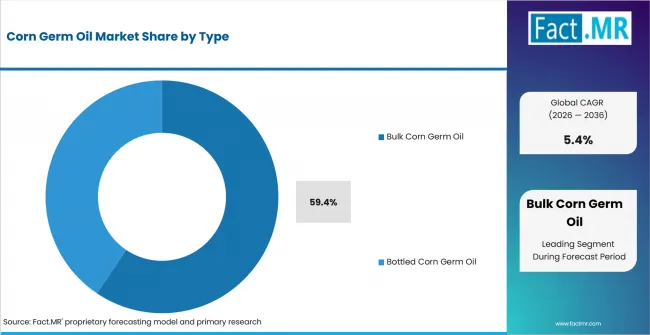
Corn Germ Oil Market Analysis By Type | Source: Fact.MR
Bulk corn germ oil leads because the product is often bought as an ingredient rather than as a premium bottle on a retail shelf. Food manufacturers, commercial kitchens, private-label packers and frying-fat blenders need larger volumes as well as predictable specifications and reliable delivery. Codex defines maize oil, or corn oil, as oil derived from maize germ. This helps distinguish it from generic vegetable-oil blends in trade and formulation. Bulk format therefore fits the strongest buying route: processors and foodservice buyers that turn refined oil into salad oils, frying media, margarineas well as bakery fats and blended edible-oil products.
Why does Salad or Cooking Oils lead Application?
Salad or Cooking Oils is projected to account for 29.8% share in 2026.
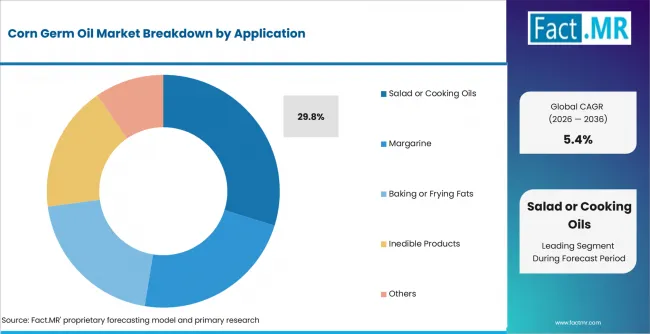
Corn Germ Oil Market Analysis By Application | Source: Fact.MR
Salad and cooking oils lead because they are the most direct route from refined corn germ oil to repeat consumption. Corn germ oil works in household cooking, commercial frying, dressing blends and prepared-food manufacturing where a neutral edible oil is needed. The USDA ERS Food Availability system tracks added fats and oils as part of the U.S. food supply, while the Oil Crops Yearbook follows fats and oils supply, use as well as stocks and prices. Those data points matter because this market moves with edible-oil availability and food-use channels, not only with corn output.
What is accelerating Corn Germ Oil Market adoption, and what is holding it back?
Adoption is supported by the continuing use of vegetable oils in packaged food, foodservice, and household cooking. In contrast, the market remains constrained by price competition and substitution from larger edible-oil categories.
Drivers Impact Analysis
| DRIVER | (~) % IMPACT ON CAGR | GEOGRAPHIC RELEVANCE | IMPACT TIMELINE |
|---|---|---|---|
| Food-use versatility | +1.3% | UK, Australia and USA | Short term (<= 2 years) |
| Bulk purchasing logic | +1.1% | Australia, USA and Canada | Short term (<= 2 years) |
| Vegetable-oil demand base | +0.8% | USA, Canada and Germany | Medium term (2-4 years) |
| Retail optionality | +0.6% | UK, Australia and USA | Medium term (2-4 years) |
Source: Fact.MR analysis. Updated Aug 6, 2026
- Food-use versatility: Corn germ oil can serve cooking, salad-oil, baking as well as frying and blending applications.
- Bulk purchasing logic: Industrial and foodservice buyers can absorb larger volumes when pricing and delivery are reliable.
- Vegetable-oil demand base: OECD-FAO expects food use of vegetable oil to keep increasing, although the pace varies by income level and region.
- Retail optionality: Bottled corn oil can grow where retailers want alternatives to standard vegetable-oil blends.
Opportunity Impact Analysis
| OPPORTUNITY | (~) % IMPACT ON CAGR | GEOGRAPHIC RELEVANCE | IMPACT TIMELINE |
|---|---|---|---|
| End-use positioning | +0.9% | UK, Australia and USA | Medium term (2-4 years) |
| Private-label and foodservice packs | +0.7% | UK, Australia and USA | Medium term (2-4 years) |
| Specification transparency | +0.5% | USA, Canada and Germany | Long term (>= 4 years) |
Source: Fact.MR analysis. Updated Aug 6, 2026
- Suppliers can position corn germ oil around clear end uses such as frying, salad oil, baking fats and food manufacturing.
- Private-label and foodservice packs offer room for growth where cost-controlled edible-oil procurement is important.
- Better specification communication can help buyers distinguish corn germ oil from generic blended vegetable oils.
Restraints Impact Analysis
| RESTRAINT | (~) % IMPACT ON CAGR | GEOGRAPHIC RELEVANCE | IMPACT TIMELINE |
|---|---|---|---|
| Substitute oil competition | -1.0% | UK, Australia and USA | Short term (<= 2 years) |
| Vegetable-oil price volatility | -0.8% | Global sourcing and import-dependent markets | Short term (<= 2 years) |
| Edible-oil standards complexity | -0.6% | Established and price-sensitive markets | Medium term (2-4 years) |
Source: Fact.MR analysis. Updated Aug 6, 2026
- Corn germ oil competes directly with soybean, canola, sunfloweras well as palm and blended vegetable oils as well as many of which have broader retail familiarity.
- Vegetable-oil price swings can compress processor and foodservice margins.
- Country-level labelling, ingredient declaration, and edible-oil standards can slow entry for suppliers that lack documentation.
Which countries are scaling the Corn Germ Oil Market fastest?
Country growth rates differ from the global 5.4% CAGR. The UK, Australia, USA and Canada sit above the global rate. In contrast, Germany sits slightly below it. These rates describe forecast pace; they do not make every country's demand structure identical.
- The UK leads the country set at 6.7% CAGR.
- Australia follows at 6.5% CAGR.
- The USA records 6.1% CAGR.
- Canada also advances at 6.1% CAGR.
- Germany expands at 5.2% CAGR.
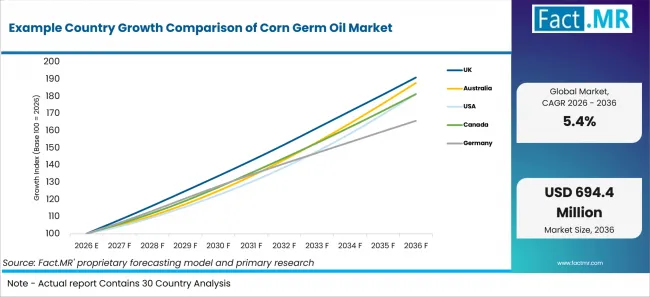
Example Country Growth Comparison Of Corn Germ Oil Market | Source: Fact.MR
| COUNTRY | CAGR, 2026 to 2036 |
|---|---|
| UK | 6.7% |
| Australia | 6.5% |
| USA | 6.1% |
| Canada | 6.1% |
| Germany | 5.2% |
Source: Fact.MR analysis. Updated Aug 6, 2026
What is driving the UK's growth through 2036?
The UK is forecast to record 6.7% CAGR through 2036, making it the fastest-growing listed country. Growth is supported by household and foodservice exposure to edible oils rather than by domestic corn supply. The UK Family Food statistics track purchased quantities and expenditure for household food and eating-out categories, giving an official route to read oils and fats demand alongside meals prepared away from home. For corn germ oil suppliers, the opportunity sits in retail packs, private-label vegetable-oil shelves as well as caterer supply and food-manufacturing uses where buyers want a neutral oil at a controllable price.
What is driving Australia's growth through 2036?
Australia is forecast to grow at 6.5% CAGR through 2036. The local story is channel-led: supermarkets, foodservice, and imported food-processing ingredients do more work than local corn-oil scale. The Australian Bureau of Statistics reported apparent consumption of fats and oils at 20.4 grams per capita per day in 2023-24, confirming that edible oils remain a regular food-use category even when per-capita volume shifts. USDA FAS also notes the importance of imported food-processing ingredients in Australia. That supports growth for corn germ oil where packers and distributors can fit the product into retail oils, restaurant cooking, and processed-food formulation.
What is driving the USA's growth through 2036?
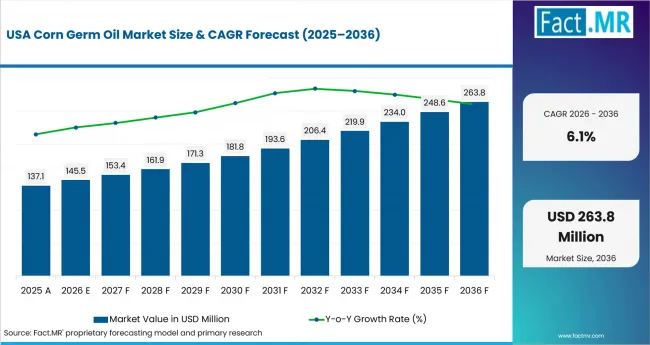
Corn Germ Oil Market Country Value Analysis | Source: Fact.MR
The USA is projected to expand at 6.1% CAGR through 2036. Growth is supported by the country's large corn-processing base and the scale of its edible-oil use. USDA ERS states that the Oil Crops Yearbook covers U.S. and global supply, use, stocks and prices for oil crops as well as fats and oils. In contrast, its Food Availability system tracks added fats and oils moving through the food supply. This matters commercially because corn germ oil can move through multiple routes: salad and cooking oils, foodservice frying, packaged foods as well as margarine as well as baking fats and inedible uses. The USA grows above the global rate because its demand base is broad, not because corn germ oil is the only oil gaining share.
What is driving Canada's growth through 2036?
Canada is forecast to grow at 6.1% CAGR through 2036. Growth is supported by a stable edible-oil processing base and a foodservice channel that uses cooking oils at scale. Statistics Canada states that its Oils and Fats survey measures production of edible vegetable oils and related products, including deodorized oils, packaged margarine as well as shortening as well as salad oils as well as oilseed crushings as well as production and stocks. Foodservice also matters: annual sales of food services and drinking places reached CAD 101.4 billion in 2025, up 5.6% from 2024. Corn germ oil benefits when processors and commercial kitchens need practical cooking-oil options, but substitution from canola and blended vegetable oils remains a real check on faster growth.
What is driving Germany's growth through 2036?
Germany is forecast to expand at 5.2% CAGR through 2036, slightly below the global rate. The market is mature and price-sensitive. Germany has a large food retail and processed-food base, but corn germ oil has to compete with established sunflower, rapeseed as well as olive and blended vegetable oils. Destatis reported that edible fats and oils were still seeing marked price increases in March and May 2025, before later easing in some wholesale categories in 2026. That kind of volatility matters for corn germ oil because buyers can switch oils when the price gap moves. Growth therefore stays steady, but less aggressive than the UK, Australia as well as USA or Canada.
Who leads the Corn Germ Oil Market?
ACH Food Companies is the largest named company in the assessed set, with 8.6% share. Other listed participants are ConAgra Foods, Elburg Global, ADVOC and Savola Group.
Competition is shaped by supply consistency, refining capability, channel access and the ability to serve both bulk and packaged formats. Buyers are likely to compare delivered cost, product specifications, service reliability and suitability for cooking-oil as well as frying-fat as well as bakery and prepared-food applications.
Which companies are the key providers?
Key companies include ACH Food Companies; ConAgra Foods; Elburg Global; ADVOC; Savola Group; Cairo Oil and Soap; Federated Group; Triangulo Alimentos; Saporito Foods; J.M. Smucker; FELDA IFFCO; NutriAsia; Lam Soon; N.K. Proteins; CHS; ADM; Sunora Foods; Henry Lamotte; Yonca Gida; and Cargill.
- ACH Food Companies
- ConAgra Foods
- Elburg Global
- ADVOC
- Savola Group
- Cairo Oil and Soap
- Federated Group
- Triangulo Alimentos
- Saporito Foods
- J.M. Smucker
- FELDA IFFCO
- NutriAsia
- Lam Soon
- N.K. Proteins
- CHS
- ADM
- Sunora Foods
- Henry Lamotte
- Yonca Gida
- Cargill
Bibliography
- Australian Bureau of Statistics. (2025, March 28). Apparent Consumption of Selected Foodstuffs, Australia, 2023-24.
- Australian Bureau of Statistics. (2025, July 31). Retail Trade, Australia, June 2025.
- Codex Alimentarius Commission. (1999, revised 2025). Standard for Named Vegetable Oils, CXS 210-1999.
- Department for Environment, Food & Rural Affairs. (2025). Family food datasets. Government of the United Kingdom.
- Federal Statistical Office of Germany. (2025, April 11). Inflation rate at +2.2% in March 2025. Destatis.
- Federal Statistical Office of Germany. (2025, June 13). Inflation rate at +2.1% in May 2025. Destatis.
- Federal Statistical Office of Germany. (2026, May 13). Wholesale prices in April 2026: +6.3% on April 2025. Destatis.
- Food and Agriculture Organization of the United Nations. (2026). FAO price indices for oilseeds, vegetable oils and oilmeals.
- OECD & Food and Agriculture Organization of the United Nations. (2025). OECD-FAO Agricultural Outlook 2025-2034: Oilseeds and oilseed products.
- Statistics Canada. (2013, January 23). Surveys and statistical programs: Oils and Fats.
- Statistics Canada. (2026, February 25). Food services and drinking places, December 2025.
- U.S. Department of Agriculture, Economic Research Service. (2025, June 26). Food Availability (Per Capita) Data System.
- U.S. Department of Agriculture, Economic Research Service. (2026, March 23). Oil Crops Yearbook.
- U.S. Department of Agriculture, Foreign Agricultural Service. (2025, September 24). Germany: Retail Foods Annual.
- U.S. Department of Agriculture, Foreign Agricultural Service. (2026, March 30). Australia: Food Processing Ingredients Annual.
This Report Answers
- The report provides strategic intelligence on the Corn Germ Oil Market across Type and Application choices that shape edible-oil purchasing and application fit.
- Segment analysis covers Bulk Corn Germ Oil and Salad or Cooking Oils as the share leaders within the 2026 market.
- Country outlook evaluates the UK and Australia alongside the USA and Canada. Germany completes the growth comparison across the profiled markets.
- Competitive analysis profiles ACH Food Companies and ConAgra Foods alongside Elburg Global and ADVOC. Savola Group completes the provider view.
- Application assessment covers Salad or Cooking Oils and Margarine. Baking or Frying Fats plus Inedible Products complete the main use view.
What does the Corn Germ Oil Market cover?
The market covers corn germ oil products and related offerings across the defined type, application, and region categories.
What is included in the scope?
The scope includes bulk and bottled corn germ oil used across salad or cooking oils, margarine, baking or frying fats as well as inedible products and other assessed applications.
What is excluded from the scope?
Products and services outside the defined type, application, and region categories are excluded. Broader corn derivatives, generic vegetable-oil blends without corn-germ-oil relevance, and unrelated industrial oils are outside the assessed scope.
How Was the Analysis Built?
The analysis combines structured desk research, company and product mapping, expert validation. Demand-side checks across major regions.
- Primary Research: Interviews with buyers, suppliers, processors as well as distributors and foodservice specialists test purchasing criteria as well as operating constraints as well as adoption barriers and replacement behavior.
- Desk Research: Public regulatory material, food statistics, trade information as well as company literature and technical publications establish market boundaries and demand context.
- Market Sizing and Forecasting: Demand indicators, channel patterns, application intensity and supplier participation are reconciled across top-down and bottom-up views.
- Data Validation and Update Cycle: Findings are cross-checked across independent evidence routes and reviewed when material market, regulatory, or company changes occur.
Segmentation
What is the report's scope and coverage?
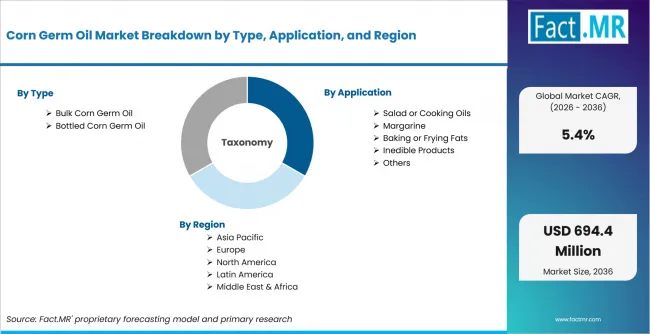
Corn Germ Oil Market Breakdown By Type, Application, And Region | Source: Fact.MR
| Attribute | Details |
|---|---|
| Quantitative Units | USD Million |
| Market Definition | Corn Germ Oil products and related offerings across the assessed categories |
| Type | Bulk Corn Germ Oil; Bottled Corn Germ Oil |
| Application | Salad or Cooking Oils; Margarine; Baking or Frying Fats; Inedible Products; Others |
| Regions Covered | North America; Latin America; Europe; East Asia; South Asia & Oceania; Middle East & Africa |
| Countries Covered | UK; Australia; USA; Canada; Germany |
| Key Companies Profiled | ACH Food Companies; ConAgra Foods; Elburg Global; ADVOC; Savola Group; Cairo Oil and Soap; and others |
| Forecast Period | 2026 to 2036 |
| Approach | Hybrid top-down and bottom-up market assessment |
Source: Fact.MR analysis. Updated Aug 6, 2026
How is the market segmented?
-
By Type:
- Bulk Corn Germ Oil
- Bottled Corn Germ Oil
-
By Application:
- Salad or Cooking Oils
- Margarine
- Baking or Frying Fats
- Inedible Products
- Others
-
By Region:
- North America
- USA
- Canada
- Latin America
- Europe
- Germany
- UK
- East Asia
- South Asia & Oceania
- Australia
- Middle East & Africa
- North America
Frequently Asked Questions
How big is the Corn Germ Oil Market in 2026?
What is the CAGR of the Corn Germ Oil Market from 2026 to 2036?
Which type leads the Corn Germ Oil Market?
How much will the Corn Germ Oil Market add between 2026 and 2036?
Who are the leading companies in the Corn Germ Oil Market?
Who worked on this report


Preview the report firsthand - request a free sample
Free SampleGet the brochure for pricing and purchase details
Download PDF