- Market Value (2025): USD 7.80 Bn
- Estimated Value (2026): USD 7.44 Bn
- Forecast Value (2036): USD 12.50 Bn
- CAGR (2026-2036): 4.8%
How Big Is the Crawler Bulldozer Market in 2026?
The global crawler bulldozer market is valued at USD 7.80 billion in 2026, up from USD 7.44 billion in 2025, and is projected by Fact.MR to reach USD 12.50 billion by 2036, expanding at a 4.8% CAGR from 2026 to 2036 and generating USD 4.70 billion in incremental revenue over the 10-year forecast period.
| Market Metric | Valuation / Share / Forecast Benchmark |
|---|---|
| 2025 Market Size (Historical) | USD 7.44 billion |
| 2026 Market Size (Estimated) | USD 7.80 billion |
| 2036 Market Size (Projected) | USD 12.50 billion |
| CAGR (2026 to 2036) | 4.8% |
| Incremental Dollar Opportunity (2026 to 2036) | USD 4.70 billion (1.60x the 2026 base) |
| Dominant Product Type (2026 share) | Medium crawler bulldozers (100 to 300 hp), 47.6% (about USD 3.71 billion) |
| Leading Application (2026 share) | Construction, 42.3% (about USD 3.30 billion) |
| Leading End User (2026 share) | Contractors, 54.0% (about USD 4.21 billion) |
| Largest Country Markets (2026 share) | United States 20.0%, Japan 8.0%, Germany 5.0% |
| Fastest-Growing Countries (CAGR, 2026 to 2036) | Germany 5.9%, United Kingdom 5.5%, United States 5.1% |
| Leading Tier-1 Companies | Caterpillar, Komatsu, Liebherr, Deere & Company, CASE Construction Equipment, Shantui |
Source: Fact.MR analysis. Updated Nov 13, 2026
Source: Fact.MR analysis of the crawler bulldozer market, 2026.
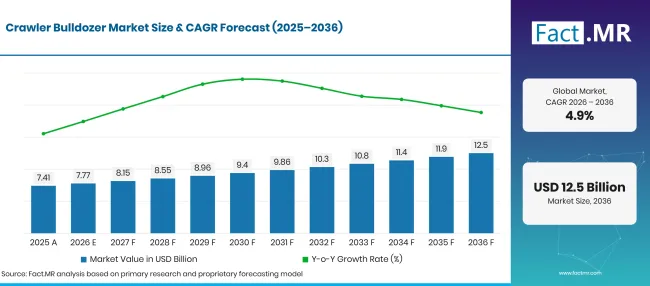
Crawler Bulldozer Market Forecast Global | Source: Fact.MR
Executive Market Overview
Demand for crawler bulldozers is anchored in road building, mine-site development and large site preparation, where tracked machines keep traction on soft or uneven ground while pushing, spreading and grading material. Construction holds 42.3% of 2026 revenue, and contractors account for 54.0% of purchases, because almost every highway, housing estate, logistics park and utility corridor starts with clearing and cut-and-fill work. Mining is the second pillar, using large dozers for overburden removal, stockpile management and haul-road upkeep. The United States (20.0%), Japan (8.0%) and Germany (5.0%) are the largest named markets. Mining and road programmes in China, India, Southeast Asia, Australia, the Middle East and Africa generate most of the 60.0% earned outside the five named countries, where price-sensitive buyers often choose mid-size machines from Chinese makers.
Growth in crawler bulldozer sales is uneven across countries. Germany (5.9% CAGR), the United Kingdom (5.5%) and the United States (5.1%) outpace the global 4.8% on the back of multi-year road and rail budgets, while Brazil (4.2%) and Japan (3.6%) trail. High list prices and undercarriage costs keep many smaller contractors renting or buying used, which holds back unit growth. Electric-drive powertrains, factory-fitted machine control and retrofit grade control are lifting spending per machine instead, since one operator can move more material in fewer passes and with less fuel. Revenue therefore rises faster than the number of dozers delivered, and the premium end of each size class gains share. Fact.MR sizes the market to include new small, medium and large crawler dozers sold for construction, mining, agriculture and forestry, while excluding wheel dozers, crawler loaders, excavators, motor graders and used or rented machines.
Analyst Perspective
"Crawler bulldozer revenue will grow faster than unit sales, because contractors and miners are paying for electric drive and machine control that cut fuel per cubic metre and reduce reliance on scarce senior operators. The main risk is a softer construction cycle, with US construction spending falling in September 2026, which could push more buyers towards rental fleets and used machines.
" Shambhu Nath Jha, Principal Consultant, Fact.MR
Source: Fact.MR analysis. Updated Nov 13, 2026
Major Market Trends and Insights
- Electric Drive Moves Into Large Production Dozers: Adoption of electric-drive dozers is widening from mid-size models into mining classes as owners look for lower fuel use per tonne moved. Caterpillar (September 2026) introduced the D11 XE with up to 25% less fuel per unit of material moved and 5% to 10% more material moved per hour than the next-generation D11. Caterpillar (March 2026) also launched the 348 hp D8 XE, which used up to 10% less fuel and moved up to 6% more material than the standard D8 in company tests, with sales starting in North America, Europe, Japan, Australia and New Zealand in the second half of 2026. Fewer moving parts than a torque-converter drivetrain also promise lower rebuild costs over the machine's life.
- Integrated Machine Control Becomes Standard in Mid-Size Dozers: Uptake of factory-fitted grade control is spreading because accurate first-pass grading saves rework, survey stakes and fuel. Komatsu (March 2026) previewed the 201 hp D61PXi-25 with intelligent Machine Control 3.0 at CONEXPO-CON/AGG 2026, claiming up to 10% higher productivity and fuel efficiency. CASE Construction Equipment (March 2026) previewed its 650N, 750N and 850N small dozers for a late-2026 launch, making electro-hydraulic blade control standard across its whole dozer line and offering integrated machine control as a factory option. Once controls are built in at the factory, buyers pay for the technology as part of the machine price, which lifts average selling prices in the mid-size class.
- Retrofit Grade Control Opens Up Machines Already in Service: Interest in retrofit 3D guidance is growing because owners rarely want to retire a dozer with years of life left, and capital budgets are tight. Liebherr (October 2025) made its PR 716 to PR 756 Generation 8 dozers compatible with Unicontrol 3D machine control through Liebherr Unicontrol Easy Link, available on new machines and as a retrofit. Unicontrol, founded in 2019 in Odense, Denmark, sells mainly in Europe, North America and Australia. Open interfaces like this widen the addressable base for the machine control systems market and give owners of mixed fleets a cheaper route to automated grading than replacing machines.
What Are the Main Drivers, Restraints, and Opportunities?
Crawler bulldozer demand rests on public road and infrastructure budgets, mining activity and the replacement of ageing fleets. High ownership costs and a slower construction cycle hold back new purchases, while fuel-saving, automated machines are the main premium opportunity.
Driver: Public Road and Infrastructure Budgets
Spending on public roads and infrastructure keeps earthmoving fleets busy and gives contractors the confidence to renew machines.
The Department for Transport (March 2026) committed GBP 27 billion to England's motorways and major A-roads under the third Road Investment Strategy for April 2026 to March 2031, including a record GBP 8.4 billion for renewals, with 15 large renewal schemes and 27 enhancement schemes planned. Railway Pro (July 2026) reports that Germany is investing about EUR 33.7 billion in transport infrastructure in 2026, backed by the EUR 500 billion special fund described by the Federal Ministry of Finance (July 2025). Nearly every one of these projects begins with clearing, cut-and-fill and embankment work, which is where crawler dozers earn their keep, so multi-year budgets translate directly into machine hours and replacement orders.
Restraint: High Ownership Costs and a Softer Construction Cycle
Ownership costs for crawler bulldozers are high and hard to justify when a machine sits idle between jobs.
Undercarriage wear on track chains, rollers and sprockets is the largest maintenance item, followed by engine servicing, fuel and the cost of hauling a dozer between sites. The US Census Bureau (November 2026) reported that construction spending fell 1.9% in September 2026 to a seasonally adjusted annual rate of USD 2,186.1 billion, with private construction at USD 1,639.3 billion. When order books thin, smaller contractors turn to the construction equipment rental market or to used machines, and dealers report longer decision times on new units. This cyclical caution is the main reason unit growth lags revenue growth.
Opportunity: Fuel-Saving and Automated Machines for Productivity Buyers
Purchases of fuel-saving, automated dozers are rising among contractors and miners that measure cost per cubic metre rather than list price.
Caterpillar (September 2026) positions the D11 XE on lower fuel use and higher hourly output, and Komatsu (March 2026) offers the D175AX-10 at 450 hp, 26% more power than the D155AX-8, for production dozing in North America from 2026. Liebherr (March 2026) has extended its hydrostatic Generation 8 range up to the 768 hp PR 776 for mining. Suppliers that pair these machines with telematics, remote diagnostics and dealer service contracts can sell on lifetime operating cost and capture recurring revenue alongside the initial sale.
How Is the Crawler Bulldozer Market Segmented?
Fact.MR segments crawler bulldozers by product type (engine power), application, end user and country, valuing every segment in USD at the point of first sale.
Table 2:Global Crawler Bulldozer Market Segmentation Architecture and Forecast Benchmarks
| Segmentation Axis | Sub-Segments Covered | 2026 Leading Segment & Share | Main Growth Benchmark (2026 to 2036) |
|---|---|---|---|
| Product Type | Small (under 100 hp), medium (100 to 300 hp), large (above 300 hp) | Medium, 47.6% (USD 3.71 billion) | Global market 4.8% CAGR, USD 7.80 billion to USD 12.50 billion |
| Application | Construction, mining, agriculture, forestry, others | Construction, 42.3% (USD 3.30 billion) | USD 4.70 billion added across all applications |
| End User | Contractors, rental companies, others | Contractors, 54.0% (USD 4.21 billion) | Global market grows 1.60x by 2036 |
| Region / Country | North America, Latin America, Europe, East Asia, South Asia and Pacific, Middle East and Africa | United States, 20.0% (USD 1.56 billion) | Germany fastest at 5.9% CAGR; Japan slowest named country at 3.6% |
Source: Fact.MR analysis. Updated Nov 13, 2026
Source: Fact.MR analysis of the crawler bulldozer market, 2026.
Why Does the Medium Segment Lead by Product Type?
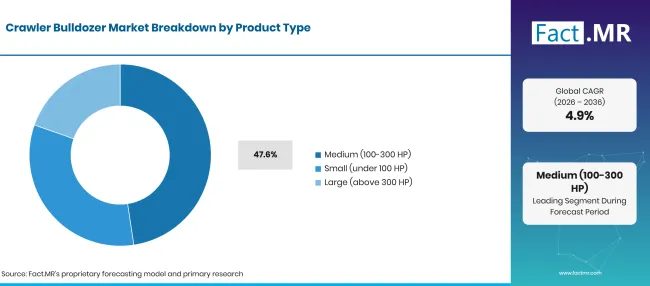
Crawler Bulldozer Market Breakdown Product Type | Source: Fact.MR
Sales of medium crawler bulldozers of 100 to 300 hp account for 47.6% of 2026 revenue, about USD 3.71 billion. Their pushing power suits road formation, site preparation and general grading without the purchase and running costs of mining-class machines, so they fill most contractor fleets. Komatsu (March 2026) chose this class for its redesigned D61PXi-25 with intelligent machine control, and Deere & Company (accessed November 2026) offers seven P-Tier models from the 450 to the 1050 to cover it. Equipment World (accessed November 2026) reports, citing EDA data, that buyers financed more than 3,200 crawler dozers in the year to July 2026, with CASE's 850M the brand's most popular financed model. Factory-fitted grade control is concentrating new spending in this class, while large dozers remain tied to mining cycles.
Why Does the Construction Segment Lead by Application?
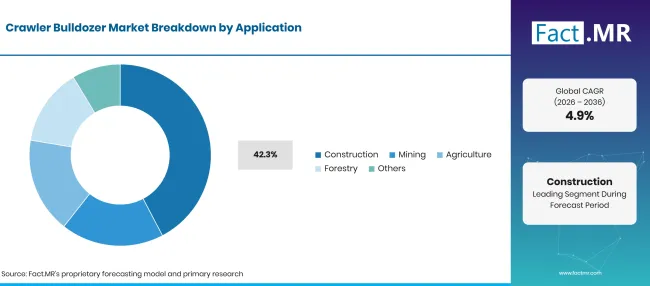
Crawler Bulldozer Market Breakdown Application | Source: Fact.MR
Use of crawler bulldozers in construction accounts for 42.3% of 2026 revenue, about USD 3.30 billion. Roads, housing estates, factories and utilities all start with land clearing, soil spreading and embankment preparation, which tracked machines handle on ground where wheeled equipment slips. The Ministry of Finance of Japan (May 2026) set FY2026 public works spending at JPY 6.1078 trillion, and similar budgets in Europe and North America keep construction fleets working. Grading accuracy matters most in this application, which is why machine control is spreading fastest here. Mining is the second application and buys most large dozers, while agriculture and forestry use smaller machines for land clearing and track building.
Why Does the Contractor Segment Lead by End User?
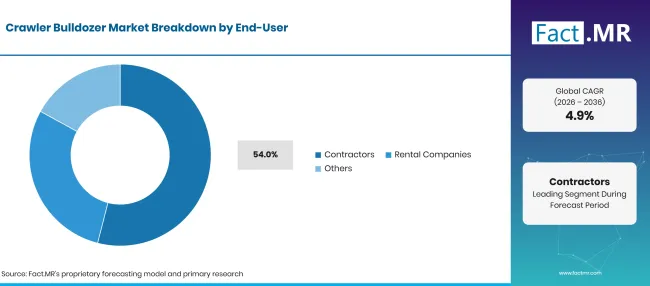
Crawler Bulldozer Market Breakdown End User | Source: Fact.MR
Purchases by contractors account for 54.0% of 2026 revenue, about USD 4.21 billion. Their work moves between road jobs, land development and building sites with very different soils, so they need flexible machines and prefer to own their core fleet. Rental companies cover short or seasonal demand and are the second-largest buyer group, often ordering standard mid-size specifications in volume. Retrofit grade control from Liebherr (October 2025) and Unicontrol lets contractors upgrade machines they already own, which supports spending even when new orders slow. Contractors also weigh dealer support heavily, because a stalled dozer can hold up an entire earthworks package.
Crawler Bulldozer Market by Region and Country (2026 to 2036)
Revenue from crawler bulldozers is concentrated in the United States, Japan, Germany, Brazil and the United Kingdom, which together account for 40.0% of 2026 revenue (USD 3.12 billion), edging up to 40.1% by 2036. The United States is by far the largest named market, Germany gains the most share on the strength of its infrastructure fund, and Japan loses the most as spending shifts towards maintenance rather than new earthworks.
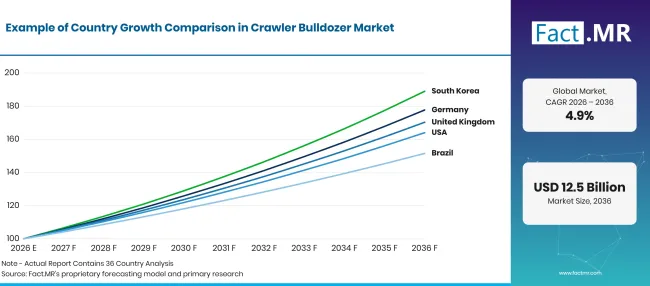
Crawler Bulldozer Market Growth Index | Source: Fact.MR
Table 3: Crawler Bulldozer Market Size, 10-Year Revenue Addition, Global Share, and CAGR by Country (2026 to 2036)
| Country | 2026 Revenue | 2036 Revenue | 10-Year Addition | 2026 to 2036 CAGR | Global Share (2026 → 2036) |
|---|---|---|---|---|---|
| United States | USD 1,560.0 million | USD 2,565.4 million | USD 1,005.4 million | 5.1% | 20.0% → 20.5% |
| Japan | USD 624.0 million | USD 888.8 million | USD 264.8 million | 3.6% | 8.0% → 7.1% |
| Germany | USD 390.0 million | USD 691.9 million | USD 301.9 million | 5.9% | 5.0% → 5.5% |
| Brazil | USD 312.0 million | USD 470.8 million | USD 158.8 million | 4.2% | 4.0% → 3.8% |
| United Kingdom | USD 234.0 million | USD 399.7 million | USD 165.7 million | 5.5% | 3.0% → 3.2% |
| Rest of world | USD 4,680.0 million | USD 7,483.4 million | USD 2,803.4 million | 4.8% | 60.0% → 59.9% |
| Global total | USD 7,800.0 million | USD 12,500.0 million | USD 4,700.0 million | 4.8% | 100.0% → 100.0% |
Source: Fact.MR analysis. Updated Nov 13, 2026
Source: Fact.MR analysis of the crawler bulldozer market, 2026.
United States
Sales of crawler bulldozers in the United States are projected to rise from USD 1,560.0 million in 2026 to USD 2,565.4 million by 2036 at a 5.1% CAGR, adding USD 1,005.4 million (1.64x) and lifting the US share from 20.0% to 20.5%. Highway work, commercial sites, energy projects and surface mining keep fleets busy. The US Census Bureau (November 2026) put September 2026 construction spending at USD 2,186.1 billion, including USD 546.8 billion of public construction, which steadies demand even as private building softens. The CONEXPO-CON/AGG launches by Komatsu, CASE and Caterpillar were aimed first at this market, and rental fleets in the country are large buyers of standard mid-size machines.
Japan
Demand for crawler bulldozers in Japan is expected to move from USD 624.0 million in 2026 to USD 888.8 million by 2036 at a 3.6% CAGR, the slowest of the named countries. That adds USD 264.8 million (1.42x), while its share slips from 8.0% to 7.1%. Spending centres on disaster resilience, embankment repair and infrastructure maintenance rather than new greenfield sites. The Ministry of Finance of Japan (May 2026) raised FY2026 public works spending by JPY 22 billion to JPY 6.1078 trillion, partly to absorb higher labour and material costs, which limits real volume growth. Domestic makers such as Komatsu dominate, and compact and mid-size machines suit Japan's narrow sites.
Germany
German crawler bulldozer revenue leads growth among the named countries, climbing from USD 390.0 million in 2026 to USD 691.9 million by 2036 at a 5.9% CAGR. The USD 301.9 million addition (1.77x) raises Germany's share from 5.0% to 5.5%. The Federal Ministry of Finance (July 2025) set record federal investment of EUR 126.7 billion for 2026, backed by the EUR 500 billion special fund for infrastructure, and Railway Pro (July 2026) reports about EUR 33.7 billion for transport infrastructure this year. Rail, road and bridge renewal create steady earthmoving work, and German contractors already use machine control widely, which favours premium machines from Liebherr, Caterpillar and Komatsu.
Brazil
Adoption of crawler bulldozers in Brazil is projected to lift revenue from USD 312.0 million in 2026 to USD 470.8 million by 2036 at a 4.2% CAGR, adding USD 158.8 million (1.51x), though its share eases from 4.0% to 3.8%. Demand comes from federal highway works, iron ore and other mining, and agricultural land clearing in the Centre-West. Jornal do Brasil (September 2026), reporting the 2027 budget bill, said federal investment is set to rise 20.8% to BRL 133.8 billion from BRL 110.8 billion in 2026, with BRL 61.5 billion for the Novo PAC programme. High interest rates still push many buyers towards rental and used machines, which keeps growth below the global rate.
United Kingdom
UK crawler bulldozer revenue is expected to expand from USD 234.0 million in 2026 to USD 399.7 million by 2036 at a 5.5% CAGR, adding USD 165.7 million (1.71x) and lifting its share from 3.0% to 3.2%. The Department for Transport (March 2026) confirmed GBP 27 billion for the strategic road network over five years, with 15 large renewal schemes and 27 enhancement schemes planned. Civil engineering contractors favour mid-size dozers with machine control for embankment and earthworks packages on these schemes. Plant hire firms supply a large share of machines, so rental fleet renewal is a key channel for new sales.
Rest of World
Outside the five named countries, crawler bulldozer sales are projected to grow from USD 4,680.0 million in 2026 to USD 7,483.4 million by 2036 at a 4.8% CAGR, adding USD 2,803.4 million (1.60x) with the share almost flat at 60.0% to 59.9%. China, India, Southeast Asia, Australia, the Middle East and Africa make up most of this demand through road corridors, new cities and open-pit mining. Buyers in these markets are price-sensitive, which favours Chinese makers such as Shantui alongside the global majors, while Australian and African mines buy the largest machines. Demand here is closely linked to the wider mining equipment market.
Competitive Environment and Notable Companies
The crawler bulldozer supply base is led by Caterpillar, Komatsu and Liebherr, which form the Tier-1 group across small to mining-class dozers, joined by Deere & Company and CASE Construction Equipment in small and mid-size machines. Tier-2 is led by Chinese makers such as Shantui, which compete on price and breadth of range, along with regional assemblers in India and elsewhere. Grade-control suppliers such as Unicontrol work alongside the machine makers, and some dealers sell machines with third-party guidance fitted before delivery. Dealers and rental firms often decide which brand reaches a contractor, so channel strength matters as much as machine design.
How Are Companies Positioned in the Crawler Bulldozer Market?
Competition among crawler bulldozer makers falls into three positions. Caterpillar, Komatsu and Liebherr cover the full size range and compete hardest in large production and mining dozers, where uptime and fuel use per tonne decide the sale. Deere & Company and CASE focus on contractor grading machines with integrated controls and easy operation for less experienced drivers. Shantui offers a wide power range, including low-ground-pressure and electric models such as the DE26-X3, according to Shantui (accessed November 2026), at lower prices for emerging markets.
What Matters When a Buyer Selects a Crawler Bulldozer Supplier?
Buyers of crawler bulldozers start with fit for the job, meaning operating weight, blade capacity and ground pressure for the soils on site. They then weigh fuel use, undercarriage life, parts availability, dealer response time and resale value, since a dozer often changes hands two or three times in its life. Contractors also look at how easily a new operator can grade to tolerance, because skilled operators are scarce and machine control can close the gap. Mining buyers add remote operation and component-life guarantees to the list.
Which Capabilities Distinguish Product Offers?
Product offers in crawler bulldozers are now separated by powertrain and control technology. Caterpillar (September 2026) uses electric drive in the D8 XE and D11 XE, Komatsu (March 2026) builds intelligent machine control into the D61PXi-25, and Liebherr (March 2026) offers hydrostatic drive across its Generation 8 range up to the 768 hp PR 776, which weighs up to 73,189 kg. CASE Construction Equipment (accessed November 2026) offers the 214 hp 2050M with hydrostatic drive and grade-control compatibility, while its new N Series makes electro-hydraulic blade control standard across its dozer line. Telematics and remote diagnostics are becoming standard on all premium machines.
How Does Geographic Reach Affect Competition?
Dealer reach shapes crawler bulldozer sales, because buyers judge how fast parts and a trained technician can reach the site, and the size of the service network often decides the deal. Caterpillar, Komatsu and Liebherr rely on long-established global dealer networks, while Shantui sells through regional distributors in Asia, Africa and Latin America. Liebherr builds its dozers in Telfs, Austria, and ships worldwide, while Caterpillar and Komatsu produce in several regions. Strong local service also helps makers win repeat orders from rental firms that run large, standardised fleets.
Table 4: Crawler Bulldozer Market Company Developments and Commercial Implications (2026)
| Verified Company Evidence (2026) | Commercial Effect | Buyer Action |
|---|---|---|
| 2 March 2026: Liebherr completed full availability of its Generation 8 crawler dozer range, from the PR 716 to the PR 776 (Liebherr, March 2026). | Gives buyers a single hydrostatic-drive family from small to mining-class machines. | Compare Generation 8 fuel use, remote-control options and dealer cover against rival ranges. |
| 3 March 2026: Komatsu previewed the D61PXi-25 with intelligent Machine Control 3.0 and the 450 hp D175AX-10 at CONEXPO-CON/AGG 2026 (Komatsu, March 2026). | Pushes integrated grade control into mid-size dozers and adds a large production dozer for North America. | Test first-pass grading accuracy and hourly output on the buyer's own sites before ordering. |
| 3 March 2026: CASE previewed its 650N, 750N and 850N small dozers for a late-2026 launch, with 74, 96 and 120 hp engines (CASE Construction Equipment, March 2026). | Refreshes the small-dozer class used on utility, residential and site-preparation work. | Check machine control options and cab features against current fleet models. |
| 9 September 2026: Caterpillar introduced the D11 XE electric-drive dozer, with up to 25% less fuel per unit of material moved (Caterpillar, September 2026). | Extends electric drive into the largest mining dozers and shifts the sale towards lifetime operating cost. | Model fuel savings, component life and service intervals before replacing large dozers. |
Source: Fact.MR analysis. Updated Nov 13, 2026
Source: Verified corporate disclosures and Fact.MR analysis, 2026.
Table 5: Crawler Bulldozer Market Representative Company Overview
| Company | Core Positioning | Verified Activity & Source Attribution |
|---|---|---|
| Caterpillar (Tier-1) | Full range of small, medium and large dozers, including electric drive | Introduced the D11 XE with up to 25% less fuel per unit of material moved (Caterpillar, September 2026). |
| Komatsu (Tier-1) | Construction and mining dozers with intelligent machine control | Previewed the D61PXi-25 and D175AX-10 at CONEXPO-CON/AGG 2026 (Komatsu, March 2026). |
| Liebherr (Tier-1) | Hydrostatic-drive Generation 8 dozers from PR 716 to PR 776 | Completed Generation 8 availability and opened the range to Unicontrol retrofit grade control (Liebherr, March 2026; Liebherr, October 2025). |
| Deere & Company (Tier-1) | Small to large P-Tier and X-Tier dozers for roadbuilding and site work | Dozer line-up runs from the 450 P-Tier to the 1050 P-Tier (Deere & Company, accessed November 2026). |
| CASE Construction Equipment (Tier-1) | Contractor dozers with machine control compatibility | Previewed the 650N, 750N and 850N for late 2026, and offers the 214 hp 2050M with hydrostatic drive (CASE Construction Equipment, March 2026; CASE Construction Equipment, accessed November 2026). |
| Shantui (Tier-2) | Chinese maker of small to high-power and electric dozers | Offers the DE26-X3 electric dozer alongside SD-series machines (Shantui, accessed November 2026). |
| Unicontrol (adjacent supplier) | 2D and 3D machine control for dozers and excavators | Integrated with Liebherr Generation 8 dozers through Liebherr Unicontrol Easy Link (Liebherr, October 2025). |
Source: Fact.MR analysis. Updated Nov 13, 2026
Research Sources and Bibliography
- CASE Construction Equipment. (Accessed 2026, November 12). 2050M crawler dozer.
- CASE Construction Equipment. (2026, March 24). Case previews new N Series dozers with operator-first performance upgrades (company release via Construction Equipment Guide).
- Caterpillar. (2026, March 1). Caterpillar expands Next Generation dozer Electric Drive lineup with introduction of the Cat D8 XE
- Caterpillar. (2026, September 9). New Cat D11 XE electric drive dozer delivers more productivity and lower operating costs
- Deere & Company. (Accessed 2026, November 12). Dozers
- Department for Transport. (2026, March 26). Road Investment Strategy 3 (RIS3): 2026 to 2031
- Equipment World. (Accessed 2026, November 12). Closer look: Case's smallest next-gen N Series dozers get big upgrades
- Federal Ministry of Finance. (2025, July 30). German government intensifies its investment drive: 2026 federal budget and fiscal plan to 2029 adopted.
- Jornal do Brasil. (2026, September 1). Orçamento de 2027 prevê R$ 133,8 bilhões em investimentos públicos (Agência Brasil).
- Komatsu. (2026, March 3). Komatsu pushes into CONEXPO-CON/AGG 2026 with an exclusive first look at two next-generation dozers
- Liebherr. (2025, October 15). Liebherr expands digital integration with Unicontrol on G8 crawler dozer
- Liebherr. (2026, March 2). Liebherr completes full availability of Generation 8 line-up of crawler dozers.
- Ministry of Finance of Japan. (2026, May).(FY2026 MLIT and public works budget)
- Railway Pro. (2026, July 24). Germany's rail infrastructure hits a new investment record.
- Shantui. (Accessed 2026, November 12). DE26-X3 electric bulldozer.
- US Census Bureau. (2026, November 2). Monthly construction spending, September 2026
Segmentation
Crawler Bulldozer Market Report Scope and Research Methodology
Fact.MR builds the crawler bulldozer estimate from unit shipments by power class in each country, multiplied by average selling prices for small, medium and large machines. Shipment assumptions are tested against public infrastructure budgets, construction spending data, mining activity and manufacturer product and launch disclosures. Country revenue is counted where the machine is first sold. The five named countries are modelled individually, and all other countries form the rest-of-world residual.
Table 6: Crawler Bulldozer Market Report Scope
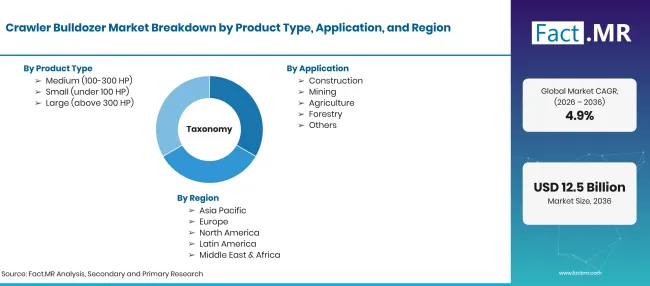
Crawler Bulldozer Market Taxonomy | Source: Fact.MR
| Coverage Field | Report Scope |
|---|---|
| Market definition | New tracked earthmoving machines with a front-mounted blade for pushing, spreading and grading soil, rock and other material |
| Product types | Small (under 100 hp), medium (100 to 300 hp) and large (above 300 hp) crawler bulldozers |
| Variants | Standard, low-ground-pressure, mining, hydrostatic-drive and electric-drive dozers |
| Ingredients included | Engine, powertrain, undercarriage, blade, ripper, cab and factory-fitted machine control |
| Packaging formats | Complete machines delivered by road or sea, with optional factory or dealer-fitted guidance kits |
| Distribution channels | Authorised dealers, direct OEM sales and sales to rental fleets |
| End users | Contractors, rental companies, mining operators, agricultural and forestry users and others |
| Exclusions | Wheel dozers, crawler loaders, excavators, motor graders, used machines, rental revenue and standalone attachments |
| Quantitative units | USD million and USD billion for value; percentage for share and CAGR |
| Volume basis | Units of new crawler bulldozers sold, counted once at first sale |
| Value basis | Manufacturer and dealer selling price in the country of first sale, constant 2026 USD |
| Regions covered | North America, Latin America, Europe, East Asia, South Asia and Pacific, Middle East and Africa |
| National coverage | United States, Japan, Germany, Brazil, United Kingdom, with the rest of the world as a residual |
| Companies covered | Caterpillar, Komatsu, Liebherr, Deere & Company, CASE Construction Equipment, Shantui, Unicontrol |
Source: Fact.MR analysis. Updated Nov 13, 2026
Frequently Asked Questions
How big is the crawler bulldozer market in 2026?
How fast is the crawler bulldozer market expected to grow through 2036?
Which product type leads the crawler bulldozer market?
Which application leads the crawler bulldozer market?
Which end user leads the crawler bulldozer market?
Which country is the largest crawler bulldozer market?
Which country is expected to grow fastest in the crawler bulldozer market?
What limits growth in the crawler bulldozer market?
Who worked on this report


Preview the report firsthand - request a free sample
Free SampleGet the brochure for pricing and purchase details
Download PDF