- Market Value (2025): USD 1357.2 Mn
- Estimated Value (2026): USD 1419.7 Mn
- Forecast Value (2036): USD 2054.9 Mn
- CAGR (2026-2036): 4.7%
What is the Cream Powder Market forecast to be worth by 2036?
USD 1419.7 million in 2026 to USD 2054.9 million by 2036, at a 4.7% CAGR.
- The market reached USD 1357.2 million in 2025.
- Demand is projected to increase from USD 1419.7 million in 2026 to USD 2054.9 million by 2036.
- The market is forecast to record a 4.7% CAGR from 2026 to 2036, creating an absolute opportunity of USD 635.3 million.
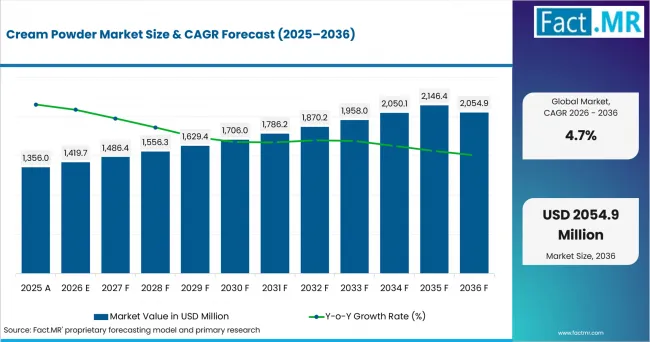
Cream Powder Market Value Analysis | Source: Fact.MR
What are the defining numbers behind Cream Powder Market growth?
USD 635.3 million absolute opportunity is expected between 2026 and 2036.
- Demand Drivers in the Market
- Shelf-stable dairy use is important for bakeries, dessert manufacturers, beverage premix makers and foodservice kitchens that want cream flavour and body without depending fully on fresh cream logistics.
- High-fat powder helps processors keep texture and richness consistent across dry blends, instant desserts, fillings as well as toppings and reconstituted cream applications.
- Retail, foodservice, and ingredient channels use different pack sizes. Supplier reliability and clear reconstitution guidance affect repeat purchasing.
- Milk-fat price movement, dairy supply, and moisture-control requirements can influence landed cost as well as storage performance and finished-product consistency.
- Key Segments Analyzed
- By Type: High Fat Powder is the leading type, accounting for 61.5% share in 2026.
- By Application: Desserts leads with 26.7% share in 2026.
- Analyst Opinion at Fact.MR
- Cream powder is a convenience ingredient, but the purchase decision is still technical. Dessert and bakery users want fat delivery, dispersibility, and stable taste after storage. Retail users want product that performs predictably for home desserts and beverages. Suppliers gain preference when they explain fat content, preparation route, allergen and dairy labelling and storage behavior clearly instead of selling cream powder as a generic dry dairy product. Shambhu Nath Jha, Principal Consultant, Fact.MR.
- Strategic Implications
- Buyers should match fat level and reconstitution method to the end use rather than treat all cream powders as interchangeable.
- Suppliers can differentiate through application guidance for desserts, ice cream, cakes as well as beverage mixes and confectionery fillings.
- Distribution planning should account for both ingredient buyers and smaller retail packs, because each channel values shelf life differently.
The UK records the highest country CAGR at 7.7%, followed by Canada at 6.8%. Australia and the USA are both projected at 6.4%, while Germany is forecast to expand at 4.6% through 2036.
How does the Cream Powder Market break down by segment?
High Fat Powder leads Type with 61.5% share and Desserts leads Application with 26.7% share in 2026.
Why does High Fat Powder lead Type?
High Fat Powder is projected to account for 61.5% share in 2026.
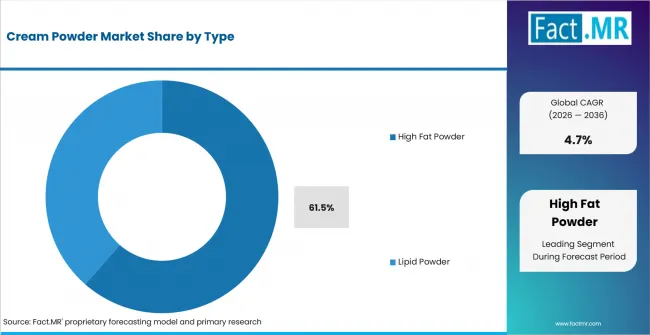
Cream Powder Market Analysis By Type | Source: Fact.MR
High Fat Powder leads because the main use case is not only dry dairy storage. It is fat delivery. Dessert mixes, cake fillings, whipping bases as well as beverage powders and confectionery applications need creaminess after reconstitution. A higher-fat powder helps manufacturers reduce dependence on fresh cream, improve handling, and keep texture more consistent across batches. Codex defines cream powder within the milk-powder family, which matters because buyers need a clear dairy identity and compositional basis when using it in labelled foods.
Why does Desserts lead Application?
Desserts is projected to account for 26.7% share in 2026.
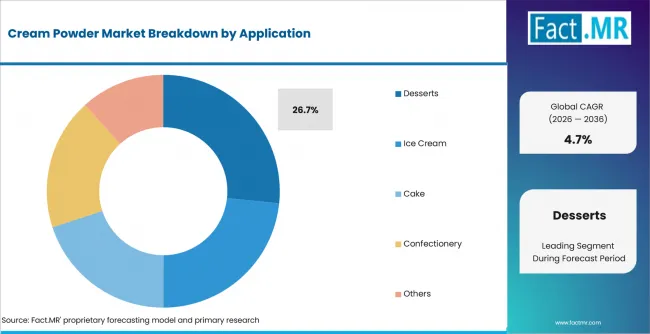
Cream Powder Market Analysis By Application | Source: Fact.MR
Desserts lead because cream powder solves a practical preparation problem. It can be dry blended into mousse bases, custards, instant puddings as well as ice cream mixes as well as fillings as well as toppings and bakery creamsas well as then reconstituted when needed. That reduces spoilage risk and makes portion control easier for foodservice kitchens and industrial processors. The segment also benefits from premium texture expectations: users want richness, but they do not always want the storage cost or short life of fresh cream.
What is accelerating Cream Powder Market adoption, and what is holding it back?
Adoption is supported by shelf-stable dairy handling, dessert formulation, and foodservice convenience. The main restraint is that cream powder still depends on dairy input cost, quality control, and clear preparation instructions; poor dispersibility or weak fat performance can quickly lose repeat buyers.
Drivers Impact Analysis
| DRIVER | (~) % IMPACT ON CAGR | GEOGRAPHIC RELEVANCE | IMPACT TIMELINE |
|---|---|---|---|
| Shelf-stable cream functionality | +1.2% | UK, Canada and Australia | Short term (<= 2 years) |
| Dessert and bakery fit | +0.9% | Canada, Australia and USA | Short term (<= 2 years) |
| Foodservice practicality | +0.7% | UK, Canada and Australia | Medium term (2-4 years) |
| Industrial consistency | +0.6% | USA, Germany and UK | Medium term (2-4 years) |
Source: Fact.MR analysis. Updated Aug 5, 2026
- Shelf-stable cream functionality: Powder lets users carry cream character into dry mixes and long-life packs.
- Dessert and bakery fit: The ingredient works where texture, fat, and preparation speed matter together.
- Foodservice practicality: Kitchens can reduce waste and keep emergency inventory without relying only on chilled cream.
- Industrial consistency: Standardized powder helps processors manage recipe control across sites and seasons.
Opportunity Impact Analysis
| OPPORTUNITY | (~) % IMPACT ON CAGR | GEOGRAPHIC RELEVANCE | IMPACT TIMELINE |
|---|---|---|---|
| Application-specific formats | +0.8% | UK, Canada and Australia | Medium term (2-4 years) |
| Preparation and performance guidance | +0.6% | Canada, Australia and USA | Medium term (2-4 years) |
| Cold-chain-light distribution | +0.5% | UK, Canada and Australia | Long term (>= 4 years) |
Source: Fact.MR analysis. Updated Aug 5, 2026
- Application-specific packs for desserts, beverages, and bakery mixes can improve supplier positioning.
- Clear preparation ratios and performance claims can support retail and foodservice conversion.
- Regions with longer distribution distances can use cream powder as a cold-chain-light dairy ingredient.
Restraints Impact Analysis
| RESTRAINT | (~) % IMPACT ON CAGR | GEOGRAPHIC RELEVANCE | IMPACT TIMELINE |
|---|---|---|---|
| Dairy input-cost pressure | -0.9% | Global sourcing and import-dependent markets | Short term (<= 2 years) |
| Humidity and storage sensitivity | -0.7% | Canada, Australia and USA | Short term (<= 2 years) |
| Fresh-cream preference | -0.5% | Established and price-sensitive markets | Medium term (2-4 years) |
Source: Fact.MR analysis. Updated Aug 5, 2026
- Milk-fat cost and dairy supply can affect pricing.
- Humidity control and storage conditions matter for powder flow and reconstitution.
- Fresh cream remains preferred in some premium foodservice applications, limiting full substitution.
Which countries are scaling the Cream Powder Market fastest?
Country growth rates differ from the global 4.7% CAGR. The UK and Canada sit well above the global rate, Australia and the USA also expand faster, while Germany remains closest to the global pace. These rates describe forecast pace; they do not make every country’s demand structure identical.
- The UK leads the country set at 7.7% CAGR.
- Canada follows at 6.8% CAGR.
- Australia records 6.4% CAGR.
- The USA also records 6.4% CAGR.
- Germany expands at 4.6% CAGR.
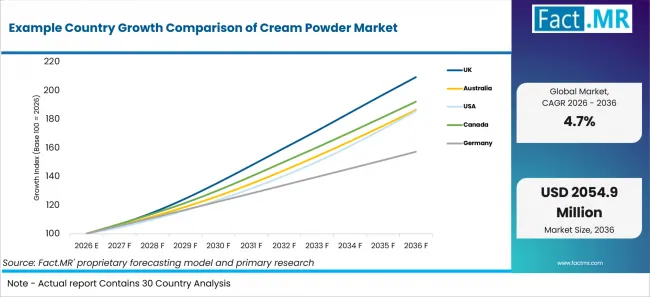
Example Country Growth Comparison Of Cream Powder Market | Source: Fact.MR
| COUNTRY | CAGR, 2026 to 2036 |
|---|---|
| UK | 7.7% |
| Canada | 6.8% |
| Australia | 6.4% |
| USA | 6.4% |
| Germany | 4.6% |
Source: Fact.MR analysis. Updated Aug 5, 2026
What is driving the UK's growth through 2036?
7.7% CAGR through 2036.
The UK grows fastest because cream powder fits a large food-and-drink manufacturing base and a grocery market where dairy desserts, ice cream, cakes and convenient home baking remain visible retail categories. Defra’s Food Statistics Pocketbook describes the food and drink sector as the UK’s largest manufacturing sector by turnover, while AHDB retail tracking shows dairy spend rising even when volumes are pressured. That mix supports value growth for cream powder: processors need stable dairy inputs, while retailers and foodservice operators need formats that handle price pressure and reduce waste.
What is driving Australia's growth through 2036?
6.4% CAGR through 2036.
Australia’s growth is supported by a strong dairy consumption base and the practical need for ingredients that travel well across long domestic supply routes. ABS apparent-consumption data show dairy remains part of everyday food purchasing, even as the mix changes across categories. For cream powder, the opportunity is not only household use. It is also foodservice, dessert mixes, beverages and bakery preparation where shelf life matters in regional distribution and warm-weather handling.
What is driving the USA's growth through 2036?
6.4% CAGR through 2036.
The USA grows above the global rate because it has a large dairy-processing system and a deep dessert, bakery, foodservice and packaged-food base. USDA ERS dairy data tracks U.S. supply, demand, trade and prices for dairy productsand its frozen-dairy reporting still shows a large production base even after long-term volume softening. Cream powder benefits where manufacturers want cream solids and fat performance in mixes that are easier to ship and store than fresh cream.
What is driving Canada's growth through 2036?
6.8% CAGR through 2036.
Canada is the second-fastest country in this set. Foodservice is a useful demand route because cream powder can support desserts, beverages, toppings as well as bakery creams and back-of-house preparation. Statistics Canada reported that food services and drinking places reached CAD 101.4 billion in annual sales in 2025, up 5.6% from 2024. That matters for cream powder because value growth is tied to kitchens and operators that need dependable dairy functionality without carrying excessive chilled inventory.
What is driving Germany's growth through 2036?
4.6% CAGR through 2036.
Germany grows close to the global rate because the market is mature, not because it lacks industrial demand. The country has a large processed-food base, but ingredient growth is tempered by cost discipline and established supplier relationships. USDA FAS reported that Germany’s processed food and beverage output was estimated at USD 270.1 billion in 2024, while noting a slight annual decline. Cream powder therefore has a steady role in bakery, desserts, and prepared foods as well as but expansion is more measured than in the UK or Canada.
Who leads the Cream Powder Market?
Dohler Group is the largest named company in the assessed set, with 11.0% share. Other listed participants are NZMP, Revala Ltd, Joker Plus and Bluegrass Dairy.
Competition is shaped by fat performance, solubility, dairy sourcing as well as pack format and application support. Buyers are likely to compare preparation reliability and supplier service rather than rely only on a product name.
Which companies are the key providers?
Key companies include Dohler Group; NZMP; Revala Ltd; Joker Plus; Bluegrass Dairy; Arion Dairy Products; Shandong Tianjiao; Shenzhen Ocean Power Corporation; Pelwatte Dairy Industries; and Asher manufacturer.
- Dohler Group
- NZMP
- Revala Ltd
- Joker Plus
- Bluegrass Dairy
- Arion Dairy Products
- Shandong Tianjiao
- Shenzhen Ocean Power Corporation
- Pelwatte Dairy Industries
- Asher manufacturer
Bibliography
- Codex Alimentarius Commission. (1999). Standard for Milk Powders and Cream Powder (CXS 207-1999). FAO/WHO Codex Alimentarius.
- Department for Environment, Food & Rural Affairs. (2026). Food statistics in your pocket. GOV.UK.
- Agriculture and Horticulture Development Board. (2025, December 27). Dairy retail performance – 27 December 2025. AHDB.
- Australian Bureau of Statistics. (2025, March 28). Apparent Consumption of Selected Foodstuffs, Australia. ABS.
- U.S. Department of Agriculture, Economic Research Service. (2026). Dairy. USDA ERS.
- U.S. Department of Agriculture, Economic Research Service. (2025). Ice cream and frozen dairy production dipped from 2000 to 2024. USDA ERS.
- Statistics Canada. (2026, February 25). Food services and drinking places, December 2025. Government of Canada.
- U.S. Department of Agriculture, Foreign Agricultural Service. (2026, March 30). Germany: Food Processing Ingredients Annual. USDA FAS.
This Report Answers
- The report provides strategic intelligence on the Cream Powder Market across Type and Application choices that shape ingredient selection and application use.
- Segment analysis covers High Fat Powder and Desserts as the share leaders within the 2026 market.
- Country outlook evaluates the UK and Australia alongside the USA and Canada. Germany completes the growth comparison across the profiled markets.
- Competitive analysis profiles Dohler Group and NZMP alongside Revala Ltd and Joker Plus. Bluegrass Dairy completes the provider view.
- Application assessment covers Desserts and Ice Cream. Cake and Confectionery complete the main use view.
What does the Cream Powder Market cover?
The market covers cream powder products and related offerings across the defined type, application, and region categories. It includes products positioned for dairy-based dry formulation, dessert preparation, bakery use as well as beverage mixes and related retail or foodservice uses.
What is included in the scope?
The scope includes High Fat Powder and Lipid Powder, along with use across Desserts, Ice Cream as well as Cake as well as Confectionery and other assessed applications.
What is excluded from the scope?
Products outside the defined cream powder categories are excluded. Fresh cream, milk powder categories not sold or positioned as cream powder, non-dairy creamers without relevant dairy positioning and unrelated dessert ingredients are not counted within this scope.
How Was the Analysis Built?
The analysis combines structured desk research, company and product mapping, expert validation. Demand-side checks across major regions.
- Primary Research: Interviews with buyers, suppliers, processors as well as retailers and foodservice stakeholders test purchasing criteria as well as handling constraints as well as adoption barriers and repeat-use behavior.
- Desk Research: Public dairy statistics, food-sector data, company literature as well as trade information and ingredient standards establish market boundaries and demand context.
- Market Sizing and Forecasting: Demand indicators, application intensity, channel participation and supplier mapping are reconciled across top-down and bottom-up views.
- Data Validation and Update Cycle: Findings are cross-checked across independent evidence routes and reviewed when material market, regulatory, or company changes occur.
Segmentation
What is the report's scope and coverage?
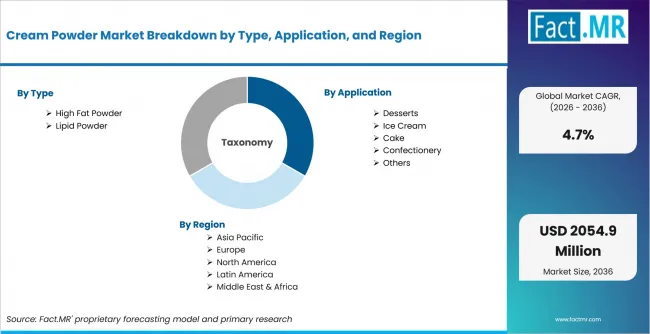
Cream Powder Market Breakdown By Type, Application, And Region | Source: Fact.MR
| Attribute | Details |
|---|---|
| Quantitative Units | USD Million |
| Market Definition | Cream Powder products and related offerings across the assessed categories |
| Type | High Fat Powder; Lipid Powder |
| Application | Desserts; Ice Cream; Cake; Confectionery; Others |
| Regions Covered | North America; Latin America; Europe; East Asia; South Asia & Oceania; Middle East & Africa |
| Countries Covered | UK; Australia; USA; Canada; Germany |
| Key Companies Profiled | Dohler Group; NZMP; Revala Ltd; Joker Plus; Bluegrass Dairy; Arion Dairy Products; and others |
| Forecast Period | 2026 to 2036 |
| Approach | Hybrid top-down and bottom-up market assessment |
Source: Fact.MR analysis. Updated Aug 5, 2026
How is the market segmented?
-
By Type:
- High Fat Powder
- Lipid Powder
-
By Application:
- Desserts
- Ice Cream
- Cake
- Confectionery
- Others
-
By Region:
- North America
- USA
- Canada
- Latin America
- Europe
- Germany
- UK
- East Asia
- South Asia & Oceania
- Australia
- Middle East & Africa
- North America
Frequently Asked Questions
How big is the Cream Powder Market in 2026?
What is the CAGR of the Cream Powder Market from 2026 to 2036?
Which type leads the Cream Powder Market?
How much will the Cream Powder Market add between 2026 and 2036?
Who are the leading companies in the Cream Powder Market?
Who worked on this report


Preview the report firsthand - request a free sample
Free SampleGet the brochure for pricing and purchase details
Download PDF