- Market Value (2025): USD 2.7 Bn
- Estimated Value (2026): USD 2.8 Bn
- Forecast Value (2036): USD 4.1 Bn
- CAGR (2026-2036): 3.9%
What is the DC Generator Market forecast to be worth by 2036?
USD 2.8 billion in 2026 to USD 4.1 billion by 2036 at a 3.9% CAGR.
- The DC Generator Market was valued at USD 2.7 billion in 2025.
- Demand is projected to increase from USD 2.8 billion in 2026 to USD 4.1 billion by 2036.
- The market is forecast to expand at a 3.9% CAGR from 2026 to 2036.
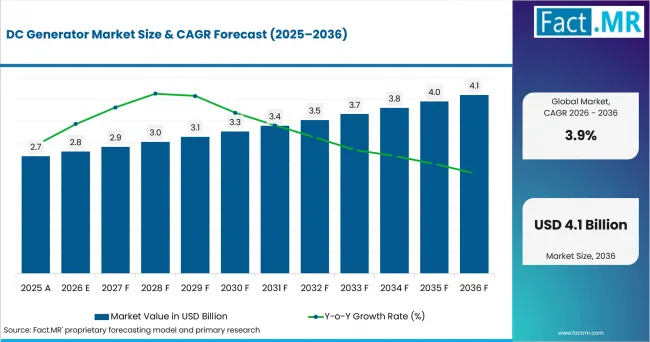
Dc Generator Market Value Analysis | Source: Fact.MR
What are the defining numbers behind DC Generator Market growth?
An absolute opportunity of USD 1.3 billion is expected between 2026 and 2036.
- Demand Drivers in the Market
- Rising electricity use is increasing the number of facilities that need dependable primary, standby, and auxiliary generation. The International Energy Agency expects global electricity demand to rise at an average 3.6% annually from 2026 to 2030, with industry, data centres, transport electrification, and buildings contributing to growth. This broadens the installed equipment base addressed by the generator market and supports demand for specialized DC output where battery buses, control systems, or direct-current loads are used.
- Industrial continuity requirements support purchases in manufacturing, mining, utilities, and other sites where a loss of control power or auxiliary electrical supply can interrupt operations. DC generators are used where buyers need a defined voltage, duty cycle, enclosure, cooling arrangement, or integration with existing DC distribution.
- Battery-backed power architectures are creating demand for generators that can charge DC storage directly or support hybrid systems. Direct-current generation can reduce the number of conversion stages in selected telecom, marine, mobile, and remote-power applications, making voltage compatibility and charging control important procurement criteria.
- Transportable and field-power requirements also support DC generator demand where mobility and quick deployment matter. Adjacent demand patterns in the portable generators market show the continued importance of compact equipment for remote and emergency applications, while DC-specific systems address battery charging and direct-current loads.
- Replacement cycles remain important because generators used for critical or industrial service require periodic overhaul, winding work, controls upgrades, and eventual replacement. Buyers therefore evaluate service coverage and parts availability alongside initial equipment cost.
- Key Segments Analyzed
- Power Generation accounts for 35.8% of Application in 2026, supported by recurring requirements for backup and primary electrical supply in facilities that use DC buses, battery systems, or control power.
- Industrial Sector accounts for 46.2% of End Use in 2026 because manufacturing, mining, process plants, and heavy-duty sites place a high value on equipment reliability and engineered power specifications.
- Direct Sales accounts for 61.8% of Distribution Channel in 2026 as many generator purchases require application engineering, voltage selection, service agreements, commissioning, and direct technical support.
- Mid Range Segment accounts for 45.6% of Pricing Tier in 2026, reflecting buyer preference for equipment that balances acquisition cost with duty-cycle capability, serviceability, and application-specific configuration.
- Analyst Opinion at Fact.MR
- Shambhu Nath Jha, Principal Consultant, Fact.MR, states, "DC generators remain a specialized equipment category in which buyers focus on electrical compatibility, operating duty, service access, and integration with battery or control systems. Growth is tied less to generic generator ownership and more to applications where direct-current output simplifies a defined power architecture. Suppliers that can support engineered selection, commissioning, and long-term maintenance are better positioned to convert these requirements into repeat purchases."
- Strategic Implications
- Generator suppliers should separate general backup-power demand from applications that specifically require DC output, because the technical buying criteria differ materially.
- Battery charging, telecom, marine auxiliary power, and remote industrial systems offer a practical route for DC generator integration as electrical architectures become more hybrid.
- Temporary power demand can be served through the generator rental market, but engineered DC installations generally require closer matching of output voltage, controls, and service support, which favors equipment-specific procurement.
- Suppliers should treat battery storage as both a complementary technology and a competitive substitute for short-duration backup loads. The strongest positioning is where a generator extends runtime, supports charging, or serves loads that cannot be economically covered by storage alone.
How does the DC Generator Market break down by segment?
The market is segmented by Application, End Use, Distribution Channel, and Pricing Tier.
Why does Power Generation lead Application?
Power Generation is projected to account for a 35.8% share in 2026.
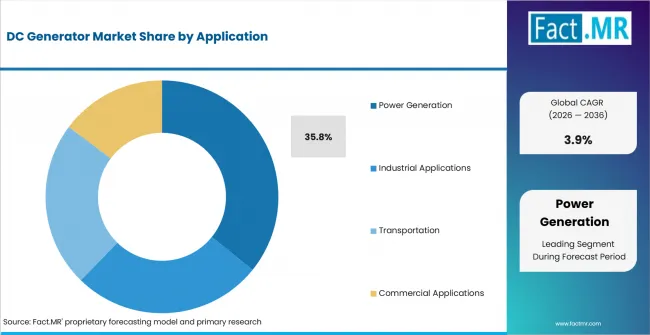
Dc Generator Market Analysis By Application | Source: Fact.MR
The category leads because backup and primary power requirements create direct demand for generating equipment, while DC-output systems are selected where facilities use battery banks, DC distribution, instrumentation, or control circuits. These applications place a premium on voltage stability, duty-cycle fit, and rapid response rather than on generic nameplate capacity alone.
Demand also reflects the wider need for standby and continuous generation documented across the diesel generators market. Within the DC category, the purchase decision is narrower: buyers need the generator to interface correctly with the DC load or charging system, which increases the value of engineered specification and commissioning.
Backup Power Supply and Primary Power Supply therefore serve distinct operating needs within the same parent segment. Backup systems prioritize readiness and automatic recovery, while primary systems require sustained operation, maintenance access, and fuel or prime-mover economics over longer duty periods.
Why does Industrial Sector lead End Use?
Industrial Sector is projected to account for a 46.2% share in 2026.
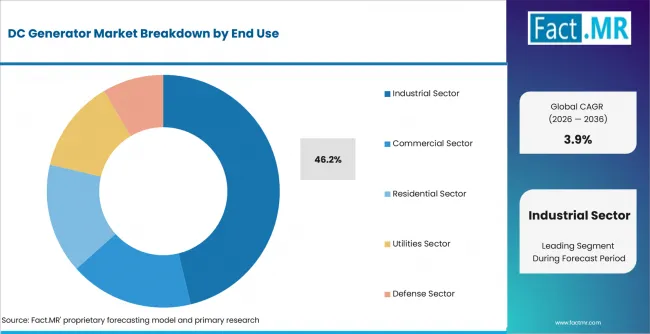
Dc Generator Market Analysis By End Use | Source: Fact.MR
Manufacturing plants, mines, processing facilities, and heavy industrial sites use generators for control power, auxiliary systems, emergency circuits, field operations, and isolated loads. The cost of downtime makes reliability, repairability, and access to technical service central to procurement.
Industrial buyers also tend to specify equipment around operating conditions such as dust, vibration, temperature, enclosure protection, duty cycle, and integration with plant control systems. These requirements support higher equipment content and more direct supplier involvement than routine residential purchases.
Why does Direct Sales lead Distribution Channel?
Direct Sales is projected to account for a 61.8% share in 2026.
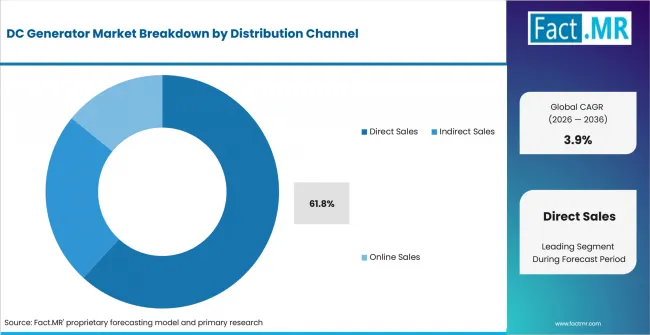
Dc Generator Market Analysis By Distribution Channel | Source: Fact.MR
A substantial share of DC generator demand is engineered rather than purely transactional. Buyers often require voltage selection, output matching, control integration, mounting, cooling, protection, commissioning, and service planning before an order is placed. Direct engagement gives manufacturers and authorized technical teams more control over these requirements.
Indirect Sales and Online Sales remain relevant for standardized products, replacement equipment, and smaller systems. However, the more application-specific the generator becomes, the more purchasing shifts toward direct technical discussion, documented specifications, and post-installation support.
Why does Mid Range Segment lead Pricing Tier?
Mid Range Segment is projected to account for a 45.6% share in 2026.
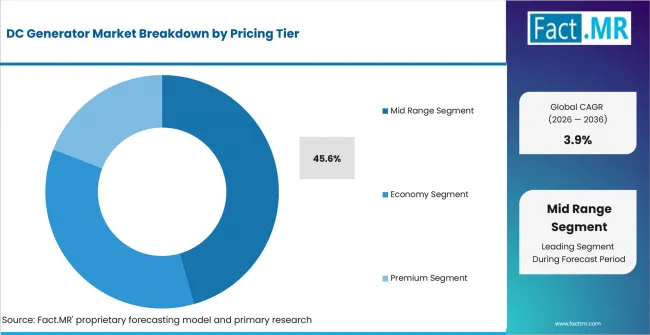
Dc Generator Market Analysis By Pricing Tier | Source: Fact.MR
Mid-range products address buyers that need dependable duty performance and service support without the customization or specialized materials associated with premium equipment. This makes the tier suitable for a broad set of commercial and industrial applications where total cost of ownership matters but extreme operating requirements are limited.
Economy products remain relevant for standardized, lower-duty applications, while premium systems are selected for harsher environments, specialized marine or defense requirements, or tightly engineered installations. The mid-range tier captures the central purchasing band between these two use cases.
What is accelerating DC Generator Market adoption, and what is holding it back?
Electricity demand growth, industrial activity, critical-facility resilience, and the expansion of battery-backed electrical systems are supporting DC generator purchases.
Adoption is constrained by competition from battery storage and by operating requirements for engine-driven generation. The IEA reports rapid growth in battery storage and battery-based UPS systems, which can cover short-duration outages and reduce generator runtime. Where combustion engines are used, emissions and maintenance requirements also affect ownership economics. These pressures are visible across adjacent gas generator market applications as buyers compare fuels, storage, and hybrid configurations.
Drivers Impact Analysis
| Factor | (~) % Impact on CAGR | Geographic Relevance | Impact Timeline |
|---|---|---|---|
| Rising electricity demand and backup-power requirements | +1.6% | Global | Short term (<= 2 years) |
| Industrial continuity and critical-load resilience | +1.4% | Germany, USA and UK | Short term (<= 2 years) |
| Battery-backed DC power integration | +1.1% | Global | Medium term (2-4 years) |
| Marine and mobile DC power demand | +0.9% | Japan, Germany and USA | Medium term (2-4 years) |
| Generator replacement and modernization | +0.6% | Global | Long term (>= 4 years) |
Source: Fact.MR analysis. Updated Sep 4, 2026
Opportunity Impact Analysis
| Factor | (~) % Impact on CAGR | Geographic Relevance | Impact Timeline |
|---|---|---|---|
| Hybrid generator-battery systems | +1.0% | Global | Medium term (2-4 years) |
| Variable-speed and remote-monitored DC generators | +0.8% | USA, Germany and UK | Medium term (2-4 years) |
| Telecom and remote-power applications | +0.7% | Brazil, USA and remote-power markets | Long term (>= 4 years) |
| Marine battery-charging systems | +0.5% | Japan, Germany and UK | Long term (>= 4 years) |
Source: Fact.MR analysis. Updated Sep 4, 2026
Restraints Impact Analysis
| Factor | (~) % Impact on CAGR | Geographic Relevance | Impact Timeline |
|---|---|---|---|
| Substitution by battery storage and UPS systems | -1.1% | Global | Short term (<= 2 years) |
| Fuel, maintenance and emissions compliance costs | -0.9% | USA, UK and Germany | Short term (<= 2 years) |
| Integration complexity in hybrid DC architectures | -0.7% | Global | Medium term (2-4 years) |
Source: Fact.MR analysis. Updated Sep 4, 2026
Which countries are scaling the DC Generator Market through 2036?
- Germany is supported by industrial equipment replacement, manufacturing continuity, and transport or marine applications. Grid reliability is high, so demand is more closely linked to engineered backup, process continuity, and equipment modernization than to routine outage exposure.
- Brazil is supported by industrial and mining activity. Empresa de Pesquisa Energetica reported higher industrial electricity consumption in 2025 across several sectors, including metallic mineral extraction and machinery and equipment manufacturing, which supports demand for industrial power equipment and field-ready systems.
- The USA combines rising electricity demand with data-centre expansion, telecom infrastructure, critical facilities, and weather-related outage exposure. These conditions sustain investment in backup and auxiliary power while battery-backed DC architectures create specialized demand for direct-current equipment.
- The UK is seeing continued investment in data infrastructure and critical services. Data centres are treated as critical national infrastructure, while healthcare electrical guidance places emphasis on resilient electrical services, supporting continued procurement of backup and auxiliary generation where required.
- Japan is supported by industrial replacement demand and investment in shipbuilding and next-generation vessels. Marine auxiliary systems, battery charging, and onboard DC architectures create a defined application base for specialized generators.
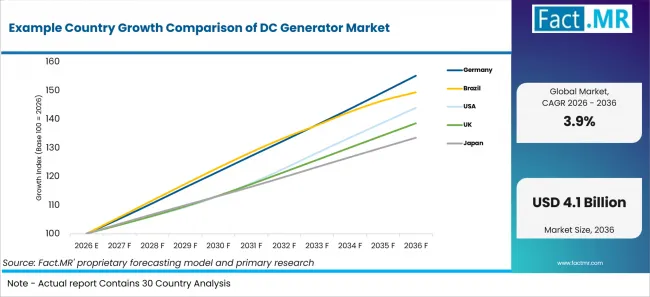
Example Country Growth Comparison Of Dc Generator Market | Source: Fact.MR
| Country | CAGR, 2026-2036 |
|---|---|
| Germany | 4.5% |
| Brazil | 4.1% |
| USA | 3.7% |
| UK | 3.3% |
| Japan | 2.9% |
Source: Fact.MR analysis. Updated Sep 4, 2026
What is driving Germany's growth through 2036?
Germany is forecast to expand at a 4.5% CAGR from 2026 to 2036.
Germany combines a large industrial equipment base with highly reliable grid supply. Bundesnetzagentur reported average electricity non-availability of 11.7 minutes per final customer in 2024, below the ten-year average. This means DC generator demand is less dependent on widespread routine outages and more dependent on applications that require continuity despite a generally stable grid.
Industrial modernization, process control, rail and marine equipment, and critical backup systems support replacement and upgrade demand. Buyers are likely to favor systems with documented service support, compatible controls, and clear integration with existing DC distribution or battery infrastructure.
What is driving Brazil's growth through 2036?
Brazil is forecast to expand at a 4.1% CAGR from 2026 to 2036.
Industrial and mining activity provide a direct demand mechanism. Empresa de Pesquisa Energetica reported industrial electricity consumption of 199,341 GWh in 2025, with metallic mineral extraction and machinery and equipment manufacturing among the sectors recording higher consumption. These activities use distributed electrical equipment across plants, mines, maintenance locations, and remote operating sites.
The purchasing opportunity therefore centers on rugged equipment, local service, parts availability, and products that can operate reliably outside tightly controlled facilities. Direct and distributor channels both matter because technical specification may be centralized while service and replenishment need regional coverage.
What is driving the USA's growth through 2036?
The USA is forecast to expand at a 3.7% CAGR from 2026 to 2036.
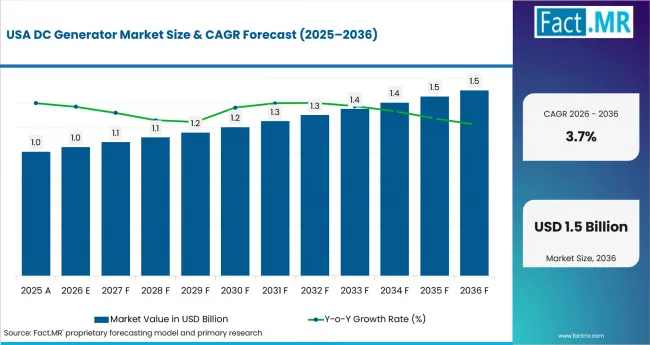
Dc Generator Market Country Value Analysis | Source: Fact.MR
The International Energy Agency expects U.S. electricity demand to rise by close to 2% per year on average through 2030, with data-centre expansion accounting for a substantial share of incremental demand. The U.S. Energy Information Administration also continues to report distribution-system reliability metrics that show major events can materially extend customer outage duration in affected states.
For DC generators, this creates demand in narrower applications such as telecom power, battery charging, control systems, remote industrial equipment, and auxiliary power. Buyers increasingly compare generators with UPS and battery storage, making runtime, charging integration, remote diagnostics, and maintenance economics central to purchase decisions.
What is driving the UK's growth through 2036?
The UK is forecast to expand at a 3.3% CAGR from 2026 to 2036.
The UK has designated data centres as critical national infrastructure. Office for National Statistics material published in 2026 cites Department for Energy Security and Net Zero estimates of 4.5 TWh of data-centre electricity use in Great Britain in 2024, up 41% from 2020. This raises the importance of resilient electrical design, including backup and control-power systems.
Healthcare facilities add another reliability-sensitive application. NHS England Health Technical Memorandum 06-01 covers the design, operation, and maintenance of electrical infrastructure in healthcare premises. DC generators are a specialist part of this broader resilience requirement where battery buses, emergency controls, or direct-current loads need dedicated support.
What is driving Japan's growth through 2036?
Japan is forecast to expand at a 2.9% CAGR from 2026 to 2036.
Japan combines a mature industrial equipment base with renewed investment in shipbuilding and marine technology. The Ministry of Land, Infrastructure, Transport and Tourism has set out measures to strengthen shipbuilding capacity and support investment in next-generation vessels through 2035.
Marine and industrial applications can require compact auxiliary generation, battery charging, or DC distribution, which supports specialized demand even in a mature equipment market. Growth therefore depends more on replacement, modernization, and application-specific installations than on broad expansion of basic generator ownership.
Who Leads the DC Generator Market?
Key players in the DC Generator Market include ABB Ltd., Siemens AG, Kirloskar Electric Company, Polar Power, Inc., Fischer Panda GmbH, WhisperPower B.V., TECO-Westinghouse, WEG S.A., Lincoln Electric Holdings, Inc., and TMEIC.
Current product evidence shows how suppliers differentiate by application. Polar Power markets DC generator systems across multiple direct-current voltage ranges for battery and remote-power use, while Fischer Panda lists AGT-DC battery-charging generators and variable-speed DC systems for mobile and marine applications. ABB and TMEIC maintain broader industrial generator portfolios that support engineered power-generation projects. The market therefore combines specialist DC suppliers with diversified electrical-equipment companies.
Which companies are the key providers?
Key Companies includes ABB Ltd.; Siemens AG; Kirloskar Electric Company; Polar Power, Inc.; Fischer Panda GmbH; WhisperPower B.V.; TECO-Westinghouse; WEG S.A.; Lincoln Electric Holdings, Inc.; TMEIC
- ABB Ltd.
- Siemens AG
- Kirloskar Electric Company
- Polar Power, Inc.
- Fischer Panda GmbH
- WhisperPower B.V.
- TECO-Westinghouse
- WEG S.A.
- Lincoln Electric Holdings, Inc.
- TMEIC
Bibliography
- International Energy Agency. (2026). Electricity 2026. IEA.
- International Energy Agency. (2026). Global Energy Review 2026: Battery Storage. IEA.
- U.S. Energy Information Administration. (2025). Electric Power Annual: Reliability Metrics Using Any Method of U.S. Distribution System by State, 2024 and 2023. U.S. Department of Energy.
- U.S. Environmental Protection Agency. (2026). Compliance Requirements for Stationary Engines. U.S. EPA.
- Bundesnetzagentur. (2025). Electricity Supply Interruptions in 2024 Shorter than in the Previous Year. Federal Network Agency, Germany.
- Empresa de Pesquisa Energetica. (2026). 2026 Statistical Yearbook of Electricity. Government of Brazil.
- NHS England. (2024). Health Technical Memorandum 06-01: Electrical Services Supply and Distribution. NHS England.
- Office for National Statistics. (2026). Data Centres and the UK National Accounts. UK Government.
- Ministry of Land, Infrastructure, Transport and Tourism. (2025). Maritime Report 2025. Government of Japan.
- Ministry of Land, Infrastructure, Transport and Tourism. (2026). Shipbuilding Revitalization Roadmap and Investment Measures for Next-Generation Vessels. Government of Japan.
- Polar Power, Inc. (2026). DC Generators. Polar Power, Inc.
- Fischer Panda GmbH. (2026). Hybrid Power DC Generator Product Documentation. Fischer Panda GmbH.
- ABB. (2026). Motors and Generators. ABB.
- TMEIC. (2026). Generators. TMEIC.
This Report Answers
- What is driving demand for DC generators from 2026 to 2036?
- Why does Power Generation account for 35.8% of Application in 2026?
- Why does Industrial Sector account for 46.2% of End Use in 2026?
- Why does Direct Sales account for 61.8% of Distribution Channel in 2026?
- Why does Mid Range Segment account for 45.6% of Pricing Tier in 2026?
- How do Germany, Brazil, the USA, the UK, and Japan differ in their demand mechanisms?
- How are battery storage, hybrid power systems, and emissions requirements changing purchase decisions?
- Which companies compete in the DC Generator Market?
What does the DC Generator Market cover?
The DC Generator Market covers electromechanical generating equipment that delivers direct-current electrical output for Power Generation, Industrial Applications, Transportation, and Commercial Applications within the defined end-use, distribution-channel, and pricing-tier categories.
Application coverage includes Backup Power Supply, Primary Power Supply, Manufacturing Plants, Mining Operations, Railway Systems, Marine Applications, Healthcare Facilities, and Commercial Buildings. End-use coverage spans Industrial Sector, Commercial Sector, Residential Sector, Utilities Sector, and Defense Sector.
What is included in the scope?
The scope includes DC generator equipment used for backup and primary power, industrial plant and mining operations, railway and marine applications, healthcare facilities, and commercial buildings. It includes products purchased through Direct Sales, Indirect Sales, and Online Sales across Mid Range Segment, Economy Segment, and Premium Segment.
Systems that integrate the generator with batteries, charging controls, monitoring, enclosures, or application-specific auxiliary equipment are included where the generator is part of the purchased DC generation solution.
What is excluded from the scope?
The market excludes AC-only generators that do not provide direct-current output as a defined product function. Standalone batteries, uninterruptible power supplies, inverters, rectifiers, and power converters sold without a generator are outside the scope.
Generator rental services are excluded because the market measures equipment sales rather than rental revenue. Standalone alternators, electric motors, and welding systems are excluded unless they are sold as part of a DC generator configuration covered by the defined applications.
How Was the Analysis Built?
The analysis combines generator-equipment sizing with evidence on electricity demand, industrial activity, grid reliability, critical-facility resilience, transport and marine investment, battery integration, emissions requirements, distribution structure, and current company activity.
- Primary Research: Relevant respondent groups include generator manufacturers, electrical-equipment distributors, industrial procurement managers, EPC and electrical engineers, facility and maintenance managers, utility personnel, mining operators, transport and marine operators, and buyers responsible for backup or auxiliary power systems.
- Desk Research: Research uses electricity-demand and reliability statistics, industrial and mining data, critical-infrastructure guidance, stationary-engine regulation, marine and transport policy, and official manufacturer documentation on DC generator voltage ranges, controls, and application use.
- Market Sizing and Forecasting: Sizing considers equipment revenue, replacement cycles, installed applications, power and voltage requirements, industrial capital expenditure, end-use demand, distribution mix, country growth, and the balance between standardized and engineered generator purchases.
- Data Validation and Update Cycle: Market values, annual progression, segment shares, country growth rates, and company identities are checked for consistency with the defined market boundaries and current operating structure.
Segmentation
What is the report's scope and coverage?
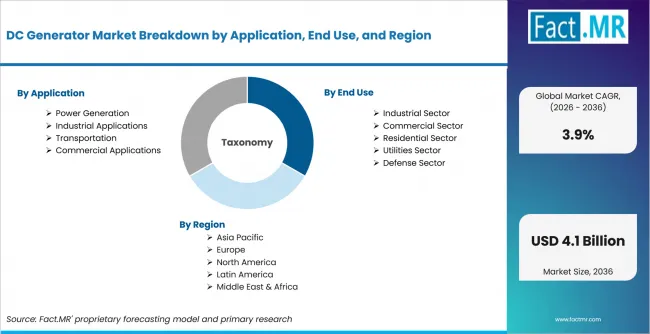
Dc Generator Market Breakdown By Application, End Use, And Region | Source: Fact.MR
| Attribute | Details |
|---|---|
| Forecast Period | 2026-2036 |
| Historical Analysis | 2021-2025 |
| Quantitative Units | USD billion; CAGR and market shares in % |
| Market Value, 2025 | USD 2.7 billion |
| Market Value, 2026 | USD 2.8 billion |
| Market Value, 2036 | USD 4.1 billion |
| CAGR, 2026-2036 | 3.9% |
| Absolute Opportunity | USD 1.3 billion |
| Segments | Application; End Use; Distribution Channel; Pricing Tier |
| Countries | Germany; Brazil; USA; UK; Japan |
| Key Companies | ABB Ltd.; Siemens AG; Kirloskar Electric Company; Polar Power, Inc.; Fischer Panda GmbH; WhisperPower B.V.; TECO-Westinghouse; WEG S.A.; Lincoln Electric Holdings, Inc.; TMEIC |
Source: Fact.MR analysis. Updated Sep 4, 2026
How is the market segmented?
-
By Application:
- Power Generation
- Backup Power Supply
- Primary Power Supply
- Industrial Applications
- Manufacturing Plants
- Mining Operations
- Transportation
- Railway Systems
- Marine Applications
- Commercial Applications
- Healthcare Facilities
- Commercial Buildings
- Power Generation
-
By End Use:
- Industrial Sector
- Commercial Sector
- Residential Sector
- Utilities Sector
- Defense Sector
-
By Distribution Channel:
- Direct Sales
- Indirect Sales
- Online Sales
-
By Pricing Tier:
- Mid Range Segment
- Economy Segment
- Premium Segment
-
By Region:
- North America
- Latin America
- Western Europe
- Eastern Europe
- East Asia
- South Asia and Pacific
- Middle East & Africa
Frequently Asked Questions
What is the DC Generator Market value in 2026?
At what CAGR is the market projected to grow?
What is the projected market value by 2036?
Which Application leads the market?
Which End Use leads the market?
Which Distribution Channel leads the market?
Which Pricing Tier leads the market?
What is Germany's CAGR from 2026 to 2036?
What is driving growth in the DC Generator Market?
What is the main restraint?
Which companies are active in the DC Generator Market?
Who worked on this report


Preview the report firsthand - request a free sample
Free SampleGet the brochure for pricing and purchase details
Download PDF