Decanediol Market Size, Share, Growth and Forecast (2026 - 2036)
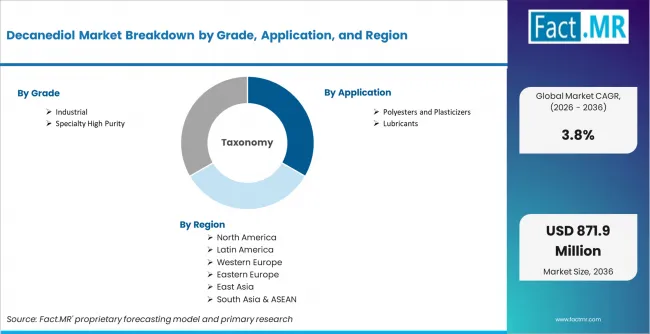
The Decanediol Market is segmented by Grade (Industrial and Specialty High Purity), Application (Polyesters and Plasticizers, Lubricants, Coatings), Form (Liquid and Solid), Purity Level (Standard Purity, High Purity, Ultra High Purity), End Use Industry (Polymer Manufacturing, Coatings Manufacturing, Lubricant Manufacturing, Cosmetics, Pharmaceutical Intermediates), Sales Channel (Direct Supply, Chemical Distributors, Online Specialty Stores), and Region. Forecast for 2026 to 2036.
Decanediol Market Forecast and Outlook By FACT MAR
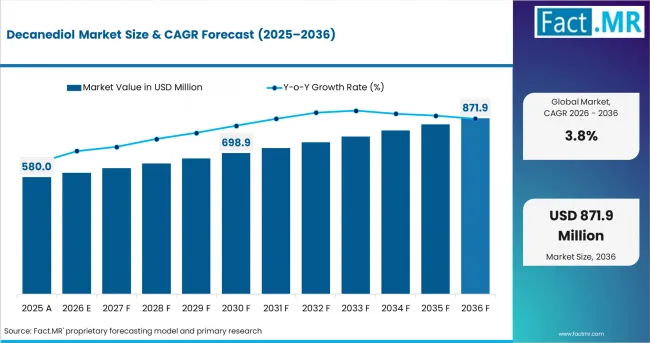
- The decanediol market was valued at USD 580.0 million in 2025. Based on Fact.MR analysis, demand is estimated to grow to USD 602.0 million in 2026 and USD 871.9 million by 2036.
- Fact.MR projects a 3.8% CAGR during the forecast period.
- The market is set to generate an incremental revenue opportunity of USD 269.9 million between 2026 and 2036.
- Growth is steady as polymer producers need diols that support controlled flexibility and stable processing. Raw material price changes and supplier qualification time can slow adoption in regulated applications.
Summary of Decanediol market
- Demand Drivers
- Polyester and plasticizer applications support decanediol demand as polymer producers need flexible chain modifiers for durable resin systems.
- Coating producers use specialty diols to improve surface performance in solvent-based and low-VOC formulations.
- Lubricant additive blenders are testing longer-chain diols in ester chemistry that needs stable flow and heat resistance.
- Key Segments Analyzed
- By Form: Liquid decanediol is projected to account for 78.0% share in 2026, with reactor dosing and bulk handling favoring liquid supply.
- By Grade: Industrial grade is expected to hold 64.0% share in 2026 because standard polymer and coating lines need consistent output at practical cost.
- By Application: Polyesters and plasticizers are projected to account for 44.0% share in 2026 because polymer flexibility and resin modification create steady industrial use.
- By Purity Level: Standard purity is estimated to hold 60.0% share in 2026 since routine industrial synthesis needs dependable material without extra purification cost.
- By End Use Industry: Polymer manufacturing is projected to represent 46.0% share in 2026, helped by resin plants that use decanediol in repeatable chain-building processes.
- By Sales Channel: Direct supply is expected to account for 52.0% share in 2026 because large chemical accounts prefer annual contracts and batch traceability.
- Analyst Opinion at Fact.MR
- Shambhu Nath Jha, Principal Consultant at Fact.MR, opines, "CXOs should treat decanediol as a specialty chemical where reliable supply and proven application performance matter most. It is mainly used in polymer and coating systems that need consistent chemistry. Lubricants add a smaller demand base. Producers with stable purity and strong batch control can retain clients more easily. Clear technical support also helps manufacturers avoid supplier changes that may affect formulation performance."
- Strategic Implications
- Manufacturers should focus on liquid and industrial-grade supply for polymer and coating plants that need steady bulk delivery.
- Suppliers should document purity and moisture levels so formulators can qualify material faster. Batch traceability should support every shipment.
- Distributors should build regional stock points for smaller coating and lubricant firms that cannot secure direct producer contracts.
| Metric | Value |
|---|---|
| Estimated Value in 2026 | USD 602.0 million |
| Forecast Value in 2036 | USD 871.9 million |
| Forecast CAGR (2026 to 2036) | 3.8% |
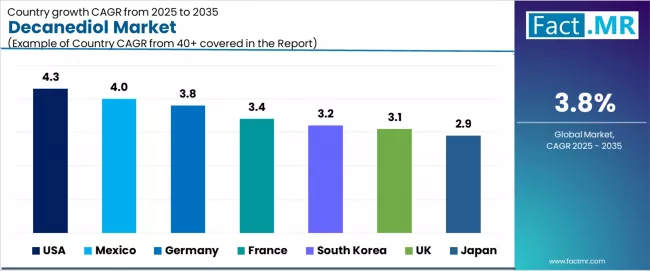
The United States is projected to record the highest CAGR at 4.3% through 2036 as specialty chemical exports and polymer production clusters support decanediol movement. Mexico follows at 4.0% as automotive and appliance manufacturing near Monterrey and Bajio increases demand for polymer modifiers and coating inputs. Germany advances at 3.8% as Rhine-Ruhr and Ludwigshafen chemical clusters support polymer and coating consumption. France records 3.4% growth through 2036 as specialty coating and fragrance intermediate activity supports selective decanediol use. South Korea expands at 3.2% as petrochemical clusters in Ulsan and Yeosu support polymer intermediate demand. The United Kingdom grows at 3.1% as specialty chemical distributors and coating formulators serve lower-volume applications. Japan is projected to rise at 2.9% as Osaka and Tokyo chemical users focus on quality records and smaller specialty lots.
Segmental Analysis
Decanediol Market Analysis by Grade
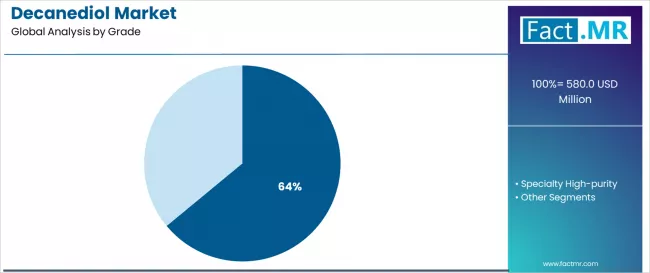
Industrial grade is projected to hold 64.0% share in 2026 as polymer and coating plants need practical purity and steady batch quality. This grade supports standard synthesis work and shortens approval time for large-volume orders. The United States chemical sector exported USD 285.4 billion in chemical manufacturing products in 2024, which supports demand for industrial intermediates moving through established trade channels. [1]
- Industrial Grade Demand: Industrial grade supports bulk polyester and plasticizer operations that need steady input quality across repeat production.
- Specialty High Purity Use: High purity grade serves personal care and pharma intermediate accounts that need tighter impurity records.
- Supplier Qualification Pressure: Chemical producers with full documents can reduce approval delays for large clients.
Decanediol Market Analysis by Application
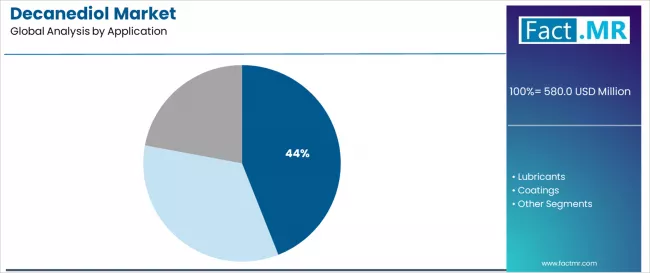
Polyesters and plasticizers are projected to account for 44.0% share in 2026 as decanediol supports flexibility and chain control in polymer systems. Producers using unsaturated polyester resin often review diols based on process behavior and final resin performance. Europe recorded about 8 million tonnes of circular plastics production in 2024, which shows why polymer systems need better input quality and material recovery planning. [2]
- Polyester Use Growth: Polyester producers use decanediol to adjust flexibility and processing behavior in specialty resin grades.
- Plasticizer Demand Base: Plasticizer makers use longer-chain alcohol chemistry to support softer materials with stable processing behavior.
- Coating Pull: Coatings use decanediol derivatives to improve surface feel and film durability in selected formulations.
Decanediol Market Analysis by Form
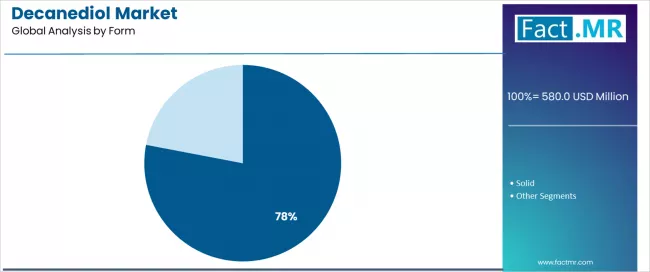
Liquid decanediol is projected to account for 78.0% share in 2026 as reactors and blending systems need easier dosing than solid feed. Liquid form reduces handling steps during polymer and additive production. Producers comparing coating additives often prefer liquid inputs that can be metered with fewer process changes.
- Liquid Handling Preference: Liquid decanediol supports faster charging into reactors and bulk tanks at industrial plants.
- Solid Form Use: Solid material serves smaller specialty batches that need easier storage and controlled weighing.
- Bulk Supply Advantage: Large accounts prefer tank or drum supply that keeps dosing stable across production campaigns.
Decanediol Market Analysis by Purity Level
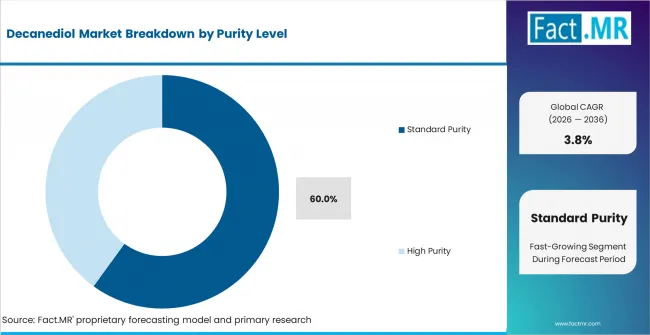
Standard purity is estimated to hold 60.0% share in 2026 as most polymer and coating synthesis does not need ultra-high purity material. This level gives manufacturers a practical balance between cost and performance control. The EU produced 224 million tonnes of chemicals in 2024, which shows the scale of industrial chemistry that supports standard purity intermediates. [3]
- Standard Purity Preference: Standard purity works for routine polymer synthesis that needs dependable chemistry without extra refining cost.
- High Purity Need: High purity supply serves sensitive applications that need lower impurity risk and tighter batch records.
- Testing Requirement: Ultra-high purity grades need stronger quality proof before use in regulated formulations.
Decanediol Market Analysis by End Use Industry
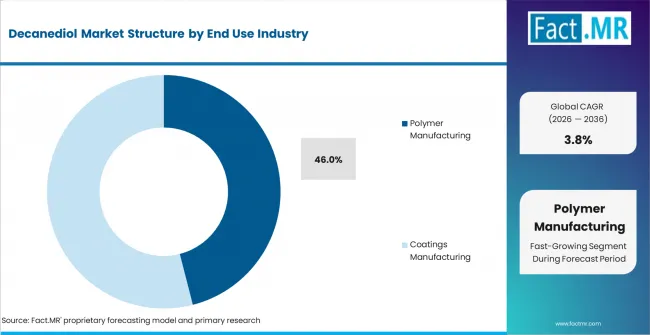
Polymer manufacturing is projected to represent 46.0% share in 2026 as resin plants use decanediol in chain-building reactions and modifier systems. Automotive materials create steady downstream demand for polymer and coating inputs. Global vehicle production rose to 96.4 million units in 2025, which supports demand for materials used in automotive coatings and engineered polymer parts. [4]
- Polymer Manufacturing Pull: Resin makers use decanediol for flexible polyester and plasticizer pathways that need repeatable process behavior.
- Coatings Manufacturing Demand: Coating producers use specialty diol chemistry for film behavior and surface performance control.
- Lubricant Manufacturing Use: Lubricant additive firms assess decanediol chemistry for ester routes that need heat and flow stability.
Decanediol Market Analysis by Sales Channel
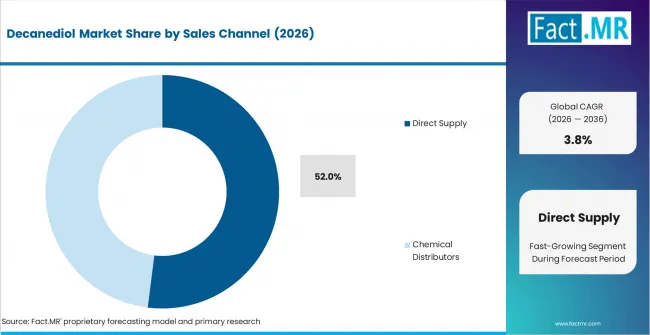
Direct supply is expected to account for 52.0% share in 2026 as large polymer and coating accounts prefer annual contracts with traceable batches. Chemical distributors serve smaller formulators that need mixed-volume orders. The European chemical industry recorded EUR 635 billion in turnover in the latest Cefic facts release, which shows why structured supply agreements remain important. [5]
- Direct Supply Preference: Large resin plants use direct supply to secure volume and batch documentation from producers.
- Distributor Role: Regional distributors serve formulators that need smaller lots and fast access to several grades.
- Online Specialty Stores: Online channels mainly serve lab and pilot-scale orders with small pack sizes.
Drivers, Restraints, and Opportunities

Decanediol demand grows through specialty chemical use, not mass commodity replacement. Polymer plants need intermediates that support flexibility and steady processing. Lubricant and coating firms compare suppliers based on purity proof and lead time. Batch stability often decides repeat orders. Producers tied to lubricants and release control additives benefit from clear application support and reliable regional stock.
- Polyester Chain Control: Polymer producers use decanediol to adjust flexibility and durability in specialty polyester systems.
- Coating Film Performance: Coating formulators use selected diol derivatives to improve surface feel under strict formulation limits.
- Lubricant Ester Chemistry: Ester lubricant makers assess longer-chain diols for heat stability and smooth flow behavior.
- Raw Material Cost Pressure: Feedstock price swings can reduce margins for producers selling standard industrial grades.
- Supplier Qualification Barrier: New suppliers face long approval cycles as formulators must test purity and reaction behavior.
Regional Analysis
The decanediol market is assessed across North America and Europe. Asia Pacific with Latin America and the Middle East and Africa are included. The full report covers 40+ country-level demand by grade and application. Form with purity level and sales channel are included.
.webp)
| Country | CAGR (2026 to 2036) |
|---|---|
| United States | 4.3% |
| Mexico | 4.0% |
| Germany | 3.8% |
| France | 3.4% |
| South Korea | 3.2% |
| United Kingdom | 3.1% |
| Japan | 2.9% |
Source: Fact.MR analysis, based on proprietary forecasting model and primary research.
North America Decanediol Market Analysis
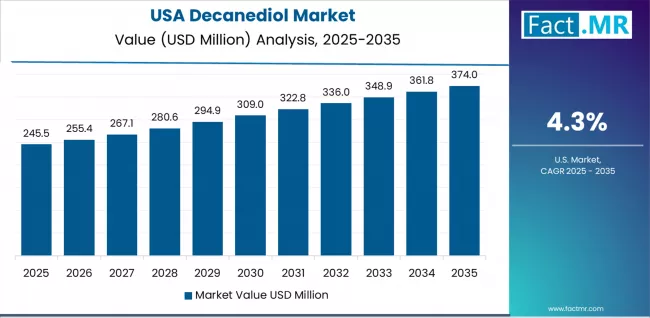
North America has a large base of chemical exporters and polymer processors that support decanediol demand in resin and coating applications. Specialty chemical exports and domestic polymer clusters give the region a stable base for industrial-grade decanediol. Secure supply is important because formulation changes can add testing cost for polymer and coating producers.
- United States: The United States is projected to grow at 4.3% CAGR from 2026 to 2036. Specialty chemical exports support decanediol movement through established industrial supply chains. Gulf Coast polymer clusters create steady use for polyester modifiers and coating inputs. Manufacturers value batch traceability because supplier changes can affect formulation performance.
- Mexico: Mexico is expected to expand at 4.0% CAGR through 2036. Automotive and appliance manufacturing near Monterrey and Bajio is raising demand for polymer modifiers. Coating input demand is also rising as regional manufacturing sites need stable industrial chemical supply. Chemical distributors support smaller users that need mixed-volume orders.
Europe Decanediol Market Analysis
Europe offers steady demand for decanediol grades that need strong documentation and tighter batch control. Polymer and coating producers value impurity records and repeatable chemistry. Germany remains the main demand center because large chemical clusters support steady industrial intermediate use.
- Germany: Germany is forecast to grow at 3.8% CAGR from 2026 to 2036. Rhine-Ruhr and Ludwigshafen chemical clusters support decanediol use in polymer and coating applications. Verband der Chemischen Industrie reported EUR 240 billion in 2024 sales for Germany’s chemical and pharmaceutical industry. This scale makes Germany a key decanediol demand base in Europe. [6]
- France: France is expected to advance at 3.4% CAGR through 2036. Specialty coating activity supports selective decanediol use in formulations that need stable surface performance. Fragrance intermediate activity adds a smaller demand base. Suppliers with reliable documents can serve users that need tighter qualification records.
- United Kingdom: The United Kingdom is forecast to grow at 3.1% CAGR by 2036. Specialty chemical distributors support lower-volume demand from coating formulators and specialized industrial users. A Verband der Chemischen Industrie country report placed United Kingdom chemical and pharmaceutical sales at just under EUR 79 billion in 2024. This shows a smaller but useful demand base for specialty intermediates. [7]
Asia Pacific Decanediol Market Analysis
Asia Pacific demand is supported by polymer output and electronics coating applications. Export-focused chemical production supports decanediol use in selected industrial formulations. Quality records are becoming more important as manufacturers serve higher-specification polymer and coating accounts.

- South Korea: South Korea is expected to post 3.2% CAGR from 2026 to 2036. Petrochemical clusters in Ulsan and Yeosu support demand for polymer intermediates. Export-focused chemical production adds a stable base for decanediol use in resin and coating systems. Producers with consistent purity records are better placed for repeat industrial orders.
- Japan: Japan is projected to rise at 2.9% CAGR by 2036. Osaka and Tokyo chemical users focus on quality records and smaller specialty lots. Electronics coatings and precision manufacturing create selective demand for decanediol-based inputs. Global electric car sales exceeded 20 million in 2025, which supports material demand tied to coatings and engineered polymer parts. [8]

Competitive Aligners for Market Players
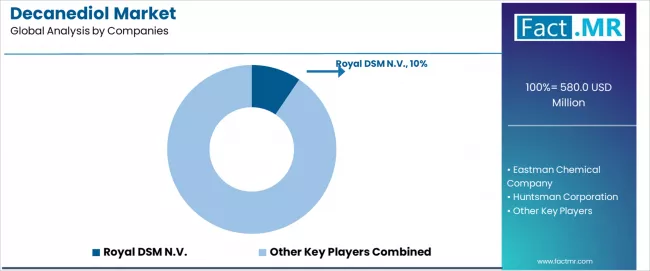
Decanediol suppliers compete on purity consistency and batch traceability. Lead time and application support shape repeat orders. Companies serving forging lubricants and ester chemistry applications need proof that material behavior stays stable under heat and shear. Larger producers benefit from feedstock access and quality systems. Distributors compete through faster delivery and smaller pack sizes.
Polymer and coating clients compare suppliers through technical data sheets and impurity profiles. Moisture limits and lot consistency guide final approval. Firms active in low profile additives and automotive additives need materials that pass internal formulation tests before volume contracts. The best-positioned suppliers combine quality records with regional stock and flexible contract terms.
Sourcing strategies are moving toward dual supply for critical specialty chemicals. Companies linking decanediol with bio-based chemicals claims need feedstock proof and auditable documents. Clients are less willing to approve a new supplier without clear purity and origin data. Reaction behavior must be documented before volume approval.
Key Players
- Tokyo Chemical Industry Co., Ltd.
- Merck KGaA / Sigma-Aldrich
- Thermo Fisher Scientific Inc.
- Matangi Industries LLP
- Dayang Chem (Hangzhou) Co., Ltd.
Bibliography
- [1] U.S. Bureau of Labor Statistics. (2025). Recent price trends in the chemicals industry.
- [2] Plastics Europe. (2025, October). Plastics the fast facts 2025.
- [3] Eurostat. (2025, December 16). EU chemical production: -15% over 10 years. European Commission.
- [4] International Organization of Motor Vehicle Manufacturers. (2026, April 23). Auto industry growth shifted east in 2025 amid global repositioning.
- [5] European Chemical Industry Council. (2025, December 15). Cefic launches 2025 Facts & Figures report.
- [6] Verband der Chemischen Industrie. (2025, November 11). Quartely report 3/2025: Business situation of the German chemical-pharmaceutical industry.
- [7] Verband der Chemischen Industrie. (2025, August). Country report United Kingdom: Chemical and pharmaceutical industry data and facts.
- [8] International Energy Agency. (2026, May 20). Close to 30% of cars sold this year are set to be electric as countries and consumers respond to energy crisis.
This Report Addresses
- Strategic demand analysis for decanediol across polyester and plasticizer applications globally. Coating, lubricant, cosmetic, and pharmaceutical intermediate uses are covered.
- Market forecast from USD 602.0 million in 2026 to USD 871.9 million by 2036 at 3.8% CAGR. Segment-level analysis covers grade, application, form, purity level, end use industry, and sales channel.
- Opportunity mapping covers the United States, Mexico, Germany, France, South Korea, the United Kingdom, and Japan. Country analysis is based on chemical production clusters, export activity, and specialty chemical buying patterns.
- Segment analysis covers industrial grade, polyesters and plasticizers, liquid form, standard purity, polymer manufacturing, and direct supply. Each segment is assessed through 2036.
- Competitive analysis covers Tokyo Chemical Industry Co., Ltd., Merck KGaA / Sigma-Aldrich, Thermo Fisher Scientific Inc., Matangi Industries LLP, and Dayang Chem (Hangzhou) Co., Ltd.
- Research delivery is supported by distributor interviews, supplier catalog checks, specialty chemical demand signals, and application-level buying behavior.
Decanediol Market Definition
The decanediol market covers 1,10-decanediol and related grades sold as specialty chemical intermediates. These grades serve polyesters and plasticizers. Coatings and lubricants add further use in selected formulations. The scope includes industrial grade and specialty high purity grade. It covers liquid form and solid form supplied through direct contracts and chemical distributors. The scope excludes unrelated short-chain diols and commodity glycols. Finished polyester resins and formulated coatings are excluded because decanediol is only one input in those products.
Decanediol Market Inclusions
Coverage includes global and regional market forecasts from 2026 to 2036 by grade and application. Form and purity level are covered as separate demand checks. End use industry and sales channel are included across North America and Europe. Asia Pacific with Latin America and the Middle East and Africa are included.
Decanediol Market Exclusions
Exclusions cover finished polyester resin systems and finished lubricants. Finished coatings and unrelated diol intermediates are outside the scope. Lab-scale reference materials sold only for small research batches are excluded. Finished consumer products that contain downstream derivatives are outside the direct revenue scope unless decanediol is the purchased chemical input.
Decanediol Market Research Methodology
- Primary Research
- Interviews covered specialty chemical distributors and polyester formulators. Coating additive suppliers and lubricant additive blenders were included. Polymer purchasing managers were consulted across the United States and Germany. France with Japan and South Korea were covered. Mexico and the United Kingdom were included for regional checks.
- Desk Research
- Desk research used chemical trade records and industrial production data. Supplier catalogs and Fact.MR internal demand checks were reviewed. Public disclosures from active chemical producers and specialty chemical distributors were included. External market statistics were limited to 2024 onward institutional sources and industry bodies.
- Market-Sizing and Forecasting
- The model combined top-down specialty chemical demand with bottom-up application checks for polyester and plasticizer use. Coating and lubricant use were checked separately. Average selling prices were tested against distributor quotations and batch-size buying patterns by purity grade.
- Data Validation and Update Cycle
- The forecast was validated through distributor interviews and supplier catalog checks. Demand was tested against polymer and coating production signals. Updates are made annually as raw material prices and application demand change. Regional trade flows are reviewed during each update.
Scope of the Report

| Attribute | Details |
|---|---|
| Quantitative Units | USD 602.0 million in 2026 to USD 871.9 million in 2036, at a CAGR of 3.8% |
| Market Definition | Decanediol grades used as specialty chemical intermediates for polyester, plasticizer, coating, lubricant, cosmetics, and pharmaceutical intermediate applications globally. |
| Grade Segmentation | Industrial, Specialty High Purity |
| Application Segmentation | Polyesters and Plasticizers, Lubricants, Coatings |
| Form Segmentation | Liquid, Solid |
| Purity Level Segmentation | Standard Purity, High Purity, Ultra High Purity |
| End Use Industry Segmentation | Polymer Manufacturing, Coatings Manufacturing, Lubricant Manufacturing, Cosmetics, Pharmaceutical Intermediates |
| Sales Channel Segmentation | Direct Supply, Chemical Distributors, Online Specialty Stores |
| Regions Covered | North America, Europe, Asia Pacific, Latin America, Middle East and Africa |
| Countries Covered | United States, Canada, Mexico, Germany, United Kingdom, France, Italy, Spain, China, Japan, South Korea, India, ASEAN, Brazil, Argentina, Saudi Arabia, GCC, Turkey, and South Africa |
| Key Companies Profiled | Tokyo Chemical Industry Co., Ltd., Merck KGaA / Sigma-Aldrich, Thermo Fisher Scientific Inc., Matangi Industries LLP, Dayang Chem (Hangzhou) Co., Ltd. |
| Forecast Period | 2026 to 2036 |
| Approach | Hybrid top-down and bottom-up model using specialty chemical demand checks, distributor interviews, supplier catalogs, and application-level buying behavior. |
Decanediol Market by Segment
-
By Grade:
- Industrial
- Specialty High Purity
-
By Application:
- Polyesters and Plasticizers
- Lubricants
- Coatings
-
By Form:
- Liquid
- Solid
-
By Purity Level:
- Standard Purity
- High Purity
- Ultra High Purity
-
By End Use Industry:
- Polymer Manufacturing
- Coatings Manufacturing
- Lubricant Manufacturing
- Cosmetics
- Pharmaceutical Intermediates
-
By Sales Channel:
- Direct Supply
- Chemical Distributors
- Online Specialty Stores
-
By Region:
- North America
- United States
- Canada
- Mexico
- Western Europe
- Germany
- United Kingdom
- France
- Italy
- Spain
- Netherlands
- Nordic Countries
- BENELUX
- Rest of Western Europe
- Eastern Europe
- Poland
- Hungary
- Balkan and Baltic
- Rest of Eastern Europe
- East Asia
- China
- Japan
- South Korea
- South Asia and Pacific
- India
- ASEAN
- Australia and New Zealand
- Rest of South Asia and Pacific
- Middle East and Africa
- Kingdom of Saudi Arabia
- Other GCC Countries
- Turkey
- South Africa
- Rest of Middle East and Africa
- North America
- Frequently Asked Questions -
How large is the global decanediol market in 2025?
The global decanediol market was valued at USD 580.0 million in 2025.
What will the decanediol market size be in 2026?
Based on Fact.MR analysis, demand for decanediol is estimated to reach USD 602.0 million in 2026.
What is the projected decanediol market size by 2036?
The decanediol market is projected to reach USD 871.9 million by 2036.
What is the expected CAGR for the decanediol market from 2026 to 2036?
Fact.MR projects a 3.8% CAGR for the global decanediol market during the forecast period.
Which form segment leads the decanediol market?
Liquid decanediol leads with 78.0% share in 2026 because reactor dosing and bulk handling favor liquid supply.
Which grade segment leads the decanediol market?
Industrial grade holds 64.0% share in 2026 because polymer and coating plants need practical purity with steady batch quality.
Which country shows the fastest growth in the decanediol market?
The United States leads at 4.3% CAGR through 2036, helped by specialty chemical exports and Gulf Coast polymer clusters.
Who are the key players in the decanediol market?
Key players include Tokyo Chemical Industry Co., Ltd., Merck KGaA / Sigma-Aldrich, Thermo Fisher Scientific Inc., Matangi Industries LLP, and Dayang Chem.
Table of Content
- Executive Summary
- Global Market Outlook
- Demand to side Trends
- Supply to side Trends
- Technology Roadmap Analysis
- Analysis and Recommendations
- Market Overview
- Market Coverage / Taxonomy
- Market Definition / Scope / Limitations
- Research Methodology
- Chapter Orientation
- Analytical Lens and Working Hypotheses
- Market Structure, Signals, and Trend Drivers
- Benchmarking and Cross-market Comparability
- Market Sizing, Forecasting, and Opportunity Mapping
- Research Design and Evidence Framework
- Desk Research Programme (Secondary Evidence)
- Company Annual and Sustainability Reports
- Peer-reviewed Journals and Academic Literature
- Corporate Websites, Product Literature, and Technical Notes
- Earnings Decks and Investor Briefings
- Statutory Filings and Regulatory Disclosures
- Technical White Papers and Standards Notes
- Trade Journals, Industry Magazines, and Analyst Briefs
- Conference Proceedings, Webinars, and Seminar Materials
- Government Statistics Portals and Public Data Releases
- Press Releases and Reputable Media Coverage
- Specialist Newsletters and Curated Briefings
- Sector Databases and Reference Repositories
- Fact.MR Internal Proprietary Databases and Historical Market Datasets
- Subscription Datasets and Paid Sources
- Social Channels, Communities, and Digital Listening Inputs
- Additional Desk Sources
- Expert Input and Fieldwork (Primary Evidence)
- Primary Modes
- Qualitative Interviews and Expert Elicitation
- Quantitative Surveys and Structured Data Capture
- Blended Approach
- Why Primary Evidence is Used
- Field Techniques
- Interviews
- Surveys
- Focus Groups
- Observational and In-context Research
- Social and Community Interactions
- Stakeholder Universe Engaged
- C-suite Leaders
- Board Members
- Presidents and Vice Presidents
- R&D and Innovation Heads
- Technical Specialists
- Domain Subject-matter Experts
- Scientists
- Physicians and Other Healthcare Professionals
- Governance, Ethics, and Data Stewardship
- Research Ethics
- Data Integrity and Handling
- Primary Modes
- Tooling, Models, and Reference Databases
- Desk Research Programme (Secondary Evidence)
- Data Engineering and Model Build
- Data Acquisition and Ingestion
- Cleaning, Normalisation, and Verification
- Synthesis, Triangulation, and Analysis
- Quality Assurance and Audit Trail
- Market Background
- Market Dynamics
- Drivers
- Restraints
- Opportunity
- Trends
- Scenario Forecast
- Demand in Optimistic Scenario
- Demand in Likely Scenario
- Demand in Conservative Scenario
- Opportunity Map Analysis
- Product Life Cycle Analysis
- Supply Chain Analysis
- Investment Feasibility Matrix
- Value Chain Analysis
- PESTLE and Porter’s Analysis
- Regulatory Landscape
- Regional Parent Market Outlook
- Production and Consumption Statistics
- Import and Export Statistics
- Market Dynamics
- Global Market Analysis 2021 to 2025 and Forecast, 2026 to 2036
- Historical Market Size Value (USD Million) Analysis, 2021 to 2025
- Current and Future Market Size Value (USD Million) Projections, 2026 to 2036
- Y to o to Y Growth Trend Analysis
- Absolute $ Opportunity Analysis
- Global Market Pricing Analysis 2021 to 2025 and Forecast 2026 to 2036
- Global Market Analysis 2021 to 2025 and Forecast 2026 to 2036, By Grade
- Introduction / Key Findings
- Historical Market Size Value (USD Million) Analysis By Grade , 2021 to 2025
- Current and Future Market Size Value (USD Million) Analysis and Forecast By Grade , 2026 to 2036
- Industrial
- Specialty High Purity
- Industrial
- Y to o to Y Growth Trend Analysis By Grade , 2021 to 2025
- Absolute $ Opportunity Analysis By Grade , 2026 to 2036
- Global Market Analysis 2021 to 2025 and Forecast 2026 to 2036, By Application
- Introduction / Key Findings
- Historical Market Size Value (USD Million) Analysis By Application, 2021 to 2025
- Current and Future Market Size Value (USD Million) Analysis and Forecast By Application, 2026 to 2036
- Polyesters and Plasticizers
- Lubricants
- Coatings
- Polyesters and Plasticizers
- Y to o to Y Growth Trend Analysis By Application, 2021 to 2025
- Absolute $ Opportunity Analysis By Application, 2026 to 2036
- Global Market Analysis 2021 to 2025 and Forecast 2026 to 2036, By Form
- Introduction / Key Findings
- Historical Market Size Value (USD Million) Analysis By Form, 2021 to 2025
- Current and Future Market Size Value (USD Million) Analysis and Forecast By Form, 2026 to 2036
- Liquid
- Solid
- Liquid
- Y to o to Y Growth Trend Analysis By Form, 2021 to 2025
- Absolute $ Opportunity Analysis By Form, 2026 to 2036
- Global Market Analysis 2021 to 2025 and Forecast 2026 to 2036, By Purity Level
- Introduction / Key Findings
- Historical Market Size Value (USD Million) Analysis By Purity Level, 2021 to 2025
- Current and Future Market Size Value (USD Million) Analysis and Forecast By Purity Level, 2026 to 2036
- Standard Purity
- High Purity
- Ultra High Purity
- Standard Purity
- Y to o to Y Growth Trend Analysis By Purity Level, 2021 to 2025
- Absolute $ Opportunity Analysis By Purity Level, 2026 to 2036
- Global Market Analysis 2021 to 2025 and Forecast 2026 to 2036, By End Use Industry
- Introduction / Key Findings
- Historical Market Size Value (USD Million) Analysis By End Use Industry, 2021 to 2025
- Current and Future Market Size Value (USD Million) Analysis and Forecast By End Use Industry, 2026 to 2036
- Polymer Manufacturing
- Coatings Manufacturing
- Cosmetics
- Polymer Manufacturing
- Y to o to Y Growth Trend Analysis By End Use Industry, 2021 to 2025
- Absolute $ Opportunity Analysis By End Use Industry, 2026 to 2036
- Global Market Analysis 2021 to 2025 and Forecast 2026 to 2036, By Sales Channel
- Introduction / Key Findings
- Historical Market Size Value (USD Million) Analysis By Sales Channel, 2021 to 2025
- Current and Future Market Size Value (USD Million) Analysis and Forecast By Sales Channel, 2026 to 2036
- Direct Supply
- Chemical Distributors
- Online Specialty Stores
- Direct Supply
- Y to o to Y Growth Trend Analysis By Sales Channel, 2021 to 2025
- Absolute $ Opportunity Analysis By Sales Channel, 2026 to 2036
- Global Market Analysis 2021 to 2025 and Forecast 2026 to 2036, By Region
- Introduction
- Historical Market Size Value (USD Million) Analysis By Region, 2021 to 2025
- Current Market Size Value (USD Million) Analysis and Forecast By Region, 2026 to 2036
- North America
- Latin America
- Western Europe
- Eastern Europe
- East Asia
- South Asia and Pacific
- Middle East & Africa
- Market Attractiveness Analysis By Region
- North America Market Analysis 2021 to 2025 and Forecast 2026 to 2036, By Country
- Historical Market Size Value (USD Million) Trend Analysis By Market Taxonomy, 2021 to 2025
- Market Size Value (USD Million) Forecast By Market Taxonomy, 2026 to 2036
- By Country
- USA
- Canada
- Mexico
- By Grade
- By Application
- By Form
- By Purity Level
- By End Use Industry
- By Sales Channel
- By Country
- Market Attractiveness Analysis
- By Country
- By Grade
- By Application
- By Form
- By Purity Level
- By End Use Industry
- By Sales Channel
- Key Takeaways
- Latin America Market Analysis 2021 to 2025 and Forecast 2026 to 2036, By Country
- Historical Market Size Value (USD Million) Trend Analysis By Market Taxonomy, 2021 to 2025
- Market Size Value (USD Million) Forecast By Market Taxonomy, 2026 to 2036
- By Country
- Brazil
- Chile
- Rest of Latin America
- By Grade
- By Application
- By Form
- By Purity Level
- By End Use Industry
- By Sales Channel
- By Country
- Market Attractiveness Analysis
- By Country
- By Grade
- By Application
- By Form
- By Purity Level
- By End Use Industry
- By Sales Channel
- Key Takeaways
- Western Europe Market Analysis 2021 to 2025 and Forecast 2026 to 2036, By Country
- Historical Market Size Value (USD Million) Trend Analysis By Market Taxonomy, 2021 to 2025
- Market Size Value (USD Million) Forecast By Market Taxonomy, 2026 to 2036
- By Country
- Germany
- UK
- Italy
- Spain
- France
- Nordic
- BENELUX
- Rest of Western Europe
- By Grade
- By Application
- By Form
- By Purity Level
- By End Use Industry
- By Sales Channel
- By Country
- Market Attractiveness Analysis
- By Country
- By Grade
- By Application
- By Form
- By Purity Level
- By End Use Industry
- By Sales Channel
- Key Takeaways
- Eastern Europe Market Analysis 2021 to 2025 and Forecast 2026 to 2036, By Country
- Historical Market Size Value (USD Million) Trend Analysis By Market Taxonomy, 2021 to 2025
- Market Size Value (USD Million) Forecast By Market Taxonomy, 2026 to 2036
- By Country
- Russia
- Poland
- Hungary
- Balkan & Baltic
- Rest of Eastern Europe
- By Grade
- By Application
- By Form
- By Purity Level
- By End Use Industry
- By Sales Channel
- By Country
- Market Attractiveness Analysis
- By Country
- By Grade
- By Application
- By Form
- By Purity Level
- By End Use Industry
- By Sales Channel
- Key Takeaways
- East Asia Market Analysis 2021 to 2025 and Forecast 2026 to 2036, By Country
- Historical Market Size Value (USD Million) Trend Analysis By Market Taxonomy, 2021 to 2025
- Market Size Value (USD Million) Forecast By Market Taxonomy, 2026 to 2036
- By Country
- China
- Japan
- South Korea
- By Grade
- By Application
- By Form
- By Purity Level
- By End Use Industry
- By Sales Channel
- By Country
- Market Attractiveness Analysis
- By Country
- By Grade
- By Application
- By Form
- By Purity Level
- By End Use Industry
- By Sales Channel
- Key Takeaways
- South Asia and Pacific Market Analysis 2021 to 2025 and Forecast 2026 to 2036, By Country
- Historical Market Size Value (USD Million) Trend Analysis By Market Taxonomy, 2021 to 2025
- Market Size Value (USD Million) Forecast By Market Taxonomy, 2026 to 2036
- By Country
- India
- ASEAN
- Australia & New Zealand
- Rest of South Asia and Pacific
- By Grade
- By Application
- By Form
- By Purity Level
- By End Use Industry
- By Sales Channel
- By Country
- Market Attractiveness Analysis
- By Country
- By Grade
- By Application
- By Form
- By Purity Level
- By End Use Industry
- By Sales Channel
- Key Takeaways
- Middle East & Africa Market Analysis 2021 to 2025 and Forecast 2026 to 2036, By Country
- Historical Market Size Value (USD Million) Trend Analysis By Market Taxonomy, 2021 to 2025
- Market Size Value (USD Million) Forecast By Market Taxonomy, 2026 to 2036
- By Country
- Kingdom of Saudi Arabia
- Other GCC Countries
- Turkiye
- South Africa
- Other African Union
- Rest of Middle East & Africa
- By Grade
- By Application
- By Form
- By Purity Level
- By End Use Industry
- By Sales Channel
- By Country
- Market Attractiveness Analysis
- By Country
- By Grade
- By Application
- By Form
- By Purity Level
- By End Use Industry
- By Sales Channel
- Key Takeaways
- Key Countries Market Analysis
- USA
- Pricing Analysis
- Market Share Analysis, 2025
- By Grade
- By Application
- By Form
- By Purity Level
- By End Use Industry
- By Sales Channel
- Canada
- Pricing Analysis
- Market Share Analysis, 2025
- By Grade
- By Application
- By Form
- By Purity Level
- By End Use Industry
- By Sales Channel
- Mexico
- Pricing Analysis
- Market Share Analysis, 2025
- By Grade
- By Application
- By Form
- By Purity Level
- By End Use Industry
- By Sales Channel
- Brazil
- Pricing Analysis
- Market Share Analysis, 2025
- By Grade
- By Application
- By Form
- By Purity Level
- By End Use Industry
- By Sales Channel
- Chile
- Pricing Analysis
- Market Share Analysis, 2025
- By Grade
- By Application
- By Form
- By Purity Level
- By End Use Industry
- By Sales Channel
- Germany
- Pricing Analysis
- Market Share Analysis, 2025
- By Grade
- By Application
- By Form
- By Purity Level
- By End Use Industry
- By Sales Channel
- UK
- Pricing Analysis
- Market Share Analysis, 2025
- By Grade
- By Application
- By Form
- By Purity Level
- By End Use Industry
- By Sales Channel
- Italy
- Pricing Analysis
- Market Share Analysis, 2025
- By Grade
- By Application
- By Form
- By Purity Level
- By End Use Industry
- By Sales Channel
- Spain
- Pricing Analysis
- Market Share Analysis, 2025
- By Grade
- By Application
- By Form
- By Purity Level
- By End Use Industry
- By Sales Channel
- France
- Pricing Analysis
- Market Share Analysis, 2025
- By Grade
- By Application
- By Form
- By Purity Level
- By End Use Industry
- By Sales Channel
- India
- Pricing Analysis
- Market Share Analysis, 2025
- By Grade
- By Application
- By Form
- By Purity Level
- By End Use Industry
- By Sales Channel
- ASEAN
- Pricing Analysis
- Market Share Analysis, 2025
- By Grade
- By Application
- By Form
- By Purity Level
- By End Use Industry
- By Sales Channel
- Australia & New Zealand
- Pricing Analysis
- Market Share Analysis, 2025
- By Grade
- By Application
- By Form
- By Purity Level
- By End Use Industry
- By Sales Channel
- China
- Pricing Analysis
- Market Share Analysis, 2025
- By Grade
- By Application
- By Form
- By Purity Level
- By End Use Industry
- By Sales Channel
- Japan
- Pricing Analysis
- Market Share Analysis, 2025
- By Grade
- By Application
- By Form
- By Purity Level
- By End Use Industry
- By Sales Channel
- South Korea
- Pricing Analysis
- Market Share Analysis, 2025
- By Grade
- By Application
- By Form
- By Purity Level
- By End Use Industry
- By Sales Channel
- Russia
- Pricing Analysis
- Market Share Analysis, 2025
- By Grade
- By Application
- By Form
- By Purity Level
- By End Use Industry
- By Sales Channel
- Poland
- Pricing Analysis
- Market Share Analysis, 2025
- By Grade
- By Application
- By Form
- By Purity Level
- By End Use Industry
- By Sales Channel
- Hungary
- Pricing Analysis
- Market Share Analysis, 2025
- By Grade
- By Application
- By Form
- By Purity Level
- By End Use Industry
- By Sales Channel
- Kingdom of Saudi Arabia
- Pricing Analysis
- Market Share Analysis, 2025
- By Grade
- By Application
- By Form
- By Purity Level
- By End Use Industry
- By Sales Channel
- Turkiye
- Pricing Analysis
- Market Share Analysis, 2025
- By Grade
- By Application
- By Form
- By Purity Level
- By End Use Industry
- By Sales Channel
- South Africa
- Pricing Analysis
- Market Share Analysis, 2025
- By Grade
- By Application
- By Form
- By Purity Level
- By End Use Industry
- By Sales Channel
- USA
- Market Structure Analysis
- Competition Dashboard
- Competition Benchmarking
- Market Share Analysis of Top Players
- By Regional
- By Grade
- By Application
- By Form
- By Purity Level
- By End Use Industry
- By Sales Channel
- Competition Analysis
- Competition Deep Dive
- Tokyo Chemical Industry Co., Ltd.
- Overview
- Product Portfolio
- Profitability by Market Segments (Product/Age /Sales Channel/Region)
- Sales Footprint
- Strategy Overview
- Marketing Strategy
- Product Strategy
- Channel Strategy
- Merck KGaA / Sigma-Aldrich
- Thermo Fisher Scientific Inc.
- Matangi Industries LLP
- Dayang Chem (Hangzhou) Co., Ltd.
- Tokyo Chemical Industry Co., Ltd.
- Competition Deep Dive
- Assumptions & Acronyms Used
List Of Table
- Table 1: Global Market Value (USD Million) Forecast by Region, 2021 to 2036
- Table 2: Global Market Value (USD Million) Forecast by Grade , 2021 to 2036
- Table 3: Global Market Value (USD Million) Forecast by Application, 2021 to 2036
- Table 4: Global Market Value (USD Million) Forecast by Form, 2021 to 2036
- Table 5: Global Market Value (USD Million) Forecast by Purity Level, 2021 to 2036
- Table 6: Global Market Value (USD Million) Forecast by End Use Industry, 2021 to 2036
- Table 7: Global Market Value (USD Million) Forecast by Sales Channel, 2021 to 2036
- Table 8: North America Market Value (USD Million) Forecast by Country, 2021 to 2036
- Table 9: North America Market Value (USD Million) Forecast by Grade , 2021 to 2036
- Table 10: North America Market Value (USD Million) Forecast by Application, 2021 to 2036
- Table 11: North America Market Value (USD Million) Forecast by Form, 2021 to 2036
- Table 12: North America Market Value (USD Million) Forecast by Purity Level, 2021 to 2036
- Table 13: North America Market Value (USD Million) Forecast by End Use Industry, 2021 to 2036
- Table 14: North America Market Value (USD Million) Forecast by Sales Channel, 2021 to 2036
- Table 15: Latin America Market Value (USD Million) Forecast by Country, 2021 to 2036
- Table 16: Latin America Market Value (USD Million) Forecast by Grade , 2021 to 2036
- Table 17: Latin America Market Value (USD Million) Forecast by Application, 2021 to 2036
- Table 18: Latin America Market Value (USD Million) Forecast by Form, 2021 to 2036
- Table 19: Latin America Market Value (USD Million) Forecast by Purity Level, 2021 to 2036
- Table 20: Latin America Market Value (USD Million) Forecast by End Use Industry, 2021 to 2036
- Table 21: Latin America Market Value (USD Million) Forecast by Sales Channel, 2021 to 2036
- Table 22: Western Europe Market Value (USD Million) Forecast by Country, 2021 to 2036
- Table 23: Western Europe Market Value (USD Million) Forecast by Grade , 2021 to 2036
- Table 24: Western Europe Market Value (USD Million) Forecast by Application, 2021 to 2036
- Table 25: Western Europe Market Value (USD Million) Forecast by Form, 2021 to 2036
- Table 26: Western Europe Market Value (USD Million) Forecast by Purity Level, 2021 to 2036
- Table 27: Western Europe Market Value (USD Million) Forecast by End Use Industry, 2021 to 2036
- Table 28: Western Europe Market Value (USD Million) Forecast by Sales Channel, 2021 to 2036
- Table 29: Eastern Europe Market Value (USD Million) Forecast by Country, 2021 to 2036
- Table 30: Eastern Europe Market Value (USD Million) Forecast by Grade , 2021 to 2036
- Table 31: Eastern Europe Market Value (USD Million) Forecast by Application, 2021 to 2036
- Table 32: Eastern Europe Market Value (USD Million) Forecast by Form, 2021 to 2036
- Table 33: Eastern Europe Market Value (USD Million) Forecast by Purity Level, 2021 to 2036
- Table 34: Eastern Europe Market Value (USD Million) Forecast by End Use Industry, 2021 to 2036
- Table 35: Eastern Europe Market Value (USD Million) Forecast by Sales Channel, 2021 to 2036
- Table 36: East Asia Market Value (USD Million) Forecast by Country, 2021 to 2036
- Table 37: East Asia Market Value (USD Million) Forecast by Grade , 2021 to 2036
- Table 38: East Asia Market Value (USD Million) Forecast by Application, 2021 to 2036
- Table 39: East Asia Market Value (USD Million) Forecast by Form, 2021 to 2036
- Table 40: East Asia Market Value (USD Million) Forecast by Purity Level, 2021 to 2036
- Table 41: East Asia Market Value (USD Million) Forecast by End Use Industry, 2021 to 2036
- Table 42: East Asia Market Value (USD Million) Forecast by Sales Channel, 2021 to 2036
- Table 43: South Asia and Pacific Market Value (USD Million) Forecast by Country, 2021 to 2036
- Table 44: South Asia and Pacific Market Value (USD Million) Forecast by Grade , 2021 to 2036
- Table 45: South Asia and Pacific Market Value (USD Million) Forecast by Application, 2021 to 2036
- Table 46: South Asia and Pacific Market Value (USD Million) Forecast by Form, 2021 to 2036
- Table 47: South Asia and Pacific Market Value (USD Million) Forecast by Purity Level, 2021 to 2036
- Table 48: South Asia and Pacific Market Value (USD Million) Forecast by End Use Industry, 2021 to 2036
- Table 49: South Asia and Pacific Market Value (USD Million) Forecast by Sales Channel, 2021 to 2036
- Table 50: Middle East & Africa Market Value (USD Million) Forecast by Country, 2021 to 2036
- Table 51: Middle East & Africa Market Value (USD Million) Forecast by Grade , 2021 to 2036
- Table 52: Middle East & Africa Market Value (USD Million) Forecast by Application, 2021 to 2036
- Table 53: Middle East & Africa Market Value (USD Million) Forecast by Form, 2021 to 2036
- Table 54: Middle East & Africa Market Value (USD Million) Forecast by Purity Level, 2021 to 2036
- Table 55: Middle East & Africa Market Value (USD Million) Forecast by End Use Industry, 2021 to 2036
- Table 56: Middle East & Africa Market Value (USD Million) Forecast by Sales Channel, 2021 to 2036
List Of Figures
- Figure 1: Global Market Pricing Analysis
- Figure 2: Global Market Value (USD Million) Forecast 2021-2036
- Figure 3: Global Market Value Share and BPS Analysis by Grade, 2026 and 2036
- Figure 4: Global Market Y-o-Y Growth Comparison by Grade,2026 to 2036
- Figure 5: Global Market Attractiveness Analysis by Grade
- Figure 6: Global Market Value Share and BPS Analysis by Application, 2026 and 2036
- Figure 7: Global Market Y-o-Y Growth Comparison by Application,2026 to 2036
- Figure 8: Global Market Attractiveness Analysis by Application
- Figure 9: Global Market Value Share and BPS Analysis by Form, 2026 and 2036
- Figure 10: Global Market Y-o-Y Growth Comparison by Form,2026 to 2036
- Figure 11: Global Market Attractiveness Analysis by Form
- Figure 12: Global Market Value Share and BPS Analysis by Purity Level, 2026 and 2036
- Figure 13: Global Market Y-o-Y Growth Comparison by Purity Level,2026 to 2036
- Figure 14: Global Market Attractiveness Analysis by Purity Level
- Figure 15: Global Market Value Share and BPS Analysis by End Use Industry, 2026 and 2036
- Figure 16: Global Market Y-o-Y Growth Comparison by End Use Industry,2026 to 2036
- Figure 17: Global Market Attractiveness Analysis by End Use Industry
- Figure 18: Global Market Value Share and BPS Analysis by Sales Channel, 2026 and 2036
- Figure 19: Global Market Y-o-Y Growth Comparison by Sales Channel,2026 to 2036
- Figure 20: Global Market Attractiveness Analysis by Sales Channel
- Figure 21: Global Market Value (USD Million) Share and BPS Analysis by Region, 2026 and 2036
- Figure 22: Global Market Y-o-Y Growth Comparison by Region,2026 to 2036
- Figure 23: Global Market Attractiveness Analysis by Region
- Figure 24: North America Market Incremental Dollar Opportunity,2026 to 2036
- Figure 25: Latin America Market Incremental Dollar Opportunity,2026 to 2036
- Figure 26: Western Europe Market Incremental Dollar Opportunity,2026 to 2036
- Figure 27: Eastern Europe Market Incremental Dollar Opportunity,2026 to 2036
- Figure 28: East Asia Market Incremental Dollar Opportunity,2026 to 2036
- Figure 29: South Asia and Pacific Market Incremental Dollar Opportunity,2026 to 2036
- Figure 30: Middle East & Africa Market Incremental Dollar Opportunity,2026 to 2036
- Figure 31: North America Market Value Share and BPS Analysis by Country, 2026 and 2036
- Figure 32: North America Market Value Share and BPS Analysis by Grade, 2026 and 2036
- Figure 33: North America Market Y-o-Y Growth Comparison by Grade,2026 to 2036
- Figure 34: North America Market Attractiveness Analysis by Grade
- Figure 35: North America Market Value Share and BPS Analysis by Application, 2026 and 2036
- Figure 36: North America Market Y-o-Y Growth Comparison by Application,2026 to 2036
- Figure 37: North America Market Attractiveness Analysis by Application
- Figure 38: North America Market Value Share and BPS Analysis by Form, 2026 and 2036
- Figure 39: North America Market Y-o-Y Growth Comparison by Form,2026 to 2036
- Figure 40: North America Market Attractiveness Analysis by Form
- Figure 41: North America Market Value Share and BPS Analysis by Purity Level, 2026 and 2036
- Figure 42: North America Market Y-o-Y Growth Comparison by Purity Level,2026 to 2036
- Figure 43: North America Market Attractiveness Analysis by Purity Level
- Figure 44: North America Market Value Share and BPS Analysis by End Use Industry, 2026 and 2036
- Figure 45: North America Market Y-o-Y Growth Comparison by End Use Industry,2026 to 2036
- Figure 46: North America Market Attractiveness Analysis by End Use Industry
- Figure 47: North America Market Value Share and BPS Analysis by Sales Channel, 2026 and 2036
- Figure 48: North America Market Y-o-Y Growth Comparison by Sales Channel,2026 to 2036
- Figure 49: North America Market Attractiveness Analysis by Sales Channel
- Figure 50: Latin America Market Value Share and BPS Analysis by Country, 2026 and 2036
- Figure 51: Latin America Market Value Share and BPS Analysis by Grade, 2026 and 2036
- Figure 52: Latin America Market Y-o-Y Growth Comparison by Grade,2026 to 2036
- Figure 53: Latin America Market Attractiveness Analysis by Grade
- Figure 54: Latin America Market Value Share and BPS Analysis by Application, 2026 and 2036
- Figure 55: Latin America Market Y-o-Y Growth Comparison by Application,2026 to 2036
- Figure 56: Latin America Market Attractiveness Analysis by Application
- Figure 57: Latin America Market Value Share and BPS Analysis by Form, 2026 and 2036
- Figure 58: Latin America Market Y-o-Y Growth Comparison by Form,2026 to 2036
- Figure 59: Latin America Market Attractiveness Analysis by Form
- Figure 60: Latin America Market Value Share and BPS Analysis by Purity Level, 2026 and 2036
- Figure 61: Latin America Market Y-o-Y Growth Comparison by Purity Level,2026 to 2036
- Figure 62: Latin America Market Attractiveness Analysis by Purity Level
- Figure 63: Latin America Market Value Share and BPS Analysis by End Use Industry, 2026 and 2036
- Figure 64: Latin America Market Y-o-Y Growth Comparison by End Use Industry,2026 to 2036
- Figure 65: Latin America Market Attractiveness Analysis by End Use Industry
- Figure 66: Latin America Market Value Share and BPS Analysis by Sales Channel, 2026 and 2036
- Figure 67: Latin America Market Y-o-Y Growth Comparison by Sales Channel,2026 to 2036
- Figure 68: Latin America Market Attractiveness Analysis by Sales Channel
- Figure 69: Western Europe Market Value Share and BPS Analysis by Country, 2026 and 2036
- Figure 70: Western Europe Market Value Share and BPS Analysis by Grade, 2026 and 2036
- Figure 71: Western Europe Market Y-o-Y Growth Comparison by Grade,2026 to 2036
- Figure 72: Western Europe Market Attractiveness Analysis by Grade
- Figure 73: Western Europe Market Value Share and BPS Analysis by Application, 2026 and 2036
- Figure 74: Western Europe Market Y-o-Y Growth Comparison by Application,2026 to 2036
- Figure 75: Western Europe Market Attractiveness Analysis by Application
- Figure 76: Western Europe Market Value Share and BPS Analysis by Form, 2026 and 2036
- Figure 77: Western Europe Market Y-o-Y Growth Comparison by Form,2026 to 2036
- Figure 78: Western Europe Market Attractiveness Analysis by Form
- Figure 79: Western Europe Market Value Share and BPS Analysis by Purity Level, 2026 and 2036
- Figure 80: Western Europe Market Y-o-Y Growth Comparison by Purity Level,2026 to 2036
- Figure 81: Western Europe Market Attractiveness Analysis by Purity Level
- Figure 82: Western Europe Market Value Share and BPS Analysis by End Use Industry, 2026 and 2036
- Figure 83: Western Europe Market Y-o-Y Growth Comparison by End Use Industry,2026 to 2036
- Figure 84: Western Europe Market Attractiveness Analysis by End Use Industry
- Figure 85: Western Europe Market Value Share and BPS Analysis by Sales Channel, 2026 and 2036
- Figure 86: Western Europe Market Y-o-Y Growth Comparison by Sales Channel,2026 to 2036
- Figure 87: Western Europe Market Attractiveness Analysis by Sales Channel
- Figure 88: Eastern Europe Market Value Share and BPS Analysis by Country, 2026 and 2036
- Figure 89: Eastern Europe Market Value Share and BPS Analysis by Grade, 2026 and 2036
- Figure 90: Eastern Europe Market Y-o-Y Growth Comparison by Grade,2026 to 2036
- Figure 91: Eastern Europe Market Attractiveness Analysis by Grade
- Figure 92: Eastern Europe Market Value Share and BPS Analysis by Application, 2026 and 2036
- Figure 93: Eastern Europe Market Y-o-Y Growth Comparison by Application,2026 to 2036
- Figure 94: Eastern Europe Market Attractiveness Analysis by Application
- Figure 95: Eastern Europe Market Value Share and BPS Analysis by Form, 2026 and 2036
- Figure 96: Eastern Europe Market Y-o-Y Growth Comparison by Form,2026 to 2036
- Figure 97: Eastern Europe Market Attractiveness Analysis by Form
- Figure 98: Eastern Europe Market Value Share and BPS Analysis by Purity Level, 2026 and 2036
- Figure 99: Eastern Europe Market Y-o-Y Growth Comparison by Purity Level,2026 to 2036
- Figure 100: Eastern Europe Market Attractiveness Analysis by Purity Level
- Figure 101: Eastern Europe Market Value Share and BPS Analysis by End Use Industry, 2026 and 2036
- Figure 102: Eastern Europe Market Y-o-Y Growth Comparison by End Use Industry,2026 to 2036
- Figure 103: Eastern Europe Market Attractiveness Analysis by End Use Industry
- Figure 104: Eastern Europe Market Value Share and BPS Analysis by Sales Channel, 2026 and 2036
- Figure 105: Eastern Europe Market Y-o-Y Growth Comparison by Sales Channel,2026 to 2036
- Figure 106: Eastern Europe Market Attractiveness Analysis by Sales Channel
- Figure 107: East Asia Market Value Share and BPS Analysis by Country, 2026 and 2036
- Figure 108: East Asia Market Value Share and BPS Analysis by Grade, 2026 and 2036
- Figure 109: East Asia Market Y-o-Y Growth Comparison by Grade,2026 to 2036
- Figure 110: East Asia Market Attractiveness Analysis by Grade
- Figure 111: East Asia Market Value Share and BPS Analysis by Application, 2026 and 2036
- Figure 112: East Asia Market Y-o-Y Growth Comparison by Application,2026 to 2036
- Figure 113: East Asia Market Attractiveness Analysis by Application
- Figure 114: East Asia Market Value Share and BPS Analysis by Form, 2026 and 2036
- Figure 115: East Asia Market Y-o-Y Growth Comparison by Form,2026 to 2036
- Figure 116: East Asia Market Attractiveness Analysis by Form
- Figure 117: East Asia Market Value Share and BPS Analysis by Purity Level, 2026 and 2036
- Figure 118: East Asia Market Y-o-Y Growth Comparison by Purity Level,2026 to 2036
- Figure 119: East Asia Market Attractiveness Analysis by Purity Level
- Figure 120: East Asia Market Value Share and BPS Analysis by End Use Industry, 2026 and 2036
- Figure 121: East Asia Market Y-o-Y Growth Comparison by End Use Industry,2026 to 2036
- Figure 122: East Asia Market Attractiveness Analysis by End Use Industry
- Figure 123: East Asia Market Value Share and BPS Analysis by Sales Channel, 2026 and 2036
- Figure 124: East Asia Market Y-o-Y Growth Comparison by Sales Channel,2026 to 2036
- Figure 125: East Asia Market Attractiveness Analysis by Sales Channel
- Figure 126: South Asia and Pacific Market Value Share and BPS Analysis by Country, 2026 and 2036
- Figure 127: South Asia and Pacific Market Value Share and BPS Analysis by Grade, 2026 and 2036
- Figure 128: South Asia and Pacific Market Y-o-Y Growth Comparison by Grade,2026 to 2036
- Figure 129: South Asia and Pacific Market Attractiveness Analysis by Grade
- Figure 130: South Asia and Pacific Market Value Share and BPS Analysis by Application, 2026 and 2036
- Figure 131: South Asia and Pacific Market Y-o-Y Growth Comparison by Application,2026 to 2036
- Figure 132: South Asia and Pacific Market Attractiveness Analysis by Application
- Figure 133: South Asia and Pacific Market Value Share and BPS Analysis by Form, 2026 and 2036
- Figure 134: South Asia and Pacific Market Y-o-Y Growth Comparison by Form,2026 to 2036
- Figure 135: South Asia and Pacific Market Attractiveness Analysis by Form
- Figure 136: South Asia and Pacific Market Value Share and BPS Analysis by Purity Level, 2026 and 2036
- Figure 137: South Asia and Pacific Market Y-o-Y Growth Comparison by Purity Level,2026 to 2036
- Figure 138: South Asia and Pacific Market Attractiveness Analysis by Purity Level
- Figure 139: South Asia and Pacific Market Value Share and BPS Analysis by End Use Industry, 2026 and 2036
- Figure 140: South Asia and Pacific Market Y-o-Y Growth Comparison by End Use Industry,2026 to 2036
- Figure 141: South Asia and Pacific Market Attractiveness Analysis by End Use Industry
- Figure 142: South Asia and Pacific Market Value Share and BPS Analysis by Sales Channel, 2026 and 2036
- Figure 143: South Asia and Pacific Market Y-o-Y Growth Comparison by Sales Channel,2026 to 2036
- Figure 144: South Asia and Pacific Market Attractiveness Analysis by Sales Channel
- Figure 145: Middle East & Africa Market Value Share and BPS Analysis by Country, 2026 and 2036
- Figure 146: Middle East & Africa Market Value Share and BPS Analysis by Grade, 2026 and 2036
- Figure 147: Middle East & Africa Market Y-o-Y Growth Comparison by Grade,2026 to 2036
- Figure 148: Middle East & Africa Market Attractiveness Analysis by Grade
- Figure 149: Middle East & Africa Market Value Share and BPS Analysis by Application, 2026 and 2036
- Figure 150: Middle East & Africa Market Y-o-Y Growth Comparison by Application,2026 to 2036
- Figure 151: Middle East & Africa Market Attractiveness Analysis by Application
- Figure 152: Middle East & Africa Market Value Share and BPS Analysis by Form, 2026 and 2036
- Figure 153: Middle East & Africa Market Y-o-Y Growth Comparison by Form,2026 to 2036
- Figure 154: Middle East & Africa Market Attractiveness Analysis by Form
- Figure 155: Middle East & Africa Market Value Share and BPS Analysis by Purity Level, 2026 and 2036
- Figure 156: Middle East & Africa Market Y-o-Y Growth Comparison by Purity Level,2026 to 2036
- Figure 157: Middle East & Africa Market Attractiveness Analysis by Purity Level
- Figure 158: Middle East & Africa Market Value Share and BPS Analysis by End Use Industry, 2026 and 2036
- Figure 159: Middle East & Africa Market Y-o-Y Growth Comparison by End Use Industry,2026 to 2036
- Figure 160: Middle East & Africa Market Attractiveness Analysis by End Use Industry
- Figure 161: Middle East & Africa Market Value Share and BPS Analysis by Sales Channel, 2026 and 2036
- Figure 162: Middle East & Africa Market Y-o-Y Growth Comparison by Sales Channel,2026 to 2036
- Figure 163: Middle East & Africa Market Attractiveness Analysis by Sales Channel
- Figure 164: Global Market - Tier Structure Analysis
- Figure 165: Global Market - Company Share Analysis