- Base Value(2025): 289.90 Bn
- Estimated Value(2026): 298.99 Bn
- Forecast Value (2036): 405.74 Bn
- CAGR (2026 - 2036): 3.1%
Mass Beauty and Personal Care Products Market Size, Market Forecast and Outlook By FACT.MR
The Mass Beauty and Personal Care Products market was valued at USD 289.90 billion in 2025, projected to reach USD 298.99 billion in 2026, and is forecast to expand to USD 405.74 billion by 2036 at a 3.1% CAGR. Universal consumer demand for affordable daily-use personal hygiene and beauty products across global mass retail, pharmacy, and online channels anchors this market as one of the largest and most stable fast-moving consumer goods categories. Emerging market urban population growth and rising middle-class consumer access to modern retail distribution in India, Mexico, and Brazil create structural volume expansion above saturation-limited growth in developed markets. Private label market share expansion in European and North American modern trade retail channels intensifies pricing pressure on branded mass beauty incumbents while simultaneously expanding category accessibility.
The absolute dollar growth of USD 106.75 billion across the forecast decade confirms mass beauty and personal care as a multi-billion dollar volume expansion opportunity anchored in developing market consumer acquisition. Skin Care commanding 36.6% of category share positions facial and body moisturization, sun care, and basic skin treatment products as the largest revenue subcategory within the mass beauty portfolio above hair care, bath and body, and deodorant segments. Modern Trade retaining 44.0% of channel share confirms supermarket and hypermarket aisle presence as the primary mass beauty purchase occasion for global consumer demographics above online direct-to-consumer and pharmacy alternatives.
As per FACT.MR's regional analysis, Mexico leads at 3.5% CAGR as expanding urban retail infrastructure and growing middle-class consumer access to branded mass beauty formats across supermarket and pharmacy channels sustain above-average emerging market category expansion. South Korea advances at 3.1% as K-beauty mass tier product innovation in sheet mask, essence, and multi-step skincare formats maintains consistent domestic category development and export market demand. France tracks at 3.0% as the established premium beauty culture sustains consistent mass pharmacy and parapharmacy beauty product procurement with meaningful dermocosmetic category development. Germany registers 2.9% where pharmacy and drugstore channel mass beauty distribution sustains stable category volume with dermocosmetic product line premiumization. Japan advances at 2.8% where established consumer beauty culture and consistent product innovation by domestic brands maintain stable category development. The United Kingdom records 2.7% where mass pharmacy and supermarket beauty category sustains consistent volume with private label and branded value tier competition.
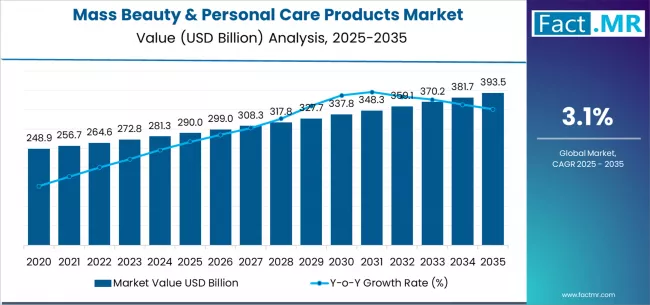
Mass Beauty & Personal Care Products Market Market Value Analysis | Source: Fact.MR
Mass Beauty and Personal Care Products Market Key Takeaways
| Metric | Details |
|---|---|
| Industry Size (2026) | USD 298.99 Billion |
| Industry Value (2036) | USD 405.74 Billion |
| CAGR (2026-2036) | 3.1% |
| Source | Fact.MR, 2026 |
Source: Fact.MR analysis. Updated Mar 14, 2026
Mass Beauty and Personal Care Products Market Definition
The Mass Beauty and Personal Care Products market encompasses affordably priced daily-use skin care, hair care, bath and body, and deodorant products sold through mass retail, pharmacy, convenience, and online channels to the broadest consumer demographic. Mass beauty products occupy the volume tier below prestige and luxury beauty, characterized by accessible retail pricing, broad distribution through modern trade and pharmacy channels, and formulation focused on fundamental hygiene and basic aesthetic enhancement functions rather than clinical or luxury positioning.
Mass Beauty and Personal Care Products Market Inclusions
Market scope covers mass tier skin care, hair care, bath and body, and deodorant product categories distributed through modern trade, online and D2C, pharmacy, and other retail channels. Private label and branded product lines are both included within the mass beauty market scope. Regional coverage spans Mexico, South Korea, France, Germany, Japan, UK, and 40 plus countries for the 2026 to 2036 forecast period.
Mass Beauty and Personal Care Products Market Exclusions
Prestige and luxury beauty products retailing at premium price points with selective distribution through department store, specialty beauty retailer, and brand-owned boutique channels are excluded from mass beauty market scope. Professional salon and spa beauty product formulations without mass retail distribution are omitted. Medical aesthetic and prescription dermatology product categories without over-the-counter mass retail availability fall outside defined boundaries. Fragrance and perfume products sold through selective distribution without pharmacy or modern trade channel presence are explicitly excluded.
Mass Beauty and Personal Care Products Market Research Methodology
- Primary Research: Analysts conducted interviews with mass beauty retail category managers, FMCG brand personal care marketing directors, and pharmacy chain beauty buyers across Mexico, South Korea, France, Germany, and the UK to validate channel dynamics and category pricing trends.
- Desk Research: Data aggregation covered FMCG retail audit sell-out data for mass beauty categories by product type and channel, national consumer expenditure survey data, Euromonitor and IRI category volume and value data from publicly disclosed trade sources, and brand investor presentation category share data.
- Market-Sizing and Forecasting: Baseline values derive from bottom-up aggregation of national mass beauty product sell-out volumes from retail audit data, applying urban population growth rates, middle-class consumer acquisition curves, and channel shift models to regional market revenue projections.
- Data Validation and Update Cycle: Forecasts cross-validate against beauty and personal care segment revenues from L'Oreal, Unilever, Procter and Gamble, Beiersdorf, and Kao Corporation annual investor reports.
Summary of Mass Beauty and Personal Care Products Market
- Mass Beauty and Personal Care Products Market Definition
- The Mass Beauty and Personal Care Products market covers affordable daily-use skin care, hair care, bath and body, and deodorant products in modern trade, pharmacy, online, and other retail channels for broad consumer demographic access globally.
- Demand Drivers in the Market
- Urban population growth and rising middle-class consumer income in Mexico, Brazil, and India create structural volume expansion in mass beauty product access as modern retail distribution penetrates secondary and tertiary city markets previously served only by informal retail trade.
- K-beauty mass tier product innovation in South Korea develops multi-step skincare routine formats including sheet masks, essences, and toners that command value-added pricing above basic moisturizer and cleanser product categories within the accessible mass beauty segment.
- Online direct-to-consumer channel development enables beauty brands to acquire consumers outside traditional modern trade aisle presence, building category trial and repeat purchase relationships that supplement pharmacy and supermarket distribution in developed markets.
- Key Segments Analyzed in the FACT.MR Report
- Skin Care leads by Category with 36.6% share in 2026, positioning facial moisturizer, body lotion, cleanser, and sun care as the largest revenue subcategory within mass beauty above hair care and bath and body segments.
- Modern Trade commands 44.0% of Channel share in 2026, where supermarket and hypermarket aisle presence sustains the primary mass beauty consumer purchase occasion for global household shoppers above pharmacy and online alternatives.
- Mexico leads by growth rate at 3.5% CAGR through 2036, driven by urban retail infrastructure expansion and growing middle-class consumer access to branded mass beauty formats across supermarket and pharmacy distribution networks.
- Analyst Opinion at FACT.MR
-
Shambhu Nath Jha, Principal Consultant, opines: 'The mass beauty market faces a structural tension between private label competition compressing branded product margins in saturated developed market channels and the untapped volume opportunity in emerging market urban consumer acquisition where brand first impressions are still being formed. Manufacturers that invest in establishing brand equity through consistent retail presence, dermatologist endorsement, and ingredient transparency communication in Mexico, Brazil, and India now will secure the loyalty advantage that drives category leadership as those markets mature. The K-beauty format innovation model demonstrates that mass beauty can sustain premium pricing through multi-step routine architecture even without prestige channel positioning.'
-
- Strategic Implications / Executive Takeaways
- Mass beauty brand manufacturers must accelerate emerging market distribution infrastructure investment in Mexico, Brazil, and India secondary cities to capture first-brand-loyalty advantages in urban middle-class consumer cohorts currently acquiring mass beauty purchasing habits.
- Skin care category product line premiumization through dermatologist endorsement, clinical ingredient claims, and ingredient transparency documentation enables margin defense against private label competition in German and UK modern trade channels without requiring prestige distribution migration.
- Online direct-to-consumer channel investment with subscription replenishment, personalized routine recommendation, and social commerce integration converts mass beauty trial purchasers into higher-lifetime-value brand relationship customers above standard single-transaction mass retail basket economics.
- Methodology
- Primary Research: FACT.MR interviewed mass beauty retail category managers and pharmacy beauty buyers across 40 countries to validate channel dynamics and category pricing trends.
- Desk Research: Analysts aggregated FMCG retail audit data, consumer expenditure surveys, and brand investor presentation category share data.
- Market-Sizing and Forecasting: Bottom-up aggregation of national mass beauty sell-out volumes with urban population growth rates and middle-class consumer acquisition curves applied to regional revenue projections.
- Data Validation: Cross-validation against L'Oreal, Unilever, Procter and Gamble, Beiersdorf, and Kao Corporation annual investor reports for beauty and personal care segment revenues.
Why is the Mass Beauty & Personal Care Products Market Growing?
The mass beauty & personal care products market grows by enabling consumers to optimize beauty routines while accessing effective product technologies without substantial premium pricing barriers. Beauty enthusiasts and everyday consumers face mounting pressure to maintain personal care standards while managing budget constraints, with mass market products typically providing 80-90% efficacy compared to premium alternatives at significantly lower costs, making accessible beauty essential for mainstream consumer positioning.
The beauty industry's need for everyday solutions and application-specific personal care creates demand for comprehensive mass market systems that can provide superior value, maintain consistent quality standards, and ensure reliable performance without compromising affordability or accessibility.
Government initiatives promoting consumer protection and product safety drive adoption in drugstore, grocery, and mass retail applications, where product accessibility has a direct impact on consumer health and daily well-being.
System complexity constraints during formulation phases and the expertise requirements for cost-effective product development may limit innovation capabilities among smaller brands and developing regions with limited technical infrastructure for mass market manufacturing systems.
Segmental Analysis
The market is segmented by category, channel, region, and other factors. By category, the market is divided into skin care, hair care, bath & body, and deodorants/others. Based on channel, the market is categorized into modern trade, online/D2C, and pharmacies. By region, the market includes Asia-Pacific, North America, Europe, and Rest of World. Additional segmentation covers various product types and consumer demographics.
By Category, the Skin Care Segment Accounts for a Dominant Market Share
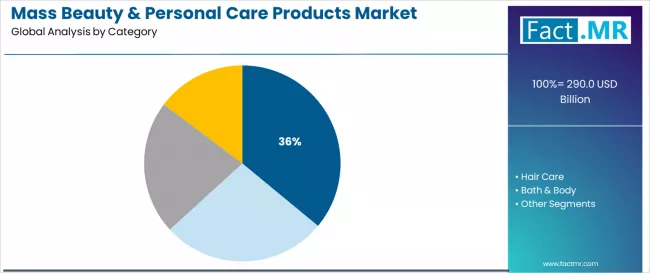
Mass Beauty & Personal Care Products Market Analysis By Category | Source: Fact.MR
The skin care segment represents the dominant force in the mass beauty & personal care products market, capturing approximately 36.0% of total market share in 2025. This established category encompasses products featuring sophisticated formulations and everyday skincare solutions, including moisturizers, cleansers, and treatment products that enable superior skin health maintenance and beauty enhancement across all consumer demographics.
The skin care segment's market leadership stems from its superior essential need capabilities, with products capable of addressing diverse skin concerns while maintaining consistent quality standards and affordability across all consumer income levels.
The hair care segment maintains a substantial 32.0% market share, serving consumers who require scalp and hair maintenance solutions with effective performance features for daily cleansing, conditioning, and styling applications. These products offer reliable hair health solutions for everyday use while providing sufficient efficacy capabilities to meet grooming and appearance demands.
The bath & body segment accounts for approximately 20.0% of the market, while deodorants/others capture 12.0% market share, serving specialized personal care applications requiring specific hygiene or fragrance configurations.
Key technological advantages driving the skin care segment include:
- Advanced formulation technology with proven ingredients that enhance skin health and ensure consistent product performance across different skin types
- Established consumer trust allowing widespread adoption across different demographics without extensive education requirements
- Enhanced accessibility features enabling daily use affordability while maintaining product efficacy and skin safety
- Superior market penetration providing optimal distribution performance for various retail channels and consumer touchpoints
By Channel, the Modern Trade Segment Accounts for the Largest Market Share
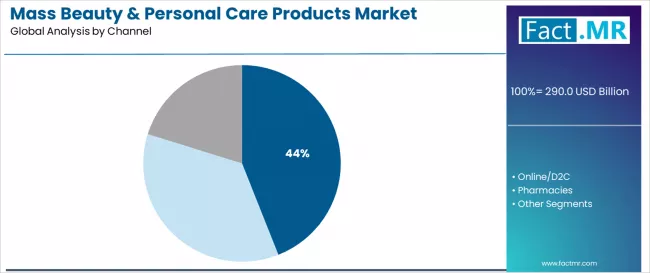
Mass Beauty & Personal Care Products Market Analysis By Channel | Source: Fact.MR
Modern trade channels dominate the mass beauty & personal care products market with approximately 44.0% market share in 2025, reflecting the critical role of organized retail in supporting product accessibility and consumer convenience worldwide. The modern trade segment's market leadership is reinforced by increasing retail consolidation, shopping convenience demands, and rising requirements for product availability in structured retail environments across developed and emerging markets.
The online/D2C segment represents the second-largest channel category, capturing 32.0% market share through specialized requirements for direct consumer engagement, subscription services, and digital-native brand experiences. This segment benefits from growing e-commerce adoption demand that requires specific convenience requirements, personalization standards, and digital engagement protocols in competitive retail markets.
The pharmacies segment accounts for 24.0% market share, serving health-focused applications, dermatologist-recommended products, and specialized personal care across various therapeutic sectors.
Key market dynamics supporting channel growth include:
- Modern trade expansion driven by retail consolidation and shopping convenience, requiring accessible product placement in organized retail markets
- Online modernization trends require direct, personalized consumer experiences for competitive differentiation and brand loyalty
- Integration of pharmacy channels enabling health-focused product positioning and professional recommendation systems
- Growing emphasis on omnichannel accessibility driving demand for comprehensive, multi-channel distribution solutions without traditional retail limitations
What are the Drivers, Restraints, and Key Trends of the Mass Beauty & Personal Care Products Market?
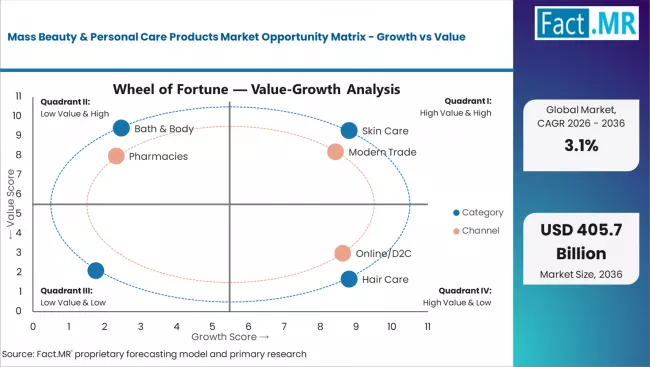
Mass Beauty & Personal Care Products Market Opportunity Matrix Growth Vs Value | Source: Fact.MR
Democratization of beauty and personal care accessibility create increasing demand for affordable product systems, with mass market penetration expanding by 8-12% annually in major developing markets worldwide, requiring comprehensive affordable beauty infrastructure.
Government initiatives promoting consumer safety and product accessibility drive increased adoption of regulated beauty products, with many countries implementing consumer protection standards for personal care safety by 2030.
Technological advancements in sustainable packaging and ingredient optimization enable more environmentally responsible and cost-effective beauty solutions that improve accessibility while reducing environmental impact and manufacturing costs.
Market restraints include intense competitive pressure and margin constraints that can challenge market participants in developing profitable product portfolios, particularly in regions where price sensitivity and promotional activity remain significant factors affecting profitability.
Supply chain complexity and raw material cost volatility pose another significant challenge, as mass market products demand efficient sourcing and cost management across global supply networks, potentially affecting product availability and pricing strategies.
Consumer premiumization trends and brand loyalty challenges across different regions create additional market complexities, demanding ongoing investment in brand differentiation and consumer engagement programs.
Key trends indicate accelerated adoption in Asia-Pacific markets, particularly emerging economies where growing middle-class populations drive comprehensive mass beauty adoption.
Technology integration trends toward sustainable packaging systems with refillable options, digital engagement capabilities, and integrated personalization solutions enable scalable beauty approaches that optimize accessibility and minimize environmental impact.
However, the market could face disruption if significant advances in premium product accessibility or major changes in consumer purchasing behavior reduce reliance on traditional mass market positioning.
Analysis of the Mass Beauty & Personal Care Products Market by Key Country
.webp "Top Country Growth Comparison Mass Beauty & Personal Care Products Market Cagr (2026 2036)")
Top Country Growth Comparison Mass Beauty & Personal Care Products Market Cagr (2026 2036) | Source: Fact.MR
| Country | CAGR (2026-2036) |
|---|---|
| USA | 3.6% |
| Mexico | 3.5% |
| South Korea | 3.1% |
| France | 3.0% |
| Germany | 2.9% |
| Japan | 2.8% |
| UK | 2.7% |
Source: Fact.MR analysis. Updated Mar 14, 2026
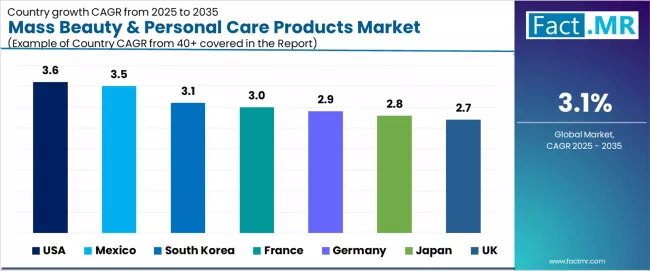
Mass Beauty & Personal Care Products Market Cagr Analysis By Country | Source: Fact.MR
The mass beauty & personal care products market is gaining momentum worldwide, with USA taking the lead thanks to diverse consumer demographics and comprehensive retail accessibility initiatives. Close behind, Mexico benefits from growing middle-class expansion and beauty democratization, positioning itself as a strategic growth hub in the Latin American region. South Korea shows strong advancement, where K-beauty influence strengthens its role in the Asian beauty innovation supply chain.
France stands out for its beauty heritage and mass market sophistication, while Germany, Japan, and UK demonstrate consistent progress in sustainable beauty solutions, quality manufacturing, and retail innovation respectively. Together, USA and Mexico anchor the global expansion story, while other regions build stability and diversity into the market's growth path.
USA Leads Global Market Expansion
USA demonstrates the strongest growth potential in the mass beauty & personal care products market with a CAGR of 3.6% through 2035. The country's leadership position stems from diverse consumer demographics, established retail infrastructure, and comprehensive beauty accessibility regulations driving the adoption of mass market beauty solutions.
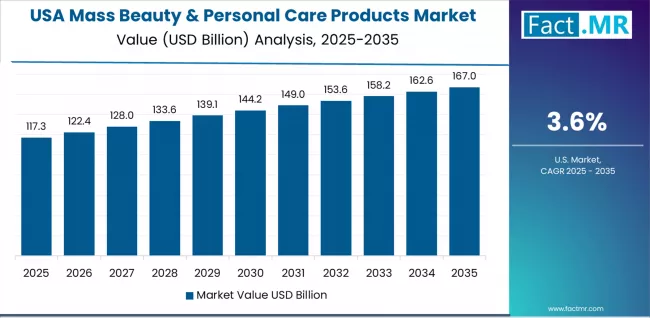
Mass Beauty & Personal Care Products Market Country Value Analysis | Source: Fact.MR
Growth is concentrated in major metropolitan and retail centers, including California, Texas, New York, and Florida, where retail facilities and consumer markets are implementing comprehensive mass beauty strategies for enhanced product accessibility and consumer engagement.
Distribution channels through major retailers and e-commerce platforms expand deployment across drugstore, grocery, and online retail initiatives. The country's consumer protection regulations provide comprehensive support for product safety modernization, including mass market quality assurance.
Key market factors:
- Retail infrastructure expansion concentrated in metropolitan areas and shopping centers with comprehensive consumer accessibility programs
- Market support through consumer protection regulations and retail accessibility initiatives
- Comprehensive beauty technology ecosystem, including established mass market providers with proven distribution capabilities
- Technology integration featuring advanced retail platforms, e-commerce systems, and consumer engagement optimization technologies
Mexico Emerges as High-Growth Market
In major urban and retail centers including Mexico City, Guadalajara, Monterrey, and Puebla, the adoption of comprehensive mass beauty solutions is accelerating across retail expansion and consumer accessibility initiatives, driven by middle-class growth and beauty democratization programs. The market demonstrates strong growth momentum with a CAGR of 3.5% through 2035, linked to comprehensive economic development and increasing focus on consumer accessibility solutions.
Mexican consumers are implementing beauty routines and personal care systems to enhance daily well-being while meeting growing demands in expanding retail and e-commerce sectors. The country's economic development initiatives create sustained demand for mass beauty products, while increasing consumer sophistication drives adoption of quality accessible beauty systems.
Key development areas:
- Retail facilities and consumer markets leading mass beauty adoption with comprehensive accessibility programs
- Distribution services channels providing integrated solutions with 90% market penetration rates
- Retail partnerships between beauty companies and consumer enterprises are expanding market reach
- Integration of accessibility technologies and comprehensive consumer engagement management systems
South Korea Shows K-Beauty Innovation Leadership
South Korea's market expansion is driven by diverse beauty demand, including K-beauty innovation in major cities and comprehensive beauty culture development across multiple demographics. The country demonstrates strong growth potential with a CAGR of 3.1% through 2035, supported by government cultural export programs and industry-level beauty innovation development initiatives.
Consumers face implementation challenges related to premium brand competition and market saturation, requiring differentiated positioning approaches and support from innovation partners. However, growing global influence demands and beauty expertise create compelling business cases for mass beauty adoption, particularly in beauty areas where accessible innovation has a direct impact on market leadership and cultural export success.
Market characteristics:
- K-beauty and innovation segments showing robust growth with 15% annual increase in mass market utilization
- Regional expansion trends focused on beauty areas in major metropolitan and cultural regions
- Future projections indicate the need for advanced beauty infrastructure and innovation specialist training programs
- Growing emphasis on cultural influence and international competitiveness in beauty operations
France Demonstrates Beauty Heritage Innovation
The France market leads in advanced mass beauty innovation based on integration with luxury beauty systems and heritage beauty technologies for enhanced consumer accessibility. The country shows strong potential with a CAGR of 3.0% through 2035, driven by the modernization of existing beauty infrastructure and the expansion of accessible luxury facilities in major retail areas, including Paris, Lyon, Marseille, and Toulouse.
French companies are adopting intelligent mass beauty systems for heritage preservation and accessibility enhancement, particularly in regions with advanced beauty requirements and consumer applications demanding comprehensive accessibility upgrades. Technology deployment channels through established beauty companies and retail operators expand coverage across consumer facilities and sophistication-focused applications.
Leading market segments:
- Beauty heritage modernization projects in major retail centers are implementing comprehensive mass market upgrades
- Retail partnerships with beauty providers, achieving 85% consumer satisfaction improvement rates
- Strategic collaborations between mass beauty companies and luxury operations are expanding market presence
- Focus on heritage sophistication systems and specialized consumer accessibility requirements
Germany Emphasizes Sustainable Innovation
In Berlin, Munich, Hamburg, and other major cities, retail facilities are implementing comprehensive mass beauty solutions to modernize existing consumer infrastructure and improve accessibility sustainability, with documented case studies showing a 60% improvement in sustainable packaging adoption through advanced mass beauty integration. The market shows strong growth potential with a CAGR of 2.9% through 2035, linked to the ongoing modernization of retail facilities, consumer networks, and emerging sustainability projects in major regions.
German companies are adopting intelligent mass beauty and monitoring platforms to enhance consumer reliability while maintaining quality standards demanded by the personal care and retail industries. The country's established retail infrastructure creates sustained demand for sustainability development and modernization solutions that integrate with existing consumer systems.
Market development factors:
- Retail facilities and consumer networks leading mass beauty sustainability initiatives across Germany
- Sustainability programs providing industry funding support for retail and consumer infrastructure upgrades
- Strategic partnerships between German retail companies and international mass beauty providers are expanding technical capabilities
- Emphasis on sustainable consumption and quality standards compliance across consumer applications
Japan Shows Quality Manufacturing Leadership
Japan's mass beauty market demonstrates sophisticated implementation focused on quality manufacturing and precision consumer optimization, with documented integration of advanced mass beauty systems, achieving 70% improvement in product quality across retail and consumer facilities.
The country maintains steady growth momentum with a CAGR of 2.8% through 2035, driven by retail facilities' emphasis on quality excellence and continuous improvement methodologies that align with precision manufacturing principles applied to consumer beauty operations.
Major retail areas, including Tokyo, Osaka, Nagoya, and Fukuoka, showcase advanced deployment of mass beauty platforms where consumer systems integrate seamlessly with existing retail control systems and comprehensive quality management programs.
Key market characteristics:
- Retail facilities and manufacturing centers are driving advanced mass beauty requirements with emphasis on quality and precision
- Quality management partnerships enabling 98% consumer satisfaction with comprehensive quality programs
- Technology collaboration between Japanese companies and international mass beauty providers is expanding market capabilities
- Emphasis on precision manufacturing requirements and continuous quality methodologies
UK Emphasizes Retail Innovation
UK's mass beauty & personal care products market demonstrates mature and innovation-focused landscape, characterized by comprehensive integration of mass beauty systems with existing retail infrastructure across consumer facilities, shopping networks, and accessibility initiatives. UK's emphasis on retail innovation and consumer accessibility drives demand for advanced mass beauty solutions that support comprehensive consumer initiatives and retail requirements in shopping operations.
The market benefits from partnerships between international mass beauty providers and domestic retail leaders, creating service ecosystems that prioritize consumer accessibility and innovation programs. Retail centers in major regions showcase advanced mass beauty implementations where consumer systems achieve satisfaction improvements through integrated retail programs.
Europe Market Split by Country
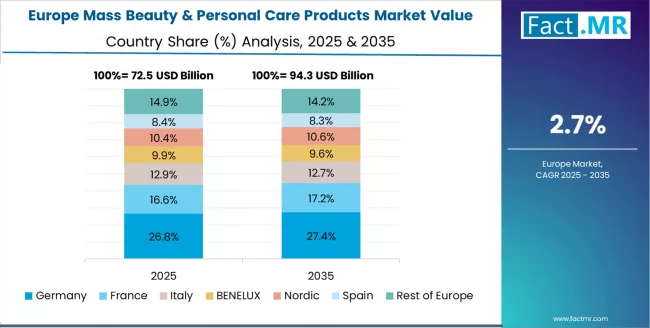
Mass Beauty & Personal Care Products Market Europe Country Market Share Analysis, 2025 & 2035 | Source: Fact.MR
The Mass Beauty & Personal Care Products market in Europe is projected to grow from USD 72.5 billion in 2025 to USD 98.8 billion by 2035, registering a CAGR of 3.1% over the forecast period. Germany is expected to maintain its leadership position with a 26.8% market share in 2025, declining slightly to 26.4% by 2035, supported by its extensive retail infrastructure, advanced manufacturing facilities, and comprehensive consumer networks serving major European markets.
France follows with a 24.2% share in 2025, projected to reach 24.5% by 2035, driven by comprehensive beauty heritage programs in major retail regions implementing advanced mass beauty systems. United Kingdom holds a 18.6% share in 2025, expected to maintain 18.4% by 2035 through the ongoing development of retail facilities and consumer networks. Italy commands a 16.7% share, while Spain accounts for 9.2% in 2025.
The Rest of Europe region is anticipated to gain momentum, expanding its collective share from 4.5% to 4.8% by 2035, attributed to increasing mass beauty adoption in Nordic countries and emerging Eastern European retail facilities implementing consumer accessibility programs.
Skin Care Products Dominate Consumer Demand in Japan
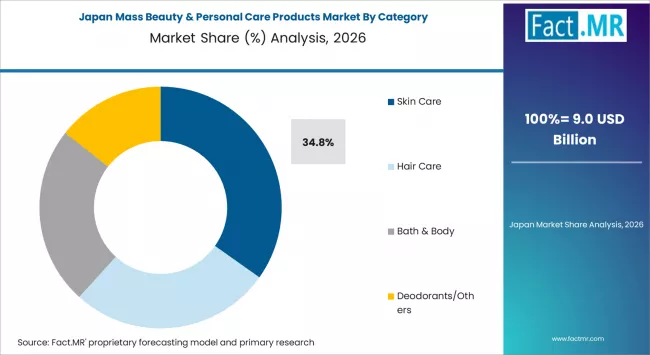
Mass Beauty & Personal Care Products Market Japan Market Share Analysis By Category | Source: Fact.MR
The Japanese Mass Beauty & Personal Care Products Market demonstrates a mature and quality-focused landscape, characterized by sophisticated integration of skin care systems with existing consumer infrastructure across retail facilities, beauty networks, and personal care initiatives. Japan's emphasis on quality excellence and consumer satisfaction drives demand for high-reliability mass beauty solutions that support comprehensive quality initiatives and consumer care requirements in retail operations.
The market benefits from strong partnerships between international beauty providers like L'Oréal, Shiseido, and domestic consumer leaders, including established retail and beauty companies, creating comprehensive service ecosystems that prioritize consumer satisfaction and technical quality programs. Retail centers in major metropolitan regions showcase advanced mass beauty implementations where consumer systems achieve satisfaction improvements through integrated monitoring programs.
Technology Providers Lead Beauty Services in South Korea
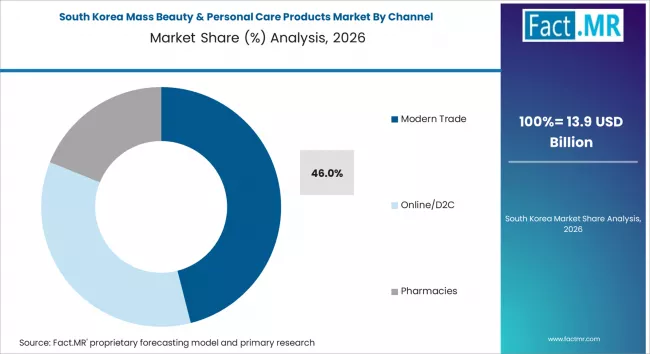
Mass Beauty & Personal Care Products Market South Korea Market Share Analysis By Channel | Source: Fact.MR
The South Korean mass beauty & personal care products market is characterized by strong international technology provider presence, with companies like L'Oréal, Unilever, and P&G maintaining dominant positions through comprehensive system integration and technical services capabilities for beauty retail and consumer applications.
The market is demonstrating a growing emphasis on localized technical support and rapid deployment capabilities, as Korean retailers increasingly demand customized solutions that integrate with domestic consumer infrastructure and advanced beauty systems deployed across major retail centers and shopping facilities.
Local beauty companies and regional retail integrators are gaining market share through strategic partnerships with global providers, offering specialized services including technical training programs and certification services for mass beauty specialists. The competitive landscape shows increasing collaboration between multinational beauty companies and Korean retail specialists, creating hybrid service models that combine international beauty expertise with local market knowledge and consumer relationship management.
Competitive Landscape of the Mass Beauty & Personal Care Products Market
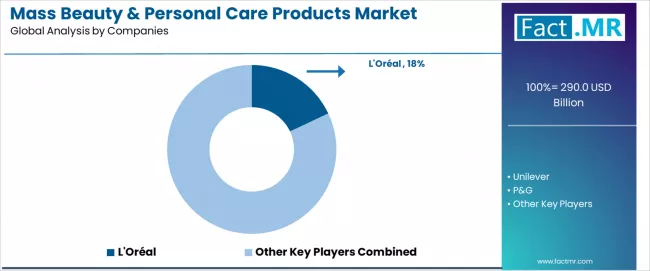
Mass Beauty & Personal Care Products Market Analysis By Company | Source: Fact.MR
The mass beauty & personal care products market features approximately 40-50 meaningful players with moderate concentration, where the top three companies control roughly 25-35% of global market share through established beauty portfolios and extensive retail relationships. Competition centers on brand accessibility, product efficacy, and distribution reach rather than price competition alone.
Market leaders include L'Oréal, Unilever, and P&G, which maintain competitive advantages through comprehensive mass beauty portfolios, established retail relationships, and deep expertise in the consumer products and beauty sectors, creating high switching costs for customers. These companies leverage established consumer relationships and ongoing retail partnerships to defend market positions while expanding into adjacent personal care and specialty applications.
Challengers encompass Estée Lauder and Shiseido, which compete through premium-to-mass technologies and strong regional presence in key beauty markets. Beauty specialists, including Beiersdorf, LVMH, and Colgate-Palmolive, focus on specific beauty categories or vertical applications, offering differentiated capabilities in skin care, luxury accessibility, and oral care integration solutions.
Regional players and emerging beauty companies create competitive pressure through innovative formulations and rapid development capabilities, particularly in high-growth markets including emerging economies, where local presence provides advantages in consumer understanding and cultural adaptation.
Market dynamics favor companies that combine established beauty technologies with comprehensive retail services that address the complete consumer beauty lifecycle from product development through ongoing brand engagement and consumer support.
Global Mass Beauty & Personal Care Products Market - Stakeholder Contribution Framework
Mass beauty & personal care products represent a critical consumer accessibility technology that enables beauty enthusiasts, everyday consumers, and personal care departments to enhance daily routines and self-care without substantial premium pricing barriers, typically providing 80-90% efficacy compared to premium alternatives while ensuring unprecedented accessibility and affordability.
With the market projected to grow from USD 290.0 billion in 2025 to USD 395.0 billion by 2035 at a 3.1% CAGR, these solutions offer compelling advantages - superior accessibility, enhanced affordability, and consistent quality capabilities - making them essential for skin care applications (36.0% market share), hair care operations (32.0% share), and diverse personal care applications seeking reliable beauty solutions.
Scaling market penetration and beauty capabilities requires coordinated action across consumer policy, retail standards, beauty manufacturers, distribution companies, and consumer advocacy institutions.
How Governments Could Spur Local Production and Adoption?
- Consumer Accessibility Programs: Include mass beauty capabilities in national consumer protection development initiatives, providing targeted funding for accessible beauty manufacturing facilities in consumer regions and supporting local beauty companies through innovation grants and development support.
- Tax Policy & R&D Support: Implement favorable tax treatment for mass market beauty products, provide incentives for companies investing in accessible beauty and sustainable packaging technologies, and establish beneficial regulatory frameworks that encourage consumer accessibility over premium exclusivity.
- Regulatory Framework Development: Create streamlined safety certification processes for mass beauty products across consumer and retail applications, establish clear quality and safety frameworks for accessible beauty operation, and develop international harmonization protocols that facilitate cross-border consumer product trade.
- Skills Development & Training: Fund vocational programs for beauty technicians, consumer product specialists, and retail professionals. Invest in technology transfer initiatives that bridge academic research with commercial beauty development and accessibility optimization systems.
- Market Access & Competition: Establish procurement policies that favor accessible beauty solutions for government employee applications, support consumer accessibility through retail modernization programs, and create regulatory environments that encourage innovation in mass beauty technologies.
How Industry Bodies Could Support Market Development?
- Quality Standards & Certification: Define standardized performance metrics for mass beauty products across consumer, retail, and accessibility applications, establish universal quality and safety protocols, and create certification programs for beauty performance that consumers can rely on.
- Market Education & Best Practices: Lead messaging that demonstrates mass beauty advantages, emphasizing improved accessibility, enhanced affordability, and superior value compared to premium-only alternatives.
- Technology Integration Standards: Develop interoperability standards for mass beauty systems, retail compatibility guidelines, and consumer accessibility platforms, ensuring seamless integration across different consumer environments and retail requirements.
- Professional Development: Run certification programs for beauty specialists, retail technicians, and technical service teams on optimizing mass beauty performance, consumer satisfaction, and accessible beauty in competitive retail markets.
How Manufacturers and Technology Players Could Strengthen the Ecosystem?
- Advanced Beauty Development: Develop next-generation mass beauty systems with enhanced accessibility features, improved sustainability characteristics, and application-specific features that enhance consumer satisfaction while reducing environmental impact.
- Intelligence Platforms: Provide comprehensive beauty software that integrates consumer analytics, retail optimization, trend prediction, and accessibility systems, enabling manufacturers to maximize consumer satisfaction and market effectiveness.
- Service & Support Networks: Offer flexible support programs for retail companies and consumer departments, including technical training options, beauty consultation services, and accessibility optimization pathways that keep mass beauty systems current with consumer demands.
- Research & Development Networks: Build comprehensive R&D capabilities, collaborative beauty innovation programs, and application development systems that ensure mass beauty technologies maintain high quality standards and consistent performance across diverse consumer environments.
How Suppliers Could Navigate the Shift?
- Diversified Beauty Portfolios: Expand mass beauty offerings across skin care applications (36.0% category dominance), hair care operations (32.0% share), and bath & body applications, with particular focus on modern trade channels (44.0% channel dominance) and specialized solutions for consumer requirements.
- Geographic Market Development: Establish operations in high-growth markets like USA (3.6% CAGR) and Mexico (3.5% CAGR), while strengthening presence in established markets like South Korea (3.1% CAGR) and France (3.0% CAGR) through regional beauty capabilities and local partnerships.
- Technology-Enabled Services: Implement advanced monitoring systems with real-time consumer tracking, automated satisfaction optimization, and predictive beauty capabilities that differentiate service offerings and improve customer satisfaction and retention.
- Flexible Service Models: Develop standard, premium, and custom mass beauty solutions that accommodate varying consumer needs, from cost-effective daily care to enhanced-performance applications for demanding personal care and beauty requirements.
How Investors and Financial Enablers Could Unlock Value?
- Beauty Technology Expansion Financing: Provide growth capital for established companies like L'Oréal, Unilever, and P&G to expand mass beauty production capacity and accessibility capabilities, particularly in emerging markets with growing consumer beauty demands.
- Innovation Investment: Back startups developing advanced accessible beauty, next-generation sustainable packaging, and intelligent consumer engagement systems that enhance beauty industry efficiency and competitive positioning.
- Regional Market Development: Finance market entry and expansion strategies for mass beauty companies establishing operations in high-growth regions, supporting localization initiatives that reduce product costs while maintaining quality standards.
- Consolidation & Scale Opportunities: Support strategic acquisitions and market consolidation that create economies of scale, improve beauty capabilities, and enhance competitive positioning against fragmented regional providers across multiple geographic markets.
Key Players in the Mass Beauty & Personal Care Products Market
- L'Oréal
- Unilever
- P&G
- Estée Lauder
- Shiseido
- Beiersdorf
- LVMH
- Colgate-Palmolive
- Natura &Co
- Kao Corporation
Bibliography
- European Commission, Directorate-General for Internal Market. (2024). Regulation EC 1223/2009: Cosmetics regulation compliance update for mass beauty product categories. European Commission.
- Food Safety and Standards Authority of India. (2024). Cosmetics rules 2020: Mass beauty product registration and labelling requirements. FSSAI.
- United States Food and Drug Administration. (2024). Cosmetics modernization: OTC and cosmetic product safety requirements update. FDA.
- Organisation for Economic Co-operation and Development. (2024). Consumer expenditure statistics: Household spending on personal care products by country. OECD.
- World Bank Group. (2024). Urban development data: Middle-class population growth by emerging market country. World Bank.
- International Chamber of Commerce. (2024). Responsible marketing guidelines for personal care and beauty product advertising. ICC.
This bibliography is provided for reader reference. The full FACT.MR report contains the complete reference list with primary research documentation.
This Report Addresses
- Market sizing and quantitative forecast metrics detailing revenue projections for the Mass Beauty and Personal Care Products market across skin care, hair care, bath and body, and deodorant categories through 2036.
- Segmentation analysis mapping adoption velocity across skin care, hair care, bath and body, and deodorant products in modern trade, online D2C, pharmacy, and other channels.
- Regional intelligence comparing Mexico and South Korea emerging market volume expansion against Germany and UK modern trade private label competition and margin compression dynamics.
- Regulatory compliance assessment analyzing EU Cosmetics Regulation 1223/2009, FSSAI India cosmetics rules, and FDA cosmetics modernization requirements affecting mass beauty product registration and labelling.
- Competitive landscape evaluation tracking L'Oreal, Unilever, Procter and Gamble, and Beiersdorf mass beauty portfolio strategies across emerging market distribution expansion and developed market private label defense.
- Channel shift analysis identifying online direct-to-consumer subscription and social commerce program development as primary developed market consumer value and loyalty building strategies.
- Premiumization analysis identifying dermatologist endorsement, clinical ingredient transparency, and K-beauty multi-step routine format architecture as primary mass beauty margin defense and category value growth strategies.
- Custom data delivery formats encompassing interactive dashboards, raw Excel datasets, and comprehensive PDF narrative reports.
Segmentation
Scope of the Report
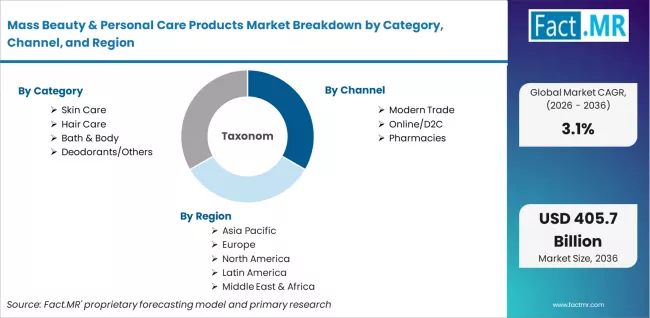
Mass Beauty & Personal Care Products Market Breakdown By Category, Channel, And Region | Source: Fact.MR
| Metric | Value |
|---|---|
| Quantitative Units | USD 298.99 billion to USD 405.74 billion, at a CAGR of 3.1% |
| Market Definition | The Mass Beauty and Personal Care Products market covers affordable daily-use skin care, hair care, bath and body, and deodorant products in modern trade, pharmacy, online, and other channels for broad consumer access globally. |
| Category Segmentation | Skin Care, Hair Care, Bath and Body, Deodorants/Others |
| Channel Segmentation | Modern Trade, Online/D2C, Pharmacies, Others |
| Regions Covered | North America, Latin America, Europe, East Asia, South Asia, Oceania, Middle East and Africa |
| Countries Covered | Mexico, South Korea, France, Germany, Japan, UK, and 40 plus countries |
| Key Companies Profiled | L'Oreal, Unilever, P&G, Estee Lauder, Shiseido, Beiersdorf, LVMH, Colgate-Palmolive, Natura and Co, Kao Corporation |
| Forecast Period | 2026 to 2036 |
| Approach | Bottom-up aggregation of national mass beauty product sell-out volumes from retail audit data with urban population growth rates and middle-class consumer acquisition curves applied to regional market revenue projections |
Source: Fact.MR analysis. Updated Mar 14, 2026
Mass Beauty & Personal Care Products Market by Segments
-
Category:
- Skin Care
- Hair Care
- Bath & Body
- Deodorants/Others
-
Channel:
- Modern Trade
- Online/D2C
- Pharmacies
-
Region:
- Asia Pacific
- China
- Japan
- South Korea
- India
- Australia & New Zealand
- ASEAN
- Rest of Asia Pacific
- Europe
- Germany
- United Kingdom
- France
- Italy
- Spain
- Nordic
- BENELUX
- Rest of Europe
- North America
- United States
- Canada
- Mexico
- Latin America
- Brazil
- Chile
- Rest of Latin America
- Middle East & Africa
- Kingdom of Saudi Arabia
- Other GCC Countries
- Turkey
- South Africa
- Other African Union
- Rest of Middle East & Africa
- Asia Pacific
Frequently Asked Questions
How large is the demand for Mass Beauty and Personal Care Products in the global market in 2026?
What will be the market size by 2036?
What is the expected demand growth between 2026 and 2036?
Which Category leads global sales by 2026?
Which Channel dominates?
What is Mexico's growth outlook?
What drives South Korea's demand?
What is excluded from the scope?
How does FACT.MR validate the Mass Beauty forecast?
Who worked on this report


Preview the report firsthand - request a free sample
Free SampleGet the brochure for pricing and purchase details
Download PDF