- Base Value(2025): 2.4 Bn
- Estimated Value(2026): 2.6 Bn
- Forecast Value (2036): 4.9 Bn
- CAGR (2026 - 2036): 6.6%
What is the deep-rooting stimulus fertilizer additive market forecast to be worth by 2036?
- In 2025, the deep-rooting stimulus fertilizer additive market was valued at USD 2.4 billion.
- Based on Fact.MR estimates, demand for deep-rooting stimulus fertilizer additives is estimated to grow to USD 2.6 billion in 2026 and USD 4.9 billion by 2036.
- Fact.MR projects a CAGR of 6.6% during the forecast period.
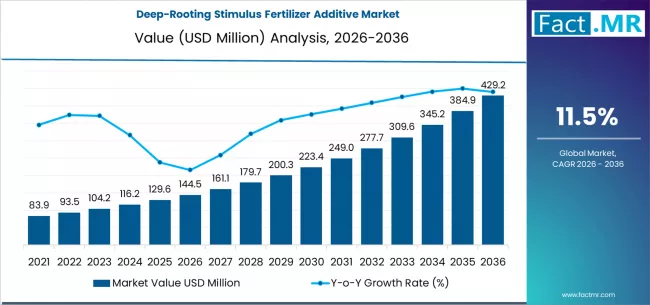
Deep Rooting Stimulus Fertilizer Additive Market Market Value Analysis | Source: Fact.MR
Summary of Deep-Rooting Stimulus Fertilizer Additive Market
- Market Definition
- The market includes fertilizer-compatible additives designed to support stronger root establishment, deeper rooting, and improved resource capture during crop growth.
- Demand Drivers
- Root architectural traits are closely tied to better plant performance under low nutrient and low water availability, which supports demand for deep-rooting stimulus inputs.
- Starter fertilizer systems remain commercially important because phosphorus-rich formulations are associated with healthy root development in new plantings and early crop establishment.
- Plant biostimulant positioning is widening the market because these products are increasingly linked with nutrient uptake, stress tolerance, and growth improvement.
- Key Segments Analyzed
- By Additive Type: Phosphorus-rich rooting additives are estimated to lead with approximately 34% share in 2026, supported by their long-standing association with early root development.
- By Application: Starter fertilizer blends are expected to hold approximately 37% share in 2026, driven by practical fit in crop-establishment programs.
- By Crop Type: Cereals & grains are projected to account for approximately 31% share in 2026, supported by large-acre crop establishment needs and drought-exposure logic.
- By End Use: Large farms are expected to contribute approximately 28% share in 2026, backed by wider use of precision nutrient placement and starter systems.
- By Geography: India leads growth at 8.1% CAGR through 2036, supported by stronger need for root-centered crop establishment and water-efficiency improvement.
- Analyst Opinion at Fact.MR
- Shambhu Nath Jha, Senior Analyst at Fact.MR, notes, “CXOs should read this market as a crop-establishment and stress-preparation category rather than a narrow specialty-input segment. Buyers are paying for more resilient root architecture that can improve the crop’s ability to search for water and nutrients under real field pressure.”
- Strategic Implications
- Invest in additive formats that fit starter fertilizer, in-furrow, and transplant-establishment systems.
- Build technical sales capability around root-depth value, early vigor, and water-stress management rather than only nutrient analysis.
- Position seaweed, amino acid, and microbial rooting products where growers want stronger early establishment without major changes to fertilizer schedules.
- Methodology
- Market sizing uses crop-establishment relevance, transplant intensity, root-development value, and adoption potential across deep-rooting additive programs.
- Analysis includes extension guidance on root-supportive fertilizer use and USDA plus peer-reviewed literature on plant biostimulants and root traits.
- Forecasts account for drought-exposure concerns, starter fertilizer adoption, and broader acceptance of root-centered crop-management inputs.
The market is projected to generate USD 2.3 billion in absolute opportunity between 2026 and 2036. Growth is being supported by stronger interest in root-centered crop establishment, better drought preparedness, and higher-value use of starter fertilizer systems. Extension materials continue to associate phosphorus starter fertilizers with healthy root development, while agronomy literature links nutrient management and biostimulant use with stronger root traits in early crop growth. That is improving the commercial case for additives that are sold specifically to push earlier and deeper rooting rather than only to raise total fertilizer dose.
India is projected to lead with a CAGR of 8.1% through 2036, driven by wider need for drought-tolerant crop establishment and stronger use of starter and specialty nutrition in intensive cropping systems. Brazil follows at 7.5% CAGR from 2026 to 2036, supported by broad-acre production and stronger value placed on root-driven stress resilience. The United States is expected to grow at 7.0% CAGR by 2036, underpinned by precision nutrient management and biostimulant adoption in row crops and specialty systems. Canada records 6.5% CAGR from 2026 to 2036, supported by crop-establishment focus in short growing windows. Mexico grows at 6.0% CAGR through 2036, backed by irrigated horticulture and transplant-intensive production. This range reflects differences in water stress, transplant use, starter fertilizer adoption, and willingness to use biostimulant-style root development programs.
How does the deep-rooting stimulus fertilizer additive market break down by segment?
Deep-Rooting Stimulus Fertilizer Additive Market Analysis by Additive Type
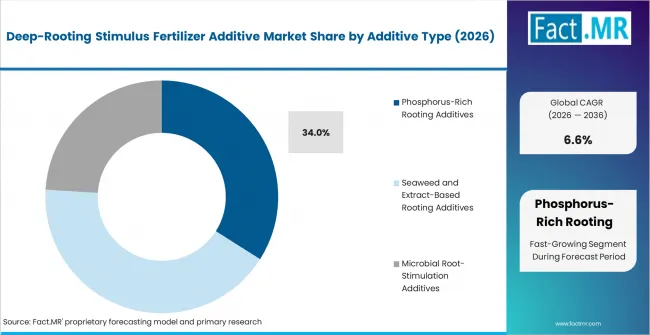
Deep Rooting Stimulus Fertilizer Additive Market Analysis By Additive Type | Source: Fact.MR
Phosphorus-rich rooting additives are estimated to hold 34% share in 2026. They lead because phosphorus has long been tied to early root growth and establishment, and starter fertilizer guidance continues to frame phosphorus-rich formulations around healthy root development. Seaweed and extract-based rooting additives remain commercially relevant because current agronomy reviews link biostimulants with hormone signaling and stress-response pathways that affect root development. Amino acid, protein hydrolysate, and microbial root-stimulation products are also expanding where growers want a root-growth benefit without shifting away from current nutrient programs. Product leadership in this segment depends on how effectively the additive improves early root exploration or deeper rooting without creating complexity in fertilizer handling.
- Phosphorus Anchor: Starter fertilizer guidance continues to associate phosphorus with healthy root development in new plantings and early growth.
- Biostimulant Expansion: Reviews describe biostimulants as supporting growth and stress tolerance through biological pathways relevant to rooting.
- Program Fit: Amino acid and microbial products gain traction where growers want root stimulation with minimal change to fertilizer placement routines.
Deep-Rooting Stimulus Fertilizer Additive Market Analysis by Application
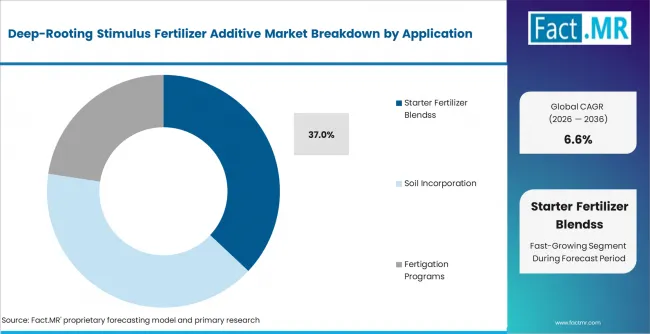
Deep Rooting Stimulus Fertilizer Additive Market Analysis By Application | Source: Fact.MR
Starter fertilizer blends are expected to reach 37% share in 2026, as the starter systems already sit close to the seed or early root zone and are widely used to support crop establishment. Extension guidance indicates that fertilizer placement matters for root access and that starter fertilizers promote healthy root development, which strengthens the commercial fit of root-stimulus additives inside these programs. Seed treatment and in-furrow use remain important where early root initiation and transplant establishment are commercially sensitive. Fertigation programs are gaining relevance in vegetables, greenhouse systems, and specialty crops, though broad-acre commercial use still favors starter and placement-based delivery because these formats act closest to the early rooting zone.
- Placement Advantage: Rooting products gain stronger relevance when placed where early roots can access them quickly.
- Starter System Strength: Starter fertilizers remain the easiest commercial route for root-growth additives in broad-acre agriculture.
- Specialty Crop Flexibility: Fertigation and transplant programs matter more in vegetables and high-management horticulture.
Deep-Rooting Stimulus Fertilizer Additive Market Analysis by Crop Type
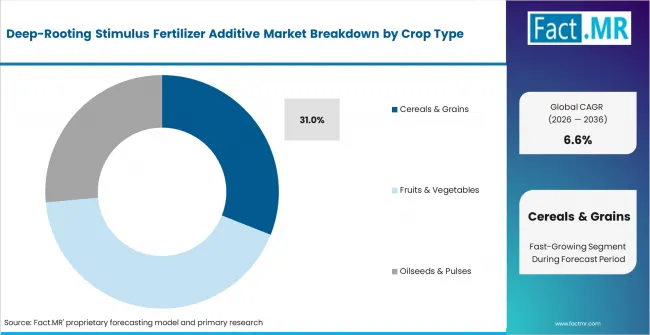
Deep Rooting Stimulus Fertilizer Additive Market Analysis By Crop Type | Source: Fact.MR
Cereals & grains are projected to account for approximately 31% share in 2026. They lead because crop-establishment quality and drought resilience carry broad economic importance across large acreages, and root architecture is directly tied to water and nutrient acquisition in these systems. Fruits and vegetables remain attractive where transplant establishment and rapid early vigor matter more visibly, while oilseeds and pulses also offer opportunity where root-system depth influences performance under variable water conditions. Crop leadership in this market is shaped by establishment risk and stress exposure rather than by yield value alone.
- Broad-Acre Logic: Grain systems create the largest commercial base because rooting improvements can matter across large planted areas.
- Water-Search Value: Root architecture matters strongly where crops must capture water and nutrients under limiting conditions.
- Transplant Pull: Vegetables and horticulture create strong high-value demand where early root establishment affects uniformity and crop quality.
What is accelerating deep-rooting stimulus fertilizer additive adoption, and what is holding it back?
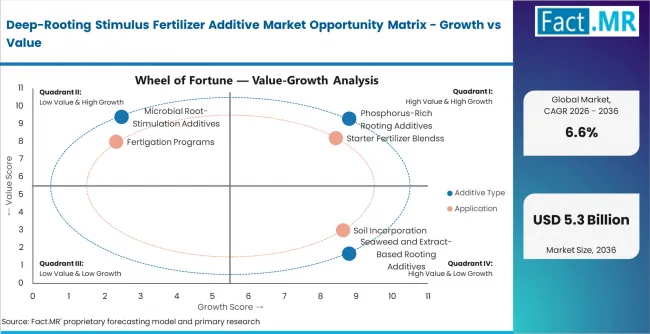
Deep Rooting Stimulus Fertilizer Additive Market Opportunity Matrix Growth Vs Value | Source: Fact.MR
The deep-rooting stimulus fertilizer additive market is being shaped by the growing need to improve crop establishment under nutrient and water pressure. Structural demand is anchored in the fact that root architecture determines how effectively plants can search for water and nutrients, especially under limiting conditions. Root-ideotype literature and USDA biostimulant guidance both support the commercial idea that better rooting can improve crop resilience and resource-use efficiency, which gives deep-rooting additives a credible agronomic foundation.
The main restraint is proof variability. Root growth is influenced by soil type, moisture, placement, genotype, and crop system, so not every additive performs uniformly in every field. This increases the proof burden for suppliers, especially where products are sold beyond phosphorus-based starter systems into broader biostimulant territory. Another restraint is that growers often need visible early-season evidence before paying for a root-directed input that may not show immediate above-ground response.
- Starter Program Expansion: Root-stimulation products have the clearest opportunity where they can be bundled into existing starter fertilizer and in-furrow systems.
- Drought-Preparedness Demand: Additives that support deeper or more active rooting gain value where water stress is a recurring yield risk.
- Biostimulant Integration: Seaweed, amino acid, and microbial formats create higher-value opportunity where growers want root improvement without raising fertilizer dose materially.
Which countries are scaling deep-rooting stimulus fertilizer additive demand fastest?
The deep-rooting stimulus fertilizer additive market is assessed across North America, Europe, Asia Pacific, Latin America, and Middle East and Africa, covering 40+ countries with demand profiles shaped by drought exposure, starter fertilizer adoption, transplant intensity, and acceptance of plant biostimulant-style crop-establishment inputs.
.webp "Top Country Growth Comparison Deep Rooting Stimulus Fertilizer Additive Market Cagr (2026 2036)")
Top Country Growth Comparison Deep Rooting Stimulus Fertilizer Additive Market Cagr (2026 2036) | Source: Fact.MR
| Country | CAGR (2026 to 2036) |
|---|---|
| India | 8.1% |
| Brazil | 7.5% |
| United States | 7.0% |
| Canada | 6.5% |
| Mexico | 6.0% |
Source: Fact.MR analysis. Updated Jun 15, 2026
Source: Fact.MR analysis, based on proprietary forecasting model and primary research
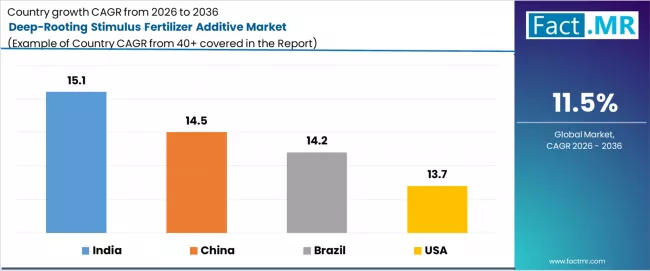
Deep Rooting Stimulus Fertilizer Additive Market Cagr Analysis By Country | Source: Fact.MR
North America Deep-Rooting Stimulus Fertilizer Additive Market Analysis
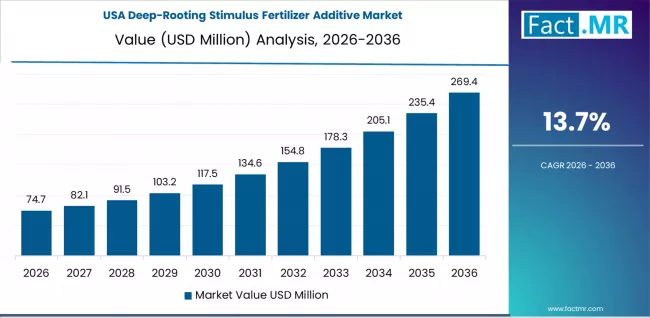
Deep Rooting Stimulus Fertilizer Additive Market Country Value Analysis | Source: Fact.MR
North America remains an important commercial region because it combines broad use of starter fertilizer systems, higher awareness of phosphorus placement, and growing interest in plant biostimulants for crop establishment. Demand is strongest where water stress, early-season root establishment, and precision placement already shape crop-management decisions. The region also benefits from strong extension culture around fertilizer placement and root-supportive starter systems.
- United States: Precision nutrient placement and the wider use of starter fertilizers continue to support demand across the United States. The market is projected to expand at a CAGR of 7.0% through 2036, driven by increasing focus on early-stage crop vigor, uniform germination, and yield optimization. Adoption is particularly strong in row crops and large-scale commercial farming where improving root development translates directly into better nutrient uptake and overall productivity.
- Canada: Short growing windows and a strong emphasis on reliable crop establishment support adoption across Canada. Deep-rooting stimulus fertilizer additive demand is expected to grow at a CAGR of 6.5% through 2036, as growers prioritize early root strength to maximize limited seasonal conditions. Use is especially relevant in cereals and oilseeds where consistent emergence and resilience are critical for achieving stable yields.
- Mexico: Irrigated horticulture and transplant-intensive farming systems create a practical fit for root-establishment additives in Mexico. Sales of deep-rooting stimulus fertilizer additives are likely to rise at a CAGR of 6.0% during the forecast period, supported by high-value crops and controlled irrigation practices. Growers are increasingly adopting these inputs to improve transplant success rates, enhance root mass, and maintain crop consistency under variable growing conditions.
Asia Pacific and Latin America Deep-Rooting Stimulus Fertilizer Additive Market Analysis
Asia Pacific and Latin America offer the strongest long-term expansion potential because water stress, transplant-intensive crops, and broad-acre establishment risk remain commercially important across these regions. Demand is likely to strengthen where growers move from simple nutrient application toward root-centered crop-establishment strategies. Adoption depends on channel education, water-stress management priorities, and the ability of suppliers to show that deeper rooting improves crop stability rather than only early vigor.
- India: Crop-establishment pressure and the need for stronger, drought-resilient rooting continue to support demand across India. The market is projected to grow at an 8.1% CAGR through 2036, driven by variable rainfall patterns and increasing focus on early-stage crop stability. Adoption is rising in cereals, pulses, and horticulture where deeper root systems help improve nutrient uptake and moisture retention, especially in semi-arid regions and irrigated farming belts.
- Brazil: Broad-acre farming practices and the need for stress-resilient crop establishment support expansion in Brazil. Deep-rooting stimulus fertilizer additive demand is expected to rise at a 7.5% CAGR through 2036, supported by large-scale cultivation of crops such as soybeans, corn, and sugarcane. Growers are increasingly using these inputs to enhance root development, improve soil interaction, and maintain yield consistency under fluctuating climate conditions.
Who leads the deep-rooting stimulus fertilizer additive market landscape?
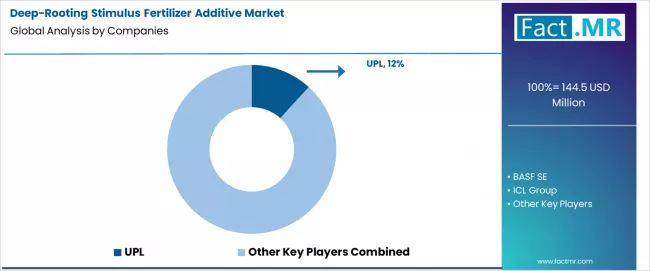
Deep Rooting Stimulus Fertilizer Additive Market Analysis By Company | Source: Fact.MR
The deep-rooting stimulus fertilizer additive market is moderately concentrated at the formulation level, while distribution and technical support remain fragmented. Competitive strength comes from the ability to connect a product with clear root-development logic rather than only with a general yield claim. Suppliers need more than a growth-promotion statement. They need a credible explanation of how the additive works through starter nutrition, hormone-like biostimulation, microbial interaction, or nutrient-placement support.
Competitive advantage is defined by field fit, compatibility with fertilizer systems, and the ability to show measurable improvement in establishment or rooting behavior. Phosphorus-linked products benefit from familiar starter fertilizer logic. Biostimulant-style products benefit from the broader expansion of natural-origin stimulators and biological crop-management inputs. Buyers in this market usually choose on technical confidence and crop-establishment value rather than on nutrient content alone. Buyer dynamics vary by crop intensity and water risk. Large farms and precision operations are more likely to adopt first because they can justify root-establishment products through acreage and input efficiency. Broader adoption will depend on whether suppliers can demonstrate that the additive improves real field resilience rather than only early visual growth. Competitive intensity is therefore rising fastest in drought-aware and transplant-sensitive crop programs rather than in general bulk fertility.
Which companies are the key players?
- Yara International ASA
- ICL Group Ltd.
- Nutrien Ltd.
- UPL Ltd.
- Haifa Group
- Coromandel International Ltd.
- The Mosaic Company
- Nufarm Limited
- Syngenta Biologicals / Valagro
Bibliography
- Yara International ASA. (2026). YaraAmplix™: Biostimulants. Yara International ASA.
- Yara International ASA. (2023). Plant biostimulants. Yara International ASA.
- ICL Group Ltd. (2025, January 28). BEOZ® products: A new era in farming with ICL. ICL Growing Solutions.
- ICL Group Ltd. (2026). Biostimulants & enhanced nutrient fertilizers. ICL Growing Solutions.
This Report Addresses
- Strategic intelligence on deep-rooting stimulus fertilizer additive demand across starter fertilizer, transplant-establishment, and drought-aware crop systems.
- Growth opportunity mapping across phosphorus-rich, seaweed-based, humic, amino acid, and microbial root-stimulation additives.
- Segment analysis by additive type, application, crop type, and end use.
- Regional outlook covering North America, Europe, Asia Pacific, Latin America, and Middle East and Africa.
- Competitive analysis of Yara International, ICL Group, Nutrien, UPL, Haifa Group, EuroChem, and other participants.
- Root-establishment analysis covering starter fertilizer fit, drought-preparedness value, root architecture logic, and biostimulant integration.
- Report delivered in PDF, Excel datasets, and presentation formats. Supported by primary interviews, extension guidance, and published agronomy literature.
What does the deep-rooting stimulus fertilizer additive market cover?
The market covers fertilizer-compatible additives designed to stimulate stronger, earlier, or deeper root development in crop plants. It includes additives used in starter fertilizers, in-furrow systems, fertigation, seed treatment, and related crop-establishment programs where root extension, root mass, root depth, or root activity are the primary commercial goals rather than nutrient supply alone.
Deep-Rooting Stimulus Fertilizer Additive Market Inclusions
Covers global and regional forecasts from 2026 to 2036. Includes phosphorus-rich rooting additives, seaweed and extract-based rooting aids, humic and fulvic products, amino acid and protein hydrolysate formulations, and microbial root-stimulation additives sold with fertilizer or nutrient-delivery programs. Covers products positioned for crop establishment, transplant recovery, stronger early vigor, and improved root exploration under nutrient or water stress.
Deep-Rooting Stimulus Fertilizer Additive Market Exclusions
Excludes conventional bulk fertilizers sold only for nutrient supply without a rooting-stimulation claim or function. Omits general biostimulants not positioned for root development, irrigation hardware, and broad soil conditioners that are not commercially framed as root-establishment or deep-rooting fertilizer additives. It also excludes seed varieties bred for root architecture unless they are paired with an actual additive product.
Deep-Rooting Stimulus Fertilizer Additive Market Research Methodology
- Primary Research
- Interviews with crop-establishment agronomy teams, transplant and starter fertilizer specialists, greenhouse nutrition managers, input distributors, seedling program advisors, and large-farm nutrient managers across key agricultural regions.
- Desk Research
- Uses extension materials on phosphorus-driven root development, USDA guidance on plant biostimulants, and agronomy literature on root architecture, nutrient management, and biostimulant-linked root stimulation.
- Market-Sizing and Forecasting
- Hybrid model using crop-establishment relevance, water-stress exposure, starter fertilizer fit, transplant intensity, and adoption potential across fertilizer-compatible root-stimulation programs.
- Data Validation and Update Cycle
- Validated using extension guidance, root-development agronomy literature, published plant biostimulant reviews, and recurring checks on crop-establishment and drought-management use cases.
Segmentation
What is the report’s scope and coverage?
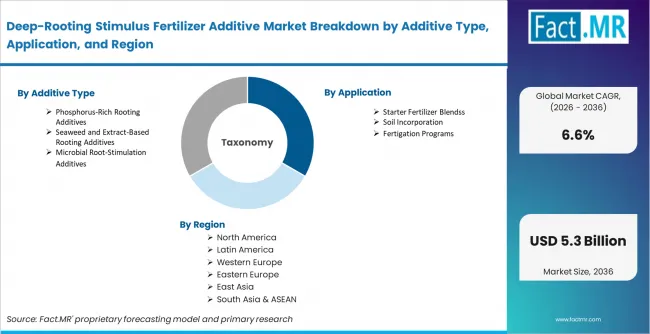
Deep Rooting Stimulus Fertilizer Additive Market Breakdown By Additive Type, Application, And Region | Source: Fact.MR
| Attribute | Details |
|---|---|
| Quantitative Units | USD billion (2026) to USD billion (2036), at a CAGR |
| Market Definition | Fertilizer-compatible additives designed to stimulate stronger, earlier, or deeper root development, improving crop establishment and water- and nutrient-capture capacity. |
| Additive Type Segmentation | Phosphorus-Rich Rooting Additives, Seaweed and Extract-Based Rooting Additives, Humic and Fulvic Rooting Additives, Amino Acid and Protein Hydrolysate Rooting Additives, Microbial Root-Stimulation Additives, Others |
| Application Segmentation | Starter Fertilizer Blends, Seed Treatment and In-Furrow Programs, Soil Incorporation, Fertigation Programs, Others |
| Crop Type Segmentation | Cereals & Grains, Fruits & Vegetables, Oilseeds & Pulses, Plantation Crops, Turf & Ornamentals, Others |
| Regions Covered | North America, Europe, Asia Pacific, Latin America, Middle East and Africa |
| Countries Covered | United States, Canada, Mexico, Spain, Netherlands, Germany, France, India, China, Australia, Brazil, Argentina, and 40+ countries |
| Key Companies Profiled | Yara International ASA, ICL Group Ltd., Nutrien Ltd., UPL Ltd., Haifa Group, Coromandel International Ltd., The Mosaic Company, Nufarm Limited, Syngenta Biologicals / Valagro |
| Forecast Period | 2026 to 2036 |
| Approach | Hybrid top-down and bottom-up model using crop-establishment relevance, starter fertilizer fit, water-stress exposure, root-development value, and primary interviews with growers, distributors, and agronomy teams. |
Source: Fact.MR analysis. Updated Jun 15, 2026
How is the market segmented?
-
By Additive Type:
- Phosphorus-Rich Rooting Additives
- Seaweed and Extract-Based Rooting Additives
- Humic and Fulvic Rooting Additives
- Amino Acid and Protein Hydrolysate Rooting Additives
- Microbial Root-Stimulation Additives
- Others
-
By Application:
- Starter Fertilizer Blends
- Seed Treatment and In-Furrow Programs
- Soil Incorporation
- Fertigation Programs
- Others
-
By Crop Type:
- Cereals & Grains
- Fruits & Vegetables
- Oilseeds & Pulses
- Plantation Crops
- Turf & Ornamentals
- Others
-
By Region:
- North America
- United States
- Canada
- Latin America
- Brazil
- Mexico
- Argentina
- Chile
- Rest of Latin America
- Western Europe
- Germany
- France
- United Kingdom
- Italy
- Spain
- Nordic Countries
- BENELUX
- Rest of Western Europe
- Eastern Europe
- Russia
- Poland
- Hungary
- Balkan and Baltic
- Rest of Eastern Europe
- East Asia
- China
- Japan
- South Korea
- South Asia and Pacific
- India
- ASEAN
- Australia and New Zealand
- Rest of South Asia and Pacific
- Middle East and Africa
- Kingdom of Saudi Arabia
- Other GCC Countries
- Turkey
- South Africa
- Rest of Middle East and Africa
- North America
Frequently Asked Questions
What is the expected CAGR from 2026 to 2036?
Which additive type is poised to lead the market?
Which application segment holds the largest share?
Which crop segment is expected to remain strongest?
Which end-use segment is likely to remain commercially important?
Which country shows the fastest growth?
What is driving demand for deep-rooting stimulus fertilizer additives?
What is the key challenge in this market?
Who worked on this report


Preview the report firsthand - request a free sample
Free SampleGet the brochure for pricing and purchase details
Download PDF