PVC Additives Market
PVC Additives Market Size and Share Forecast Outlook 2026 to 2036
PVC additives market is projected to grow from USD 7.3 billion in 2026 to USD 13.8 billion by 2036, at a CAGR of 6.6%. Stabilizers will dominate with a 35.2% market share, while construction applications will lead the application segment with a 48.7% share.
PVC Additives Market Forecast and Outlook 2026 to 2036
The global PVC additives market is valued at USD 7.3 billion in 2026 and is set to reach USD 13.8 billion by 2036, recording a compound annual growth rate (CAGR) of 6.6% between 2026 and 2036. In 2026, the stabilizers segment is projected to hold a 35.2% share, while construction applications account for 48.7% of the total demand.
Key Takeaways from the PVC Additives Market
- PVC Additives Market Value (2026): USD 7.3 billion
- PVC Additives Market Forecast Value (2036): USD 13.8 billion
- PVC Additives Market Forecast CAGR: 6.6%
- Leading Additive Type in PVC Additives Market: Stabilizers (35.2%)
- Key Growth Regions in PVC Additives Market: Asia Pacific, Europe, North America
- Key Players in PVC Additives Market: BASF SE, Dow Inc., Arkema SA, Clariant AG, Songwon Industrial Co., Ltd.

Market expansion is fundamentally driven by the sustained global consumption of PVC across core end-use industries such as construction, automotive, and packaging. The versatility, durability, and cost-effectiveness of PVC necessitate a wide range of additives to tailor its properties for specific applications. Growth is accelerated by stringent regulatory standards for product safety, performance, and environmental sustainability, pushing manufacturers to adopt advanced additive systems that enhance heat stability, weatherability, flexibility, and flame retardancy.
Technological innovation and sustainability trends will define growth over the forecast period. Advances in additive chemistry such as the development of bio-based plasticizers, heavy-metal-free stabilizers, and additives that improve PVC recyclability are key focus areas. Concurrently, the demand for high-performance materials in wire & cable, medical devices, and lightweight automotive components is expanding the application scope for specialized PVC additives, driving innovation in multifunctional and high-efficiency formulations.
PVC Additives Market
| Metric | Value |
|---|---|
| Estimated Value in (2026E) | USD 7.3 billion |
| Forecast Value in (2036F) | USD 13.8 billion |
| Forecast CAGR (2026 to 2036) | 6.6% |
Why is the PVC Additives Market Growing?
| Category | Segments |
|---|---|
| Additive Type | Stabilizers, Plasticizers, Impact Modifiers, Lubricants, Flame Retardants, Others |
| Application | Construction, Automotive, Packaging, Electrical & Electronics, Others |
| End-Use Industry | Building & Construction, Automotive, Packaging, Electrical & Electronics, Others |
| Region | North America, Europe, Asia Pacific, Latin America, Middle East & Africa |
Segmental Analysis
By Additive Type, Which Segment of the PVC Additives Market Commands the Leading Share?
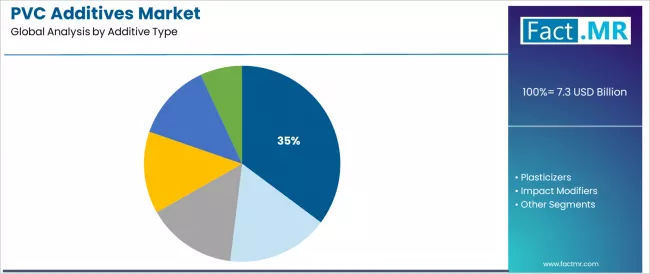
The stabilizers segment will command a 35.2% market share in 2026, as it represents an essential component for all PVC processing. Stabilizers prevent the thermal and UV degradation of PVC during high-temperature extrusion, injection molding, and throughout the product's lifecycle. Their dominance is reinforced by their indispensable role in maintaining polymer integrity, color stability, and mechanical properties, especially in demanding outdoor construction applications like window profiles, siding, and piping.
- The global push for longer-lasting, durable building materials and the phase-out of lead-based stabilizers are driving significant R&D and demand for advanced calcium-based and organic-based stabilizer systems.
- Increasing PVC consumption in regions with high solar irradiance is boosting demand for light and heat stabilizers that protect against weathering and extend product service life.
Which Application Segment Generates Maximum Demand for PVC Additives?

Construction applications are projected to hold a 48.7% share in 2026. PVC is a cornerstone material in modern construction due to its corrosion resistance, durability, and low maintenance. Additives are critical for enabling its use in pipes and fittings, window profiles, flooring, cables, and roofing membranes. The massive, ongoing global investment in infrastructure, residential, and commercial building projects ensures sustained, high-volume demand for PVC and its associated additives.
- Urbanization and stringent building codes emphasizing energy efficiency are driving the use of PVC in window profiles and insulation, which require specific additive packages for thermal stability and impact resistance.
- The replacement of aging infrastructure, particularly water and sewer pipelines, is a major driver for PVC pipe demand, relying heavily on stabilizer and impact modifier additives.
What are the Drivers, Restraints, and Key Trends of the PVC Additives Market?
The market is primarily driven by the robust growth in PVC consumption globally, particularly in the construction and infrastructure sectors. Secondary drivers include stringent environmental and safety regulations banning hazardous additives such as phthalates, lead stabilizers), which necessitate reformulation and create demand for safer alternatives, and the continuous need for performance enhancement in end-products. Key restraints include volatility in the prices of raw materials, environmental concerns regarding PVC waste, and intense competition within the chemical industry.
The market is trending strongly towards the development and adoption of sustainable and bio-based additives, such as non-phthalate plasticizers and bio-stabilizers. Another key trend is the innovation in additive systems that enhance PVC recyclability, supporting the circular economy for plastics. There is a growing focus on multifunctional additives that provide several benefits such as stabilization and lubrication from a single component, simplifying formulations and improving cost-efficiency.
Analysis of the PVC Additives Market by Key Countries

| Country | CAGR (2026-2036) |
|---|---|
| China | 7.4% |
| India | 7.1% |
| Germany | 5.8% |
| Brazil | 6.2% |
| USA | 5.5% |
| UK | 5.1% |
| South Korea | 6.8% |
What is Propelling China's Leadership in Market Growth?
The market in China is projected to grow at a leading CAGR of 7.4% through 2036. As the world's largest producer and consumer of PVC, China's massive construction and manufacturing sectors are the primary engines. Government initiatives in infrastructure development, urbanization projects, and the "Made in China 2026" plan focusing on advanced materials ensure sustained demand for high-performance PVC additives.
How is India's Infrastructure Boom Driving Adoption?
The market in India is forecast to grow at a CAGR of 7.1%. Unprecedented investment in infrastructure (smart cities, highways, housing) and a booming packaging industry are key growth drivers. The government's push for domestic manufacturing ("Make in India") and improving standards in the construction sector are increasing the consumption of quality PVC compounds and their necessary additives.
How does Germany's Chemical Excellence Shape its Market?
The market in Germany is forecast to grow at a CAGR of 5.8%. Germany is a hub for high-value, specialty chemical production. Its market is driven by demand for advanced, environmentally compliant additive systems from the domestic automotive, construction, and electrical industries, as well as strong export demand for premium additives.
Why is Brazil a Key Growth Market in Latin America?
The market in Brazil is set to grow at a CAGR of 6.2%. Growth is tied to the expansion of the construction sector, agricultural infrastructure (e.g., irrigation pipes), and the automotive industry. Domestic production of PVC and a recovering economy are creating consistent demand for additive technologies.
What Underpins the Mature US Market's Steady Growth?

The market in the USA is expected to grow at a CAGR of 5.5%. Steady demand from the well-established construction and automotive industries, coupled with ongoing re-investment in water and energy infrastructure, supports the market. Innovation is focused on developing next-generation, sustainable additives to meet strict regulatory standards and consumer preferences.
What Supports the UK's Focus on High-Performance and Sustainable Formulations?
The market in the UK is projected to grow at a CAGR of 5.1%. The UK market is characterized by high standards for building materials and a strong focus on sustainability. The need for high-performance, non-hazardous additives for construction applications and specialized compounds for the technical packaging and automotive sectors drive demand.
How does South Korea's Advanced Manufacturing Base Influence the Market?

The market in South Korea is projected to grow at a CAGR of 6.8%. South Korea's advanced electronics, automotive, and display panel industries require specialized PVC compounds for wiring, interior components, and materials. This drives demand for high-purity, thermally stable, and flame-retardant additive systems.
Competitive Landscape of the PVC Additives Market

Global chemical conglomerates dominate the competitive landscape with broad portfolios competing against specialized additive manufacturers. Competition centers on technological expertise in polymer chemistry, the ability to provide customized solutions, global supply chain reliability, and compliance with evolving regional regulations. Leading players compete through continuous R&D to develop safer, more efficient, and sustainable additive systems.
Strategic acquisitions to bolster specialty portfolios and partnerships with PVC compounders are common. Success depends on providing not just products but also technical support and formulation expertise to help customers navigate regulatory changes and optimize their processing and product performance.
Key Players in the PVC Additives Market
- BASF SE
- Dow Inc.
- Arkema SA
- Clariant AG
- Songwon Industrial Co., Ltd.
- Akzo Nobel N.V.
- Evonik Industries AG
- Solvay S.A.
- Eastman Chemical Company
- Adeka Corporation
- Baerlocher GmbH
- Kaneka Corporation
- LyondellBasell Industries N.V.
- Mitsubishi Chemical Corporation
Scope of the Report
| Items | Values |
|---|---|
| Quantitative Units (2026) | USD 7.3 Billion |
| Additive Type | Stabilizers, Plasticizers, Impact Modifiers, Lubricants, Flame Retardants, Other Additive Configurations |
| Application | Construction Applications, Automotive Applications, Packaging Applications, Electrical Applications, Others |
| End-Use Industry | Building and Construction, Automotive, Packaging, Electrical and Electronics, Others |
| Processing Method | Extrusion Processing, Injection Molding, Blow Molding, Other Processing Platforms |
| Regions Covered | North America, Europe, Asia Pacific, Latin America, MEA, Other Regions |
| Countries Covered | China, India, Germany, Brazil, USA, UK, South Korea, and 40+ countries |
| Key Companies Profiled | BASF SE, Dow Inc., Arkema SA, Clariant AG, Songwon Industrial Co., Ltd., and other leading PVC additive companies |
| Additional Attributes | Dollar sales by additive type, application, end-use industry, processing method, and region; regional demand trends, competitive landscape, technological advancements in additive engineering, material performance optimization initiatives, processing enhancement programs, and premium product development strategies |
PVC Additives Market by Segments
-
Additive Type :
- Stabilizers
- Plasticizers
- Impact Modifiers
- Lubricants
- Flame Retardants
- Other Additive Configurations
-
Application :
- Construction Applications
- Automotive Applications
- Packaging Applications
- Electrical Applications
- Others
-
End-Use Industry :
- Building and Construction
- Automotive
- Packaging
- Electrical and Electronics
- Others
-
Processing Method :
- Extrusion Processing
- Injection Molding
- Blow Molding
- Other Processing Platforms
-
Region :
-
North America
- USA
- Canada
- Mexico
-
Europe
- Germany
- UK
- France
- Italy
- Spain
- Nordic Countries
- BENELUX
- Rest of Europe
-
Asia Pacific
- China
- India
- Japan
- South Korea
- Australia
- Rest of Asia Pacific
-
Latin America
- Brazil
- Argentina
- Rest of Latin America
-
MEA
- Saudi Arabia
- UAE
- South Africa
- Rest of MEA
-
Table of Content
- Executive Summary
- Global Market Outlook
- Demand to side Trends
- Supply to side Trends
- Technology Roadmap Analysis
- Analysis and Recommendations
- Market Overview
- Market Coverage / Taxonomy
- Market Definition / Scope / Limitations
- Market Background
- Market Dynamics
- Drivers
- Restraints
- Opportunity
- Trends
- Scenario Forecast
- Demand in Optimistic Scenario
- Demand in Likely Scenario
- Demand in Conservative Scenario
- Opportunity Map Analysis
- Product Life Cycle Analysis
- Supply Chain Analysis
- Investment Feasibility Matrix
- Value Chain Analysis
- PESTLE and Porter’s Analysis
- Regulatory Landscape
- Regional Parent Market Outlook
- Production and Consumption Statistics
- Import and Export Statistics
- Market Dynamics
- Global Market Analysis 2021 to 2025 and Forecast, 2026 to 2036
- Historical Market Size Value (USD Million) Analysis, 2021 to 2025
- Current and Future Market Size Value (USD Million) Projections, 2026 to 2036
- Y to o to Y Growth Trend Analysis
- Absolute $ Opportunity Analysis
- Global Market Pricing Analysis 2021 to 2025 and Forecast 2026 to 2036
- Global Market Analysis 2021 to 2025 and Forecast 2026 to 2036, By Additive Type
- Introduction / Key Findings
- Historical Market Size Value (USD Million) Analysis By Additive Type, 2021 to 2025
- Current and Future Market Size Value (USD Million) Analysis and Forecast By Additive Type, 2026 to 2036
- Stabilizers
- Plasticizers
- Impact Modifiers
- Lubricants
- Flame Retardants
- Other Additive Configurations
- Y to o to Y Growth Trend Analysis By Additive Type, 2021 to 2025
- Absolute $ Opportunity Analysis By Additive Type, 2026 to 2036
- Global Market Analysis 2021 to 2025 and Forecast 2026 to 2036, By Application
- Introduction / Key Findings
- Historical Market Size Value (USD Million) Analysis By Application, 2021 to 2025
- Current and Future Market Size Value (USD Million) Analysis and Forecast By Application, 2026 to 2036
- Construction Applications
- Automotive Applications
- Packaging Applications
- Electrical Applications
- Others
- Y to o to Y Growth Trend Analysis By Application, 2021 to 2025
- Absolute $ Opportunity Analysis By Application, 2026 to 2036
- Global Market Analysis 2021 to 2025 and Forecast 2026 to 2036, By Region
- Introduction
- Historical Market Size Value (USD Million) Analysis By Region, 2021 to 2025
- Current Market Size Value (USD Million) Analysis and Forecast By Region, 2026 to 2036
- North America
- Latin America
- Western Europe
- Eastern Europe
- East Asia
- South Asia and Pacific
- Middle East & Africa
- Market Attractiveness Analysis By Region
- North America Market Analysis 2021 to 2025 and Forecast 2026 to 2036, By Country
- Historical Market Size Value (USD Million) Trend Analysis By Market Taxonomy, 2021 to 2025
- Market Size Value (USD Million) Forecast By Market Taxonomy, 2026 to 2036
- By Country
- USA
- Canada
- Mexico
- By Additive Type
- By Application
- By Country
- Market Attractiveness Analysis
- By Country
- By Additive Type
- By Application
- Key Takeaways
- Latin America Market Analysis 2021 to 2025 and Forecast 2026 to 2036, By Country
- Historical Market Size Value (USD Million) Trend Analysis By Market Taxonomy, 2021 to 2025
- Market Size Value (USD Million) Forecast By Market Taxonomy, 2026 to 2036
- By Country
- Brazil
- Chile
- Rest of Latin America
- By Additive Type
- By Application
- By Country
- Market Attractiveness Analysis
- By Country
- By Additive Type
- By Application
- Key Takeaways
- Western Europe Market Analysis 2021 to 2025 and Forecast 2026 to 2036, By Country
- Historical Market Size Value (USD Million) Trend Analysis By Market Taxonomy, 2021 to 2025
- Market Size Value (USD Million) Forecast By Market Taxonomy, 2026 to 2036
- By Country
- Germany
- UK
- Italy
- Spain
- France
- Nordic
- BENELUX
- Rest of Western Europe
- By Additive Type
- By Application
- By Country
- Market Attractiveness Analysis
- By Country
- By Additive Type
- By Application
- Key Takeaways
- Eastern Europe Market Analysis 2021 to 2025 and Forecast 2026 to 2036, By Country
- Historical Market Size Value (USD Million) Trend Analysis By Market Taxonomy, 2021 to 2025
- Market Size Value (USD Million) Forecast By Market Taxonomy, 2026 to 2036
- By Country
- Russia
- Poland
- Hungary
- Balkan & Baltic
- Rest of Eastern Europe
- By Additive Type
- By Application
- By Country
- Market Attractiveness Analysis
- By Country
- By Additive Type
- By Application
- Key Takeaways
- East Asia Market Analysis 2021 to 2025 and Forecast 2026 to 2036, By Country
- Historical Market Size Value (USD Million) Trend Analysis By Market Taxonomy, 2021 to 2025
- Market Size Value (USD Million) Forecast By Market Taxonomy, 2026 to 2036
- By Country
- China
- Japan
- South Korea
- By Additive Type
- By Application
- By Country
- Market Attractiveness Analysis
- By Country
- By Additive Type
- By Application
- Key Takeaways
- South Asia and Pacific Market Analysis 2021 to 2025 and Forecast 2026 to 2036, By Country
- Historical Market Size Value (USD Million) Trend Analysis By Market Taxonomy, 2021 to 2025
- Market Size Value (USD Million) Forecast By Market Taxonomy, 2026 to 2036
- By Country
- India
- ASEAN
- Australia & New Zealand
- Rest of South Asia and Pacific
- By Additive Type
- By Application
- By Country
- Market Attractiveness Analysis
- By Country
- By Additive Type
- By Application
- Key Takeaways
- Middle East & Africa Market Analysis 2021 to 2025 and Forecast 2026 to 2036, By Country
- Historical Market Size Value (USD Million) Trend Analysis By Market Taxonomy, 2021 to 2025
- Market Size Value (USD Million) Forecast By Market Taxonomy, 2026 to 2036
- By Country
- Kingdom of Saudi Arabia
- Other GCC Countries
- Turkiye
- South Africa
- Other African Union
- Rest of Middle East & Africa
- By Additive Type
- By Application
- By Country
- Market Attractiveness Analysis
- By Country
- By Additive Type
- By Application
- Key Takeaways
- Key Countries Market Analysis
- USA
- Pricing Analysis
- Market Share Analysis, 2025
- By Additive Type
- By Application
- Canada
- Pricing Analysis
- Market Share Analysis, 2025
- By Additive Type
- By Application
- Mexico
- Pricing Analysis
- Market Share Analysis, 2025
- By Additive Type
- By Application
- Brazil
- Pricing Analysis
- Market Share Analysis, 2025
- By Additive Type
- By Application
- Chile
- Pricing Analysis
- Market Share Analysis, 2025
- By Additive Type
- By Application
- Germany
- Pricing Analysis
- Market Share Analysis, 2025
- By Additive Type
- By Application
- UK
- Pricing Analysis
- Market Share Analysis, 2025
- By Additive Type
- By Application
- Italy
- Pricing Analysis
- Market Share Analysis, 2025
- By Additive Type
- By Application
- Spain
- Pricing Analysis
- Market Share Analysis, 2025
- By Additive Type
- By Application
- France
- Pricing Analysis
- Market Share Analysis, 2025
- By Additive Type
- By Application
- India
- Pricing Analysis
- Market Share Analysis, 2025
- By Additive Type
- By Application
- ASEAN
- Pricing Analysis
- Market Share Analysis, 2025
- By Additive Type
- By Application
- Australia & New Zealand
- Pricing Analysis
- Market Share Analysis, 2025
- By Additive Type
- By Application
- China
- Pricing Analysis
- Market Share Analysis, 2025
- By Additive Type
- By Application
- Japan
- Pricing Analysis
- Market Share Analysis, 2025
- By Additive Type
- By Application
- South Korea
- Pricing Analysis
- Market Share Analysis, 2025
- By Additive Type
- By Application
- Russia
- Pricing Analysis
- Market Share Analysis, 2025
- By Additive Type
- By Application
- Poland
- Pricing Analysis
- Market Share Analysis, 2025
- By Additive Type
- By Application
- Hungary
- Pricing Analysis
- Market Share Analysis, 2025
- By Additive Type
- By Application
- Kingdom of Saudi Arabia
- Pricing Analysis
- Market Share Analysis, 2025
- By Additive Type
- By Application
- Turkiye
- Pricing Analysis
- Market Share Analysis, 2025
- By Additive Type
- By Application
- South Africa
- Pricing Analysis
- Market Share Analysis, 2025
- By Additive Type
- By Application
- USA
- Market Structure Analysis
- Competition Dashboard
- Competition Benchmarking
- Market Share Analysis of Top Players
- By Regional
- By Additive Type
- By Application
- Competition Analysis
- Competition Deep Dive
- BASF SE
- Overview
- Product Portfolio
- Profitability by Market Segments (Product/Age /Sales Channel/Region)
- Sales Footprint
- Strategy Overview
- Marketing Strategy
- Product Strategy
- Channel Strategy
- Dow Inc.
- Arkema SA
- Clariant AG
- Songwon Industrial Co., Ltd.
- Akzo Nobel N.V.
- Evonik Industries AG
- Solvay S.A.
- Eastman Chemical Company
- Adeka Corporation
- Baerlocher GmbH
- Kaneka Corporation
- LyondellBasell Industries N.V.
- Mitsubishi Chemical Corporation
- BASF SE
- Competition Deep Dive
- Assumptions & Acronyms Used
- Research Methodology
List Of Table
- Table 1: Global Market Value (USD Million) Forecast by Region, 2021 to 2036
- Table 2: Global Market Value (USD Million) Forecast by Additive Type, 2021 to 2036
- Table 3: Global Market Value (USD Million) Forecast by Application, 2021 to 2036
- Table 4: North America Market Value (USD Million) Forecast by Country, 2021 to 2036
- Table 5: North America Market Value (USD Million) Forecast by Additive Type, 2021 to 2036
- Table 6: North America Market Value (USD Million) Forecast by Application, 2021 to 2036
- Table 7: Latin America Market Value (USD Million) Forecast by Country, 2021 to 2036
- Table 8: Latin America Market Value (USD Million) Forecast by Additive Type, 2021 to 2036
- Table 9: Latin America Market Value (USD Million) Forecast by Application, 2021 to 2036
- Table 10: Western Europe Market Value (USD Million) Forecast by Country, 2021 to 2036
- Table 11: Western Europe Market Value (USD Million) Forecast by Additive Type, 2021 to 2036
- Table 12: Western Europe Market Value (USD Million) Forecast by Application, 2021 to 2036
- Table 13: Eastern Europe Market Value (USD Million) Forecast by Country, 2021 to 2036
- Table 14: Eastern Europe Market Value (USD Million) Forecast by Additive Type, 2021 to 2036
- Table 15: Eastern Europe Market Value (USD Million) Forecast by Application, 2021 to 2036
- Table 16: East Asia Market Value (USD Million) Forecast by Country, 2021 to 2036
- Table 17: East Asia Market Value (USD Million) Forecast by Additive Type, 2021 to 2036
- Table 18: East Asia Market Value (USD Million) Forecast by Application, 2021 to 2036
- Table 19: South Asia and Pacific Market Value (USD Million) Forecast by Country, 2021 to 2036
- Table 20: South Asia and Pacific Market Value (USD Million) Forecast by Additive Type, 2021 to 2036
- Table 21: South Asia and Pacific Market Value (USD Million) Forecast by Application, 2021 to 2036
- Table 22: Middle East & Africa Market Value (USD Million) Forecast by Country, 2021 to 2036
- Table 23: Middle East & Africa Market Value (USD Million) Forecast by Additive Type, 2021 to 2036
- Table 24: Middle East & Africa Market Value (USD Million) Forecast by Application, 2021 to 2036
List Of Figures
- Figure 1: Global Market Pricing Analysis
- Figure 2: Global Market Value (USD Million) Forecast 2021 to 2036
- Figure 3: Global Market Value Share and BPS Analysis by Additive Type, 2026 and 2036
- Figure 4: Global Market Y to o to Y Growth Comparison by Additive Type, 2026 to 2036
- Figure 5: Global Market Attractiveness Analysis by Additive Type
- Figure 6: Global Market Value Share and BPS Analysis by Application, 2026 and 2036
- Figure 7: Global Market Y to o to Y Growth Comparison by Application, 2026 to 2036
- Figure 8: Global Market Attractiveness Analysis by Application
- Figure 9: Global Market Value (USD Million) Share and BPS Analysis by Region, 2026 and 2036
- Figure 10: Global Market Y to o to Y Growth Comparison by Region, 2026 to 2036
- Figure 11: Global Market Attractiveness Analysis by Region
- Figure 12: North America Market Incremental Dollar Opportunity, 2026 to 2036
- Figure 13: Latin America Market Incremental Dollar Opportunity, 2026 to 2036
- Figure 14: Western Europe Market Incremental Dollar Opportunity, 2026 to 2036
- Figure 15: Eastern Europe Market Incremental Dollar Opportunity, 2026 to 2036
- Figure 16: East Asia Market Incremental Dollar Opportunity, 2026 to 2036
- Figure 17: South Asia and Pacific Market Incremental Dollar Opportunity, 2026 to 2036
- Figure 18: Middle East & Africa Market Incremental Dollar Opportunity, 2026 to 2036
- Figure 19: North America Market Value Share and BPS Analysis by Country, 2026 and 2036
- Figure 20: North America Market Value Share and BPS Analysis by Additive Type, 2026 and 2036
- Figure 21: North America Market Y to o to Y Growth Comparison by Additive Type, 2026 to 2036
- Figure 22: North America Market Attractiveness Analysis by Additive Type
- Figure 23: North America Market Value Share and BPS Analysis by Application, 2026 and 2036
- Figure 24: North America Market Y to o to Y Growth Comparison by Application, 2026 to 2036
- Figure 25: North America Market Attractiveness Analysis by Application
- Figure 26: Latin America Market Value Share and BPS Analysis by Country, 2026 and 2036
- Figure 27: Latin America Market Value Share and BPS Analysis by Additive Type, 2026 and 2036
- Figure 28: Latin America Market Y to o to Y Growth Comparison by Additive Type, 2026 to 2036
- Figure 29: Latin America Market Attractiveness Analysis by Additive Type
- Figure 30: Latin America Market Value Share and BPS Analysis by Application, 2026 and 2036
- Figure 31: Latin America Market Y to o to Y Growth Comparison by Application, 2026 to 2036
- Figure 32: Latin America Market Attractiveness Analysis by Application
- Figure 33: Western Europe Market Value Share and BPS Analysis by Country, 2026 and 2036
- Figure 34: Western Europe Market Value Share and BPS Analysis by Additive Type, 2026 and 2036
- Figure 35: Western Europe Market Y to o to Y Growth Comparison by Additive Type, 2026 to 2036
- Figure 36: Western Europe Market Attractiveness Analysis by Additive Type
- Figure 37: Western Europe Market Value Share and BPS Analysis by Application, 2026 and 2036
- Figure 38: Western Europe Market Y to o to Y Growth Comparison by Application, 2026 to 2036
- Figure 39: Western Europe Market Attractiveness Analysis by Application
- Figure 40: Eastern Europe Market Value Share and BPS Analysis by Country, 2026 and 2036
- Figure 41: Eastern Europe Market Value Share and BPS Analysis by Additive Type, 2026 and 2036
- Figure 42: Eastern Europe Market Y to o to Y Growth Comparison by Additive Type, 2026 to 2036
- Figure 43: Eastern Europe Market Attractiveness Analysis by Additive Type
- Figure 44: Eastern Europe Market Value Share and BPS Analysis by Application, 2026 and 2036
- Figure 45: Eastern Europe Market Y to o to Y Growth Comparison by Application, 2026 to 2036
- Figure 46: Eastern Europe Market Attractiveness Analysis by Application
- Figure 47: East Asia Market Value Share and BPS Analysis by Country, 2026 and 2036
- Figure 48: East Asia Market Value Share and BPS Analysis by Additive Type, 2026 and 2036
- Figure 49: East Asia Market Y to o to Y Growth Comparison by Additive Type, 2026 to 2036
- Figure 50: East Asia Market Attractiveness Analysis by Additive Type
- Figure 51: East Asia Market Value Share and BPS Analysis by Application, 2026 and 2036
- Figure 52: East Asia Market Y to o to Y Growth Comparison by Application, 2026 to 2036
- Figure 53: East Asia Market Attractiveness Analysis by Application
- Figure 54: South Asia and Pacific Market Value Share and BPS Analysis by Country, 2026 and 2036
- Figure 55: South Asia and Pacific Market Value Share and BPS Analysis by Additive Type, 2026 and 2036
- Figure 56: South Asia and Pacific Market Y to o to Y Growth Comparison by Additive Type, 2026 to 2036
- Figure 57: South Asia and Pacific Market Attractiveness Analysis by Additive Type
- Figure 58: South Asia and Pacific Market Value Share and BPS Analysis by Application, 2026 and 2036
- Figure 59: South Asia and Pacific Market Y to o to Y Growth Comparison by Application, 2026 to 2036
- Figure 60: South Asia and Pacific Market Attractiveness Analysis by Application
- Figure 61: Middle East & Africa Market Value Share and BPS Analysis by Country, 2026 and 2036
- Figure 62: Middle East & Africa Market Value Share and BPS Analysis by Additive Type, 2026 and 2036
- Figure 63: Middle East & Africa Market Y to o to Y Growth Comparison by Additive Type, 2026 to 2036
- Figure 64: Middle East & Africa Market Attractiveness Analysis by Additive Type
- Figure 65: Middle East & Africa Market Value Share and BPS Analysis by Application, 2026 and 2036
- Figure 66: Middle East & Africa Market Y to o to Y Growth Comparison by Application, 2026 to 2036
- Figure 67: Middle East & Africa Market Attractiveness Analysis by Application
- Figure 68: Global Market - Tier Structure Analysis
- Figure 69: Global Market - Company Share Analysis
- FAQs -
How big is the PVC additives market in 2026?
The global PVC additives market is estimated to be valued at USD 7.3 billion in 2026.
What will be the size of PVC additives market in 2036?
The market size for the PVC additives market is projected to reach USD 13.8 billion by 2036.
How much will be the PVC additives market growth between 2026 and 2036?
The PVC additives market is expected to grow at a 6.6% CAGR between 2026 and 2036.
What are the key product types in the PVC additives market?
The key product types in PVC additives market are stabilizers, plasticizers, impact modifiers, lubricants, flame retardants and other additive configurations.
Which application segment to contribute significant share in the PVC additives market in 2026?
In terms of application, construction applications segment to command 48.7% share in the PVC additives market in 2026.