- Market Value (2025): USD 1.64 Bn
- Estimated Value (2026): USD 1.76 Bn
- Forecast Value (2036): USD 3.49 Bn
- CAGR (2026-2036): 7.1%
What is the Defogging Glass Market forecast to be worth by 2036?
USD 1.8 billion in 2026 to USD 3.5 billion by 2036 at a 7.1% CAGR.
- As per Fact.MR analysis, the Defogging Glass Market was valued at USD 1.64 billion in 2025.
- Demand is projected to grow from USD 1.76 billion in 2026 to USD 3.49 billion by 2036.
- The forecast indicates a 7.1% CAGR from 2026 to 2036 as manufacturers prioritize visibility and occupant safety alongside effective condensation management.
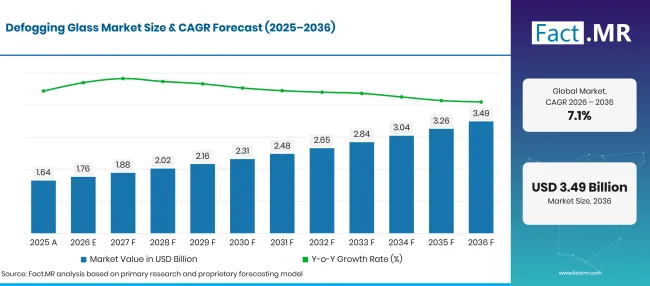
Defogging Glass Market Forecast Global | Source: Fact.MR
| Year | Basis | Market Value (USD billion) |
|---|---|---|
| 2025 | Actual | 1.64 |
| 2026 | Estimate | 1.76 |
| 2036 | Forecast | 3.49 |
| CAGR 2026 to 2036 | Forecast period | 7.1% |
Source: Fact.MR analysis. Updated Oct 26, 2026
What are the defining numbers behind Defogging Glass Market growth?
USD 1.7 billion in absolute market opportunity between 2026 and 2036
- Demand Drivers in the Market
- Automotive manufacturers prioritize clear visibility in changing weather conditions. Defogging technologies help address condensation on vehicle windows and windshields to support safer driving. India produced approximately 5.38 million passenger vehicles in 2025 according to figures reported by the Ministry of Heavy Industries, highlighting the scale of the automotive manufacturing base relevant to automotive glass applications [1].
- Building developers and commercial property operators seek glass solutions that maintain visibility under changing temperature and humidity conditions. Hydrophobic coatings offer a surface-based approach to managing water accumulation depending on coating durability and application requirements. The European Commission estimates that buildings account for approximately 40% of energy use in the European Union, reinforcing the importance of evaluating glazing technologies for energy performance alongside moisture management [2].
- Glass manufacturers and coating suppliers compete on optical clarity and durability while considering energy consumption and installation and lifecycle costs. UNECE glazing requirements address transparency and optical distortion as well as resistance to temperature and chemical effects. These requirements highlight the importance of performance testing when evaluating defogging glass and coating solutions [3].
- Key Segments Analyzed
- By Product Type: Hydrophobic Coatings account for 42.3% of the market in 2026, reflecting demand for surface treatments designed to manage moisture on glass.
- By Application: Automotive leads with 38.0% of the market in 2026, highlighting the importance of visibility across vehicle glass applications.
- By Distribution Channel: Specialty Stores hold 38.6% market share in 2026, reflecting the role of specialized suppliers in meeting application-specific glass and coating requirements.
- By End-User: Commercial applications represent 44.8% of the market in 2026, supported by demand for visibility and condensation management across commercial facilities.
- Analyst Opinion at Fact.MR
- Shambhu Nath Jha, Principal Consultant at Fact.MR, states, “Defogging glass adoption is likely to depend on how effectively suppliers balance visibility performance, durability, energy consumption, and installation costs. Hydrophobic coatings may suit applications that favor surface-based moisture management, while electric defogging systems are relevant where active heating is required.”
- Strategic Implications
- Glass manufacturers must evaluate hydrophobic coatings, electric defogging systems, and chemical solutions against the operating conditions and visibility requirements of each application.
- Automotive suppliers need to prioritize optical clarity, defogging response, durability, and compatibility with vehicle glass systems.
- Commercial building developers can assess coating performance, maintenance requirements, and lifecycle costs before specifying defogging glass solutions.
- Distribution partners are expected to provide application-specific product guidance and distinguish between passive surface treatments and active electrical systems.
- Product developers must validate performance under varying humidity and temperature conditions before making durability or efficiency claims.
Germany is projected to record a 7.0% CAGR through 2036. Brazil is expected to register a 5.6% CAGR, followed by the US at 9.2%. The UK is forecast to advance at 6.1%, while Japan is projected to record a 7.9% CAGR.
How does the Defogging Glass Market break down by segment?
Fact.MR analysis identifies Hydrophobic Coatings as the leading Product Type with a 42.3% share, Automotive as the leading Application with 38.0%, Specialty Stores as the leading Distribution Channel with 38.6%, and Commercial as the leading End-User segment with 44.8%.
Which Product Type dominates?
Hydrophobic Coatings are projected to hold a 42.3% share in 2026.
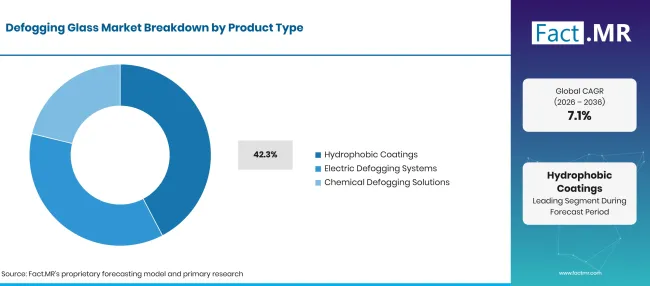
Defogging Glass Market Breakdown Product Type | Source: Fact.MR
| Product Type | Share (2026) |
|---|---|
| Hydrophobic Coatings (Leading segment) | 42.3% |
| Other product types combined | 57.7%* |
| Total | 100.0% |
Source: Fact.MR analysis. Updated Oct 26, 2026
Hydrophobic coatings are designed to modify the surface interaction between glass and water, helping moisture spread or move across treated surfaces instead of accumulating in the same manner as on untreated glass. Their suitability depends on optical performance, coating durability, surface preparation, and environmental exposure. Electric defogging systems provide active heating, while chemical defogging solutions may use treatments intended to reduce condensation or improve moisture management.
What leads the Application segment?
Automotive is projected to represent a 38.0% share in 2026.
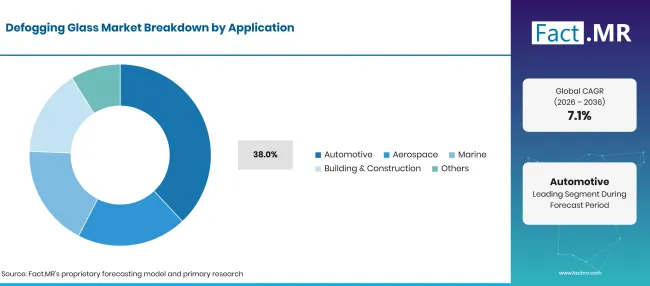
Defogging Glass Market Breakdown Application | Source: Fact.MR
| Application | Share (2026) |
|---|---|
| Automotive (Leading segment) | 38.0% |
| Other applications combined | 62.0%* |
| Total | 100.0% |
Source: Fact.MR analysis. Updated Oct 26, 2026
Automotive applications require reliable visibility across windshields, side windows, rear windows, and other vehicle glass surfaces. Defogging performance can be particularly important when outside temperatures and cabin humidity differ. Aerospace applications have specialized visibility and operational requirements, while marine applications face moisture exposure associated with water and changing environmental conditions. Building and construction applications include glass surfaces in commercial and other properties where condensation can affect visibility and usability.
How does Distribution Channel shape demand?
Specialty Stores are projected to account for a 38.6% share in 2026.
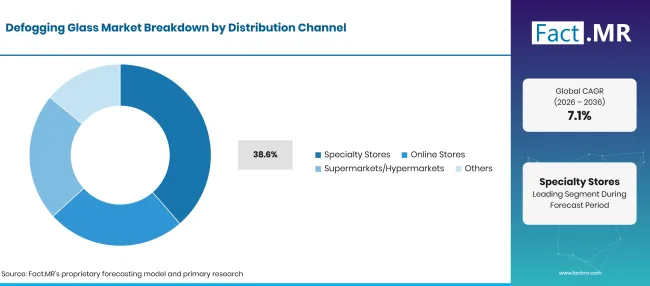
Defogging Glass Market Breakdown Distribution Channel | Source: Fact.MR
| Distribution Channel | Share (2026) |
|---|---|
| Specialty Stores (Leading segment) | 38.6% |
| Other distribution channels combined | 61.4%* |
| Total | 100.0% |
Source: Fact.MR analysis. Updated Oct 26, 2026
Specialty stores can serve buyers who need technical guidance on glass treatments, coatings, installation, and compatibility. Online stores may support product discovery and purchases of selected defogging products, particularly where buyers can assess specifications before ordering. Supermarkets and hypermarkets may serve standardized consumer-oriented products, while other channels can include direct manufacturer sales, distributors, and specialized business-to-business procurement routes.
Which End-User segment leads demand?
Commercial applications lead with 44.8% share in 2026.
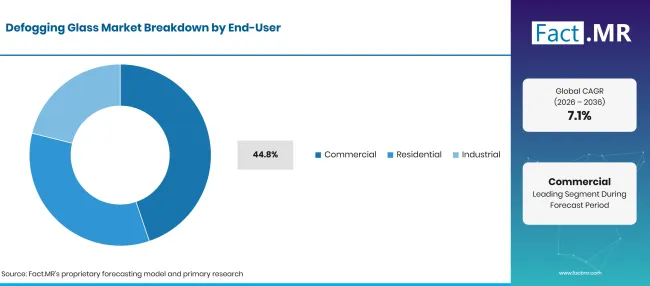
Defogging Glass Market Breakdown End User | Source: Fact.MR
| End-User | Share (2026) |
|---|---|
| Commercial (Leading segment) | 44.8% |
| Other end-users combined | 55.2%* |
| Total | 100.0% |
Source: Fact.MR analysis. Updated Oct 26, 2026
Commercial demand can arise from offices, retail properties, institutional buildings, and other facilities using extensive glass surfaces. Condensation management may help preserve visibility and support the functional use of glazed spaces. Residential users may consider defogging solutions for windows and other glass surfaces, while industrial users can require specialized treatments for equipment and process environments. Product selection depends on the glass type, exposure conditions, maintenance schedule, and required performance.
What is accelerating Defogging Glass Market adoption, and what is holding it back?
Demand for improved visibility and advanced glass treatments supports adoption, while installation costs, durability requirements, and technology-specific limitations may constrain wider use.
Drivers Impact Analysis
| DRIVER | (~) % IMPACT ON CAGR | GEOGRAPHIC RELEVANCE | IMPACT TIMELINE |
|---|---|---|---|
| Rising automotive production and visibility requirements | +1.0% | Asia Pacific, Europe, Americas | Medium term (2–4 years) |
| Condensation control in commercial buildings | +0.8% | Europe, Asia Pacific | Medium term (2–4 years) |
| Windshield visibility requirements in aerospace applications | +0.7% | North America, Europe, Asia Pacific | Short term (≤ 2 years) |
| Adoption of electrically heated glass systems | +0.6% | Global | Medium term (2–4 years) |
| Demand for durable hydrophobic coatings | +0.4% | Global | Long term (≥ 4 years) |
Source: Fact.MR analysis. Updated Oct 26, 2026
Opportunity Impact Analysis
| OPPORTUNITY | (~) % IMPACT ON CAGR | GEOGRAPHIC RELEVANCE | IMPACT TIMELINE |
|---|---|---|---|
| Integration of defogging systems into electric vehicles | +0.8% | Asia Pacific, Europe, Americas | Medium term (2–4 years) |
| Advanced hydrophobic and anti-fog coating development | +0.7% | Global | Medium term (2–4 years) |
| Energy-efficient heated glazing technologies | +0.6% | Europe, North America, Asia Pacific | Long term (≥ 4 years) |
| Application-specific glass solutions for aerospace and marine sectors | +0.5% | North America, Europe, Asia Pacific | Long term (≥ 4 years) |
Source: Fact.MR analysis. Updated Oct 26, 2026
Restraints Impact Analysis
| RESTRAINT | (~) % IMPACT ON CAGR | GEOGRAPHIC RELEVANCE | IMPACT TIMELINE |
|---|---|---|---|
| High manufacturing and installation costs | −0.8% | Global | Short term (≤ 2 years) |
| Electricity consumption of heated defogging systems | −0.6% | Global | Medium term (2–4 years) |
| Coating durability and performance variability | −0.5% | Global | Medium term (2–4 years) |
| Integration complexity with existing glass systems | −0.4% | Global | Short term (≤ 2 years) |
Source: Fact.MR analysis. Updated Oct 26, 2026
Which countries are scaling the Defogging Glass Market through 2036?
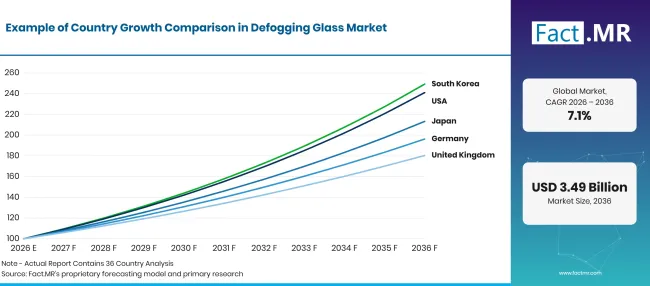
Defogging Glass Market Growth Index | Source: Fact.MR
| Country | CAGR (2026–2036) |
|---|---|
| Germany | 7.0% |
| Brazil | 5.6% |
| USA | 9.2% |
| UK | 6.1% |
| Japan | 7.9% |
Source: Fact.MR analysis. Updated Oct 26, 2026
What supports Germany adoption?
7.0% CAGR, supported by demand for advanced automotive glass and building applications.
Germany's automotive and industrial manufacturing base provides potential opportunities for defogging glass technologies. Vehicle manufacturers and component suppliers may evaluate hydrophobic coatings and electric defogging systems based on visibility requirements, energy consumption, and durability. Commercial buildings also provide applications where condensation management can support the functional use of glass surfaces. Adoption will depend on installation economics and compatibility with existing glass systems.
How is Brazil developing defogging glass adoption?
5.6% CAGR, led by potential demand across automotive and construction applications.
Brazil's market opportunity spans vehicle glass, commercial properties, and other applications exposed to changing humidity and temperature conditions. Hydrophobic coatings may appeal to customers seeking surface-based moisture management, while active systems may suit applications requiring controlled heating. Suppliers can support adoption by offering products suited to local operating environments, providing clear installation guidance and demonstrating durability under relevant conditions.
What supports United States adoption?
9.2% CAGR, reflecting the forecast for demand across specialized glass applications.
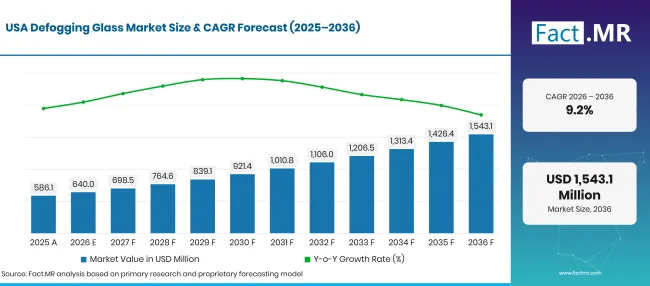
Defogging Glass Market Forecast Usa | Source: Fact.MR
The United States offers opportunities across vehicle manufacturing as well as building projects and aerospace and marine applications. Buyers may prioritize rapid defogging alongside optical clarity and dependable performance under changing environmental conditions. Manufacturers can differentiate products through durable coatings and energy-efficient heating while ensuring compatibility with existing glass systems and validating performance through testing.
How is the United Kingdom building adoption?
6.1% CAGR, shaped by potential demand for visibility management in automotive and building applications.
The UK market can benefit from solutions designed to address condensation on vehicle windows and glass surfaces in commercial properties. Hydrophobic treatments may suit applications where passive moisture management is preferred, while electric defogging systems may be relevant where active heating is required. Suppliers need to demonstrate suitability for local environmental conditions and clearly explain maintenance requirements alongside service life and installation costs.
What supports Japan adoption?
7.9% CAGR, backed by potential opportunities in automotive glass, advanced materials, and commercial applications.
Japan's automotive and advanced manufacturing sectors offer opportunities for technologies that improve glass performance and visibility. Hydrophobic coatings can support surface treatment applications, while electric systems may be considered where active defogging is necessary. Product developers can strengthen adoption by improving integration with vehicle glass, validating optical performance, and developing durable solutions that satisfy application-specific requirements.
Who leads the Defogging Glass Market?
Fact.MR identifies Saint-Gobain S.A., AGC Inc., Nippon Sheet Glass, and Fuyao Glass as key companies to profile.
Saint-Gobain S.A. and AGC Inc. are relevant to the glass and advanced-materials industry. Nippon Sheet Glass participates in glass manufacturing. Their inclusion in the competitive landscape does not establish that every company offers every defogging technology listed in this report. Individual product portfolios and commercial availability should be verified before comparing direct market participation.
Competitive positioning depends on glass manufacturing capabilities, coating technologies, product durability, integration with heating systems, and customer relationships. Suppliers can differentiate through optical quality, performance under changing humidity, production consistency, and compatibility with automotive and architectural glass applications.
Which companies are the key providers?
Key companies covered include Saint-Gobain S.A., AGC Inc., Nippon Sheet Glass, and Fuyao Glass.
- Saint-Gobain S.A.
- AGC Inc.
- Nippon Sheet Glass
- Fuyao Glass
Bibliography
- [1] Ministry of Heavy Industries. (2026, February 6). Promotion of automotive and heavy engineering sector. Press Information Bureau, Government of India.
- [2] European Commission. (2025, July 15). In focus: Reaching the EU’s energy efficiency target.
- [3] United Nations Economic Commission for Europe. (n.d.). UN Regulation No. 43 – Rev.4: Safety glazing.
- [4] Ministry of Heavy Industries, Government of India. (2026, February 6). Impact of ‘Make in India’ on automobile industry (Rajya Sabha Unstarred Question No. 890).
- [5] Ministry of Heavy Industries, Government of India. (2026, March 27). Annual report 2025–26.
This Report Answers
- The report examines how defogging glass technologies address condensation and visibility requirements across automotive, aerospace, marine, and building applications.
- Segment analysis compares hydrophobic coatings, electric defogging systems, and chemical defogging solutions.
- Distribution analysis covers specialty stores, online stores, supermarkets/hypermarkets, and other channels.
- Country analysis compares Germany, Brazil, the USA, the UK, and Japan CAGRs.
- The competitive overview identifies Saint-Gobain S.A., AGC Inc., Nippon Sheet Glass, and Fuyao Glass for company profiling.
What does the Defogging Glass Market cover?
The market covers glass products and associated treatments or systems intended to manage condensation and fogging. It includes hydrophobic coatings, electric defogging systems, and chemical defogging solutions across automotive, aerospace, marine, and building and construction applications. The market also considers distribution channels and commercial, residential, and industrial end users.
What is included in the scope?
Included technologies comprise glass treatments and systems intended to improve visibility by managing moisture or reducing fog formation. The segmentation covers the specified product types, applications, distribution channels, and end-user categories. The geographic assessment includes the listed countries and broader regional markets.
What is excluded from the scope?
The scope excludes unrelated glass products without a defogging function, conventional glazing sold without a relevant defogging treatment or system, and general heating or ventilation equipment not specifically included in the defined market. Standalone chemicals used for purposes unrelated to glass defogging and unrelated glass installation services are also outside the defined product boundary unless explicitly included in the underlying market methodology.
How Was the Analysis Built?
The analysis draws on 120+ sources, 35+ company portfolios, 25+ countries, and more than 20 industry interviews.
- Primary Research: Primary research includes discussions with manufacturers, service providers, technology developers, distributors, end users, and subject-matter experts. These conversations examine purchasing priorities, product adoption, operational challenges, approval requirements, competitive positioning, and the factors that influence wider market acceptance.
- Desk Research: Desk research covers government statistics, regulatory publications, company filings, trade data, technical studies, industry associations, standards, public policy, and other authoritative sources. Every source used in the analysis is documented in the bibliography.
- Market Sizing and Forecasting: Market estimates combine historical performance, demand indicators, pricing and volume trends, segment shares, company participation, country-level growth, adoption patterns, investment activity, and barriers to market expansion.
- Data Validation and Update Cycle: Findings are validated by comparing primary interviews with public data, company activity, regulatory changes, trade patterns, and industry developments. Regular updates review new product launches, capacity changes, partnerships, approvals, and shifts in commercial adoption.
Segmentation
What is the report's scope and coverage?
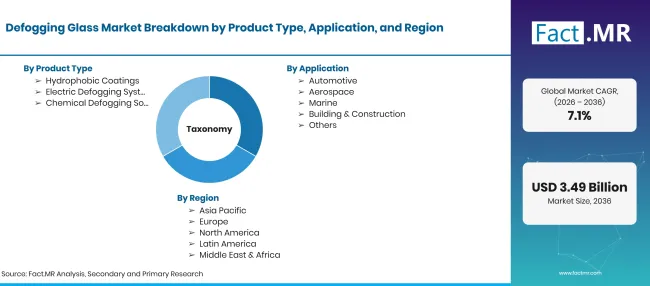
Defogging Glass Market Taxonomy | Source: Fact.MR
| Attribute | Details |
|---|---|
| Quantitative Units | USD billion in 2026 to USD billion by 2036, at CAGR |
| Market Definition | Glass products and associated technologies designed to reduce or manage condensation and fogging on glass surfaces |
| Product Type | Hydrophobic Coatings; Electric Defogging Systems; Chemical Defogging Solutions |
| Application | Automotive; Aerospace; Marine; Building & Construction; Others |
| Distribution Channel | Specialty Stores; Online Stores; Supermarkets/Hypermarkets; Others |
| End-User | Commercial; Residential; Industrial |
| Regions Covered | North America; Latin America; Western Europe; Eastern Europe; East Asia; South Asia & Pacific; Middle East & Africa |
| Countries Covered | Germany; Brazil; USA; UK; Japan |
| Companies Profiled | Saint-Gobain S.A.; AGC Inc.; Nippon Sheet Glass; Fuyao Glass |
| Forecast Period | 2026 to 2036 |
| Approach | Market segmentation and forecast analysis based on market estimates, segment shares, country growth rates, and company information |
Source: Fact.MR analysis. Updated Oct 26, 2026
How is the market segmented?
-
By Product Type
- Hydrophobic Coatings
- Electric Defogging Systems
- Chemical Defogging Solutions
-
By Application
- Automotive
- Aerospace
- Marine
- Building & Construction
- Others
-
By Distribution Channel
- Specialty Stores
- Online Stores
- Supermarkets/Hypermarkets
- Others
-
By End-User
- Commercial
- Residential
- Industrial
-
By Region
- North America
- Latin America
- Western Europe
- Eastern Europe
- East Asia
- South Asia & Pacific
- Middle East & Africa
Frequently Asked Questions
How big is the Defogging Glass Market in 2026?
What is the CAGR from 2026 to 2036?
Which Product Type has the largest stated share?
Which Application leads the market?
Which country has the highest projected CAGR?
Which companies are covered?
Who worked on this report


Preview the report firsthand - request a free sample
Free SampleGet the brochure for pricing and purchase details
Download PDF