- Market Value (2025): USD 776.0 Mn
- Estimated Value (2026): USD 815.0 Mn
- Forecast Value (2036): USD 1330.0 Mn
- CAGR (2026-2036): 5.0%
What is the Demethanizer Market forecast to be worth by 2036?
USD 815.0 million in 2026 to USD 1,330.0 million by 2036 at a 5.0% CAGR from 2026 to 2036.
- The Demethanizer market crossed a valuation of USD 776.0 million in 2025, driven by replacement demand in gas-processing plants and cold-section work in ethylene units.
- Demand is projected to increase from USD 815.0 million in 2026 to USD 1,330.0 million by 2036.
- The market is forecast to record a 5.0% CAGR from 2026 to 2036 as NGL recovery economics and ethane-feed petrochemical projects support ordered growth.
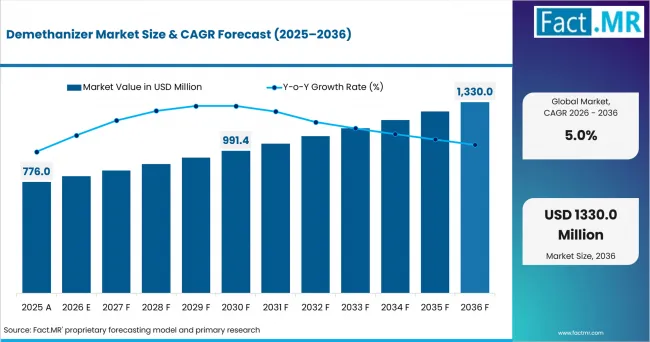
Demethanizer Market Value Analysis | Source: Fact.MR
What are the defining numbers behind Demethanizer Market growth?
USD 515.0 million absolute opportunity is expected by 2036.
- Demand Drivers in the Market
- Better recovery systems help plants turn more wet gas into saleable ethane, propane and other liquid products.
- Ethane recovered in a demethanizer can be used in ethylene plants when chemical companies want a lighter raw material.
- Upgrading the parts inside an older column can increase output when the main shell is still in good condition but gas flow has become restricted.
- Factory-built demethanizer units can reduce construction work at remote sites and help new gas projects start in stages.
- Key Segments Analyzed
- By Column Type: Cryogenic Demethanizers are expected to hold 38.0% share in 2026 supported by deep-refrigeration performance and clear methane rejection targets.
- By Application: NGL Recovery is projected to account for 32.0% share in 2026 owing to the value of separating methane from ethane-rich and heavier liquid streams.
- By Capacity: Small systems below 100 MMscfd are anticipated to capture 24.0% share in 2026 due to their fit with associated-gas volumes that do not justify a large processing train.
- By Internals: Structured Packing is estimated to represent 34.0% share in 2026 attributable to lower pressure drop across cryogenic separation duties.
- By End User: Gas Processors are forecast to hold 31.0% share in 2026 driven by liquid recovery requirements and residue-gas specification control.
- Analyst Opinion at Fact.MR
- Shambhu Nath Jha, Senior Analyst at Fact.MR, states, “Demethanizer projects are judged on more than methane removal. Plant owners also look at ethane recovery, cooling use and pressure loss when feed conditions change. Upgrades at existing plants must fit the current cold section and avoid a long shutdown. Companies that offer clear recovery results, reliable column parts and strong startup support are expected to win more project approvals.”
- Strategic Implications
- Start with clear recovery results that show the financial benefit for the plant. Owners want proof that methane removal and ethane recovery remain steady when the feed changes.
- Offer the column together with the cooling system and related gas equipment. A complete setup makes installation easier and reduces problems between different parts of the project.
- Build service plans around replacing internal parts and improving older units. Many existing gas plants want short shutdowns that raise output without replacing the full system.
- Keep spare parts and service staff close to major operating areas. Local project companies are more likely to work with equipment makers that respond quickly during shutdowns and continue to support the plant after startup.
In April 2026, Technip Energies said it had been awarded a contract by Long Son Petrochemicals for the Long Son Petrochemicals Enhancement project in Vietnam. The contract covers engineering and procurement services, site assistance and proprietary burners for cracking furnaces. The project is planned to convert an existing steam cracker from naphtha to ethane feedstock using Technip Energies USC furnace and HRS technologies.
UAE is estimated to post a 5.7% CAGR as downstream gas projects and NGL recovery investments continue to shape demand. The USA is anticipated to advance at a 5.0% CAGR through brownfield upgrades, liquids-rich gas processing and cold-section optimization. Japan is forecast to record a 4.9% CAGR, supported by petrochemical processing and LNG-related separation requirements. The United Kingdom is projected to post a 4.7% CAGR, with demand centered on selective upgrades across mature gas-processing infrastructure, while Germany is estimated to record a 4.4% CAGR through replacement projects and petrochemical cold-section applications.
How does the Demethanizer Market break down by segment?
Cryogenic demethanizers are expected to lead Column Type at 38.0% share in 2026. NGL recovery is projected to lead Application at 32.0% share in 2026.
Why does Cryogenic demethanizers lead Column Type?
Cryogenic Demethanizers hold 38.0% share in 2026.
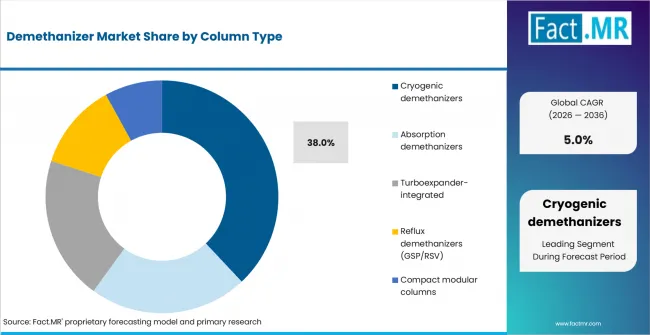
Demethanizer Market Analysis By Column Type | Source: Fact.MR
These systems lead because deep cooling helps separate methane from ethane and heavier liquids. Methane leaves as a clean gas stream, while the heavier parts stay in liquid form for further recovery. Other designs are used for specific plant needs, but cryogenic columns remain the main choice when plants need steady product recovery and consistent gas quality at a large scale.
Why does NGL Recovery lead Application demand?
NGL Recovery is estimated to represent 32.0% share in 2026.
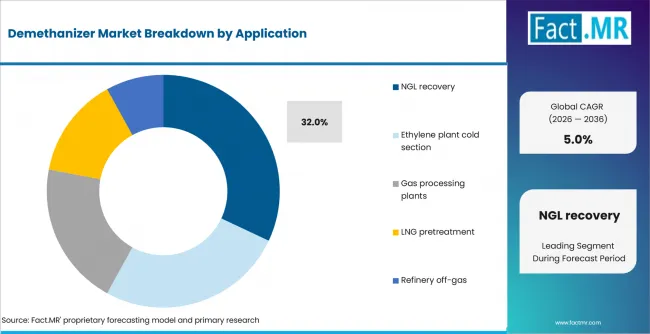
Demethanizer Market Analysis By Application | Source: Fact.MR
This application is important because it turns wet gas into several products that can be sold. After methane is removed, the liquid stream moves to the next separation stage for ethane, propane and heavier products. Similar equipment is also used in ethylene and LNG plants, but NGL recovery gives gas processors the clearest financial return from better column performance.
Why do Small systems below 100 MMscfd remain important?
Small systems below 100 MMscfd are anticipated to capture 24.0% share in 2026.
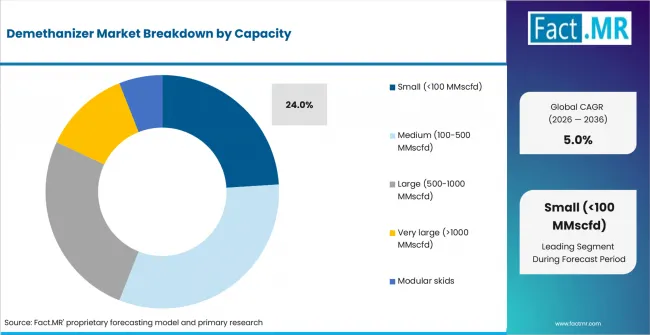
Demethanizer Market Analysis By Capacity | Source: Fact.MR
This size works well for associated-gas projects and smaller gas collection networks that cannot justify a large custom system. Standard factory construction and faster site installation also help control project cost. Larger units can process more gas, but they need more cooling equipment, longer setup time and more site work.
How does Structured Packing Support Internals demand?
Structured Packing leads with 34.0% share in 2026.
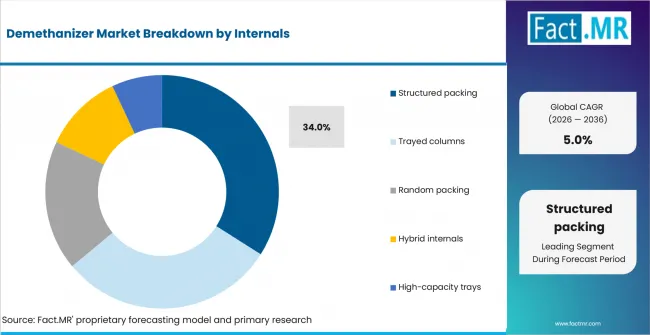
Demethanizer Market Analysis By Internals | Source: Fact.MR
Its main benefit is smoother gas and liquid flow through the column. Cryogenic systems already use a large amount of cooling, so extra pressure loss can raise energy use and reduce product recovery. Structured packing gives more contact area while keeping flow resistance lower. It also helps the system handle moderate changes in the feed without a major drop in performance.
Why do Gas Processors lead End User demand?
Gas Processors account for 31.0% share in 2026.
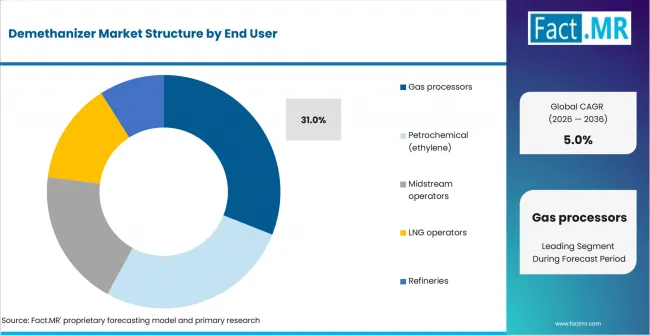
Demethanizer Market Analysis By End User | Source: Fact.MR
Demethanizer performance has a direct effect on their revenue. These companies receive wet gas and separate it into methane-rich gas and valuable liquid products before the next processing stage. Petrochemical and LNG plants use demethanizers as one part of a much larger site. Gas processors depend more directly on recovery rates, product output and final gas quality.
What is accelerating Demethanizer Market adoption, and what is holding it back?
NGL value recovery is anticipated to expand Demethanizer Market demand, although cyclic energy investment is expected to restrain project timing.
Drivers Impact Analysis
| DRIVER | (~) % IMPACT ON CAGR | GEOGRAPHIC RELEVANCE | IMPACT TIMELINE |
|---|---|---|---|
| Ethane and NGPL recovery economics | +1.5% | USA; China; gas-processing regions | Short term (<=2 years) |
| Ethane-feed petrochemical demand | +1.0% | China; UAE; USA | Medium term (2-4 years) |
| Brownfield recovery debottlenecking | +0.8% | USA; UK; Germany | Short term (<=2 years) |
| Modular gas-processing deployment | +0.5% | UAE; remote gas fields | Medium term (2-4 years) |
Source: Fact.MR analysis. Updated Jul 21, 2026
- Ethane and NGPL recovery economics: EIA reported in March 2026 that U.S. natural gas plant liquids exports reached 3.1 million barrels per day in 2025 and grew 7% from the previous year. That figure supports demethanizer demand because these liquids are extracted from gas streams before they move into export or petrochemical channels.
- Ethane-feed petrochemical demand: Ethane cracking needs a cold section that handles methane rejection and light-end separation cleanly. When petrochemical producers shift toward ethane feed, demethanizer performance becomes tied to plant flexibility and product recovery.
- Brownfield recovery debottlenecking: Existing plants often face limits before a full shell replacement is justified. Internals changes are expected to help owners raise usable capacity during planned outages.
- Modular gas-processing deployment: Remote gas fields carry schedule and labor risk when too much work is left for the site. Modular demethanizer packages are expected to suit phased developments where truckable or bargeable modules improve control over fabrication quality.
Opportunity Impact Analysis
| OPPORTUNITY | (~) % IMPACT ON CAGR | GEOGRAPHIC RELEVANCE | IMPACT TIMELINE |
|---|---|---|---|
| High-capacity internals retrofits | +0.9% | USA; UK; Germany | Short term (<=2 years) |
| Integrated cold-section packages | +0.7% | China; UAE; Japan | Medium term (2-4 years) |
| Performance monitoring for cryogenic columns | +0.6% | USA; Germany; Japan | Medium term (2-4 years) |
| Small-scale modular units | +0.5% | UAE; China; remote gas fields | Long term (>=4 years) |
Source: Fact.MR analysis. Updated Jul 21, 2026
- High-capacity internals retrofits: Structured packing and high-capacity trays are expected to create work where operators need more recovery inside an existing column. This opportunity is strongest when pressure drop or flooding limits appear before the shell reaches the end of useful life.
- Integrated cold-section packages: Engineering teams increasingly prefer one supplier interface for column, refrigeration and turboexpander coordination. The opportunity is tied to risk reduction during design review and commissioning.
- Performance monitoring for cryogenic columns: Digital surveillance is expected to help operators spot declining recovery and early signs of hydraulic stress. The value comes from preventing unscheduled shutdowns in units that are difficult to warm up and restart.
- Small-scale modular units: Smaller gas streams need a lower-cost path to liquids recovery. Standard modules are expected to fit these projects when plant owners need repeatable design and fewer field construction hours.
Restraints Impact Analysis
| RESTRAINT | (~) % IMPACT ON CAGR | GEOGRAPHIC RELEVANCE | IMPACT TIMELINE |
|---|---|---|---|
| Cyclic gas-processing investment | -1.1% | Global | Short term (<=2 years) |
| Cryogenic integration complexity | -0.8% | Global | Short term (<=2 years) |
| Long-lead alloy and fabrication capacity | -0.6% | USA; China; UAE | Medium term (2-4 years) |
| Project concentration risk | -0.5% | China; UAE; USA | Medium term (2-4 years) |
Source: Fact.MR analysis. Updated Jul 21, 2026
- Cyclic gas-processing investment: New demethanizer orders depend on gas-processing and petrochemical capital budgets. When owners delay final investment decisions, equipment suppliers see order timing move even when the underlying need remains clear.
- Cryogenic integration complexity: The column cannot be judged alone because refrigeration, feed conditioning and turboexpander performance all affect recovery. This narrows the field to teams with proven cold-section engineering and commissioning depth.
- Long-lead alloy and fabrication capacity: Demethanizer systems require qualified fabrication and careful material selection for low-temperature service. Tight shop capacity is expected to stretch schedules when LNG, petrochemical and industrial-gas projects compete for the same fabrication resources.
- Project concentration risk: A few large gas-processing or petrochemical awards shift annual demand more than many small orders. This makes revenue uneven for providers that depend on large integrated packages.
Which countries are scaling Demethanizer Market fastest?
The global growth rate is based on the combined performance of all countries covered in the study. It does not have to match the rate of every country shown in the comparison. China and the UAE are growing faster than the global rate of 5.0%. Japan, the United Kingdom and Germany are below it. The six countries are included as examples to show how national growth can differ from the worldwide average.
- The main difference between these countries comes from the type of projects supporting demand, not only from their CAGRs.
- China and the UAE form the faster-growing group. China benefits from new gas-processing plants and added ethylene capacity. Growth in the UAE is linked more closely to NGL recovery projects and further petrochemical expansion.
- The USA and Japan sit close to the global average. In the USA, demand comes from its large base of liquids-rich gas plants and upgrades at older sites. Japan depends more on ethylene plants and gas-separation work linked to LNG.
- The United Kingdom and Germany are growing more slowly. Most opportunities in these countries come from extending the life of older plants, making selected upgrades and supporting petrochemical operations.
- Countries with similar growth rates can still develop in very different ways. The type of gas entering the plant, the design of the cooling section and access to experienced engineers can all affect when a project moves from planning to equipment purchase.
The full report reviews these conditions across every country covered in the study. It provides country-level CAGR analysis across North America, Latin America, Europe, East Asia, South Asia, Oceania and the Middle East and Africa.
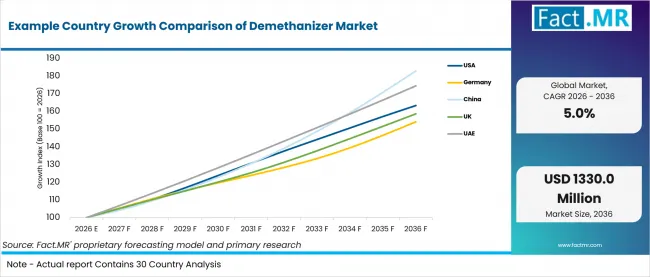
Example Country Growth Comparison Of Demethanizer Market | Source: Fact.MR
| COUNTRY | CAGR (2026 to 2036) |
|---|---|
| UAE | 5.7% |
| USA | 5.0% |
| Japan | 4.9% |
| UK | 4.7% |
| Germany | 4.4% |
Source: Fact.MR analysis. Updated Jul 21, 2026
Where does China’s demethanizer demand come from?
6.2% CAGR, linked to ethylene production and better recovery of lighter gas products.
China’s demand comes from its large ethylene industry and the equipment used to separate methane from valuable liquid products. New ethylene plants and upgrades at older sites create demand for cryogenic columns that help protect ethane output and maintain the required gas quality. Equipment companies are likely to gain more business when the demethanizer is planned together with the cooling system and the next separation stage.
Why is the UAE adding new capacity?
5.7% CAGR, supported by gas-processing projects and rising petrochemical feed needs.
Projects in the UAE recover ethane-rich liquids while preparing methane-rich gas for pipelines or export. This means the demethanizer supports both gas sales and chemical production. Factory-built cooling units also suit these projects because they reduce work at the site and bring the main equipment into one complete setup.
What is sustaining the USA market?
5.0% CAGR, driven by liquids-rich gas fields and upgrades at existing plants.
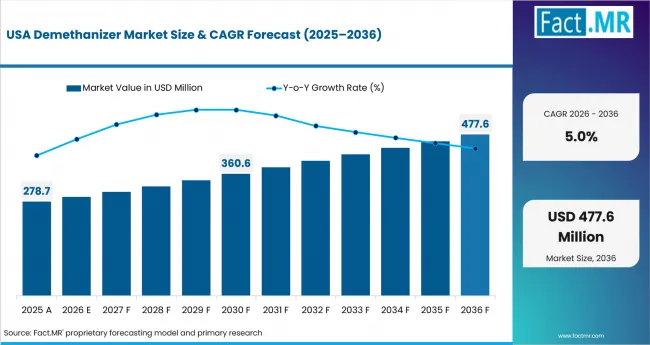
Demethanizer Market Country Value Analysis | Source: Fact.MR
The USA already has a large gas-processing network. Most demand is therefore expected to come from improving older plants and adding selected capacity. Strong ethane and natural gas liquids output keeps recovery gains financially important. Replacing parts inside the column and improving the cooling system can raise output without rebuilding the full plant.
Where does Japan find commercial use?
4.9% CAGR, backed by petrochemical plants and LNG-related gas separation.
Japan has limited wet-gas production of its own, so demand comes mainly from chemical plants and facilities linked to imported gas. Demethanizers are used when older separation equipment is replaced or when companies want more reliable operation in plants with limited space. Approval often depends on how well the unit fits the cooling system, maintains product quality and supports easy maintenance.
How is the United Kingdom generating project activity?
4.7% CAGR, tied to longer use of North Sea assets and selected plant upgrades.
Demand in the United Kingdom comes mainly from older gas-processing sites instead of large new projects. Companies may replace internal column parts or improve gas flow during planned shutdowns. These upgrades become more attractive when they raise liquid recovery without requiring a new column shell.
What defines Germany’s outlook?
4.4% CAGR, shaped by chemical plants and careful spending on existing sites.
Germany depends more on chemical and petrochemical plants than on gas-field processing. New spending is likely to focus on projects that reduce pressure loss and improve product recovery in existing equipment. Companies with strong upgrade experience and a clear cost-saving case are expected to find more opportunities than those focused mainly on large new plants.
Who leads the Demethanizer Market?
Linde Engineering has the widest presence in demethanizer projects. Honeywell UOP and Chart Industries also have a strong position through gas recovery systems and equipment used for low-temperature processing.
Linde Engineering offers NGL recovery technologies, including CRYO-PLUS and STANDARD-GSP, along with related process options. Honeywell UOP provides modular cryogenic plants and Ortloff technology for ethane recovery and separation. Chart Industries supplies brazed aluminium heat exchangers and cold boxes used in NGL and LNG plants. Technip Energies supports gas-processing and ethylene projects.
Through 2036, companies are expected to compete on recovery performance, how well the cooling system works with the column and how easily the equipment fits into existing plants. Plant operators are also likely to compare equipment quality, shutdown time and service after installation. Companies that deliver the column, internal parts and cooling equipment as one complete system are expected to have a stronger position.
Which companies are the key providers?
The key companies are Linde Engineering; Honeywell UOP; Chart Industries; Technip Energies.
- Linde Engineering
- Honeywell UOP
- Chart Industries
- Technip Energies
Bibliography
- Chart Industries, Inc. (2025). BAHX operation and maintenance for asset integrity.
- U.S. Energy Information Administration. (2026, March 30). Natural gas plant liquids exports reached record highs in 2025. U.S. Energy Information Administration.
- Technip Energies. (2026, April 9). Technip Energies awarded contract for Long Son Petrochemicals enhancement project in Vietnam. Technip Energies.
This Report Addresses
- The report provides strategic intelligence on Demethanizer Market across Column Type and Application choices that shape purchase decisions.
- Segment analysis covers Cryogenic demethanizers as the share leader within the 2026 market structure.
- Regional outlook evaluates China and UAE alongside USA and Japan, while UK and Germany complete the growth comparison.
- Competitive analysis profiles Linde Engineering alongside Honeywell UOP and Chart Industries, followed by additional active providers.
- Use-case assessment covers the categories and applications that shape demethanizer market demand across the forecast period.
What does the Demethanizer Market cover?
Cryogenic and related separation columns used to remove methane from ethane, propane and heavier hydrocarbons in gas-processing and petrochemical operations.
The Demethanizer Market covers equipment installed in NGL recovery plants, ethylene cold sections, LNG pretreatment systems and refinery off-gas units. Coverage includes cryogenic columns, absorption designs, turboexpander-integrated systems, reflux configurations and compact modular units. Column shells, structured packing, trays, hybrid internals, controls and engineering tied directly to the demethanizer package are included.
The market differs from complete gas-processing or petrochemical plant spending since commercial value is assigned only to the methane-separation section. Compressors, fractionation trains and unrelated cryogenic equipment remain outside the boundary. LNG liquefaction systems are also excluded unless the demethanizer as a separately identifiable package.
What is included in the scope?
Demethanizer systems used by gas processors, petrochemical producers, midstream operators, LNG facilities and refineries are included.
The scope covers Column Type and Application alongside Capacity, Internals and End User. Cryogenic and absorption units are included with turboexpander-integrated and reflux designs. Capacity ranges from systems below 100 MMscfd to very large trains above 1,000 MMscfd and modular skids. Structured packing, trayed columns, random packing, hybrid designs and high-capacity trays are included within the column package.
What is excluded from the scope?
Complete gas-processing plants and equipment that does not perform the demethanizer separation function remain outside the market.
The scope excludes standalone compressors, downstream fractionation systems and complete LNG liquefaction trains. General cold boxes, heat exchangers and unrelated cryogenic equipment are excluded when their value cannot be assigned directly to the demethanizer. Broader EPC plant value and feedstock costs are also outside the market boundary.
How Was the Analysis Built?
The analysis draws on 120+ sources, 35+ company portfolios, 25+ countries, and more than 20 industry interviews.
- Primary Research: Primary research includes discussions with manufacturers, service providers, technology developers, distributors, end users, procurement teams, and subject-matter experts. These conversations examine purchasing priorities, product adoption, operational challenges, approval requirements, competitive positioning, and the factors that influence wider market acceptance.
- Desk Research: Desk research covers government statistics, regulatory publications, company filings, trade data, technical studies, industry associations, standards, public policy, and other authoritative sources. Every source used in the analysis is documented in the bibliography.
- Market Sizing and Forecasting: Market estimates combine historical performance, demand indicators, pricing and volume trends, segment shares, company participation, country-level growth, adoption patterns, investment activity, and barriers to market expansion.
- Data Validation and Update Cycle: Findings are validated by comparing primary interviews with public data, company activity, regulatory changes, trade patterns, and industry developments. Regular updates review new product launches, capacity changes, partnerships, approvals, procurement trends, and shifts in commercial adoption.
Segmentation
What is the report's scope and coverage?
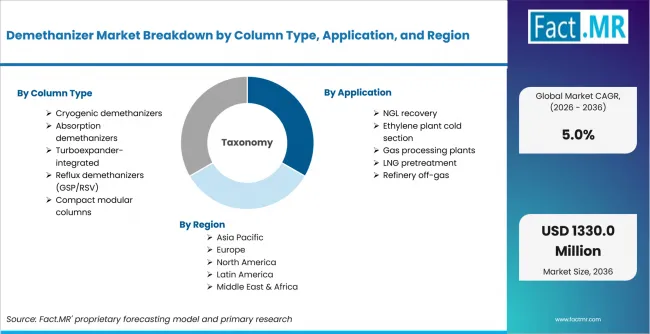
Demethanizer Market Breakdown By Column Type, Application, And Region | Source: Fact.MR
| Attribute | Details |
|---|---|
| Quantitative Units | USD million, with CAGR from 2026 to 2036 |
| Market Definition | A demethanizer is a cryogenic column that separates methane from ethane, propane and heavier hydrocarbons in gas-processing and ethylene-plant service. |
| Column Type | Cryogenic demethanizers; Absorption demethanizers; Turboexpander-integrated; Reflux demethanizers (GSP/RSV); Compact modular columns |
| Application | NGL recovery; Ethylene plant cold section; Gas processing plants; LNG pretreatment; Refinery off-gas |
| Capacity | Small (<100 MMscfd); Medium (100-500 MMscfd); Large (500-1000 MMscfd); Very large (>1000 MMscfd); Modular skids |
| Internals | Structured packing; Trayed columns; Random packing; Hybrid internals; High-capacity trays |
| End User | Gas processors; Petrochemical (ethylene); Midstream operators; LNG operators; Refineries |
| Regions Covered | North America; Latin America; Europe; East Asia; South Asia & Oceania; Middle East & Africa |
| Countries Covered | USA; Canada; Brazil; Mexico; Germany; U.K.; France; Italy; Spain; South Korea; Japan; China; India; Australia & New Zealand; GCC Countries; South Africa; UAE |
| Key Companies Profiled | Linde Engineering; Honeywell UOP; Chart Industries; Technip Energies |
| Forecast Period | 2026 to 2036 |
| Approach | Hybrid top-down and bottom-up approach using demand indicators across Column Type, Application, Capacity, Internals, End User; country-level growth; company participation and adoption trends |
Source: Fact.MR analysis. Updated Jul 21, 2026
How is the market segmented?
-
By Column Type:
- Cryogenic demethanizers
- Absorption demethanizers
- Turboexpander-integrated
- Reflux demethanizers (GSP/RSV)
- Compact modular columns
-
By Application:
- NGL recovery
- Ethylene plant cold section
- Gas processing plants
- LNG pretreatment
- Refinery off-gas
-
By Capacity:
- Small (<100 MMscfd)
- Medium (100-500 MMscfd)
- Large (500-1000 MMscfd)
- Very large (>1000 MMscfd)
- Modular skids
-
By Internals:
- Structured packing
- Trayed columns
- Random packing
- Hybrid internals
- High-capacity trays
-
By End User:
- Gas processors
- Petrochemical (ethylene)
- Midstream operators
- LNG operators
- Refineries
-
By Region:
- North America
- USA
- Canada
- Latin America
- Brazil
- Mexico
- Rest of Latin America
- Europe
- Germany
- U.K.
- France
- Italy
- Spain
- Rest of Europe
- East Asia
- South Korea
- Japan
- China
- South Asia & Oceania
- India
- Australia & New Zealand
- Rest of South Asia & Oceania
- Middle East & Africa
- GCC Countries
- South Africa
- UAE
- Rest of Middle East & Africa
- North America
Frequently Asked Questions
Which Column Type leads the Demethanizer Market?
Which Application leads the Demethanizer Market?
Which Capacity leads the Demethanizer Market?
Which Internals leads the Demethanizer Market?
Which End User leads the Demethanizer Market?
How does UAE perform in the Demethanizer Market?
How does USA perform in the Demethanizer Market?
What is the primary driver in the Demethanizer Market?
What is the main restraint in the Demethanizer Market?
Who worked on this report


Preview the report firsthand - request a free sample
Free SampleGet the brochure for pricing and purchase details
Download PDF