- Market Value (2025): USD 216.5 Mn
- Estimated Value (2026): USD 225.6 Mn
- Forecast Value (2036): USD 339.7 Mn
- CAGR (2026-2036): 4.2%
Marine Filler Market Forecast and Outlook 2026 to 2036
As per the Fact.MR analysis, the marine fillers market was valued at USD 216.5 million in 2025 and is projected to grow from USD 225.6 million in 2026 to USD 339.7 million by 2036. Demand for marine fillers is likely to grow at a CAGR of 4.2% over the forecast period.
Demand for marine fillers is rising as boatbuilders and repair yards fair hulls, fill voids and restore gelcoat on fiberglass, aluminum and steel vessels. Suppliers of marine fillers are offering lightweight epoxy fairing compounds and fast-cure polyester fillers. For example, boot Düsseldorf, one of the largest boat shows, continues to draw builders and suppliers each January, reflecting Europe's active yacht-building base. Similar boatbuilding activity is projected to drive sales of marine fillers through 2036.
Key Takeaways from the Marine Filler Market
- Marine Filler Market Value (2025): USD 216.5 million
- Marine Filler Market Value (2026): USD 225.6 million
- Marine Filler Market Forecast Value (2036): USD 339.7 million
- Marine Filler Market Forecast CAGR (2026-2036): 4.2%
- Leading Product Type: Epoxy-Based (38.2%)
- Key Market Participants: 3M Company, BASF SE, Akzo Nobel N.V., Sika AG, Jotun A/S, Hempel A/S
- Key Growth Regions: Germany, Brazil, United States, United Kingdom, Japan
German superyacht builders such as Lürssen and Abeking & Rasmussen continue to deliver large custom yachts that require extensive fairing before topcoat. Demand for marine fillers is growing as yacht owners expect mirror-smooth finishes. Suppliers of marine fillers are offering low-density fairing systems with long working times. Similar premium builds are projected to drive sales of marine fillers in Europe.
Marine Filler Market
| Metric | Value |
|---|---|
| Estimated Value in (2026) | USD 225.6 million |
| Forecast Value in (2036) | USD 339.7 million |
| Forecast CAGR (2026 to 2036) | 4.2% |
Source: Fact.MR analysis. Updated Nov 20, 2026
Source: Fact.MR analysis.
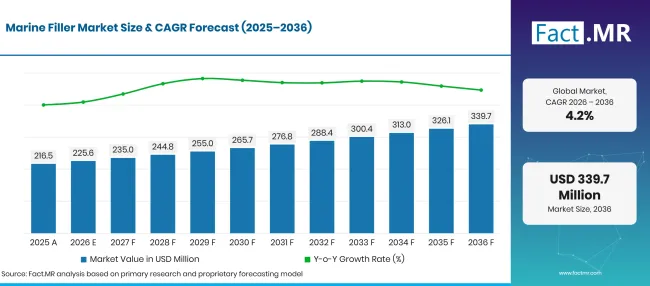
Marine Filler Market Forecast Global | Source: Fact.MR
Category
| Category | Segments |
|---|---|
| Product Type | Epoxy-Based, Polyester-Based, Vinyl Ester-Based, Others |
| Application | Boat Building, Yacht Repair, Ship Maintenance, Others |
| End-User | Commercial, Recreational, Military, Others |
| Distribution Channel | Marine Supply Stores, Online Stores, Others |
| Region | Germany; Brazil; United States; United Kingdom; Japan |
Source: Fact.MR analysis. Updated Nov 20, 2026
Segmental Analysis
Why do epoxy-based fillers lead product demand in the Marine Filler Market?
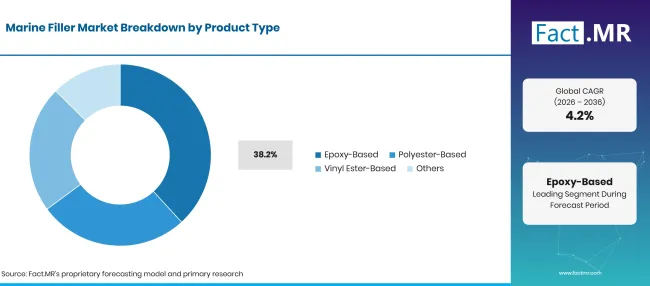
Marine Filler Market Breakdown Product Type | Source: Fact.MR
Demand for epoxy-based fillers account for 38.2% of revenue in 2026, about USD 86.2 million, as strong adhesion, moisture resistance and low-shrinkage curing make them suitable for hull fairing and below-waterline applications. Polyester and vinyl ester fillers serve faster cosmetic repairs. The U.S. Coast Guard's February 2026 recreational boating survey estimated that 84.5 million people operate more than 25.5 million recreational boats across the United States. Continued use of this extensive vessel fleet creates maintenance requirements for durable repair materials, supporting demand for epoxy-based fillers.
What makes boat building lead application demand in the Marine Filler Market?
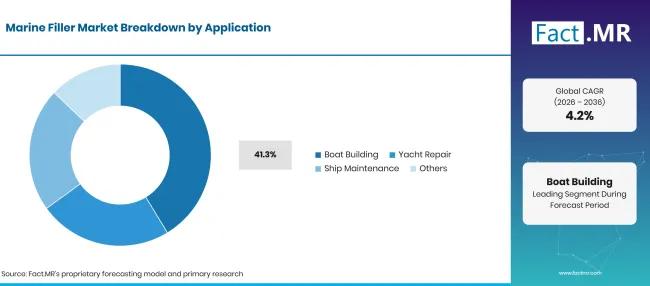
Marine Filler Market Breakdown Application | Source: Fact.MR
Sales of boat building holds 41.3% of revenue in 2026, about USD 93.2 million, as newly manufactured hulls and superstructures require filling, fairing and surface preparation before protective coatings are applied. Yacht repair and ship maintenance follow. India's Ministry of Ports, Shipping and Waterways reported in November 2026 that the country's shipbuilding order book had exceeded USD 1.7 billion across more than 150 vessels. The government is also developing five greenfield coastal shipbuilding clusters to expand domestic manufacturing capacity. Increased vessel construction is expected to support demand for marine fillers used in surface preparation and finishing.
Which factor make commercial users lead end-user demand in the Marine Filler Market?
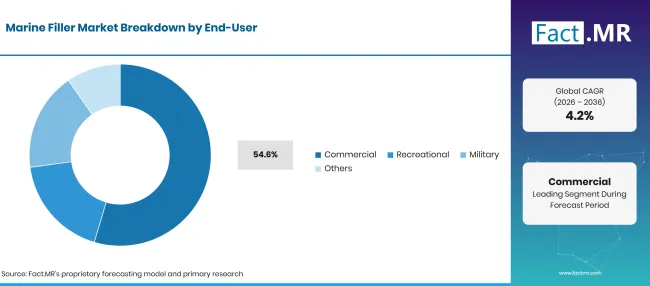
Marine Filler Market Breakdown End User | Source: Fact.MR
Commercial users represent 54.6% of revenue in 2026, about USD 125 million, as commercial shipyards, boatbuilders and refit centers purchase fillers for recurring hull preparation, surface finishing and vessel maintenance. Recreational owners and military yards follow. India's Ministry of Ports, Shipping and Waterways reported in July 2026 that the government had approved a ₹69,725 crore shipbuilding revitalization package. The initiative includes financial assistance, maritime infrastructure development and shipyard capacity expansion. These investments are expected to support professional procurement of marine fillers across commercial shipbuilding and repair operations.
What make marine supply stores lead distribution in the Marine Filler Market?
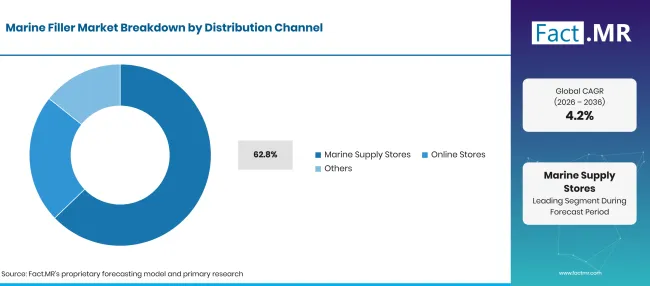
Marine Filler Market Breakdown Distribution Channel | Source: Fact.MR
Sales through marine supply stores account for 62.8% of revenue in 2026, about USD 140 million, as boatbuilders, repair yards and vessel owners purchase fillers alongside paints, primers, abrasives and application tools. Online sales are gaining traction for smaller repair packs, while specialist marine retailers remain important for product selection and technical guidance. The U.S. Coast Guard's 2026 National Recreational Boating Safety Survey covers more than 50,000 households across all 50 states and the District of Columbia, highlighting the nationwide reach of recreational boating and the potential customer base for marine maintenance products. This broad boating market is expected to support sales through specialist marine supply stores.
Marine Filler Market-Drivers, Restraints & Trends
Drivers – Rising Naval Shipbuilding and Metal-Hull Vessel Investment
Demand for marine fillers is gaining support from increased investment in naval vessels, patrol boats and commercial shipbuilding. According to the European Defence Agency, EU member states' defence expenditure is projected to reach €454 billion in 2026, up from €418 billion in 2025, representing an 8.6% increase. Higher defence investment is expected to support naval procurement and shipyard activity, creating opportunities for metal-hull fairing compounds, corrosion-resistant fillers and surface-finishing materials.
Restraints – Weak Recreational Boat Sales and Shipyard Workforce Shortages
Demand for marine fillers faces pressure from fluctuations in recreational boat purchases and limited shipyard labour availability. The National Marine Manufacturers Association reported that the United States had 15.2 million recreational boats in use in 2025, down 0.8% from 2024. Separately, the U.S. government's 2026 Maritime Action Plan identifies skilled-worker shortages as a challenge affecting shipbuilding capacity. These conditions can constrain new vessel construction and delay repair projects, encouraging suppliers to develop easier-to-apply filler systems.
Opportunity – Increasing Adoption of Spray-Applied Fairing Compounds
Demand for spray-applied marine fillers is gaining attention as shipyards seek to improve application speed and manage skilled-labour constraints. The U.S. Maritime Action Plan released in February 2026 identifies workforce shortages as a challenge to domestic shipbuilding capacity. This is encouraging interest in application-efficient repair materials, including sprayable fairing compounds that can reduce manual spreading and support consistent surface preparation.
Trend – Growing Demand for Lower-Styrene Marine Fillers
Demand for lower-styrene marine fillers is supported by increasing attention to occupational exposure and workplace safety during hull finishing and repair. The U.S. Occupational Safety and Health Administration identifies boat manufacturing and repair workers as potentially exposed to styrene and specifies an occupational exposure limit of 100 parts per million over an eight-hour workday for maritime employment. This regulatory requirement supports interest in lower-emission resin formulations that help shipyards manage workplace exposure.
Marine Filler Market by Analysis by Key Country
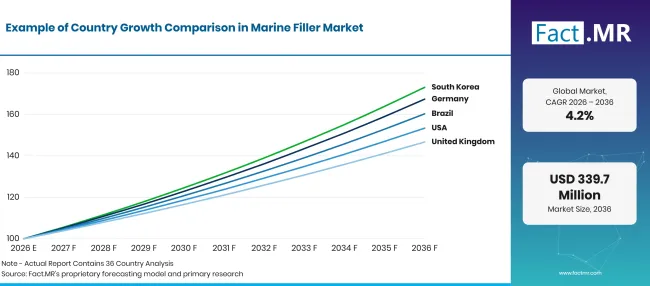
Marine Filler Market Growth Index | Source: Fact.MR
| Country | CAGR (2026-2036) |
|---|---|
| Germany | 5.3% |
| Brazil | 4.8% |
| United States | 4.4% |
| United Kingdom | 3.9% |
| Japan | 3.5% |
Source: Fact.MR analysis. Updated Nov 20, 2026
Source: Fact.MR analysis.
Why is Germany the fastest-growing market for marine fillers?
Demand for marine fillers in Germany is estimated to grow at a 5.3% CAGR, the fastest among the five key countries, as superyacht builders and naval yards fair large hulls.
Germany's 2025 naval industry data recorded approximately €3.4 billion in ship deliveries, compared with €2.8 billion in 2024. The country's maritime defence industry also accounted for 19% of EU maritime defence vehicle output value in 2025, according to the European Commission. Continued frigate, submarine and naval vessel production is expected to support demand for metal-hull fillers, epoxy compounds and fairing materials used in vessel construction and maintenance.
What is supporting marine filler demand in Brazil?
Sales of marine fillers in Brazil are anticipated to record a 4.8% CAGR as boatbuilders in Santa Catarina and São Paulo produce leisure boats for domestic and export markets.
Industry data published in 2026 by the Santa Catarina nautical association ACATMAR indicates that the state accounts for approximately 70% of Brazil's sport and leisure boat production. Its boat exports reached USD 37.6 million in 2025, while January–August 2026 exports totalled USD 20.8 million. This manufacturing concentration supports demand for hull fillers, surface-finishing compounds and repair materials across boatbuilding and maintenance operations.
What is shaping marine filler sales in the United States?
Sales of marine fillers in the United States are projected to grow at a 4.4% CAGR as a large recreational fleet needs repair while new boat sales recover slowly.
The U.S. Coast Guard's 2026 National Recreational Boating Safety Survey estimates that approximately 84.5 million people participate in recreational boating and operate more than 25.5 million boats. Additionally, the Coast Guard recorded 11.67 million registered recreational vessels in 2024. This extensive installed fleet creates opportunities for epoxy fillers, hull repair putties and fairing compounds used in maintenance and restoration.
What is shaping marine filler demand in the United Kingdom?
Demand for marine fillers in the United Kingdom is estimated to hold a 3.9% CAGR as yacht builders such as Princess and Sunseeker and refit yards maintain activity.
According to the UK Ministry of Defence's 2026 employment estimates, defence expenditure supported £6.9 billion in the shipbuilding and repairing industry during 2024/25, generating approximately 41,500 direct jobs and 32,800 indirect jobs. Continued investment in naval vessel construction and repair is expected to sustain demand for hull fillers, protective coatings and surface-finishing materials across British shipyards.
Why is marine filler growth slower in Japan?
Demand for marine fillers in Japan is projected to record a 3.5% CAGR, the slowest among the five key countries, as the pleasure boat market is small and aging.
Chugoku Marine Paints and Nippon Paint serve yards. Similar conditions are projected to keep growth slower. Demand for marine fillers in Japan is supported by established shipbuilding and vessel maintenance activity, although recreational boating remains a more limited demand segment than in major Western boating markets. Japan's Ministry of Land, Infrastructure, Transport and Tourism reported 833 recreational boat accidents in 2025, 33 fewer than in 2024. Recreational boats accounted for approximately half of the country's 1,711 recorded vessel accidents. These figures highlight an ongoing requirement for vessel maintenance and repair, although the country's relatively mature recreational boating market may moderate incremental demand for marine fillers.
Competitive Landscape for Marine Filler Market
Competition in the marine filler market is divided between marine coatings groups and adhesive specialists. AkzoNobel, Jotun, Hempel, PPG, Nippon Paint, Kansai and Chugoku compete on coating systems, while 3M, Sika and BASF compete on fillers and resins. Buyers select on sandability, weight, cure time and compatibility.
From 2024 onward, competition shifted toward labor-saving products. Suppliers with sprayable systems are best placed.
Recent Developments
- In January 2025, boot Düsseldorf hosted major yacht and equipment launches.
- In September 2026, Hempel signed a three-year global hull coatings agreement with Maersk covering its 2026–2028 dry-docking programme. The agreement reinforces Hempel's position in marine coatings and supports vessel performance, hull protection and fuel-efficiency improvements through its silicone coating technologies.
- In February 2026, Hempel announced the successful first applications of its Hempaguard NB silicone hull coating on Maersk's newbuilding vessel, Tangier Maersk. The development demonstrates the integration of advanced silicone coating technology into new vessel construction while maintaining shipyard production schedules.
- In January 2026, Sika announced the launch of Sikafloor Marine-109 and Sikafloor Marine-119, a new generation of self-leveling mortars for marine applications. Marine-109 replaces the earlier Marine-120 formulation and offers lightweight construction, high strength and fast curing.
Key Players in Marine Filler Market
Key companies profiled include 3M Company; Sika AG; Jotun A/S; Hempel A/S; and Kossan Paint (M) Sdn. Bhd.
- 3M Company
- Sika AG
- Jotun A/S
- Hempel A/S
- Kossan Paint (M) Sdn. Bhd.
Bibliography
- AkzoNobel. (2025). Annual report 2024. Amsterdam, The Netherlands: AkzoNobel.
- Bureau of Labor Statistics. (2026). Table B-1b. Employees on nonfarm payrolls by industry sector and selected industry detail, not seasonally adjusted: October 2026. U.S. Department of Labor.
- Checkpoint Surgical. (2026, August 20). Checkpoint Surgical expands peripheral nerve portfolio with new flexible nerve conduit
- European Defence Agency. (2026, July 16). EU defence spending: €418 billion in 2025, projected to €454 billion in 2026.
- Hempel A/S. (2026, February 3). Hempel completes the first round of successful applications with Hempaguard NB on new Maersk vessels.
- Hempel A/S. (2026, September 14). Hempel secures 3-year global hull coatings agreement with Maersk for fleet dry dockings.
- Jotun A/S. (2025). Annual report 2024. Sandefjord, Norway: Jotun. .
- Messe Düsseldorf. (2025, January 26). boot Düsseldorf 2025
- Ministry of Ports, Shipping and Waterways, Government of India. (2026, July 24)
- Ministry of Ports, Shipping and Waterways, Government of India. (2026, November 16)
- Ministry of Ports, Shipping and Waterways, Government of India. (n.d.)
- National Marine Manufacturers Association. (2026, November 2)
- Occupational Safety and Health Administration. (n.d.). Styrene. U.S. Department of Labor
- Occupational Safety and Health Administration. (n.d.). Styrene: Chemical data. U.S. Department of Labor
- Sika AG. (2026, February 13). Sika to acquire Akkim: Marking a major step in accelerating global expansion in adhesives and sealants
- Sika AG. (2026, May). Sikafloor Marine-109: Product data sheet
- U.S. Coast Guard. (2026). National Recreational Boating Safety Survey (NRBSS)
- U.S. Coast Guard. (2026, February 13). The National Recreational Boating Safety Survey: Participation and exposure findings
- The White House. (2026, February). America's maritime action plan
Segmentation
Scope of Report
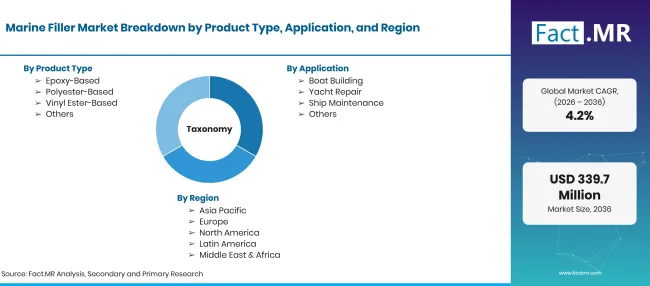
Marine Filler Market Taxonomy | Source: Fact.MR
| Items | Values |
|---|---|
| Quantitative Units (2026) | USD 225.6 Million |
| Product Type | Epoxy-Based, Polyester-Based, Vinyl Ester-Based, Others |
| Application | Boat Building, Yacht Repair, Ship Maintenance, Others |
| End-User | Commercial, Recreational, Military, Others |
| Distribution Channel | Marine Supply Stores, Online Stores, Others |
| Regions Covered | North America, Latin America, Europe, East Asia, South Asia and Pacific, Middle East & Africa |
| Countries Covered | United States, Germany, Japan, United Kingdom, Brazil, and other countries |
| Key Companies Profiled | 3M Company; Sika AG; Jotun A/S; Hempel A/S; Kossan Paint (M) Sdn. Bhd. |
| Additional Attributes | Dollar revenue in the Marine Filler Market is segmented by product type (epoxy-based, polyester-based, vinyl ester-based); application (boat building, yacht repair, ship maintenance); end-user (commercial, recreational, military); distribution channel (marine supply stores, online stores) and region. |
Source: Fact.MR analysis. Updated Nov 20, 2026
Marine Filler Market by Segments
-
Product Type
- Epoxy-Based
- Polyester-Based
- Vinyl Ester-Based
- Others
-
Application
- Boat Building
- Yacht Repair
- Ship Maintenance
- Others
-
End-User
- Commercial
- Recreational
- Military
- Others
-
Distribution Channel
- Marine Supply Stores
- Online Stores
- Others
-
Region:
- North America
- United States
- Canada
- Mexico
- Europe
- Germany
- United Kingdom
- France
- Italy
- Spain
- Rest of Europe
- Asia Pacific
- China
- India
- Japan
- South Korea
- Australia
- Rest of Asia Pacific
- Latin America
- Brazil
- Mexico
- Argentina
- Rest of Latin America
- Middle East & Africa
- GCC Countries
- South Africa
- Rest of Middle East & Africa
- North America
Frequently Asked Questions
How big is the global Marine Filler Market in 2026?
What will be the size of the Marine Filler Market by 2036?
How fast will the Marine Filler Market grow during the forecast period?
Which product type segment holds the largest share of the Marine Filler Market?
Who worked on this report


Preview the report firsthand - request a free sample
Free SampleGet the brochure for pricing and purchase details
Download PDF