PET Depolymerization Technology Market
PET Depolymerization Technology Market Size and Share Forecast Outlook 2026 to 2036
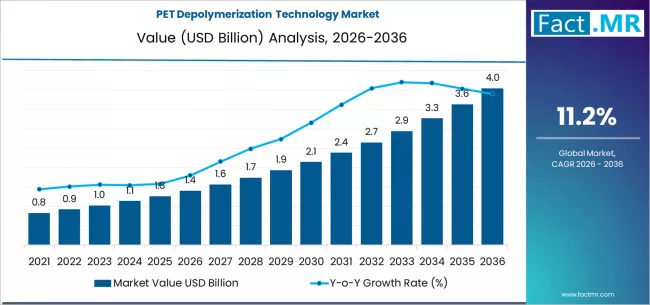
PET depolymerization technology market is projected to grow from USD 1.4 billion in 2026 to USD 4.0 billion by 2036, at a CAGR of 11.2%. Bottle-to-bottle recycling will dominate with a 42.8% market share, while glycolysis systems will lead the technology type segment with a 39.9% share.
PET Depolymerization Technology Market Forecast and Outlook 2026 to 2036
The global PET depolymerization technology market is projected to total USD 1.41 billion in 2026, reaching USD 4.05 billion by 2036, advancing at a CAGR of 11.2%. This accelerated expansion is driven by an urgent global mandate to establish circular pathways for polyethylene terephthalate, one of the most prolific packaging polymers.
Key Takeaways from the PET Depolymerization Technology Market
- Market Value for 2026: USD 1.41 Billion
- Market Value for 2036: USD 4.05 Billion
- Forecast CAGR 2026 to 2036: 11.2%
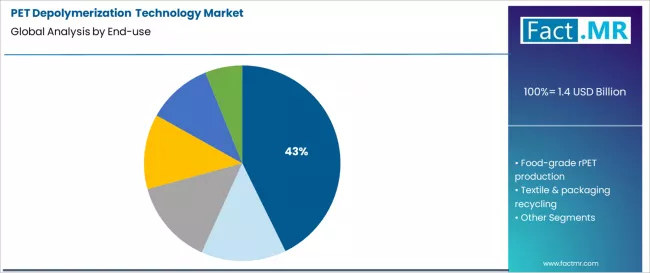
- Leading End-Use Segment (2026): Bottle-to-Bottle Recycling (42.8%)
- Leading Technology Type Segment (2026): Glycolysis Systems (39.9%)
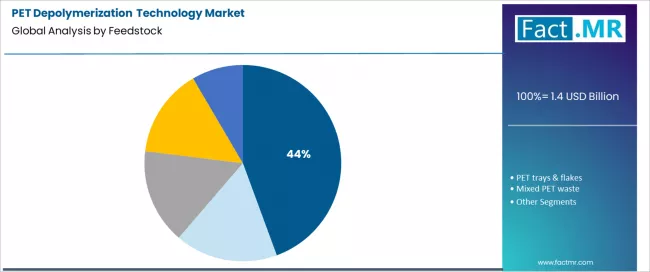
- Leading Feedstock Segment (2026): Post-Consumer PET Bottles (44.4%)
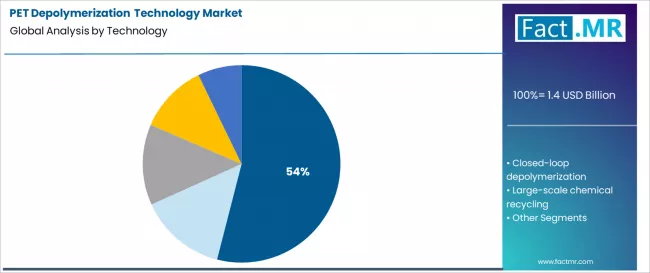
- Leading Technology Segment (2026): Chemical Depolymerization Reactors (54.0%)
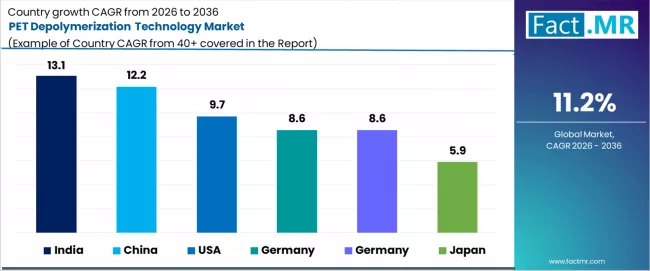
- Key Growth Countries: India (13.1% CAGR), China (12.2% CAGR), USA (9.7% CAGR), Brazil (8.6% CAGR), Germany (8.6% CAGR), Japan (5.9% CAGR)
- Key Players: Eastman, Loop Industries, BASF, Carbios, Zhejiang Wankai, Reliance Industries, Teijin

Regulatory pressure for high mandatory recycled content, particularly in food-contact applications, is rendering mechanical recycling insufficient, creating a definitive economic and compliance-based demand for chemical recycling technologies.
Depolymerization, which breaks PET down to its core monomers or oligomers, offers a solution to quality degradation and contamination issues inherent in mechanical processes. This capability to produce virgin-quality rPET resin is critical for brand owners aiming to meet ambitious sustainability pledges for packaging.
The technology's evolution from pilot-scale to commercial deployment is being catalyzed by multi-stakeholder partnerships across the petrochemical, waste management, and consumer goods industries, transforming plastic waste into a strategic feedstock.
Market progress is therefore a direct function of policy stringency and the economic viability of producing food-grade recycled resin. As legislation increasingly mandates "bottle-to-bottle" recycling and recognizes chemical recycling for content credits, investment flows into scaling depolymerization facilities that can integrate with existing PET value chains.
PET Depolymerization Technology Market
| Metric | Value |
|---|---|
| Market Value (2026) | USD 1.41 Billion |
| Market Forecast Value (2036) | USD 4.05 Billion |
| Forecast CAGR 2026 to 2036 | 11.2% |
Category
| Category | Segments |
|---|---|
| End-Use | Bottle-to-Bottle Recycling, Food-Grade rPET Production, Textile & Packaging Recycling, Packaging Resin Recovery, Beverage Packaging, High-Purity Recycling |
| Technology Type | Glycolysis Systems, Methanolysis, Hydrolysis, Hybrid Depolymerization, Others |
| Feedstock | Post-Consumer PET Bottles, PET Trays & Flakes, Mixed PET Waste, PET Bottles, Others |
| Technology | Chemical Depolymerization Reactors, Closed-Loop Depolymerization, Large-Scale Chemical Recycling, Cost-Efficient Depolymerisation, Others |
| Region | North America, Latin America, Western Europe, Eastern Europe, East Asia, South Asia & Pacific, Middle East & Africa |
Convergence of Chemical Engineering and Waste Logistics
Advancements are inextricably linked to innovations in catalyst science, process efficiency, and the development of robust pre-treatment supply chains. The evolution of enzymatic and catalytic depolymerization methods is lowering energy thresholds and improving monomer yield purity.
The economic viability of these plants hinges on securing consistent, high-volume flows of sorted PET waste, driving integration with advanced MRFs and the development of regional feedstock aggregation hubs. This synergy between molecular-scale chemical innovation and macro-scale reverse logistics defines the pathway to commercial scale and cost parity with virgin PET production.
Segmental Analysis
By Technology, Which System Forms the Industrial Heart of Monomer Recovery?

Chemical depolymerization reactors hold a commanding 54.0% share as the core enabling hardware. These specialized reactor systems are engineered to maintain precise temperature, pressure, and catalytic conditions required to efficiently break PET polymer chains into their constituent monomers, typically BHET, DMT or TPA. Their design dictates process scalability, energy efficiency, and final monomer purity.
Advancements in reactor engineering, including continuous-flow systems and advanced catalyst recovery mechanisms, are directly responsible for improving the economic profile and output quality of commercial depolymerization plants.
By End-Use, Which Application Demands the Highest Purity Output?

Bottle-to-bottle recycling constitutes the primary end-use segment with a 42.8% share. This application sets the highest bar for output quality, requiring depolymerization to produce monomers pure enough for re-polymerization into PET resin that meets stringent FDA or EFSA standards for direct food contact.
The technical challenge of removing contaminants, colorants, and additives during the chemical process is greatest here, but the economic premium for food-grade rPET is a powerful driver. This segment's growth is the most direct indicator of the technology's success in closing the loop for plastic packaging.
By Feedstock, Which Stream Offers Optimal Economics and Availability?

Post-consumer PET bottles represent the dominant feedstock segment with a 44.4% share. This stream is relatively homogenous, widely collected, and has established sorting infrastructure, making it the most economically viable and readily available input for nascent depolymerization facilities.
The high surface-to-volume ratio of bottles also facilitates more efficient chemical breakdown compared to denser forms. Securing long-term supply agreements for this feedstock is a critical strategic objective for plant operators, as it ensures consistent run rates and predictable input quality.
What are the Principal Drivers, Restraints, Opportunities, and Trends?
| Attribute | Impact |
|---|---|
| Driver | Stringent Regulatory Mandates for Recycled Content in Packaging |
| Legislation in the EU, North America, and Asia setting mandatory recycled content targets, especially for food-contact plastic, creates a compliance-driven market for high-purity rPET only attainable via depolymerization. | |
| Restraint | High Capital Intensity and Operational Complexity |
| Significant upfront investment for plant construction and technically demanding operations requiring specialized expertise present substantial barriers to entry and scale, impacting short-term return on investment. | |
| Opportunity | Licensing of Proprietary Catalytic and Enzymatic Processes |
| Technology pioneers can generate significant revenue by licensing their patented low-energy depolymerization processes to chemical companies and waste handlers seeking to enter the circular PET market without in-house R&D. | |
| Trend | Vertical Integration from Waste to Resin |
| Major petrochemical and packaging producers are investing in or partnering with depolymerization firms to secure closed-loop control over feedstock and guarantee supply of circular raw materials for their production lines. |
Analysis of the PET Depolymerization Technology Market by Key Countries

| Country | CAGR 2026 to 2036 |
|---|---|
| USA | 9.7% |
| Germany | 8.6% |
| China | 12.2% |
| India | 13.1% |
| Brazil | 8.6% |
| Japan | 5.9% |
How do State-Level Regulations and Corporate Sustainability Goals Drive the USA?
A 9.7% CAGR is propelled by a patchwork of state-level recycled content laws and strong corporate commitments from beverage and consumer packaged goods companies. Demand centers on technologies capable of processing colored and hard-to-recycle PET streams into food-grade material.
Federal grant programs for advanced recycling infrastructure and growing investor focus on circular economy solutions are providing crucial capital for first commercial-scale plants, with an emphasis on glycolysis and methanolysis pathways.
What Characterizes Germany's Role as a EU Regulatory and Technological Pioneer?
Germany's 8.6% CAGR reflects its leadership in implementing the EU's circular economy action plan. Stringent packaging laws, high landfill diversion rates, and the presence of leading chemical firms drive the market.
German investments often focus on sophisticated enzymatic depolymerization and hydrolysis technologies suited for high-purity recovery from complex feedstocks, serving as pilot hubs for processes destined for broader European deployment within integrated chemical parks.
What Underpins China's Rapid Scale-Up in Circular Plastics Infrastructure?
A 12.2% CAGR is fueled by national Zero-Waste City policies and massive investments in building a domestic circular economy for plastics. The scale of PET consumption generates an unparalleled feedstock base.
Growth is characterized by rapid deployment of large-scale methanolysis and glycolysis plants, often backed by state-owned chemical enterprises or large petrochemical players like Zhejiang Wankai, aiming to achieve polyester value chain sovereignty and reduce reliance on imported oil-based virgin PET.
How is India's Formalizing Waste Ecosystem and Polymer Demand Catalyzing Growth?
India leads with a 13.1% CAGR, driven by the formalization of plastic waste collection and the massive domestic demand for polyester fiber and packaging. The need to manage post-consumer PET waste within a price-sensitive framework fosters innovation in cost-optimized glycolysis systems.
Major conglomerates like Reliance Industries are investing heavily to integrate depolymerization into their chemical production complexes, viewing waste PET as a strategic alternative feedstock for their vast polyester operations.
Why is Brazil's Growth Linked to Packaging Recovery and Renewable Chemistry?
An 8.6% CAGR is closely tied to the enforcement of reverse logistics systems and a strong focus on renewable chemistry. The well-established collection networks for PET bottles provide a solid feedstock base.
Growth is further supported by the potential integration of depolymerization with Brazil's bio-based chemical industry, exploring pathways to use bio-glycols in the process, thereby creating a partially bio-attributed rPET with a enhanced sustainability profile for export markets.
What Defines Japan's Focus on Precision Recycling for a Closed-Loop Society?
Japan's 5.9% CAGR represents a focused approach on precision recycling to achieve its Sound Material-Cycle Society goals. Demand stems from the need to efficiently recycle high volumes of collected PET trays and bottles back into high-value applications.
Japanese technology developers and chemical companies like Teijin are pioneering compact, highly efficient depolymerization systems suited for dense urban environments, with a strong emphasis on achieving ultra-high monomer purity for sensitive electronics and automotive applications beyond packaging.
Competitive Landscape of the PET Depolymerization Technology Market
The competitive arena features a dynamic mix of specialty technology innovators and established chemical industry titans. Pure-play innovators like Carbios and Loop Industries compete through breakthrough proprietary processes, such as enzymatic or catalytic depolymerization, protected by robust IP portfolios. Their strategy revolves around technology licensing and forming joint ventures with industrial partners capable of scaling their methods.
Incumbent chemical giants like Eastman and BASF leverage their deep expertise in polymerization, catalysis, and plant engineering to develop and scale integrated processes. They compete by offering offtake agreements for monomers and leveraging existing customer relationships in the packaging and textile industries. Success is increasingly determined by the ability to form complete value chain partnerships rather than by technology alone.
Key Players in the PET Depolymerization Technology Market
- Eastman Chemical Company
- Loop Industries
- BASF
- Carbios
- Zhejiang Wankai
- Reliance Industries
- Teijin
Scope of Report
| Items | Metrics |
|---|---|
| Quantitative Units | USD Billion |
| Technology | Chemical Depolymerization Reactors, Closed-Loop Depolymerization, Large-Scale Chemical Recycling, Cost-Efficient Depolymerisation, Others |
| Technology Type | Glycolysis Systems, Methanolysis, Hydrolysis, Hybrid Depolymerization, Others |
| End-Use | Bottle-to-Bottle Recycling, Food-Grade rPET Production, Textile & Packaging Recycling, Packaging Resin Recovery, Beverage Packaging, High-Purity Recycling |
| Feedstock | Post-Consumer PET Bottles, PET Trays & Flakes, Mixed PET Waste, PET Bottles, Others |
| Key Countries | India, China, USA, Brazil, Germany, Japan |
| Key Companies | Eastman, Loop Industries, BASF, Carbios, Zhejiang Wankai, Reliance Industries, Teijin, Others |
| Additional Analysis | Comparative analysis of energy consumption across depolymerization pathways; total cost of ownership models for commercial-scale plants; impact on lifecycle assessment and carbon footprint of rPET; study of IP landscape and licensing models; analysis of pre-treatment technology requirements for contaminated feedstocks. |
Market by Segments
-
End-Use :
- Bottle-to-Bottle Recycling
- Food-Grade rPET Production
- Textile & Packaging Recycling
- Packaging Resin Recovery
- Beverage Packaging
- High-Purity Recycling
-
Technology Type :
- Glycolysis Systems
- Methanolysis
- Hydrolysis
- Hybrid Depolymerization
- Others
-
Feedstock :
- Post-Consumer PET Bottles
- PET Trays & Flakes
- Mixed PET Waste
- PET Bottles
- Others
-
Region :
- North America
- USA
- Canada
- Latin America
- Brazil
- Mexico
- Argentina
- Rest of Latin America
- Western Europe
- Germany
- France
- Italy
- Spain
- UK
- BENELUX
- Rest of Western Europe
- Eastern Europe
- Russia
- Poland
- Czech Republic
- Rest of Eastern Europe
- East Asia
- China
- Japan
- South Korea
- Rest of East Asia
- South Asia & Pacific
- India
- ASEAN
- Australia
- Rest of South Asia & Pacific
- MEA
- GCC Countries
- South Africa
- Turkiye
- Rest of MEA
- North America
References
- Ellen MacArthur Foundation. (2024). The Global Commitment 2024: A shared vision for a circular economy for plastic. Progress Report.
- European Commission. (2025). Commission Implementing Regulation on the use of recycled plastic materials and articles in contact with food. Official Journal of the EU.
- International Journal of Life Cycle Assessment. (2024). "Lifecycle assessment of chemical recycling for PET via hydrolysis and glycolysis: A comparative review." Special Issue on Circular Polymers.
- Pavel, K., & Šimoníkova, L. (2023). Chemical Recycling of Polyethylene Terephthalate: Processes, Catalysts, and Industrial Prospects. In Advances in Polymer Science (Vol. 290). Springer.
- United Nations Environment Programme. (2024). Turning off the Tap: How the world can end plastic pollution and create a circular economy. UNEP Synthesis Report.
- U.S. Department of Energy. (2025). Plastics Innovation Challenge: Chemical Recycling Pathways Roadmap. DOE Report.
Table of Content
- Executive Summary
- Global Market Outlook
- Demand to side Trends
- Supply to side Trends
- Technology Roadmap Analysis
- Analysis and Recommendations
- Market Overview
- Market Coverage / Taxonomy
- Market Definition / Scope / Limitations
- Market Background
- Market Dynamics
- Drivers
- Restraints
- Opportunity
- Trends
- Scenario Forecast
- Demand in Optimistic Scenario
- Demand in Likely Scenario
- Demand in Conservative Scenario
- Opportunity Map Analysis
- Product Life Cycle Analysis
- Supply Chain Analysis
- Investment Feasibility Matrix
- Value Chain Analysis
- PESTLE and Porter’s Analysis
- Regulatory Landscape
- Regional Parent Market Outlook
- Production and Consumption Statistics
- Import and Export Statistics
- Market Dynamics
- Global Market Analysis 2021 to 2025 and Forecast, 2026 to 2036
- Historical Market Size Value (USD Million) Analysis, 2021 to 2025
- Current and Future Market Size Value (USD Million) Projections, 2026 to 2036
- Y to o to Y Growth Trend Analysis
- Absolute $ Opportunity Analysis
- Global Market Pricing Analysis 2021 to 2025 and Forecast 2026 to 2036
- Global Market Analysis 2021 to 2025 and Forecast 2026 to 2036, By End-use
- Introduction / Key Findings
- Historical Market Size Value (USD Million) Analysis By End-use, 2021 to 2025
- Current and Future Market Size Value (USD Million) Analysis and Forecast By End-use, 2026 to 2036
- Bottle-to-bottle recycling
- Food-grade rPET production
- Textile & packaging recycling
- Packaging resin recovery
- Beverage packaging
- High-purity recycling
- Bottle-to-bottle recycling
- Y to o to Y Growth Trend Analysis By End-use, 2021 to 2025
- Absolute $ Opportunity Analysis By End-use, 2026 to 2036
- Global Market Analysis 2021 to 2025 and Forecast 2026 to 2036, By Technology Type
- Introduction / Key Findings
- Historical Market Size Value (USD Million) Analysis By Technology Type, 2021 to 2025
- Current and Future Market Size Value (USD Million) Analysis and Forecast By Technology Type, 2026 to 2036
- Glycolysis systems
- Methanolysis
- Hydrolysis
- Hybrid depolymerization
- Others
- Glycolysis systems
- Y to o to Y Growth Trend Analysis By Technology Type, 2021 to 2025
- Absolute $ Opportunity Analysis By Technology Type, 2026 to 2036
- Global Market Analysis 2021 to 2025 and Forecast 2026 to 2036, By Feedstock
- Introduction / Key Findings
- Historical Market Size Value (USD Million) Analysis By Feedstock, 2021 to 2025
- Current and Future Market Size Value (USD Million) Analysis and Forecast By Feedstock, 2026 to 2036
- Post-consumer PET bottles
- PET trays & flakes
- Mixed PET waste
- PET bottles
- Others
- Post-consumer PET bottles
- Y to o to Y Growth Trend Analysis By Feedstock, 2021 to 2025
- Absolute $ Opportunity Analysis By Feedstock, 2026 to 2036
- Global Market Analysis 2021 to 2025 and Forecast 2026 to 2036, By Technology
- Introduction / Key Findings
- Historical Market Size Value (USD Million) Analysis By Technology, 2021 to 2025
- Current and Future Market Size Value (USD Million) Analysis and Forecast By Technology, 2026 to 2036
- Chemical depolymerization reactors
- Closed-loop depolymerization
- Large-scale chemical recycling
- Cost-efficient depolymerisation
- Others
- Chemical depolymerization reactors
- Y to o to Y Growth Trend Analysis By Technology, 2021 to 2025
- Absolute $ Opportunity Analysis By Technology, 2026 to 2036
- Global Market Analysis 2021 to 2025 and Forecast 2026 to 2036, By Region
- Introduction
- Historical Market Size Value (USD Million) Analysis By Region, 2021 to 2025
- Current Market Size Value (USD Million) Analysis and Forecast By Region, 2026 to 2036
- North America
- Latin America
- Western Europe
- Eastern Europe
- East Asia
- South Asia and Pacific
- Middle East & Africa
- Market Attractiveness Analysis By Region
- North America Market Analysis 2021 to 2025 and Forecast 2026 to 2036, By Country
- Historical Market Size Value (USD Million) Trend Analysis By Market Taxonomy, 2021 to 2025
- Market Size Value (USD Million) Forecast By Market Taxonomy, 2026 to 2036
- By Country
- USA
- Canada
- Mexico
- By End-use
- By Technology Type
- By Feedstock
- By Technology
- By Country
- Market Attractiveness Analysis
- By Country
- By End-use
- By Technology Type
- By Feedstock
- By Technology
- Key Takeaways
- Latin America Market Analysis 2021 to 2025 and Forecast 2026 to 2036, By Country
- Historical Market Size Value (USD Million) Trend Analysis By Market Taxonomy, 2021 to 2025
- Market Size Value (USD Million) Forecast By Market Taxonomy, 2026 to 2036
- By Country
- Brazil
- Chile
- Rest of Latin America
- By End-use
- By Technology Type
- By Feedstock
- By Technology
- By Country
- Market Attractiveness Analysis
- By Country
- By End-use
- By Technology Type
- By Feedstock
- By Technology
- Key Takeaways
- Western Europe Market Analysis 2021 to 2025 and Forecast 2026 to 2036, By Country
- Historical Market Size Value (USD Million) Trend Analysis By Market Taxonomy, 2021 to 2025
- Market Size Value (USD Million) Forecast By Market Taxonomy, 2026 to 2036
- By Country
- Germany
- UK
- Italy
- Spain
- France
- Nordic
- BENELUX
- Rest of Western Europe
- By End-use
- By Technology Type
- By Feedstock
- By Technology
- By Country
- Market Attractiveness Analysis
- By Country
- By End-use
- By Technology Type
- By Feedstock
- By Technology
- Key Takeaways
- Eastern Europe Market Analysis 2021 to 2025 and Forecast 2026 to 2036, By Country
- Historical Market Size Value (USD Million) Trend Analysis By Market Taxonomy, 2021 to 2025
- Market Size Value (USD Million) Forecast By Market Taxonomy, 2026 to 2036
- By Country
- Russia
- Poland
- Hungary
- Balkan & Baltic
- Rest of Eastern Europe
- By End-use
- By Technology Type
- By Feedstock
- By Technology
- By Country
- Market Attractiveness Analysis
- By Country
- By End-use
- By Technology Type
- By Feedstock
- By Technology
- Key Takeaways
- East Asia Market Analysis 2021 to 2025 and Forecast 2026 to 2036, By Country
- Historical Market Size Value (USD Million) Trend Analysis By Market Taxonomy, 2021 to 2025
- Market Size Value (USD Million) Forecast By Market Taxonomy, 2026 to 2036
- By Country
- China
- Japan
- South Korea
- By End-use
- By Technology Type
- By Feedstock
- By Technology
- By Country
- Market Attractiveness Analysis
- By Country
- By End-use
- By Technology Type
- By Feedstock
- By Technology
- Key Takeaways
- South Asia and Pacific Market Analysis 2021 to 2025 and Forecast 2026 to 2036, By Country
- Historical Market Size Value (USD Million) Trend Analysis By Market Taxonomy, 2021 to 2025
- Market Size Value (USD Million) Forecast By Market Taxonomy, 2026 to 2036
- By Country
- India
- ASEAN
- Australia & New Zealand
- Rest of South Asia and Pacific
- By End-use
- By Technology Type
- By Feedstock
- By Technology
- By Country
- Market Attractiveness Analysis
- By Country
- By End-use
- By Technology Type
- By Feedstock
- By Technology
- Key Takeaways
- Middle East & Africa Market Analysis 2021 to 2025 and Forecast 2026 to 2036, By Country
- Historical Market Size Value (USD Million) Trend Analysis By Market Taxonomy, 2021 to 2025
- Market Size Value (USD Million) Forecast By Market Taxonomy, 2026 to 2036
- By Country
- Kingdom of Saudi Arabia
- Other GCC Countries
- Turkiye
- South Africa
- Other African Union
- Rest of Middle East & Africa
- By End-use
- By Technology Type
- By Feedstock
- By Technology
- By Country
- Market Attractiveness Analysis
- By Country
- By End-use
- By Technology Type
- By Feedstock
- By Technology
- Key Takeaways
- Key Countries Market Analysis
- USA
- Pricing Analysis
- Market Share Analysis, 2025
- By End-use
- By Technology Type
- By Feedstock
- By Technology
- Canada
- Pricing Analysis
- Market Share Analysis, 2025
- By End-use
- By Technology Type
- By Feedstock
- By Technology
- Mexico
- Pricing Analysis
- Market Share Analysis, 2025
- By End-use
- By Technology Type
- By Feedstock
- By Technology
- Brazil
- Pricing Analysis
- Market Share Analysis, 2025
- By End-use
- By Technology Type
- By Feedstock
- By Technology
- Chile
- Pricing Analysis
- Market Share Analysis, 2025
- By End-use
- By Technology Type
- By Feedstock
- By Technology
- Germany
- Pricing Analysis
- Market Share Analysis, 2025
- By End-use
- By Technology Type
- By Feedstock
- By Technology
- UK
- Pricing Analysis
- Market Share Analysis, 2025
- By End-use
- By Technology Type
- By Feedstock
- By Technology
- Italy
- Pricing Analysis
- Market Share Analysis, 2025
- By End-use
- By Technology Type
- By Feedstock
- By Technology
- Spain
- Pricing Analysis
- Market Share Analysis, 2025
- By End-use
- By Technology Type
- By Feedstock
- By Technology
- France
- Pricing Analysis
- Market Share Analysis, 2025
- By End-use
- By Technology Type
- By Feedstock
- By Technology
- India
- Pricing Analysis
- Market Share Analysis, 2025
- By End-use
- By Technology Type
- By Feedstock
- By Technology
- ASEAN
- Pricing Analysis
- Market Share Analysis, 2025
- By End-use
- By Technology Type
- By Feedstock
- By Technology
- Australia & New Zealand
- Pricing Analysis
- Market Share Analysis, 2025
- By End-use
- By Technology Type
- By Feedstock
- By Technology
- China
- Pricing Analysis
- Market Share Analysis, 2025
- By End-use
- By Technology Type
- By Feedstock
- By Technology
- Japan
- Pricing Analysis
- Market Share Analysis, 2025
- By End-use
- By Technology Type
- By Feedstock
- By Technology
- South Korea
- Pricing Analysis
- Market Share Analysis, 2025
- By End-use
- By Technology Type
- By Feedstock
- By Technology
- Russia
- Pricing Analysis
- Market Share Analysis, 2025
- By End-use
- By Technology Type
- By Feedstock
- By Technology
- Poland
- Pricing Analysis
- Market Share Analysis, 2025
- By End-use
- By Technology Type
- By Feedstock
- By Technology
- Hungary
- Pricing Analysis
- Market Share Analysis, 2025
- By End-use
- By Technology Type
- By Feedstock
- By Technology
- Kingdom of Saudi Arabia
- Pricing Analysis
- Market Share Analysis, 2025
- By End-use
- By Technology Type
- By Feedstock
- By Technology
- Turkiye
- Pricing Analysis
- Market Share Analysis, 2025
- By End-use
- By Technology Type
- By Feedstock
- By Technology
- South Africa
- Pricing Analysis
- Market Share Analysis, 2025
- By End-use
- By Technology Type
- By Feedstock
- By Technology
- USA
- Market Structure Analysis
- Competition Dashboard
- Competition Benchmarking
- Market Share Analysis of Top Players
- By Regional
- By End-use
- By Technology Type
- By Feedstock
- By Technology
- Competition Analysis
- Competition Deep Dive
- Eastman
- Overview
- Product Portfolio
- Profitability by Market Segments (Product/Age /Sales Channel/Region)
- Sales Footprint
- Strategy Overview
- Marketing Strategy
- Product Strategy
- Channel Strategy
- Loop Industries
- BASF
- Carbios
- Zhejiang Wankai
- Reliance Industries
- Teijin
- Eastman
- Competition Deep Dive
- Assumptions & Acronyms Used
- Research Methodology
List Of Table
- Table 1: Global Market Value (USD Million) Forecast by Region, 2021 to 2036
- Table 2: Global Market Value (USD Million) Forecast by End-use, 2021 to 2036
- Table 3: Global Market Value (USD Million) Forecast by Technology Type, 2021 to 2036
- Table 4: Global Market Value (USD Million) Forecast by Feedstock, 2021 to 2036
- Table 5: Global Market Value (USD Million) Forecast by Technology, 2021 to 2036
- Table 6: North America Market Value (USD Million) Forecast by Country, 2021 to 2036
- Table 7: North America Market Value (USD Million) Forecast by End-use, 2021 to 2036
- Table 8: North America Market Value (USD Million) Forecast by Technology Type, 2021 to 2036
- Table 9: North America Market Value (USD Million) Forecast by Feedstock, 2021 to 2036
- Table 10: North America Market Value (USD Million) Forecast by Technology, 2021 to 2036
- Table 11: Latin America Market Value (USD Million) Forecast by Country, 2021 to 2036
- Table 12: Latin America Market Value (USD Million) Forecast by End-use, 2021 to 2036
- Table 13: Latin America Market Value (USD Million) Forecast by Technology Type, 2021 to 2036
- Table 14: Latin America Market Value (USD Million) Forecast by Feedstock, 2021 to 2036
- Table 15: Latin America Market Value (USD Million) Forecast by Technology, 2021 to 2036
- Table 16: Western Europe Market Value (USD Million) Forecast by Country, 2021 to 2036
- Table 17: Western Europe Market Value (USD Million) Forecast by End-use, 2021 to 2036
- Table 18: Western Europe Market Value (USD Million) Forecast by Technology Type, 2021 to 2036
- Table 19: Western Europe Market Value (USD Million) Forecast by Feedstock, 2021 to 2036
- Table 20: Western Europe Market Value (USD Million) Forecast by Technology, 2021 to 2036
- Table 21: Eastern Europe Market Value (USD Million) Forecast by Country, 2021 to 2036
- Table 22: Eastern Europe Market Value (USD Million) Forecast by End-use, 2021 to 2036
- Table 23: Eastern Europe Market Value (USD Million) Forecast by Technology Type, 2021 to 2036
- Table 24: Eastern Europe Market Value (USD Million) Forecast by Feedstock, 2021 to 2036
- Table 25: Eastern Europe Market Value (USD Million) Forecast by Technology, 2021 to 2036
- Table 26: East Asia Market Value (USD Million) Forecast by Country, 2021 to 2036
- Table 27: East Asia Market Value (USD Million) Forecast by End-use, 2021 to 2036
- Table 28: East Asia Market Value (USD Million) Forecast by Technology Type, 2021 to 2036
- Table 29: East Asia Market Value (USD Million) Forecast by Feedstock, 2021 to 2036
- Table 30: East Asia Market Value (USD Million) Forecast by Technology, 2021 to 2036
- Table 31: South Asia and Pacific Market Value (USD Million) Forecast by Country, 2021 to 2036
- Table 32: South Asia and Pacific Market Value (USD Million) Forecast by End-use, 2021 to 2036
- Table 33: South Asia and Pacific Market Value (USD Million) Forecast by Technology Type, 2021 to 2036
- Table 34: South Asia and Pacific Market Value (USD Million) Forecast by Feedstock, 2021 to 2036
- Table 35: South Asia and Pacific Market Value (USD Million) Forecast by Technology, 2021 to 2036
- Table 36: Middle East & Africa Market Value (USD Million) Forecast by Country, 2021 to 2036
- Table 37: Middle East & Africa Market Value (USD Million) Forecast by End-use, 2021 to 2036
- Table 38: Middle East & Africa Market Value (USD Million) Forecast by Technology Type, 2021 to 2036
- Table 39: Middle East & Africa Market Value (USD Million) Forecast by Feedstock, 2021 to 2036
- Table 40: Middle East & Africa Market Value (USD Million) Forecast by Technology, 2021 to 2036
List Of Figures
- Figure 1: Global Market Pricing Analysis
- Figure 2: Global Market Value (USD Million) Forecast 2021 to 2036
- Figure 3: Global Market Value Share and BPS Analysis by End-use, 2026 and 2036
- Figure 4: Global Market Y to o to Y Growth Comparison by End-use, 2026 to 2036
- Figure 5: Global Market Attractiveness Analysis by End-use
- Figure 6: Global Market Value Share and BPS Analysis by Technology Type, 2026 and 2036
- Figure 7: Global Market Y to o to Y Growth Comparison by Technology Type, 2026 to 2036
- Figure 8: Global Market Attractiveness Analysis by Technology Type
- Figure 9: Global Market Value Share and BPS Analysis by Feedstock, 2026 and 2036
- Figure 10: Global Market Y to o to Y Growth Comparison by Feedstock, 2026 to 2036
- Figure 11: Global Market Attractiveness Analysis by Feedstock
- Figure 12: Global Market Value Share and BPS Analysis by Technology, 2026 and 2036
- Figure 13: Global Market Y to o to Y Growth Comparison by Technology, 2026 to 2036
- Figure 14: Global Market Attractiveness Analysis by Technology
- Figure 15: Global Market Value (USD Million) Share and BPS Analysis by Region, 2026 and 2036
- Figure 16: Global Market Y to o to Y Growth Comparison by Region, 2026 to 2036
- Figure 17: Global Market Attractiveness Analysis by Region
- Figure 18: North America Market Incremental Dollar Opportunity, 2026 to 2036
- Figure 19: Latin America Market Incremental Dollar Opportunity, 2026 to 2036
- Figure 20: Western Europe Market Incremental Dollar Opportunity, 2026 to 2036
- Figure 21: Eastern Europe Market Incremental Dollar Opportunity, 2026 to 2036
- Figure 22: East Asia Market Incremental Dollar Opportunity, 2026 to 2036
- Figure 23: South Asia and Pacific Market Incremental Dollar Opportunity, 2026 to 2036
- Figure 24: Middle East & Africa Market Incremental Dollar Opportunity, 2026 to 2036
- Figure 25: North America Market Value Share and BPS Analysis by Country, 2026 and 2036
- Figure 26: North America Market Value Share and BPS Analysis by End-use, 2026 and 2036
- Figure 27: North America Market Y to o to Y Growth Comparison by End-use, 2026 to 2036
- Figure 28: North America Market Attractiveness Analysis by End-use
- Figure 29: North America Market Value Share and BPS Analysis by Technology Type, 2026 and 2036
- Figure 30: North America Market Y to o to Y Growth Comparison by Technology Type, 2026 to 2036
- Figure 31: North America Market Attractiveness Analysis by Technology Type
- Figure 32: North America Market Value Share and BPS Analysis by Feedstock, 2026 and 2036
- Figure 33: North America Market Y to o to Y Growth Comparison by Feedstock, 2026 to 2036
- Figure 34: North America Market Attractiveness Analysis by Feedstock
- Figure 35: North America Market Value Share and BPS Analysis by Technology, 2026 and 2036
- Figure 36: North America Market Y to o to Y Growth Comparison by Technology, 2026 to 2036
- Figure 37: North America Market Attractiveness Analysis by Technology
- Figure 38: Latin America Market Value Share and BPS Analysis by Country, 2026 and 2036
- Figure 39: Latin America Market Value Share and BPS Analysis by End-use, 2026 and 2036
- Figure 40: Latin America Market Y to o to Y Growth Comparison by End-use, 2026 to 2036
- Figure 41: Latin America Market Attractiveness Analysis by End-use
- Figure 42: Latin America Market Value Share and BPS Analysis by Technology Type, 2026 and 2036
- Figure 43: Latin America Market Y to o to Y Growth Comparison by Technology Type, 2026 to 2036
- Figure 44: Latin America Market Attractiveness Analysis by Technology Type
- Figure 45: Latin America Market Value Share and BPS Analysis by Feedstock, 2026 and 2036
- Figure 46: Latin America Market Y to o to Y Growth Comparison by Feedstock, 2026 to 2036
- Figure 47: Latin America Market Attractiveness Analysis by Feedstock
- Figure 48: Latin America Market Value Share and BPS Analysis by Technology, 2026 and 2036
- Figure 49: Latin America Market Y to o to Y Growth Comparison by Technology, 2026 to 2036
- Figure 50: Latin America Market Attractiveness Analysis by Technology
- Figure 51: Western Europe Market Value Share and BPS Analysis by Country, 2026 and 2036
- Figure 52: Western Europe Market Value Share and BPS Analysis by End-use, 2026 and 2036
- Figure 53: Western Europe Market Y to o to Y Growth Comparison by End-use, 2026 to 2036
- Figure 54: Western Europe Market Attractiveness Analysis by End-use
- Figure 55: Western Europe Market Value Share and BPS Analysis by Technology Type, 2026 and 2036
- Figure 56: Western Europe Market Y to o to Y Growth Comparison by Technology Type, 2026 to 2036
- Figure 57: Western Europe Market Attractiveness Analysis by Technology Type
- Figure 58: Western Europe Market Value Share and BPS Analysis by Feedstock, 2026 and 2036
- Figure 59: Western Europe Market Y to o to Y Growth Comparison by Feedstock, 2026 to 2036
- Figure 60: Western Europe Market Attractiveness Analysis by Feedstock
- Figure 61: Western Europe Market Value Share and BPS Analysis by Technology, 2026 and 2036
- Figure 62: Western Europe Market Y to o to Y Growth Comparison by Technology, 2026 to 2036
- Figure 63: Western Europe Market Attractiveness Analysis by Technology
- Figure 64: Eastern Europe Market Value Share and BPS Analysis by Country, 2026 and 2036
- Figure 65: Eastern Europe Market Value Share and BPS Analysis by End-use, 2026 and 2036
- Figure 66: Eastern Europe Market Y to o to Y Growth Comparison by End-use, 2026 to 2036
- Figure 67: Eastern Europe Market Attractiveness Analysis by End-use
- Figure 68: Eastern Europe Market Value Share and BPS Analysis by Technology Type, 2026 and 2036
- Figure 69: Eastern Europe Market Y to o to Y Growth Comparison by Technology Type, 2026 to 2036
- Figure 70: Eastern Europe Market Attractiveness Analysis by Technology Type
- Figure 71: Eastern Europe Market Value Share and BPS Analysis by Feedstock, 2026 and 2036
- Figure 72: Eastern Europe Market Y to o to Y Growth Comparison by Feedstock, 2026 to 2036
- Figure 73: Eastern Europe Market Attractiveness Analysis by Feedstock
- Figure 74: Eastern Europe Market Value Share and BPS Analysis by Technology, 2026 and 2036
- Figure 75: Eastern Europe Market Y to o to Y Growth Comparison by Technology, 2026 to 2036
- Figure 76: Eastern Europe Market Attractiveness Analysis by Technology
- Figure 77: East Asia Market Value Share and BPS Analysis by Country, 2026 and 2036
- Figure 78: East Asia Market Value Share and BPS Analysis by End-use, 2026 and 2036
- Figure 79: East Asia Market Y to o to Y Growth Comparison by End-use, 2026 to 2036
- Figure 80: East Asia Market Attractiveness Analysis by End-use
- Figure 81: East Asia Market Value Share and BPS Analysis by Technology Type, 2026 and 2036
- Figure 82: East Asia Market Y to o to Y Growth Comparison by Technology Type, 2026 to 2036
- Figure 83: East Asia Market Attractiveness Analysis by Technology Type
- Figure 84: East Asia Market Value Share and BPS Analysis by Feedstock, 2026 and 2036
- Figure 85: East Asia Market Y to o to Y Growth Comparison by Feedstock, 2026 to 2036
- Figure 86: East Asia Market Attractiveness Analysis by Feedstock
- Figure 87: East Asia Market Value Share and BPS Analysis by Technology, 2026 and 2036
- Figure 88: East Asia Market Y to o to Y Growth Comparison by Technology, 2026 to 2036
- Figure 89: East Asia Market Attractiveness Analysis by Technology
- Figure 90: South Asia and Pacific Market Value Share and BPS Analysis by Country, 2026 and 2036
- Figure 91: South Asia and Pacific Market Value Share and BPS Analysis by End-use, 2026 and 2036
- Figure 92: South Asia and Pacific Market Y to o to Y Growth Comparison by End-use, 2026 to 2036
- Figure 93: South Asia and Pacific Market Attractiveness Analysis by End-use
- Figure 94: South Asia and Pacific Market Value Share and BPS Analysis by Technology Type, 2026 and 2036
- Figure 95: South Asia and Pacific Market Y to o to Y Growth Comparison by Technology Type, 2026 to 2036
- Figure 96: South Asia and Pacific Market Attractiveness Analysis by Technology Type
- Figure 97: South Asia and Pacific Market Value Share and BPS Analysis by Feedstock, 2026 and 2036
- Figure 98: South Asia and Pacific Market Y to o to Y Growth Comparison by Feedstock, 2026 to 2036
- Figure 99: South Asia and Pacific Market Attractiveness Analysis by Feedstock
- Figure 100: South Asia and Pacific Market Value Share and BPS Analysis by Technology, 2026 and 2036
- Figure 101: South Asia and Pacific Market Y to o to Y Growth Comparison by Technology, 2026 to 2036
- Figure 102: South Asia and Pacific Market Attractiveness Analysis by Technology
- Figure 103: Middle East & Africa Market Value Share and BPS Analysis by Country, 2026 and 2036
- Figure 104: Middle East & Africa Market Value Share and BPS Analysis by End-use, 2026 and 2036
- Figure 105: Middle East & Africa Market Y to o to Y Growth Comparison by End-use, 2026 to 2036
- Figure 106: Middle East & Africa Market Attractiveness Analysis by End-use
- Figure 107: Middle East & Africa Market Value Share and BPS Analysis by Technology Type, 2026 and 2036
- Figure 108: Middle East & Africa Market Y to o to Y Growth Comparison by Technology Type, 2026 to 2036
- Figure 109: Middle East & Africa Market Attractiveness Analysis by Technology Type
- Figure 110: Middle East & Africa Market Value Share and BPS Analysis by Feedstock, 2026 and 2036
- Figure 111: Middle East & Africa Market Y to o to Y Growth Comparison by Feedstock, 2026 to 2036
- Figure 112: Middle East & Africa Market Attractiveness Analysis by Feedstock
- Figure 113: Middle East & Africa Market Value Share and BPS Analysis by Technology, 2026 and 2036
- Figure 114: Middle East & Africa Market Y to o to Y Growth Comparison by Technology, 2026 to 2036
- Figure 115: Middle East & Africa Market Attractiveness Analysis by Technology
- Figure 116: Global Market - Tier Structure Analysis
- Figure 117: Global Market - Company Share Analysis
- FAQs -
How big is the PET depolymerization technology market in 2026?
The global PET depolymerization technology market is estimated to be valued at USD 1.4 billion in 2026.
What will be the size of PET depolymerization technology market in 2036?
The market size for the PET depolymerization technology market is projected to reach USD 4.0 billion by 2036.
How much will be the PET depolymerization technology market growth between 2026 and 2036?
The PET depolymerization technology market is expected to grow at a 11.2% CAGR between 2026 and 2036.
What are the key product types in the PET depolymerization technology market?
The key product types in PET depolymerization technology market are bottle-to-bottle recycling, food-grade rPET production, textile & packaging recycling, packaging resin recovery, beverage packaging and high-purity recycling.
Which technology type segment to contribute significant share in the PET depolymerization technology market in 2026?
In terms of technology type, glycolysis systems segment to command 39.9% share in the PET depolymerization technology market in 2026.