- Market Value (2025): USD 2.7 Bn
- Estimated Value (2026): USD 2.9 Bn
- Forecast Value (2036): USD 5.7 Bn
- CAGR (2026-2036): 6.9%
What is the Detectable Light-Blocking Sleeves Market forecast to be worth by 2036?
USD 2.9 billion in 2026 to USD 5.7 billion by 2036 at a 6.9% CAGR.
- The Detectable Light-Blocking Sleeves Market crossed a valuation of USD 2.7 billion in 2025.
- Demand is projected to increase from USD 2.9 billion in 2026 to USD 5.7 billion by 2036.
- The market is forecast to record 6.9% CAGR from 2026 to 2036 as beverage, dairy and personal-care packaging teams qualify light protection without giving up bottle-sortability requirements.
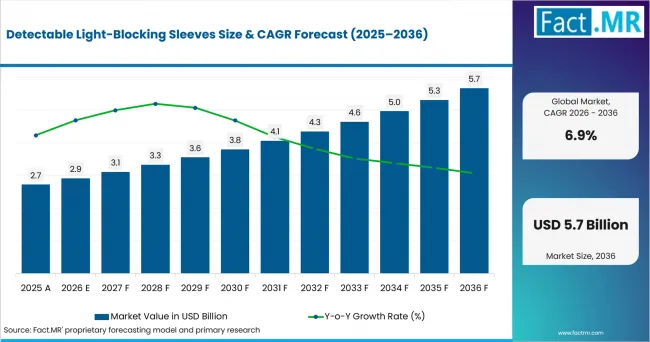
Detectable Light Blocking Sleeves Value Analysis | Source: Fact.MR
What are the defining numbers behind Detectable Light-Blocking Sleeves Market growth?
An absolute opportunity of USD 2.8 billion is expected between 2026 and 2036.
- Demand Drivers in the Market
- Dairy packaging teams need strong light protection. USDA Economic Research Service reported in February 2026 that U.S. milk output exceeded 231 billion pounds per year. Dairy bottle applications are therefore expected to favor sleeve structures that protect light-sensitive contents while preserving clear PET.
- Beverage brands need full-body decoration with UV or visible-light protection. Ready-to-drink packaging uses bottles across high-volume retail formats. Shrink sleeves can combine 360-degree graphics with light control on shaped PET containers.
- Recycling teams need detectable and separable labels. High-recyclability label systems are expected to gain relevance where low-density films and washable inks support clear-PET recovery.
- Personal-care and household converters need light protection and full print area on shaped containers. Full-body sleeves combine shielding with 360-degree graphics.
- Key Segments Analyzed
- By Sleeve Material: Crystallizable PET is expected to hold 33.0% share in 2026 because heat-shrink performance and PETG label film processing experience supports beverage and dairy sleeve programs.
- By Optical Function: Full block-out is projected to account for 34.0% share in 2026 as photosensitive products require near-total opacity across the decorated bottle surface.
- By Container: Beverage PET is anticipated to capture 37.0% share in 2026 owing to established filling lines and the broad use of PET containers across packaged beverages.
- By Printing: Gravure is estimated to represent 29.0% share in 2026 due to long-run print consistency and dense ink laydown for high-opacity sleeve designs.
- Analyst Opinion at Fact.MR
- Shambhu Nath Jha, Principal Consultant at Fact.MR states, “Opacity is one part of the commercial decision. Packaging teams increasingly need a sleeve that shields the product and supports a workable recycling route. Competitive offers are expected to pair measurable light transmission with sorting compatibility and repeatable print performance.”
- Strategic Implications
- Bottle converters should qualify clear PET and barrier sleeves as one package system. The European Commission states that single-use PET beverage bottles must incorporate 25% recycled plastic from 2025, rising to 30% for all single-use plastic beverage bottles from 2030. Sustainable packaging requirements therefore increase the value of sleeve designs that preserve the bottle recycling stream.
- Sleeve-film suppliers should publish light-transmission and density data before line trials. Converters need values that can be checked against product shelf-life targets and the separation behavior expected in PET recycling systems.
- Printers should control ink coverage because opaque graphics can affect detection and recyclability. Transparent rPET beverage packaging increases the commercial value of de-inkable or separable sleeve systems.
- Brand owners should test separation and de-inking behavior alongside shelf-life performance. Qualification should cover the filled package because complete-package testing determines whether the bottle and sleeve move cleanly through sorting and washing steps.
China is projected at 8.6% CAGR through 2036, followed by France at 7.4%. The USA and Japan are each forecast at 6.2%, while Germany is estimated at 6.0% as recycling requirements shape sleeve design.
How does the Detectable Light-Blocking Sleeves Market break down by segment?
Beverage PET leads Container at 37.0% share in 2026; Full block-out leads Optical Function at 34.0% share.
Which Sleeve Material leads?
Crystallizable PET is expected to hold 33.0% share in 2026.
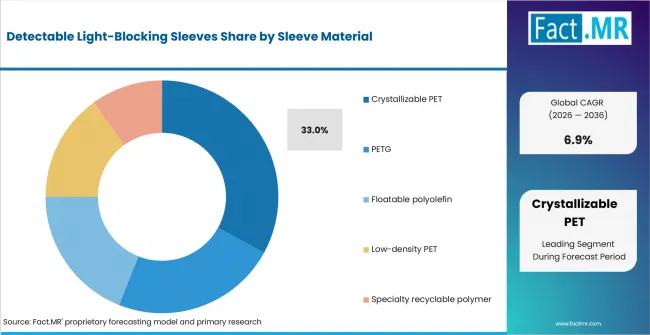
Detectable Light Blocking Sleeves Analysis By Sleeve Material | Source: Fact.MR
Crystallizable PET combines shrink performance with PET-oriented package design. It can move opacity from the bottle into a sleeve. Density and ink behavior still determine recycling compatibility.
Crystallizable PET sleeve construction is expected to remain useful where converters want opacity in the label while retaining a clear bottle wall. Recycling performance depends on film density and ink removal during washing.
What leads the Optical Function segment?
Full block-out is projected to account for 34.0% share in 2026.
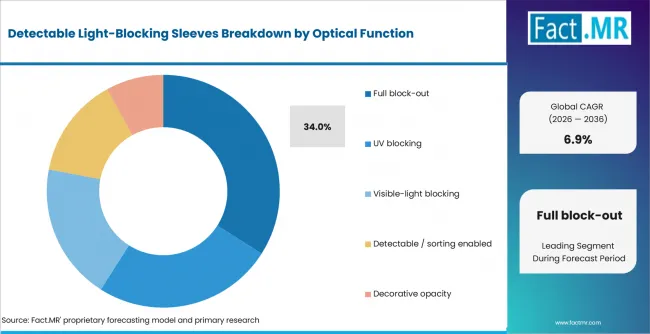
Detectable Light Blocking Sleeves Analysis By Optical Function | Source: Fact.MR
Full block-out suits milk and other light-sensitive contents. Brands can specify transmission limits and tune film opacity or print coverage. Sleeve labels become a functional barrier layer when opacity is designed around the product.
Sleever lists LDPET White Barrier with light transmission below 1% and PET recycling compatibility. CCL describes EcoFloat WHITE for light-sensitive dairy products. The format combines clear PET with an opaque functional sleeve.
How does Container shape demand?
Beverage PET is anticipated to hold 37.0% share in 2026.
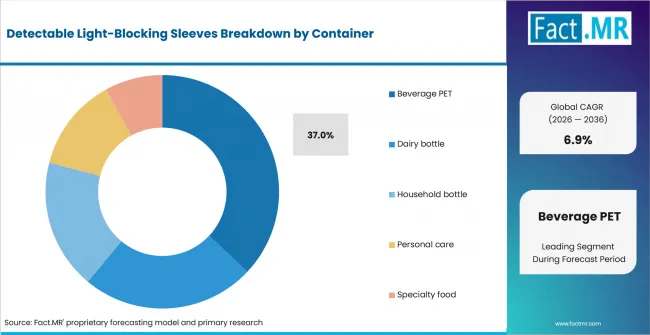
Detectable Light Blocking Sleeves Analysis By Container | Source: Fact.MR
PET beverage bottles suit this architecture because the bottle can stay transparent while the sleeve carries opacity. Plastic bottles and containers provide a broad application base for recyclable full-body sleeve systems.
Japan’s Ministry of the Environment reported on March 31, 2026 that municipalities projected the separate collection of 346 thousand tonnes of PET bottles in fiscal 2026. Bottled water packaging and other clear-bottle formats therefore place a high value on sleeve structures that preserve PET recovery.
What supports Gravure within Printing?
Gravure is estimated to represent 29.0% share in 2026.
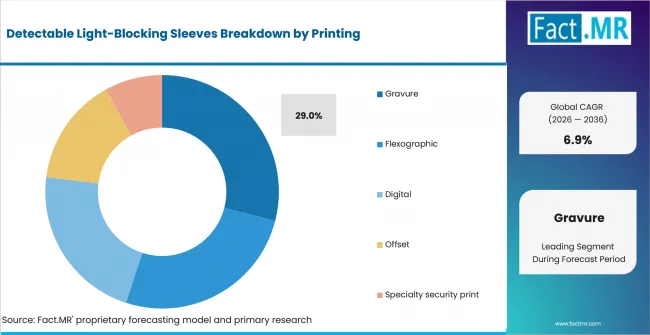
Detectable Light Blocking Sleeves Analysis By Printing | Source: Fact.MR
Gravure suits long sleeve runs that require dense color and repeatable opacity. Recycling-oriented projects still need controlled ink chemistry and wash behavior, while flexographic or digital printing fits shorter or more varied runs.
Printing must satisfy artwork and package-recovery requirements. Non-bleeding or washable systems help protect contents while supporting cleaner PET wash streams. Gravure remains suited to long runs where dense opacity must remain consistent across high-volume sleeves.
What is accelerating Detectable Light-Blocking Sleeves Market adoption, and what is holding it back?
Demand is expected to rise through light-sensitive product protection and clear-PET conversion. Growth is constrained by sorting compatibility, ink behavior and recycling qualification.
Drivers Impact Analysis
| DRIVER | (~) % IMPACT ON CAGR | GEOGRAPHIC RELEVANCE | IMPACT TIMELINE |
|---|---|---|---|
| Clear-PET conversion for light-sensitive products | +1.4% | North America, Europe, East Asia | Short term (<= 2 years) |
| Shelf-life protection for dairy and beverages | +1.2% | Global | Medium term (2-4 years) |
| Low-density and washable-ink sleeve designs | +0.9% | North America, Europe | Medium term (2-4 years) |
| Full-body print area on shaped containers | +0.6% | Global | Long term (>= 4 years) |
Opportunity Impact Analysis
| OPPORTUNITY | (~) % IMPACT ON CAGR | GEOGRAPHIC RELEVANCE | IMPACT TIMELINE |
|---|---|---|---|
| Recyclable white barrier sleeves for clear PET | +1.1% | North America, Europe | Short term (<= 2 years) |
| Detectable sorting-enabled sleeve constructions | +0.8% | Europe, East Asia | Medium term (2-4 years) |
| Digital short-run opaque decoration | +0.6% | Global | Long term (>= 4 years) |
Restraints Impact Analysis
| RESTRAINT | (~) % IMPACT ON CAGR | GEOGRAPHIC RELEVANCE | IMPACT TIMELINE |
|---|---|---|---|
| Full-sleeve interference with sorting systems | -0.6% | North America, Europe | Short term (<= 2 years) |
| Opacity and ink systems that contaminate PET wash | -0.5% | Global | Medium term (2-4 years) |
| Qualification cost across film, ink and application lines | -0.4% | Global | Long term (>= 4 years) |
Which countries are scaling the Detectable Light-Blocking Sleeves Market through 2036?
- The displayed country CAGR range spans 2.6 percentage points from China at 8.6% to Germany at 6.0%.
- China remains 1.2 percentage points above France as packaged beverage retail and milk output support a broad bottle base.
- France remains 1.2 percentage points above the USA. Dairy collection and plastic-recycling requirements are expected to shape material choices.
- The USA and Japan both record 6.2%. U.S. demand is linked to food and dairy output while Japan combines beverage use with high PET collection coverage.
- Germany closes the range at 6.0% as recyclability measurement and EU recycled-content requirements increase qualification pressure on full-body sleeves.
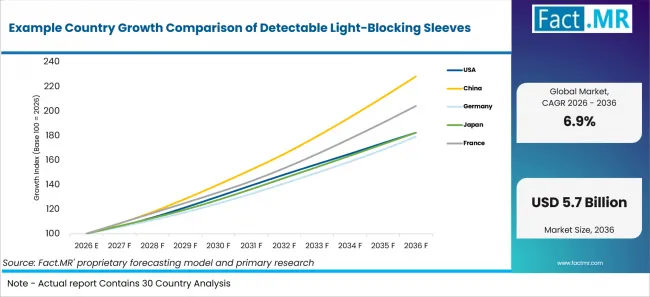
Example Country Growth Comparison Of Detectable Light Blocking Sleeves | Source: Fact.MR
| Country | CAGR (2026-2036) |
|---|---|
| United States | 6.2% |
| China | 8.6% |
| Germany | 6.0% |
| Japan | 6.2% |
| France | 7.4% |
What supports USA adoption?
6.2% CAGR, supported by packaged-food output and clear-PET conversion.
The U.S. Census Bureau reported on September 3, 2026 that Food Manufacturing (NAICS 311) generated an estimated USD 1,054.3 billion in value of shipments in 2024. That scale supports a broad packaging base for functional labels and sleeves. Detectable light-blocking formats are expected to gain relevance where brands use clear PET for light-sensitive beverages or dairy products.
How is China scaling demand?
8.6% CAGR, led by packaged beverage and dairy applications.
The National Bureau of Statistics of China reported on February 28, 2026 that milk output reached 40.91 million tonnes in 2025. The volume provides a large application base for bottles that need visible-light or UV protection. Local sleeve conversion capacity is expected to support high-volume beverage and dairy programs.
What is supporting Germany’s adoption?
6.0% CAGR, shaped by packaging recovery requirements.
Destatis reported on February 23, 2026 that Germany collected or took back 8.828 million tonnes of packaging in 2024. Lightweight packaging accounted for 2.654 million tonnes. Detectable and separable sleeve structures are expected to receive closer attention where converters need light protection and measurable recycling compatibility.
How does Japan perform?
6.2% CAGR, supported by PET collection and beverage use.
Japan’s Ministry of the Environment reported in March 2026 that municipalities collected 360,498 tonnes of PET bottles in fiscal 2024. That collection base raises the commercial value of sleeves designed for clean separation or PET-compatible recycling. Light-blocking formats are expected to remain concentrated in beverages and dairy.
What supports France’s growth?
7.4% CAGR, supported by dairy volumes and recyclable bottle design.
Agreste reported in June 2026 that French cow-milk collection reached 2.111 billion liters in April 2026 and increased 1.2% year on year. Dairy provides a direct application for sleeves that control light exposure. Clear PET plus a detachable barrier sleeve is expected to gain attention where recycling compatibility remains part of packaging qualification.
Who leads the Detectable Light-Blocking Sleeves Market?
CCL Industries supplies EcoFloat® White through CCL Label for light-sensitive products such as dairy and beverages packaged in transparent PET. The floatable white shrink sleeve provides light protection while supporting separation from PET during recycling. Sleever provides LDPET® White Barrier, a light-blocking shrink sleeve designed for clear PET packaging and compatible with closed-loop PET recycling.
Fuji Seal International supplies recyclable shrink-sleeve technologies through RecShrink™ and separately provides light-shielding sleeve solutions. The company has also reported development and promotion of RecShrink technologies combined with light-barrier functionality for applications transitioning from colored bottles to clear PET.
Klöckner Pentaplast provides Pentalabel® eklipse® for light-blocking shrink-sleeve applications and the SmartCycle® family for recycling-compatible shrink-sleeve films. Bonset America remains active in white PETG heat-shrink films, including Bonpet® 7G and 7X, which provide light protection for packaged contents.
Multi-Color Corporation is the current corporate successor encompassing the former Fort Dearborn and Hammer Packaging lineage and continues to provide shrink-sleeve solutions, including recycling-compatible and light-blocking options.
Competitive differentiation across these suppliers includes measured light transmission, shrink performance, recycling compatibility, print performance and technical support during bottle-and-sleeve qualification.
Which companies are the key providers?
Key companies include CCL Industries; Fuji Seal International; Sleever International; Klöckner Pentaplast; Bonset America; and Multi-Color Corporation (Hammer Packaging legacy).
- CCL Industries
- Fuji Seal International
- Sleever International
- Klöckner Pentaplast
- Bonset America
- Multi-Color Corporation (Hammer Packaging legacy)
Bibliography
- U.S. Census Bureau. (2026, September 3). Census Bureau releases new Annual Integrated Economic Survey data.
- Valcu-Lisman, A. (2026, February 17). Growth in output per cow drives U.S. milk production gains. U.S. Department of Agriculture, Economic Research Service.
- National Bureau of Statistics of China. (2026, February 28). Statistical communiqué of the People’s Republic of China on the 2025 national economic and social development.
- Statistisches Bundesamt (Destatis). (2026, February 23). Abfallentsorgung 2024: Art und Menge der im Berichtsjahr 2024 gesammelten/zurückgenommenen Verpackungen [Waste disposal 2024: Type and quantity of packaging collected/taken back in the reporting year 2024].
- Touati-Houari, N. (2026, June 12). Lait. Avril 2026 : la collecte de lait toujours en hausse sur un an. Agreste.
- European Commission, Directorate-General for Environment. (2025, July 8). Plastic waste: Commission consults on new rules for chemically-recycled content in plastic bottles.
- Klöckner Pentaplast. (2025, August 11). Rethinking shrink sleeves: How recycled content is reshaping sustainable packaging.
This Report Answers
- The report explains where detectable light-blocking sleeves are used across sleeve material and optical function. It also covers container type and printing method, together with regional demand patterns.
- Segment analysis identifies the leading subsegments and the functional reasons converters prioritize them. It examines crystallizable PET, full block-out structures, beverage PET applications and gravure printing.
- Country analysis examines the listed markets and the packaging, dairy, beverage and recycling factors supporting sleeve adoption. Coverage includes the United States, China, Germany, Japan and France.
- Competitive analysis reviews current providers across recyclable shrink-sleeve films, light-barrier structures and sorting-compatible solutions. It covers CCL Industries, Fuji Seal International, Sleever International, Klöckner Pentaplast, Bonset America and Multi-Color Corporation.
- Application analysis assesses how light protection, sorting compatibility and print performance influence material selection. It also considers PET separation, ink behavior, shrink performance and recycling qualification across beverage, dairy, household, personal-care and specialty-food containers.
What does the Detectable Light-Blocking Sleeves Market cover?
The market covers heat-shrinkable sleeves that provide light protection or optical blocking. It includes opaque films, printed block-out structures and sleeves engineered for PET recycling.
Applications include beverages and dairy. Household products and personal care are covered together with specialty foods. Materials are assessed across the defined sleeve-material categories.
What is included in the scope?
The scope includes block-out and UV-protection sleeves. Visible-light blocking and sorting-enabled functions are covered where they are integral to the sleeve. Decorative opacity is included when functional.
The assessment covers sleeve films and converted sleeves for the listed containers and printing methods.
What is excluded from the scope?
The scope excludes decoration-only clear sleeves and opaque bottles. Pressure-sensitive labels and stretch sleeves fall outside the boundary. Standalone barrier coatings are excluded.
General flexible films and tamper bands are excluded without meaningful light-blocking sleeve coverage.
How Was the Analysis Built?
The analysis draws on 120+ sources, 35+ company portfolios, 25+ countries, and more than 20 industry interviews.
- Primary Research: Primary research includes discussions with manufacturers, service providers, technology developers, distributors, end users, and subject-matter experts. These conversations examine purchasing priorities, product adoption, operational challenges, approval requirements, competitive positioning, and the factors that influence wider market acceptance.
- Desk Research: Desk research covers government statistics, regulatory publications, company filings, trade data, technical studies, industry associations, standards, public policy, and other authoritative sources. Every source used in the analysis is documented in the bibliography.
- Market Sizing and Forecasting: Market estimates combine historical performance, demand indicators, pricing and volume trends, segment shares, company participation, country-level growth, adoption patterns, investment activity, and barriers to market expansion.
- Data Validation and Update Cycle: Findings are validated by comparing primary interviews with public data, company activity, regulatory changes, trade patterns, and industry developments. Regular updates review new product launches, capacity changes, partnerships, approvals, and shifts in commercial adoption.
What is the report’s scope and coverage?
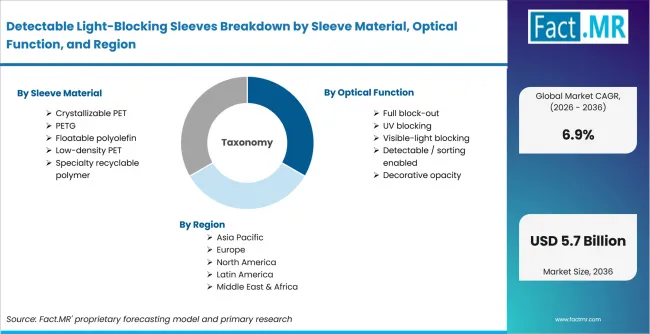
Detectable Light Blocking Sleeves Breakdown By Sleeve Material, Optical Function, And Region | Source: Fact.MR
| Attribute | Details |
|---|---|
| Quantitative Units | USD billion in 2026 to USD billion by 2036 at a CAGR |
| Market Definition | Heat-shrinkable full-body sleeves that provide measurable visible-light or UV blocking while supporting container detection, separation or recycling compatibility. |
| Sleeve Material | Crystallizable PET; PETG; Floatable polyolefin; Low-density PET; Specialty recyclable polymer |
| Optical Function | Full block-out; UV blocking; Visible-light blocking; Detectable / sorting enabled; Decorative opacity |
| Container | Beverage PET; Dairy bottle; Household bottle; Personal care; Specialty food |
| Printing | Gravure; Flexographic; Digital; Offset; Specialty security print |
| Regions Covered | North America; Latin America; Western Europe; Eastern Europe; East Asia; South Asia & Pacific; Middle East & Africa |
| Countries Covered | United States; China; Germany; Japan; France |
| Key Companies Profiled | CCL Industries; Fuji Seal International; Sleever International; Klöckner Pentaplast; Bonset America; Multi-Color Corporation (Hammer Packaging legacy) |
| Forecast Period | 2026 to 2036 |
| Approach | Hybrid top-down and bottom-up approach using sleeve-film portfolios, light-barrier functions, bottle recycling requirements, container applications, printing methods and country-level packaging indicators. |
How is the market segmented?
-
By Sleeve Material
- Crystallizable PET
- PETG
- Floatable polyolefin
- Low-density PET
- Specialty recyclable polymer
-
By Optical Function
- Full block-out
- UV blocking
- Visible-light blocking
- Detectable / sorting enabled
- Decorative opacity
-
By Container
- Beverage PET
- Dairy bottle
- Household bottle
- Personal care
- Specialty food
-
By Printing
- Gravure
- Flexographic
- Digital
- Offset
- Specialty security print
-
By Region
- North America
- Latin America
- Western Europe
- Eastern Europe
- East Asia
- South Asia & Pacific
- Middle East & Africa