- Base Value(2026): 280.0 Mn
- Estimated Value(2026): 280.0 Mn
- Forecast Value (2036): 640.0 Mn
- CAGR (2026 - 2036): 8.6%
Label, Adhesive and Ink Systems for High-Recyclability Plastic Packaging Market Forecast and Outlook 2026 to 2036
The global label, adhesive and ink systems market for high-recyclability plastic packaging is valued at USD 280.0 million in 2026 and is set to reach USD 640.0 million by 2036, recording a compound annual growth rate (CAGR) of 8.6% between 2026 and 2036. In 2026, the beverage & FMCG application segment is projected to hold a 40% share, while roll-stock labels & shrink sleeves account for 45% by packaging format.
Key Takeaways from the Label, Adhesive and Ink Systems for High-Recyclability Plastic Packaging Market Report
- Market Value (2026): USD 280.0 Million
- Market Forecast Value (2036): USD 640.0 Million
- Forecast CAGR (2026-2036): 8.6%
- Leading Application Segment: Beverage & FMCG (40%)
- Leading Packaging Format: Roll-stock Labels & Shrink Sleeves (45%)
- Key Growth Regions: North America, Europe, Asia Pacific, Latin America, MEA
- Key Players: Avery Dennison, LINTEC, Siegwerk, UFlex, Huhtamaki, Aplix, Toyo Ink, Henkel, BASF SE, CCL, and other label converters
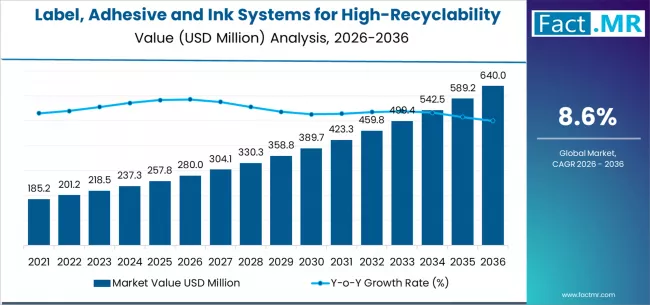
Label, Adhesive And Ink Systems For High Recyclability Plastic Packaging Market Market Value Analysis | Source: Fact.MR
Market expansion is driven by the critical realization that a mono-material plastic package can be rendered unrecyclable by its label, adhesive, or ink. As brand owners invest in recyclable primary packaging, the supporting decoration systems must evolve to avoid contaminating recycling streams. This demand is creating a new design paradigm where label selection is dictated by end-of-life compatibility as much as by aesthetics and functionality, aligning the entire package structure with circular economy principles.
Growth through the forecast period will be influenced by innovation in chemistry and application technology. Advanced adhesive systems engineered to be repulpable, washable, or fully dissolvable in recycling processes are entering the market. Simultaneously, new generations of recycling-friendly inks that de-ink easily or are compatible with plastic flake are under development. This evolution requires close collaboration between chemical suppliers, label converters, and packaging producers to create integrated, certified solutions that meet stringent recyclability standards set by bodies like RecyClass or APR.
Label, Adhesive and Ink Systems for High-Recyclability Plastic Packaging Market
| Metric | Value |
|---|---|
| Estimated Value in (2026E) | USD 280.0 Million |
| Forecast Value in (2036F) | USD 640.0 Million |
| Forecast CAGR (2026 to 2036) | 8.6% |
Source: Fact.MR analysis. Updated Dec 22, 2025
Category
| Category | Segments |
|---|---|
| End-use/Application | Beverage & FMCG, Personal Care, Food Packaging, Retail & Industrial, Logistics & Shipping Labels, Others |
| Packaging Format/Type | Roll-stock Labels & Shrink Sleeves, In-mold Labels & Shrink Sleeves, Pressure Sensitive Labels, Thermal & Pressure Labels, Others |
| Material | Recyclable Adhesives (PE/PP compatible), Water-based / Low-migration Inks, PP-Compatible Adhesives, Eco-adhesive Formulations, Others |
| Technology | Removable/Repulpable Adhesive Systems + Recyclable Inks, Laser-removable Adhesives, Digital UV Inks (recycling-friendly), Solvent-free Lamination Adhesives, Others |
| Region | North America, Europe, Asia Pacific, Latin America, MEA |
Source: Fact.MR analysis. Updated Dec 22, 2025
Segmental Analysis
Which Application Segment Captures the Maximum Share in the Label, Adhesive and Ink Systems for High-Recyclability Plastic Packaging Market?
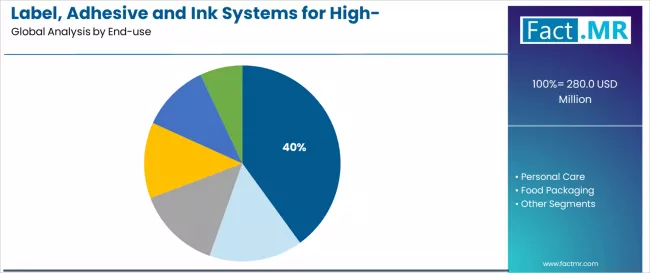
Label, Adhesive And Ink Systems For High Recyclability Plastic Packaging Market Analysis By End Use | Source: Fact.MR
The beverage and FMCG segment commands a 40% market share in 2026, establishing it as the primary testing ground for recyclable decoration systems. High-volume products like bottled water, soft drinks, and household cleaners are under intense scrutiny from EPR schemes and consumers.
A full-body shrink sleeve made from PET on a PET bottle, for instance, can contaminate the rPET stream if the sleeve uses a PVC base or a non-dissolving adhesive. Brands are therefore demanding label and adhesive systems certified for compatibility with specific recycling processes.
This segment incorporated solutions that maintain high-speed application and brilliant graphics while ensuring the labeled package achieves a high recyclability score. The shift often requires reformulating adhesives to wash off in standard recycling caustic baths and developing inks that do not bleed or stain the recycled plastic flake.
- Major beverage conglomerates are setting global specifications for label systems that do not compromise the value of their recycled PET feedstock.
- The need for accurate sorting at recycling facilities is driving innovation in labels that are either easily separable or designed to sink/float with the primary polymer.
What Makes Roll-stock Labels & Shrink Sleeves the Leading Format?
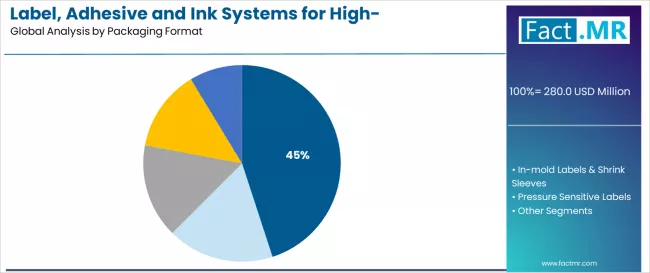
Label, Adhesive And Ink Systems For High Recyclability Plastic Packaging Market Analysis By Packaging Format | Source: Fact.MR
Roll-stock labels and shrink sleeves are projected to hold a 45% share by format in 2026. Their dominance reflects their widespread use for 360-degree decoration and promotional campaigns on bottles and containers. The recyclability challenge for shrink sleeves is particularly acute, as they encapsulate the package. The market response is the development of full-body sleeves using mono-material films (e.g., PET-G or OPS) that are compatible with the underlying container and employ removable or repulpable adhesive systems.
For roll-stock labels, the focus is on minimizing label mass relative to the container and ensuring the facestock, adhesive, and ink combination is recognized as a "non-disruptive" stream in automated sorting. PP-compatible adhesives for PP containers and PE-compatible versions for HDPE are becoming standard, moving away from universal adhesives that can hinder recycling.
- The format drives innovation in thinner gauge films and lighter adhesives that reduce overall material consumption and improve wash-off characteristics.
- Advancements in digital printing with recycling-friendly UV inks allow for short runs of customized, compliant labels without the need for solvent-based inks.
What are the Drivers, Restraints, and Trends in the Market?
The market is directly driven by recycling regulations such as EU PPWR and brand commitments to design 100% recyclable packaging, which includes all components. The technical complexity and higher cost of specialized recyclable adhesives and inks act as a restraint, alongside the need for extensive testing and certification.
The market is trending towards digital watermarking on labels to carry recycling instructions for AI sorting systems, and towards the development of functional adhesives that maintain performance during product use but rapidly degrade under specific recycling process conditions.
Analysis of the Market by Key Countries
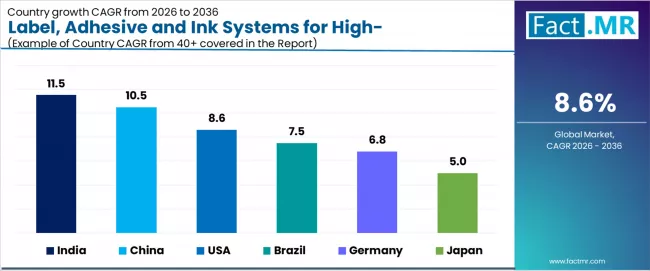
Label, Adhesive And Ink Systems For High Recyclability Plastic Packaging Market Cagr Analysis By Country | Source: Fact.MR
| Country | CAGR (2026-2036) |
|---|---|
| India | 11.5% |
| China | 10.5% |
| USA | 8.6% |
| Brazil | 7.5% |
| Germany | 6.8% |
| Japan | 5.0% |
Source: Fact.MR analysis. Updated Dec 22, 2025
How is India's New EPR Framework Creating Urgent Demand for Compatible Systems?
Demand for recyclable label systems in India is projected to grow at a leading CAGR of 11.5% through 2036. The newly enforced EPR rules are compelling the massive food packaging and FMCG sectors to seek compliant solutions immediately. Pressure sensitive labels with PP-compatible adhesives and digital UV inks are seeing rapid adoption as they allow converters to upgrade existing lines. Local ink manufacturers and label converters are collaborating to develop cost-optimized, recycling-friendly formulations suited to the domestic recycling infrastructure.
- The price-sensitive market prioritizes solutions that offer a clear path to compliance without a significant premium over traditional materials.
- The growth of organized retail and private labels accelerates the shift, as large retailers impose packaging guidelines on suppliers.
What Role Does Export Compliance and Personal Care Innovation Play in China's Market?
The market in China is forecast to grow at a CAGR of 10.5%. Dual drivers are at play: export-oriented manufacturers must meet the stringent label requirements of Western markets for recycling, and the domestic personal care sector is adopting advanced in-mold labels with laser-removable adhesives as a premium feature. Investment is focused on water-based and low-migration ink systems that ensure safety and recyclability for sensitive applications.
- Domestic innovation aims to reduce reliance on imported specialty adhesives by developing local formulations for mono-PP and mono-PE packaging.
- The government's focus on reducing plastic waste includes supporting R&D into cleaner separation technologies for labels and inks.
How do State-Level Regulations and Corporate Sustainability Goals Shape USA’s Market?
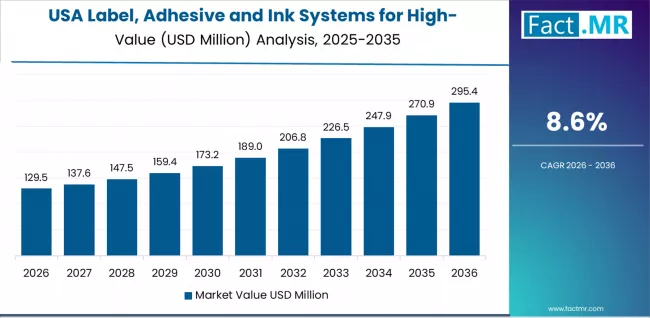
Label, Adhesive And Ink Systems For High Recyclability Plastic Packaging Market Country Value Analysis | Source: Fact.MR
The market in the USA is set to grow at a CAGR of 8.6%. In the absence of federal law, state-level EPR legislation and the binding sustainability goals of major beverage and consumer goods corporations are creating powerful demand. The focus is on roll-stock and shrink sleeve systems employing removable/repulpable adhesives and recyclable inks. Technological development centers on creating adhesives that perform in cold, wet conditions (like beverage refrigeration) but release cleanly in recycling processes.
- The need for compatibility with material recovery facilities (MRFs) dictates label design, favoring smaller label sizes, perforations, and specific adhesive chemistries.
- Brand owners are funding independent testing and certification to validate their label systems' recyclability claims.
How does Advanced Legislation and Precision Engineering Define the Market in Germany?
The market in Germany is expected to grow at a CAGR of 6.8%. Germany's advanced position under the EU's PPWR makes the adoption of certified recyclable label systems a compliance necessity. German chemical companies are leaders in developing advanced recyclable adhesive systems and solvent-free lamination adhesives. The emphasis is on precision engineering of adhesive chemistry to ensure clean separation in recycling plants and on developing comprehensive life-cycle assessment data for each component.
- The Grüner Punkt system's detailed fee modulation makes the financial benefit of optimized label systems immediately calculable for brands.
- Collaboration between adhesive manufacturers, ink makers, and recycling plants is deep, focusing on creating integrated technical protocols.
How is Retail and Industrial Packaging Demand Influencing Brazil's Market?
The market in Brazil is projected to grow at a CAGR of 7.5%. Growth is driven by the retail and industrial sectors seeking sustainable packaging solutions. Eco-adhesive formulations and solvent-free lamination adhesives are gaining traction as converters upgrade their capabilities. The focus is on practical, durable solutions that perform in Brazil's climate and are compatible with local recycling initiatives, which are often less automated than in Europe or North America.
- The strong agricultural and chemical sectors provide a base for developing bio-based raw materials for adhesives and inks.
- Regional converters play a key role in adapting global technologies to meet local cost and performance requirements.
What drives Japan's Focus on High-Performance Logistics and Precision Inks?
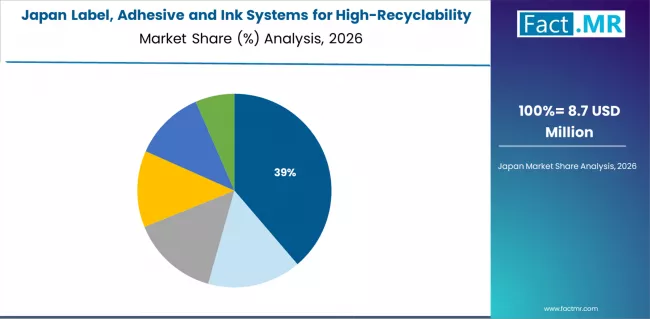
Label, Adhesive And Ink Systems For High Recyclability Plastic Packaging Market Japan Market Share Analysis By End Use | Source: Fact.MR
The market in Japan is projected to grow at a CAGR of 5.0%. Adoption focuses on high-performance applications like logistics & shipping labels, where adhesion strength and scannability are critical, and on food packaging requiring impeccable safety and recyclability. Japanese innovation targets ultra-precise adhesive application and the development of high-quality, recycling-friendly digital inks that meet the country's exceptional standards for print fidelity and material purity in recycling streams.
- The mature recycling infrastructure demands label systems that do not interfere with sophisticated automated sorting and washing processes.
- Space-saving and lightweight label solutions align with Japan's focus on logistics efficiency and waste minimization.
Competitive Landscape of the Market
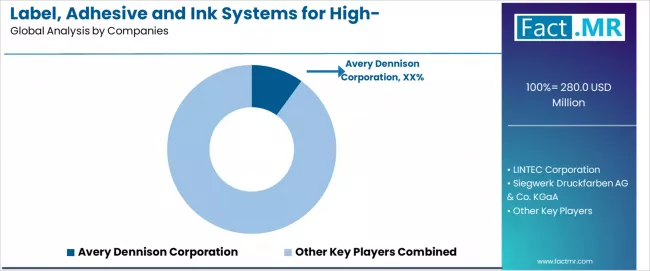
Label, Adhesive And Ink Systems For High Recyclability Plastic Packaging Market Analysis By Company | Source: Fact.MR
The competitive landscape features global specialty chemical giants, leading label stock manufacturers, and major ink producers, all converging on this niche. Competition centers on proprietary adhesive and ink chemistries, the breadth of recycling certifications (APR, RecyClass), and the ability to provide complete, tested systems.
Key players are investing heavily in application-specific R&D, such as adhesives for wet-strength beverage labels or low-temperature logistics. Strategic partnerships with brand owners for co-development and pilot testing are crucial. Success depends on providing robust technical data and ensuring supply chain consistency for these performance-critical, chemistry-driven components.
Key Players in the Market
- Avery Dennison Corporation
- LINTEC Corporation
- Siegwerk Druckfarben AG & Co. KGaA
- UFlex Limited
- Huhtamaki Oyj
- Aplix S.A.
- Toyo Ink Group
- Henkel AG & Co. KGaA
- BASF SE
- CCL Industries Inc.
- Other Local and Regional Label Converters
Segmentation
Scope of the Report
| Items | Values |
|---|---|
| Quantitative Units (2026) | USD 280.0 Million |
| End-use/Application | Beverage & FMCG, Personal Care, Food Packaging, Retail & Industrial, Logistics & Shipping Labels, Others |
| Packaging Format/Type | Roll-stock Labels & Shrink Sleeves, In-mold Labels & Shrink Sleeves, Pressure Sensitive Labels, Thermal & Pressure Labels, Others |
| Material | Recyclable Adhesives (PE/PP compatible), Water-based / Low-migration Inks, PP-Compatible Adhesives, Eco-adhesive Formulations, Others |
| Technology | Removable/Repulpable Adhesive Systems + Recyclable Inks, Laser-removable Adhesives, Digital UV Inks (recycling-friendly), Solvent-free Lamination Adhesives, Others |
| Regions Covered | North America, Europe, Asia Pacific, Latin America, MEA |
| Key Companies Profiled | Avery Dennison, LINTEC, Siegwerk, UFlex, Huhtamaki, Aplix, Toyo Ink, Henkel, BASF SE, CCL, and other leading players |
| Additional Attributes | Market share analysis, in-depth analysis of adhesive and ink chemistry, recyclability testing and certification landscape, insights into brand owner specifications and converter adoption challenges. |
Source: Fact.MR analysis. Updated Dec 22, 2025
Market by Segments
-
By End-use/Application :
- Beverage & FMCG
- Personal Care
- Food Packaging
- Retail & Industrial
- Logistics & Shipping Labels
- Others
-
By Packaging Format/Type :
- Roll-stock Labels & Shrink Sleeves
- In-mold Labels & Shrink Sleeves
- Pressure Sensitive Labels
- Thermal & Pressure Labels
- Others
-
By Material :
- Recyclable Adhesives (PE/PP compatible)
- Water-based/Low-migration Inks
- PP-Compatible Adhesives
- Eco-adhesive Formulations
- Others
-
By Technology :
- Removable/Repulpable Adhesive Systems + Recyclable Inks
- Laser-removable Adhesives
- Digital UV Inks (recycling-friendly)
- Solvent-free Lamination Adhesives
- Others
-
By Region :
-
North America
- USA
- Canada
- Mexico
-
Europe
- Germany
- UK
- France
- Italy
- Spain
- Nordic Countries
- BENELUX
- Rest of Europe
-
Asia Pacific
- China
- India
- Japan
- South Korea
- Australia
- Rest of Asia Pacific
-
Latin America
- Brazil
- Argentina
- Rest of Latin America
-
MEA
- Saudi Arabia
- UAE
- South Africa
- Rest of MEA
-
Frequently Asked Questions
How big is the label, adhesive and ink systems for high-recyclability plastic packaging market in 2026?
What will be the size of label, adhesive and ink systems for high-recyclability plastic packaging market in 2036?
How much will be the label, adhesive and ink systems for high-recyclability plastic packaging market growth between 2026 and 2036?
What are the key product types in the label, adhesive and ink systems for high-recyclability plastic packaging market?
Which packaging format/type segment to contribute significant share in the label, adhesive and ink systems for high-recyclability plastic packaging market in 2026?
Who worked on this report


Preview the report firsthand - request a free sample
Free SampleGet the brochure for pricing and purchase details
Download PDF