- Base Value(2025): 177.5 Bn
- Estimated Value(2026): 185.7 Bn
- Forecast Value (2036): 290.9 Bn
- CAGR (2026 - 2036): 4.6%
Plastic Bottles and Containers Market Forecast and Outlook By Fact.MR
- In 2025, the plastic bottles and containers market was valued at USD 177.5 billion.
- Based on Fact.MR analysis, demand for plastic bottles and containers is estimated to grow to USD 185.7 billion in 2026 and USD 290.9 billion by 2036.
- FACT.MR projects a CAGR of 4.6% during the forecast period.
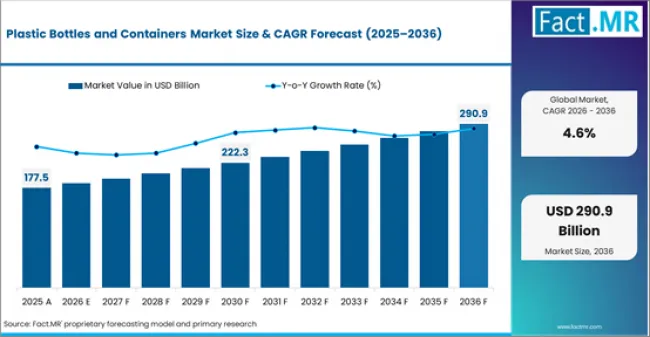
Plastic Bottles And Containers Market Market Value Analysis 1 | Source: Fact.MR
| Metric | Value |
|---|---|
| Estimated Value in 2026 | USD 185.7 billion |
| Forecast Value in 2036 | USD 290.9 billion |
| Forecast CAGR (2026 to 2036) | 4.6% |
Source: Fact.MR analysis. Updated May 27, 2026
Summary of Plastic Bottles and Containers Market
- Market Definition
- The market covers rigid PET, HDPE, PP, and LDPE plastic bottles and containers used across beverage, food, personal care, pharmaceutical, and household end uses globally, distributed through B2B direct, retail, and e-commerce channels.
- Demand Drivers
- India's rapid urbanisation and expanding organised retail sector are driving packaged beverage and personal care product consumption, increasing PET and HDPE bottle procurement volumes at FMCG manufacturers and regional bottling plants.
- Extended Producer Responsibility legislation enacted across the European Union in 2024 mandates minimum recycled-content thresholds in PET packaging, compelling beverage and FMCG brand owners to shift procurement toward compliant rPET bottle formats.
- China's packaged food and beverage sector expansion, supported by e-commerce logistics growth, is increasing polypropylene and HDPE container demand at domestic food processors and household care product manufacturers.
- Key Segments Analyzed
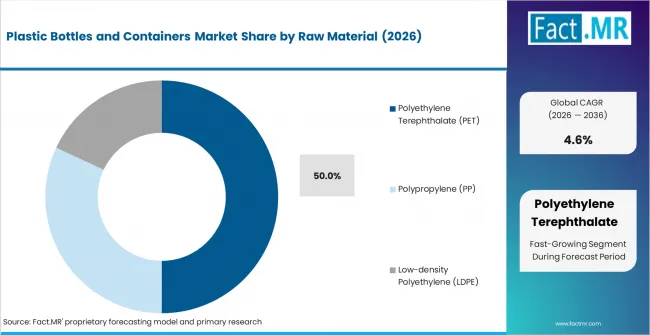
- By Raw Material: PET holds approximately 50% share in 2026, driven by its clarity, recyclability, and barrier performance across beverage and food packaging applications globally.
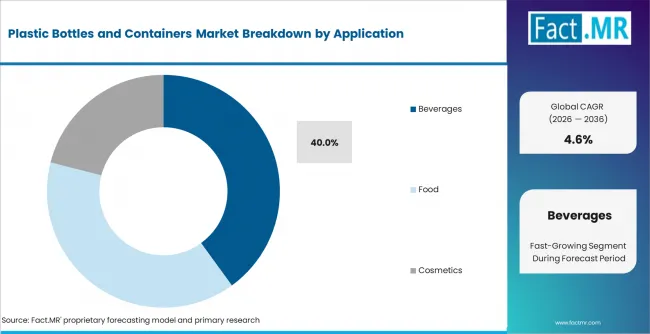
- By Application: Beverages lead with approximately 40% share in 2026, anchored by bottled water, soft drink, and ready-to-drink category volume consumption across all major markets.
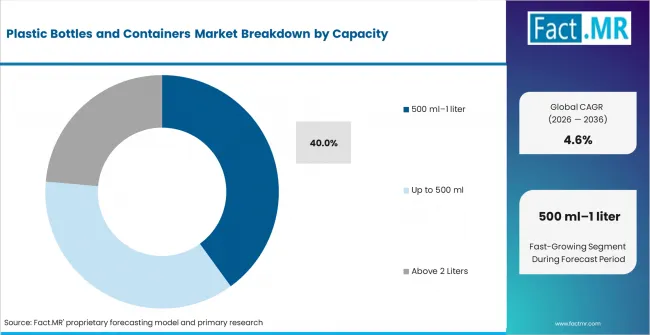
- By Capacity: 500 ml–1 liter segment dominates with approximately 40% share in 2026, reflecting high usage in single-serve bottled water and ready-to-drink beverage formats.
- By End-Use Industry: Food & beverage leads with approximately 55% share in 2026, representing the largest consumption base for rigid plastic containers across retail and food service channels.
- By Distribution Channel: Direct/B2B sales account for approximately 65% share in 2026, as manufacturers supply bulk quantities directly to beverage, food, and FMCG companies for large-scale filling operations.
- By Geography: India leads at 7.0% CAGR, driven by urbanisation, organised retail expansion, and rising FMCG packaged goods penetration across domestic consumer markets.
- Analyst Opinion at FACT.MR
- Shambhu Nath Jha, Principal Consultant at Fact.MR, opines, 'CXOs will recognize that the shift toward rPET is no longer optional. Regulatory frameworks are turning recycled content from a branding choice into a compliance requirement. Extended Producer Responsibility mandates are forcing beverage and FMCG companies to integrate recycled materials into their packaging.’
- Strategic Implications
- Invest in rPET processing and compounding capacity ahead of EU and UK EPR minimum recycled-content enforcement cycles to secure compliant bottle supply for European beverage and FMCG brand owner customers.
- Expand lightweight PET and HDPE bottle manufacturing capabilities in India and Southeast Asia to capture rising FMCG packaged goods demand at structurally lower production costs than incumbent Western capacity.
- Develop direct B2B supply agreements with Chinese and Indian food and beverage manufacturers to lock in multi-year volume commitments ahead of regional packaging capacity expansion by local competitors.
- Methodology
- Market sizing uses Plastics Europe resin production data and average selling price benchmarks by end-use category, validated against manufacturer revenue disclosures from 2024 to 2025.
- Analysis incorporates EU EPR programme documentation, EPA recycling statistics, EFSA packaging material assessments, and national EPR compliance audit data across key markets.
- Forecasts account for resin price trends by polymer type, EPR compliance cost trajectories, recycled-content adoption rates by brand owner, and e-commerce packaging volume growth by country.
The market is projected to generate USD 105.2 billion in incremental revenue over the forecast period. Growth reflects steady volume expansion in packaged beverage, FMCG, and personal care end uses. Rising recycled-content mandates and lightweighting requirements are reshaping material costs and supplier investment cycles. Substitution pressure from alternative packaging formats remains a structural moderator.
India's packaged goods sector and expanding retail infrastructure drive demand at 7.0% CAGR through 2036. China follows at 6.7%, supported by large-scale food and beverage consumption growth and expanding modern retail penetration. The United States records 6.2% CAGR, anchored by mature high-volume beverage and FMCG packaging markets with stable replacement demand. Brazil grows at 5.5%, driven by rising household product consumption. Germany records 4.8%, shaped by strong recycling regulation and sustainability-mandated packaging transitions. Japan grows at 4.0%, representing a mature and innovation-driven market where lightweight and sustainable formats are displacing standard containers, constrained by population ageing and declining total volume growth.
Segmental Analysis
Plastic Bottles and Containers Market Analysis by Raw Material
Plastic Bottles And Containers Market Analysis By Raw Material | Source: Fact.MR
Based on FACT.MR's plastic bottles and containers market report, PET is estimated to hold approximately 50% share in 2026. It dominates due to its lightweight nature, optical clarity, and recyclability, making it the material of choice for beverage and food manufacturers seeking performance, logistics efficiency, and EPR compliance alignment.
- Amcor rPET Investment: Amcor plc disclosed in its fiscal year 2024 annual report that it continued capital investment in rPET processing capability across its European and North American packaging operations, targeting beverage and food brand owner demand for bottles meeting EU EPR minimum recycled-content thresholds effective from 2025. [4]
- Berry Global HDPE Expansion: Berry Global reported in its fiscal year 2024 results that HDPE container production volumes for household care and personal care applications increased year-on-year, with capacity additions at its North American manufacturing network driven by FMCG customer volume commitments in cleaning products and personal care categories. [5]
- PP Container Innovation: ALPLA disclosed in its 2024 sustainability and innovation report that it launched lightweight polypropylene container formats for food and dairy applications in European markets, targeting retailers' sustainability-linked packaging specifications and reducing material intensity by an average of 15% per unit compared to incumbent standard-weight formats. [6]
Plastic Bottles and Containers Market Analysis by Application
Plastic Bottles And Containers Market Analysis By Application | Source: Fact.MR
Based on FACT.MR's report, beverages account for approximately 40% application share in 2026. Bottled water, carbonated soft drinks, and ready-to-drink beverage segments sustain structurally high PET bottle procurement volumes. Large global bottlers and regional water brands anchor demand through multi-year direct supply agreements with packaging manufacturers.
- Silgan Holdings Beverage Supply: Silgan Holdings disclosed in its fiscal year 2024 annual report that it secured expanded multi-year beverage bottle supply agreements with major North American still water and carbonated soft drink brand owners, including volume commitments for lightweight PET formats meeting brand owner sustainability specifications. [7]
- Pharmaceutical Bottle Demand: Plastipak Holdings reported in its 2024 commercial communications that pharmaceutical-grade HDPE bottle production volumes increased, driven by over-the-counter supplement and liquid medication packaging demand growth in North America and Europe, with regulatory-compliant resin grades required for all pharmaceutical contact applications. [8]
- Cosmetics Container Premiumisation: Greiner Packaging disclosed in its 2024 annual report that premium cosmetics container orders increased across its European operations, with brand owners in personal care and beauty categories specifying lightweight and aesthetically differentiated PP and PET formats to align with sustainability-linked retail listing requirements. [9]
Plastic Bottles and Containers Market Analysis by Capacity
Plastic Bottles And Containers Market Analysis By Capacity | Source: Fact.MR
Based on FACT.MR's report, the 500 ml–1 liter capacity segment holds approximately 40% share in 2026. Single-serve and on-the-go consumption occasions anchor this segment's dominance, particularly in bottled water and ready-to-drink beverage categories.
- Single-Serve Bottled Water Growth: The International Bottled Water Association reported in its 2024 annual statistics that bottled water consumption in the United States exceeded 15 billion gallons, with single-serve PET bottles in the 500 ml–1 liter range representing the highest-volume SKU format across retail, vending, and food service channels. [10]
- Above-2-Liter Format Demand: Resilux NV disclosed in its fiscal year 2024 results that large-format PET preform and bottle production for home-use and bulk beverage applications increased, with European private label water and carbonated soft drink bottlers driving demand for above-2-liter formats in value retail channels. [11]
- Sub-500ml E-commerce Growth: Plastics Industry Association noted in its 2024 packaging market update that sub-500ml plastic container formats for personal care and single-use pharmaceutical applications grew in e-commerce channels, with direct-to-consumer brands specifying compact lightweight bottles for last-mile logistics cost efficiency. [12]
Plastic Bottles and Containers Market Analysis by End-Use Industry
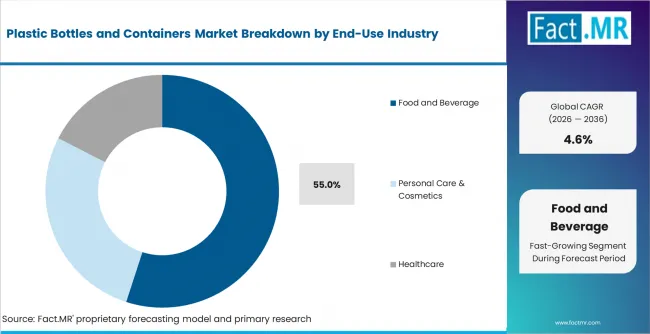
Plastic Bottles And Containers Market Analysis By End Use Industry | Source: Fact.MR
Based on FACT.MR's report, the food and beverage end-use industry accounts for approximately 55% share in 2026. This dominance reflects the sector's structural reliance on rigid plastic containers for product integrity, shelf life, and supply chain efficiency across both packaged food and liquid beverage categories.
- Amcor Food Packaging Contracts: Amcor plc reported in its fiscal year 2024 results that food-grade rigid plastic container volumes in North America and Asia Pacific increased, supported by multi-year supply agreements with packaged food manufacturers transitioning from glass to lightweight plastic formats to reduce logistics costs and improve carbon footprint per unit.
- Healthcare Container Compliance: Berry Global disclosed in its 2024 annual report that pharmaceutical and healthcare-grade HDPE container production expanded at its specialised North American facilities, driven by OTC supplement and medical device packaging customers requiring FDA-compliant resin grades and child-resistant closure integration.
- Household Products Channel Growth: Plastipak Holdings reported in its 2024 communications that household cleaning product container volumes grew at B2B direct supply channel, with major North American and European private label household care brand owners increasing HDPE bottle procurement for concentrated and refill-format cleaning product launches. [8]
Plastic Bottles and Containers Market Analysis by Distribution Channel
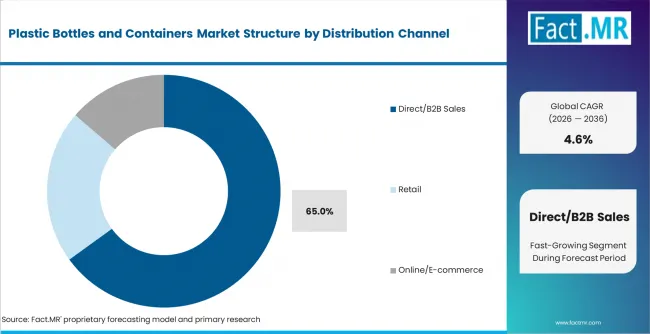
Plastic Bottles And Containers Market Analysis By Distribution Channel | Source: Fact.MR
Based on FACT.MR's report, direct/B2B sales account for approximately 65% share in 2026. Large-volume filling operations at beverage, food, and FMCG manufacturers require consistent, high-volume direct supply of bottles and containers.
- B2B Contract Structure Trends: Silgan Holdings disclosed in its 2024 annual report that the average duration of B2B direct supply contracts with beverage and food brand owners extended to three to five years, reflecting customer preference for supply security and pricing predictability amid resin cost volatility. [7]
- E-commerce Channel Expansion: ALPLA reported in its 2024 sustainability report that e-commerce customer orders for packaging through online procurement platforms increased, with direct-to-consumer personal care and household brand owners increasingly sourcing smaller-run custom container volumes through digital channel procurement models. [6]
- Retail Channel Private Label Growth: Greiner Packaging disclosed in its 2024 annual report that private label retail packaging volumes grew across its Central European operations, with grocery retailers specifying lightweight rPET and PP container formats for own-brand food, beverage, and personal care products aligned with EPR compliance procurement requirements. [9]
Drivers, Restraints, and Opportunities
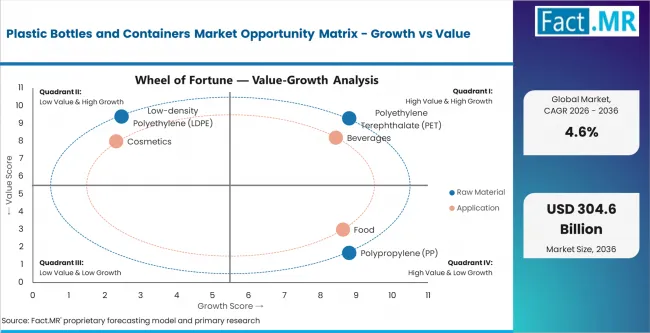
Plastic Bottles And Containers Market Opportunity Matrix Growth Vs Value | Source: Fact.MR
FACT.MR analysts observe the plastic bottles and containers market is a mature but structurally large commodity packaging category, sustained by consistent FMCG, beverage, and household product volume demand.
The core market tension is between commodity volume growth in Asia Pacific and regulatory cost pressure in Europe and North America. Standard virgin-resin PET bottles face rising compliance costs from EPR mandates.
- EU EPR Recycled-Content Mandates: EU EPR recycled-content mandates are tightening. The EU Packaging and Packaging Waste Regulation sets minimum recycled-content targets for PET bottles from 2025. This is increasing rPET demand and driving investment in recycling capacity. [1]
- India Packaged Goods Consumption Growth: India packaged goods consumption is rising. FMCG demand grew at double-digit rates in Tier 2 and Tier 3 cities in 2024. This is supporting higher PET and HDPE bottle usage across sectors. [2]
- China E-commerce Packaging Demand: China e-commerce packaging demand is expanding. Alibaba Group reported rising packaging volumes across Taobao and Tmall in 2024. Growth in HDPE and PP containers is supporting logistics-driven demand. [3]
Regional Analysis
The plastic bottles and containers market is assessed across North America, Europe, Asia Pacific, Latin America, and Middle East and Africa, covering major countries with demand shaped by packaged goods consumption volumes, EPR regulatory frameworks, resin availability, and distribution infrastructure. The full report provides market attractiveness analysis by region and country.
.webp "Top Country Growth Comparison Plastic Bottles And Containers Market Cagr (2026 2036)")
Top Country Growth Comparison Plastic Bottles And Containers Market Cagr (2026 2036) | Source: Fact.MR
| Country | CAGR (2026 to 2036) |
|---|---|
| India | 7.0% |
| China | 6.7% |
| United States | 6.2% |
| Germany | 4.8% |
| Brazil | 5.5% |
| Japan | 4.0% |
Source: Fact.MR analysis. Updated May 27, 2026
Source: Fact.MR (FACT.MR) analysis, based on proprietary forecasting model and primary research
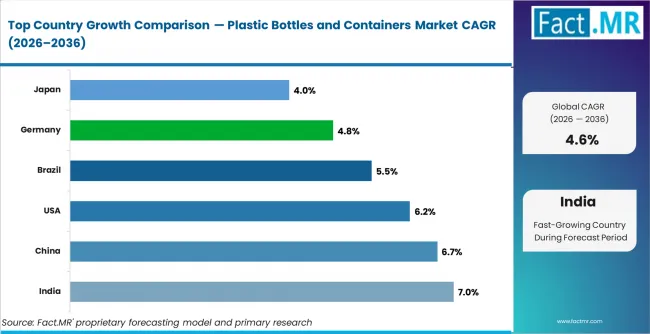
Plastic Bottles And Containers Market Cagr Analysis By Country | Source: Fact.MR
North America Plastic Bottles and Containers Market Analysis
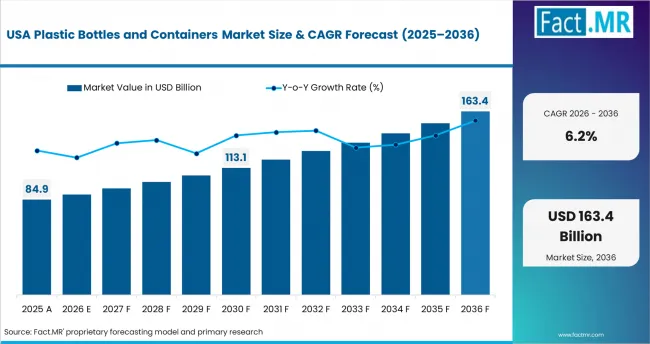
Plastic Bottles And Containers Market Country Value Analysis | Source: Fact.MR
North America is the largest established market for plastic bottles and containers, anchored by the United States' high-volume beverage and FMCG packaging ecosystem. Amcor, Berry Global, and Silgan Holdings dominate supply within large B2B direct channel relationships with category-leading brand owners in beverage, personal care, and household products.
- United States: United States is projected to rise at 6.2% CAGR through 2036. The market is driven by consistent high-volume beverage and FMCG packaging demand. The U.S. Environmental Protection Agency updated its recycled-content guidance for plastic packaging in 2024, encouraging voluntary rPET adoption ahead of potential federal EPR programme implementation.
FACT.MR's analysis of the plastic bottles and containers market in North America includes the United States, Canada, and Mexico. Readers can access resin procurement data, EPR policy developments, and B2B supply contract benchmarks.
Asia Pacific Plastic Bottles and Containers Market Analysis
Asia Pacific is the fastest-growing region for plastic bottles and containers, driven by India's FMCG consumption expansion and China's packaged food and e-commerce logistics growth. ALPLA and Resilux NV are expanding regional manufacturing presence, while domestic operators in India and China scale capacity alongside brand owner packaged goods investment.
- China: Plastic bottles and containers in China is projected to rise at 6.7% CAGR through 2036. Growth is anchored in packaged food and beverage sector expansion and rising e-commerce logistics volume. The China National Light Industry Council reported in its 2024 packaging industry review that PET and HDPE container output increased, supported by capacity investment at domestic manufacturers serving food and beverage export and domestic consumption channels.
- India: Demand for plastic bottles and containers in India is projected to rise at 7.0% CAGR through 2036, the fastest among covered countries. Rapid urbanisation and organised retail expansion are driving packaged beverage and personal care product volume growth. The Food Safety and Standards Authority of India updated food contact material regulations in 2024, introducing revised standards for PET and HDPE containers used in packaged food and beverage applications. Hindustan Unilever reported in its FY2024–25 annual report that packaging volumes for personal and household care products increased across its India operations. This led to higher procurement of HDPE and PET containers from domestic suppliers, aligned with its recyclability and sustainability commitments.
- Japan: Japan is projected to rise at 4.0% CAGR through 2036, reflecting a mature packaging market oriented toward lightweight innovation and recyclability. Japan's Ministry of Environment updated its Containers and Packaging Recycling Law guidelines in 2024, reinforcing collection obligations for PET beverage bottles and encouraging adoption of mono-material formats to improve recycling efficiency.
FACT.MR's analysis of the plastic bottles and containers market in Asia Pacific includes China, India, Japan, South Korea, ASEAN, and Australia and New Zealand. Readers can access consumption growth data, regulatory compliance updates, and regional manufacturing investment benchmarks.
Europe Plastic Bottles and Containers Market Analysis
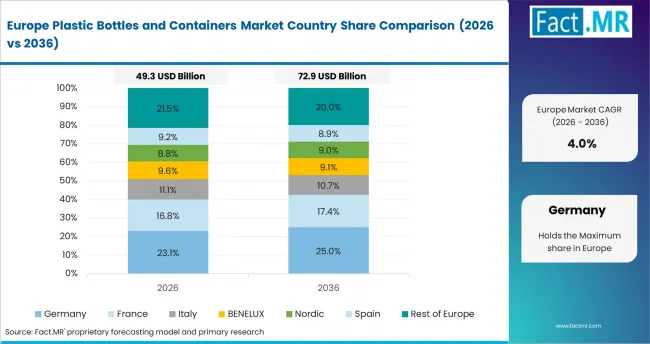
Plastic Bottles And Containers Market Europe Country Market Share Analysis, 2026 & 2036 | Source: Fact.MR
Europe is the global regulatory benchmark market for sustainable plastic packaging, shaped by the EU Packaging and Packaging Waste Regulation, national EPR frameworks, and statutory resin recycling targets. ALPLA and Greiner Packaging lead in compliance-aligned rPET and lightweighted container supply to European FMCG and beverage brand owners.
- Germany: Germany is projected to rise at 4.8% CAGR through 2036. The market operates under Germany's Verpackungsgesetz packaging law, which sets statutory minimum recycled-content requirements for plastic packaging sold in Germany. The Stiftung Zentrale Stelle Verpackungsregister reported in its 2024 annual compliance data that registered plastic packaging volumes increased, with beverage and household care brand owners accelerating rPET bottle procurement to meet recycled-content thresholds.
FACT.MR's analysis of the plastic bottles and containers market in Europe consists of country-wise assessment that includes Germany, France, the United Kingdom, Italy, Spain, and Nordic countries. Readers can find EU EPR compliance data, rPET procurement trends, recycled-content regulation timelines, and national packaging law enforcement updates by country.
Competitive Aligners for Market Players
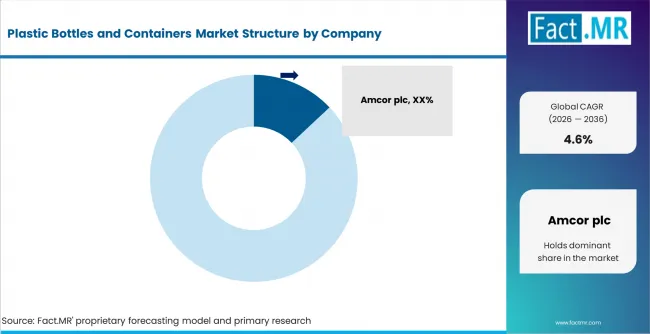
Plastic Bottles And Containers Market Analysis By Company | Source: Fact.MR
Companies in the plastic bottles and containers market are operating in a changing environment. Sustainability is no longer a side initiative. It is becoming a core business requirement. Regulations around recycled content and waste management are pushing companies to rethink how they produce and source packaging materials.
Producers that invest in recycled plastics, especially rPET, are gaining an advantage. They are better positioned to meet regulatory targets and customer expectations. At the same time, securing a stable supply of recycled material is becoming critical. This is leading many companies to invest in recycling infrastructure or form long-term supply partnerships.
Light weighting is another key focus area. Reducing material usage helps lower costs and improves sustainability metrics. Companies that can achieve this without compromising strength or performance are able to stay competitive.
Customer demand is also evolving. Large beverage and FMCG companies are prioritizing packaging that aligns with their environmental goals. This means suppliers need to offer solutions that are both functional and compliant with sustainability standards. Cost pressure remains in standard plastic formats. Commodity products are becoming more competitive, with limited pricing power. This is pushing companies to differentiate through innovation, design, and material quality. Distribution and scale still matter. Large players benefit from strong manufacturing networks and global supply chains. However, smaller players can compete by focusing on niche or high-value segments.
Key Players
- Amcor plc
- Berry Global
- ALPLA
- Silgan Holdings
- Plastipak Holdings
- Greiner Packaging
- Resilux NV
Bibliography
- [1] European Commission. Packaging and Packaging Waste Regulation (PPWR): minimum recycled-content requirements for PET beverage bottles and EPR legislative implementation timeline; 2024. Available from: environment.ec.europa.eu/topics/waste-and-recycling/packaging-waste
- [2] Indian FMCG Industry Association. 2024 Annual Industry Review: packaged beverage and personal care product consumption growth in Tier 2 and Tier 3 cities and organised retail expansion; 2024. Available from: ficci.in/sector/21/index.asp
- [3] Alibaba Group. 2024 Sustainability Report: e-commerce packaging volume growth and HDPE and PP container adoption in household and personal care direct-to-consumer delivery logistics; 2024. Available from: alibabagroup.com/en-US/sustainability
- [4] Amcor plc. Fiscal Year 2024 Annual Report: rPET processing capacity investment, food-grade rigid container volume performance, and EU EPR compliance procurement alignment; 2024. Available from: amcor.com/investors
- [5] Berry Global Group Inc. Fiscal Year 2024 Annual Report: HDPE container capacity expansion, North American household care and personal care supply agreement performance, and pharmaceutical-grade packaging compliance; 2024. Available from: berryglobal.com/investors
- [6] ALPLA Group. 2024 Sustainability and Innovation Report: lightweight PP container launch for food and dairy applications, rPET bottle production expansion, and European EPR compliance procurement data; 2024. Available from: alpla.com/en/company/newsroom
- [7] Silgan Holdings Inc. Fiscal Year 2024 Annual Report: beverage bottle supply agreement extensions, lightweight PET format adoption, and B2B direct channel contract duration trends; 2024. Available from: silganholdings.com/investors
- [8] Plastipak Holdings. 2024 Commercial Communications: pharmaceutical-grade HDPE bottle production expansion and household cleaning product container B2B supply growth in North America and Europe; 2024. Available from: plastipak.com/news
- [9] Greiner Packaging. 2024 Annual Report: premium cosmetics container order growth, private label rPET and PP container volumes, and EPR compliance packaging procurement in Central Europe; 2024. Available from: greiner-gpi.com/newsroom
- [10] International Bottled Water Association. 2024 Annual Statistics Report: U.S. bottled water consumption volumes, single-serve PET bottle format share, and retail, vending, and food service channel distribution data; 2024. Available from: bottledwater.org/education/statistics
- [11] Resilux NV. Fiscal Year 2024 Annual Report: large-format PET preform and bottle production volumes, European private label beverage bottler demand, and above-2-liter format performance; 2024. Available from: resilux.com/investors
- [12] Plastics Industry Association. 2024 Packaging Market Update: sub-500ml plastic container growth in e-commerce personal care and pharmaceutical channels and direct-to-consumer packaging format trends; 2024. Available from: plasticsindustry.org/resources
This Report Addresses
- Strategic demand intelligence across the United States, China, India, Germany, Brazil, and Japan covering packaged goods consumption trends, EPR compliance programme timelines, and rPET procurement dynamics by country.
- Market size forecast from USD 185.7 billion in 2026 to USD 290.9 billion by 2036, at 4.6% CAGR, with absolute dollar opportunity of USD 105.2 billion.
- Growth opportunity mapping across EU EPR recycled-content mandates, India FMCG packaged goods consumption expansion, China e-commerce plastic container volume growth, and Brazil National Solid Waste Policy EPR implementation.
- Segment forecasts by raw material, application, capacity, end-use industry, and distribution channel, covering PET, HDPE, PP, and LDPE formats across beverage, food, personal care, pharmaceutical, and industrial end uses.
- Competitive analysis of Amcor plc, Berry Global, ALPLA, Silgan Holdings, Plastipak Holdings, Greiner Packaging, and Resilux NV.
- Technology and compliance tracking on rPET content integration, lightweighting innovation, EPR fee structure evolution, and mono-material format development across key regulatory markets.
- Regulatory impact analysis covering EU Packaging and Packaging Waste Regulation, Germany Verpackungsgesetz requirements, Japan Containers and Packaging Recycling Law, India FSSAI food contact material standards, and US EPA recycled-content guidance.
- Report delivery in PDF, Excel, and presentation formats with validated data from primary interviews, Plastics Europe production statistics, EPR compliance records, and brand owner procurement disclosures.
Plastic Bottles and Containers Market Definition
The plastic bottles and containers market covers rigid plastic packaging formats manufactured from PET, HDPE, PP, and LDPE resins, used for storing and transporting beverages, food, personal care products, pharmaceuticals, and household chemicals.
Plastic Bottles and Containers Market Inclusions
Covers global and regional forecasts from 2026 to 2036 by raw material, application, capacity, end-use industry, and distribution channel. Includes PET, HDPE, PP, and LDPE rigid bottles and containers across beverage, food, personal care, pharmaceutical, household, and industrial end uses in B2B direct, retail, and e-commerce channels.
Plastic Bottles and Containers Market Exclusions
Excludes flexible plastic pouches, sachets, and films not formed as rigid bottles or containers. Omits glass and metal packaging formats and corrugated secondary packaging. Excludes plastic caps, closures, and labels unless integrated as part of a complete filled container assembly.
Plastic Bottles and Containers Market Research Methodology
- Primary Research
- Interviews with plastic packaging procurement managers, bottling plant operators, FMCG packaging directors, and resin suppliers across the United States, Germany, India, China, and Brazil.
- Desk Research
- Uses Plastics Europe annual production data, EPA recycling statistics, EFSA packaging material assessments, national EPR programme documentation, and company annual reports from 2024 to 2025.
- Market Sizing and Forecasting
- Hybrid top-down and bottom-up model using resin production volumes by type, bottle and container unit volumes by end-use category, average selling prices by geography, and brand owner procurement benchmarks.
- Data Validation and Update Cycle
- Validated against manufacturer revenue disclosures, resin trade association production statistics, and EPR compliance programme audit data. Updated using regulatory programme timelines and primary inputs from packaging procurement managers.
Segmentation
Scope of Report
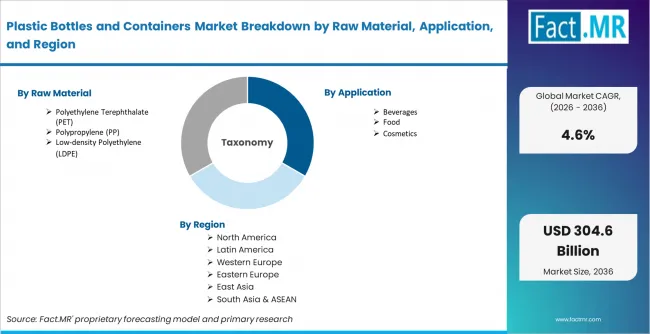
Plastic Bottles And Containers Market Breakdown By Raw Material, Application, And Region | Source: Fact.MR
| Attribute | Details |
|---|---|
| Quantitative Units | USD 185.7 billion (2026) to USD 290.9 billion (2036), at a CAGR of 4.6% |
| Market Definition | Rigid PET, HDPE, PP, and LDPE plastic bottles and containers for beverage, food, personal care, pharmaceutical, and household end uses across B2B direct, retail, and e-commerce distribution channels globally. |
| Raw Material Segmentation | PET, PP, LDPE, HDPE, Others |
| Application Segmentation | Beverages, Food, Cosmetics, Pharmaceuticals, Household Care, Industrial |
| Capacity Segmentation | Up to 500 ml, 500 ml–1 Liter, 1–2 Liters, Above 2 Liters |
| End-Use Industry Segmentation | Food & Beverage, Personal Care & Cosmetics, Healthcare, Household Products, Chemicals & Industrial |
| Distribution Channel Segmentation | Direct/B2B Sales, Retail, Online/E-commerce |
| Regions Covered | North America, Europe, Asia Pacific, Latin America, Middle East and Africa |
| Countries Covered | USA, Canada, Mexico, Germany, UK, France, Italy, Spain, Nordic, BENELUX, China, Japan, South Korea, India, ASEAN, Australia and New Zealand, Brazil, Argentina, Colombia, Saudi Arabia, GCC, Turkey, South Africa, Rest of MEA |
| Key Companies Profiled | Amcor plc, Berry Global, ALPLA, Silgan Holdings, Plastipak Holdings, Greiner Packaging, Resilux NV |
| Forecast Period | 2026 to 2036 |
| Approach | Hybrid top-down and bottom-up model using resin production volumes, bottle and container unit volumes by end-use category, average selling prices by geography, brand owner procurement benchmarks, and primary interviews with packaging procurement managers. |
Source: Fact.MR analysis. Updated May 27, 2026
Plastic Bottles and Containers Market By Segment
-
By Raw Material
- Polyethylene Terephthalate (PET)
- Polypropylene (PP)
- Low-density Polyethylene (LDPE)
- High-density Polyethylene (HDPE)
- Others
-
By Application
- Beverages
- Food
- Cosmetics
- Pharmaceuticals
- Household Care
- Industrial
-
By Capacity
- Up to 500 ml
- 500 ml – 1 Liter
- 1–2 Liters
- Above 2 Liters
-
By End-Use Industry
- Food & Beverage
- Personal Care & Cosmetics
- Healthcare
- Household Products
- Chemicals & Industrial
-
By Distribution Channel
- Direct/B2B Sales
- Retail
- Online/E-commerce
-
By Region
- North America
- United States
- Canada
- Mexico
- Latin America
- Brazil
- Argentina
- Colombia
- Rest of Latin America
- Western Europe
- Germany
- United Kingdom
- France
- Italy
- Spain
- Nordic Countries
- BENELUX
- Rest of Western Europe
- Eastern Europe
- Russia
- Poland
- Hungary
- Rest of Eastern Europe
- East Asia
- China
- Japan
- South Korea
- South Asia and Pacific
- India
- ASEAN
- Australia and New Zealand
- Rest of South Asia and Pacific
- Middle East and Africa
- Kingdom of Saudi Arabia
- Other GCC Countries
- Turkey
- South Africa
- Rest of Middle East and Africa
- North America
Frequently Asked Questions
How large is the global plastic bottles and containers market in 2025?
What will the market size be in 2026?
What is the projected market size by 2036?
What is the expected CAGR from 2026 to 2036?
Which raw material segment is poised to lead the market?
Which application segment leads the market?
Which capacity segment dominates the market?
Which end-use industry holds the largest share?
Which country shows the fastest growth?
Who are the key market players?
Who worked on this report


Preview the report firsthand - request a free sample
Free SampleGet the brochure for pricing and purchase details
Download PDF