- Market Value (2025): USD 126.7 Mn
- Estimated Value (2026): USD 134.0 Mn
- Forecast Value (2036): USD 235.0 Mn
- CAGR (2026-2036): 5.8%
What is the Diamond Testers Market forecast to be worth by 2036?
USD 134 million in 2026 to USD 235 million by 2036, at 5.8% CAGR.
- The market stood at approximately USD 126.7 million in 2025, showing that compact testing tools already have a broad commercial role across jewelry intake, resale, and verification workflows.
- Revenue is forecast to rise from USD 134 million in 2026 to USD 235 million by 2036 as more users screen stones before purchase, acceptance, or resale.
- A 5.8% CAGR from 2026 to 2036 reflects continuing demand for handheld convenience, stronger differentiation between diamond and common simulants, and more disciplined escalation of referred stones.
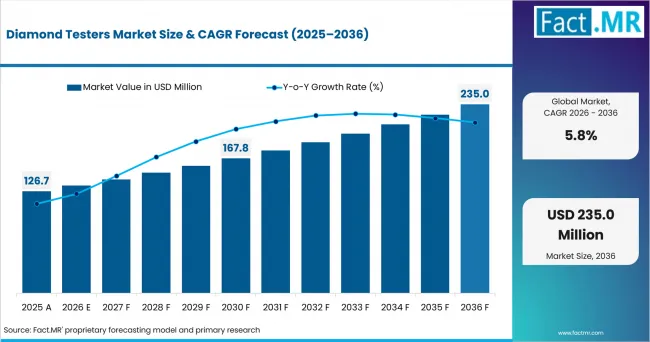
Diamond Testers Market Value Analysis | Source: Fact.MR
What are the defining numbers behind Diamond Testers Market growth?
USD 101 million absolute opportunity by 2036, led by Thermal conductivity testers and Handheld pen tester within their respective segments.
- Demand Drivers in the Market
- Fast verification at a sales counter or intake desk reduces the time required to decide whether a stone can proceed to the next commercial step.
- The presence of moissanite, simulants, and laboratory-grown stones is pushing buyers to match the sensing method to the exact distinction they need to make.
- Handheld devices fit distributed retail and pawn networks because they can be carried between counters without a dedicated instrument station.
- Wholesalers and gem laboratories are adding screening tools to separate routine stones from the smaller group that requires advanced analysis.
- Key Segments Analyzed
- By Test Technology: Thermal conductivity testers leads at 46.0% of demand because diamond's unusually high thermal conductivity gives a probe a heat-transfer reading in seconds, a speed advantage almost no other gem material can match except moissanite, whose similarly efficient heat conduction is the exact reason electrical and spectroscopic methods still have to back it up.
- By Device Form: Handheld pen tester accounts for 52.0% of demand as the thermal and electrical probes inside these devices only need a single point of contact with a stone, a requirement the slim pen shape satisfies without the bulk of a benchtop unit, letting a jeweler test a ring, a pawn intake piece, or loose melee at the counter in the time it takes to touch the tip to the stone.
- By Stone Differentiation: Diamond/moissanite hold 42.0% of demand. Cubic zirconia and glass fail a thermal-conductivity reading outright, but moissanite conducts heat almost as well as diamond does and only separates from it on the electrical-conductivity check built into dual testers, since natural and lab-grown diamonds are electrical insulators while moissanite is a semiconductor. That specific pairing is what buy counters are actually screening for when a customer brings in a stone of uncertain origin.
- By User Group: Jewelry retailers represents 41.0% of demand, driven by two overlapping obligations: the FTC's Jewelry Guides require sellers to disclose whether a stone is mined, lab-grown, or simulant at the point of sale, and the same counter routinely verifies stones coming back in through trade-ins and buybacks, putting a tester in daily use far more often than an independent appraiser or a one-time consumer buyer needs one.
- By Sales Channel: Online marketplaces capture 34.0% of demand. A diamond tester is a compact, self-contained electronic instrument with a fixed spec sheet, so a buyer can compare accuracy claims and stone coverage across listed models without a supplier visit or an in-person demonstration, which is why handheld pen testers are sold and reviewed directly on consumer platforms rather than exclusively through jewelry trade distributors.
- Analyst Opinion at Fact.MR
- Shambhu Nath Jha, Senior Analyst at Fact.MR, states, "A diamond tester is most valuable when the operator understands what its result proves and what it does not. Suppliers that pair simple operation with explicit pass, warning, or referral guidance can earn trust across both professional and occasional users."
- Strategic Implications
- Jewelry retailers should select devices around their actual intake mix instead of assuming one sensing method resolves every stone-identification question.
- Pawn businesses need durable probes, easy calibration checks, and staff instructions that support consistent decisions across locations.
- Manufacturers can differentiate by combining complementary sensors and presenting an unambiguous next step when a reading is uncertain.
- Distributors should demonstrate devices with mounted stones, loose stones, small stones, and realistic counter conditions before recommending a model.
GIA's iD100 applies spectroscopic screening and returns a pass or refer result, illustrating how instrument makers are turning complex analysis into a practical triage decision. A referred result still calls for additional testing rather than a definitive conclusion.
The United States is projected to expand at a 6.2% CAGR from 2026 to 2036 because jewelry stores, pawnbrokers, appraisers, and collectors routinely encounter undocumented stones. The United Kingdom follows at 5.9% on its resale, antiques, and pawnbroking trade, while Belgium's Antwerp trading offices support a 5.8% pace as lab-grown screening becomes routine. A 6.0% CAGR is forecast for the United Arab Emirates, where trading and premium retail reward rapid transaction confidence, and Hong Kong is anticipated to advance at 5.7% through its dense cross-border network of gem professionals.
How does the Diamond Testers Market break down by segment?
The leading shares are Thermal conductivity testers at 46.0% by Test Technology and Handheld pen tester at 52.0% by Device Form.
Why do thermal conductivity testers lead the technology mix?
At 46.0% share in 2026, the leading position goes to Thermal conductivity testers because they provide a familiar and rapid first check in compact devices.
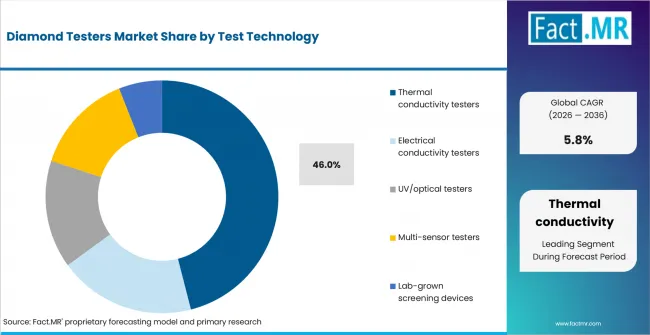
Diamond Testers Market Analysis By Test Technology | Source: Fact.MR
Thermal conductivity testers hold 46.0% of demand because their operating logic is widely understood and well suited to routine counter screening. Electrical conductivity testers account for 19.0% and add useful separation where thermal behavior alone can be ambiguous. UV or optical testers at 15.0%, multi-sensor testers at 14.0%, and lab-grown screening devices at 6.0% serve narrower or more demanding identification tasks.
What keeps handheld pen testers in the leading position?
The 2026 leader is Handheld pen tester at 52.0% share because a compact probe can be used immediately wherever a stone enters the business.
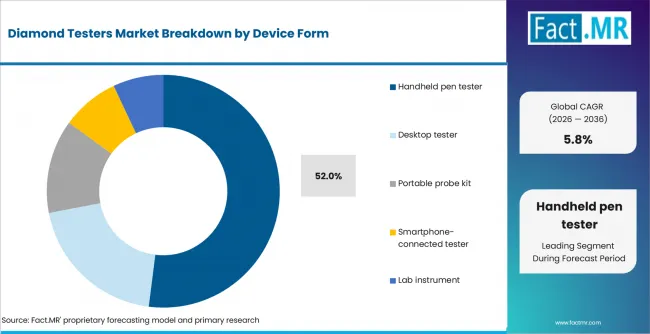
Diamond Testers Market Analysis By Device Form | Source: Fact.MR
Handheld pen testers represent 52.0% of the market and suit retailers, pawnbrokers, and mobile buyers that prioritize speed and portability. Desktop testers hold 20.0%, offering a more controlled station for repeated use. Portable probe kits at 13.0%, smartphone-connected testers at 8.0%, and laboratory instruments at 7.0% address users seeking accessories, records, connectivity, or more formal analysis.
Why is diamond versus moissanite the largest differentiation task?
A 42.0% share puts Diamond/moissanite first in 2026 because the distinction occurs frequently in ordinary jewelry intake and directly affects transaction confidence.
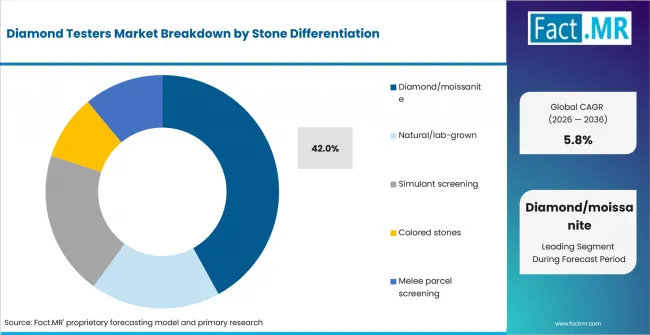
Diamond Testers Market Analysis By Stone Differentiation | Source: Fact.MR
Diamond or moissanite differentiation accounts for 42.0% of demand and remains the most common reason to deploy a compact tester. Simulant screening represents 20.0%, while natural or laboratory-grown differentiation holds 18.0% and generally requires a different level of sensing and interpretation. Melee parcel screening at 11.0% and colored-stone testing at 9.0% create specialized workflows in which throughput or broader gem knowledge matters.
Why are jewelry retailers the principal user group?
For User Group, the top 2026 position is Jewelry retailers at 41.0% share because they must make frequent verification decisions close to the customer and the transaction.
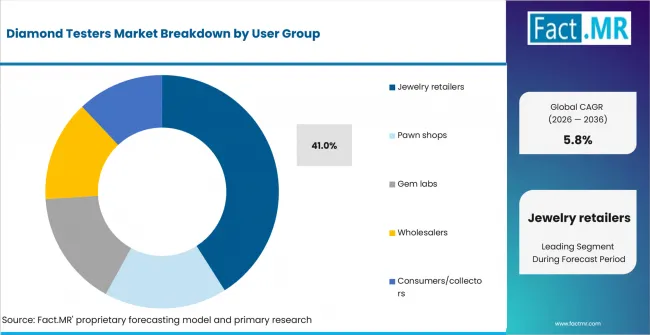
Diamond Testers Market Analysis By User Group | Source: Fact.MR
Jewelry retailers generate 41.0% of demand as testing supports intake, exchange, repair, and sales conversations. Pawn shops account for 17.0% and place a premium on fast, repeatable checks across varied incoming jewelry. Gem laboratories at 16.0%, wholesalers at 14.0%, and consumers or collectors at 12.0% span progressively different needs for screening depth, throughput, and technical guidance.
How have online marketplaces become the largest sales channel?
The leading 2026 share is 34.0% for Online marketplaces because buyers can compare compact tools, availability, and price without relying on a local specialist outlet.
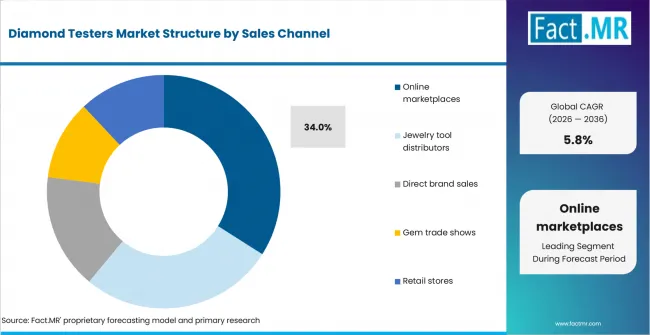
Diamond Testers Market Analysis By Sales Channel | Source: Fact.MR
Online marketplaces lead with 34.0% of sales, particularly for recognizable handheld formats and replacement purchases. Jewelry tool distributors hold 27.0% and remain important when buyers need application advice, demonstrations, or after-sales support. Direct brand sales at 16.0%, retail stores at 12.0%, and gem trade shows at 11.0% provide more controlled opportunities to explain device limits and advanced features.
What is accelerating Diamond Testers Market adoption, and what is holding it back?
The strongest accelerator is the need to make quick, defensible screening decisions wherever stones are bought or accepted. Adoption is constrained by the risk that an operator treats a limited test as a complete gemological identification.
Drivers Impact Analysis
| DRIVER | (~) % IMPACT ON CAGR | GEOGRAPHIC RELEVANCE | IMPACT TIMELINE |
|---|---|---|---|
| Counter-level verification | +0.9% | Global jewelry retail | Short term (<= 2 years) |
| Secondary jewelry intake | +0.8% | United States and major urban resale markets | Short term (<= 2 years) |
| Mixed stone supply | +0.6% | Belgium, the United Arab Emirates, and Hong Kong | Medium term (2-4 years) |
| Melee screening discipline | +0.5% | Diamond manufacturing and wholesale hubs | Medium term (2-4 years) |
| Training and procedure | +0.4% | Global | Long term (>= 4 years) |
Source: Fact.MR analysis. Updated Jul 17, 2026
- Counter-level verification: Retail staff need an immediate check before discussing a stone with a customer or accepting it into inventory. Handheld units fit this moment because they require little bench space and can remain near the transaction.
- Secondary jewelry intake: Pawn, repair, and resale businesses receive stones with uneven documentation. A repeatable screening step helps staff decide which items can proceed and which should be referred.
- Mixed stone supply: Trading networks handle natural diamonds, laboratory-grown stones, moissanite, and other simulants through overlapping channels. This mix supports demand for complementary technologies rather than reliance on a single conductivity reading.
Opportunity Impact Analysis
| OPPORTUNITY | (~) % IMPACT ON CAGR | GEOGRAPHIC RELEVANCE | IMPACT TIMELINE |
|---|---|---|---|
| Multi-sensor handhelds | +0.5% | Jewelry and pawn channels worldwide | Medium term (2-4 years) |
| Connected test records | +0.4% | Multi-site retailers | Long term (>= 4 years) |
| Guided referral workflows | +0.3% | Laboratory-linked distribution networks | Short term (<= 2 years) |
| Accessible professional kits | +0.3% | Major trading and retail hubs | Medium term (2-4 years) |
Source: Fact.MR analysis. Updated Jul 17, 2026
- Multi-sensor handhelds: Combining thermal and electrical behavior can reduce ambiguity in common diamond and moissanite checks. The commercial opportunity lies in presenting the added sensing without making the device harder to operate.
- Connected test records: Smartphone-connected testers can attach a result to an intake or inventory record. Traceability is most useful when the app also records device status, operator, stone reference, and any referral action.
- Guided referral workflows: A tester can become the first step in a service relationship rather than a stand-alone sale. Distributors and laboratories can give users a simple route for stones that return an uncertain or referred result.
Restraints Impact Analysis
| RESTRAINT | (~) % IMPACT ON CAGR | GEOGRAPHIC RELEVANCE | IMPACT TIMELINE |
|---|---|---|---|
| Result overinterpretation | -0.4% | Global | Short term (<= 2 years) |
| Stone and setting variability | -0.3% | Retail and pawn channels | Short term (<= 2 years) |
| Price gap to advanced screening | -0.3% | Small independent businesses | Medium term (2-4 years) |
| Low-cost product inconsistency | -0.2% | Online marketplaces | Medium term (2-4 years) |
Source: Fact.MR analysis. Updated Jul 17, 2026
- Result overinterpretation: A positive conductivity response may not answer whether a diamond is natural or laboratory-grown. Misunderstanding the test boundary can expose a buyer to avoidable commercial risk.
- Stone and setting variability: Small stones, mounted jewelry, metal contact, surface condition, and operator pressure can compl
icate probe use. Devices must be paired with procedures that account for these practical conditions. - Price gap to advanced screening: Optical or spectroscopic screening systems can require a larger investment than a pen tester. Smaller buyers may defer the upgrade and rely on outside laboratories for difficult cases.
Which countries drive diamond tester purchases?
United States 6.2% CAGR. United Kingdom 5.9%. Belgium 5.8%. United Arab Emirates 6.0%. Hong Kong 5.7%.
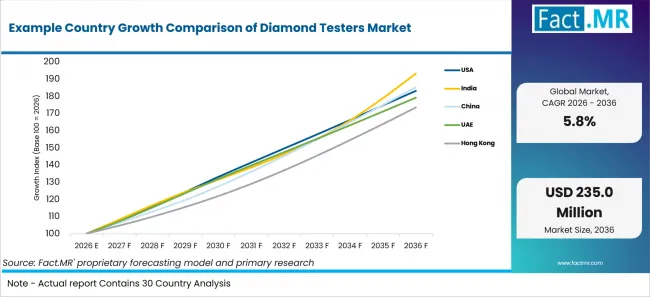
Example Country Growth Comparison Of Diamond Testers Market | Source: Fact.MR
Regional analysis covers North America, Europe, Middle East & Africa, and Asia Pacific, with country sections for the United States, the United Kingdom, Belgium, the United Arab Emirates, and Hong Kong. The full report carries this analysis across more than 30 countries.
| COUNTRY | CAGR |
|---|---|
| United States | 6.2% |
| United Kingdom | 5.9% |
| Belgium | 5.8% |
| United Arab Emirates | 6.0% |
| Hong Kong | 5.7% |
Source: Fact.MR analysis. Updated Jul 17, 2026
Why does US diamond testing demand track FTC disclosure enforcement more than pure retail growth?
GIA runs its main grading campus in Carlsbad, California, and in October 2025 began adding Premium and Standard quality terms to lab-grown diamond reports, sharpening the line retailers must draw between mined and lab-grown stock.
FTC Jewelry Guides require a qualifier like "laboratory-grown" placed immediately before the word "diamond" in any ad, a rule the agency has enforced against sellers who buried disclosures in hashtags. Independent US jewelers closed the 2025 holiday season with diamond jewelry gross sales down 4% and unit sales down 13% even as average prices climbed, per Edge Retail Academy tracking, while colored stones and simulants gained share. As lab-grown and simulant volumes rise inside a shrinking natural-diamond unit count, retailers lean on thermal and conductivity testers at intake to confirm what sits in a case, not just what the tag claims, supporting 6.2% CAGR growth from 2026 to 2036.
What makes London's diamond trade so exposed to disclosure enforcement?
The London Diamond Bourse is the UK's only diamond trading floor, a private members' exchange in the Hatton Garden quarter that opened in 1940 after the Nazi occupation of Belgium cut London off from Antwerp's trading floors, and remains a member of the World Federation of Diamond Bourses.
Hatton Garden also houses Gem-A, the gemmological body founded in 1908 that trains graders through its Fellowship and Diamond Diploma courses, alongside the roughly 2,000 member firms of the National Association of Jewellers, giving the UK trade a concentrated base of specialist verification skill rather than one spread evenly across the country. In May 2026 the Advertising Standards Authority upheld complaints from the Natural Diamond Council and the London Diamond Bourse against retailers Novita Diamonds and Hong Kong-based Linjer for ads that called lab-grown stones simply "diamonds" with no qualifier. Both firms were ordered to add clear lab-grown labeling to future ads, putting UK jewelers on notice that stock verification, not just marketing copy, draws regulatory scrutiny, a climate supporting 5.9% CAGR growth in tester demand from 2026 to 2036.
Why is Antwerp buying more testers even as its diamond trade shrinks?
Antwerp's combined rough and polished diamond trade fell 22.4% in 2025 to USD 19.1 billion, Antwerp World Diamond Centre figures show, down from a 2022 peak near USD 41 billion.
Much of the drop traces to the European Union's ban on Russian-origin diamonds, in effect since January 1, 2024, which cost the city a significant share of its prior rough import volume, since Russian goods once supplied a large fraction of Antwerp's rough intake. Synthetic diamonds still made up only 0.37% of Antwerp's 2025 trade value by AWDC's own count, a small share that undersells how often diamantaires now screen incoming parcels, since one undetected lab-grown or simulant stone mixed into a natural parcel can void a buyer's confidence in an entire lot. That parcel-level screening need, layered on tighter origin tracing since sanctions took hold, supports 5.8% CAGR growth in Belgian tester demand from 2026 to 2036.
What is pulling diamond testers into Dubai's record trading volumes?
Dubai's total diamond trade hit a record USD 41.7 billion in 2025, with 359.5 million carats traded, a 42.5% year-on-year volume jump reported by DMCC, operator of the Dubai Diamond Exchange.
The UAE has positioned itself as a leading hub for rough diamond trade by value in recent years, and re-exports climbed 33.5% in 2025 as goods moved through Dubai to buyers across Asia, Europe, and Africa. DMCC's code of conduct for its diamond and lab-grown ecosystems requires member firms to keep natural and lab-grown stock physically separate and fully disclosed, with a System of Warranties attached to every invoice tracing Kimberley Process compliance. Enforcing that separation across a trading floor moving hundreds of millions of carats a year calls for testing at intake rather than spot checks, supporting 6.0% CAGR growth in UAE tester demand from 2026 to 2036.
Why does Hong Kong's role as a manufacturing hub shape its tester demand?
Hong Kong hosts the Jewellery & Gem World fair each September, drawing more than 4,000 exhibitors from over 40 countries across the AsiaWorld-Expo and the Hong Kong Convention and Exhibition Centre, alongside the HKTDC's separate Diamond, Gem & Pearl Show.
That fair calendar sits on top of a manufacturing base that still cuts, sets, and re-exports stones for buyers across mainland China and Southeast Asia, giving the territory a testing need tied to production volume, not just end-consumer retail. The Diamond Federation of Hong Kong runs its Natural Diamond Quality Assurance mark with grading partner NGTC(HK), an ISO/IEC 17025-accredited lab, giving manufacturers and retailers a shared authentication standard. In 2025, Hong Kong's fine jewellery exports rose on higher precious metal prices while exports of pearls, gemstones, and rough diamonds and imitation jewellery both fell, a split pushing firms toward testers to sort genuine stones from simulants, supporting 5.7% CAGR growth from 2026 to 2036.
Who leads the Diamond Testers Market?
GIA, Presidium, GemOro, and Yehuda shape competition through screening credibility, handheld usability, channel support, and coverage of different stone-identification tasks.
GIA leads the source-company set with a 14.0% share, while Presidium holds 10.0% and GemOro accounts for 8.0%. GIA's research and laboratory association supports confidence in advanced screening, whereas handheld specialists compete on speed, portability, and straightforward operation.
Yehuda represents 6.0% of the source-company set. Competitive advantage depends as much on training, calibration guidance, test-piece availability, and warranty service as on the device itself, together with an honest explanation of when further laboratory work is required.
Which companies are the key providers?
The company set includes GIA, Presidium, GemOro, and Yehuda.
- GIA
- Presidium
- GemOro
- Yehuda
These five brands headline the assessment, and the complete study reviews more than 30 companies making and distributing gem-testing instruments.
What is the report's scope and coverage?
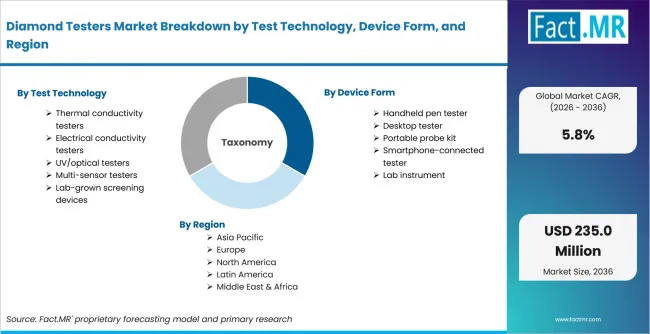
Diamond Testers Market Breakdown By Test Technology, Device Form, And Region | Source: Fact.MR
| ATTRIBUTE | DETAILS |
|---|---|
| Quantitative Units | USD million in 2026 to USD million by 2036 at CAGR |
| Market Definition | The market covers handheld, desktop, connected, and laboratory devices sold principally to screen diamonds against moissanite, simulants, laboratory-grown stones, or other defined comparison groups. |
| Test Technology | Thermal conductivity testers; Electrical conductivity testers; UV/optical testers; Multi-sensor testers; Lab-grown screening devices |
| Device Form | Handheld pen tester; Desktop tester; Portable probe kit; Smartphone-connected tester; Lab instrument |
| Stone Differentiation | Diamond/moissanite; Natural/lab-grown; Simulant screening; Colored stones; Melee parcel screening |
| User Group | Jewelry retailers; Pawn shops; Gem labs; Wholesalers; Consumers/collectors |
| Sales Channel | Online marketplaces; Jewelry tool distributors; Direct brand sales; Gem trade shows; Retail stores |
| Regions Covered | North America; Europe; Middle East & Africa; Asia Pacific |
| Countries Covered | United States; United Kingdom; Belgium; United Arab Emirates; Hong Kong (30+ countries in the full report) |
| Key Companies Profiled | GIA; Presidium; GemOro; Yehuda |
| Forecast Period | 2026 to 2036 |
| Approach | Sizing combines device shipments, realized prices by sensing method and form, channel markups, replacement demand, user expansion, and the mix of basic testers versus advanced screeners. |
Source: Fact.MR analysis. Updated Jul 17, 2026
How is the market segmented?
-
By Test Technology
- Thermal conductivity testers
- Electrical conductivity testers
- UV/optical testers
- Multi-sensor testers
- Lab-grown screening devices
-
By Device Form
- Handheld pen tester
- Desktop tester
- Portable probe kit
- Smartphone-connected tester
- Lab instrument
-
By Stone Differentiation
- Diamond/moissanite
- Natural/lab-grown
- Simulant screening
- Colored stones
- Melee parcel screening
-
By User Group
- Jewelry retailers
- Pawn shops
- Gem labs
- Wholesalers
- Consumers/collectors
-
By Sales Channel
- Online marketplaces
- Jewelry tool distributors
- Direct brand sales
- Gem trade shows
- Retail stores
-
By Region
- North America
- United States
- Europe
- United Kingdom
- Belgium
- Middle East & Africa
- United Arab Emirates
- Asia Pacific
- Hong Kong
Bibliography
- Gemological Institute of America. (n.d.). GIA Instruments.
- Gemological Institute of America. (n.d.). Instrument User Guides and Manuals.
- Presidium. (n.d.). Multi Tester III.
- Presidium. (n.d.). Diamond and Moissanite Testers.
- Yehuda. (n.d.). Sherlock Holmes 3.0 Yehuda Detector.
This Report Addresses
- The report establishes the 2025 revenue base and tracks the market through 2036.
- It compares the United States, the United Kingdom, Belgium, the United Arab Emirates, and Hong Kong, inside coverage that spans 30+ countries.
- It assesses GIA, Presidium, GemOro, and Yehuda within the stated competitive set.
- It separates thermal, electrical, optical, multi-sensor, and laboratory-grown screening technologies.
- It examines jewelry retail, pawn, laboratory, wholesale, and consumer purchasing behavior.
- It tests the forecast against stone-mix complexity, resale intake, operator training, channel access, and device replacement.
What does the Diamond Testers Market cover?
The study follows diamond testing devices from basic counter probes to advanced screening instruments used for commercial triage.
Revenue covers complete devices and their bundled operating accessories across online marketplaces, jewelry-tool distributors, direct brand sales, gem shows, and retail stores. Testers are separated by sensing technology, physical form, and intended differentiation task.
Demand is modeled across retailers, pawn shops, laboratories, wholesalers, and consumers or collectors. Country analysis reflects jewelry trade, resale activity, professional infrastructure, distribution, and adoption of screening procedures.
What is included in the scope?
A product is included when its principal marketed function is the screening or preliminary identification of diamonds and defined look-alike or origin groups.
Thermal and electrical probes, optical and UV testers, multi-sensor devices, laboratory-grown screening units, and spectroscopic screeners are included. Handheld pens, desktop units, portable kits, connected devices, and laboratory instruments are counted in their relevant form categories.
Bundled cases, chargers, loose-stone trays, test pieces, software, and probes are included in the realized price of a complete unit. Sales through professional and consumer channels remain within scope when the device meets the market definition.
What is excluded from the scope?
The market does not count laboratory opinions or unrelated gemological tools as diamond tester revenue.
Gem grading and identification services, certification fees, microscopes, refractometers, balances, loupes, and general spectroscopy platforms are excluded. Stand-alone consumables, replacement accessories, and used-device transactions are outside the new-device revenue model.
How was the analysis built?
Device portfolios, trade-channel interviews, retail evidence, and forecast cross-checks referencing more than 30 countries.
- Primary Research: Primary interviews cover jewelry retailers, pawnbrokers, wholesalers, gemologists, laboratory managers, device manufacturers, distributors, and experienced collectors. Discussion focuses on stone mix, test purpose, throughput, false or referred results, training, replacement, pricing, and service.
- Desk Research: Desk research uses official instrument guides, manufacturer product pages, operating instructions, and gemological institution material. Named capabilities are retained only when an official source in the bibliography supports them.
- Market-Sizing and Forecasting: The model combines annual unit sales with average realized prices for handheld, desktop, connected, and laboratory formats. It reconciles channel and user estimates to USD 134 million in 2026 and USD 235 million in 2036.
- Data Validation and Update Cycle: Validation checks technology, form, user, and country splits with both suppliers and operators. Updates monitor new screening methods, stone-supply changes, retail and resale activity, channel pricing, and instrument replacement.
Frequently Asked Questions
What is the diamond testers market worth in 2026?
What value is forecast for 2036?
What CAGR is expected for the market?
Which test technology leads?
What is the largest device form?
Which differentiation task is most common?
Who is the largest user group?
Which sales channel leads?
Who worked on this report


Preview the report firsthand - request a free sample
Free SampleGet the brochure for pricing and purchase details
Download PDF