- Market Value (2025): USD 45.8 Bn
- Estimated Value (2026):USD 48.6 Bn
- Forecast Value (2036): USD 86.9 Bn
- CAGR (2026-2036): 6.0%
What is the Automotive Aluminum Parts High Pressure Die Casting HPDC Market forecast to be worth by 2036?
USD 48.6 billion in 2026 to USD 86.9 billion by 2036 at 6.0% CAGR.
- The automotive aluminum parts high pressure die casting HPDC market surpassed a value of USD 45.8 billion in 2025.
- Demand is projected to increase from USD 48.6 billion in 2026 to USD 86.9 billion by 2036.
- The market is forecast to record 6.0% CAGR from 2026 to 2036 as vehicle programs add cast aluminum parts to structural and battery applications.
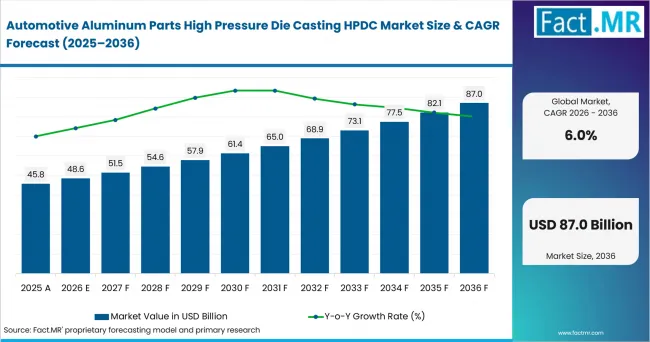
Automotive Aluminum Parts High Pressure Die Casting Hpdc Market Value Analysis | Source: Fact.MR
What are the defining numbers behind Automotive Aluminum Parts High Pressure Die Casting HPDC Market growth?
USD 38.3 billion absolute opportunity by 2036.
- Demand Drivers in the Market
- Vehicle makers need lighter body and chassis parts because range and payload targets leave less room for unnecessary mass.
- Electric platforms need battery trays and motor housings that protect thermal paths and sealing surfaces.
- Body teams are evaluating single-piece castings where removed welds lower assembly work without weakening crash performance.
- Key Segments Analyzed
- By Casting Component: Structural Body Components are expected to hold 36% share in 2026 supported by shock tower and rear longitudinal member programs.
- By Vehicle Application: Body-in-White Components are projected to account for 34% share in 2026 owing to front-end and rear-underbody uses.
- By Vehicle Category: Passenger Cars are anticipated to capture 61% share in 2026 because scale supports dedicated dies and longer casting runs.
- By End User: Automotive Original Equipment Manufacturers are estimated to represent 68% share in 2026 as vehicle makers control platform approval.
- By Casting Technology: Vacuum High Pressure Die Casting is forecast to account for 38% share in 2026 driven by parts that need lower trapped gas.
- Analyst Opinion at Fact.MR
- Shambhu Nath Jha, Principal Consultant at Fact.MR, states, “Automotive aluminum HPDC is becoming a platform-engineering decision. A casting improves the commercial case when it removes parts and welds. The company must still prove crash behavior and joining quality before the part earns a durable program position.”
- Strategic Implications
- Casting companies gain stronger vehicle-maker confidence by qualifying alloys and vacuum levels as one controlled process before presenting capacity.
- Automotive original equipment manufacturers benefit from comparing assembled cost with repair planning before approving a large aluminum casting.
- Equipment providers improve defect traceability by linking press-control and inspection data to each stage of the casting cycle.
The USA follows at 6.5% as lightweighting needs support large vehicle platforms. Germany reaches 6.2% through premium engineering and strict qualification. Japan records 5.9%, South Korea 5.6%, India 5.3%, and Mexico 5.0% through localized automotive production.
How does the Automotive Aluminum Parts High Pressure Die Casting HPDC Market break down by segment?
Structural Body Components lead Casting Component at 36% share in 2026. Body-in-White Components lead Vehicle Application at 34%.
Which Casting Component dominates?
Structural Body Components hold 36% share in 2026.
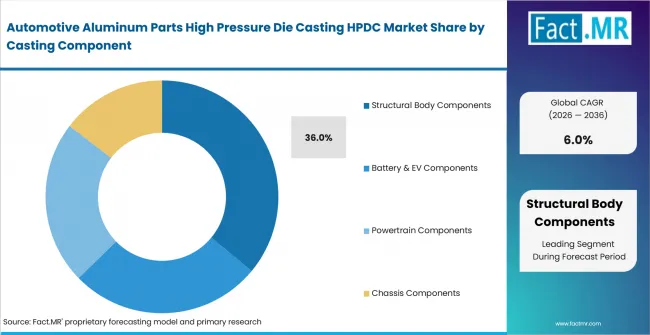
Automotive Aluminum Parts High Pressure Die Casting Hpdc Market Analysis By Casting Component | Source: Fact.MR
Shock towers and rear longitudinal members lead because they carry crash loads and hold suspension points. Battery & EV Components follow through trays and inverter housings. Powertrain and Chassis Components remain relevant through housings.
What leads the Vehicle Application segment?
Body-in-White Components lead with 34% share in 2026.
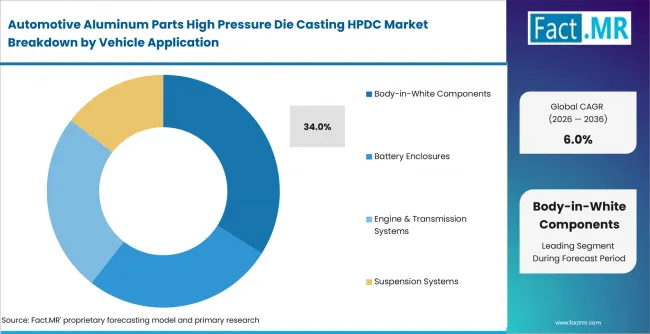
Automotive Aluminum Parts High Pressure Die Casting Hpdc Market Analysis By Vehicle Application | Source: Fact.MR
Front-end and rear-underbody structures are set early in vehicle architecture. Casting design allows ribs and bosses to be built into one part. Battery Enclosures and automotive power electronics packaging add demand where geometry must stay controlled.
Why do Passenger Cars lead Vehicle Category demand?
Passenger Cars hold 61% share in 2026.
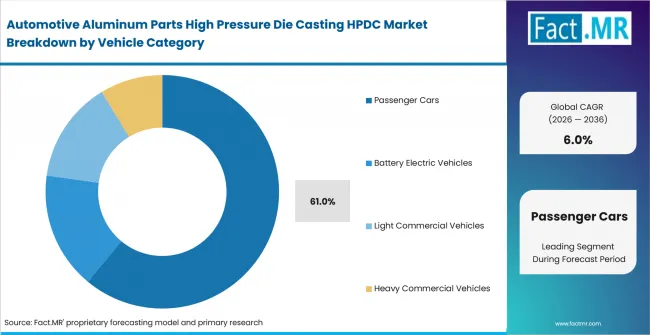
Automotive Aluminum Parts High Pressure Die Casting Hpdc Market Analysis By Vehicle Category | Source: Fact.MR
Sedans and sport utility vehicles provide the volume needed to pay for dies and large presses. Battery Electric Vehicles add housing demand. Plug-in Hybrid Vehicles still need cast parts for both electric and conventional systems.
Which End User accounts for the largest share?
Automotive Original Equipment Manufacturers account for 68% share in 2026.
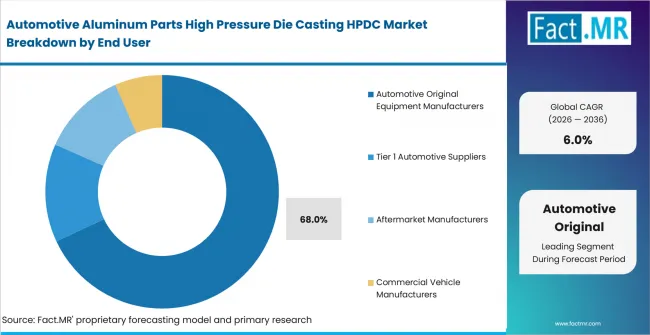
Automotive Aluminum Parts High Pressure Die Casting Hpdc Market Analysis By End User | Source: Fact.MR
Automotive Original Equipment Manufacturers decide architecture and launch timing. They use automotive lightweight materials only after the part fits cost and repair targets. Tier 1 Automotive Suppliers serve subassemblies where the same approval path applies.
Which Casting Technology leads?
Vacuum High Pressure Die Casting holds 38% share in 2026.
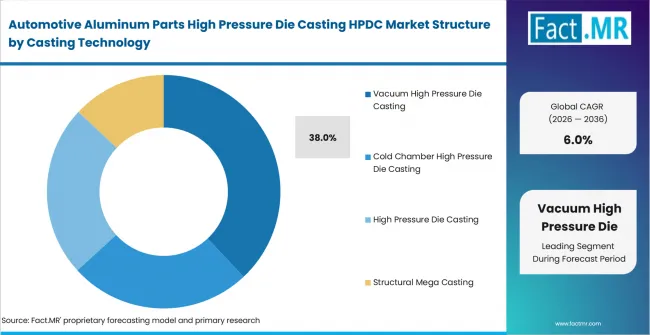
Automotive Aluminum Parts High Pressure Die Casting Hpdc Market Analysis By Casting Technology | Source: Fact.MR
Vacuum High Pressure Die Casting leads because structural parts need low trapped gas and repeatable strength. Cold Chamber High Pressure Die Casting remains the main route for many aluminum castings. Structural Mega Casting raises the burden on die care and scrap control.
What is accelerating Automotive Aluminum Parts High Pressure Die Casting HPDC Market adoption, and what is holding it back?
Vehicle lightweighting and electric platform redesign support adoption. Tooling cost and repair planning limit programs that begin without enough validation.
Drivers Impact Analysis
| DRIVER | COMMERCIAL EFFECT | GEOGRAPHIC RELEVANCE | IMPACT TIMELINE |
|---|---|---|---|
| Vehicle lightweighting under efficiency targets | Supports aluminum substitution and platform redesign | Global with USA; Europe; Asia Pacific emphasis | Current forecast period |
| Electric battery and motor housings | Expands demand beyond conventional powertrain castings | China; USA; Germany; Japan; South Korea | Current forecast period |
| Body-in-white part consolidation | Moves value from stamped assemblies into large castings | China; USA; Germany | Short to medium term |
| Automated casting and inline checks | Raises launch confidence for large parts | Established automotive hubs | Medium term |
| Regional casting localization | Supports near-plant capacity and lower logistics exposure | Mexico; India; China; USA | Medium to long term |
Source: Fact.MR analysis. Updated Aug 6, 2026
- Vehicle lightweighting: Automakers are expected to compare lightweight body panels on full system value. A lighter structure matters only when it also meets crash and repair needs.
- Electric platform redesign: Battery trays and motor housings are expected to favor suppliers that support sealing and thermal paths during the design stage.
- Body-in-white consolidation: Large castings are expected to move value from stamped assemblies to HPDC where validation confirms fit and crash behavior.
Opportunity Impact Analysis
| OPPORTUNITY | COMMERCIAL EFFECT | GEOGRAPHIC RELEVANCE | IMPACT TIMELINE |
|---|---|---|---|
| Large structural underbody castings | Creates higher-value tooling and machining programs | China; USA; Germany | Short to medium term |
| Battery trays and electric housings | Broadens demand beyond engine and gearbox castings | China; South Korea; Japan; USA; Germany | Current forecast period |
| Recycled aluminum and lower-carbon sourcing | Adds traceability value during supplier selection | Europe; USA; Japan | Medium term |
| Connected process monitoring | Supports lower scrap and faster root-cause review | Global casting plants | Medium to long term |
Source: Fact.MR analysis. Updated Aug 6, 2026
- Structural integration: Programs that count removed welds and fixtures are expected to connect HPDC with wider metal casting decisions.
- Circular aluminum systems: Foundries gain advantage when alloy chemistry and return-scrap loops are controlled with the casting process.
- Connected process monitoring: Data from press settings and inspection is expected to make defect review faster during production launch.
Restraints Impact Analysis
| RESTRAINT | COMMERCIAL EFFECT | GEOGRAPHIC RELEVANCE | IMPACT TIMELINE |
|---|---|---|---|
| Large press and die investment | Raises break-even volume and program risk | Global structural casting programs | Current forecast period |
| Porosity and dimensional variation | Extends validation and raises scrap exposure | All HPDC plants | Current forecast period |
| Joining and corrosion complexity | Adds body-shop and materials work | Mixed-material vehicle platforms | Medium term |
| Repair and replacement economics | Slows use of large parts | Insurance-sensitive passenger vehicle markets | Medium to long term |
Source: Fact.MR analysis. Updated Aug 6, 2026
- Capital and utilization risk: Large casting lines need press and machining capacity to remain loaded. Delayed platforms are expected to make the business case harder.
- Quality risk: Porosity and distortion are expected to move a part outside approval limits. Inspection rules must be clear before volume production begins.
- Integration complexity: Joining and corrosion choices must be approved where aluminum meets steel or automotive plastic components.
Which countries are scaling Automotive Aluminum Parts High Pressure Die Casting HPDC Market fastest?
- The country comparison spans 1.8 percentage points across the forecast period.
- The USA remains 0.3 percentage point above Germany through lightweighting pressure and large vehicle platforms.
- Germany remains 0.3 percentage point above Japan through premium vehicle engineering.
- Japan remains 0.3 percentage point above South Korea through process control and company depth.
- South Korea remains 0.3 percentage point above India through integrated vehicle and battery supply chains.
- India remains 0.3 percentage point above Mexico as localization and electric mobility programs widen the casting base.
Comparable CAGRs create different entry conditions because each country has a different mix of vehicle scale and near-plant casting capacity. Full report coverage includes North America; Latin America; Europe; East Asia; South Asia and Pacific; Middle East and Africa.
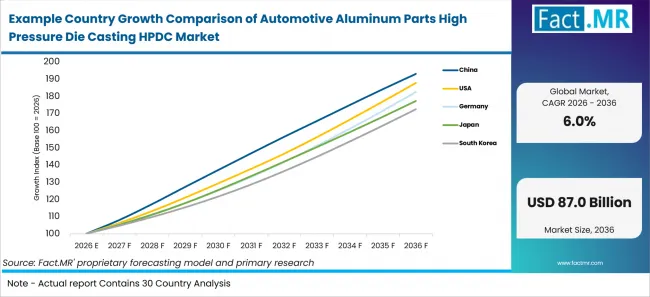
Example Country Growth Comparison Of Automotive Aluminum Parts High Pressure Die Casting Hpdc Market | Source: Fact.MR
| Country | CAGR (2026-2036) |
|---|---|
| USA | 6.5% |
| Germany | 6.2% |
| Japan | 5.9% |
| South Korea | 5.6% |
| Mexico | 5.0% |
Source: Fact.MR analysis. Updated Aug 6, 2026
How is the USA scaling Automotive Aluminum Parts HPDC demand?
6.5% CAGR, supported by lightweighting requirements and large vehicle platforms.
USA programs are expected to qualify body castings and battery enclosures with nearby machining support. Pickup and sport utility vehicle platforms give casting companies a larger volume base.
What supports Germany's outlook?
6.2% CAGR, shaped by premium vehicle engineering and strict body-structure qualification.
German buyers are expected to test dimensional stability before approving a new casting architecture. This approach favors suppliers that document process control during prototype and launch work.
What underpins Japan's growth?
5.9% CAGR, attributable to quality-led manufacturing and electrified powertrain development.
Japan is expected to scale HPDC through stable process capability. Vehicle makers are likely to favor casting partners that protect alloy quality across several program cycles.
How is South Korea developing Automotive Aluminum Parts HPDC demand?
5.6% CAGR, supported by vehicle and battery supply-chain depth.
South Korea connects vehicle producers with battery and electronics companies. Buyers are expected to require short cycle times and clean surfaces before wider sourcing approval.
What shapes Mexico's outlook?
5.0% CAGR, supported by export vehicle production and North American supply-chain integration.
Mexico serves vehicle programs tied to nearby assembly networks. Localized aluminum structures and powertrain housings are expected to reduce transport exposure during launch.
Who leads the Automotive Aluminum Parts High Pressure Die Casting HPDC Market?
Nemak and Bocar Group hold strong positions in automotive aluminum casting, while Rheinmetall adds structural and electrified powertrain expertise.
Alteams and Martinrea support lightweight vehicle programs across body and chassis applications. Dynacast and Handtmann contribute precision casting capabilities. Endurance Technologies, Ahresty, Ryobi and BENTELER expand the supplier field through powertrain, suspension and large structural aluminum components.
Which companies are the key providers?
Key companies include Nemak, S.A.B. de C.V.; Bocar Group; Rheinmetall AG; Alteams Group; Martinrea International Inc.; Dynacast International Inc.; Handtmann Holding GmbH & Co. KG; Endurance Technologies Limited; Ahresty Corporation; Ryobi Limited; and BENTELER International AG
- Nemak, S.A.B. de C.V.
- Bocar Group
- Rheinmetall AG
- Alteams Group
- Martinrea International Inc.
- Dynacast International Inc.
- Handtmann Holding GmbH & Co. KG
- Endurance Technologies Limited
- Ahresty Corporation
- Ryobi Limited
- BENTELER International AG
What is the report’s scope and coverage?
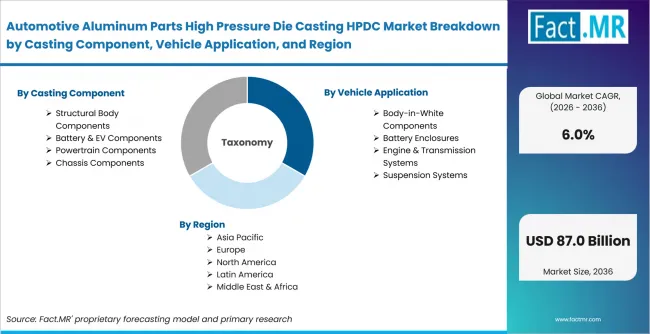
Automotive Aluminum Parts High Pressure Die Casting Hpdc Market Breakdown By Casting Component, Vehicle Application, And Region | Source: Fact.MR
| Attribute | Details |
|---|---|
| Quantitative Units | USD billion |
| Market Definition | Aluminum automotive components produced through high pressure die casting for body; battery; powertrain; chassis and related vehicle uses |
| Casting Component | Structural Body Components; Battery & EV Components; Powertrain Components; Chassis Components |
| Vehicle Application | Body-in-White Components; Battery Enclosures; Engine & Transmission Systems; Suspension Systems |
| Vehicle Category | Passenger Cars; Battery Electric Vehicles; Light Commercial Vehicles; Heavy Commercial Vehicles |
| End User | Automotive Original Equipment Manufacturers; Tier 1 Automotive Suppliers; Aftermarket Manufacturers; Commercial Vehicle Manufacturers |
| Casting Technology | Vacuum High Pressure Die Casting; Cold Chamber High Pressure Die Casting; High Pressure Die Casting; Structural Mega Casting |
| Regions Covered | North America; Latin America; Europe; East Asia; South Asia and Pacific; Middle East and Africa |
| Countries Covered | USA; Germany; Japan; South Korea; Mexico |
| Key Companies Profiled | Nemak, S.A.B. de C.V.; Bocar Group; Rheinmetall AG; Alteams Group; Martinrea International Inc.; Dynacast International Inc.; Handtmann Holding GmbH & Co. KG; Endurance Technologies Limited; Ahresty Corporation; Ryobi Limited; BENTELER International AG |
| Forecast Period | 2026 to 2036 |
| Approach | Hybrid top-down and bottom-up approach using vehicle production; component content; platform architecture; die-casting technology adoption; tooling cycles; country growth rates and company portfolio review |
Source: Fact.MR analysis. Updated Aug 6, 2026
Bibliography
- U.S. Geological Survey. (2025, January 31). Mineral commodity summaries 2025. U.S. Department of the Interior.
- International Energy Agency. (2025, May 14). Global EV outlook 2025: Expanding sales in diverse markets.
- National Bureau of Statistics of China. (2025, July 28). Industrial production operation in June 2025.
This Report Answers
- The report provides strategic intelligence on Automotive Aluminum Parts HPDC across casting component and vehicle-application choices.
- Segment analysis covers Structural Body Components and Body-in-White Components as the leading share categories within 2026 demand.
- Country outlook evaluates China and the USA alongside Germany and Japan. South Korea, India and Mexico complete the growth comparison.
- Competitive analysis profiles Nemak, S.A.B. de C.V. alongside Bocar Group and other listed automotive casting providers.
- Technology assessment compares Vacuum High Pressure Die Casting with Cold Chamber and Structural Mega Casting.
What does the Automotive Aluminum Parts High Pressure Die Casting HPDC Market cover?
The market covers aluminum vehicle parts made through high pressure die casting for structural and vehicle-system applications.
Coverage includes structural body parts; battery enclosures; powertrain housings and chassis parts sold into passenger car and commercial vehicle programs. The market also covers components where high-voltage interlock components and electric housings need safe packaging space.
What is included in the scope?
Automotive aluminum HPDC parts used in body-in-white; battery; electric powertrain; engine; transmission; suspension and chassis systems are included.
The scope includes shock towers; rear longitudinal members; battery trays; inverter housings; transmission housings; cross members and control arms. Vacuum; cold chamber; conventional and structural mega casting routes are covered.
What is excluded from the scope?
Non-HPDC aluminum forms, finished vehicles and general die-casting equipment revenue are outside the market boundary.
The scope excludes aluminum sheet; extrusions; forgings and castings made mainly through sand; gravity; permanent-mold or low-pressure processes. Standalone equipment and raw alloy sales remain outside market value.
How Was the Analysis Built?
The analysis draws on 120+ sources; 40+ company portfolios; 25+ countries; and more than 20 industry interviews.
- Primary Research: Primary research includes discussions with manufacturers; service providers; technology developers; distributors; end users; procurement teams and subject-matter experts. These conversations examine purchasing priorities; adoption barriers; approval needs; competitive positioning and wider market acceptance.
- Desk Research: Desk research covers government statistics; regulatory publications; company filings; trade data; technical studies; industry associations; standards and public policy. Every source used in the analysis is documented in the bibliography.
- Market Sizing and Forecasting: Market estimates combine historical performance; demand indicators; pricing trends; segment shares; company participation; country growth; adoption patterns; investment activity and barriers to market expansion.
- Data Validation and Update Cycle: Findings are validated by comparing primary interviews with public data; company activity; regulation; trade patterns and industry developments. Regular updates review launches; capacity changes; partnerships; approvals and procurement trends.
Segmentation
How is the market segmented?
-
By Casting Component
- Structural Body Components
- Shock Towers
- Rear Longitudinal Members
- Battery & EV Components
- Battery Trays
- Inverter Housings
- Powertrain Components
- Transmission Housings
- Transmission Cases
- Chassis Components
- Cross Members
- Control Arms
- Structural Body Components
-
By Vehicle Application
- Body-in-White Components
- Front End Structures
- Rear Underbody Components
- Battery Enclosures
- Motor Housings
- Power Electronics Housings
- Engine & Transmission Systems
- Engine Blocks
- Gearbox Housings
- Suspension Systems
- Subframes
- Suspension Mounts
- Body-in-White Components
-
By Vehicle Category
- Passenger Cars
- Sedans
- Sport Utility Vehicles
- Battery Electric Vehicles
- Hybrid Electric Vehicles
- Plug-in Hybrid Vehicles
- Light Commercial Vehicles
- Delivery Vans
- Pick-up Trucks
- Heavy Commercial Vehicles
- Trucks
- Buses
- Passenger Cars
-
By End User
- Automotive Original Equipment Manufacturers
- Global Automotive Manufacturers
- Electric Vehicle Manufacturers
- Tier 1 Automotive Suppliers
- Electric Powertrain Suppliers
- Component Manufacturers
- Aftermarket Manufacturers
- Replacement Parts Manufacturers
- Specialty Automotive Producers
- Commercial Vehicle Manufacturers
- Bus Manufacturers
- Special Vehicle Manufacturers
- Automotive Original Equipment Manufacturers
-
By Casting Technology
- Vacuum High Pressure Die Casting
- High Vacuum Casting
- Squeeze-assisted HPDC
- Cold Chamber High Pressure Die Casting
- Automated Cold Chamber Casting
- Robotic Die Casting Cells
- High Pressure Die Casting
- Conventional HPDC
- Integrated Die Lubrication
- Structural Mega Casting
- Giga Casting Technology
- Integrated Structural Casting
- Vacuum High Pressure Die Casting
-
By Region
- North America
- Latin America
- Europe
- East Asia
- South Asia and Pacific
- Middle East and Africa
Frequently Asked Questions
How big is the automotive aluminum parts high pressure die casting HPDC market in 2026?
What is the CAGR of the automotive aluminum parts high pressure die casting HPDC market from 2026 to 2036?
Which casting component leads the automotive aluminum parts high pressure die casting HPDC market?
Which end-user segment leads the automotive aluminum parts high pressure die casting HPDC market?
Who are the leading companies in the automotive aluminum parts high pressure die casting HPDC market?
Who worked on this report


Preview the report firsthand - request a free sample
Free SampleGet the brochure for pricing and purchase details
Download PDF