- Market Value (2025): USD 27.9 Bn
- Estimated Value (2026): USD 29.8 Bn
- Forecast Value (2036): USD 58.1 Bn
- CAGR (2026-2036): 6.9%
What is the Digital Oil Field Services Market forecast to be worth by 2036?
USD 29.8 billion in 2026 to USD 58.1 billion by 2036, at 6.9% CAGR.
- The Digital Oil Field Services Market is valued at USD 27.9 billion in 2025 as operators purchase production optimization, remote asset management, drilling automation, reservoir modeling, and connected field technologies.
- Demand is projected to increase from USD 29.8 billion in 2026 to USD 58.1 billion by 2036.
- The market is forecast to record a 6.9% CAGR from 2026 to 2036 as high-output and mature fields use real-time surveillance, automated lift and drilling workflows, predictive maintenance, and integrated subsurface-to-surface data to protect production and reduce avoidable field intervention.
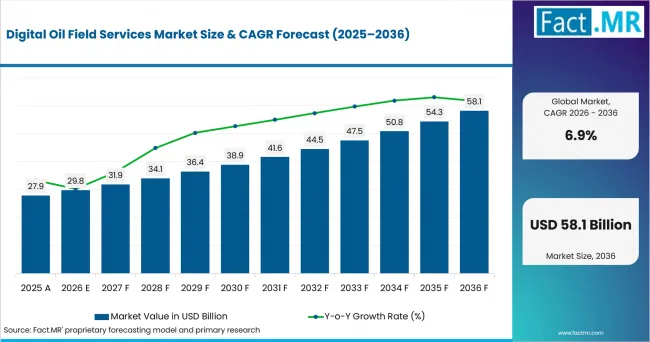
Digital Oil Field Services Market Value Analysis | Source: Fact.MR
What are the defining numbers behind Digital Oil Field Services Market growth?
Production Optimization Services leads Service Category at 38%, Onshore Oilfields leads Field Operation at 44%, Upstream Oil & Gas leads End-use Sector at 47%, National Oil Companies leads Client Type at 42%, and Industrial IoT Platform leads Digital Technology at 39% in 2026.
- Demand Drivers in the Market
- Production teams need continuous well and field surveillance because artificial-lift settings, reservoir behavior, pressure, water cut, and equipment condition can change production performance between scheduled field visits.
- Distributed onshore assets need remote monitoring and exception-based work because thousands of wells, pads, gathering points, and rotating equipment cannot be supervised economically through manual rounds alone.
- National oil companies and integrated operators are building shared data and analytics environments so subsurface, drilling, production, maintenance, and business teams can work from a more consistent operational picture across large portfolios.
- Offshore and hard-to-access assets need predictive maintenance, remote diagnostics, and digitally assisted operating workflows because travel, intervention, shutdowns, and specialist mobilization are expensive when equipment problems are discovered late.
- Key Segments Analyzed
- By Service Category: Production Optimization Services is expected to hold 38% share in 2026 because Artificial Lift Optimization and Reservoir Performance Monitoring can affect producing-well performance directly and create recurring service demand after first production.
- By Field Operation: Onshore Oilfields is projected to account for 44% share in 2026 as Conventional Wells and Mature Oilfields create a broad installed base for remote monitoring, optimization, and predictive maintenance across dispersed assets.
- By End-use Sector: Upstream Oil & Gas is anticipated to capture 47% share in 2026 because Crude Oil Production and Natural Gas Production place digital decisions closest to reservoir, well, lift, and production outcomes.
- By Client Type: National Oil Companies is estimated to represent 42% share in 2026 because large asset portfolios support common digital standards, centralized operating centers, and multi-field deployment of analytics and automation.
- By Digital Technology: Industrial IoT Platform is forecast to account for 39% share in 2026 as Edge IoT Devices and Real-time Sensor Networks provide the data and connectivity layer on which remote monitoring, AI, cloud analytics, and digital twins depend.
- Analyst Opinion at Fact.MR
- Shambhu Nath Jha, Principal Consultant at Fact.MR, states: “Digital oilfield programs create value when an insight can be converted into a controlled field action. Fact.MR opines that operators will increasingly test whether a provider can connect sensor quality, subsurface context, equipment condition, production economics, and workflow ownership rather than buying dashboards in isolation. The strongest service models will reduce deferred production and unnecessary site work while preserving clear control over operating technology, model changes, and maintenance decisions.”
- Strategic Implications
- Operators should define the production decision that each digital workflow must improve before selecting sensors, cloud services, or AI models, so the business case is tied to a measurable operating action rather than data volume.
- Production-optimization providers should prove compatibility with multiple lift systems, field historians, SCADA environments, and well models because mixed installed bases are common across mature asset portfolios.
- National oil companies should standardize data models, access controls, and deployment patterns where possible while allowing field teams to preserve the local engineering limits that determine safe operating envelopes.
- Automation and industrial-software suppliers should treat cybersecurity, offline operation, edge failover, and model governance as qualification requirements because production systems cannot depend on continuous cloud connectivity or uncontrolled software change.
The USA records the highest country CAGR at 7.8% through 2036 as its large onshore production base creates repeated demand for remote well surveillance and optimization. Saudi Arabia follows at 7.5% as national-scale digital investment expands AI, modeling, and production workflows. Canada advances at 7.1% as record oil output increases the value of remote monitoring across geographically dispersed assets. Norway records 6.8% as mature offshore fields rely on surveillance, integrity, and optimization to sustain high production. The UAE posts 6.4% as ADNOC scales AI-enabled predictive maintenance and autonomous operating tools. Brazil grows at 6.1% as pre-salt and offshore production expand the use of digital twins and real-time production management. Australia records 5.8% as LNG and offshore operators prioritize reliable monitoring, well integrity, and remote asset performance across long-distance operations.
How does the Digital Oil Field Services Market break down by segment?
Production Optimization Services leads Service Category at 38%, Onshore Oilfields leads Field Operation at 44%, Upstream Oil & Gas leads End-use Sector at 47%, National Oil Companies leads Client Type at 42%, and Industrial IoT Platform leads Digital Technology at 39% in 2026.
Why do Production Optimization Services lead Service Category?
Production Optimization Services holds 38% share in 2026.
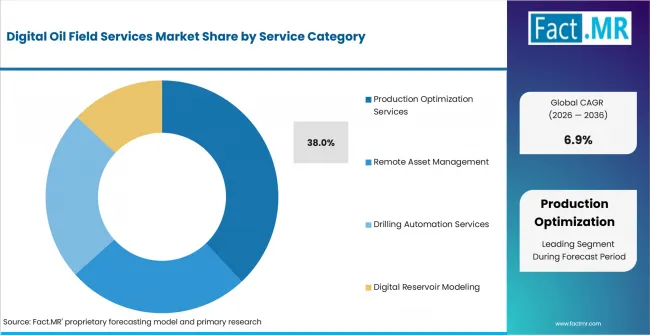
Digital Oil Field Services Market Analysis By Service Category | Source: Fact.MR
Production Optimization Services is expected to hold 38% share in 2026 because the service acts on producing assets that already have a measurable baseline and a recurring performance gap. Artificial Lift Optimization changes pump, gas-lift, or operating settings as well conditions move, while Reservoir Performance Monitoring helps engineers distinguish equipment limitations from reservoir decline or changing fluid behavior. Remote Asset Management is important when the primary need is visibility and maintenance, Drilling Automation Services concentrates on well-construction execution, and Digital Reservoir Modeling supports planning and scenario analysis. SLB describes production optimization workflows that combine surveillance, artificial lift, flow assurance, and digital operations, while Baker Hughes positions Leucipa around AI-driven field production management. The leading category therefore remains closest to the point where an analytical recommendation can be tested against actual production response.
Why do Onshore Oilfields lead Field Operation?
Onshore Oilfields holds 44% share in 2026.
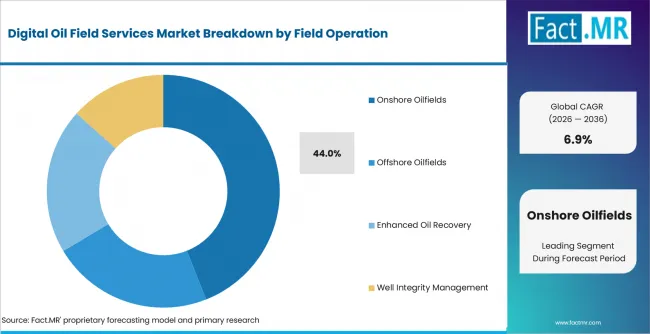
Digital Oil Field Services Market Analysis By Field Operation | Source: Fact.MR
Onshore Oilfields is projected to account for 44% share in 2026 because Conventional Wells and Mature Oilfields create a large population of assets where standardized connectivity, remote supervision, and repeatable optimization can be deployed across many locations. Offshore Oilfields justify more intensive digital work per asset, especially in Deepwater and Ultra-deepwater Fields, but their asset count is smaller and deployment must fit offshore control and communications constraints. Enhanced Oil Recovery and Well Integrity Management remain important operating categories when CO2 Injection, Chemical EOR, lifecycle surveillance, or integrity inspection becomes the principal task. In the USA, the Energy Information Administration reported that Lower 48 production outside the federal Gulf accounted for 11.3 million barrels per day, or 83% of national crude output, in 2025. That production scale illustrates why land-based operators have a strong economic reason to move from manual well checks toward exception-based digital field management.
Why does Upstream Oil & Gas lead End-use Sector?
Upstream Oil & Gas holds 47% share in 2026.
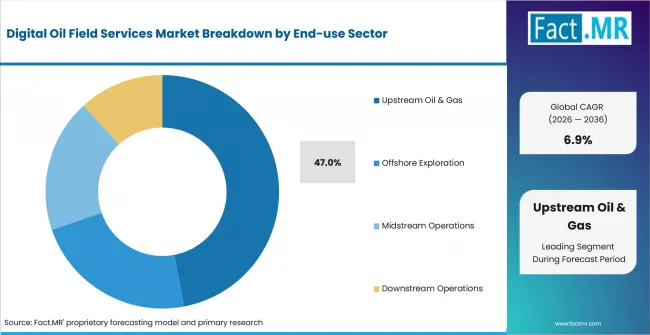
Digital Oil Field Services Market Analysis By End Use Sector | Source: Fact.MR
Upstream Oil & Gas is anticipated to capture 47% share in 2026 because Crude Oil Production and Natural Gas Production are the points at which reservoir interpretation, well control, artificial lift, metering, maintenance, and production allocation converge. A change in pressure, flow, lift performance, or equipment health can affect hydrocarbons produced before the signal reaches a broader enterprise planning system. Offshore Exploration extends the digital requirement into Deepwater Production and LNG Operations, while Midstream Operations and Downstream Operations use related technologies for pipelines, gas processing, refining, and distribution. The segmentation therefore places the largest share where digital services can connect subsurface and surface decisions to producing wells in a continuous operating loop rather than to a later transportation or conversion step.
Why do National Oil Companies lead Client Type?
National Oil Companies holds 42% share in 2026.
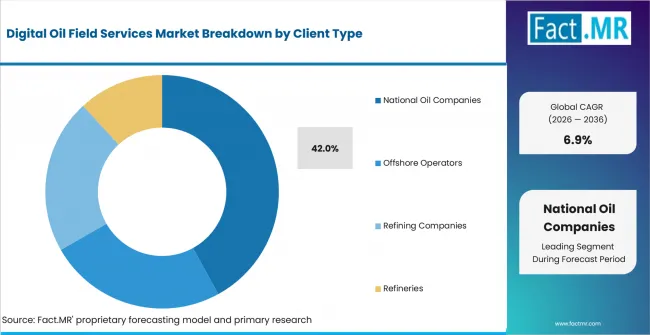
Digital Oil Field Services Market Analysis By Client Type | Source: Fact.MR
National Oil Companies is estimated to represent 42% share in 2026 because large national portfolios can justify common data foundations, centralized operating centers, reusable AI models, and multi-year service relationships across many fields. Integrated Energy Companies and Independent Exploration Companies operate inside the same competitive environment, while Offshore Operators, Oilfield Service Companies, Drilling Contractors, Refining Companies, Midstream Operators, Pipeline Operators, Refineries, Petrochemical Companies, and Distribution Operators make different technology choices around their assigned assets. Aramco reported USD 5.3 billion of Technology Realized Value from AI, digital, and other solutions in 2025, with USD 2.6 billion coming from AI-driven solutions. ADNOC states that its Neuron 5 initiative combines AI, advanced analytics, and secure 5G for predictive maintenance and had reached an initial 1,200 pieces of critical equipment by the end of 2024. These examples show why a national operator can turn a digital standard into a portfolio program rather than a single-field pilot.
Why does Industrial IoT Platform lead Digital Technology?
Industrial IoT Platform holds 39% share in 2026.
Industrial IoT Platform is forecast to account for 39% share in 2026 because Edge IoT Devices and Real-time Sensor Networks create the continuous data path required for remote operations. Cloud-based Analytics can centralize large multi-field workloads, Artificial Intelligence Analytics can detect patterns or recommend actions, and Big Data Analytics can support high-performance modeling and visualization, but each depends on trusted field data and reliable context. SLB describes Agora as an edge AI and IIoT environment that moves computing closer to oilfield data for faster decisions, while Weatherford positions ForeSite Edge around real-time data integration, asset monitoring, and autonomous control for artificial-lift and natural-flowing wells. The platform layer leads because it must keep working at the boundary between physical equipment and higher-level analytics, including periods when bandwidth or cloud access is constrained.
What is accelerating Digital Oil Field Services Market adoption, and what is holding it back?
Production optimization, remote field visibility, edge AI, and integrated operating data are accelerating adoption, while operational-technology cybersecurity, legacy integration, harsh-field connectivity, and model governance can slow deployment.
Drivers Impact Analysis
| DRIVER | (~) % IMPACT ON CAGR | GEOGRAPHIC RELEVANCE | IMPACT TIMELINE |
|---|---|---|---|
| Production optimization across mature and high-output fields | Not quantified | USA; Saudi Arabia; Canada; Norway | Medium term (2-4 years) |
| Remote monitoring of distributed field assets | Not quantified | USA; Canada; UAE; Australia | Medium term (2-4 years) |
| AI-assisted subsurface and production decision workflows | Not quantified | Saudi Arabia; UAE; Brazil; Norway | Medium term (2-4 years) |
| Drilling automation and real-time well control | Not quantified | USA; Saudi Arabia; Brazil | Long term (>= 4 years) |
| Integrated data foundations for multi-asset operators | Not quantified | Global national and integrated operators | Long term (>= 4 years) |
Source: Fact.MR analysis. Updated Aug 11, 2026
- Production optimization across mature and high-output fields: Digital services gain budget when operators can connect surveillance to an action on lift, choke, injection, maintenance, or operating setpoints. SLB’s production-optimization portfolio explicitly combines surveillance and artificial-lift workflows, while Baker Hughes has expanded Leucipa deployments around AI-assisted field production. The purchasing decision therefore depends on whether the service can improve a producing asset without creating another disconnected monitoring layer.
- Remote monitoring of distributed field assets: Weatherford’s ForeSite platform links well, reservoir, and surface-facility data, and Emerson offers cloud-native SCADA for real-time remote monitoring and control of upstream assets. These architectures reduce the dependence on routine field rounds, but operators still need local fail-safe control and a clear escalation path when a remote recommendation requires physical intervention.
- AI-assisted subsurface and production decision workflows: Halliburton’s 2025 PETRONAS deployment of DecisionSpace 365 and Unified Ensemble Modeling was designed to connect exploration and development workflows through live earth models and probabilistic scenarios. Aramco’s reported technology value and ADNOC’s Neuron 5 rollout show the same commercial direction from a different angle: AI is being evaluated against production, reliability, and decision-cycle outcomes rather than as a stand-alone analytics feature.
Opportunity Impact Analysis
| OPPORTUNITY | (~) % IMPACT ON CAGR | GEOGRAPHIC RELEVANCE | IMPACT TIMELINE |
|---|---|---|---|
| Edge AI and IIoT for low-latency field decisions | Not quantified | USA; Saudi Arabia; UAE; Canada | Short term (<= 2 years) |
| Artificial-lift and mature-well optimization services | Not quantified | USA; Canada; Saudi Arabia | Medium term (2-4 years) |
| Digital twins linking reservoirs, wells, and facilities | Not quantified | Brazil; Norway; UAE | Medium term (2-4 years) |
| Cloud and hybrid analytics for multi-asset remote operations | Not quantified | Norway; Australia; Brazil; UAE | Long term (>= 4 years) |
Source: Fact.MR analysis. Updated Aug 11, 2026
- Edge AI and IIoT: The commercial opening is strongest where a model must act close to the field rather than wait for a cloud round trip. In July 2026, SLB disclosed a memorandum of understanding with Qualcomm Technologies to combine low-power edge computing and AI processing with Agora edge AI and IIoT for wells, facilities, and production systems. Providers can convert this opportunity into service revenue when edge hardware, model deployment, device management, security, and remote support are delivered as one governed operating stack.
- Digital twins and hybrid operating models: Petrobras validated a lift-and-flow digital twin on offshore platforms and said the technology could be extended across its maritime wells after testing showed roughly 1% production uplift potential. Digital twins become commercially useful when real-time field data, physics or reservoir models, maintenance context, and operator workflows stay synchronized. The opportunity is therefore larger than visualization and depends on integration with the control and engineering systems that own the actual operating decision.
Restraints Impact Analysis
| RESTRAINT | (~) % IMPACT ON CAGR | GEOGRAPHIC RELEVANCE | IMPACT TIMELINE |
|---|---|---|---|
| Operational-technology cybersecurity and remote-access exposure | Not quantified | Global connected oilfield environments | Short term (<= 2 years) |
| Legacy instrumentation, historian, and data-model interoperability | Not quantified | Mature fields in North America; Europe; Middle East | Medium term (2-4 years) |
| Sensor and connectivity reliability in remote or harsh environments | Not quantified | Canada; Australia; offshore Brazil and Norway | Medium term (2-4 years) |
| Model governance, data quality, and workforce adoption | Not quantified | Global national and integrated operators | Long term (>= 4 years) |
Source: Fact.MR analysis. Updated Aug 11, 2026
- Operational-technology cybersecurity: Digital oilfield programs connect instruments, remote terminal units, SCADA, edge devices, applications, and remote users to production-critical environments. The ISA/IEC 62443 series treats industrial automation and control security as a lifecycle responsibility shared among asset owners, integrators, suppliers, and service providers, while CISA guidance highlights insecure remote access as an OT risk. Operators can delay otherwise useful remote projects when identity, segmentation, patching, recovery, and local safe-state behavior are not defined before connection.
- Legacy integration and data governance: Mature fields often contain equipment generations, historians, tag conventions, engineering models, and maintenance records accumulated over decades. Honeywell’s 2025 Aker BP deployment emphasizes an OEM-agnostic asset-performance layer across multiple automation systems, which illustrates the value but also the integration requirement. A digital model cannot produce a reliable operating recommendation when equipment identity, units, timestamps, or maintenance state are inconsistent, so data cleanup and interface testing can consume more project time than the analytics configuration itself.
Which countries are scaling Digital Oil Field Services Market fastest?
USA 7.8%, Saudi Arabia 7.5%, Canada 7.1%, Norway 6.8%, UAE 6.4%, Brazil 6.1%, and Australia 5.8% through 2036.
Regional analysis covers North America, Europe, Asia Pacific, Central & South America, and the Middle East & Africa, while the country growth discussion is limited to the seven profiled markets.
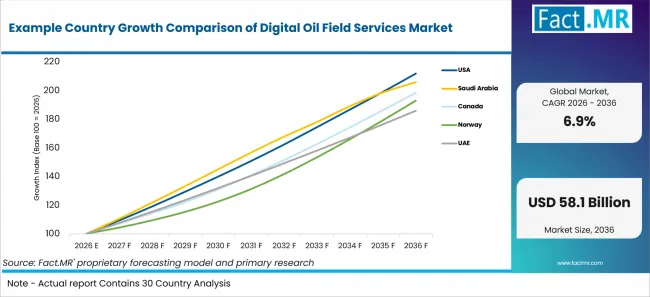
Example Country Growth Comparison Of Digital Oil Field Services Market | Source: Fact.MR
| COUNTRY | CAGR THROUGH 2036 |
|---|---|
| USA | 7.8% |
| Saudi Arabia | 7.5% |
| Canada | 7.1% |
| Norway | 6.8% |
| UAE | 6.4% |
| Brazil | 6.1% |
| Australia | 5.8% |
Source: Fact.MR analysis. Updated Aug 11, 2026
What is driving USA growth through 2036?
7.8% CAGR through 2036, supported by a large onshore production base, distributed well operations, and continuing pressure to raise output per field visit and per unit of operating cost.
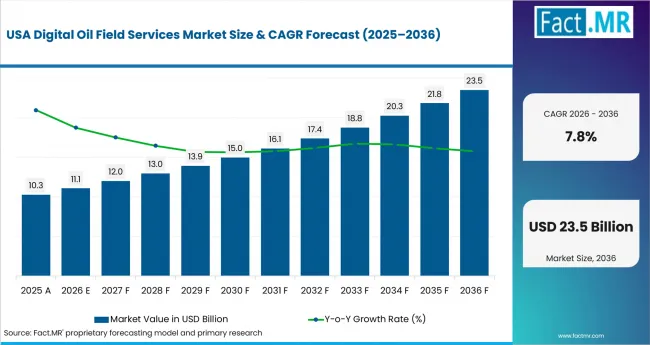
Digital Oil Field Services Market Country Value Analysis | Source: Fact.MR
The USA combines large unconventional, conventional, offshore, and mature-field operations, but its land production base is especially relevant to digital field services because a single operating team may supervise assets spread over wide areas. The U.S. Energy Information Administration reported that crude oil production reached a record 13.6 million barrels per day in 2025, with 11.3 million barrels per day coming from the Lower 48 outside the federal Gulf. That operating scale favors remote well surveillance, artificial-lift optimization, predictive maintenance, automated drilling, and edge analytics that prioritize which wells need physical attention. The market is projected to record 7.8% CAGR through 2036 as operators connect field telemetry with production economics and maintenance workflows while retaining local control at the wellsite.
How is Saudi Arabia scaling Digital Oil Field Services demand?
7.5% CAGR through 2036, supported by national-scale upstream operations, large digital programs, and the use of AI and modeling to improve field decisions.
Saudi Arabia has a concentrated route to digital deployment because Saudi Aramco can standardize technology across large producing and development programs rather than qualifying every workflow as an isolated pilot. In March 2026, Aramco reported USD 5.3 billion in Technology Realized Value from AI, digital, and other solutions during 2025, including USD 2.6 billion from AI-driven solutions. Its 2025 results material also highlights real-time geological model updates and reservoir simulation within the company’s technology program. Those capabilities fit Production Optimization Services, Digital Reservoir Modeling, Industrial IoT Platform, and Artificial Intelligence Analytics directly. Demand is forecast to advance at 7.5% CAGR through 2036 as digital services move closer to production and subsurface decisions that can be replicated across a national portfolio.
What supports Canada growth through 2036?
7.1% CAGR through 2036, driven by record oil production, geographically dispersed assets, and the value of remote monitoring across oil sands, conventional, and other producing operations.
Canada’s production system creates a practical need for digital services that reduce unnecessary travel and help operators concentrate maintenance on assets with the highest production or integrity risk. The Canada Energy Regulator reported that crude oil and equivalent production averaged a record 5.35 million barrels per day in 2025, up from 5.14 million barrels per day in 2024, and reached 5.64 million barrels per day in December. A high-output base increases the value of production surveillance, artificial-lift and flow optimization, predictive maintenance, remote equipment monitoring, and well-integrity data because small performance changes can accumulate across many assets. The market is expected to expand at 7.1% CAGR through 2036 as operators combine field connectivity with analytics that remain usable across remote locations and variable communications conditions.
What is driving Norway growth through 2036?
6.8% CAGR through 2036, supported by high offshore production, mature-field optimization, and continued reliance on surveillance and integrity as the Norwegian Continental Shelf ages.
Norway’s digital oilfield requirement is shaped less by a large population of simple land wells and more by expensive offshore assets where reliability, remote expertise, and production optimization have direct operating consequences. The Norwegian Offshore Directorate reported oil production of about 106 million standard cubic meters in 2025, the highest level since 2009, while emphasizing that continued investment and technology are needed as fields mature. Offshore teams therefore need reservoir and well models, condition monitoring, integrated operations, predictive maintenance, and production surveillance that can reduce unnecessary offshore work without weakening control discipline. Demand is anticipated to record 6.8% CAGR through 2036 as digital services help operators manage decline, tie-ins, integrity, and operating complexity across established North Sea and Norwegian Sea assets.
How is the UAE developing Digital Oil Field Services demand?
6.4% CAGR through 2036, shaped by AI-enabled asset performance, secure field connectivity, predictive maintenance, and the move toward more autonomous operations.
The UAE offers a clear multi-asset implementation path through ADNOC’s upstream and integrated operations. ADNOC’s Sustainability Report 2024 states that Neuron 5 combines AI, advanced analytics, and secure 5G connectivity to support predictive maintenance and more autonomous operations, and that the system had been deployed across an initial 1,200 pieces of critical equipment by the end of 2024. This kind of program requires Industrial IoT Platform, Cloud-based Analytics, Artificial Intelligence Analytics, and Remote Asset Management to work together with existing automation. The market is projected to grow at 6.4% CAGR through 2036 as UAE operators scale digital services from equipment health into wider production and operating workflows while maintaining cyber and process-safety controls.
What underpins Brazil growth through 2036?
6.1% CAGR through 2036, supported by pre-salt scale, offshore production concentration, and increasing use of digital twins and real-time production management.
Brazil’s demand is strongly offshore, which changes the value of remote services because a production or integrity issue can require expensive vessel, platform, or specialist intervention. ANP reported total Brazilian oil and gas production of 5.842 million barrels of oil equivalent per day in June 2026, with the pre-salt accounting for 82% of total production and maritime fields producing 98.1% of the country’s oil. Petrobras separately validated a lift-and-flow digital twin on the Cidade de Anchieta and P-57 platforms and stated that the technology could raise production by roughly 1% while supporting real-time production data and incident anticipation. The market is estimated to post 6.1% CAGR through 2036 as offshore operators link digital reservoir models, lift-and-flow optimization, remote monitoring, and asset integrity to large producing systems.
How is Australia scaling Digital Oil Field Services demand?
5.8% CAGR through 2036, supported by LNG operating scale, offshore asset-management requirements, and the need to manage wells and equipment across long-distance operating environments.
Australia’s digital oilfield market is tied to a smaller oil base than the USA or Canada but a substantial gas and LNG operating system where reliability, remote operations, and well integrity remain commercially important. The Australian Department of Industry, Science and Resources forecast LNG export earnings to rise from AUD 59 billion in 2025-26 to AUD 65 billion in 2026-27, highlighting the scale of the country’s gas export infrastructure. NOPSEMA also introduced annual well-integrity reporting requirements for applicable offshore titleholders from 2026, increasing the need for structured well and integrity records. Demand is forecast to grow at 5.8% CAGR through 2036 as operators combine remote monitoring, predictive maintenance, and digital records with field and offshore control systems that must remain reliable over long distances and harsh operating conditions.
Who leads the Digital Oil Field Services Market?
Schlumberger Limited is the only profiled provider with a quantified share, at 15.4% in 2026; the remaining companies address different parts of the subsurface, production, automation, asset-performance, industrial-IoT, and digital-transformation stack.
Schlumberger Limited’s profiled position is represented by SLB-branded digital production and edge technologies. SLB describes integrated production-optimization workflows across surveillance, artificial lift, flow assurance, and digital operations, while Agora brings edge AI and IIoT closer to wells and facilities. Halliburton Company competes through Landmark software and digital services: its 2025 PETRONAS Carigali deployment of DecisionSpace 365 Geosciences Suite and Unified Ensemble Modeling connects live earth models, scenario generation, and reservoir-flow information across exploration and development, and its July 2026 Basra Oil Company award includes a digital foundation connecting subsurface, well delivery, production operations, and business planning.
Baker Hughes Company positions Leucipa as an automated field-production solution using AI-driven workflows for operational efficiency and production management. Weatherford International plc links ForeSite production optimization with CygNet SCADA and ForeSite Edge for field connectivity, artificial-lift optimization, and asset-wide monitoring.
The industrial-automation providers compete where the digital field meets equipment and control. Honeywell International Inc. is deploying Forge Asset Performance Management across five Aker BP North Sea assets to support condition-based monitoring and predictive maintenance across multiple automation systems. Emerson Electric Co. offers cloud-native DeltaV SaaS SCADA, remote monitoring and control, RTU applications, measurement, and optimization for upstream assets. ABB Ltd. combines oil and gas automation, asset management, remote automation, condition monitoring, and System 800xA capabilities. Rockwell Automation, Inc. positions onshore digital-oilfield solutions around real-time data, remote monitoring, predictive maintenance, and connected production.
Siemens AG contributes industrial-edge, remote-monitoring, and digital-twin capabilities for oil and gas applications, while CGI Inc. focuses on data modernization, industrial AI, cybersecurity, digital twins, and managed services across upstream and the wider oil and gas value chain. Competition through 2036 is expected to turn on field-data quality, interoperability with installed control systems, domain models, cybersecurity, edge resilience, measurable production outcomes, and the provider’s ability to support a workflow after deployment rather than only deliver software licenses.
Which companies are the key providers?
Schlumberger Limited holds 15.4% share in 2026. Halliburton Company, Baker Hughes Company, Weatherford International plc, Siemens AG, Honeywell International Inc., Emerson Electric Co., ABB Ltd., Rockwell Automation, Inc., and CGI Inc. complete the profiled company set.
- Schlumberger Limited
- Halliburton Company
- Baker Hughes Company
- Weatherford International plc
- Siemens AG
- Honeywell International Inc.
- Emerson Electric Co.
- ABB Ltd.
- Rockwell Automation, Inc.
- CGI Inc.
Bibliography
- U.S. Energy Information Administration. (2026, March 31). U.S. crude oil production rose in 2025, setting new record.
- Saudi Aramco. (2026, March 10). Aramco announces fourth quarter and full-year 2025 results.
- Saudi Aramco. (2026, March 10). FY2025 Results presentation.
- Canada Energy Regulator. (2026, June 17). Canada sets new record in crude oil production in 2025.
- Norwegian Offshore Directorate. (2026, January 8). Best exploration year in several years.
- Norwegian Offshore Directorate. (2026). The Shelf in 2025: Production, operating fields and investments.
- ADNOC. (n.d.). Sustainability Report 2024.
- Agencia Nacional do Petroleo, Gas Natural e Biocombustiveis. (2026, August 3). ANP divulga dados consolidados da producao de petroleo e gas em junho de 2026.
- Petrobras News Agency. (2024, August 14). Petrobras will use a digital twin to optimize oil production and flow.
- Australian Department of Industry, Science and Resources. (2026, July 3). Resources and energy quarterly: June 2026.
- National Offshore Petroleum Safety and Environmental Management Authority. (2026, April 15). Offshore Petroleum and Greenhouse Gas Storage resource management: well integrity reporting information.
- SLB. (2025, February 12). Production Optimization: Boost Output, Cut OPEX.
- SLB. (2025, June 25). Edge AI platform for oilfield operations.
- SLB. (2026, July 24). SLB announces second-quarter 2026 results.
- Halliburton Company. (2025, June 19). Halliburton and PETRONAS Carigali to deploy next-generation geoscience and reservoir modeling solutions.
- Halliburton Company. (2026, July 21). Halliburton announces second quarter 2026 results.
- Baker Hughes Company. (2026, January 29). Baker Hughes and Expand Energy to deploy Leucipa across U.S. natural gas fields.
- Baker Hughes Company. (2025, June 10). Baker Hughes and Repsol launch new AI-powered functionality for Leucipa.
- Weatherford International plc. (n.d.). ForeSite Production Optimization Platform.
- Weatherford International plc. (n.d.). IoT-Enabled Automation: ForeSite Edge.
- Honeywell International Inc. (2025, April 29). Honeywell technology to drive process automation for Aker BP operations in the North Sea.
- Emerson Electric Co. (n.d.). Upstream Oil & Gas.
- ABB Ltd. (n.d.). Oil & Gas and Petrochemical services and solutions.
- Rockwell Automation, Inc. (n.d.). Onshore Oil and Gas Exploration and Production.
- Siemens AG. (n.d.). Oil and gas industry solutions.
- CGI Inc. (n.d.). Oil & Gas.
- International Society of Automation. (2025, January 28). Update to ISA/IEC 62443 standards addresses organizational cybersecurity requirements.
- Cybersecurity and Infrastructure Security Agency. (2025, August 13). Foundations for OT Cybersecurity: Asset Inventory Guidance for Owners and Operators.
This Report Addresses
- The report provides strategic intelligence on Digital Oil Field Services across Service Category and Field Operation choices that shape production optimization, remote monitoring, drilling automation, reservoir modeling, and well-integrity workflows.
- Segment analysis covers Production Optimization Services, Onshore Oilfields, Upstream Oil & Gas, National Oil Companies, and Industrial IoT Platform as the 2026 share leaders within their respective parent categories.
- Regional outlook compares the USA and Saudi Arabia with Canada, Norway, the UAE, Brazil, and Australia using the stated country growth rates through 2036 and country-specific operating conditions.
- Competitive analysis profiles Schlumberger Limited with its quantified 15.4% share alongside nine additional providers spanning oilfield services, automation, asset performance, industrial software, and digital transformation.
- Technology assessment covers Edge IoT Devices, Real-time Sensor Networks, Hybrid Cloud Platform, Remote Monitoring Platform, Machine Learning Models, Digital Twin Technology, High-performance Computing, and Advanced Visualization.
- Operational assessment covers conventional and mature onshore wells, deepwater and ultra-deepwater operations, enhanced recovery, well lifecycle management, crude and gas production, offshore exploration, pipelines, gas processing, refining, and distribution contexts represented in the segmentation.
What does the Digital Oil Field Services Market cover?
Digital services and software that turn oilfield data into monitored, modeled, optimized, or automated operating decisions across wells, reservoirs, equipment, and field infrastructure.
The Digital Oil Field Services Market covers production-optimization services, remote asset management, drilling automation, digital reservoir modeling, industrial IoT, cloud and hybrid analytics, AI, big-data analytics, digital twins, and closely associated implementation or support when these functions are purchased to improve field operations. Commercial value is counted where the service or software connects oil and gas operating data to surveillance, diagnosis, forecasting, optimization, control, maintenance, integrity, or remote-operation workflows.
The market is not the value of crude oil, natural gas, LNG, refined products, or field equipment itself. A sensor, RTU, control system, communications link, cloud service, or engineering package enters scope only to the extent that its commercial value is attributable to a qualifying digital-oilfield function. The boundary therefore separates digital field services from commodity production, generic enterprise IT, stand-alone telecommunications, and mechanical oilfield equipment sold without a digital service layer.
What is included in the scope?
Digital field services across the defined service, field-operation, end-use, client, and technology taxonomy, including recurring software and service components that support operating decisions.
The scope includes Production Optimization Services with Artificial Lift Optimization and Reservoir Performance Monitoring; Remote Asset Management with Remote Equipment Monitoring and Predictive Maintenance; Drilling Automation Services with Automated Drilling Control and Real-time Well Control; and Digital Reservoir Modeling with 3D Reservoir Simulation and AI-assisted Reservoir Modeling. Field Operation coverage includes Onshore Oilfields, Offshore Oilfields, Enhanced Oil Recovery, and Well Integrity Management together with their listed subsegments.
End-use coverage includes Upstream Oil & Gas, Offshore Exploration, Midstream Operations, and Downstream Operations where the purchased digital function aligns with the segmentation. Client Type covers National Oil Companies, Offshore Operators, Refining Companies, and Refineries with the listed client subgroups. Digital Technology includes Industrial IoT Platform, Cloud-based Analytics, Artificial Intelligence Analytics, and Big Data Analytics with edge devices, real-time sensors, hybrid cloud, remote monitoring, machine learning, digital twins, high-performance computing, and advanced visualization when those technologies form part of the qualifying digital-field solution.
What is excluded from the scope?
Hydrocarbon commodity value, stand-alone physical oilfield equipment, generic enterprise technology, and services whose principal purchased function is not digital field monitoring, modeling, optimization, automation, or integrity management are outside the scope.
The scope excludes the market value of crude oil, natural gas, LNG, refined products, and petrochemicals. Drilling rigs, pumps, valves, compressors, artificial-lift hardware, production trees, subsea equipment, pipelines, processing equipment, and other physical assets are excluded when sold without a separable digital-service or software component. General ERP, finance, HR, office productivity, data-center infrastructure, cloud capacity, telecommunications, and cybersecurity services are excluded unless the portion of value counted is specifically attributable to a digital oilfield workflow. Conventional engineering, maintenance, inspection, and consulting are also outside the boundary when they do not include a qualifying digital operating function.
How was the analysis built?
The analysis combines structured market modeling with official petroleum and energy statistics, regulator material, first-party provider documentation, and country-specific evidence on digital operating practices. Quantitative values are applied consistently across the forecast, segment, country, competitive, scope, and FAQ sections, while external sources explain operating mechanisms and provider roles rather than replacing the market figures.
- Primary Research: The primary-research framework is structured around oil and gas operators, national oil companies, production engineers, reservoir teams, drilling teams, field automation specialists, maintenance and integrity personnel, digital program leaders, oilfield-service providers, industrial software suppliers, and system integrators. It tests how buyers define the digital-oilfield boundary, which decisions justify service spending, what data and control interfaces are required, and what conditions determine scale-up after a pilot.
- Desk Research: Desk research reviews official production statistics and petroleum-agency material from the USA, Saudi Arabia, Canada, Norway, the UAE, Brazil, and Australia alongside regulator guidance, industrial cybersecurity standards, company filings, official product documentation, and provider announcements. Company sources are used only to establish the capabilities or actions of the named provider.
- Market-Sizing and Forecasting: The sizing framework uses the USD 29.8 billion 2026 market base, USD 57.9 billion 2036 forecast, 6.9% CAGR, leading segment shares, country growth rates, and company set together with production-optimization activity, remote-monitoring adoption, drilling automation, reservoir-modeling demand, client structure, and technology-platform deployment. Alternative subsegments are assessed qualitatively unless a share is specified for the leader.
- Data Validation and Update Cycle: Forecast values, segment shares, country CAGRs, company names, and the disclosed Schlumberger Limited share are reconciled across all quantitative sections before publication. Country CAGRs are treated strictly as growth rates rather than market size or share. Driver, opportunity, and restraint tables use “Not quantified” where no controlled numerical impact value is available, while external evidence is reviewed for changes in production conditions, digital deployments, regulations, and provider portfolios.
Segmentation
What is the report's scope and coverage?
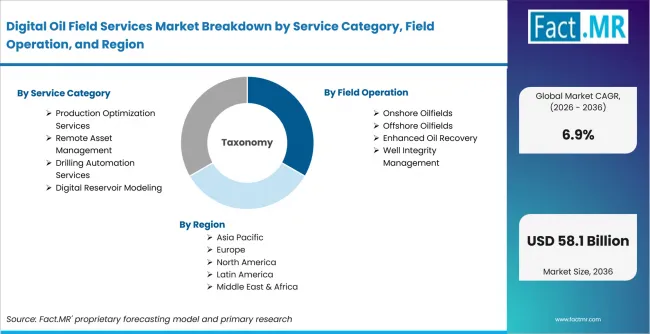
Digital Oil Field Services Market Breakdown By Service Category, Field Operation, And Region | Source: Fact.MR
| Attribute | Details |
|---|---|
| Quantitative Units | USD Billion in 2026 to 2036 |
| Market Definition | Digital services and software used to monitor, model, optimize, automate, or remotely manage oil and gas field operations. |
| Service Category | Production Optimization Services; Remote Asset Management; Drilling Automation Services; Digital Reservoir Modeling |
| Field Operation | Onshore Oilfields; Offshore Oilfields; Enhanced Oil Recovery; Well Integrity Management |
| End-use Sector | Upstream Oil & Gas; Offshore Exploration; Midstream Operations; Downstream Operations |
| Client Type | National Oil Companies; Offshore Operators; Refining Companies; Refineries |
| Digital Technology | Industrial IoT Platform; Cloud-based Analytics; Artificial Intelligence Analytics; Big Data Analytics |
| Regions Covered | North America; Europe; Asia Pacific; Central & South America; Middle East & Africa |
| Countries Covered | USA; Saudi Arabia; Canada; Norway; UAE; Brazil; Australia |
| Key Companies Profiled | Schlumberger Limited; Halliburton Company; Baker Hughes Company; Weatherford International plc; Siemens AG; Honeywell International Inc.; Emerson Electric Co.; ABB Ltd.; Rockwell Automation, Inc.; CGI Inc. |
| Forecast Period | 2026 to 2036 |
| Approach | Hybrid top-down and bottom-up approach using production optimization, remote monitoring, automation, reservoir modeling, client and technology adoption, provider participation, and country oil and gas activity. |
Source: Fact.MR analysis. Updated Aug 11, 2026
How is the market segmented?
-
By Service Category:
- Production Optimization Services
- Artificial Lift Optimization
- Reservoir Performance Monitoring
- Remote Asset Management
- Remote Equipment Monitoring
- Predictive Maintenance
- Drilling Automation Services
- Automated Drilling Control
- Real-time Well Control
- Digital Reservoir Modeling
- 3D Reservoir Simulation
- AI-assisted Reservoir Modeling
- Production Optimization Services
-
By Field Operation:
- Onshore Oilfields
- Conventional Wells
- Mature Oilfields
- Offshore Oilfields
- Deepwater Fields
- Ultra-deepwater Fields
- Enhanced Oil Recovery
- CO2 Injection
- Chemical EOR
- Well Integrity Management
- Well Lifecycle Management
- Asset Integrity Inspection
- Onshore Oilfields
-
By End-use Sector:
- Upstream Oil & Gas
- Crude Oil Production
- Natural Gas Production
- Offshore Exploration
- Deepwater Production
- LNG Operations
- Midstream Operations
- Pipeline Transportation
- Gas Processing
- Downstream Operations
- Refining & Petrochemicals
- Fuel Distribution
- Upstream Oil & Gas
-
By Client Type:
- National Oil Companies
- Integrated Energy Companies
- Independent Exploration Companies
- Offshore Operators
- Oilfield Service Companies
- Drilling Contractors
- Refining Companies
- Midstream Operators
- Pipeline Operators
- Refineries
- Petrochemical Companies
- Distribution Operators
- National Oil Companies
-
By Digital Technology:
- Industrial IoT Platform
- Edge IoT Devices
- Real-time Sensor Network
- Cloud-based Analytics
- Hybrid Cloud Platform
- Remote Monitoring Platform
- Artificial Intelligence Analytics
- Machine Learning Models
- Digital Twin Technology
- Big Data Analytics
- High-performance Computing
- Advanced Visualization
- Industrial IoT Platform
-
By Region:
- North America
- Latin America
- Western Europe
- Eastern Europe
- East Asia
- South Asia and Pacific
- Middle East & Africa
Frequently Asked Questions
Which Service Category leads the Digital Oil Field Services Market?
Which Field Operation leads the Digital Oil Field Services Market?
Which End-use Sector leads the Digital Oil Field Services Market?
Which Client Type leads the Digital Oil Field Services Market?
Which Digital Technology leads the Digital Oil Field Services Market?
Which country records the highest CAGR in the Digital Oil Field Services Market?
How does Saudi Arabia perform in the Digital Oil Field Services Market?
How does Canada perform in the Digital Oil Field Services Market?
How does Norway perform in the Digital Oil Field Services Market?
How does the UAE perform in the Digital Oil Field Services Market?
How does Brazil perform in the Digital Oil Field Services Market?
How does Australia perform in the Digital Oil Field Services Market?
What is the primary driver in the Digital Oil Field Services Market?
What is the main restraint in the Digital Oil Field Services Market?
Why are Production Optimization Services important?
Why do Industrial IoT Platforms matter?
Who worked on this report


Preview the report firsthand - request a free sample
Free SampleGet the brochure for pricing and purchase details
Download PDF