- Market Value (2025): USD 920.9 Mn
- Estimated Value (2026): USD 1050 Mn
- Forecast Value (2036): USD 3900.0 Mn
- CAGR (2026-2036): 14%
What is the Thermal Runaway Barriers Market forecast to be worth by 2036?
The market is projected to increase from USD 1,050.0 million in 2026 to USD 3,900.0 million by 2036, expanding at a 14% CAGR.
- The Thermal Runaway Barriers Market reached USD 920.9 million in 2025 as battery manufacturers accelerated safety validation for next-generation battery packs.
- Market value is expected to grow by USD 1,050 million between 2026 and 2036 as thermal barrier materials become standard across electric vehicle battery platforms.
- The market is projected 14% CAGR through 2036, supported by increasing battery safety requirements and wider adoption of advanced battery pack architectures.
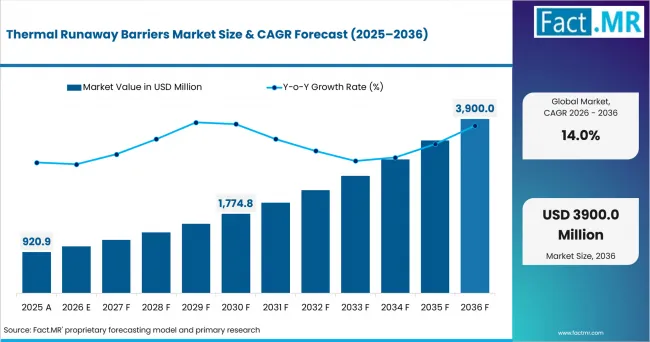
Thermal Runaway Barriers Market Market Value Analysis | Source: Fact.MR
What are the defining numbers behind Thermal Runaway Barriers Market growth?
The market is expected to create an absolute opportunity of USD 1,050 million by 2036 led by Mica and sheets.
- Demand Drivers in the Market
- Battery manufacturers require reliable thermal barrier materials that help limit cell-to-cell heat propagation during abnormal operating conditions.
- Pack designers are looking for lightweight barrier solutions that improve battery safety without adding unnecessary weight or reducing available energy density.
- Automotive companies continue to strengthen thermal validation programs as battery packs become larger and more energy dense.
- Energy storage system developers rely on advanced thermal protection materials to improve long-term operational safety across large battery installations.
- Battery manufacturers continue to place greater emphasis on thermal protection as battery capacity and energy density increase. This trend is creating sustained demand for advanced barrier materials that improve battery safety while supporting changing battery pack designs.
- Strategic Implications
- Material suppliers need application-specific thermal performance data to support qualification programs and demonstrate product reliability under actual battery operating conditions.
- Battery manufacturers benefit from comparing thermal propagation performance before introducing new barrier materials into commercial battery platforms, helping reduce validation risks during scale-up.
- Product developers are placing greater emphasis on lightweight barrier materials that provide reliable thermal protection without affecting battery pack design or energy density.
- Companies expanding in China will benefit from aligning product development with local battery manufacturing requirements, where the market is projected to grow at an 18.9% CAGR through 2036.
China is expected to record an 18.9% CAGR through 2036 driven by rapid battery manufacturing expansion. India is projected to grow at 17.5% CAGR supported by domestic EV production. Germany is anticipated to advance at 16.1% CAGR owing to automotive battery innovation. Brazil is estimated to register 14.7% CAGR as battery manufacturing gradually expands. The United States is forecast to post 13.3% CAGR backed by continued investment in battery production and energy storage technologies.
How does the Thermal Runaway Barriers Market break down by segment?
Mica remains the leading material segment with a 28% share in 2026, while Sheet accounts for the largest share among form types at 34%.
Which Material dominates?
Mica holds 28% share in 2026.
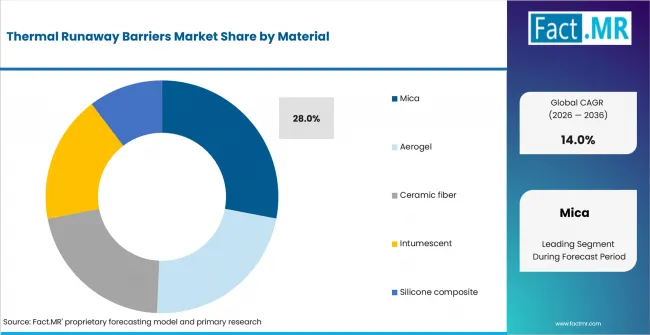
Thermal Runaway Barriers Market Analysis By Material | Source: Fact.MR
Mica continues to lead the market because it provides dependable thermal insulation while fitting well into established battery manufacturing processes. Alternative materials such as Aerogel and Intumescent solutions continue to gain attention where lower weight or different thermal performance is required. In October 2024, Aspen Aerogels secured a conditional U.S. Department of Energy loan commitment of up to USD 670.6 million to expand PyroThin® thermal barrier manufacturing for electric vehicle battery applications.
What leads the Form segment?
Sheet accounts for 34% share in 2026.
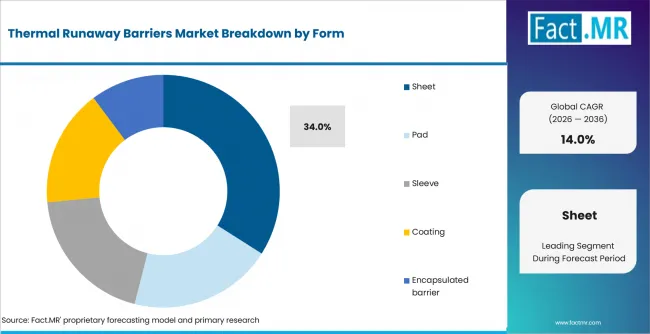
Thermal Runaway Barriers Market Analysis By Form | Source: Fact.MR
Sheet barriers remain the preferred format as they are easy to integrate into battery packs without introducing significant changes to existing production methods. Pad and Coating formats continue to serve specialized applications where different installation methods or protection levels are required. In June 2024, Aspen Aerogels won a new PyroThin® thermal barrier design award for a next-generation European luxury sports car platform, expanding its presence in EV battery safety applications.
How does Battery Format shape demand?
Pouch leads with 33% share in 2026.
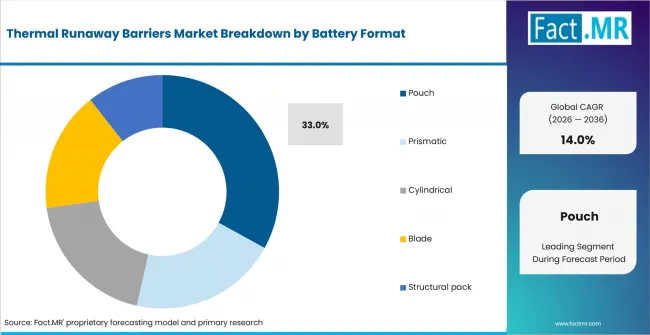
Thermal Runaway Barriers Market Analysis By Battery Format | Source: Fact.MR
Pouch batteries continue to generate the highest demand for thermal runaway barriers because their compact structure requires effective thermal protection between adjacent cells. Prismatic and Blade batteries remain important applications, although barrier selection varies according to pack architecture and cooling design.
Where is Application demand strongest?
EV holds 71% share in 2026.
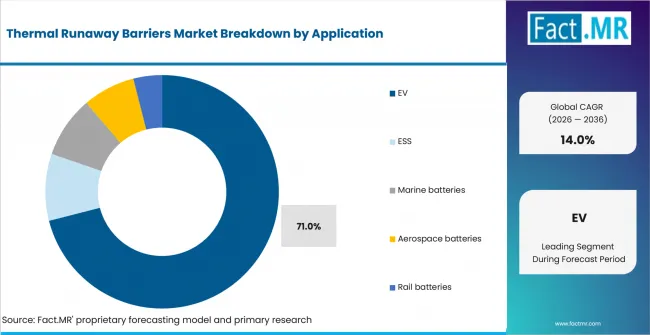
Thermal Runaway Barriers Market Analysis By Application | Source: Fact.MR
Electric vehicles account for the largest share of demand as battery safety remains a critical requirement across passenger and commercial vehicle platforms. Energy storage systems, marine batteries, and aerospace applications continue to create additional opportunities where reliable thermal management is equally important. Application requirements differ across these sectors, resulting in a broader range of material specifications. Vehicle manufacturers continue to strengthen battery validation programs as pack capacities increase.
What supports Performance adoption?
Temperature Resistance accounts for 32% share in 2026.
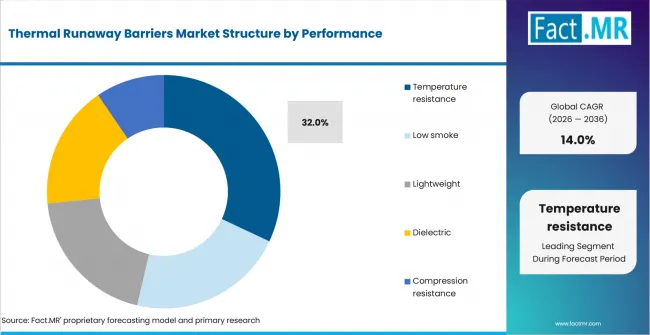
Thermal Runaway Barriers Market Analysis By Performance | Source: Fact.MR
Temperature resistance remains the leading performance requirement because delaying thermal propagation continues to be a primary objective in battery safety design. Other performance characteristics such as Low Smoke, Lightweight construction, and Dielectric properties remain important depending on battery configuration and application requirements.
What is accelerating Thermal Runaway Barriers Market adoption and what is holding it back?
Growing investment in battery safety is expected to accelerate adoption, while lengthy qualification programs and validation costs continue to slow commercial deployment.
Drivers Impact Analysis
| DRIVER | (~) % IMPACT ON CAGR | GEOGRAPHIC RELEVANCE | IMPACT TIMELINE |
|---|---|---|---|
| Cycling stress control in Mica | +0.8% | China and export suppliers | Medium term (2-4 years) |
| Thermal spread testing | +0.6% | Europe and North America | Short term (<= 2 years) |
| EV battery packs approval programs | +0.5% | Asia Pacific | Medium term (2-4 years) |
| Local support near cell engineers | +0.4% | Global | Long term (>= 4 years) |
Source: Fact.MR analysis. Updated Jul 14, 2026
- Cycling stress control in Mica: Battery manufacturers continue to evaluate mica barriers under repeated charge and discharge conditions before approving them for commercial battery packs. Reliable performance during cycling helps strengthen confidence in long-term battery safety.
- Thermal spread testing: More demanding thermal validation programs are increasing the need for materials that can consistently slow heat propagation between battery cells. Test results generated under realistic operating conditions play an important role during qualification.
- EV battery pack approval programs: Growing electric vehicle production is expanding qualification activity across battery platforms. Barrier materials that integrate easily into existing pack designs are more likely to achieve commercial adoption.
- Local support near cell engineers: Close technical collaboration helps suppliers respond more quickly to application challenges during product evaluation. Local engineering support also shortens development cycles and improves customer engagement.
Opportunity Impact Analysis
| OPPORTUNITY | (~) % IMPACT ON CAGR | GEOGRAPHIC RELEVANCE | IMPACT TIMELINE |
|---|---|---|---|
| Grades tuned for EV battery packs | +0.5% | Global | Medium term (2-4 years) |
| Application labs for Sheet | +0.4% | Asia Pacific and Europe | Short term (<= 2 years) |
| Rule-ready documentation | +0.4% | Europe and United Kingdom | Medium term (2-4 years) |
| Local trials with electrode developers | +0.3% | India and Brazil | Long term (>= 4 years) |
Source: Fact.MR analysis. Updated Jul 14, 2026
- Grades tuned for EV battery packs: Battery manufacturers continue to seek barrier materials designed specifically for electric vehicle platforms. Products that meet thermal safety requirements without affecting battery pack design are expected to create new commercial opportunities.
- Application laboratories for Sheet: Local testing facilities allow manufacturers to evaluate sheet materials under production conditions before commercial deployment. Early validation helps reduce development time and supports faster customer approval.
- Qualification-ready documentation: Complete technical documentation makes product evaluation more efficient and helps manufacturers meet increasingly detailed qualification requirements.
- Local trials with electrode developers: Joint development programs allow suppliers to demonstrate product performance during battery design. These partnerships also help establish long-term commercial relationships before full-scale production begins.
Restraints Impact Analysis
| RESTRAINT | (~) % IMPACT ON CAGR | GEOGRAPHIC RELEVANCE | IMPACT TIMELINE |
|---|---|---|---|
| Electrochemical compatibility requirements | -0.5% | Global | Medium term |
| Qualification cost | -0.4% | Global processors | Medium term (2-4 years) |
| Fit limits in Sheet | -0.3% | Global | Short term (<= 2 years) |
| Documentation burden | -0.3% | Europe and North America | Medium term (2-4 years) |
| Scale-up risk | -0.2% | High-volume plants | Long term (>= 4 years) |
Source: Fact.MR analysis. Updated Jul 14, 2026
- Electrochemical compatibility requirements: Thermal barrier materials must remain stable alongside battery components throughout the product life cycle. Extensive testing is often required before commercial approval can be granted.
- Qualification cost: Introducing new materials into battery production involves extensive validation and performance testing. These additional requirements can slow adoption and increase development costs.
- Fit limits in Sheet: Battery pack designs differ across manufacturers and applications. A sheet material that performs well in one platform may require modification before it can be adopted elsewhere.
- Documentation burden: Customer approval increasingly depends on detailed technical records and traceable performance data. Preparing this documentation can extend product qualification timelines.
- Scale-up risk: Performance achieved during laboratory evaluation must remain consistent when production volumes increase. Maintaining the same level of quality during large-scale manufacturing continues to be a challenge for suppliers.
Which countries are scaling the Thermal Runaway Barriers Market fastest?
China (18.9%), India (17.5%), Germany (16.1%), Brazil (14.7%), and the United States (13.3%) represent the fastest-growing country markets through 2036.
Growth trends reflect expanding battery manufacturing, rising investments in electric mobility, and stronger focus on battery safety across major production hubs. The assessment covers North America, Europe, Asia Pacific, Latin America, and the Middle East & Africa.
.webp "Top Country Growth Comparison Thermal Runaway Barriers Market Cagr (2026 2036)")
Top Country Growth Comparison Thermal Runaway Barriers Market Cagr (2026 2036) | Source: Fact.MR
| Country | CAGR |
|---|---|
| China | 18.9% |
| India | 17.5% |
| Germany | 16.1% |
| Brazil | 14.7% |
| United States | 13.3% |
Source: Fact.MR analysis. Updated Jul 14, 2026
What is driving China's growth through 2036?
18.9% CAGR driven by large-scale battery manufacturing and expanding battery safety requirements.
China continues to strengthen its position as the world's largest battery manufacturing base, supported by large investments in electric vehicle production and battery cell capacity. As production volumes increase, manufacturers are placing greater emphasis on materials that improve thermal protection without affecting battery pack design. Local suppliers also benefit from close collaboration with battery producers, allowing faster product validation and technical support. The rapid adoption of advanced battery architectures is expected to create additional demand for high-performance thermal runaway barriers.
How is India scaling demand?
17.5% CAGR supported by domestic battery manufacturing and expanding electric mobility programs.
Battery manufacturing in India is moving into a new phase as domestic cell production capacity continues to expand. New battery plants are creating demand for materials that improve thermal safety while supporting localized battery assembly. Manufacturers are increasingly looking for products that balance performance with cost, particularly for high-volume electric vehicle production. Growing technical capabilities within the country are also helping suppliers work more closely with customers during qualification and application development.
What supports the Germany outlook?
16.1% CAGR driven by automotive battery innovation and advanced engineering capabilities.
Germany combines a strong automotive industry with well-established chemical manufacturing expertise, making it an important market for advanced battery materials. Battery developers continue to evaluate thermal protection solutions that meet demanding safety and performance requirements. Product qualification often includes detailed environmental and durability testing before commercial approval. Suppliers capable of providing consistent technical performance and comprehensive validation data are expected to strengthen their competitive position.
How is Brazil developing demand?
14.7% CAGR supported by battery manufacturing investment and industrial electrification.
Brazil's growing interest in electric mobility and stationary energy storage is gradually strengthening demand for battery safety materials. While much of the specialty material supply currently depends on imports, local battery assembly continues to create new business opportunities for thermal protection products. Manufacturers are focusing on practical solutions that simplify battery integration while meeting evolving safety expectations. Regional technical support is also becoming increasingly valuable as battery production expands.
What underpins the United States outlook?
13.3% CAGR reinforced by domestic battery production and advanced battery development programs.
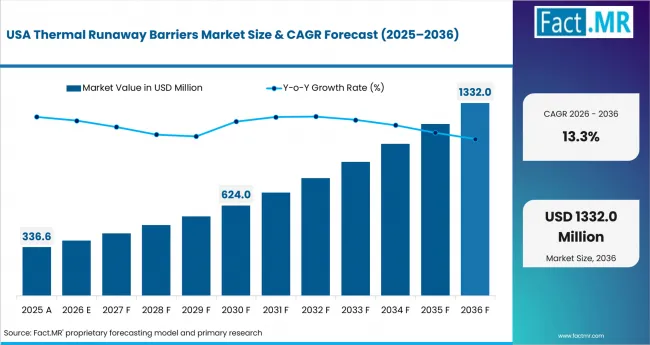
Thermal Runaway Barriers Market Country Value Analysis | Source: Fact.MR
The United States continues to invest heavily in battery manufacturing as companies expand domestic cell production and energy storage capacity. Thermal safety remains a key consideration as manufacturers introduce larger battery packs and next-generation battery technologies. Material suppliers are working closely with battery developers to support qualification programs and improve integration into commercial battery platforms.
Who leads the Thermal Runaway Barriers Market?
3M and Saint-Gobain lead through established thermal insulation technologies and broad battery safety portfolios. Rogers Corporation and Aspen Aerogels strengthen competition through high-performance thermal protection materials designed for advanced battery systems.
3M supplies thermal insulation materials used across electric vehicle and energy storage battery packs. Its portfolio focuses on thermal management, electrical insulation, and battery safety. Saint-Gobain provides high-temperature insulation materials that help slow thermal propagation between battery cells. The company continues to expand solutions for next-generation battery platforms.
Rogers Corporation develops engineered materials that combine thermal insulation with lightweight battery pack integration. Aspen Aerogels offers aerogel-based thermal barriers designed to improve thermal runaway protection while reducing overall pack weight. Morgan Advanced Materials provides ceramic-based insulation products for demanding battery applications.
Von Roll supplies electrical insulation and thermal protection materials that support battery safety across commercial battery systems. Competitive positioning through 2036 will depend on thermal performance, material integration, and the ability to support customer qualification with strong technical expertise.
Which companies are the key providers?
3M and Saint-Gobain continue to hold strong positions in the market through established battery insulation technologies. The remaining companies expand the competitive landscape with specialized thermal protection materials and application support.
- 3M
- Saint-Gobain
- Rogers Corporation
- Aspen Aerogels
- Morgan Advanced Materials
- Von Roll
Bibliography
- Aspen Aerogels, Inc. (2024, April 30). Aspen Aerogels wins Automotive News PACE and Innovation Partnership Awards.
- Aspen Aerogels, Inc. (2024, October 16). Aspen Aerogels, Inc. receives conditional commitment for proposed DOE loan and provides Q3 2024 preliminary financial results.
This Report Addresses
- The report provides strategic intelligence across Material, Form, Battery Format, Application, and Performance segments.
- Segment analysis identifies Mica and Sheet as the leading categories based on commercial battery safety requirements.
- Regional assessment compares China, India, Germany, Brazil, and the United States to highlight major growth opportunities.
- Competitive analysis profiles leading thermal barrier suppliers and evaluates their product positioning across battery applications.
- Market assessment examines thermal propagation control, battery qualification requirements, and material adoption across evolving battery pack designs.
What does the Thermal Runaway Barriers Market cover?
Thermal protection materials used to slow or prevent heat propagation inside battery packs.
The Thermal Runaway Barriers Market includes materials designed to reduce the spread of heat from one battery cell to another during thermal runaway events. These products improve battery safety by delaying thermal propagation and providing additional time for protection systems to respond. Their use continues to expand across electric vehicles, stationary energy storage, and other battery-powered applications where safety remains a primary design consideration.
Unlike general insulation materials, thermal runaway barriers are developed specifically for battery systems and must satisfy demanding thermal, electrical, and mechanical performance requirements. Products that do not provide a direct thermal protection function within battery packs fall outside the market scope.
What is included in the scope?
Barrier materials integrated into commercial battery safety systems.
The report includes mica, aerogel, ceramic fiber, intumescent materials, and other thermal protection solutions used across battery pack assemblies. Sheet, pad, coating, sleeve, and related product formats are covered where they provide protection against thermal propagation.
The assessment includes applications across electric vehicles, energy storage systems, marine batteries, aerospace, and industrial battery platforms. Revenue generated from qualified thermal barrier materials and application support related to battery integration is reflected within the market analysis.
What is excluded from the scope?
Products without a direct thermal protection function are outside the market boundary.
The report excludes conventional electrical insulation products that do not provide thermal runaway protection. Battery cells, cooling systems, structural pack components, adhesives without thermal barrier functionality, and battery management systems are also outside the scope.
Manufacturing equipment, testing instruments, and general industrial insulation materials are not included unless they are specifically developed for thermal runaway protection within battery packs.
How was the analysis built?
More than 120 industry sources and 40+ product portfolios were evaluated alongside interviews with battery manufacturers and material suppliers.
- Primary Research:
- Primary research included discussions with battery manufacturers, material suppliers, battery pack engineers, and thermal management specialists. These interviews focused on qualification requirements, battery safety validation, and future material adoption across different battery platforms.
- Industry feedback also helped assess product performance under commercial operating conditions and identify the factors influencing supplier selection.
- Desk Research:
- Desk research reviewed official company announcements, technical documentation, product literature, regulatory publications, and battery safety standards. Public information from battery manufacturers and material suppliers was used to evaluate product development activities and commercial expansion.
- Published technical papers supported background understanding, while company announcements provided the basis for recent market developments.
- Market Sizing and Forecasting:
- Market estimates combine battery production volumes with the adoption of thermal runaway barriers across different battery pack configurations. Segment allocation reflects material usage, battery format, and application trends.
- Country forecasts consider battery manufacturing investment, electric vehicle production, energy storage deployment, and supplier expansion across major regional markets.
- Data Validation and Update Cycle:
- Market estimates were validated through industry interviews and compared with commercial battery production activity. Forecasts were cross-checked against company developments, manufacturing expansion plans, and battery safety trends.
- Regular updates reflect new product launches, capacity additions, regulatory developments, and changing customer qualification requirements.
Segmentation
What is the report’s scope and coverage?
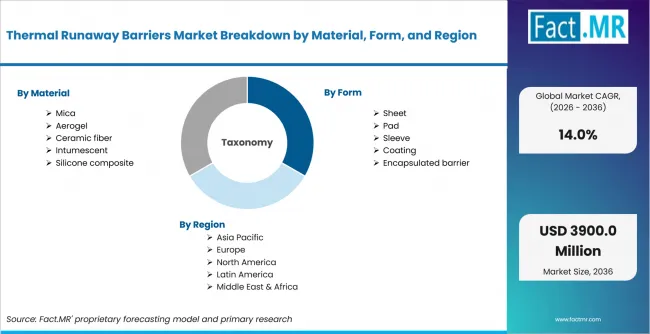
Thermal Runaway Barriers Market Breakdown By Material, Form, And Region | Source: Fact.MR
| Attribute | Details |
|---|---|
| Quantitative Units | USD Million in 2026 to USD Million by 2036 at CAGR |
| Market Definition | Thermal barrier materials designed to delay or prevent cell-to-cell thermal runaway propagation in battery packs |
| Material | Mica, Aerogel, Ceramic Fiber, Intumescent Materials, Others |
| Form | Sheet, Pad, Coating, Sleeve, Others |
| Battery Format | Pouch, Prismatic, Cylindrical, Blade Battery, Others |
| Application | EV Battery Packs, Energy Storage Systems, Marine Batteries, Aerospace Batteries, Industrial Batteries |
| Performance | Temperature Resistance, Flame Resistance, Electrical Insulation, Lightweight Construction, Low Smoke Generation |
| Regions Covered | North America, Europe, Asia Pacific, Latin America, Middle East and Africa |
| Countries Covered | China, India, Germany, Brazil, United States |
| Key Companies Profiled | 3M, Saint-Gobain, Rogers Corporation, Aspen Aerogels, Morgan Advanced Materials, Von Rol |
| Forecast Period | 2026 to 2036 |
| Approach | Hybrid assessment using battery production, barrier material adoption, battery pack qualification, and thermal safety validation |
Source: Fact.MR analysis. Updated Jul 14, 2026
How is the market segmented?
-
By Material:
- Mica
- Aerogel
- Ceramic Fiber
- Intumescent Materials
- Others
-
By Form:
- Sheet
- Pad
- Coating
- Sleeve
- Others
-
By Battery Format:
- Pouch
- Prismatic
- Cylindrical
- Blade Battery
- Others
-
By Application:
- EV Battery Packs
- Energy Storage Systems
- Marine Batteries
- Aerospace Batteries
- Industrial Batteries
-
By Performance:
- Temperature Resistance
- Flame Resistance
- Electrical Insulation
- Lightweight Construction
- Low Smoke Generation
-
By Region:
- North America
- United States
- Canada
- Europe
- Germany
- United Kingdom
- France
- Italy
- Spain
- Asia Pacific
- China
- India
- Japan
- South Korea
- Australia
- Latin America
- Brazil
- Mexico
- Argentina
- Chile
- Middle East and Africa
- UAE
- Saudi Arabia
- South Africa
- North America
Frequently Asked Questions
Which Material leads the Thermal Runaway Barriers Market?
Which Form leads the Thermal Runaway Barriers Market?
Which Battery Format leads the Thermal Runaway Barriers Market?
Which Application leads the Thermal Runaway Barriers Market?
Which Performance category leads the Thermal Runaway Barriers Market?
Which country records the highest CAGR in the Thermal Runaway Barriers Market?
How does India perform in the Thermal Runaway Barriers Market?
How does Germany perform in the Thermal Runaway Barriers Market?
What is the primary driver in the Thermal Runaway Barriers Market?
Who worked on this report


Preview the report firsthand - request a free sample
Free SampleGet the brochure for pricing and purchase details
Download PDF