- Market Value (2025): USD 376.0 Mn
- Estimated Value (2026): USD 470.0 Mn
- Forecast Value (2036): USD 4377.0 Mn
- CAGR (2026-2036): 25.0%
What is the Thermal Graphene Coatings Market forecast to be worth by 2036?
USD 470.0 million in 2026 to USD 4377.0 million by 2036 at 25.0% CAGR.
- The Thermal Graphene Coatings Market reached USD 376.0 million in 2025.
- Demand is projected to increase from USD 470.0 million in 2026 to USD 4377.0 million by 2036.
- The market is forecast to record 25.0% CAGR from 2026 to 2036 as automotive, electronics and energy-system coating programs specify lighter thermal layers.
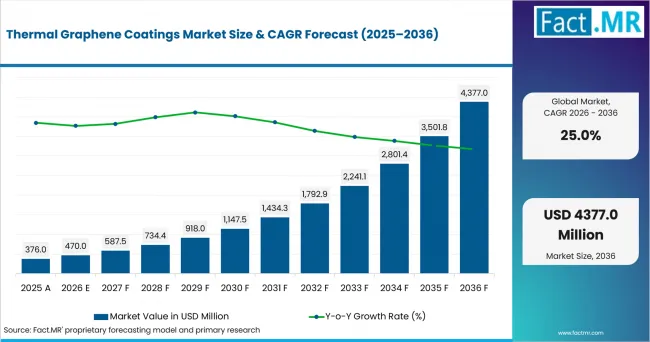
Thermal Graphene Coatings Market Value Analysis | Source: Fact.MR
What are the defining numbers behind Thermal Graphene Coatings Market growth?
An absolute opportunity of USD 3907.0 million is expected between 2026 and 2036.
- Demand Drivers in the Market
- EV component engineers need thin heat-spreading coatings because battery enclosures and power electronics face tighter thermal limits as electrified vehicle sales scale.
- Electronics manufacturers need conductive coating layers that manage localized heat while preserving compact device layouts and surface finish requirements.
- Data center operators need improved heat-transfer surfaces since the International Energy Agency projected in April 2025 that global data center electricity use would reach about 945 TWh by 2030.
- Industrial coating formulators need stable graphene dispersions so production teams avoid sedimentation, viscosity drift and uneven thermal performance during coating application.
- Key Segments Analyzed
- By Graphene Form: Nanoplatelets are expected to hold 46.0%share in 2026 due to platelet geometry that supports thermal pathways at practical loading levels.
- By Carrier Matrix: Thermoplastics are projected to account for 39.0%share in 2026 because melt-processable systems fit automotive parts and electronics housings.
- By Function: Conductivity is anticipated to capture 37.0%share in 2026 owing to heat spreading and electrical-control needs in compact assemblies.
- By Application: Automotive is estimated to represent 28.0%share in 2026, shaped by EV packs, inverters and lightweight thermal surfaces.
- Analyst Opinion at Fact.MR
- Shambhu Nath Jha, Principal Consultant at Fact.MR, states, "Thermal graphene coatings are no longer judged only by headline conductivity. Procurement teams are asking whether dispersion quality, coating adhesion and thermal cycling data hold across production batches. Suppliers are expected to combine graphene functionalization, polymer know-how and application testing so customers have fewer qualification gaps."
- Strategic Implications
- Graphene suppliers should publish dispersion, platelet-size and thermal-cycling data in formats that coating formulators already use during qualification.
- Coating producers should align graphene loading with existing spray, dip and film-coating equipment to reduce process changes for customers.
- Automotive material teams should test coatings against vibration, humidity and dielectric requirements before shifting from thermal pads or filled polymers.
- Electronics brands should compare heat-spreading gains against coating thickness, surface finish and reliability data for each device family.
The USA is expected to record 29.7% CAGR through 2036, supported by EV thermal loads and data center cooling pressure. Germany is projected to post 27.6% CAGR because automotive production and industrial coating capacity remain central to European material qualification. Japan is anticipated to advance at 26.4% CAGR due to battery strategy targets and electronics demand. South Korea is estimated to hold 23.1% CAGR, led by vehicle exports and ICT supply chains. The UK is forecast to reach 18.1% CAGR as battery innovation funding and zero-emission vehicle registrations support application testing.
How does the Thermal Graphene Coatings Market break down by segment?
Nanoplatelets lead at 46.0% share; thermoplastics lead at 39.0% share.
Which Graphene Form dominates?
Nanoplatelets hold 46.0% share in 2026.
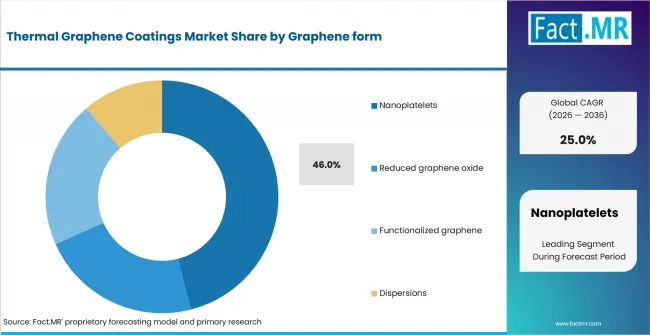
Thermal Graphene Coatings Market Analysis By Graphene Form | Source: Fact.MR
Nanoplatelets are expected to lead graphene form demand due to their broad availability and practical processing window. Platelet shape helps coating formulators build thermal pathways across thin layers without pushing filler content too high. Reduced graphene oxide remains useful where chemical functionality improves compatibility. Functionalized graphene is used where adhesion and dispersion stability define the coating result.
What leads the Carrier Matrix segment?
Thermoplastics account for 39.0% share in 2026.
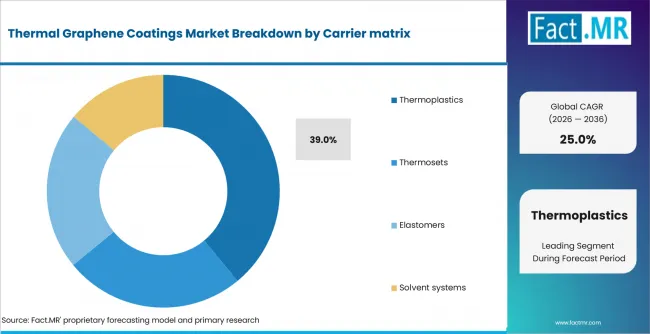
Thermal Graphene Coatings Market Analysis By Carrier Matrix | Source: Fact.MR
Thermoplastics are projected to account for 39.0% share because coated parts and films need repeatable processing. Automotive interiors, battery enclosures and electronics housings often depend on polymer systems that fit existing conversion steps. Thermosets remain useful where chemical resistance and dimensional stability are required. Elastomers support flexible thermal interfaces when vibration or movement is present.
How does Function shape demand?
Conductivity leads with 37.0% share in 2026.
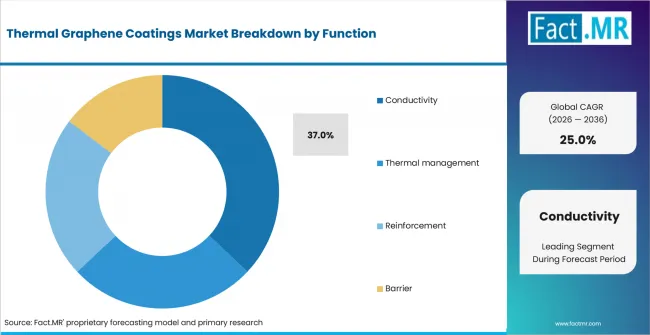
Thermal Graphene Coatings Market Analysis By Function | Source: Fact.MR
Conductivity is anticipated to lead function demand because thermal and electrical control often appear together in compact components. Coating buyers evaluate whether graphene creates a continuous heat path while maintaining adhesion and dielectric needs. Thermal management remains close to conductivity because heat spreading is the immediate performance goal. Reinforcement and barrier functions add value when the same coating must resist abrasion, moisture or corrosion. The International Energy Agency reported in May 2026 that global electric car sales exceeded 20 million units in 2025. Continued growth in EV deployment, alongside advances in battery packs and power electronics, provides a strong application backdrop for thermal-management materials and design.
What supports Automotive within Application?
Automotive represents 28.0% share in 2026.
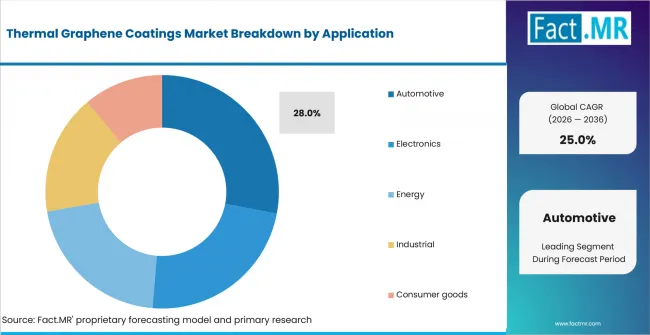
Thermal Graphene Coatings Market Analysis By Application | Source: Fact.MR
Automotive is estimated to represent 28.0% share as EV packs, inverters and lightweight components create repeated heat-control problems. Graphene coatings fit cases where designers need lower weight than metal heat spreaders and thinner layers than conventional filled systems. Electronics follows closely because compact devices concentrate heat near chips, connectors and housings. Energy and industrial uses are supported by cooling equipment, heat exchangers and protective coatings.
What is accelerating Thermal Graphene Coatings Market adoption, and what is holding it back?
EV thermal management drives it; qualification complexity restrains it.
Drivers Impact Analysis
| DRIVER | (~) % IMPACT ON CAGR | GEOGRAPHIC RELEVANCE | IMPACT TIMELINE |
|---|---|---|---|
| EV battery and power-electronics heat control | +2.4% | USA, Germany, Japan, South Korea | Short term (<= 2 years) |
| Data center and electronics cooling pressure | +1.8% | USA, UK, Japan | Medium term (2-4 years) |
| Thin conductive coatings replacing heavier thermal parts | +1.3% | North America, Europe, East Asia | Medium term (2-4 years) |
| Graphene dispersion and functionalization improvements | +1.0% | Global | Long term (>= 4 years) |
Source: Fact.MR analysis. Updated Aug 26, 2026
- EV battery and power-electronics heat control: Electrified vehicles place heat near battery cells, inverters and charging electronics. Graphene coatings are used where designers need thin heat-spreading layers.
- Data center and electronics cooling pressure: AI servers and compact electronics create localized heat that standard coatings struggle to handle consistently. Graphene-enhanced surfaces help move heat across a broader area.
- Thin conductive coatings replacing heavier thermal parts: Thermal graphene coatings are attractive where metal plates, pads or thick filled polymers add weight. Formulators can target conductivity and barrier properties in the same layer. The benefit is clearer when the coating also protects against corrosion or mechanical wear.
- Graphene dispersion and functionalization improvements: Better surface treatment helps graphene mix into thermoplastics, thermosets and solvent systems. Stable dispersions reduce hot spots caused by uneven filler distribution.
Opportunity Impact Analysis
| OPPORTUNITY | (~) % IMPACT ON CAGR | GEOGRAPHIC RELEVANCE | IMPACT TIMELINE |
|---|---|---|---|
| Retrofitted heat-exchanger and HVAC coatings | +1.2% | USA, UK, South Korea | Medium term (2-4 years) |
| Battery pack coatings for lighter thermal stacks | +1.1% | USA, Japan, South Korea | Long term (>= 4 years) |
| Printed and sprayed electronics thermal layers | +0.9% | East Asia, North America | Medium term (2-4 years) |
Source: Fact.MR analysis. Updated Aug 26, 2026
- Retrofitted heat-exchanger and HVAC coatings: Coatings that improve heat transfer on existing exchanger surfaces give facility teams a lower-disruption route than equipment replacement.
- Battery pack coatings for lighter thermal stacks: EV battery programs create openings where designers want fewer layers between cells, plates and pack housings. Graphene coatings can support thinner thermal paths when adhesion and electrical behavior are controlled.
- Printed and sprayed electronics thermal layers: Electronics assemblers need thermal layers that fit into high-volume coating lines. Graphene inks and sprayable systems support localized heat spreading without major geometry changes. Adoption is strongest when the coating remains stable across reflow, humidity and device-life testing.
Restraints Impact Analysis
| RESTRAINT | (~) % IMPACT ON CAGR | GEOGRAPHIC RELEVANCE | IMPACT TIMELINE |
|---|---|---|---|
| Long customer qualification cycles | -0.8% | Global | Short term (<= 2 years) |
| Graphene dispersion variability | -0.6% | North America, Europe, East Asia | Medium term (2-4 years) |
| Raw material and import exposure | -0.5% | USA, Europe, Japan | Medium term (2-4 years) |
Source: Fact.MR analysis. Updated Aug 26, 2026
- Long customer qualification cycles: Thermal coatings must pass adhesion, heat cycling and substrate-compatibility checks before engineers approve production use. That sequence slows orders even when lab conductivity looks attractive. Suppliers can reduce friction with repeatable batch data and application guides.
- Graphene dispersion variability: Uneven dispersion can create coating defects and inconsistent heat-transfer results. Functionalization helps, yet each polymer or solvent system needs separate validation. Formulators therefore prefer graphene grades with clear particle data and handling instructions.
- Raw material and import exposure: Natural graphite routes affect graphene cost and availability. Procurement teams review feedstock traceability when a coating becomes part of a qualified thermal design. Local supply partnerships are expected to gain weight where import exposure affects customer confidence.
Which countries are scaling the Thermal Graphene Coatings Market through 2036?
- The country comparison spans 11.6 percentage points and forms three practical growth bands across the forecast period.
- The USA remains 2.1 percentage points above Germany through EV thermal loads and data center heat pressure.
- Germany remains 1.2 percentage points above Japan through automotive production and industrial coating expertise.
- Japan remains 3.3 percentage points above South Korea as battery strategy targets create a direct pull for thermal materials.
- South Korea remains 5.0 percentage points above the UK through auto exports and electronics supply chains.
Comparable CAGRs create different entry conditions due to vehicle electrification, electronics production, battery policy and coating qualification depth. Full report coverage includes North America, Western Europe, East Asia, South Asia & Pacific, and Middle East & Africa.
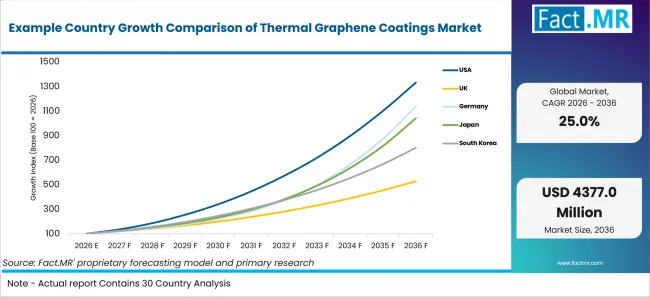
Example Country Growth Comparison Of Thermal Graphene Coatings Market | Source: Fact.MR
| Country | CAGR |
|---|---|
| USA | 29.7% |
| Germany | 27.6% |
| Japan | 26.4% |
| South Korea | 23.1% |
| UK | 18.1% |
Source: Fact.MR analysis. Updated Aug 26, 2026
What supports USA adoption?
29.7% CAGR, supported by EV thermal load and data center cooling pressure.
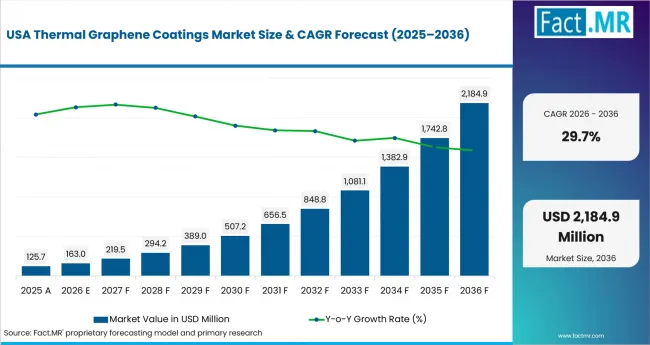
Thermal Graphene Coatings Market Country Value Analysis | Source: Fact.MR
USA coating demand is shaped by heat control in electrified vehicles and high-density electronics. The country is expected to record 29.7% CAGR through 2036 as thermal graphene coatings move closer to battery packs, inverters and cooling hardware. U.S. EIA reported in July 2026 that electrified vehicles accounted for 24% of new U.S. light-duty vehicle sales in Q2 2026.
What supports Germany’s outlook?
27.6% CAGR, backed by automotive production and industrial coating qualification.
German demand is anchored in automotive components and industrial coating know-how. Germany is projected to post 27.6% CAGR through 2036 because material approval systems already emphasize durability, surface preparation and production repeatability. Destatis reported in August 2026 that automotive industry production rose 3.6% in June 2026 from the previous month.
How is Japan scaling demand?
26.4% CAGR, driven by battery strategy and electronics miniaturization.
Japan’s electronics and battery ecosystem is expected to favor coating systems that deliver heat control inside compact assemblies. The country is anticipated to advance at 26.4% CAGR through 2036 as battery programs raise the value of thermal materials. METI revised the Battery Industry Strategy as the Battery and Power Industry Strategy in June 2026, maintaining the 150 GWh-per-year scale for its domestic manufacturing-base target while revising the timeframe to 2030 through the mid-2030s.
What supports South Korea’s growth?
23.1% CAGR, supported by eco-friendly vehicle sales and electronics supply chains.
South Korea’s route is tied to export-focused automotive programs and large electronics supply chains. The country is estimated to hold 23.1% CAGR through 2036 as coating developers target battery, module and device-assembly needs. MOTIR reported in January 2026 that eco-friendly vehicle sales reached 813,000 units in 2025, up 25% from 2024.
What underpins UK growth?
18.1% CAGR, backed by zero-emission vehicle registrations and battery innovation funding.
UK demand is more specialized, and application testing remains active across specialty coatings, batteries and performance vehicles. The UK is forecast to reach 18.1% CAGR through 2036 as electrification programs create more use cases for thermal coatings. The Department for Transport reported in April 2026 that 473,000 zero-emission cars were first registered in 2025, up 24% from 2024.
Who leads the Thermal Graphene Coatings Market?
Directa Plus S.p.A. is active through G+® Graphene Plus coatings, thermal-management textile applications and graphene additives for batteries. Haydale Graphene Industries plc competes through HDPlas® functionalisation, graphene inks, coatings and heating technologies. NanoXplore Inc. supplies GrapheneBlack™ materials, graphene-enhanced masterbatches and polymer products for automotive and industrial applications.
Graphene Manufacturing Group Ltd. has direct coating exposure through THERMAL-XR®, a graphene-enhanced coating for HVAC-R heat-transfer surfaces, with additional applications being evaluated across other thermal-management settings. First Graphene Limited supports coating and ink systems through PureGRAPH® materials with electrical- and thermal-conductivity properties. Across these portfolios, graphene dispersion, application-level performance data, regulatory and technical documentation, and ease of integration into existing coating or materials processes are relevant competitive considerations.
Which companies are the key providers?
Key companies include Directa Plus S.p.A., Haydale Graphene Industries plc, NanoXplore Inc., Graphene Manufacturing Group Ltd. and First Graphene Limited.
- Directa Plus S.p.A.
- Haydale Graphene Industries plc
- NanoXplore Inc.
- Graphene Manufacturing Group Ltd.
- First Graphene Limited
Bibliography
- International Energy Agency. (2025, April 10). Energy demand from AI. In Energy and AI.
- International Energy Agency. (2026, May 20). Trends in electric cars. In Global EV Outlook 2026.
- U.S. Energy Information Administration. (2026, July 27). Hybrid sales rise while battery electric sales remain lower after tax credit expiration.
- Federal Statistical Office (Destatis). (2026, August 7). Production in June 2026: +0.2% on the previous month.
- Ministry of Economy, Trade and Industry. (2026, June 2). “Battery Industry Strategy” revised as the “Battery and Power Industry Strategy”.
- Ministry of Trade, Industry and Resources. (2026, January 15). Automobile exports hit record high of $72 billion in 2025.
- Department for Transport. (2026, April 29). Vehicle licensing statistics, United Kingdom: 2025. GOV.UK.
- Haydale Graphene Industries plc. (2025, October 30). Expansion of commercial platform.
- Graphene Manufacturing Group Ltd. (2025, October 6). GMG receives European REACH registration & launch of GMG SPRAY ACADEMY.
- NanoXplore Inc. (2026, February). Investor presentation.
This Report Answers
- The report explains where thermal graphene coatings are used across graphene form and carrier matrix. It also covers function and application.
- Segment analysis identifies nanoplatelets, thermoplastics, conductivity and automotive as the leading subsegments by share.
- Country analysis examines the USA, Germany, Japan, South Korea and the UK using official vehicle, battery and production indicators.
- Competitive analysis reviews Directa Plus S.p.A., Haydale Graphene Industries plc, NanoXplore Inc., Graphene Manufacturing Group Ltd. and First Graphene Limited.
- Application analysis assesses how heat spreading, coating thickness, substrate adhesion and qualification needs influence purchase decisions.
What does the Thermal Graphene Coatings Market cover?
The Thermal Graphene Coatings Market covers coating systems that use graphene materials to move heat, control conductivity or add barrier properties. It includes polymeric and solvent-borne coatings used on automotive components, electronics housings, energy equipment, industrial heat-transfer surfaces and selected consumer goods.
The market differs from bulk graphene powder sales because commercial value is concentrated in the formulated coating and tested performance. Adjacent graphene coating demand and graphene-based coating additives are relevant when graphene improves thermal behavior inside a finished coating.
What is included in the scope?
The scope includes graphene-enhanced thermoplastic, thermoset, elastomer and solvent-system coatings where thermal performance is a stated function. It includes coatings based on nanoplatelets, reduced graphene oxide, functionalized graphene and dispersions. Adjacent coverage connects to commercial graphene materials, thermal management materials, thermally conductive epoxies and thermal conductive sheets where those categories overlap with coating performance.
What is excluded from the scope?
Raw graphene powder sold alone is outside the scope when coating formulation or application performance is absent. The scope also leaves out carbon black coatings, ceramic-filled pads, metallic heat spreaders and general anti-corrosion paints where graphene is absent from the functional layer. Related high-temperature coatings and low-friction coatings are considered only when graphene-based thermal coating performance is part of the product boundary.
How Was the Analysis Built?
The analysis draws on 120+ sources, 35+ company portfolios, 25+ countries, and more than 20 industry interviews.
- Primary Research: Primary research includes discussions with coating formulators, graphene material suppliers, thermal-management specialists, automotive component teams and electronics buyers. These discussions examine qualification criteria, dispersion needs, coating-process limits, pricing pressure and the factors that slow conversion from laboratory testing to commercial use.
- Desk Research: Desk research covers government statistics, regulator publications, company product pages, investor releases, technical material descriptions, industry associations and public policy sources. Each evidence point is checked against the original organization before entering the report.
- Market Sizing and Forecasting: Market estimates combine historical values, segment shares, country CAGRs, graphene-form participation, matrix mix, application demand and supplier portfolio review. Forecasts reflect qualification timing, adoption patterns and the premium attached to thermally conductive coatings.
- Data Validation and Update Cycle: Findings are validated by comparing primary interviews with public data, company activity, regulatory changes, product launches and country-level demand indicators. Review cycles check duplicate statistics, source quality and whether new developments change the adoption path.
Segmentation
What is the report’s scope and coverage?
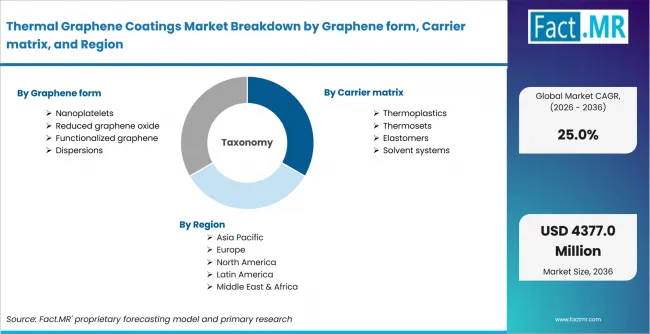
Thermal Graphene Coatings Market Breakdown By Graphene Form, Carrier Matrix, And Region | Source: Fact.MR
| Attribute | Details |
|---|---|
| Quantitative Units | USD million |
| Market Definition | Thermal graphene coatings are formulated coating systems that use graphene forms to improve heat spreading, conductivity or surface protection in automotive, electronics, energy and industrial applications. |
| Graphene Form | Nanoplatelets; Reduced graphene oxide; Functionalized graphene; Dispersions |
| Carrier Matrix | Thermoplastics; Thermosets; Elastomers; Solvent systems |
| Function | Conductivity; Thermal management; Reinforcement; Barrier |
| Application | Automotive; Electronics; Energy; Industrial; Consumer goods |
| Regions Covered | North America; Western Europe; East Asia; South Asia & Pacific; Middle East & Africa |
| Countries Covered | USA; Germany; Japan; South Korea; UK |
| Key Companies Profiled | Directa Plus S.p.A.; Haydale Graphene Industries plc; NanoXplore Inc.; Graphene Manufacturing Group Ltd.; First Graphene Limited |
| Forecast Period | 2026 to 2036 |
| Approach | Hybrid top-down and bottom-up approach using graphene form, carrier matrix, function, application mix, country adoption and provider portfolio review. |
Source: Fact.MR analysis. Updated Aug 26, 2026
How is the market segmented?
-
By Graphene Form:
- Nanoplatelets
- Reduced graphene oxide
- Functionalized graphene
- Dispersions
-
By Carrier Matrix:
- Thermoplastics
- Thermosets
- Elastomers
- Solvent systems
-
By Function:
- Conductivity
- Thermal management
- Reinforcement
- Barrier
-
By Application:
- Automotive
- Electronics
- Energy
- Industrial
- Consumer goods
-
By Region:
- North America
- Western Europe
- East Asia
- South Asia & Pacific
- Middle East & Africa
Frequently Asked Questions
How big is the thermal graphene coatings market in 2026?
What is the CAGR of the thermal graphene coatings market from 2026 to 2036?
Which graphene form leads the thermal graphene coatings market?
Which carrier matrix leads the thermal graphene coatings market?
Who are the leading companies in the thermal graphene coatings market?
Who worked on this report


Preview the report firsthand - request a free sample
Free SampleGet the brochure for pricing and purchase details
Download PDF