- Market Value (2025): USD 327.7 Mn
- Estimated Value (2026): USD 390.0 Mn
- Forecast Value (2036): USD 2221.0 Mn
- CAGR (2026-2036): 19.0%
What is the Dispersible Bio Films Market forecast to be worth by 2036?
USD 390.0 million in 2026 to USD 2221.0 million by 2036 at a 19.0% CAGR.
- The dispersible bio films market reached USD 327.7 million in 2025.
- Demand is projected to increase from USD 390.0 million in 2026 to USD 2221.0 million by 2036.
- The market is forecast to record 19.0% CAGR from 2026 to 2036 as food packaging brands and personal care formulators seek lower-plastic film systems with practical end-of-life routes.
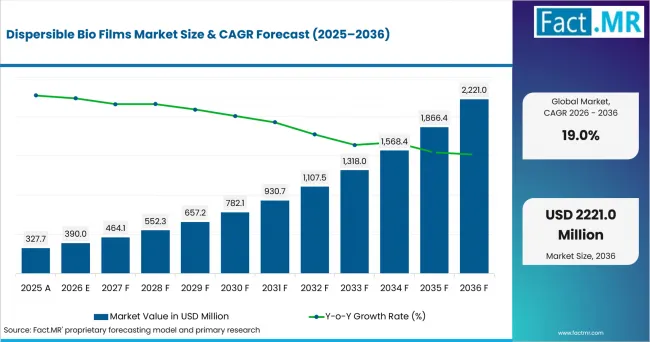
Dispersible Bio Films Market Value Analysis | Source: Fact.MR
What are the defining numbers behind Dispersible Bio Films Market growth?
An absolute opportunity of USD 1831.0 million is expected between 2026 and 2036.
- Demand Drivers in the Market
- Food packaging brands need films that manage moisture and grease while reducing difficult multilayer structures.
- E-commerce pack designers need lighter protective formats for shipped goods.
- European converters need packaging structures that match new recyclability rules.
- Bio-based film producers need proof of available polymer capacity.
- Key Segments Analyzed
- By Material: Bio-polymers are expected to hold 38.0% share in 2026 due to their use in soluble, compostable and recyclable film systems.
- By Format: Coating is projected to account for 41.0% share in 2026 since brands can apply thin functional layers to paper or board.
- By Function: Barrier protection is anticipated to capture 36.0% share in 2026 because oxygen, oil and moisture control guide pack trials.
- By Application: Food packaging is estimated to represent 40.0% share in 2026 owing to high pack volumes and visible waste pressure.
- Analyst Opinion at Fact.MR
- Shambhu Nath Jha, Principal Consultant at Fact.MR, states, “Dispersible bio films are being judged by the same questions used for established flexible packaging: seal behavior, barrier life and line speed. The market is expected to widen when films prove that disposal claims match local waste systems. Suppliers that combine coating know-how, test data and converter support are better placed for repeat orders.”
- Strategic Implications
- Material producers should publish dissolution, biodegradation and repulpability data for each film grade so brand teams can approve claims with fewer review cycles.
- Packaging converters should test coating weights and seal windows on existing lines before recommending a switch from paper-plastic laminates.
- Foodservice operators should prioritize formats that retain grease resistance and portion visibility during peak service without adding sorting steps.
- Brand owners should align pack claims with local recycling, composting or disposal rules before printing front-of-pack language.
The USA is expected to record 20.9% CAGR through 2036, supported by food packaging scale. Germany is projected to post 20.0% CAGR as PPWR changes converter specifications. Japan is anticipated to advance at 18.6% CAGR because compact pack formats raise barrier needs. France is estimated to hold 17.9% CAGR due to foodservice restrictions. Brazil is forecast to reach 17.1% CAGR as reverse logistics rules push lower-plastic formats.
How does the Dispersible Bio Films Market break down by segment?
Coating leads Format at 41.0% share in 2026; Food packaging leads Application at 40.0% share.
Which Material dominates?
Bio-polymers are expected to hold 38.0% share in 2026.
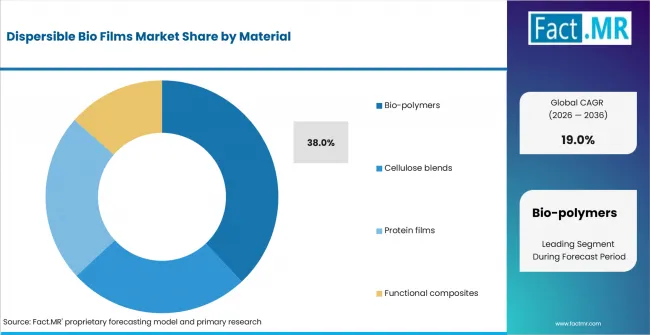
Dispersible Bio Films Market Analysis By Material | Source: Fact.MR
Bio-polymers are expected to lead material demand because dispersible films need polymers that support dissolution or compostability claims. Cellulose blends serve paper-recovery use cases, while protein films remain suited to thin food-contact concepts. The European Commission Joint Research Centre reported in March 2026 that bio-based and biodegradable plastics are projected to remain near 1% of global production capacity by 2030.
What leads the Format segment?
Coating is projected to account for 41.0% share in 2026.
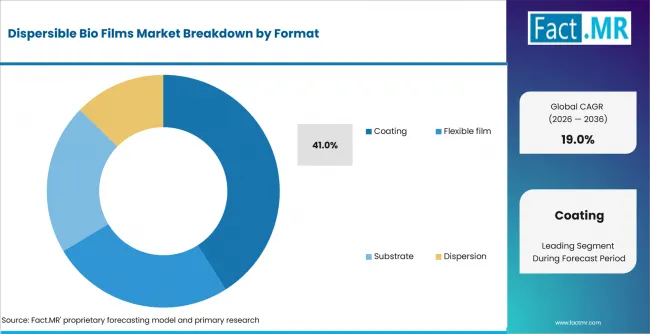
Dispersible Bio Films Market Analysis By Format | Source: Fact.MR
Coating is projected to lead the format segment because converters can add a dispersible layer to paper or board. Flexible film is used where the film forms a wrap or pouch. Aquapak stated in July 2025 that Hydropol-coated paper can dissolve in recycling and allow up to 100% recovery of paper pulp in the paper mill.
How does Function shape demand?
Barrier protection is anticipated to capture 36.0% share in 2026.
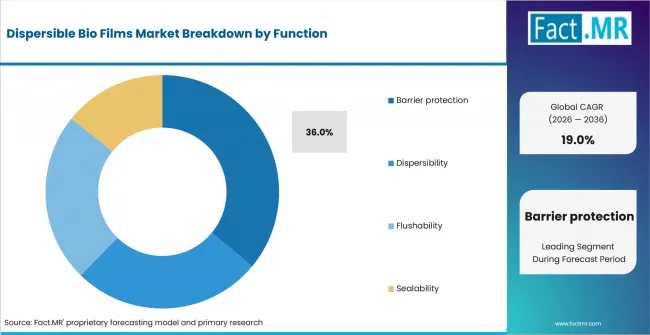
Dispersible Bio Films Market Analysis By Function | Source: Fact.MR
Barrier protection is anticipated to lead function demand because food and personal care packs require moisture, oxygen and oil resistance. Dispersibility follows where the film must break down under water or recovery conditions. Notpla Limited introduced SeaView in May 2026 as a food-to-go range using a seaweed-based transparent window and coating.
What supports Food packaging within Application?
Food packaging is estimated to represent 40.0% share in 2026.
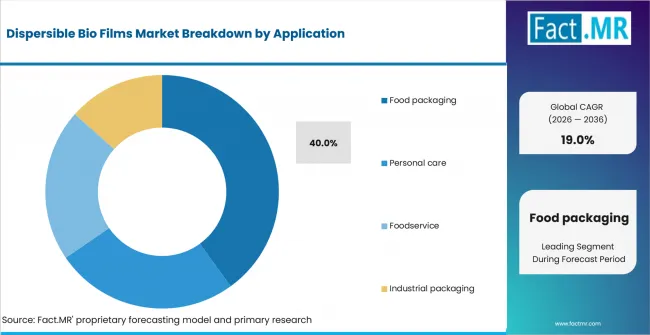
Dispersible Bio Films Market Analysis By Application | Source: Fact.MR
Food packaging is estimated to lead application demand because snack and foodservice packs generate high volumes. Personal care uses are shaped by refill and unit-dose formats. In June 2026, INSEE reported French household spending on food and non-alcoholic beverages at EUR 192.8 billion in 2025.
What is accelerating Dispersible Bio Films Market adoption, and what is holding it back?
Packaging substitution drives it; material qualification restrains it.
Drivers Impact Analysis
| DRIVER | (~) % IMPACT ON CAGR | GEOGRAPHIC RELEVANCE | IMPACT TIMELINE |
|---|---|---|---|
| Lower-plastic packaging conversion | +2.0% | North America, Europe | Short term (<= 2 years) |
| Food packaging barrier needs | +1.5% | Global | Medium term (2-4 years) |
| Water-soluble and dispersible formats | +1.2% | USA, Japan, Europe | Medium term (2-4 years) |
| Paper coating and repulpability trials | +0.9% | Europe, North America | Long term (>= 4 years) |
- Lower-plastic packaging conversion: Plastic-packaging scrutiny is expected to move brands toward films and coatings that reduce hard-to-recycle layers and support simpler packaging structures.
- Food packaging barrier needs: Food packs need grease, oxygen and moisture control before a new film reaches commercial use. Barrier performance remains central to protecting product quality, shelf life and handling.
- Water-soluble and dispersible formats: Portion packs and refill systems are anticipated to create demand for films that dissolve after use. Water-soluble PVOH films suit personal care, cleaning and ingredient formats requiring precise dosing and convenient disposal.
- Paper coating and repulpability trials: Paper-based packs are projected to gain attention where bio-based or water-soluble coatings can replace conventional plastic linings while supporting recycling and repulping requirements.
Opportunity Impact Analysis
| OPPORTUNITY | (~) % IMPACT ON CAGR | GEOGRAPHIC RELEVANCE | IMPACT TIMELINE |
|---|---|---|---|
| Food-to-go plastic-window replacement | +1.3% | Europe, USA | Short term (<= 2 years) |
| Personal care unit-dose films | +1.0% | North America, Japan | Medium term (2-4 years) |
| Bio-polymer packaging capacity | +0.8% | Europe, East Asia | Medium term (2-4 years) |
| Retailer specification programs | +0.6% | Global | Long term (>= 4 years) |
- Food-to-go plastic-window replacement: Food-to-go packs are expected to shift toward bio-based film windows where product visibility remains important for sandwiches, wraps, deli packs and similar formats.
- Personal care unit-dose films: Personal care brands are anticipated to use soluble films where small-dose formats can reduce packaging weight, improve dosing convenience and limit product mess.
- Bio-polymer packaging capacity: Bio-polymer producers are expected to benefit as packaging remains a major application area for bioplastics, supporting demand for films, coatings and other alternative packaging materials.
- Retailer specification programs: Retailers are projected to favor materials with clear and traceable end-of-life pathways as packaging specifications increasingly consider recyclability, material design and waste-handling requirements.
Restraints Impact Analysis
| RESTRAINT | (~) % IMPACT ON CAGR | GEOGRAPHIC RELEVANCE | IMPACT TIMELINE |
|---|---|---|---|
| Moisture and storage sensitivity | -0.6% | Global | Short term (<= 2 years) |
| Claim proof and labeling complexity | -0.5% | Europe, USA | Medium term (2-4 years) |
| Cost of conversion trials | -0.4% | Brazil, Japan | Medium term (2-4 years) |
| Limited waste-system alignment | -0.3% | Global | Long term (>= 4 years) |
- Moisture and storage sensitivity: Water-responsive films require careful storage and conversion control. Supplier documentation on humidity, seal behavior and shelf life is expected to influence adoption across flexible film and coating formats.
- Claim proof and labeling complexity: Dispersible and compostable claims require clear supporting evidence that aligns with local waste-management and end-of-life pathways. Packaging teams are expected to prioritize materials with well-defined disposal and recycling guidance.
- Cost of conversion trials: Converters need line trials before moving from polyethylene or coated paper to dispersible formats. Adoption is expected to depend on material availability, processing compatibility and the ability of suppliers to support qualification across converting lines.
Which countries are scaling the Dispersible Bio Films Market through 2036?
- The country comparison spans 3.8 percentage points and forms three practical growth bands across the forecast period.
- The USA remains 0.9 percentage point above Germany through food packaging scale and e-commerce pack flows.
- Germany remains 1.4 percentage points above Japan as PPWR changes converter and brand specifications.
- Japan remains 0.7 percentage point above France through food export packaging and compact convenience formats.
- France remains 0.8 percentage point above Brazil as plastic recycling policy creates demand for lower-plastic foodservice materials.
- Brazil closes the displayed range through retail growth and national plastic reverse logistics rules.
Comparable CAGRs create different entry conditions due to packaging laws, retailer pack trials, converter readiness and waste-system alignment. Full report coverage includes North America, Latin America, Western Europe, Eastern Europe, East Asia, South Asia & Pacific, Middle East & Africa.
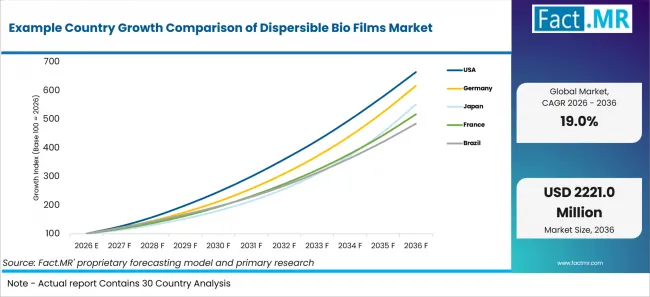
Example Country Growth Comparison Of Dispersible Bio Films Market | Source: Fact.MR
| Country | CAGR |
|---|---|
| United States | 20.9% |
| Germany | 20.0% |
| Japan | 18.6% |
| France | 17.9% |
| Brazil | 17.1% |
What supports USA adoption?
20.9% CAGR, supported by food packaging scale and e-commerce pack flows.
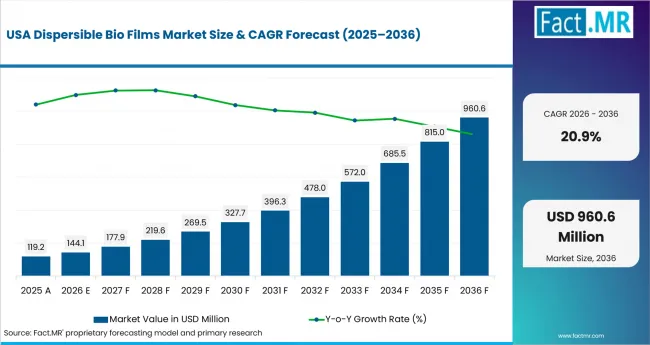
Dispersible Bio Films Market Country Value Analysis | Source: Fact.MR
U.S. food and retail channels give dispersible bio films a large testing base. The country is projected to record 20.9% CAGR through 2036. USDA Economic Research Service reported in June 2026 that total U.S. food spending reached USD 2.51 trillion in 2025.
How is Germany scaling demand?
20.0% CAGR, driven by PPWR implementation and paper-coating substitution.
Germany is moving under EU packaging rules that reshape design and disposal claims. Dispersible bio films are projected to post 20.0% CAGR through 2036. The German Environment Agency reported in April 2026 that packaging consumption in Germany was 17.92 million tonnes in 2023.
What supports Japan performance?
18.6% CAGR, led by food exports and compact pack formats.
Japan’s convenience retail culture creates room for compact films with precise barrier behavior. The market is anticipated to advance at 18.6% CAGR through 2036. Japan’s Ministry of the Environment reported in June 2026 that estimated food loss and waste totaled 4.61 million tonnes in FY2024, underscoring continued efforts to reduce food waste across households and businesses.
What underpins France growth?
17.9% CAGR, backed by foodservice restrictions and plastic recycling pressure.
French foodservice channels face policy pressure to reduce single-use plastic in paper and board formats. Demand is estimated to hold 17.9% CAGR through 2036. France’s Ministry for Ecological Transition reported in May 2026 that only 26% of plastic packaging was recycled in France.
How does Brazil perform?
17.1% CAGR, supported by retail growth and plastic reverse logistics.
Brazil’s retail base and plastic-waste policy are expected to support measured adoption. The market is forecast to reach 17.1% CAGR through 2036. Decree No. 12,644 established Brazil’s National Ocean Without Plastic Strategy for 2025–2030, creating a clearer policy framework for reducing plastic use and improving the recyclability and sustainability of packaging.
Who leads the Dispersible Bio Films Market?
Kuraray Co., Ltd. / MonoSol, LLC lead water-soluble film coverage, while Aquapak Polymers and Notpla Limited strengthen coating and foodservice formats.
Aquapak Polymers competes through Hydropol water-soluble polymer technology for barrier paper and flexible packaging. Notpla Limited uses seaweed-based coating and film-window formats for foodservice packs.
Which companies are the key providers?
Key companies include Kuraray Co., Ltd. / MonoSol, LLC, Aquapak Polymers, Notpla Limited, Lactips, and Xampla Ltd.
- Kuraray Co., Ltd. / MonoSol, LLC
- Aquapak Polymers
- Notpla Limited
- Lactips
- Xampla Ltd.
Bibliography
- Aquapak Polymers Ltd. (2025, July 16). Hydropol™ wins snacks and confectionery category at Environmental Packaging Awards.
- European Bioplastics e.V. (2025, December 2). EUBP presents the results of the 2025 Market Data Report.
- Directorate-General for Communication. (2026, August 12). New packaging rules for less waste and easier recycling. European Commission.
- Joint Research Centre. (2026, March 3). Bio-based plastics: Technology readiness and high cost key barriers to wide use. European Commission.
- Eurostat. (2025, October 22). Plastic packaging waste in the EU: 35.3 kg per person.
- Ministère de la Transition écologique. (2025, December 31). Report de l’échéance d’interdiction des gobelets en plastique à usage unique.
- Ministère de la Transition écologique. (2026, May 28). Plan plastique : la concertation est lancée pour atteindre les objectifs européens en matière de recyclage plastique à horizon 2030.
- Brazilian Institute of Geography and Statistics. (2026, February 13). Retail sales close 2025 with rise of 1.6%. IBGE News Agency.
- Ministry of Economy, Trade and Industry. (2025, August 26). Results of FY2024 E-Commerce Market Survey compiled.
- Ministry of the Environment, Government of Japan. (2026, June 30). MOE Japan discloses the estimated amount of Japan’s food loss and waste generated in FY2024.
- Notpla. (2026, May 8). The future of food-to-go packaging? A plastic-free window box built for real foodservice.
- Presidência da República. (2025, October 1). Decreto nº 12.644, de 1º de outubro de 2025.
- U.S. Census Bureau. (2026, August 14). Advance monthly sales for retail and food services.
- U.S. Census Bureau. (2026, August 18). Quarterly retail e-commerce sales.
- U.S. Environmental Protection Agency. (2025, October 31). About plastic products and plastic pollution.
This Report Answers
- The report explains where dispersible bio films are used across material, format and function. It also covers application and regional demand across food packaging, personal care, foodservice and industrial packaging.
- Segment analysis identifies the leading subsegments and the operational reasons converters and brands prioritize them.
- Country analysis examines the listed markets and the packaging-policy, recycling and material-conversion mechanisms supporting adoption.
- Competitive analysis reviews current providers across water-soluble films, functional coatings, bio-polymers and alternative film technologies.
- Application analysis assesses how barrier protection, dispersibility, flushability and sealability influence material selection. It also considers conversion compatibility and end-of-life pathways.
What does the Dispersible Bio Films Market cover?
The Dispersible Bio Films Market covers bio-based, water-dispersible, soluble, compostable or recoverable film and coating materials used in food, personal care, foodservice and industrial packaging. It includes materials designed to reduce conventional plastic layers while maintaining practical filling, sealing, barrier and disposal performance.
The assessment covers bio-polymers, cellulose blends, protein films and functional composites across coating, flexible-film and substrate formats. Demand is assessed across barrier protection, dispersibility, flushability and sealability functions together with the listed packaging applications.
What is included in the scope?
The scope includes dispersible and bio-based film systems supplied as coatings, flexible films or functional substrates for packaging applications. It covers bio-polymers, cellulose blends, protein films and functional composites used where moisture, oxygen, oil or grease control must be combined with soluble, compostable, recyclable or recoverable end-of-life characteristics.
It includes food packaging, personal care, foodservice and industrial packaging applications, together with converter qualification involving seal behavior, coating performance, material compatibility and recovery or disposal claims.
What is excluded from the scope?
The scope excludes conventional packaging films and coatings that fall outside bio-based, dispersible, soluble, compostable or recoverable positioning. Standard plastic films used without a dispersibility or alternative end-of-life function fall outside the defined market boundary.
It also excludes packaging machinery, raw packaging substrates sold without a qualifying functional film or coating, and finished packaged consumer products where the dispersible bio film itself is not the commercial material being assessed.
How Was the Analysis Built?
The analysis draws on 120+ sources, 35+ company portfolios, 25+ countries, and more than 20 industry interviews.
- Primary Research: Primary research includes discussions with packaging converters, film producers, food brands, personal care formulators and material testing specialists. These interviews examine seal behavior, line trials and claim approval.
- Desk Research: Desk research covers government statistics, regulatory publications, company product pages, technical resources, trade data, industry associations, packaging policy and official waste reports.
- Market Sizing and Forecasting: Market estimates combine historical values, demand indicators, segment shares, country growth, application mix, qualification cycles, policy pressure and provider portfolio review.
- Data Validation and Update Cycle: Findings are validated by comparing interviews with public data, company activity, regulatory changes and packaging developments. Updates review product launches, coating trials and recovery claims.
Segmentation
What is the report’s scope and coverage?
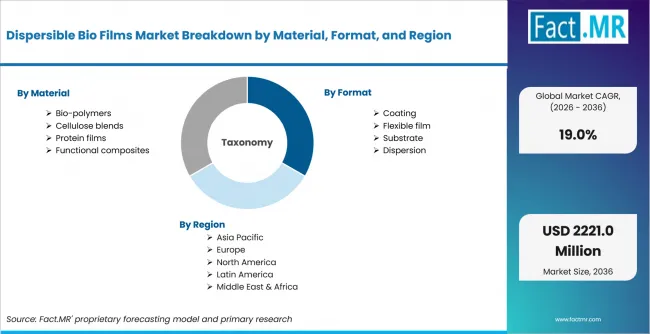
Dispersible Bio Films Market Breakdown By Material, Format, And Region | Source: Fact.MR
| Attribute | Details |
|---|---|
| Quantitative Units | USD million in 2026 to USD million by 2036 at a CAGR |
| Market Definition | Dispersible bio films are bio-based, water-dispersible, soluble, compostable or recoverable film and coating materials used to protect food, personal care, foodservice and industrial packaging formats. |
| Material | Bio-polymers; Cellulose blends; Protein films; Functional composites |
| Format | Coating; Flexible film; Substrate |
| Function | Barrier protection; Dispersibility; Flushability; Sealability |
| Application | Food packaging; Personal care; Foodservice; Industrial packaging |
| Regions Covered | North America; Latin America; Western Europe; Eastern Europe; East Asia; South Asia & Pacific; Middle East & Africa |
| Countries Covered | United States; Germany; Japan; France; Brazil |
| Key Companies Profiled | Kuraray Co., Ltd. / MonoSol, LLC, Aquapak Polymers, Notpla Limited, Lactips, and Xampla Ltd. |
| Forecast Period | 2026 to 2036 |
| Approach | Hybrid top-down and bottom-up approach using packaging conversion trends, material qualification, country policy review, segment shares and provider portfolio review. |
How is the market segmented?
-
By Material:
- Bio-polymers
- Cellulose blends
- Protein films
- Functional composites
-
By Format:
- Coating
- Flexible film
- Substrate
-
By Function:
- Barrier protection
- Dispersibility
- Flushability
- Sealability
-
By Application:
- Food packaging
- Personal care
- Foodservice
- Industrial packaging
-
By Region:
- North America
- Latin America
- Western Europe
- Eastern Europe
- East Asia
- South Asia & Pacific
- Middle East & Africa
Frequently Asked Questions
How big is the dispersible bio films market in 2026?
What is the CAGR of the dispersible bio films market from 2026 to 2036?
Which material leads the dispersible bio films market?
Which format leads the dispersible bio films market?
Who are the leading companies in the dispersible bio films market?
Who worked on this report


Preview the report firsthand - request a free sample
Free SampleGet the brochure for pricing and purchase details
Download PDF