- Market Value (2025): USD 1.1 Bn
- Estimated Value (2026): USD 1.2 Bn
- Forecast Value (2036): USD 5.2 Bn
- CAGR (2026-2036): 15.6%
What is the Flushable Bio Packaging Films Market forecast to be worth by 2036?
USD 1.2 billion in 2026 to USD 5.2 billion by 2036, at a 15.6% CAGR.
- The Flushable Bio Packaging Films Market reached USD 1.1 billion in 2025.
- Demand is projected to increase from USD 1.2 billion in 2026 to USD 5.2 billion by 2036.
- The market is forecast to record 15.6% CAGR from 2026 to 2036.
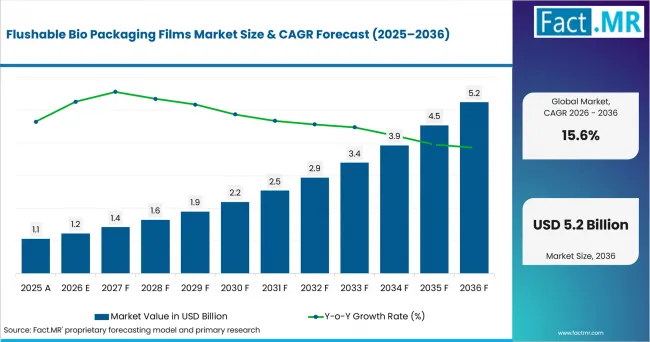
Flushable Bio Packaging Films Market Value Analysis | Source: Fact.MR
What are the defining numbers behind Flushable Bio Packaging Films Market growth?
An absolute opportunity of USD 4.01 billion is expected between 2026 and 2036.
- Demand Drivers in the Market
- Unit-dose home-care brands need film that protects concentrated detergent before use and dissolves during use. PVOH and water-soluble bio-attributed film meets that need because it gives formulators a familiar dose-pack pathway.
- Hygiene converters need liner and overwrap materials that hold shape in storage and separate cleanly in disposal. Clear water-response testing helps brands separate sewer-dispersible, compostable and cold-water dispersible claims.
- Foodservice pack developers need compact formats for sauces, condiments and single-serve foods. USDA Economic Research Service reported in June 2026 that inflation-adjusted U.S. food spending reached USD 2.51 trillion in 2025.
- European packaging teams need materials that fit the Packaging and Packaging Waste Regulation. The European Commission says PPWR entered into force on 11 February 2025 and generally applies from 12 August 2026.
- Key Segments Analyzed
- By Film Polymer: PVOH and water-soluble bio-attributed is expected to hold 36.00% share in 2026 because unit-dose packs need predictable dissolution and stable film handling.
- By Disintegration Route: Cold-water dispersible is projected to account for 31.00% share in 2026 as household and hygiene uses rely on performance at normal-use temperatures.
- By Package Format: Unit-dose and sachet film is anticipated to capture 37.00% share in 2026 owing to dose control, compact storage and filling-line fit.
- By Performance Requirement: Controlled dissolution is estimated to represent 32.00% share in 2026 because the film must remain intact before use and release at the planned point.
- Analyst Opinion at Fact.MR
- Shambhu Nath Jha, Principal Consultant at Fact.MR, states, “Flushable bio packaging films are judged by proof of behavior after use. Brands ask how a film performs in water, composting or sewer-adjacent conditions. Suppliers are expected to gain preference when they combine film chemistry, disposal testing and conversion support.”
- Strategic Implications
- Film producers should document dissolution time, storage stability and residue behavior by application because claims must match the actual disposal route.
- Converters should qualify seal strength and printability before scaling pouch or sachet formats across high-speed packing lines.
- Home-care brands should pair water-soluble film selection with detergent chemistry testing so pack failure and early softening are controlled.
- Foodservice packaging teams should track PPWR design rules while choosing compostable or dispersible film structures for small-format wraps and sachets.
The USA is projected to post 16.7% CAGR through 2036, supported by unit-dose home-care formats and online retail packaging. The UK is expected to record 16.0% CAGR as online retail and packaging compliance guide film trials. Germany is forecast to advance at 15.6% CAGR due to recycling discipline. France is anticipated to reach 14.5% CAGR, reinforced by producer responsibility work. Italy is estimated to grow at 14.0% CAGR through foodservice and specialty food applications.
How does the Flushable Bio Packaging Films Market break down by segment?
PVOH and water-soluble bio-attributed leads Film Polymer at 36.00%; Unit-dose and sachet film leads Package Format at 37.00%.
Which Film Polymer dominates?
PVOH and water-soluble bio-attributed is expected to hold 36.0% share in 2026.
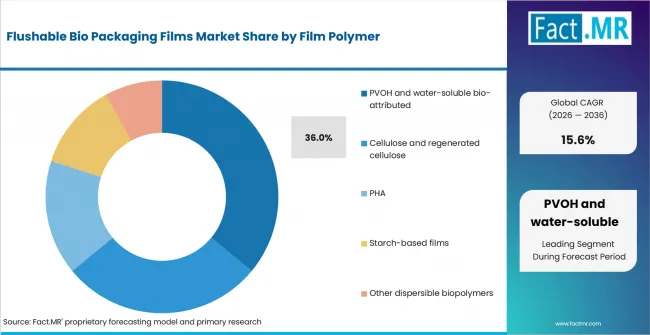
Flushable Bio Packaging Films Market Analysis By Film Polymer | Source: Fact.MR
PVOH and water-soluble bio-attributed film is expected to lead Film Polymer because dose packs measure film integrity and dissolution together. Cellulose and regenerated cellulose support compostable wraps and sachet laminates. PHA and starch-based films serve biodegradation claims. Kuraray describes PVOH as a water-soluble polymer used in soluble unit-dose detergent systems.
What leads the Disintegration Route segment?
Cold-water dispersible is projected to account for 31.0% share in 2026.
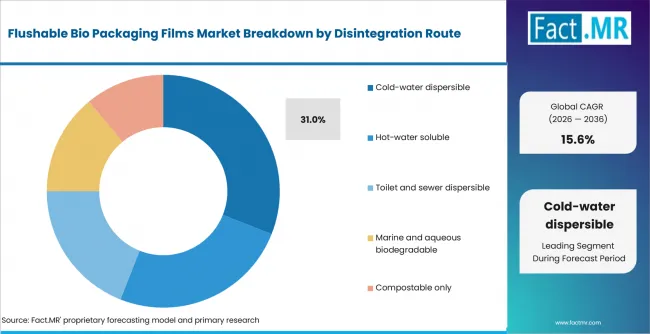
Flushable Bio Packaging Films Market Analysis By Disintegration Route | Source: Fact.MR
Cold-water dispersible film is projected to lead Disintegration Route because laundry, surface-care and some hygiene uses operate at ordinary water temperatures. Hot-water soluble grades apply where release occurs under heated-use conditions. Toilet- and sewer-dispersible formats require careful management of performance and disposal claims. ISO/TS 18671:2026 provides wastewater-compatibility test methodologies for wet wipes and moist toilet tissue but explicitly excludes water-soluble polymers. It therefore serves as adjacent wastewater-compatibility context rather than as a test standard for water-soluble packaging films.
How does Package Format shape demand?
Unit-dose and sachet film is anticipated to lead with 37.0% share in 2026.
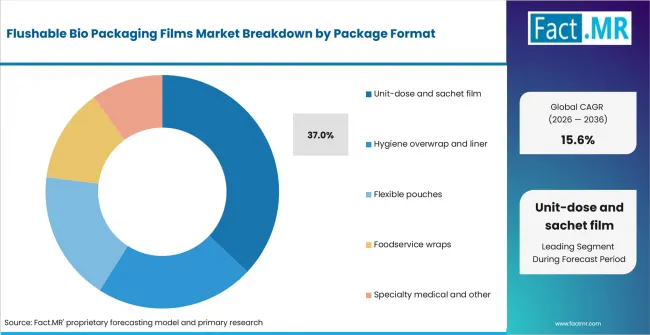
Flushable Bio Packaging Films Market Analysis By Package Format | Source: Fact.MR
Unit-dose and sachet film is anticipated to lead Package Format because small packs need measured product delivery and controlled opening behavior. Hygiene overwrap and liner formats need storage strength and clear disposal behavior. Flexible pouches and foodservice wraps expand use when suppliers solve sealing needs. Cellulose-based barrier films support single-serve liquids when seal integrity and end-of-life performance are qualified together.
What supports Controlled Dissolution within Performance Requirement?
Controlled dissolution is estimated to represent 32.0% share in 2026.
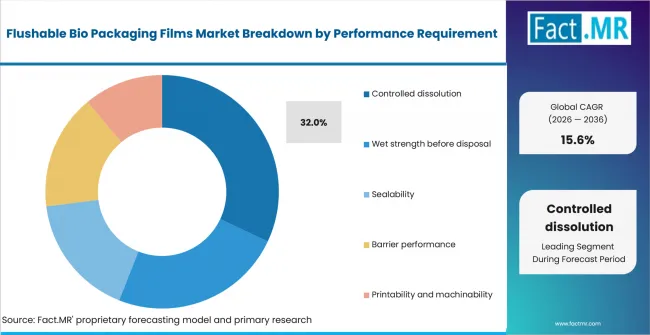
Flushable Bio Packaging Films Market Analysis By Performance Requirement | Source: Fact.MR
Controlled dissolution is estimated to lead Performance Requirement because timing decides whether the package works before use and clears after use. Wet strength before disposal supports hygiene liners and moist environments. Sealability and barrier performance guide pouch and wrap conversion. Printability and machinability affect approval because films must run through familiar packaging equipment.
What is accelerating Flushable Bio Packaging Films Market adoption, and what is holding it back?
Dose control and verified disposal routes drive adoption; qualification cost and performance tradeoffs restrain it.
Drivers Impact Analysis
| DRIVER | (~) % IMPACT ON CAGR | GEOGRAPHIC RELEVANCE | IMPACT TIMELINE |
|---|---|---|---|
| Unit-dose detergent and cleaner packaging | +2.4% | North America, Europe | Short term (<= 2 years) |
| EU packaging regulation and material redesign | +1.8% | Western Europe | Medium term (2-4 years) |
| Hygiene and flushable liner qualification | +1.3% | North America, Western Europe | Medium term (2-4 years) |
| Foodservice sachet and wrap conversion | +1.0% | Europe, North America | Short term (<= 2 years) |
Source: Fact.MR analysis. Updated Sep 3, 2026
- Unit-dose detergent and cleaner packaging: Home-care brands use water-soluble films to separate concentrated products into measured doses. These formats support convenient handling, controlled dosing, and reduced direct contact with concentrated cleaning formulations.
- EU packaging regulation and material redesign: Evolving packaging requirements are increasing attention on material selection, recyclability, and documentation across European markets. This supports greater evaluation of alternative film structures and packaging materials that can fit changing compliance and design expectations.
- Hygiene and flushable liner qualification: Hygiene brands evaluate films where wet strength, product integrity, and end-of-life behavior must be balanced. Water-dispersible and soluble film technologies can support sanitary and nonwoven applications where controlled breakdown after use is an important design requirement.
- Foodservice sachet and wrap conversion: Small servings and takeaway formats support demand for compact sachets, wraps, and portion packs. Compostable and water-dispersible films can create opportunities where foodservice operators and packaging suppliers seek lower-impact alternatives for single-use formats.
Opportunity Impact Analysis
| OPPORTUNITY | (~) % IMPACT ON CAGR | GEOGRAPHIC RELEVANCE | IMPACT TIMELINE |
|---|---|---|---|
| Flushable hygiene overwraps and liners | +1.5% | North America, Western Europe | Medium term (2-4 years) |
| Foodservice wraps and portion packs | +1.1% | Europe, North America | Short term (<= 2 years) |
| Water-soluble sachets for home care | +0.8% | Global | Short term (<= 2 years) |
Source: Fact.MR analysis. Updated Sep 3, 2026
- Flushable hygiene overwraps and liners: Hygiene applications create an expansion path where film dissolvability, wet strength, and end-of-life behavior can be demonstrated through product testing. Regulatory attention on plastic-containing wipes also encourages manufacturers to evaluate alternative materials for sanitary and personal-care formats.
- Foodservice wraps and portion packs: Foodservice applications create opportunities for alternative packaging materials as single-use plastic requirements become more restrictive. Water-soluble, compostable, and other lower-impact film formats can support portion packs, condiment sachets, and related HORECA packaging applications.
- Water-soluble sachets for home care: Detergent and cleaning packs create recurring demand for films that dissolve at the point of use. Wider adoption depends on storage stability, moisture resistance before use, and compatibility with concentrated cleaning formulations.
Restraints Impact Analysis
| RESTRAINT | (~) % IMPACT ON CAGR | GEOGRAPHIC RELEVANCE | IMPACT TIMELINE |
|---|---|---|---|
| Wastewater approval and misuse risk | -0.8% | North America, Western Europe | Short term (<= 2 years) |
| Higher qualification and conversion cost | -0.6% | Global | Medium term (2-4 years) |
| Barrier and wet-strength tradeoffs | -0.4% | Global | Medium term (2-4 years) |
Source: Fact.MR analysis. Updated Sep 3, 2026
- Wastewater approval and misuse risk: Sewer-dispersible and flushable claims require careful validation because products can enter public wastewater systems. Manufacturers need clear evidence around dispersibility, breakdown behavior, and appropriate use to support qualification and reduce concerns about downstream treatment impacts.
- Higher qualification and conversion cost: New films require testing across sealing, filling speed, storage humidity, and packed-product chemistry. Adoption can move faster where suppliers provide clear processing windows, application guidance, and technical support before commercial scale-up.
- Barrier and wet-strength tradeoffs: Films designed to dissolve or disperse must still protect products during storage, transport, and handling. Demand is likely to concentrate where film chemistry and production-line settings can be qualified together to balance durability before use with controlled breakdown afterward.
Which countries are scaling the Flushable Bio Packaging Films Market through 2036?
- The country comparison spans 2.65 percentage points and forms a tight Western market band across the forecast period.
- The USA remains 0.73 percentage point above the UK through unit-dose home-care packaging and e-commerce parcel growth.
- The UK remains 0.36 percentage point above Germany as online retail and packaging tax pressure keep material redesign active.
- Germany remains 1.11 percentage points above France through recycling discipline and converter qualification strength.
- France remains 0.45 percentage point above Italy as professional packaging responsibility rules widen compliance work.
- Italy closes the displayed range through flexible-pack conversion for foodservice and specialty food applications.
Comparable CAGRs create different entry conditions due to brand testing cycles, disposal-route rules, packaging recovery systems and converter readiness. Full report coverage includes North America, Latin America, Western Europe, Eastern Europe, East Asia, South Asia & Pacific, Middle East & Africa.
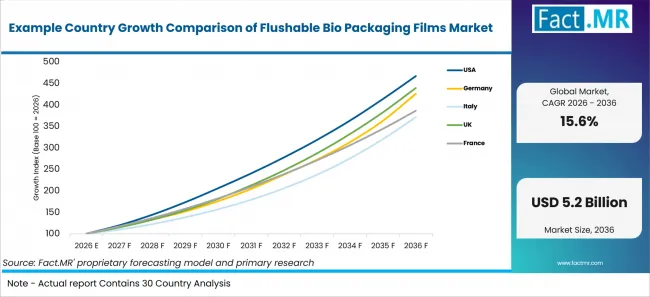
Example Country Growth Comparison Of Flushable Bio Packaging Films Market | Source: Fact.MR
| Country | CAGR (2026-2036) |
|---|---|
| United States | 16.7% |
| United Kingdom | 16.0% |
| Germany | 15.6% |
| France | 14.5% |
| Italy | 14.0% |
Source: Fact.MR analysis. Updated Sep 3, 2026
What supports USA adoption?
16.7% CAGR, supported by unit-dose home-care packaging and online retail scale.
U.S. brand owners use water-soluble sachets where dosing accuracy and shelf stability can be tested before national rollout. The USA is projected to record 16.7% CAGR through 2036. The U.S. Census Bureau reported in May 2026 that retail e-commerce accounted for 16.9% of total retail sales in the first quarter of 2026.
How is the UK scaling demand?
16.0% CAGR, driven by online retail and plastic packaging tax pressure.
UK converters face steady demand for compact wraps and sachets that work in postal and store channels. The market is expected to post 16.0% CAGR through 2036. The Office for National Statistics reported in July 2026 that online spending values rose 11.7% in Quarter 2 2026 compared with Quarter 2 2025.
What supports Germany’s growth?
15.6% CAGR, led by recycling discipline and converter qualification.
Germany’s packaging system gives converters a clear reason to document end-of-life performance before switching film structures. The market is forecast to advance at 15.6% CAGR through 2036. UBA and ZSVR reported in January 2026 that around 5.5 million tonnes of packaging waste collected by the dual systems were recovered in 2024.
How is France developing demand?
14.5% CAGR, supported by professional packaging responsibility rules.
France is widening compliance work for professional packaging used by foodservice, retail and business channels. The market is anticipated to reach 14.5% CAGR through 2036. ADEME reported that three producer responsibility organisations were accredited on 5 June 2026 to roll out the professional packaging EPR scheme.
How does Italy perform?
14.0% CAGR, driven by foodservice conversion and high packaging recovery.
Italian converters serve specialty foods, wraps and portion packs where appearance and sealing quality affect brand approval. The market is estimated to grow at 14.0% CAGR through 2036. Eurostat reported in October 2025 that Italy recycled 162.2 kg of packaging waste per inhabitant in 2023.
Who leads the Flushable Bio Packaging Films Market?
Kuraray is a direct supplier through MonoSol’s PVOH water-soluble films for soluble unit-dose packaging. Kuraray identifies laundry and dishwasher detergent unit-dose systems among the applications for these films.
Aicello Corporation participates through SOLUBLON® water-soluble film for unit-dose and other water-dissolvable packaging applications.
Aquapak Polymers supports dissolvable hygiene formats through Hydropol. Mitsubishi Chemical Corporation supplies HI-SELON, a water-soluble PVOH film used as packaging material for liquid detergent capsules.
Which companies are the key providers?
Key companies include Kuraray; Aicello Corporation; Aquapak Polymers; and Mitsubishi Chemical Corporation.
- Kuraray
- Aicello Corporation
- Mitsubishi Chemical Corporation
- Aquapak Polymers
Bibliography
- European Commission. (2026, August 12). New packaging rules for less waste and easier recycling.
- European Commission. (2026, August 11). New EU packaging rules start to apply, including restrictions on PFAS in food-contact packaging.
- Eurostat. (2025, October 22). Plastic packaging waste in the EU: 35.3 kg per person.
- U.S. Census Bureau. (2026, May 18). Quarterly retail e-commerce sales: 1st quarter 2026. Zeballos, E., & Sinclair, W. (2026, June 11). Total U.S. food spending reached $2.51 trillion in 2025. Economic Research Service, U.S. Department of Agriculture.
- Office for National Statistics. (2026, July 24). Retail sales, Great Britain: June 2026.
- German Environment Agency, & Central Agency Packaging Register. (2026, January 27). Facts against myths: Packaging waste recycling in Germany is working. German Environment Agency.
- ADEME. (2026, July 29). La filière des emballages professionnels agrandit son périmètre.
- International Organization for Standardization. (2026, August). ISO/TS 18671:2026: Test methodologies for assessing the compatibility of wet wipes and moist toilet tissue with the wastewater collection and treatment systems, and appropriate labelling.
- Aquapak Polymers Ltd. (2025, March 12). Hydropol™ set to revolutionise disposable hygiene products, making them dissolvable, fully flushable, microplastic free and preventing them forming fatbergs.
- Department for Environment, Food & Rural Affairs. (2025, December 17). Plastic wet wipes ban. GOV.UK.
This Report Answers
- The report explains where flushable bio packaging films are used across film polymer, disintegration route, package format and performance requirement.
- Segment analysis identifies the leading subsegments and the practical reasons brands prioritize them.
- Country analysis examines listed markets and the regulation, retail, hygiene and foodservice factors supporting adoption.
- Competitive analysis reviews current providers across water-soluble, cellulose and compostable film approaches.
- Application analysis assesses how dissolution control and conversion fit influence commercial approval.
What does the Flushable Bio Packaging Films Market cover?
The flushable packaging substrates view is central to this market because end-of-life behavior is part of the film specification. The assessment covers films used for sachets, pouches, wraps, liners and specialty flexible formats where dissolution, dispersion or compostability must be verified.
The scope includes material families that overlap with water soluble packaging and dispersible bio films when the film is used as packaging. It covers PVOH, cellulose, PHA, starch-based structures and other dispersible biopolymers.
What is included in the scope?
The scope includes films sold for unit-dose sachets, hygiene liners, flexible pouches and foodservice wraps. It includes materials used in bioplastics for packaging when the film has a defined disintegration route.
It includes products that overlap with compostable laminate packaging materials where a film layer provides sealing, barrier or end-of-life performance. It also includes marine biodegradable films where aqueous biodegradation is part of the claim and application fit.
What is excluded from the scope?
The scope excludes rigid packaging, ordinary polyethylene film and finished hygiene products sold as consumer goods. Conventional films are outside scope unless they form part of a flushable, dispersible or compostable packaging design.
General resin sales are outside scope when sold apart from a packaging film. Packaging machinery and basic paperboard remain outside scope unless sold with polyvinyl alcohol films or bio barrier coatings that support listed applications.
How Was the Analysis Built?
The analysis draws on 120+ sources, 35+ company portfolios, 25+ countries, and more than 20 industry interviews.
- Primary Research: Primary research includes discussions with manufacturers, service providers, technology developers, distributors, end users, and subject-matter experts. These conversations examine purchasing priorities, product adoption, operational challenges, approval requirements, competitive positioning, and the factors that influence wider market acceptance.
- Desk Research: Desk research covers government statistics, regulatory publications, company filings, trade data, technical studies, industry associations, standards, public policy, and other authoritative sources. Every source used in the analysis is documented in the bibliography.
- Market Sizing and Forecasting: Market estimates combine historical performance, demand indicators, pricing and volume trends, segment shares, company participation, country-level growth, adoption patterns, investment activity, and barriers to market expansion.
- Data Validation and Update Cycle: Findings are validated by comparing primary interviews with public data, company activity, regulatory changes, trade patterns, and industry developments. Regular updates review new product launches, capacity changes, partnerships, approvals, and shifts in commercial adoption.
Segmentation
What is the report’s scope and coverage?
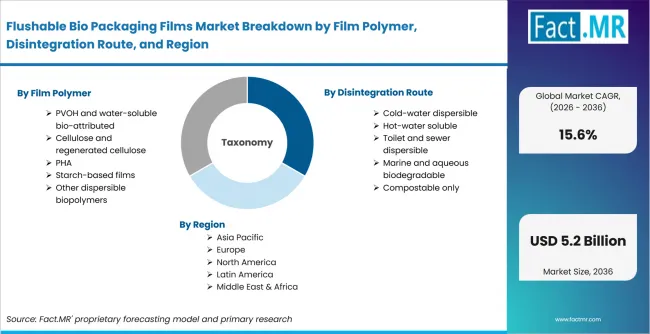
Flushable Bio Packaging Films Market Breakdown By Film Polymer, Disintegration Route, And Region | Source: Fact.MR
| Attribute | Details |
|---|---|
| Quantitative Units | USD billion |
| Market Definition | Bio-based, water-soluble, dispersible, compostable or aqueous-biodegradable films used in flexible packaging formats where post-use dissolution, dispersion or composting behavior is part of the product specification. |
| Film Polymer | PVOH and water-soluble bio-attributed; Cellulose and regenerated cellulose; PHA; Starch-based films; Other dispersible biopolymers |
| Disintegration Route | Cold-water dispersible; Hot-water soluble; Toilet and sewer dispersible; Marine and aqueous biodegradable; Compostable only |
| Package Format | Unit-dose and sachet film; Hygiene overwrap and liner; Flexible pouches; Foodservice wraps; Specialty medical and other |
| Performance Requirement | Controlled dissolution; Wet strength before disposal; Sealability; Barrier performance; Printability and machinability |
| Regions Covered | North America; Latin America; Western Europe; Eastern Europe; East Asia; South Asia & Pacific; Middle East & Africa |
| Countries Covered | United States; United Kingdom; Germany; France; Italy |
| Key Companies Profiled | Kuraray; Aicello Corporation; Aquapak Polymers; Mitsubishi Chemical Corporation |
| Forecast Period | 2026 to 2036 |
| Approach | Hybrid top-down and bottom-up approach using film polymer mix, application volume, disposal-route qualification, country regulation, company portfolio review and converter validation. |
Source: Fact.MR analysis. Updated Sep 3, 2026
How is the market segmented?
-
By Film Polymer:
- PVOH and water-soluble bio-attributed
- Cellulose and regenerated cellulose
- PHA
- Starch-based films
- Other dispersible biopolymers
-
By Disintegration Route:
- Cold-water dispersible
- Hot-water soluble
- Toilet and sewer dispersible
- Marine and aqueous biodegradable
- Compostable only
-
By Package Format:
- Unit-dose and sachet film
- Hygiene overwrap and liner
- Flexible pouches
- Foodservice wraps
- Specialty medical and other
-
By Performance Requirement:
- Controlled dissolution
- Wet strength before disposal
- Sealability
- Barrier performance
- Printability and machinability
-
By Region:
- North America
- Latin America
- Western Europe
- Eastern Europe
- East Asia
- South Asia & Pacific
- Middle East & Africa
Frequently Asked Questions
How big is the flushable bio packaging films market in 2026?
What is the CAGR of the flushable bio packaging films market from 2026 to 2036?
Which film polymer leads the flushable bio packaging films market?
Which disintegration route leads the flushable bio packaging films market?
Who are the leading companies in the flushable bio packaging films market?
Who worked on this report


Preview the report firsthand - request a free sample
Free SampleGet the brochure for pricing and purchase details
Download PDF