- Market Value (2025): USD 9.4 Bn
- Estimated Value (2026): USD 10.4 Bn
- Forecast Value (2036): UUSD 27.7 Bn
- CAGR (2026-2036): 10.3%
What is the DNA Repair Drugs Market forecast to be worth by 2036?
USD 10.4 billion in 2026 to USD 27.7 billion by 2036 at 10.3% CAGR.
- The DNA Repair Drugs Market was valued at USD 9.4 billion in 2025 as oncology teams used DNA repair pathway medicines in selected cancer care settings.
- Demand is projected to increase from USD 10.4 billion in 2026 to USD 27.7 billion by 2036.
- The market is forecast to record 10.3% CAGR from 2026 to 2036 owing to biomarker-led prescribing and hospital pharmacy access.
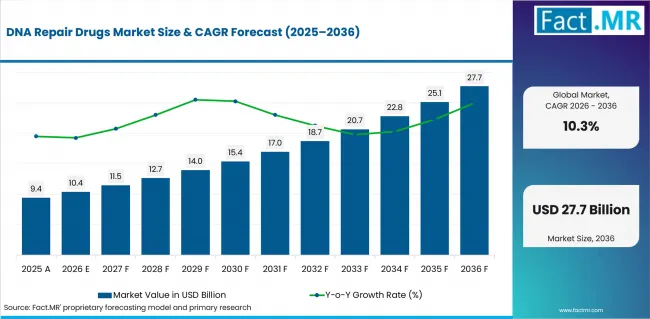
Dna Repair Drugs Market Value Analysis | Source: Fact.MR
What are the defining numbers behind DNA Repair Drugs Market growth?
USD 17.3 billion absolute opportunity by 2036, led by PARP Inhibitors and Breast Cancer applications alongside Hospitals and Hospital Pharmacies.
- Demand Drivers in the Market
- Biomarker testing helps clinicians identify patients who may respond to PARP inhibitor therapy. This makes treatment selection easier to explain during oncology review.
- Breast cancer pathways provide a clear use case since BRCA status can guide therapy choice. Hospitals still need clean evidence before wider use.
- Hospital pharmacies remain central to access because these drugs need benefit checks and safety follow-up. This keeps prescribing and dispensing under one controlled route.
- Combination therapy research is expected to keep supplier pipelines active beyond first PARP inhibitor use. Buyers are likely to compare safety records before approving broader protocols.
- Key Segments Analyzed
- By Drug Type: PARP Inhibitors are expected to hold 38.5% share in 2026 because they have the clearest clinical use base within DNA repair pathway treatment.
- By Application: Breast Cancer is projected to hold 31.2% share in 2026 as biomarker testing gives this use case a defined treatment-selection route.
- By End User: Hospitals are anticipated to account for 30.6% share in 2026 since treatment review and safety monitoring usually remain inside oncology systems.
- By Distribution Channel: Hospital Pharmacies are estimated to represent 30.4% share in 2026 due to reimbursement checks and controlled dispensing needs.
- By Mechanism of Action: PARP Enzyme Inhibition is forecast to hold 41.7% share in 2026 because it anchors the largest set of pathway-specific therapies.
- Analyst Opinion at Fact.MR
- Shambhu Nath Jha, Senior Analyst at Fact.MR, states, “DNA repair drugs are being judged on patient-selection clarity instead of product breadth. Hospitals want evidence that the drug fits the biomarker result. They need proof that the cancer pathway and pharmacy review step can support wider use.”
- Strategic Implications
- Oncology providers need clear patient-selection rules before expanding PARP inhibitor use. Companion diagnostic results must reach treatment teams on time.
- Suppliers can improve market access by explaining how PARP inhibitors fit breast and ovarian cancer treatment. Reliable testing supports better therapy decisions.
- Investors need to separate direct DNA repair drug exposure from wider oncology spending. Pipeline value increases when new drugs improve treatment access or pharmacy control.
The USA is expected to record a 13.4% CAGR from 2026 to 2036, supported by documentation-led hospital purchasing and biomarker testing depth. Japan is projected to record a 12.3% CAGR through quality-focused oncology review. Germany is anticipated to grow at 11.3% as evidence-led procurement guides hospital adoption. The UK is estimated to post a 10.3% CAGR through reimbursement discipline and pathway review. Canada is forecast at 9.3%, supported by service coverage across specialist cancer centers. Australia is projected to reach 8.2% through access planning and dependable pharmacy channels. Brazil is expected to grow at 7.3% where distributor reach and specialist availability shape adoption.
How does the DNA Repair Drugs Market break down by segment?
PARP Inhibitors are expected to lead Drug Type at 38.5% share in 2026. Breast Cancer is projected to lead Application at 31.2% share in 2026.
Why does PARP Inhibitors lead Drug Type?
PARP Inhibitors are projected to account for 38.5% share in 2026.
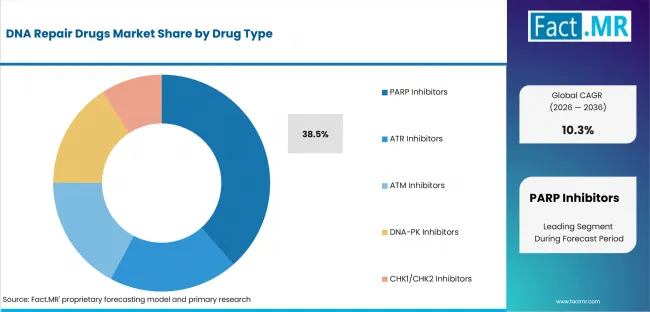
Dna Repair Drugs Market Analysis By Drug Type | Source: Fact.MR
PARP inhibitors hold the top position as oncology teams already use them in biomarker-led treatment plans. Olaparib-Based Drugs and Niraparib-Based Drugs strengthen this established base. ATR Inhibitors remain more limited because their use is still concentrated in research and combination therapies.
Why does Breast Cancer lead Application?
Breast Cancer is expected to hold 31.2% share in 2026.
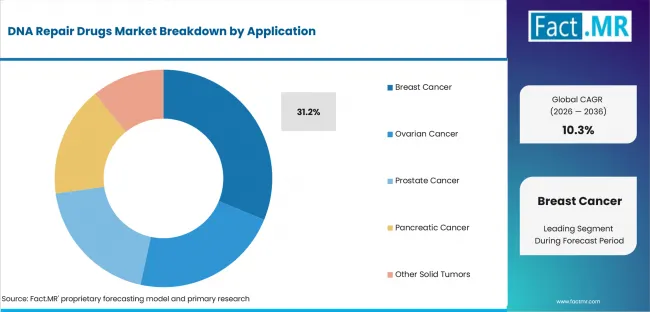
Dna Repair Drugs Market Analysis By Application | Source: Fact.MR
Breast cancer gains the largest share through the clear role of BRCA testing in treatment selection. HER2-Negative Breast Cancer and BRCA-Mutated Breast Cancer create well-defined patient groups. In comparison, Ovarian Cancer follows a separate demand path through maintenance therapy and longer treatment planning.
Why does Hospitals lead End User?
Hospitals are anticipated to account for 30.6% share in 2026.
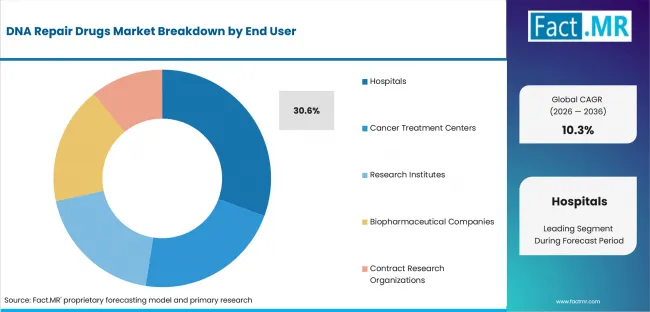
Dna Repair Drugs Market Analysis By End User | Source: Fact.MR
Most PARP inhibitor treatment is managed in hospitals because several teams are involved in each case. Oncologists review eligibility, diagnostic teams confirm biomarkers and pharmacy staff control dispensing. Specialty Cancer Hospitals support high patient volumes, while General Hospitals and Cancer Treatment Centers extend access to broader populations.
Why does Hospital Pharmacies lead Distribution Channel?
Hospital Pharmacies are estimated to represent 30.4% share in 2026.
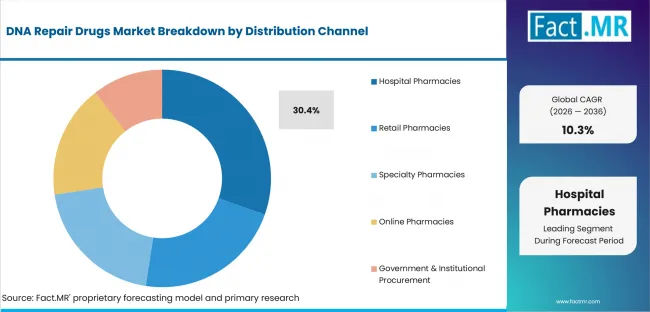
Dna Repair Drugs Market Analysis By Distribution Channel | Source: Fact.MR
Hospital pharmacies stay ahead by keeping reimbursement checks, prescription review and repeat supply within the treatment setting. Inpatient Pharmacies support urgent care needs. Outpatient and Retail Pharmacies widen access, although they depend on clear monitoring and refill rules.
Why does PARP Enzyme Inhibition lead Mechanism of Action?
PARP Enzyme Inhibition is forecast to hold 41.7% share in 2026.
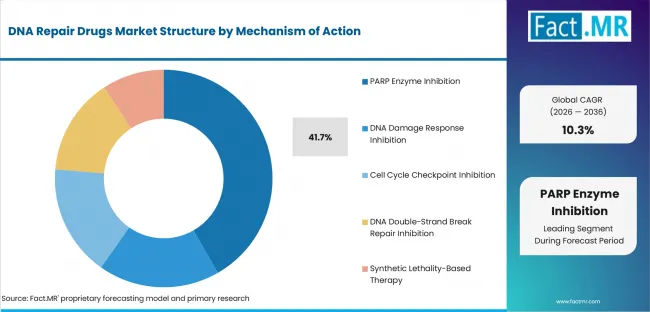
Dna Repair Drugs Market Analysis By Mechanism Of Action | Source: Fact.MR
Among DNA repair approaches, PARP enzyme inhibition has the strongest commercial use and clearest treatment pathway. PARP1 Inhibition and PARP1/2 Dual Inhibition allow more targeted positioning. Meanwhile, DNA Damage Response Inhibition remains important mainly for future drug development and pipeline expansion.
What is accelerating DNA Repair Drugs Market adoption, and what is holding it back?
Demand will rise with biomarker-based treatment and hospital pharmacy access. Reimbursement checks and safety monitoring may slow adoption.
Drivers Impact Analysis
| Biomarker-led PARP inhibitor selection | High | USA, Japan, Germany | Short term (<= 2 years) |
|---|---|---|---|
| Breast cancer treatment workflow demand | High | USA, UK, Canada | Short term (<= 2 years) |
| Hospital pharmacy access and monitoring | High | USA and Australia | Medium term (2-4 years) |
| Combination therapy pipeline activity | High | Germany, Japan, Brazil | Medium term (2-4 years) |
| Companion diagnostic coordination | High | Specialist oncology markets | Long term (>= 4 years) |
Source: Fact.MR analysis. Updated Jul 29, 2026
- Biomarker-led PARP inhibitor selection: Testing evidence is expected to make patient selection easier to defend. Hospitals can approve use faster when the report supports the therapy choice.
- Breast cancer treatment workflow demand: Breast cancer pathways are expected to support repeat drug review. Biomarker status can influence whether PARP inhibitor therapy enters the care plan.
- Hospital pharmacy access and monitoring: Hospital pharmacies are expected to remain central to dispensing control. They help manage benefit checks and adverse-event follow-up before repeat supply.
- Combination therapy pipeline activity: Combination studies are expected to keep interest active beyond single-agent PARP inhibitor use. Clinical buyers still need safety clarity before wider use.
- Companion diagnostic coordination: Diagnostic partners are expected to improve adoption when test reporting supports treatment timing. Weak coordination can delay therapy review and reduce conversion.
Opportunity Impact Analysis
| OPPORTUNITY | QUALITATIVE RELEVANCE | GEOGRAPHIC RELEVANCE | IMPACT TIMELINE |
|---|---|---|---|
| Breast cancer workflow packages | High | USA and Japan | Medium term (2-4 years) |
| Testing-to-pharmacy service coordination | Moderate | UK and Canada | Medium term (2-4 years) |
| PARP inhibitor validation support | Moderate | Germany and Australia | Long term (>= 4 years) |
| Pipeline partnerships for DNA-damage-response drugs | Moderate | Research-led oncology markets | Long term (>= 4 years) |
Source: Fact.MR analysis. Updated Jul 29, 2026
- Breast cancer workflow packages: Suppliers can improve conversion by pairing therapy education with testing and pharmacy approval steps. This helps providers understand how treatment should move from diagnosis to dispensing.
- Testing-to-pharmacy service coordination: Providers that reduce delays between genetic test results and pharmacy review are likely to gain preference. The benefit is clearest when oncology teams work across several sites.
- PARP inhibitor validation support: Suppliers can support adoption by giving hospitals simple evidence packs for protocol review. Clear safety notes and patient-selection guidance can reduce approval friction.
- Pipeline partnerships for DNA-damage-response drugs: Research partners can create new treatment options where single-agent use is limited. Commercial value depends on trial progress that improves availability or pathway fit.
Restraints Impact Analysis
| RESTRAINT | QUALITATIVE RELEVANCE | GEOGRAPHIC RELEVANCE | IMPACT TIMELINE |
|---|---|---|---|
| Reimbursement review for PARP inhibitor use | High | USA, UK, Canada | Short term (<= 2 years) |
| Safety monitoring and adverse-event burden | Moderate | Hospital oncology settings | Short term (<= 2 years) |
| Uneven access to biomarker testing | Moderate | Brazil and regional care sites | Medium term (2-4 years) |
| Slower pathway approval for combination therapy | Selective | Research-led markets | Long term (>= 4 years) |
Source: Fact.MR analysis. Updated Jul 29, 2026
- Reimbursement review for PARP inhibitor use: Adoption slows when payers require more proof before treatment approval. Hospitals may delay prescribing if benefit checks are uncertain.
- Safety monitoring and adverse-event burden: Oncology teams must track side effects through the treatment period. Monitoring work can limit use in centers with thin staffing.
- Uneven access to biomarker testing: Therapy selection becomes harder where genetic testing is delayed or unavailable. This can reduce demand even when the drug is approved.
- Slower pathway approval for combination therapy: Combination use requires careful review of safety and treatment sequence. New protocols may take longer to move from research into routine care.
Which countries are scaling DNA Repair Drugs Market fastest?
The country comparison is defined by a narrow spread between mature oncology markets. The USA and Japan form the upper pair through testing depth and hospital review discipline. Germany remains aligned with the global rate. The UK and Canada follow slightly slower paths. Australia and Brazil are shaped by reimbursement limits and service coverage.
- The USA shows the highest listed CAGR because hospital systems can connect biomarker results with specialist prescribing. Pharmacy control supports repeat use when monitoring is clear.
- Japan remains close to the USA through quality review and oncology service discipline. Adoption is careful but consistent when hospitals can confirm pathway fit.
- Germany tracks the global rate because buyers require strong evidence before expanding use. Hospital procurement teams are likely to test therapy value against clinical documentation.
- The UK is shaped by reimbursement review and pathway discipline. Approval can take time but access becomes more orderly once the pathway is accepted.
- Canada and Australia depend more on service coverage across specialist sites. Distance and refill support can affect how smoothly treatment reaches patients.
- Brazil remains a distributor-led opportunity where access depends on specialist channels. Reliable therapy availability is expected to matter more than broad portfolio claims.
The full report provides country-level CAGR analysis across North America and Latin America. Coverage extends to Europe and East Asia. South Asia and Oceania is reviewed with the Middle East and Africa.
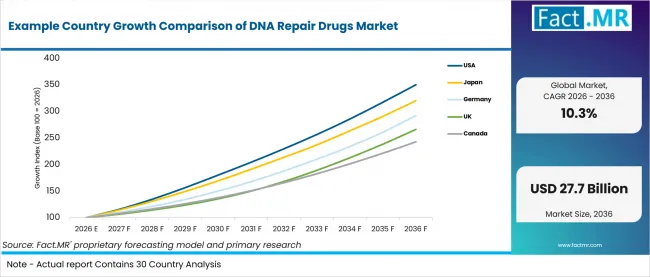
Example Country Growth Comparison Of Dna Repair Drugs Market | Source: Fact.MR
| Country | CAGR (2026-2036) |
|---|---|
| USA | 13.4% |
| Japan | 12.3% |
| Germany | 11.3% |
| UK | 10.3% |
| Canada | 9.3% |
| Australia | 8.2% |
| Brazil | 7.3% |
Source: Fact.MR analysis. Updated Jul 29, 2026
What supports USA adoption?
13.4% CAGR, supported by documentation-led hospital purchasing and biomarker testing depth.
In the USA, growth is closely tied to the strength of biomarker testing and hospital approval systems. PARP inhibitor use can expand faster when test results move smoothly into prescribing and pharmacy review. Clear guidance on patient selection, treatment safety and follow-up gives suppliers a stronger position with oncology teams.
How is Japan building demand?
12.3% CAGR, driven by quality-focused oncology review and controlled therapy access.
Japan is building demand through careful clinical assessment and controlled treatment access. Hospitals place strong value on handling guidance, safety records and consistent supply. DNA repair drugs are more likely to gain acceptance when they fit established cancer-care routines without adding unnecessary complexity.
What shapes Germany’s route to adoption?
11.3% CAGR, backed by evidence-led procurement and specialist cancer care.
Germany follows an evidence-first route where hospitals review clinical value before expanding treatment protocols. Pharmacy oversight, testing readiness and safety data all influence approval. Suppliers can support wider use by linking documentation directly to treatment decisions instead of relying on broad product claims.
Why does the UK remain slightly below the global rate?
10.3% CAGR, influenced by reimbursement review and structured pathway approval.
Formal reimbursement checks and structured cancer pathways keep UK adoption slightly below the global pace. Early uptake may slow when drug cost and patient-selection evidence require additional review. Demand improves once suppliers clearly show how the therapy fits testing, prescribing and follow-up requirements.
How does Canada convert specialist oncology demand?
9.3% CAGR, supported by cancer-center coverage and service dependability.
Across Canada, specialist demand depends on maintaining consistent support over a wide healthcare network. Cancer centers need reliable testing, prescribing and refill access before expanding use. Suppliers that reduce gaps in service and follow-up are more likely to convert interest into repeat hospital demand.
What supports Australia’s growth?
8.2% CAGR, led by access planning and dependable pharmacy channels.
Australia gains momentum where hospitals can coordinate testing, treatment and repeat dispensing across large distances. Simple patient-selection processes and dependable pharmacy channels help reduce delays. Suppliers that support monitoring without adding extra steps can strengthen adoption among oncology teams.
How is Brazil developing demand?
7.3% CAGR, shaped by specialist availability and distributor reach.
Brazil’s market is developing through specialist oncology centers and stronger distributor coverage. Uneven testing access and refill support can still limit wider use. Stable product availability, clear patient-selection guidance and dependable clinical support can help suppliers improve acceptance across hospitals.
Who leads the DNA Repair Drugs Market?
AstraZeneca plc and Merck & Co., Inc. show the clearest direct relevance through PARP inhibitor commercialization. GSK plc and Pfizer Inc. widen the provider set through oncology and targeted-therapy portfolios.
AstraZeneca plc and Merck & Co., Inc. support the market through established PARP inhibitor activity. GSK plc adds oncology reach through its DNA repair therapy portfolio. Pfizer Inc. strengthens the competitive field through targeted cancer medicines. Johnson & Johnson add broader oncology development capability. Repare Therapeutics Inc. and Artios Pharma Limited extend pipeline depth in DNA-damage-response research.
From 2026 to 2036, providers will compete on patient-selection support, safety guidance and reliable drug access. Hospitals will review supply strength and treatment fit before wider use. Companies that simplify approval may gain more demand from cancer centers and hospital pharmacies.
Which companies are the key providers?
Key companies include AstraZeneca plc; Merck & Co., Inc.; GSK plc; Pfizer Inc.; Johnson & Johnson; Repare Therapeutics Inc.; Artios Pharma Limited.
- AstraZeneca plc
- Merck & Co., Inc.
- GSK plc
- Pfizer Inc.
- Johnson & Johnson
- Repare Therapeutics Inc.
- Artios Pharma Limited
How is the market segmented?
-
By Drug Type:
- PARP Inhibitors
- Olaparib-Based Drugs
- Niraparib-Based Drugs
- ATR Inhibitors
- Other DNA Repair Pathway Drugs
-
By Application:
- Breast Cancer
- HER2-Negative Breast Cancer
- BRCA-Mutated Breast Cancer
- Ovarian Cancer
- Prostate Cancer
- Other Oncology Applications
-
By End User:
- Hospitals
- Specialty Cancer Hospitals
- General Hospitals
- Cancer Treatment Centers
- Research and Academic Institutes
-
By Distribution Channel:
- Hospital Pharmacies
- Inpatient Pharmacies
- Outpatient Pharmacies
- Retail Pharmacies
- Online Pharmacies
-
By Mechanism of Action:
- PARP Enzyme Inhibition
- PARP1 Inhibition
- PARP1/2 Dual Inhibition
- DNA Damage Response Inhibition
- Other DNA Repair Mechanisms
-
By Region:
- North America
- USA
- Canada
- Europe
- Germany
- UK
- East Asia
- Japan
- South Asia and Oceania
- Australia
- Latin America
- Brazil
- North America
Bibliography
- Pfizer Inc. (2025, February 13). Pfizer’s TALZENNA in combination with XTANDI improves survival outcomes in metastatic castration-resistant prostate cancer.
- GlaxoSmithKline Pharmaceuticals Limited. (2025, August 25). GSK enters oncology in India with Jemperli and Zejula, bringing precision therapies for gynecological cancers.
- U.S. Food and Drug Administration. (2025, December 12). FDA approves niraparib and abiraterone acetate plus prednisone for BRCA2-mutated metastatic castration-sensitive prostate cancer.
- National Cancer Institute. (2025, May 14). Ovarian epithelial, fallopian tube, and primary peritoneal cancer treatment (PDQ®): Health professional version. National Institutes of Health.
This Report Answers
- The report provides strategic intelligence on the DNA Repair Drugs Market across Drug Type and Application choices that shape oncology treatment planning.
- Segment analysis covers PARP Inhibitors and Breast Cancer as the share leaders within the 2026 market.
- Country outlook evaluates the USA and Japan alongside Germany and the UK. Canada, Australia and Brazil complete the growth comparison across the profiled markets.
- Competitive analysis profiles AstraZeneca plc and Merck & Co., Inc. GSK plc and Pfizer Inc. widen the provider review. Johnson & Johnson are covered with Repare Therapeutics Inc. and Artios Pharma Limited.
- Access assessment covers Hospital Pharmacies and hospital use. Research programs and targeted-treatment review complete the market view.
What does the DNA Repair Drugs Market cover?
DNA repair drugs are used in cancer care where defects in repair pathways help guide treatment decisions.
The DNA Repair Drugs Market covers medicines used across PARP inhibitor therapy and other DNA-damage-response approaches. Coverage extends to breast cancer, ovarian cancer and prostate cancer where biomarker testing supports treatment selection. Hospitals and hospital pharmacies are included when they manage prescribing review, safety follow-up and controlled dispensing.
The market differs from general oncology drugs because commercial value comes from matching a therapy with a biomarker-defined patient group. Standard chemotherapy remains outside the boundary. Supportive-care medicines are excluded. General cancer screening is excluded unless the testing result directly affects DNA repair drug use.
What is included in the scope?
DNA repair drugs are used across hospitals and specialty cancer centers. Research and academic institutes are included where pathway drugs support treatment studies and development work.
The scope includes Drug Type and Application alongside End User, Distribution Channel and Mechanism of Action. Coverage spans PARP Inhibitors and olaparib-based drugs. Niraparib-based drugs and ATR inhibitors complete the drug-type scope. It includes Breast Cancer, HER2-Negative Breast Cancer and BRCA-Mutated Breast Cancer. Ovarian Cancer and Prostate Cancer follow the same treatment-use rule.
What is excluded from the scope?
General oncology medicines without a DNA repair pathway role remain outside the scope of this market.
The scope excludes drugs that do not target DNA repair or DNA-damage-response pathways. Standard chemotherapy and immunotherapy are excluded unless their use is part of a DNA repair drug regimen. General diagnostic testing is excluded unless the result supports patient selection for these medicines. Company revenue without a clear connection to DNA repair drug use remains excluded.
How Was the Analysis Built?
The analysis draws on 120+ sources, 35+ company portfolios, 25+ countries, and more than 20 industry interviews.
- Primary Research: Primary research includes discussions with manufacturers, service providers, technology developers, distributors, end users, procurement teams, and subject-matter experts. These conversations examine purchasing priorities, product adoption, operational challenges, approval requirements, competitive positioning, and the factors that influence wider market acceptance.
- Desk Research: Desk research covers government statistics, regulatory publications, company filings, trade data, technical studies, industry associations, standards, public policy, and other authoritative sources. Every source used in the analysis is documented in the bibliography.
- Market Sizing and Forecasting: Market estimates combine historical performance, demand indicators, pricing and volume trends, segment shares, company participation, country-level growth, adoption patterns, investment activity, and barriers to market expansion.
- Data Validation and Update Cycle: Findings are validated by comparing primary interviews with public data, company activity, regulatory changes, trade patterns, and industry developments. Regular updates review new product launches, capacity changes, partnerships, approvals, procurement trends, and shifts in commercial adoption.
Segmentation
What is the report’s scope and coverage?
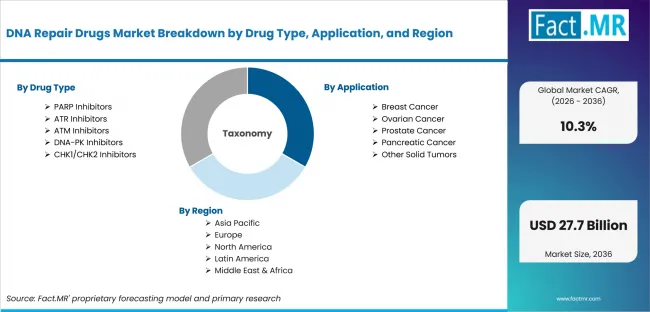
Dna Repair Drugs Market Breakdown By Drug Type, Application, And Region | Source: Fact.MR
| Attribute | Details |
|---|---|
| Quantitative Units | USD billion in 2026 to USD billion by 2036 at CAGR |
| Market Definition | Commercial sale and clinical use of medicines that target DNA repair pathways in cancer care where biomarker results support patient selection, prescribing review and controlled pharmacy access |
| Drug Type | PARP Inhibitors; Olaparib-Based Drugs; Niraparib-Based Drugs; ATR Inhibitors; Other DNA Repair Pathway Drugs |
| Application | Breast Cancer; HER2-Negative Breast Cancer; BRCA-Mutated Breast Cancer; Ovarian Cancer; Prostate Cancer; Other Oncology Applications |
| End User | Hospitals; Specialty Cancer Hospitals; General Hospitals; Cancer Treatment Centers; Research and Academic Institutes |
| Distribution Channel | Hospital Pharmacies; Inpatient Pharmacies; Outpatient Pharmacies; Retail Pharmacies; Online Pharmacies |
| Mechanism of Action | PARP Enzyme Inhibition; PARP1 Inhibition; PARP1/2 Dual Inhibition; DNA Damage Response Inhibition; Other DNA Repair Mechanisms |
| Regions Covered | North America; Latin America; Europe; East Asia; South Asia and Pacific; Middle East and Africa |
| Countries Covered | USA; Japan; Germany; UK; Canada; Australia; Brazil |
| Key Companies Profiled | AstraZeneca plc; Merck & Co., Inc.; GSK plc; Pfizer Inc.; Johnson & Johnson; Repare Therapeutics Inc.; Artios Pharma Limited |
| Forecast Period | 2026 to 2036 |
| Approach | Hybrid top-down and bottom-up approach using oncology drug demand; PARP inhibitor use; biomarker testing activity; breast cancer treatment pathways; hospital pharmacy access; reimbursement review; safety monitoring needs; country adoption patterns and company portfolio review |
Source: Fact.MR analysis. Updated Jul 29, 2026
Frequently Asked Questions
Which Drug Type leads the market?
Which Application leads the market?
Which End User category leads the market?
Which Distribution Channel leads the market?
Which Mechanism of Action leads the market?
Which country records the highest listed CAGR?
What is the primary driver in this market?
What is the main restraint?
Why do hospitals lead demand?
Who worked on this report


Preview the report firsthand - request a free sample
Free SampleGet the brochure for pricing and purchase details
Download PDF