- Market Value (2025): USD 1.6 Bn
- Estimated Value (2026): USD 1.8 Bn
- Forecast Value (2036): USD 5.9 Bn
- CAGR (2026-2036): 12.7%
What is the DNA Encoded Library Market forecast to be worth by 2036?
USD 1.8 billion in 2026 to USD 5.9 billion by 2036 at 12.7% CAGR.
- The DNA encoded library market reached USD 1.6 billion in 2025 as pharmaceutical companies, discovery CROs, biotech sponsors and academic screening groups increased spending where drug discovery teams need larger chemical search space, faster hit identification and more efficient early screening.
- Demand is projected to increase from USD 1.8 billion in 2026 to USD 5.9 billion by 2036.
- The market is forecast to record 12.7% CAGR from 2026 to 2036.
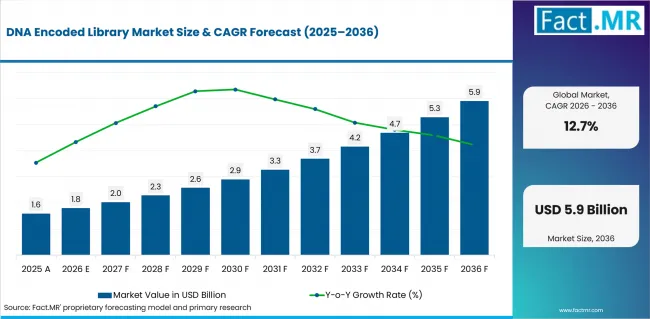
Dna Encoded Library Market Value Analysis | Source: Fact.MR
What are the defining numbers behind DNA Encoded Library Market growth?
USD 4.1 billion absolute opportunity is expected by 2036.
- Demand Drivers in the Market
- Single-pharmacophore libraries lead because they offer focused chemical diversity that can be screened efficiently against defined targets.
- Drug discovery remains the core application because encoded libraries help teams search large compound sets before committing to conventional synthesis programs.
- Pharmaceutical companies lead demand because they have the target portfolios, screening budgets and follow-up chemistry needed to convert hits.
- Affinity-based screening leads because it matches the encoded-library workflow of target binding, sequencing and hit confirmation.
- Key Segments Analyzed
- By Library Type: Single-Pharmacophore Libraries are expected to hold 41.3% share in 2026 because focused library design supports efficient screening against defined targets.
- By Application: Drug Discovery is expected to hold 33.3% share in 2026 because DEL platforms are used most directly for early hit discovery and lead generation.
- By End User: Pharmaceutical Companies are expected to hold 36.0% share in 2026 because pharma buyers have the target portfolios and budgets to fund screening and follow-up chemistry.
- By Screening Method: Affinity-Based Screening is expected to hold 46.5% share in 2026 because the method fits target binding, sequencing and hit-confirmation workflows.
- By Therapeutic Area: Oncology is expected to hold 34.4% share in 2026 because oncology programs often require broad chemical exploration against difficult targets.
- Analyst Opinion at Fact.MR
- Shambhu Nath Jha, Sr. Consultant at Fact.MR, states, "DEL demand depends on what happens after the screen. Sponsors want chemical diversity, but they also want validated hits, clean data and a credible path from sequence output to follow-up chemistry."
- Strategic Implications
- DEL providers should show hit-confirmation workflows, not only library size.
- Pharma buyers need clear IP terms, assay controls and follow-up synthesis plans before expanding programs.
- CROs can gain share by combining library access with sequencing, data analysis and medicinal chemistry support.
- South Korea is projected at 13.7%; USA is projected at 13.2%; UK is projected at 13.1%; Australia is projected at 12.7%; Germany is projected at 12.4%; Canada is projected at 12.2%; Japan is projected at 11.7% during 2026 to 2036. Country analysis is shaped by biopharma R&D intensity, CRO capacity and access to validated screening workflows.
How does the DNA Encoded Library Market break down by segment?
Single-Pharmacophore Libraries leads Library Type at 41.3% share in 2026, while Drug Discovery leads Application at 33.3% share.
Why does Single-Pharmacophore Libraries lead Library Type?
Single-Pharmacophore Libraries is expected to account for 41.3% share in 2026.
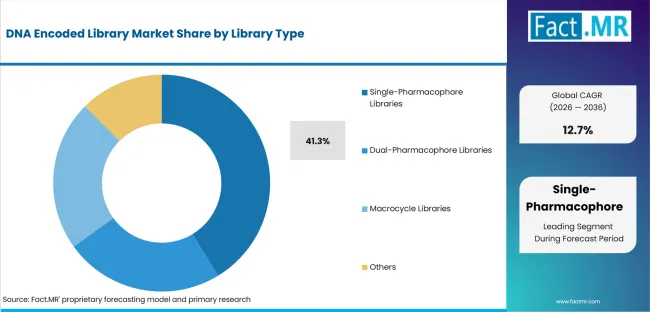
Dna Encoded Library Market Analysis By Library Type | Source: Fact.MR
Single-Pharmacophore Libraries lead the library type segment because focused library design supports efficient screening against defined targets.
Why does Drug Discovery lead Application?
Drug Discovery is expected to account for 33.3% share in 2026.
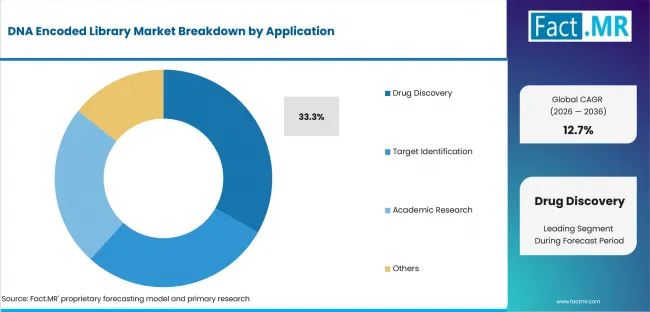
Dna Encoded Library Market Analysis By Application | Source: Fact.MR
Drug Discovery leads the application segment because DEL platforms are used most directly for early hit discovery and lead generation.
Why does Pharmaceutical Companies lead End User?
Pharmaceutical Companies is expected to account for 36.0% share in 2026.
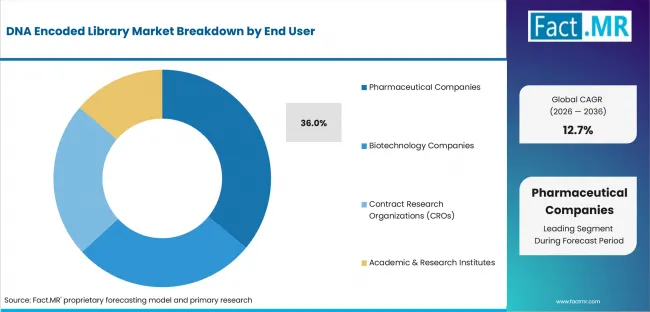
Dna Encoded Library Market Analysis By End User | Source: Fact.MR
Pharmaceutical Companies lead the end user segment because pharma buyers have the target portfolios and budgets to fund screening and follow-up chemistry.
Why does Affinity-Based Screening lead Screening Method?
Affinity-Based Screening is expected to account for 46.5% share in 2026.
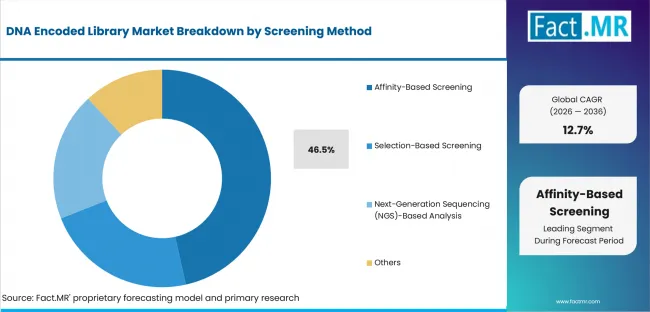
Dna Encoded Library Market Analysis By Screening Method | Source: Fact.MR
Affinity-Based Screening leads the screening method segment because the method fits target binding, sequencing and hit-confirmation workflows.
Why does Oncology lead Therapeutic Area?
Oncology is expected to account for 34.4% share in 2026.
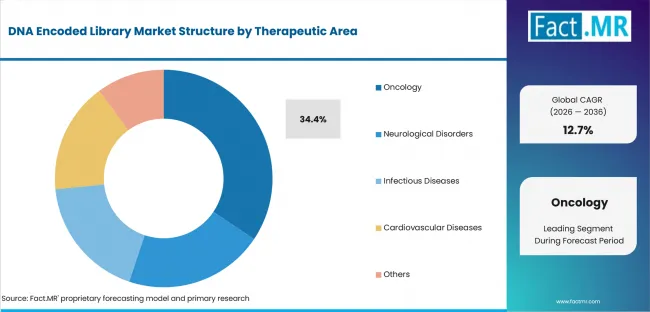
Dna Encoded Library Market Analysis By Therapeutic Area | Source: Fact.MR
Oncology leads the therapeutic area segment because oncology programs often require broad chemical exploration against difficult targets.
What is accelerating DNA Encoded Library Market adoption, and what is holding it back?
Demand is supported by early discovery productivity needs, oncology target work and outsourced screening capacity. Growth is held back by hit-validation risk, assay quality concerns and specialist workflow requirements.
| DRIVER | QUALITATIVE RELEVANCE | GEOGRAPHIC RELEVANCE | IMPACT TIMELINE |
|---|---|---|---|
| Single-pharmacophore libraries | High | South Korea | Short term (<=2 years) |
| Drug discovery | High | USA | Short term (<=2 years) |
| Pharma demand | Moderate | UK | Medium term (2-4 years) |
| Affinity-based screening | Selective | Australia | Medium term (2-4 years) |
Source: Fact.MR analysis. Updated Jul 29, 2026
- Single-pharmacophore libraries: Focused design helps teams screen chemical space without losing target relevance.
- Drug discovery: DEL platforms support early hit finding before larger medicinal chemistry investment.
- Pharma demand: Pharmaceutical companies have the target portfolios and budgets needed for repeat screening.
- Affinity-based screening: Binding, sequencing and confirmation fit the core DEL workflow.
Opportunity Impact Analysis
| OPPORTUNITY | QUALITATIVE RELEVANCE | GEOGRAPHIC RELEVANCE | IMPACT TIMELINE |
|---|---|---|---|
| Integrated DEL and medicinal chemistry services | High | South Korea | Medium term (2-4 years) |
| Oncology and difficult-target programs | Moderate | USA | Medium term (2-4 years) |
| CRO partnerships | Selective | UK | Medium term (2-4 years) |
Source: Fact.MR analysis. Updated Jul 29, 2026
- Integrated DEL and medicinal chemistry services can help sponsors move from hits to leads faster.
- Oncology and difficult-target programs create demand for broader and more focused libraries.
- CRO partnerships can widen access for biotech companies without in-house DEL capability.
Restraints Impact Analysis
| RESTRAINT | QUALITATIVE RELEVANCE | GEOGRAPHIC RELEVANCE | IMPACT TIMELINE |
|---|---|---|---|
| False positives and weak hit validation | High | South Korea | Short term (<=2 years) |
| Specialist assay requirements | Moderate | USA | Medium term (2-4 years) |
| Follow-up chemistry | Selective | UK | Medium term (2-4 years) |
Source: Fact.MR analysis. Updated Jul 29, 2026
- False positives and weak hit validation can reduce buyer confidence.
- Assay design and target preparation require specialist expertise.
- Follow-up chemistry can be difficult when encoded hits do not translate cleanly into conventional compounds.
Which countries are scaling DNA Encoded Library Market fastest?
The global CAGR is 12.7%. Country rates show how biopharma R&D intensity, CRO capacity and access to validated screening workflows change the adoption route by market.
- South Korea records the highest listed CAGR at 13.7% from 2026 to 2036.
- USA and UK also sit close to the upper end of the comparison where local demand conditions are stronger.
- Australia, Germany, Canada, and Japan grow more steadily as buyers weigh cost, availability and adoption risk.
The full regional view covers North America, Latin America, Europe, East Asia, South Asia and Oceania, and the Middle East and Africa.
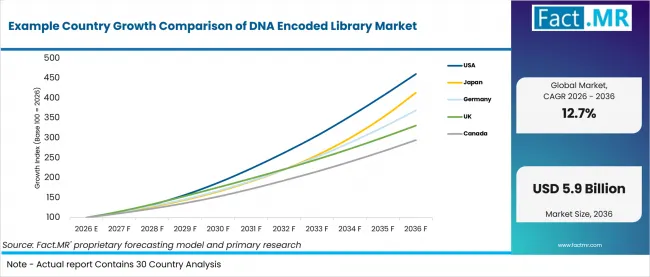
Example Country Growth Comparison Of Dna Encoded Library Market | Source: Fact.MR
| COUNTRY | CAGR, 2026 to 2036 |
|---|---|
| South Korea | 13.7% |
| USA | 13.2% |
| UK | 13.1% |
| Australia | 12.7% |
| Germany | 12.4% |
| Canada | 12.2% |
| Japan | 11.7% |
Source: Fact.MR analysis. Updated Jul 29, 2026
What is shaping South Korea's outlook through 2036?
South Korea is projected at 13.7% CAGR during 2026 to 2036, above the global 12.7% trajectory. biopharma R&D groups benefit from local screening support, sequencing capacity and CRO activity.
What is shaping USA's outlook through 2036?
USA is projected at 13.2% CAGR during 2026 to 2036, above the global 12.7% trajectory. large pharma and biotech pipelines support repeat demand for DEL discovery services.
What is shaping UK's outlook through 2036?
UK is projected at 13.1% CAGR during 2026 to 2036, above the global 12.7% trajectory. drug-discovery clusters and university-linked screening activity support adoption.
What is shaping Australia's outlook through 2036?
Australia is projected at 12.7% CAGR during 2026 to 2036, in line with the global 12.7% trajectory. distance from major discovery hubs makes outsourced screening and data turnaround important.
What is shaping Germany's outlook through 2036?
Germany is projected at 12.4% CAGR during 2026 to 2036, below the global 12.7% trajectory. pharma and academic buyers emphasize reproducibility, assay control and chemistry quality.
What is shaping Canada's outlook through 2036?
Canada is projected at 12.2% CAGR during 2026 to 2036, below the global 12.7% trajectory. distributed biotech teams need reliable screening protocols and hit-confirmation support.
What is shaping Japan's outlook through 2036?
Japan is projected at 11.7% CAGR during 2026 to 2036, below the global 12.7% trajectory. quality expectations and target fit shape measured use of DEL workflows.
Who leads the DNA Encoded Library Market?
X-Chem, Inc and WuXi AppTec are among the visible providers in the DNA encoded library market. HitGen Inc and Vipergen A/S also compete in the named provider set.
X-Chem, Inc is estimated to hold leading share in 2026. Competition is shaped by library quality, assay control, sequencing accuracy, hit confirmation, IP terms and medicinal chemistry support.
Through 2036, competitive gains are expected to come from clearer positioning around Single-Pharmacophore Libraries and stronger execution in the highest-growth country markets.
Which companies are active in the DNA Encoded Library Market?
DNA encoded library providers include X-Chem, Inc.; WuXi AppTec; HitGen Inc.; and Vipergen A/S. Pharmaceutical companies active in DEL research or consortium activity include Novartis AG, AstraZeneca PLC, GSK plc, and Pfizer Inc.
- X-Chem, Inc.
- WuXi AppTec
- HitGen Inc.
- Vipergen A/S
- Novartis AG
- AstraZeneca PLC
- GSK plc
- Pfizer Inc.
Bibliography
- NIH PubMed Central: Small-molecule Discovery Through DNA-encoded Libraries.
- NIH PubMed Central: DNA-Encoded Chemical Libraries - A Comprehensive Review.
- NIH NCATS: Assay Guidance Manual Program.
This Report Addresses
- The report evaluates the DNA Encoded Library Market through Library Type and Application choices that define the 2026 market structure.
- Segment analysis covers Single-Pharmacophore Libraries and Drug Discovery as the leading 2026 positions.
- Country outlook compares the listed markets by CAGR and explains how biopharma R&D intensity, CRO capacity and access to validated screening workflows shape local demand.
- Competitive analysis profiles the named providers and evaluates competition around library quality, assay control, sequencing accuracy, hit confirmation, IP terms and medicinal chemistry support.
What does the DNA Encoded Library Market cover?
The DNA Encoded Library Market covers DNA encoded library platforms, screening services and related discovery workflows used to identify small-molecule hits for pharmaceutical and biotech research.
The market boundary is tied to paid products, services and channels that directly support this use case. Adjacent spending is included only when it is part of the same purchase or operating decision.
What is included in the scope?
The scope includes library type, application, end user, screening method, therapeutic area and regional demand for DEL products and services.
Coverage also includes adjacent segment options when they are purchased for the same defined market use.
What is excluded from the scope?
The scope excludes general compound libraries, non-encoded screening services and downstream drug commercialization revenue.
How Was the Analysis Built?
The analysis combines primary research with desk research focused on the DNA encoded library market, its segment structure and country-level demand.
- Primary Research: Interviews and validation discussions test buyer priorities, adoption barriers, pricing logic and operating requirements.
- Desk Research: The assessment reviews company disclosures, public datasets, regulatory material, technical literature and industry records relevant to the market.
- Market Sizing and Forecasting: Estimates combine top-down and bottom-up checks across demand signals, segment shares, country activity, company participation and adoption constraints.
Segmentation
What is the report's scope and coverage?
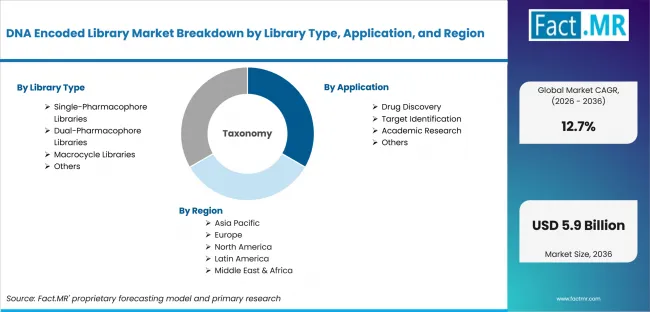
Dna Encoded Library Market Breakdown By Library Type, Application, And Region | Source: Fact.MR
| Attribute | Details |
|---|---|
| Quantitative Units | USD 1.8 billion in 2026 to USD 5.9 billion by 2036 at 12.7% CAGR |
| Market Definition | The DNA Encoded Library Market covers commercial DNA-encoded library platforms and related services used for library construction, screening, sequencing, and hit validation in early drug discovery. |
| Library Type | Single-Pharmacophore Libraries; Peptide Libraries; Small Molecule Libraries; Dual-Pharmacophore Libraries; Bispecific Libraries; Linker-Based Libraries; Macrocycle Libraries; Cyclic Peptide Libraries; Macrocyclic Small Molecules; Others; DNA-Templated Libraries; Custom DEL Libraries |
| Application | Drug Discovery; Hit Identification; Lead Optimization; Target Identification; Protein Target Screening; Receptor Screening; Academic Research; Chemical Biology; Genomics Research; Others; Diagnostic Research; Agricultural Biotechnology |
| End User | Pharmaceutical Companies; Large Pharmaceutical Companies; Specialty Pharma Companies; Biotechnology Companies; Early-Stage Biotech; Contract Biotech Research; Contract Research Organizations (CROs); Discovery CROs; Preclinical CROs; Academic & Research Institutes; Universities; Public Research Institutes |
| Screening Method | Affinity-Based Screening; Protein Binding Assays; Target-Based Screening; Selection-Based Screening; In Vitro Selection; Cell-Based Selection; Next-Generation Sequencing (NGS)-Based Analysis; High-Throughput Sequencing; Barcode Decoding; Others; Computational Screening; AI-Assisted Hit Analysis |
| Therapeutic Area | Oncology; Solid Tumors; Hematological Malignancies; Neurological Disorders; Neurodegenerative Diseases; CNS Disorders; Infectious Diseases; Antiviral Drug Discovery; Antibacterial Drug Discovery; Cardiovascular Diseases; Heart Failure; Metabolic Disorders; Others; Autoimmune Diseases; Rare Diseases |
| Regions Covered | North America; Latin America; Europe; East Asia; South Asia and Oceania; Middle East and Africa |
| Countries Covered | South Korea; USA; UK; Australia; Germany; Canada; Japan |
| Key Companies Profiled | X-Chem, Inc.; WuXi AppTec; HitGen Inc.; Vipergen A/S; Novartis AG; AstraZeneca PLC; GSK plc; Pfizer Inc. |
| Forecast Period | 2026 to 2036 |
| Approach | Hybrid top-down and bottom-up assessment using demand indicators, segment mix, country growth, company participation and public evidence relevant to the category. |
Source: Fact.MR analysis. Updated Jul 29, 2026
How is the market segmented?
-
By Library Type:
- Single-Pharmacophore Libraries
- Peptide Libraries
- Small Molecule Libraries
- Dual-Pharmacophore Libraries
- Bispecific Libraries
- Linker-Based Libraries
- Macrocycle Libraries
- Cyclic Peptide Libraries
- Macrocyclic Small Molecules
- Others
- DNA-Templated Libraries
- Custom DEL Libraries
-
By Application:
- Drug Discovery
- Hit Identification
- Lead Optimization
- Target Identification
- Protein Target Screening
- Receptor Screening
- Academic Research
- Chemical Biology
- Genomics Research
- Others
- Diagnostic Research
- Agricultural Biotechnology
-
By End User:
- Pharmaceutical Companies
- Large Pharmaceutical Companies
- Specialty Pharma Companies
- Biotechnology Companies
- Early-Stage Biotech
- Contract Biotech Research
- Contract Research Organizations (CROs)
- Discovery CROs
- Preclinical CROs
- Academic & Research Institutes
- Universities
- Public Research Institutes
-
By Screening Method:
- Affinity-Based Screening
- Protein Binding Assays
- Target-Based Screening
- Selection-Based Screening
- In Vitro Selection
- Cell-Based Selection
- Next-Generation Sequencing (NGS)-Based Analysis
- High-Throughput Sequencing
- Barcode Decoding
- Others
- Computational Screening
- AI-Assisted Hit Analysis
-
By Therapeutic Area:
- Oncology
- Solid Tumors
- Hematological Malignancies
- Neurological Disorders
- Neurodegenerative Diseases
- CNS Disorders
- Infectious Diseases
- Antiviral Drug Discovery
- Antibacterial Drug Discovery
- Cardiovascular Diseases
- Heart Failure
- Metabolic Disorders
- Others
- Autoimmune Diseases
- Rare Diseases
-
By Region:
- North America
- Latin America
- Europe
- East Asia
- South Asia and Oceania
- Middle East and Africa
Frequently Asked Questions
Which Library Type leads the DNA Encoded Library Market?
Which Application leads the DNA Encoded Library Market?
Which End User leads the DNA Encoded Library Market?
Which Screening Method leads the DNA Encoded Library Market?
Which Therapeutic Area leads the DNA Encoded Library Market?
How does South Korea perform in the DNA Encoded Library Market?
How does USA perform in the DNA Encoded Library Market?
How does UK perform in the DNA Encoded Library Market?
What is the primary driver in the DNA Encoded Library Market?
What is the main restraint in the DNA Encoded Library Market?
Who worked on this report


Preview the report firsthand - request a free sample
Free SampleGet the brochure for pricing and purchase details
Download PDF