- Forecast Value (2035): 344.2 Mn
- CAGR (2035): 8.3%
Drone Nozzles Market Outlook 2025 to 2035
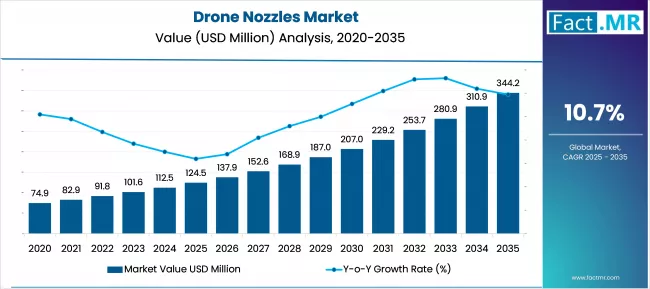
The global drone nozzles market is expected to reach USD 344.2 million by 2035, up from USD 124.5 million in 2025, reflecting a projected CAGR of 10.7% over the forecast period.
Drone nozzles play an important role in efficient, targeted and uniform spraying of large farmlands. Accuracy spraying at the field level achieves a saving of labor and cost, particularly in rice paddies, orchards, vineyards and cereal fields.
Nozzles on drones can offer optimal coverage, less drift, and specific spray pattern over crops compared to manual/ground-based spraying. Especially in demand is the low-drift, anti-drip and variable-flow nozzle development that enhances chemical deposition with less impact on the environment.
Quick Stats for Drone Nozzles Market
- Industry Value (2025): USD 124.5 Million
- Projected Value (2035): USD 344.2 Million
- Forecast CAGR (2025 to 2035): 10.7%
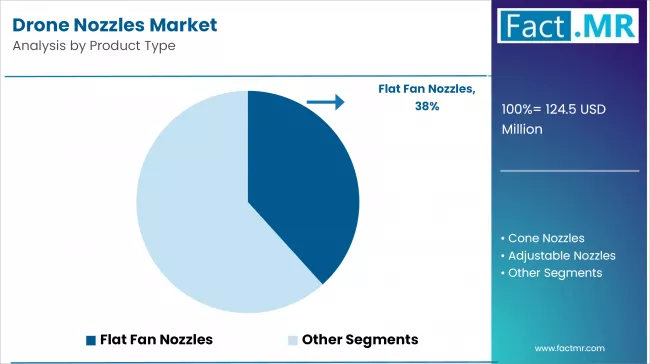
- Leading Segment (2025): Flat Fan Nozzles (38% Market Share)
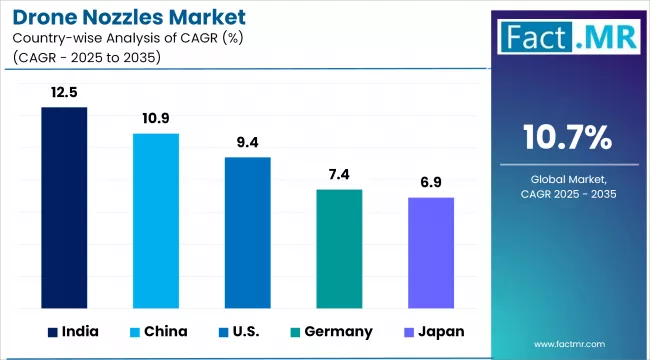
- Fastest Growing Country (2025-2035): India (12.5% CAGR)
- Top Key Players: Synergy Spray Systems, Hongfei Aviation Technology Co., Ltd., Terra Drone Corp., TeeJet Technologies, Lechler GmbH, Albuz, Pentair, Wilger Industries Ltd., Eavision Robotic
Drone Nozzles Market Market Value Analysis | Source: Fact.MR
What is driving demand for drone nozzles globally?
Swoppable nozzle systems, which can work across a variety of different liquid viscosities and application rates, are becoming increasingly popular among farmers and agritech companies, allowing them to work in a wide variety of crops and environments.
In the meantime, the market is redefining itself with strict global and regional frameworks on the use of pesticides, including the Farm to Fork Strategy and the Drone Pesticide Management Guidelines in the EU and India respectively.
In order to be cost-effective as well as compliant, manufacturers are developing precision-engineered nozzles with finer droplet control, lightweight materials, modular mounting, and fitment with AI-enabled spray systems. Such developments would lead to the second wave of adoption of the drone nozzles market.
What are the regional dynamics of the Drone Nozzles Market?
In North America, all drone nozzles are rapidly adopted due to a transition to sustainability and precision agriculture. Nozzles that provide accurate droplet size control are being increasingly used by farmers to streamline their use of chemicals and reduce drift. Efficient pest and nutrient application and subsidies of smart farming equipment are driving adoption in both row crops and specialty farming.
Stringent environmental policies and Common Agricultural Policy (CAP) funding are the replacement of traditional spraying systems with drones that have advanced nozzles in Europe. France, Germany and Spain are leading the way in using precision nozzles in vineyards, orchards and high value crops where droplet uniformity and wastage is of great importance.
Asia-Pacific market is the biggest and in China, India and Japan, there is a massive adoption of the product following government-led smart agriculture initiatives. The scale of adoption is broad in rice, wheat, and cash crops, and there is increased demand of nozzles capable of operating at different spray viscosities and cover a large field. Also, the plantation crops that are being grown in the southeast part of Asia like palm oil and rubber are adopting drones with multi-nozzle systems to enhance efficiency.
Adoption in Latin America is increasing steadily, mostly due to large scale soybean and sugarcane plantations in Brazil and Argentina. Specifically, nozzles that are designed to cover a wide area and which can withstand the climate of a tropical environment are especially sought after.
Drone nozzles in the Middle East & Africa are currently in the early adoption phase but gaining momentum in regions that face water scarcity, where high precision spraying helps to save on chemical and water wastage and increase yields. This opens up a lot of development opportunities as governments and commercial farms embrace water efficient farming methods.
What are the challenges and restraining factors of Drone Nozzles market?
One of the biggest challenges is still high acquisition costs to the small and mid-size farmers in the developing countries. The drone nozzles not only need one to invest in the equipment itself but also in training and certifying the operator and in maintenance which must be certified by the relevant regulatory body which often restricts the adoption of this technology by cost sensitive end users. The short flight time, payload, and susceptibility to bad weather are all operational problems that reduce the efficacy of spraying compared to conventional machinery.
Additional problems which can influence reliability in large scale farming processes are battery performance and longevity of continuously used pumps. Regulatory uncertainty also exists in emerging economies where aerial spraying practice, pesticide licensing and the use of air space are not clearly established. The rural market also lacks good service networks and access to spare parts, which complicates post-purchase support and reduces the rate of mass adoption.
Country-Wise Outlook
Drone Nozzles Market Cagr Analysis By Country | Source: Fact.MR
United States Facilitates Efficiency of Aerial Spraying Through Precision Agriculture Policies
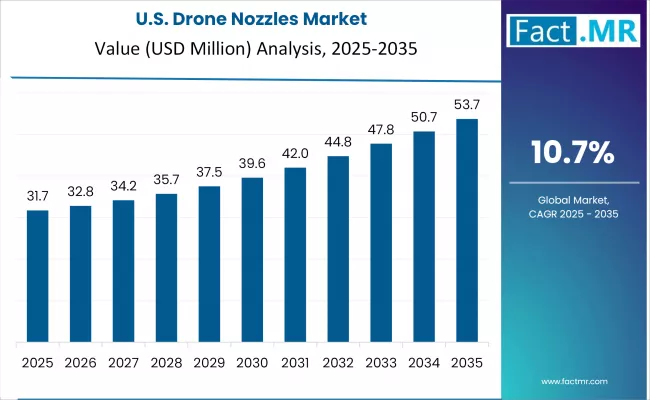
In the year 2025, the drone nozzles market in the United States is estimated at USD 31.7 million and it is estimated to grow at a CAGR of 9.4% to the year 2035. With USDA subsidies and FAA exemptions of agricultural drone systems, large-scale row crop precision nozzles have been widely adopted in the country.
Drone Nozzles Market Country Value Analysis | Source: Fact.MR
The Precision Agriculture Loan Program and federal grants are increasing accessibility to mid-sized farms and universities are increasing pilot training programs to enhance operational reliability. Ground sprayers are being even more phased out, with drones fitted with low-drift precision nozzles and growers in the Midwest are finding it more economical and sustainable to use drones rather than ground sprayers to apply crop inputs.
China goes at scale with smart farming subsidies and dominance in nozzle-integrated drone systems
The Chinese drone nozzle market is estimated to reach USD 20.8 million in the year 2025 at a CAGR of 10.9% up to 2035. Being the world leader in drone production, China enjoys the benefit of mass-made nozzle systems at low costs along with artificial intelligence-based spray optimization software. Through government subsidies as part of the Digital Agriculture Plan, uptake of rural cooperatives in rice, wheat, and maize production is speeding up.
Domestic producers are developing hybrid-powered nozzle systems that can extend spray range and flight time, and the strict pesticide regulations mean that certified nozzles can be used with certified agrochemicals. This size, policy encouragement and production power make China the most effective market of drone nozzles in the world.
India Accelerates Adoption with High-Growth Potential in Precision Spraying
In 2025, the India drone nozzles market is USD 1.5 million with the highest growth rate of 12.5% CAGR. Adoption is being encouraged by government-sponsored Digital Agriculture Missions as well as subsidies, especially in rice, wheat, and horticulture crops. Precision nozzles are becoming more attractive to farmers given the need to enhance per-acre productivity and overcome the challenge of water scarcity.
Drone spraying with variable-rate nozzles, which limit wastage and enhance the effectiveness of chemicals, are sounding out in pilot projects in states like Maharashtra, Punjab and Karnataka. In the coming decade, India would be one of the major growth points in the world drone nozzles market.
Category-Wise Analysis
Flat Fan Nozzles Dominate Agricultural Drone Spraying Applications
Drone Nozzles Market Analysis By Product Type | Source: Fact.MR
The flat fan nozzle component, which is worth USD 47.7 million in 2025, still remains the most popular type of nozzle used in agricultural drone spraying. The patterns of the sprays and the uniformity of the droplet size are very suitable to pesticides, herbicides and liquid fertilizers in row crops, orchards and in specialty plantations.
The reason why farmers use flat fan nozzles is because they have low spray drifts, good coverage, and can work at different operating pressures. Although hollow cone and air-induction nozzles are being tested in small-scale applications, in the field of precision agriculture, flat fan nozzles are the standard application because of their accuracy and affordability.
Plastic Remains the Material of Choice for Drone Nozzles
By material type, plastic nozzles account for the dominant share of the global market in 2025. Plastic is widely adopted because of its lightweight properties, resistance to corrosion, and cost-effectiveness, making it ideal for integration with lightweight drone designs. In addition, plastic nozzles can be precision-molded to achieve specific spray characteristics, ensuring better efficiency in field applications.
Metal and ceramic nozzles, while more durable, are primarily used in limited high-pressure or specialized spraying tasks. With drones requiring optimized payload capacity, plastic nozzles will continue to lead adoption across small to mid-sized agricultural drones.
Competitive Analysis
The market of drone nozzles in the world is moderately concentrated with dominant players holding a considerable portion of total value. The most important competitive leverages in this market are spray accuracy, droplet size control, chemical compatibility and being lightweight.
Manufacturers are also coming up with highly precise nozzle platforms that are allowing farmers to switch over to pesticides, fertilizers, and micronutrients on the same platform without the long downtime associated with the change-over.
Differentiation is also being driven by technological innovation. To improve efficiency of sprays and reduce wastage, companies are investing in low drift nozzle geometries, anti-drip systems and variable flow mechanisms. Moreover, AI-controlled droplet surveillance and modular nozzle assemblies are becoming popular, especially among professional users that demand a high degree of reliability in various agricultural tasks.
After sales services and technical services are another important area of competition. The latter is more likely to have farmers and agricultural service providers partners with companies that offer modular nozzle kits, fast replacement parts, and digital clogging diagnostics. Cost is also key-lightweight plastic nozzles and affordable replacement kits continue to be high adoption drivers in price elastic markets.
Competition is also defined by regional dynamics. China: Domestic suppliers are controlling high volume spraying of rice and wheat, whereas Indian manufacturers are developing small, low cost nozzle systems that can be used on small land holdings.
Premium nozzle producers in Europe and North America are also setting themselves apart with new design standards and integration into sustainability-oriented precision farming programs. The market has also been consolidating with larger agricultural technology companies and drone OEMs adding nozzle systems to complete spraying systems.
Although this leads to standardization of the products, it also increases competition in prices, especially in South Asia and Africa, where the local manufacturers compete mostly on volume with low technological differentiation.
Major players in the Drone Nozzles Market include Synergy Spray Systems, Hongfei Aviation Technology Co., Ltd., Terra Drone Corp., TeeJet Technologies, Lechler GmbH, Albuz, Pentair, Wilger Industries Ltd., and Eavision Robotic.
Recent Development
- April 2025 - TeeJet Technologies introduced its new adaptive drone nozzle air-induction in field trials in the Central Valley in California. These state-of-the-art nozzles dynamically change the size of droplets depending on the dynamic environmental conditions- the nozzles optimise the performance of the sprays and they also reduce the drift greatly. Testing revealed a 35 percent decline in pesticide drifting, which indicates major improvements in spray accuracy and the environment.
- May 2025 - Lechler GmbH launched its next generation drift reducing flat-fan nozzles that were originally aimed at agricultural drones in Europe. These nozzles have optimized spray angles and superior polymer materials, which guarantee greater longevity with corrosive agrochemicals and greater vineyard and specialty crop coverage. The adoption pilot projects in Germany and France have shown a 2025% saving of chemicals over conventional nozzle systems, which is in line with the EU target of sustainability as part of the Farm to Fork.
Methodology and Industry Tracking Approach
The study by Fact.MR took the form of a 12-month analysis (June 2024 May 2025) in 19 countries combining both demand- and supply-side data.
There were over 5,800 respondents who were farm equipment dealers, drone operators, agricultural cooperatives, and agronomists in rice cultivation, vineyards, horticulture, and large-scale cereal farming sectors.
Primary research, aimed at assessing:
- Drone nozzle replacement, renewal cycles, and wear resistance.
- Preferences for nozzle types (hollow cone, flat fan, air-induction, multi-directional, and electrostatic).
- Spray droplet size optimization for different crops and terrain.
- Fit and compatibility with drone spray systems, pumps, and chemical formulations.
Secondary validation was completed by: Pesticide spraying compliance and drift control guidelines: EPA (U.S.), EU CAP, Central Insecticides Board of India, and MARA standards of China. Precision agriculture adoption data: FAO and agricultural ministries of respective regions. Supplier-level analysis: Based on OEM annual reports, nozzle product catalogues, and certified drift-reduction/performance test sheets.
Since 2017, Fact.MR monitors the drone technology ecosystem within its extended Agricultural Mechanization and Smart Farming Program with a focus on input efficiency and digital farming adoption, as well as the integration of specific equipment into crops.
Segmentation
Segmentation of Drone Nozzles market
-
By Nozzle Type :
- Flat Fan Nozzles
- Cone Nozzles
- Hollow Cone Nozzles
- Full Cone Nozzles
- Adjustable Nozzles
- Specialized Nozzles
- Anti-Drift Nozzles
- Low-Pressure Nozzles
- Others
-
By Droplet Size / Flow Rate Control :
- Ultra-Fine (<150 microns)
- Fine (150-250 microns)
- Medium (250-400 microns)
- Coarse (>400 microns)
- Variable Flow Rate
- Multi-Pattern Capability
-
By Pressure Range :
- Low Pressure (<2 bar)
- Medium Pressure (2-5 bar)
- High Pressure (>5 bar)
-
By Material :
- Plastic
- Stainless Steel
- Brass
- Ceramic
- Others
-
By Drone Integration / Compatibility :
- Micro Drones (<5 kg payload)
- Small Agricultural Drones (5-10 kg payload)
- Medium Drones (10-20 kg payload)
- Heavy-Duty Drones (>20 kg payload)
-
By Application :
- Crop Protection
- Fertilizer & Nutrient Spraying
- Defoliant Application
- Vector & Mosquito Control
- Forestry & Plantation Spraying
- Specialty Crops
-
By Region :
- North America
- Latin America
- Western Europe
- Eastern Europe
- East Asia
- South Asia & Pacific
- Middle East & Africa
Frequently Asked Questions
What is the expected market size of drone nozzles in 2025?
What is the forecasted valuation by 2035?
Who are the key manufacturers in this market?
Which product type segment dominates demand?
Who worked on this report


Preview the report firsthand - request a free sample
Free SampleGet the brochure for pricing and purchase details
Download PDF