- Market Value (2025): USD 93.9 Mn
- Estimated Value (2026): USD 115.0 Mn
- Forecast Value (2036): USD 870.0 Mn
- CAGR (2026-2036): 22.4%
What is the Dry Electrode Binders Market forecast to be worth by 2036?
USD 115.0 million in 2026 to USD 870.0 million by 2036, at 22.4% CAGR.
- The dry electrode binders market crossed a valuation of USD 93.9 million in 2025 as developers moved from polymer screening into pilot mixing and cell-build trials.
- Demand is projected to increase from USD 115.0 million in 2026 to USD 870.0 million by 2036.
- The market is forecast to record a 22.4% CAGR from 2026 to 2036 as LFP and Solid-state programs test binders under chemistry-specific pressure and loading conditions.
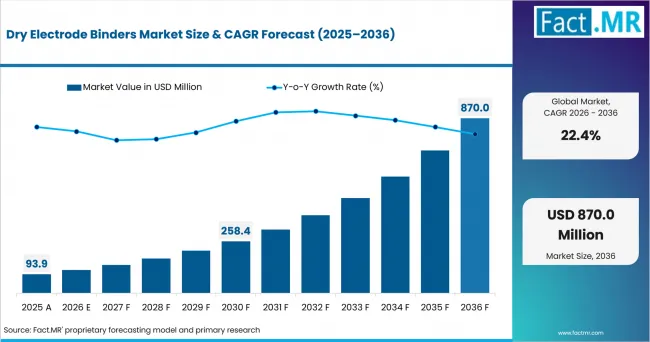
Dry Electrode Binders Market Market Value Analysis | Source: Fact.MR
What are the defining numbers behind Dry Electrode Binders Market growth?
USD 755.0 million absolute opportunity by 2036, led by PTFE and LFP alongside Cathode applications.
- Demand Drivers in the Market
- Cell manufacturers need binders that hold active powder and conductive carbon together without wet slurry dispersion. Qualification covers powder flow and production yield.
- Battery plants are examining dry routes as the removal of NMP handling and long drying ovens changes floor-space and solvent-recovery requirements.
- LFP production gives binder developers a large cost-sensitive platform for repeated dry-cathode trials across electric-vehicle and stationary-storage cells.
- Sodium-ion programs widen the qualification base, with different particle surfaces and compaction settings requiring separate binder validation.
- Key Segments Analyzed
- By Binder Type: PTFE is expected to hold 33% share in 2026, supported by shear-induced fibrillation that forms a reinforcing network inside dry powder films.
- By Battery Type: LFP is projected to account for 34% share in 2026, reflecting production scale that supports repeated dry-cathode trials and line validation.
- By Electrode: Cathode is anticipated to capture 28% share in 2026 as manufacturers target NMP removal and shorter coating lines.
- By Manufacturing Route: Dry coating is estimated to represent 30% share in 2026, with the route directly replacing slurry preparation and long drying stages.
- By End User: Cell manufacturers are forecast to account for 36% share in 2026 since final approval depends on electrode handling and yield data.
- Analyst Opinion at Fact.MR
- Shambhu Nath Jha, Senior Analyst at Fact.MR, states, “Dry electrode binder selection has become a process decision, not a polymer choice alone. Cell manufacturers are expected to favor grades that hold powder dispersion and electrochemical performance within the same production window. Material producers therefore need pilot-cell proof before making scale claims.”
- Strategic Implications
- Binder producers should publish process windows for mixing energy, temperature, roll pressure, and electrode loading before presenting commercial scale claims.
- Cell developers should compare PTFE and composite binder grades under the same active-material and loading conditions.
- Equipment teams should treat binder choice as part of line design and foil treatment change the result.
- Commercial teams should separate polymer producers from dry-electrode process developers so material revenue is not mixed with equipment and engineering activity.
Dry coating reaches a pilot line only when the film can be formed and laminated without tearing or losing uniformity. Equipment data therefore shows binder producers where material behavior breaks down during scale-up. Dürr introduced X.Cellify DC in October 2025 after proving a free-standing dry-electrode film at its Chassieu pilot plant. The company reported that the process reduced production space by up to 65% and energy use by up to 70% through the removal of dryers and solvent recovery. These results link binder approval directly to film strength, calender response, and lamination behavior.
China is expected to record a 30.3% CAGR through 2036, supported by battery-cell production scale. India is projected to post a 28.0% CAGR as ACC manufacturing policy brings new qualification work closer to local plants. Germany is anticipated to advance at a 25.8% CAGR through pilot-line infrastructure and production engineering. Brazil is forecast to post a 23.5% CAGR following growth in electrified-vehicle sales. The United States is estimated to record a 21.3% CAGR as laboratory research moves into domestic cell programs.
How does the Dry Electrode Binders Market break down by segment?
PTFE leads with 33%, LFP accounts for 34%.
Which binder type dominates?
PTFE holds 33% share in 2026.
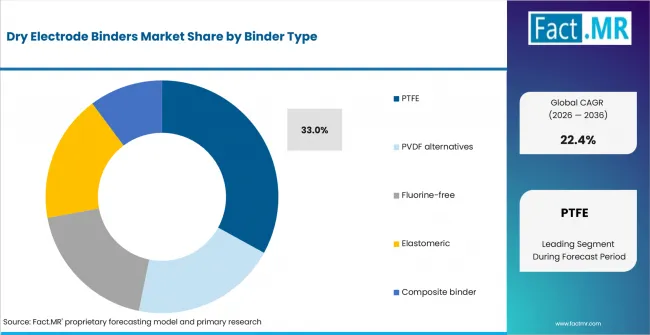
Dry Electrode Binders Market Analysis By Binder Type | Source: Fact.MR
PTFE is expected to hold 33% share in 2026 supported by its ability to form reinforcing fibers under shear and pressure. This network helps dry powder form a coherent film before calendering and lamination. PVDF alternatives serve programs that need different processing windows while Fluorine-free binders address specific material requirements. Elastomeric and Composite binder systems remain relevant where flexibility and particle retention influence electrode performance.
What leads the Battery Type segment?
LFP accounts for 34% share in 2026.
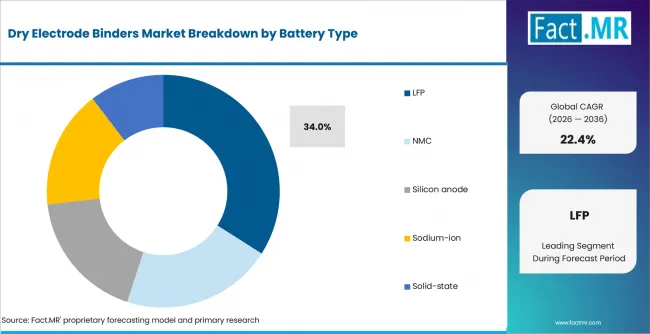
Dry Electrode Binders Market Analysis By Battery Type | Source: Fact.MR
LFP is projected to account for 34% share in 2026 reflecting its large production base and strict manufacturing cost targets. Its use across electric vehicles and stationary storage creates repeated opportunities to test loading and film strength. NMC programs require different binder behavior under higher energy-density conditions while Silicon anode systems need stronger particle retention during repeated volume changes. Sodium-ion and Solid-state programs require separate validation because their particle surfaces and mechanical conditions differ.
How does Electrode shape demand?
Cathode leads with 28% share in 2026.
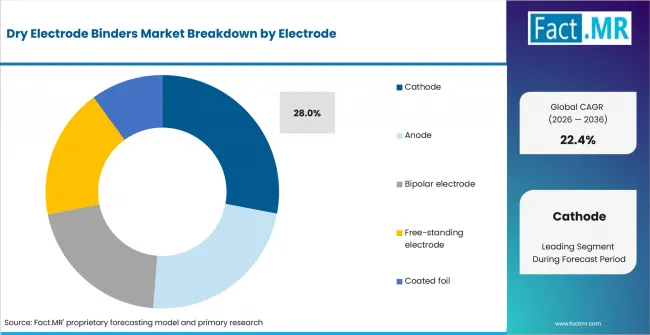
Dry Electrode Binders Market Analysis By Electrode | Source: Fact.MR
Cathode is anticipated to capture 28% share in 2026 as manufacturers target solvent removal and shorter electrode production lines. LFP and NMC cathodes support early dry-processing programs where film cohesion and current-collector attachment must remain stable at high loading. Anode applications follow a different development path because Silicon anode systems require greater elasticity during repeated expansion and contraction. Bipolar electrode and Free-standing electrode formats remain under qualification for specialized cell designs and process routes.
What supports Dry coating within Manufacturing Route?
Dry coating is projected to hold 30% share in 2026.
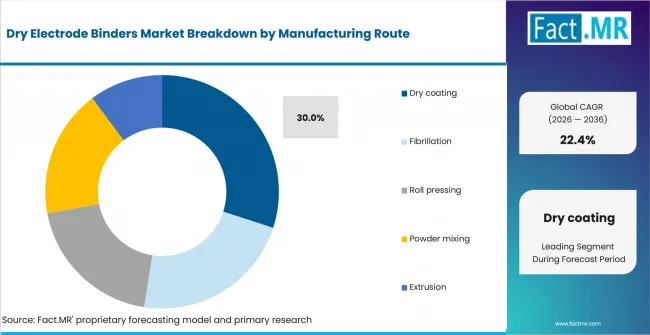
Dry Electrode Binders Market Analysis By Manufacturing Route | Source: Fact.MR
Dry coating holds 30% share in 2026 owing to its removal of slurry preparation and solvent-based drying stages. The route can reduce dependence on solvent recovery while changing how binders create structure during electrode formation. Fibrillation and roll pressing support film formation through controlled mechanical processing while powder mixing influences binder distribution before densification. Extrusion remains relevant where continuous material handling can support stable film production under controlled pressure conditions.
What leads the End User segment?
Cell manufacturers hold 36% share in 2026.
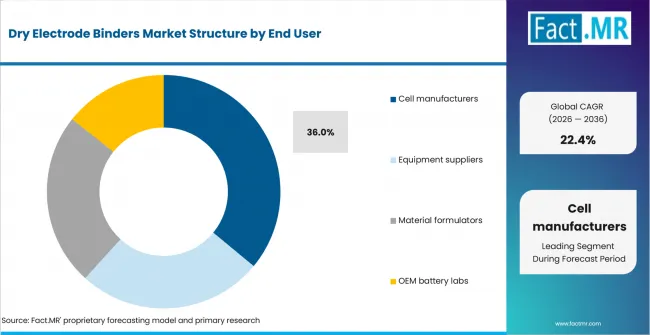
Dry Electrode Binders Market Analysis By End User | Source: Fact.MR
Cell manufacturers are forecast to account for 36% share in 2026 because they control the final qualification process before production adoption. Each binder grade must pass powder handling and electrode processing checks before entering cell assembly trials. Cycling performance and safety results then influence whether a formulation advances toward commercial production. Equipment suppliers and material formulators support process development while OEM battery labs provide additional qualification routes for emerging cell programs.
What is accelerating Dry Electrode Binders Market adoption, and what is holding it back?
Solvent-free electrode production is anticipated to drive market growth, while dry-sheet brittleness and scale-up costs restrain adoption.
Drivers Impact Analysis
| DRIVER | (~) % IMPACT ON CAGR | GEOGRAPHIC RELEVANCE | IMPACT TIMELINE |
|---|---|---|---|
| Solvent-free electrode manufacturing | +0.9% | Global battery plants | Medium term (2-4 years) |
| LFP cathode output | +0.7% | China and export supply chains | Medium term (2-4 years) |
| Sodium-ion dry-electrode work | +0.5% | United States, East Asia, and South Asia and Pacific | Short term (<= 2 years) |
| Local battery manufacturing policy | +0.4% | India, Western Europe, East Asia and United States | Medium term (2-4 years) |
| Improved film and interface design | +0.3% | Global research and pilot centers | Long term (>= 4 years) |
Source: Fact.MR analysis. Updated Jul 13, 2026
- Solvent-free electrode manufacturing: Cell plants are expected to test dry routes where oven length and ventilation raise capital or operating costs. Removing those steps changes the mechanical work assigned to the binder during film formation and lamination. Commercial adoption is projected to depend on whether the electrode keeps uniform thickness and current-collector contact at production speed.
- LFP cathode output: High-volume LFP lines give material teams repeated opportunities to compare binder loading and film strength under strict cost targets. The chemistry also supports long production campaigns, which expose small variations in powder feed and calender pressure. Binder grades that remain stable across those runs are anticipated to move through qualification faster than laboratory-only formulations.
- Sodium-ion dry-electrode work: Sodium-ion programs create a second qualification route, as particle surfaces and compaction conditions differ from conventional lithium-ion cathodes. Binder developers must therefore tune cohesion and flexibility without carrying lithium-ion assumptions into a new chemistry. This work is forecast to expand first in stationary storage and cost-sensitive mobility platforms.
- Local battery manufacturing policy: New cell plants in India, Western Europe, Japan, and the United States are expected to bring material testing closer to domestic production lines. Local technical teams shorten feedback loops when a film cracks, delaminates, or misses a density target during scale-up. Regional qualification is projected to favor binder producers that support trials on site and adjust formulations quickly.
- Improved film and interface design: Better control of particle contact and current-collector attachment is anticipated to raise confidence in dry electrodes. The binder must distribute stress through the sheet while preserving conductive pathways and active-material loading. Progress is forecast to come from joint work among polymer teams and calender specialists instead of isolated material testing.
Opportunity Impact Analysis
| OPPORTUNITY | (~) % IMPACT ON CAGR | GEOGRAPHIC RELEVANCE | IMPACT TIMELINE |
|---|---|---|---|
| PTFE and fluorine-free binder systems | +0.5% | Global | Medium term (2-4 years) |
| Dry coating for LFP cathodes | +0.5% | China, Western Europe and United States | Medium term (2-4 years) |
| Sodium-ion dry-electrode routes | +0.4% | United States, East Asia, and South Asia and Pacific | Short term (<= 2 years) |
| Public pilot-line support | +0.3% | Germany, United Kingdom and Japan | Long term (>= 4 years) |
Source: Fact.MR analysis. Updated Jul 13, 2026
- PTFE and Fluorine-free: PTFE offers an established fibrillation route, while the Fluorine-free category gives developers another option where material policy or recycling requirements shape qualification. The two categories create different process windows for temperature and electrode loading. Opportunity is expected to widen as cell teams compare both routes under the same chemistry and line conditions.
- Dry coating for LFP cathodes: LFP offers a practical opportunity through its large production base and focus on manufacturing cost. Dry films are projected to gain attention where plants seek higher loading without adding long ovens or solvent-recovery systems. Binder producers that demonstrate stable porosity and foil attachment across repeated batches are anticipated to secure earlier pilot orders.
- Sodium-ion dry-electrode routes: Sodium-ion is projected to create additional trials in stationary storage and lower-cost mobility applications. The chemistry relies on different active materials, so binder selection must account for moisture response and compaction pressure. Material developers with flexible formulation platforms are expected to address these differences without rebuilding the process from the beginning.
- Public pilot-line support: Shared facilities reduce the cost of testing powder handling, film formation, lamination, and cell performance before plant approval. Fraunhofer FFB produced the first charged cell on its PreFab line in December 2025, showing that European pilot infrastructure now connects electrode work with complete cell manufacture. Access to this type of line is anticipated to shorten the path from polymer sample to production evidence.
Restraints Impact Analysis
| RESTRAINT | (~) % IMPACT ON CAGR | GEOGRAPHIC RELEVANCE | IMPACT TIMELINE |
|---|---|---|---|
| Dry-sheet brittleness | -0.5% | Global cell developers | Medium term (2-4 years) |
| Battery supply-chain concentration | -0.4% | Global | Short term (<= 2 years) |
| Scale-up testing cost | -0.3% | Global battery plants | Medium term (2-4 years) |
| Chemistry-specific binder fit | -0.2% | Global cell developers | Long term (>= 4 years) |
Source: Fact.MR analysis. Updated Jul 13, 2026
- Dry-sheet brittleness: Poor dispersion or uneven pressure creates cracked and non-uniform films that lose contact with the current collector during handling. These defects often appear only after the sheet leaves the laboratory press and enters continuous web movement. Adoption is expected to remain selective until binder producers demonstrate strength across wider films and longer production runs.
- Battery supply-chain concentration: Qualification remains centered on a limited number of large cell producers with proprietary recipes and line settings. Smaller binder firms must support long approval cycles without visibility on the final production volume. This structure is projected to slow market entry for firms that lack regional technical teams or pilot-scale material capacity.
- Scale-up testing cost: A laboratory result still requires larger batches and yield validation. Each stage consumes active material and engineering time before a purchasing decision is made. Development budgets are anticipated to favor binder programs that define clear pass-fail criteria before entering expensive line trials.
- Chemistry-specific binder fit: LFP and Solid-state cells place different demands on adhesion and chemical stability. A formulation that works for one particle surface can lose cohesion or raise resistance in another. Portfolio expansion is forecast to remain slower where a company relies on a single polymer grade for several Battery Type categories.
Which countries are scaling Dry Electrode Binders Market fastest?
China 30.3%, India 28.0%, Germany 25.8%, Brazil 23.5%, United States 21.3%.
Regional analysis covers North America, Latin America, Western Europe, Eastern Europe, East Asia, South Asia and Pacific, and Middle East & Africa.
.webp "Top Country Growth Comparison Dry Electrode Binders Market Cagr (2026 2036)")
Top Country Growth Comparison Dry Electrode Binders Market Cagr (2026 2036) | Source: Fact.MR
| COUNTRY | CAGR |
|---|---|
| China | 30.3% |
| India | 28.0% |
| Germany | 25.8% |
| Brazil | 23.5% |
| United States | 21.3% |
Source: Fact.MR analysis. Updated Jul 13, 2026
What is driving China growth through 2036?
30.3% CAGR, driven by battery-cell production scale and LFP manufacturing depth.
China dense cell-manufacturing clusters give binder developers access to LFP lines and export-oriented qualification programs. The international energy agency reported in May 2026 that China accounted for over 80% of global battery-cell production during 2025. The market is expected to record a 30.3% CAGR through 2036 as dry formulations move from laboratory trials into line-specific validation.
How is India scaling Dry Electrode Binders demand?
28.0% CAGR, supported by the ACC manufacturing program and local value addition.
India dry-binder opportunity is tied to new cell plants that must qualify local materials before stable output begins. A February 2026 update from the Press Information Bureau confirmed an INR 18,100 crore PLI outlay for 50 GWh of domestic advanced-chemistry cell capacity. This buildout is projected to support a 28.0% CAGR from 2026 to 2036 as polymer producers add local testing and process support.
What supports Germany outlook?
25.8% CAGR, owing to pilot-line infrastructure and battery-production engineering.
Germany connects polymer research with electrode equipment through shared scale-up facilities in Dresden and Münster. Fraunhofer IWS added a concrete asset in November 2025 when it inaugurated the EUR 3.7 million DRYplatform around its solvent-free DRYtraec process. That infrastructure is anticipated to support a 25.8% CAGR by 2036 by giving material producers a route to test films before full cell-line approval.
What underpins Brazil growth?
23.5% CAGR, driven by electrified-vehicle sales and regional supply-chain planning.
Brazil starts from a smaller cell-manufacturing base, yet local vehicle assembly and storage planning are widening the need for battery-material qualification. ABVE recorded 223,912 electrified light-vehicle sales in 2025, up 26% from 2024, in its January 2026 market review. The dry electrode binder market is estimated to post a 23.5% CAGR through 2036 as local programs seek materials that fit regional production and service conditions.
How is the United States developing Dry Electrode Binders demand?
21.3% CAGR, supported by national-laboratory research and domestic manufacturing programs.
National laboratories give United States binder teams a route to test mechanical fixes before committing material to larger pilot runs. Oak Ridge National Laboratory reported in July 2025 that long carbon fibers equal to 1% of electrode weight made dry-processed films stronger and more flexible. The market is forecast to record a 21.3% CAGR from 2026 to 2036 as those findings move into cell-maker qualification programs.
Who leads the Dry Electrode Binders Market?
Syensqo, Arkema, Daikin Industries, and Zeon are the companies profiled.
The profiled companies include polymer producers and one battery-material distributor. Arkema, Daikin Industries, Zeon, and Syensqo supply binders and fluoropolymer materials for lithium-ion batteries.
Daikin Chemical Europe concluded Project ProLiT in January 2026 after studying PTFE fibrillation for LFP and NMC cathodes. Arkema's July 2026 update described dry-process laboratory work with Kynar PVDF grades, while Zeon's December 2025 integrated report documented continuing battery-material development. Competition through 2036 is expected to depend on process evidence, chemistry fit, and technical support near cell-development lines.
Which companies are the key providers?
Syensqo, Arkema, Daikin Industries, and Zeon.
- Syensqo
- Arkema
- Daikin Industries
- Zeon
How is the market segmented?
-
By Binder Type
- PTFE
- PVDF alternatives
- Fluorine-free
- Elastomeric
- Composite binder
-
By Battery Type
- LFP
- NMC
- Silicon anode
- Sodium-ion
- Solid-state
-
By Electrode
- Cathode
- Anode
- Bipolar electrode
- Free-standing electrode
- Coated foil
-
By Manufacturing Route
- Dry coating
- Fibrillation
- Roll pressing
- Powder mixing
- Extrusion
-
By End User
- Cell manufacturers
- Equipment suppliers
- Material formulators
- OEM battery labs
-
By Region
- North America
- USA
- Canada
- Latin America
- Brazil
- Mexico
- Chile
- Rest of Latin America
- Western Europe
- Germany
- UK
- Italy
- Spain
- France
- Nordic
- BENELUX
- Rest of Western Europe
- Eastern Europe
- Russia
- Poland
- Hungary
- Balkan & Baltic
- Rest of Eastern Europe
- East Asia
- China
- Japan
- South Korea
- South Asia and Pacific
- India
- ASEAN
- Australia & New Zealand
- Rest of South Asia and Pacific
- Middle East & Africa
- Kingdom of Saudi Arabia
- Other GCC Countries
- Türkiye
- South Africa
- Other African Union
- Rest of Middle East & Africa
- North America
Bibliography
- International Energy Agency. (2026, May 20). Global EV Outlook 2026. International Energy Agency.
- Press Information Bureau, Government of India. (2026, February 6). PLI scheme for advance chemistry cells. Ministry of Heavy Industries.
- Brazilian Electric Vehicle Association. (2026, January 6). Electrified vehicles grow ten times faster than the overall market in 2025, with 224 thousand vehicles sold. ABVE.
- Fraunhofer Institute for Material and Beam Technology IWS. (2025, November 4). DRYplatform launches: Battery research gains lighthouse infrastructure. Fraunhofer IWS.
- Oak Ridge National Laboratory. (2025, July 30). Carbon fiber boosts dry-processed battery performance. Oak Ridge National Laboratory.
- Dürr AG. (2025, October 6). X.Cellify DC enables dry coating with free-standing film. Dürr AG.
- Daikin Chemical Europe. (2026, January 22). Project ProLiT concluded: Driving the future of battery manufacturing with solvent-free dry coating. Daikin Chemical Europe.
- Arkema. (2026, July 1). Lithium-ion batteries: Arkema paves the way for the next generation of solvent-free electrodes. Arkema.
- Zeon Corporation. (2025, December 19). Zeon Group Integrated Report 2025. Zeon Corporation.
- Fraunhofer Research Institution for Battery Cell Production FFB. (2025, December 15). The first battery cell from FFB PreFab marks a milestone for batteries made in Germany. Fraunhofer FFB.
This Report Addresses
- The report provides strategic intelligence on Dry Electrode Binders across binder choices, battery chemistries, electrode formats, manufacturing routes, and qualification paths.
- Regional outlook evaluates China and India alongside Germany, while Brazil and the United States complete the country growth comparison.
- Competitive analysis profiles Syensqo, Arkema, Daikin Industries, and Zeon.
- Manufacturing-route assessment covers Dry coating, Fibrillation, Roll pressing, Powder mixing, and Extrusion across solvent-free electrode production.
- Use-case assessment covers Cathode, Anode, Bipolar electrode, Free-standing electrode, and Coated foil across LFP, NMC, Silicon anode, Sodium-ion, and Solid-state programs.
What does the Dry Electrode Binders Market cover?
PTFE, PVDF alternatives, Fluorine-free, Elastomeric, and Composite binder grades used in solvent-free electrode production.
The Dry Electrode Binders Market covers materials sold or qualified for solvent-free battery-electrode production. Coverage includes Dry coating, Fibrillation, Roll pressing, Powder mixing, and Extrusion.
The market differs from general battery binders because dry-electrode grades must create structure without conventional slurry coating and solvent evaporation. Wet-process binders are included only when the producer documents dry-process compatibility or qualification.
What is included in the scope?
Dry-electrode binder systems used across Cathode, Anode, Bipolar electrode, Free-standing electrode, and Coated foil.
The scope includes PTFE, PVDF alternatives, Fluorine-free, Elastomeric, and Composite binder categories. Battery Type coverage is limited to LFP, NMC, Silicon anode, Sodium-ion, and Solid-state where dry processing is part of electrode development or scale-up. Supporting process evidence is included only when it directly affects Dry coating, Fibrillation, Roll pressing, Powder mixing, or Extrusion.
What is excluded from the scope?
Wet-slurry-only binders and equipment revenue are outside the market value boundary.
The scope excludes active cathode materials, active anode materials, conductive additives, separators, electrolytes, current collectors, completed cells, and general adhesives. Revenue from mixers, calenders, coating machines, printing systems, and engineering services is excluded even when those technologies appear in the competitive discussion.
How was the analysis built?
120+ sources, 40+ company product ranges, 25+ countries, 20+ interviews.
- Primary Research
- Primary research includes interviews with binder producers, cell manufacturers, equipment suppliers, material formulators, and OEM battery labs. Discussion topics cover powder handling, film cohesion, foil attachment, chemistry compatibility, cycle performance, and scale-up risk.
- Desk Research
- Desk research reviews official battery-production data, government manufacturing programs, dry-electrode research, official product pages, company announcements, and process-development updates. Sources from the IEA, ORNL, Fraunhofer institutes, India's Ministry of Heavy Industries, ABVE, and company technical pages support the analysis.
- Market-Sizing and Forecasting
- Forecasting uses dry-electrode manufacturing activity across LFP, NMC, Silicon anode, Sodium-ion, and Solid-state programs. The model also considers Binder Type fit, Electrode demand, Manufacturing Route activity, regional cell-capacity buildout, qualification timelines, and conversion from pilot work to commercial material orders. Equipment and engineering revenue is removed from the binder value model.
- Data Validation and Update Cycle
- Interviews with binder producers, cell manufacturers, equipment specialists, and material formulators test assumptions on binder loading, process yield, chemistry adoption, and line qualification. Official product pages and company disclosures track dry-electrode pilots as they move into larger cell-production trials.
Segmentation
What is the report’s scope and coverage?
| Attribute | Details |
|---|---|
| Quantitative Units | USD Million in 2026 to USD Million by 2036 at CAGR |
| Market Definition | Binder materials used or qualified for solvent-free dry-electrode production in rechargeable batteries |
| Binder Type | PTFE; PVDF alternatives; Fluorine-free; Elastomeric; Composite binder |
| Battery Type | LFP; NMC; Silicon anode; Sodium-ion; Solid-state |
| Electrode | Cathode; Anode; Bipolar electrode; Free-standing electrode; Coated foil |
| Manufacturing Route | Dry coating; Fibrillation; Roll pressing; Powder mixing; Extrusion |
| End User | Cell manufacturers; Equipment suppliers; Material formulators; OEM battery labs |
| Regions Covered | North America; Latin America; Western Europe; Eastern Europe; East Asia; South Asia and Pacific; Middle East & Africa |
| Countries Covered | USA; Canada; Brazil; Mexico; Chile; Rest of Latin America; Germany; UK; Italy; Spain; France; Nordic; BENELUX; Rest of Western Europe; Russia; Poland; Hungary; Balkan & Baltic; Rest of Eastern Europe; China; Japan; South Korea; India; ASEAN; Australia & New Zealand; Rest of South Asia and Pacific; Kingdom of Saudi Arabia; Other GCC Countries; Türkiye; South Africa; Other African Union; Rest of Middle East & Africa |
| Key Companies Profiled | Syensqo; Arkema; Daikin Industries; Zeon |
| Forecast Period | 2026 to 2036 |
| Approach | Hybrid top-down and bottom-up approach using battery-cell production; dry-electrode pilot activity; chemistry mix; binder qualification; regional manufacturing programs; official disclosures and industry interviews |
Source: Fact.MR analysis. Updated Jul 13, 2026
Frequently Asked Questions
Which Binder Type leads the Dry Electrode Binders Market?
Which Battery Type leads the Dry Electrode Binders Market?
Which Electrode leads the Dry Electrode Binders Market?
Which Manufacturing Route leads the Dry Electrode Binders Market?
Which End User leads the Dry Electrode Binders Market?
Which country records the highest CAGR in the Dry Electrode Binders Market?
How does India perform in the Dry Electrode Binders Market?
How does Germany perform in the Dry Electrode Binders Market?
How does Brazil perform in the Dry Electrode Binders Market?
How does the United States perform in the Dry Electrode Binders Market?
What is the primary driver in the Dry Electrode Binders Market?
What is the main restraint in the Dry Electrode Binders Market?
Why do cell manufacturers dominate demand?
Who worked on this report


Preview the report firsthand - request a free sample
Free SampleGet the brochure for pricing and purchase details
Download PDF