- Base Value(2026): 26.2 Bn
- Estimated Value(2026): 26.2 Bn
- Forecast Value (2036): 39.5 Bn
- CAGR (2026 - 2036): 4.2%
Vehicle Barrier System Market Forecast and Outlook 2026 to 2036
In 2025, the vehicle barrier system market surpassed a valuation of USD 25.2 billion. Based on Fact.MR analysis, demand for vehicle barrier systems is estimated to grow to USD 26.2 billion in 2026 and USD 39.5 billion by 2036. Fact.MR projects a CAGR of 4.2% during the forecast period.
Between 2026 and 2036, the vehicle barrier system market is projected to create an absolute dollar opportunity of USD 13.3 billion. This sustained expansion is underpinned by the system’s entrenched role in critical infrastructure protection, public space security, and smart city access control. Regulatory compliance requirements and structured government procurement cycles provide consistent baseline demand.
Keith Bobrosky, President of Delta Scientific said "The market focus for vehicle barriers has shifted from military and government saturation to public safety applications such as stadiums, schools, and data centers. It’s an example of deploying technology developed in ‘wartime’ for the broader public good."
Country growth reflects threat environment, infrastructure investment cycles, and regulatory mandates. China leads at 5.9% CAGR, supported by infrastructure expansion and smart city initiatives under successive Five-Year Plans. India follows at 5.3% driven by Smart Cities Mission procurement and critical infrastructure hardening. The United States posts 4.2% anchored by federal critical infrastructure protection funding and replacement demand for aging barrier stock. Germany grows at 3.9% supported by EU security directives and municipal public space protection mandates. The United Kingdom registers 3.5% driven by post-attack regulatory reviews and PAS68 compliance upgrades across transportation hubs and government buildings.
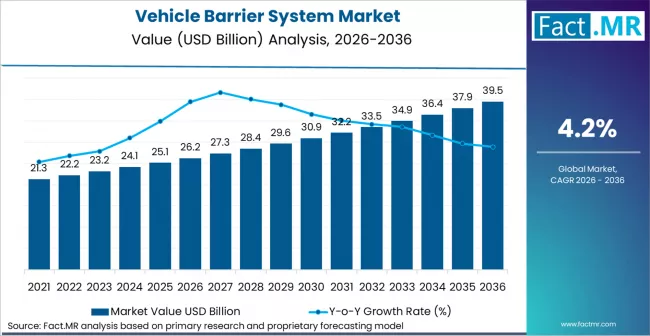
Vehicle Barrier System Market Market Value Analysis | Source: Fact.MR
| Metric | Value |
|---|---|
| Estimated Value in 2026 | USD 26.2 billion |
| Forecast Value in 2036 | USD 39.5 billion |
| Forecast CAGR (2026 to 2036) | 4.2% |
Market Definition
Covers crash-rated and access-control vehicle barriers installed at critical infrastructure, government sites, transport hubs, commercial properties, and public spaces to prevent unauthorized vehicle entry. Includes bollards, road blockers, drop arms, gates, and automated systems across manual to fully automated configurations.
Market Inclusions
Includes global and regional revenue forecasts (2026-2036) by barrier type, automation level, and end use. Covers government, defense, commercial, industrial, transportation, and smart city sectors, along with pricing and regulatory analysis.
Market Exclusions
Excludes temporary crowd barriers, traffic cones, decorative non-crash-rated bollards, standalone fencing or CCTV, residential driveway systems, parking kiosks, and standalone cybersecurity solutions.
Research Methodology
- Primary Research: Interviews were conducted with physical security consultants, critical infrastructure facility managers, government procurement officers, and specialist distributors across North America, Europe, and Asia Pacific.
- Desk Research: Sources included government procurement databases, U.S. DHS Safety Act certifications, UK PAS68/IWA14 regulatory documentation, EU security directive implementation reports, municipal tenders, and manufacturer product filings.
- Market Sizing and Forecasting: A hybrid model combined top-down installation environment estimates with bottom-up unit pricing data. Inputs included barrier category pricing, replacement cycle assumptions, regulatory compliance timelines, and government programme funding scope from primary interviews and public procurement records.
- Data Validation and Update Cycle: Results were validated against government security funding appropriations, manufacturer revenue disclosures, product certification records, and public infrastructure investment data. Forecasts are reviewed annually.
Summary
- Market Definition
- Vehicle barrier systems are crash-rated and access-controlled physical installations deployed at infrastructure perimeters, government buildings, transportation hubs, and public spaces to prevent unauthorized vehicular intrusion and mitigate vehicle-borne security threats.
- Demand Drivers
- Escalating frequency of hostile vehicle incidents at public venues and government sites is forcing emergency replacement procurement and forward specification upgrades toward crash-rated automated barrier systems in North America and Europe.
- Government critical infrastructure protection mandates, including U.S. Department of Homeland Security Safety Act certifications and UK PAS68/IWA14 compliance requirements, are driving institutional procurement of crash-certified barrier products.
- Smart city programmes in China and India are generating structured, multi-year procurement cycles for automated and IoT-integrated vehicle barriers at transportation hubs, civic plazas, and government campuses.
- Key Segments Analyzed
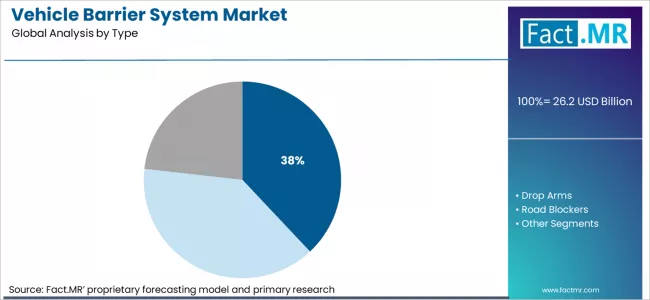
- By Type: Bollards dominate with an estimated 38.0% share, favoured for their aesthetic compatibility with urban environments and crash-certification availability across a wide range of installation depths.
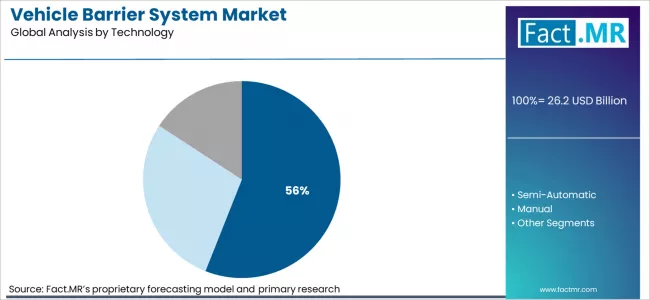
- By Technology: Automatic systems lead with approximately 56.0% share as labour shortages and real-time monitoring requirements accelerate automation adoption across government and commercial sites.
- By End Use: Government and Defense commands the largest end-use share, anchored by mandatory compliance specifications, replacement cycles across federal estate, and critical infrastructure protection investment.
- By Geography: North America leads in revenue, driven by federal procurement and large installed base, while Asia Pacific records the fastest growth from smart city and infrastructure investment.
- Analyst Opinion at FACT.MR
- Shambhu Nath Jha, Principal Consultant at Fact.MR, opines, 'CXOs will find this report essential for navigating the inflection from manual to automated crash-rated systems. Premium automated bollards and road blockers generate two to three times the revenue per installation of manual equivalents, and IoT integration opens recurring monitoring and maintenance service revenue streams through 2036.'
- Strategic Implications
- Manufacturers should expand shallow-mount and surface-mount bollard lines. Installation depth constraints at urban sites with dense subterranean utilities are increasingly the selection-defining factor, and ultra-shallow crash-certified products command a significant price premium.
- Distributors should target government and critical infrastructure procurement channels in India and China. Structured Smart Cities and infrastructure hardening budgets are creating predictable, multi-year tender pipelines for automated barrier systems.
- Commercial suppliers should develop IoT monitoring and remote diagnostics service contracts. Automated barrier installations with connectivity capabilities enable recurring annual service revenue that offsets margin pressure on capital equipment.
- Methodology
- Market sizing combined installation environment estimates by end-use sector with average unit pricing across barrier types and technology tiers, validated through distributor sales data and manufacturer filings.
- Automation and IoT adoption trends were benchmarked against product launches from leading manufacturers and government procurement specifications from DHS Safety Act certifications and PAS68 compliance registers.
- Regional forecasts incorporated government security funding appropriations, smart city programme budgets, critical infrastructure investment plans, and public event security regulatory timelines.
Segmental Analysis
Vehicle Barrier System Market Analysis by Type
Vehicle Barrier System Market Analysis By Type | Source: Fact.MR
Bollards are projected to hold a 38.0% share in 2026. Their dominance stems from their compact footprint, architectural adaptability, and availability in both fixed and retractable formats. Government buyers favor bollards because they offer ASTM M30-M50 crash protection while maintaining pedestrian accessibility in dense urban settings.
- Delta Scientific MP100 Portable Barrier Certification: In October 2024, Delta Scientific’s MP100 portable barrier achieved M30/P3 designation with 51 feet penetration. This certification expands opportunities for deployable crash-rated solutions at temporary events and high-security sites without permanent civil works. [4]
- CAME S.p.A. Motorline Acquisition: In July 2024, CAME S.p.A. acquired Motorline, strengthening its automatic barrier and access control portfolio across Europe and emerging markets. The move enhances its presence in automated gate and barrier distribution channels. [5]
- Electromechanical Bollard Adoption Trend: In November 2023, Pilomat introduced EM and EMB electromechanical bollards, replacing hydraulic systems with electric motor-driven alternatives. Showcased at UEFA EURO 2024 in Stuttgart, the Road Blocker Mobile stopped a 7.5-ton truck at 50 km/h, demonstrating competitive performance with lower lifecycle costs. [6]
Vehicle Barrier System Market Analysis by Technology
Vehicle Barrier System Market Analysis By Technology | Source: Fact.MR
Automatic vehicle barrier systems are expected to account for 56.0% of market share in 2026. Their leadership reflects reduced labor reliance, remote monitoring capability, and compatibility with IoT-based perimeter management platforms. Centralized control systems allow operators to manage multiple access points efficiently without proportional staffing increases.
- Magnetic Autocontrol Next-Gen Bollard Launch: In 2024, Magnetic Autocontrol GmbH launched an upgraded automatic bollard system featuring enhanced remote operation and diagnostics. The product targets high-throughput facilities requiring fast response and centralized security management. [7]
- Avon Barrier Solar-Powered Barrier Launch: In 2024, Avon Barrier introduced a solar-powered automated barrier to support sustainability-focused procurement and off-grid installations. The solution aligns with environmental compliance requirements in commercial and government sectors.
- AI and IoT Integration Trend: TYMETAL’s 2025 security barrier assessment highlighted growing adoption of AI-enabled and sensor-integrated automated barriers. These systems allow security teams to oversee multiple entry points with improved efficiency, accelerating specification across transportation, government, and commercial facilities.
Drivers, Restraints, and Opportunities
Demand is largely non-discretionary, as crash-rated vehicle mitigation is now embedded in regulatory and security compliance frameworks across North America, Europe, and increasingly Asia Pacific.
The market is gradually splitting into two tiers: legacy manual systems facing replacement pressure, and higher-value automated, IoT-integrated systems gaining traction. As security standards tighten, facilities are upgrading from passive bollards and basic drop arms to automated, crash-rated solutions that deliver stronger compliance and monitoring capabilities.
- U.S. Critical Infrastructure Protection Mandates: FEMA’s Fiscal Year 2025 Homeland Security Grant Program allocated USD 1.008 billion to state and local governments for security infrastructure, including physical barrier systems. The DHS Safety Act approval of Gibraltar Perimeter Security’s anti-vehicle barrier family in April 2024, valid through April 2029, reinforces certified procurement pathways toward compliant suppliers. [1]
- UK PAS68 and IWA14 Compliance Requirements: The UK’s Centre for the Protection of National Infrastructure requires PAS68 and IWA14 crash-test certification at government sites and crowded venues. Avon Barrier’s PAS68-rated portfolio, including the SB970CR Scimitar bollard and RB880CR Defender road blocker, positions it to benefit from regulatory-driven replacement demand following vehicle attack reviews in 2024 and 2025. [2]
- China and India Smart City Infrastructure Procurement: China’s urban development plans and Smart City programs increasingly integrate vehicle access control into transport hubs and civic infrastructure. India’s Smart Cities Mission, with 94% of 8,067 projects completed by March 2025, includes intelligent transport and controlled perimeter systems across 100 cities, creating sustained procurement opportunities in Asia Pacific. [3]
Regional Analysis
The vehicle barrier system market is analysed across North America, Latin America, Europe, East Asia, South Asia, Oceania and Middle East & Africa across 40+ countries. The full report also offers market attractiveness analysis based on regional trends.
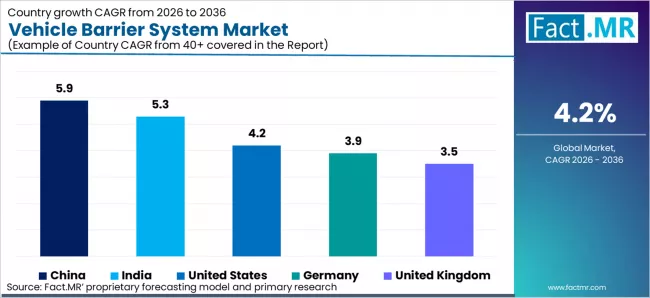
Vehicle Barrier System Market Cagr Analysis By Country | Source: Fact.MR
| Country | CAGR (2026-2036) |
|---|---|
| China | 5.9% |
| India | 5.3% |
| United States | 4.2% |
| Germany | 3.9% |
| United Kingdom | 3.5% |
Source: Fact.MR (FACT.MR) analysis, based on proprietary forecasting model and primary research
Asia Pacific Vehicle Barrier System Market Analysis
Asia Pacific is the fastest-growing market for vehicle barrier systems. Growth is supported by large-scale smart city programs, airport and rail infrastructure expansion, and rising government investment in critical infrastructure protection across China and India. The region includes global premium suppliers serving government and transport projects, alongside strong domestic players competing in commercial and residential access control segments.
- China: Demand in China is projected to expand at a 5.9% CAGR through 2036. Growth is tied to successive Five-Year Plans that embed automated vehicle access control into government campuses, transport hubs, and smart civic spaces. Domestic manufacturers compete in mid-tier commercial systems, while international brands retain strength in high-security government installations.
- India: Demand in India is projected to grow at a 5.3% CAGR through 2036. Under the Smart Cities Mission, which had released 99.44% of its allocated budget to 100 cities by March 2025, authorities expanded intelligent transport and access-controlled perimeter installations.
FACT.MR’s Asia Pacific analysis covers China, Japan, South Korea, India, Australia and New Zealand, ASEAN, and Rest of Asia Pacific. The report details program funding pipelines, smart city timelines, transport hub installations, and automation adoption trends across countries.
Europe Vehicle Barrier System Market Analysis
Europe’s market is shaped by regulatory compliance and policy responses to vehicle-related security incidents. Certification standards such as PAS68 and IWA14 in the UK, along with municipal security investments in Germany and other EU countries, create structured demand for rated barrier systems. Buyers prioritize crash certification, durability, and energy-efficient automation across public and transport infrastructure.
- Germany: Demand in Germany is projected to grow at a 3.9% CAGR through 2036. Municipal authorities are strengthening vehicle access control at pedestrian zones, event sites, and civic infrastructure following updated security guidance after vehicle-ramming incidents in 2024. Deployments such as Pilomat’s Road Blocker Mobile at UEFA EURO 2024 in Stuttgart highlight growing adoption of certified temporary barriers for major public events.
- United Kingdom: Demand in the UK is projected to expand at a 3.5% CAGR through 2036. PAS68 and IWA14 certification requirements from the Centre for the Protection of National Infrastructure are driving replacement of non-rated legacy systems. Domestic suppliers with certified portfolios remain well positioned in public tenders, supported by continued engagement with government procurement channels.
FACT.MR’s European analysis covers Germany, France, the United Kingdom, Italy, Spain, the Netherlands, the Nordics, and Rest of Europe. The report outlines compliance frameworks, municipal security budgets, certification adoption, and public venue procurement standards.
North America Vehicle Barrier System Market Analysis
North America represents the largest and most mature vehicle barrier system market by revenue. The United States has a substantial installed base across federal facilities, airports, commercial properties, and public venues. Growth is supported by replacement demand and ongoing federal infrastructure protection programs.
- United States: Demand in the U.S. is projected to rise at a 4.2% CAGR through 2036. Federal funding programs, including FEMA’s USD 1.008 billion FY2025 Homeland Security Grant allocation, continue to support barrier installations at high-risk sites. DHS Safety Act certification renewals and federal contracts for border and government facilities reinforce procurement preference for certified suppliers and sustain long-term demand visibility.
FACT.MR’s North American analysis covers the United States, Canada, and Mexico. The report includes federal funding allocations, certification trends, procurement frameworks, and replacement cycle benchmarks by facility category.
Competitive Aligners for Market Players
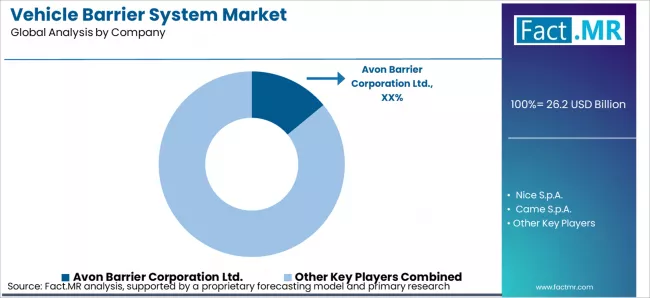
Vehicle Barrier System Market Analysis By Company | Source: Fact.MR
The global vehicle barrier system market is moderately fragmented, combining specialist security manufacturers and diversified access control automation groups. Avon Barrier holds an estimated 12.0% share among dedicated specialists, supported by its PAS68-certified portfolio and strong UK government positioning under Perimeter Protection Group ownership. In North America, Delta Scientific, Ameristar Perimeter Security, and Gibraltar Perimeter Security maintain leadership in federal and critical infrastructure segments through DoD anti-ram certifications, which act as procurement gatekeepers. European players such as FAAC, CAME, and Magnetic Autocontrol compete broadly across commercial and institutional automation markets.
Sustained competitive advantage is typically built on multi-level crash certification, domestic manufacturing eligibility for public tenders, and strong after-sales service networks. Companies that combine portable, permanent, and high-security systems capture both project and lifecycle revenue. Product innovations such as shallow-mount and low-excavation bollards help suppliers address complex urban site constraints.
Government procurement favors certified incumbents due to compliance requirements and specification familiarity. In commercial markets, integrator relationships strongly influence supplier selection. Pricing flexibility remains limited in certified government tiers but more competitive in manual and semi-automatic commercial segments.
Recent Developments
- In September 2025, Beijing ZhuoAoShiPeng Technology showcased new automatic bollard and hydraulic access control products for hostile vehicle mitigation at the 2025 Intersec Saudi Arabia exhibition.
- In May 2025, Avon Security Products introduced the Apex 360 multi-lane high-security vehicle barrier, expanding its crash-rated perimeter portfolio for critical infrastructure and multi-access installations.
Key Players
- Avon Barrier Corporation Ltd.
- Nice S.p.A.
- Came S.p.A.
- Magnetic Autocontrol GmbH
- FAAC S.p.A.
- Gunnebo Group
- Delta Scientific Corporation
- Gibraltar Perimeter Security LP
- Ameristar Perimeter Security
- Hormann Industries GmbH
Bibliography
- [1] U.S. Department of Homeland Security. (2025). DHS Safety Act Technology Certification Registry: Gibraltar Perimeter Security Anti-Vehicle Barriers.
- [2] U.S. Federal Emergency Management Agency. (2025). Fiscal Year 2025 Homeland Security Grant Program Notice of Funding Opportunity.
- [3] Ministry of Housing and Urban-Rural Development, People's Republic of China / Press Information Bureau, Government of India. (2025).
- [4] Delta Scientific Corporation. (2024). MP100 Portable Barrier System: M30/P3 ASTM Crash Test Certification, October 23, 2024.
- [5] Business Reporter Intelligence / Automated Barriers and Bollards Market Report 2025. (2025).
- [6] Pilomat S.r.l. (2024). Road Blocker Mobile at UEFA EURO 2024 Stuttgart.
- [7] Global Growth Insights. (2025). Automated Barriers and Bollards Market.
This Report Addresses
- Strategic market intelligence covering product development, crash-certification investment, IoT and AI integration, and pricing pressure in automated commercial systems.
- Market size and forecast: valued at USD 26.2 billion in 2026, projected to reach USD 39.5 billion by 2036 at 4.2% CAGR, segmented by type, technology, end use, and region.
- Growth opportunity mapping across automatic and IoT-enabled systems, DHS Safety Act and PAS68-driven government procurement, and Asia Pacific smart city installations.
- Segment and regional outlook with country-level CAGR for China (5.9%), India (5.3%), United States (4.2%), Germany (3.9%), and United Kingdom (3.5%).
- Competitive strategy analysis of Avon Barrier, Delta Scientific, CAME, Ameristar, and Gibraltar, covering certification strength, procurement positioning, product differentiation, and pricing dynamics.
- Product and technology tracking including electromechanical bollards, solar-powered barriers, AI sensor integration, portable crash-rated systems, and IoT monitoring capabilities.
- Report delivered in Excel datasets, PowerPoint summary, and detailed PDF supported by verified regulatory and manufacturer sources.
Segmentation
Scope of Report
| Items | Values |
|---|---|
| Quantitative Units | USD 26.2 billion (2026) to USD 39.5 billion (2036), at a CAGR of 4.2% |
| Market Definition | Vehicle barrier systems are crash-rated and access-controlled physical security installations deployed at government facilities, critical infrastructure perimeters, transportation hubs, commercial properties, and public spaces to prevent unauthorized vehicular entry and mitigate vehicle-borne threats, spanning bollards, road blockers, drop arms, gates, and turnstiles across manual, semi-automatic, and automated technology configurations. |
| Type Segmentation | Bollards, Drop Arms, Road Blockers, Gates, Turnstiles |
| Technology Segmentation | Automatic, Semi-Automatic, Manual |
| End Use Segmentation | Government/Defense, Commercial, Industrial, Transportation, Smart City |
| Application Coverage | Federal and municipal government perimeter protection, transportation hub access control, critical infrastructure security, commercial real estate access management, public event temporary barrier deployment, smart city vehicle exclusion zones |
| Regions Covered | Asia Pacific, Europe, North America, Latin America, Middle East and Africa |
| Countries Covered | China, Japan, South Korea, Australia and New Zealand, India, ASEAN, Rest of Asia Pacific, Germany, United Kingdom, France, Italy, Spain, Netherlands, Nordics, Rest of Europe, United States, Canada, Mexico, Brazil, Chile, Ecuador, Rest of Latin America, Kingdom of Saudi Arabia, United Arab Emirates, South Africa, Turkey, Rest of Middle East and Africa |
| Key Companies Profiled | Avon Barrier Corporation Ltd., Nice S.p.A., Came S.p.A., Magnetic Autocontrol GmbH, FAAC S.p.A., Gunnebo Group, Delta Scientific Corporation, Gibraltar Perimeter Security LP, Ameristar Perimeter Security, Hormann Industries GmbH |
| Forecast Period | 2026 to 2036 |
| Approach | A hybrid top-down and bottom-up modelling approach was applied. Top-down inputs included total addressable installation environments by facility type, government security programme funding scope, and regulatory compliance timelines. Bottom-up inputs incorporated average unit prices by barrier type and technology tier, replacement cycle assumptions by end-use application, and new installation growth rates from primary interviews with distributors, integrators, and security consultants. |
Vehicle Barrier System Market by Segment
-
By Type
- Bollards
- Drop Arms
- Road Blockers
- Gates
- Turnstiles
-
By Technology
- Automatic-56.0% share (base year)
- Semi-Automatic
- Manual
-
By End Use
- Government/Defense
- Commercial
- Industrial
- Transportation
- Smart City
-
By Region
- North America
- United States
- Canada
- Mexico
- Europe
- Germany
- United Kingdom
- France
- Italy
- Spain
- Netherlands
- Nordics
- Rest of Europe
- Asia Pacific
- China
- Japan
- South Korea
- India
- Australia and New Zealand
- ASEAN
- Rest of Asia Pacific
- Latin America
- Brazil
- Chile
- Ecuador
- Rest of Latin America
- Middle East and Africa
- Kingdom of Saudi Arabia
- United Arab Emirates
- South Africa
- Turkey
- Rest of Middle East and Africa
- North America
Frequently Asked Questions
How large is the vehicle barrier system market in 2025?
What will the market size be in 2026?
What is the projected market size by 2036?
What is the expected CAGR for the forecast period 2026 to 2036?
Which type segment is poised to lead the vehicle barrier system market?
Which technology segment holds the largest share?
Which end-use segment commands the largest revenue share?
Which country shows the fastest growth rate?
How fast is the vehicle barrier system market expected to expand in India?
What is the forecast CAGR for Germany's vehicle barrier system market?
What growth rate is expected for the vehicle barrier system market in the United Kingdom?
How is the vehicle barrier system market in the United States expected to grow?
Who worked on this report


Preview the report firsthand - request a free sample
Free SampleGet the brochure for pricing and purchase details
Download PDF