- Market Value (2025): USD 1.24 Bn
- Estimated Value (2026): USD 1.29 Bn
- Forecast Value (2036): USD 1.88 Bn
- CAGR (2026-2036): 3.8%
What is the Dry-packed Scallops Market forecast to be worth by 2036?
USD 1.3 billion in 2026 to USD 1.9 billion by 2036, at a 3.8% CAGR.
- According to Fact.MR analysis, the dry-packed scallops market reached USD 1.24 billion in 2025.
- Demand will increase from USD 1.29 billion in 2026 to USD 1.88 billion by 2036.
- The market is forecast to record a 3.8% CAGR during 2026 to 2036, with Japan and the United States posting comparatively higher country growth.
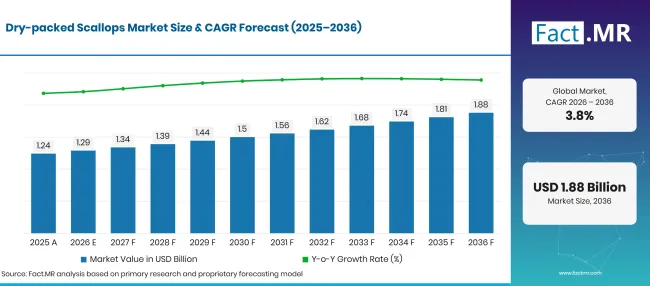
Factmr Dry Packed Scallops Market Forecast Global | Source: Fact.MR
| Year | Basis | Market Value (USD billion) |
|---|---|---|
| 2025 | Actual | 1.24 |
| 2026 | Estimate | 1.29 |
| 2036 | Forecast | 1.88 |
| CAGR 2026 to 2036 | Forecast period | 3.8% |
Source: Fact.MR analysis. Updated Oct 13, 2026
What are the defining numbers behind Dry-packed Scallops Market growth?
The forecast represents USD 0.6 billion in more market value between 2026 and 2036 across the specified scallop categories.
- Demand Drivers in the Market
- Restaurant chefs need scallops that cook evenly and release very little extra liquid. Dry-packed scallops stand apart from water-treated products and help deliver consistent results.
- Seafood importers need dependable standards for frozen-at-sea products. Clearwater describes North Atlantic scallops that are frozen at sea and graded at its Nova Scotia facility, showing an established export supply process.
- U.S. processors operate under managed harvest limits. NOAA Fisheries set Northern Gulf of Maine total allowable scallop landings at 712,093 lb for the 2025 fishing year [1], making supply planning an important purchasing consideration.
- Key Segments Analyzed
- By Product Type: Fresh holds 58.3% share in 2026, as restaurants purchase for short service windows and close control over appearance.
- By Application: Food Service captures 62.1% share in 2026 since chefs buy graded scallops for repeatable portions.
- By Sales Channel: Supermarkets/Hypermarkets represents 38.2% share in 2026 because shoppers can examine chilled packaging and compare origin labels.
- By End-User: Restaurants accounts for 54.3% share in 2026 as menu pricing places a premium on consistent size and cooking yield.
- Analyst Opinion at Fact.MR
- Shambhu Nath Jha, Principal Consultant at Fact.MR, states, “Dry-packed scallop buyers will give greater attention to consistent size, cooking performance, and clear product information. Restaurants will need scallops that sear evenly without releasing excess liquid, while distributors will manage harvest limits and cold-storage costs. Suppliers that maintain consistent grading, clearly communicate moisture-treatment practices, and provide reliable chilled or frozen deliveries will strengthen their position for repeat orders from food-service and retail customers.”
- Strategic Implications
- Processors can keep dry-packed scallops clearly separate from water-treated products in packaging and buyer documents. This makes product differences easier to understand.
- Food-service distributors benefit from offering consistent piece counts, allowing kitchens to price portions without frequent recipe changes.
- Supermarkets can present storage instructions and product type clearly, especially when chilled and frozen scallops are displayed in the same section.
- Importers need to review harvest records and cold-chain performance before committing to longer supply agreements.
Fact.MR forecasts that Japan will record 4.9% CAGR through 2036. The United States follows at 4.4%, while the United Kingdom records 4.1%. Brazil is projected at 3.2% and Germany at 2.7%.
How does the Dry-packed Scallops Market break down by segment?
Fresh leads Product Type at 58.3%; Food Service leads Application at 62.1%; Supermarkets/Hypermarkets lead Sales Channel at 38.2%; Restaurants lead End-User at 54.3%.
Which Product Type dominates?
Fresh scallops hold 58.3% market share in 2026.
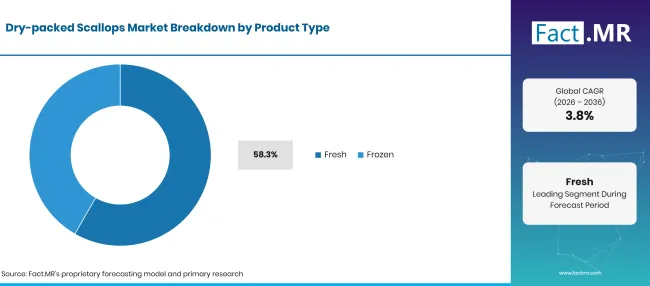
Factmr Dry Packed Scallops Market Breakdown Product Type | Source: Fact.MR
| Product Type | Share (2026) |
|---|---|
| Fresh (Leading segment) | 58.3% |
| Other segments combined | 41.7%* |
| Total | 100.0% |
Source: Fact.MR analysis. Updated Oct 13, 2026
Fresh scallops will remain a preferred option for restaurants that operate with short delivery and serving schedules. Chefs will be able to assess appearance, firmness, and size before cooking, helping them maintain consistent dish quality. Fresh products will also suit menu offerings where presentation plays a key role. Suppliers providing dependable chilled deliveries and consistent grading will be better placed to support regular restaurant demand.
What leads the Application segment?
Food Service accounts for 62.1% of sales in 2026.
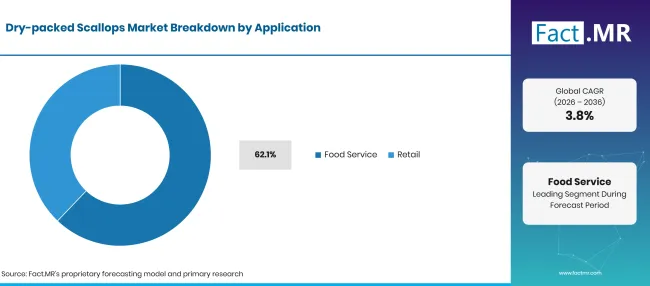
Factmr Dry Packed Scallops Market Breakdown Application 1 | Source: Fact.MR
| Application | Share (2026) |
|---|---|
| Food Service (Leading segment) | 62.1% |
| Other segments combined | 37.9%* |
| Total | 100.0% |
Source: Fact.MR analysis. Updated Oct 13, 2026
Food-service buyers purchase scallops based on portion size, cooking performance, and supply reliability. Restaurants depend on products that cook evenly and deliver consistent results across repeat orders. Uniform sizing helps chefs manage food costs and maintain consistent plate presentation. Distributors offering dependable grading and clear handling guidance are better positioned to strengthen relationships with restaurants and other professional kitchens.
How does Sales Channel shape purchases?
Supermarkets/Hypermarkets hold 38.2% share in 2026.
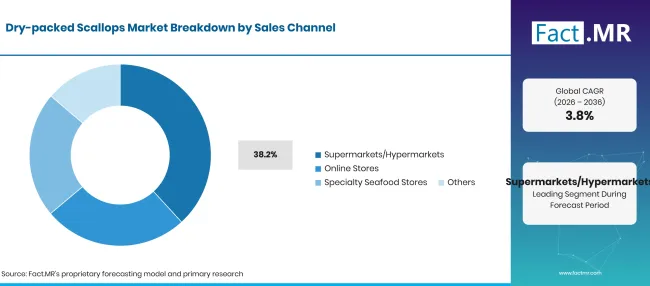
Factmr Dry Packed Scallops Market Breakdown Sales Channel | Source: Fact.MR
| Sales Channel | Share (2026) |
|---|---|
| Supermarkets/Hypermarkets (Leading segment) | 38.2% |
| Other segments combined | 61.8%* |
| Total | 100.0% |
Source: Fact.MR analysis. Updated Oct 13, 2026
Supermarkets and hypermarkets make packaged scallops easily available, with clear details on origin, storage, and product type. Shoppers can compare fresh and frozen options during their regular grocery trips. Online channels make home delivery more convenient, while specialty seafood stores provide additional product guidance. Dependable cold storage and transportation play a key role across all retail channels.
Which End-User contributes most?
Restaurants lead with 54.3% of sales in 2026.
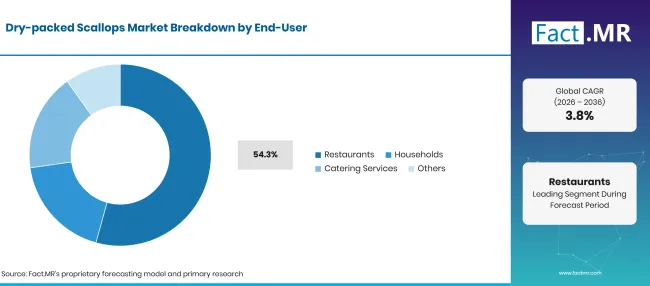
Factmr Dry Packed Scallops Market Breakdown End User | Source: Fact.MR
| End-User | Share (2026) |
|---|---|
| Restaurants (Leading segment) | 54.3% |
| Other segments combined | 45.7%* |
| Total | 100.0% |
Source: Fact.MR analysis. Updated Oct 13, 2026
Restaurants will remain the main buyers of dry-packed scallops because they help kitchens manage portion sizes, cooking yield, and plate presentation. Chefs prefer consistent sizing across deliveries so recipes and food costs stay under control. Households tend to purchase smaller packs, while catering companies buy based on event requirements. Clear product information makes it easier for buyers to distinguish dry-packed scallops from treated alternatives.
What is accelerating Dry-packed Scallops Market adoption, and what is holding it back?
Cooking yield and steady purchases from food-service customers support dry-packed scallop sales. At the same time, harvest limits and cold-storage costs affect product availability and supply across the market.
Drivers Impact Analysis
| DRIVER | (~) % IMPACT ON CAGR | GEOGRAPHIC RELEVANCE | IMPACT TIMELINE |
|---|---|---|---|
| Restaurant preference for consistent cooking yield | +0.9% | North America, Europe | Medium term (2–4 years) |
| Frozen-at-sea handling and grading | +0.7% | North America, Japan | Medium term (2–4 years) |
| Clearer origin and moisture specifications | +0.6% | Global | Short term (<= 2 years) |
| Seafood counters and packaged retail | +0.5% | Europe, Asia | Medium term (2–4 years) |
| Stable food-service replenishment | +0.4% | Global | Long term (>= 4 years) |
Source: Fact.MR analysis. Updated Oct 13, 2026
Opportunity Impact Analysis
| OPPORTUNITY | (~) % IMPACT ON CAGR | GEOGRAPHIC RELEVANCE | IMPACT TIMELINEh |
|---|---|---|---|
| Verified moisture-treatment labeling | +0.7% | Global | Short term (<= 2 years) |
| Portion-ready packs for restaurants | +0.6% | North America, Europe | Medium term (2–4 years) |
| Premium frozen food-service lines | +0.5% | Japan, UK | Medium term (2–4 years) |
| Direct specialty and online seafood retail | +0.4% | Global | Long term (>= 4 years) |
Source: Fact.MR analysis. Updated Oct 13, 2026
Restraints Impact Analysis
| RESTRAINT | (~) % IMPACT ON CAGR | GEOGRAPHIC RELEVANCE | IMPACT TIMELINE |
|---|---|---|---|
| Fishing limits and stock variation | -0.8% | USA, UK, Japan | Long term (>= 4 years) |
| Refrigeration and transport expense | -0.6% | Global | Short term (<= 2 years) |
| Differences in added-water treatment | -0.5% | Global | Medium term (2–4 years) |
| Premium price sensitivity | -0.4% | Brazil, Germany | Medium term (2–4 years) |
Source: Fact.MR analysis. Updated Oct 13, 2026
Which countries are scaling the Dry-packed Scallops Market through 2036?
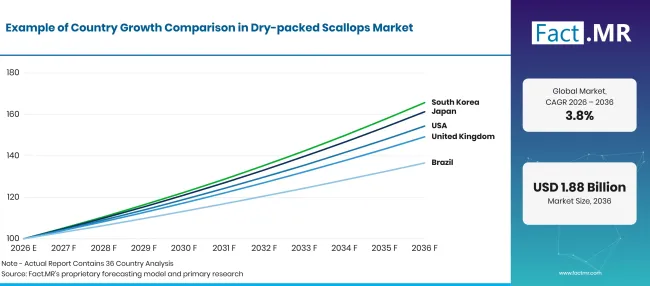
Factmr Dry Packed Scallops Market Growth Index | Source: Fact.MR
| Country | CAGR (2026–2036) |
|---|---|
| Japan | 4.9% |
| United States | 4.4% |
| United Kingdom | 4.1% |
| Brazil | 3.2% |
| Germany | 2.7% |
Source: Fact.MR analysis. Updated Oct 13, 2026
Why is Japan seeing stronger dry-packed scallop adoption?
4.9% CAGR, supported by established seafood preparation and retail channels.
Japanese restaurants use scallops in dishes where consistent size helps maintain cooking time and presentation. Seafood retailers also serve households purchasing fresh and frozen scallops for everyday use. Frozen products give restaurants greater flexibility when harvest volumes and import schedules vary. Specialty stores make it easier for customers to understand product size, storage needs, and handling requirements.
How is the United States shaping dry-packed scallop sales?
4.4% CAGR, reflecting restaurant purchasing and managed Atlantic harvests.
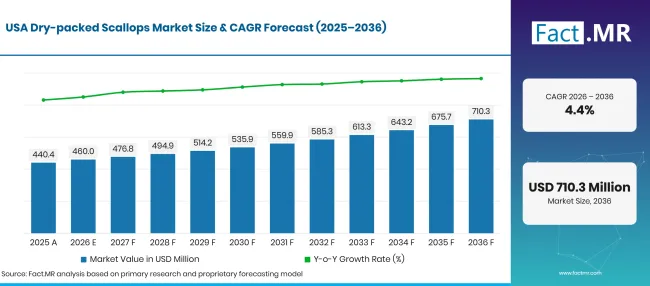
Factmr Dry Packed Scallops Market Forecast Usa | Source: Fact.MR
U.S. restaurants purchase size-graded scallops to manage serving portions, cooking results, and plate costs. NOAA Fisheries reported 1,176,738 lb of scallop meats landed by limited-access general-category quota vessels during its 2025 fee period [3]. Retail seafood counters also provide households with access to chilled and frozen scallops. Harvest regulations, seasonal availability, vessel operating costs, and long-distance cold storage play a key role in shaping supply levels and market prices.
What is driving dry-packed scallop use in the United Kingdom?
4.1% CAGR, supported by seafood trade and restaurant use.
UK restaurants prefer scallops with consistent grading and dependable chilled delivery because short cooking times leave little room for variation. The Marine Management Organisation reported 745 thousand tonnes of fish landed by UK vessels in 2024 [2]. Imports provide additional frozen shellfish when domestic supply changes, while specialist fishmongers support household demand. Delivery schedules, seasonal fishing costs, and restaurant profit margins influence purchasing decisions across the market.
How is Brazil developing its dry-packed scallop market?
3.2% CAGR, reflecting selective restaurant uptake and modern seafood retail.
Brazilian restaurants purchasing premium seafood rely on frozen scallops because they are easier to handle across longer inland delivery routes. The federal government reported 128,200 tonnes of seafood exports during 2025 [4], highlighting an established seafood distribution network. Specialty traders can explain the differences between dry-packed and frozen scallops to buyers. Currency fluctuations, refrigerated transport costs, menu pricing, and limited consumer awareness continue to influence purchasing decisions.
Why is Germany maintaining steady dry-packed scallop demand?
2.7% CAGR, shaped by seafood retail and reliable import supply.
German restaurants and seafood wholesalers prefer clear origin details, reliable cold storage, and consistent scallop sizes. EU seafood labeling and traceability requirements provide supporting documentation as imported shellfish moves through wholesale and food-service channels. Supermarkets also offer chilled and frozen seafood options for household buyers. Refrigeration expenses across the supply chain, longer inland transport routes, and premium pricing reduce how often households purchase dry-packed scallops.
Who leads the Dry-packed Scallops Market?
Clearwater Seafoods and Pacific Seafood will remain active participants in the North American scallop supply chain. Clearwater offers Atlantic sea scallops as part of its seafood portfolio. Broader seafood companies such as High Liner Foods operate across related product categories, while specialist distributors compete through product grading and delivery quality.
Competitive positioning will depend on scallop-specific supply capabilities, including harvest source, piece count, and chilled or frozen distribution. Seafood suppliers such as Northern Wind and Seatrade are associated with scallop sales, while other companies maintain broader portfolios covering fish and frozen seafood products.
Which companies are the key providers?
Key companies include Clearwater Seafoods Incorporated; Pacific Seafood Group; High Liner Foods Inc.; Ocean Choice International; Seatrade International Company Inc.; Northern Wind Inc.; Stavis Seafoods; and Eastern Fish Company.
- Clearwater Seafoods Incorporated
- Pacific Seafood Group
- High Liner Foods Inc.
- Ocean Choice International
- Seatrade International Company Inc.
- Northern Wind Inc.
- Stavis Seafoods
- Eastern Fish Company
Bibliography
- [1] NOAA Fisheries. (2025, April 15). 2025 Fishing Year Northern Gulf of Maine Sea Scallop Possession Limit and Total Allowable Landings.
- [2] Marine Management Organisation. (2025, December 2). Fishing industry 2024 statistics published. GOV.UK.
- [3] NOAA Fisheries. (2026, May). 2025 Annual Report of the Atlantic Sea Scallop Individual Fishing Quota Cost Recovery Program.
- [4] Presidência da República, Casa Civil. (2026, February 2). Mensagem ao Congresso Nacional 2026.
This Report Answers
- The report explains how dry-packed scallops are sold across fresh and frozen product forms.
- Segment analysis identifies the largest supplied 2026 shares for applications and distribution channels.
- Country outlook compares Japan, the United States, the United Kingdom, Brazil and Germany.
- Competitive discussion separates verified scallop activity from wider seafood supply businesses.
- Supply-chain analysis considers cooking yield, handling and seafood harvest limits.
What does the Dry-packed Scallops Market cover?
The Dry-packed Scallops Market covers edible scallop meats supplied without added moisture-retaining treatment. Fresh and frozen refer to the storage condition, while dry-packed refers to handling. Sales to restaurants and households are included alongside specialist catering accounts.
What is included in the scope?
The scope includes new sales of qualifying dry-packed scallop meat through food-service distribution, supermarkets, specialist seafood stores and online stores. The assessment includes chilled products and frozen formats where the dry-packed specification is retained.
What is excluded from the scope?
The scope excludes scallops treated with added phosphate or water-retaining solutions when they do not meet the dry-packed standard. Dried scallops are excluded because drying is a separate preservation process. Whole-shell souvenir products, restaurant meal revenue and unrelated shellfish also fall outside the assessed sales boundary.
How Was the Analysis Built?
The analysis draws on 120+ sources, 35+ company portfolios, 25+ countries, and more than 20 industry interviews.
- Primary Research: Primary research includes discussions with manufacturers, service providers, technology developers, distributors, end users, and subject-matter experts. These conversations examine purchasing priorities, product adoption, operational challenges, approval requirements, competitive positioning, and the factors that influence wider market acceptance.
- Desk Research: Desk research covers government statistics, regulatory publications, company filings, trade data, technical studies, industry associations, standards, public policy, and other authoritative sources. Every source used in the analysis is documented in the bibliography.
- Market Sizing and Forecasting: Market estimates combine historical performance, demand indicators, pricing and volume trends, segment shares, company participation, country-level growth, adoption patterns, investment activity, and barriers to market expansion.
- Data Validation and Update Cycle: Findings are validated by comparing primary interviews with public data, company activity, regulatory changes, trade patterns, and industry developments. Regular updates review new product launches, capacity changes, partnerships, approvals, and shifts in commercial adoption.
Segmentation
What is the report’s scope and coverage?
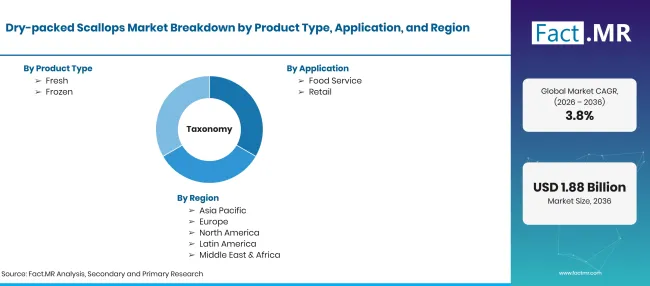
Factmr Dry Packed Scallops Market Taxonomy 1 | Source: Fact.MR
| Attribute | Details |
|---|---|
| Quantitative Units | USD billion in 2026 to USD billion by 2036 at CAGR |
| Market Definition | Fresh and frozen scallop meats sold with no added moisture-retaining treatment |
| Product Type | Fresh; Frozen |
| Application | Food Service; Retail |
| Sales Channel | Supermarkets/Hypermarkets; Online Stores; Specialty Seafood Stores; Others |
| End-User | Restaurants; Households; Catering Services; Others |
| Countries Covered | Japan; United States; United Kingdom; Brazil; Germany |
| Forecast Period | 2026 to 2036 |
| Approach | Segment value outlook and qualitative review of supply, fishery regulation and seafood distribution |
Source: Fact.MR analysis. Updated Oct 13, 2026
How is the market segmented?
-
By Product Type
- Fresh
- Frozen
-
By Application
- Food Service
- Retail
-
By Sales Channel
- Supermarkets/Hypermarkets
- Online Stores
- Specialty Seafood Stores
- Others
-
By End-User
- Restaurants
- Households
- Catering Services
- Others
-
By Region
- North America
- Latin America
- Western Europe
- Eastern Europe
- East Asia
- South Asia & Pacific
- Middle East & Africa
Frequently Asked Questions
How big is the dry-packed scallops market in 2026?
What is the CAGR of the dry-packed scallops market?
Which product type leads?
Which application leads?
Who are the main companies in the Dry-Packed Scallops market?
Who worked on this report


Preview the report firsthand - request a free sample
Free SampleGet the brochure for pricing and purchase details
Download PDF