- Forecast Value (2036): 9.3 Bn
- CAGR (2036): 14.5%
What is the dry-reagent PCR cartridges market forecast to be worth by 2036?
USD 2.4 billion in 2026 to USD 9.3 billion by 2036, at 14.5% CAGR.
- The dry-reagent PCR cartridges market crossed a valuation of USD 2.1 billion in 2025.
- Demand is expected to increase from USD 2.4 billion in 2026 to USD 9.3 billion by 2036.
- The market is forecast to record 14.5% CAGR from 2026 to 2036 as hospitals and decentralized testing sites adopt closed PCR cartridges with stabilized reagents.
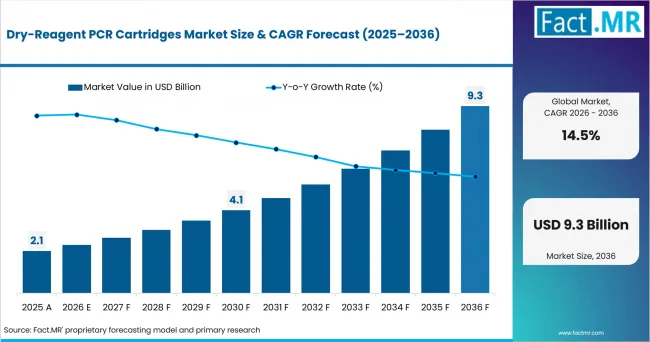
Dry Reagent Pcr Cartridges Market Market Value Analysis | Source: Fact.MR
What are the defining numbers behind dry-reagent PCR cartridges market growth?
USD 6.9 billion absolute opportunity by 2036, led by the United States and India.
- Demand Drivers in the Market
- Hospital labs need PCR cartridges that reduce manual reagent preparation.
- Point-of-care sites need stable cartridges that lower cold-chain pressure.
- Diagnostic companies need dry chemistry that supports longer shelf life.
- Public health programs need portable PCR tests for decentralized disease control.
- Key Segments Analyzed
- By Cartridge Format: Fully Integrated Sample-to-Answer Cartridges are expected to hold 46.0% share in 2026 as users prefer closed molecular workflows.
- By Reagent Format: Lyophilized PCR Beads and Pellets lead because freeze-dried chemistry supports stable cartridge storage. The share is projected at 41.0% in 2026.
- By Assay Type:Infectious Disease PCR Assays are likely to account for 54.0% share in 2026 since rapid pathogen detection drives cartridge use.
- By Sample Type: Respiratory Samples lead with 32.0% share in 2026 because flu, COVID-19, and RSV testing created broad cartridge adoption.
- By End Use: Hospital and Near-Patient Testing Sites are expected to hold 43.0% share in 2026 because rapid clinical decisions need faster PCR turnaround.
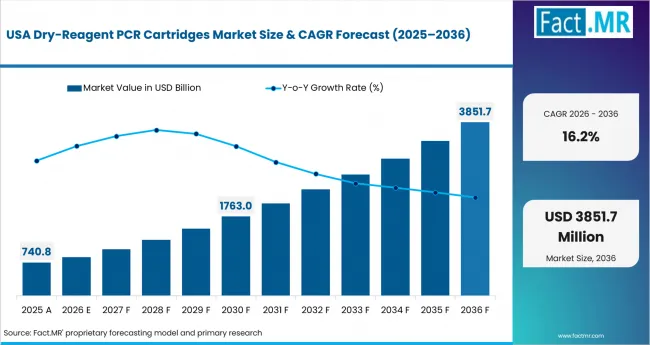
- By Geography: The United States is projected to record 16.2% CAGR through 2036 as cartridge-based molecular testing expands.
- Analyst Opinion at Fact.MR
- Shambhu Nath Jha, Senior Analyst at Fact.MR, states, “Dry-reagent PCR cartridges are turning molecular testing into a simpler consumable workflow. We see laboratories shifting from reagent preparation toward closed cartridges that hold stabilized chemistry. Providers that combine broad assay menus with reliable cartridge manufacturing will gain stronger access to decentralized testing budgets.”
- Strategic Implications
- Cartridge suppliers should improve dry reagent stability across transport conditions.
- Diagnostic developers should design cartridges around rehydration flow early.
- Hospitals should compare cartridge cost with labor and turnaround savings.
- Public health programs should align cartridge menus with local disease priorities.
Dry-reagent PCR cartridges are disposable molecular diagnostic cartridges that store freeze-dried or air-dried PCR chemistry inside a closed test device. The category connects with molecular diagnostics because PCR cartridges bring nucleic acid testing into faster and easier workflows. The strongest adoption case comes from infectious disease testing where laboratories need rapid results and low hands-on time.
Cepheid’s Xpert Xpress CoV-2 plus package insert states that each cartridge contains 3 freeze-dried reagent beads and integrates sample processing with real-time RT-PCR. This supports dry-reagent cartridge demand because the cartridge holds the assay chemistry before use.
BioFire’s FDA 510(k) summary for the BIOFIRE FILMARRAY Tropical Fever Panel states that the pouch contains all required reagents in a freeze-dried format. This supports syndromic PCR cartridges where dry reagents simplify multiplex testing. QIAGEN’s 2024 FDA 510(k) summary for QIAstat-Dx Respiratory Panel Plus states that all reagents are pre-loaded and self-contained in the cartridge. This reinforces demand for closed cartridges that reduce preparation steps.
The United States is projected to record 16.2% CAGR through 2036 as Cepheid, BioFire and Visby Medical expand point-of-care PCR use. India is expected to post 15.8% CAGR through 2036 as Molbio’s Truenat platform supports decentralized PCR testing. Germany is likely to record 14.9% CAGR as QIAGEN expands cartridge-based syndromic testing. Switzerland is forecast to advance at 14.2% CAGR as Roche Diagnostics strengthens cobas liat near-patient PCR. China is set to record 13.8% CAGR as local diagnostic manufacturers scale cartridge-based molecular testing.
How does the dry-reagent PCR cartridges market break down by segment?
Fully Integrated Sample-to-Answer Cartridges lead at 46%; Infectious Disease PCR Assays lead at 54%.
Which cartridge format dominates?
Fully Integrated Sample-to-Answer Cartridges hold 46% share in 2026.
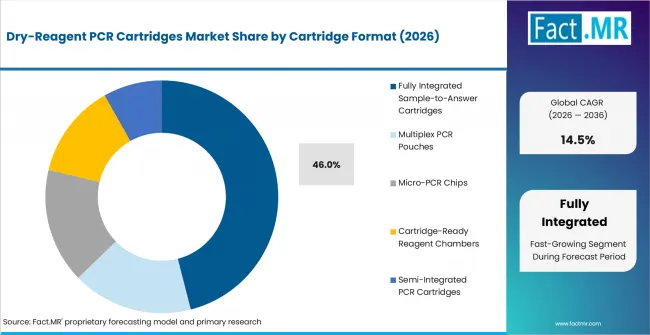
Dry Reagent Pcr Cartridges Market Analysis By Cartridge Format | Source: Fact.MR
Fully Integrated Sample-to-Answer Cartridges are expected to hold 46% share in 2026 because they combine sample handling and PCR chemistry in one closed device. These cartridges reduce manual preparation and contamination risk. The format works well in urgent testing settings where staff need simple workflows. It connects with clinical diagnostics because clinical users value reliable results with minimal hands-on work.
Which reagent format dominates?
Lyophilized PCR Beads and Pellets account for 41% share in 2026.
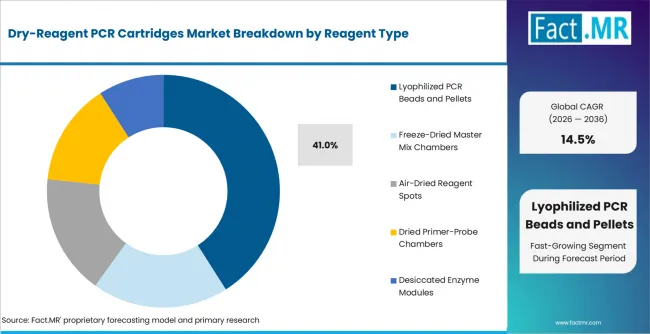
Dry Reagent Pcr Cartridges Market Analysis By Reagent Type | Source: Fact.MR
Lyophilized PCR Beads and Pellets lead because freeze-dried chemistry can be stored inside the cartridge until rehydration. The reagent format is projected to capture 41% share in 2026. Beads help dose enzymes, primers and probes consistently. They also support easier assembly into cartridge chambers. Biofortuna notes that lyophilized reagents inside microfluidic cartridges can improve assay accessibility, increase shelf life, and reduce cold-chain logistics.
Which assay type dominates?
Infectious Disease PCR Assays hold 54% share in 2026.
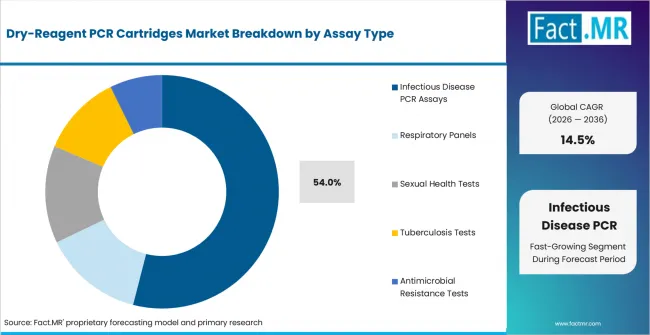
Dry Reagent Pcr Cartridges Market Analysis By Assay Type | Source: Fact.MR
Infectious Disease PCR Assays lead because cartridge platforms first scaled around respiratory, gastrointestinal and sexual health testing. The assay type is likely to account for 54% share in 2026. These tests benefit from rapid molecular turnaround and closed handling. BioFire and QIAstat-Dx both show strong adoption in multiplex infectious disease panels. The segment links with diagnostic testing because fast pathogen identification can guide treatment decisions.
Which sample type dominates?
Respiratory Samples lead with 32% share in 2026.
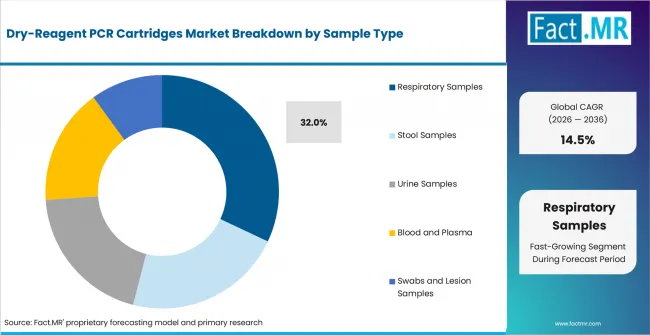
Dry Reagent Pcr Cartridges Market Analysis By Sample Type | Source: Fact.MR
Respiratory Samples lead because COVID, influenza and RSV testing expanded cartridge-based PCR use. The sample type is expected to hold 32% share in 2026. Nasal swabs and nasopharyngeal swabs fit point-of-care molecular workflows. Roche’s cobas liat respiratory tests show how compact PCR systems can support near-patient respiratory diagnosis. The in-vitro diagnostics layer is relevant because respiratory panels remain a major IVD consumable category.
Which end use dominates?
Hospital and Near-Patient Testing Sites hold 43% share in 2026.
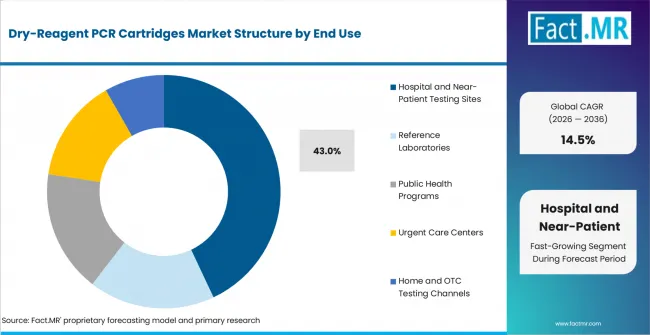
Dry Reagent Pcr Cartridges Market Analysis By End Use | Source: Fact.MR
Hospital and Near-Patient Testing Sites lead because clinicians need actionable results during the same care episode. The end use is expected to hold 43% share in 2026. Emergency departments and urgent care settings benefit from fast PCR workflows. Visby Medical’s FDA De Novo authorization for an OTC PCR sexual health test shows how cartridge-style PCR is moving closer to patients. The lab automation link matters because central labs still use cartridge systems to reduce manual workload.
What is accelerating dry-reagent PCR cartridge demand, and what is holding it back?
Decentralized molecular testing drives demand; cartridge cost restrains adoption.
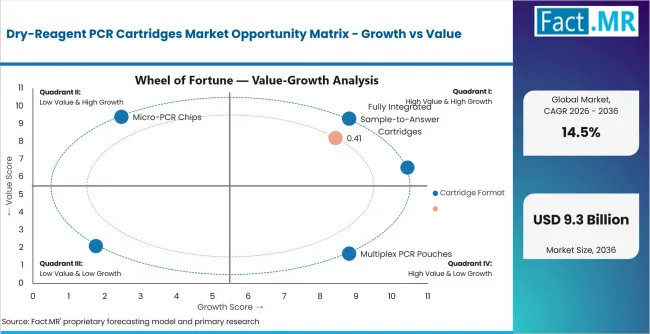
Dry Reagent Pcr Cartridges Market Opportunity Matrix Growth Vs Value | Source: Fact.MR
Decentralized molecular testing is the main driver. Hospitals and clinics want molecular accuracy without sending every sample to a central laboratory. Dry reagents help cartridges work in settings where cold-chain control is harder.
Roche received FDA clearance with CLIA waiver for cobas liat molecular STI tests in 2025. This supports near-patient PCR adoption where rapid treatment decisions are needed. Visby Medical received FDA De Novo authorization in 2025 for an OTC PCR sexual health test. This supports broader use of self-contained PCR testing formats outside conventional laboratories.
The main restraint is cartridge cost. Integrated cartridges are more expensive than open PCR reagents. Adoption improves when faster turnaround reduces follow-up visits and treatment delays.
Where do the biggest dry-reagent PCR cartridge opportunities sit?
Respiratory panels, sexual health testing and decentralized TB programs.
- Respiratory Panels: Hospitals can use dry-reagent cartridges for rapid flu and RSV testing.
- Sexual Health Testing: Near-patient PCR cartridges can shorten treatment decisions for STI care.
- TB Programs: Decentralized PCR cartridges can support testing closer to patients.
Which countries are scaling dry-reagent PCR cartridges fastest?
United States 16.2%, India 15.8%, Germany 14.9%, Switzerland 14.2%, China 13.8%.
Based on regional analysis, the dry-reagent PCR cartridges market covers North America, Western Europe, Asia Pacific, Latin America, and Middle East and Africa complete the regional scope.
.webp "Top Country Growth Comparison Dry Reagent Pcr Cartridges Market Cagr (2026 2036)")
Top Country Growth Comparison Dry Reagent Pcr Cartridges Market Cagr (2026 2036) | Source: Fact.MR
| Country | CAGR |
|---|---|
| United States | 16.2% |
| India | 15.8% |
| Germany | 14.9% |
| Switzerland | 14.2% |
| China | 13.8% |
Source: Fact.MR analysis. Updated Jun 26, 2026
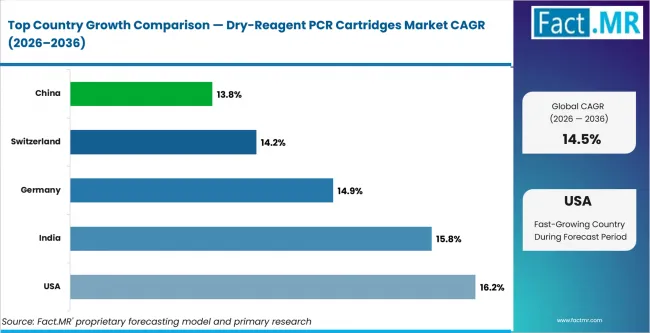
Dry Reagent Pcr Cartridges Market Cagr Analysis By Country | Source: Fact.MR
What is powering the United States lead?
16.2% CAGR, driven by Cepheid and near-patient PCR adoption.
Dry Reagent Pcr Cartridges Market Country Value Analysis | Source: Fact.MR
The United States is projected to record 16.2% CAGR through 2036 as hospitals use cartridge PCR for faster infectious disease diagnosis. Cepheid and BioFire have large installed molecular testing platforms. Visby Medical adds momentum in self-contained PCR formats. Growth will favor providers with FDA-cleared menus and strong clinical support.
How is India scaling dry-reagent PCR cartridge demand?
15.8% CAGR, supported by Molbio Diagnostics and decentralized TB testing.
India is expected to post 15.8% CAGR from 2026 to 2036 as Truenat supports PCR testing closer to patients. Dry reagent formats help public health programs reduce storage and transport pressure. Infectious disease control programs need portable molecular systems. Growth will favor cartridge platforms that balance cost and field usability.
What supports Germany’s outlook?
14.9% CAGR, driven by QIAGEN and syndromic PCR cartridge adoption.
Germany is likely to record 14.9% CAGR through 2036 as QIAstat-Dx cartridges support multiplex infectious disease testing. Hospitals need closed systems that reduce manual setup. German diagnostic manufacturers also support cartridge assay development. Growth will favor platforms with flexible panel design.
How is Switzerland scaling dry-reagent PCR cartridge adoption?
14.2% CAGR, due to Roche Diagnostics and cobas liat near-patient PCR.
Switzerland is forecast to advance at 14.2% CAGR by 2036 as Roche Diagnostics expands compact PCR workflows. cobas liat supports fast testing in near-patient settings. Swiss IVD expertise strengthens assay development and quality systems. Growth will favor cartridges that support rapid clinical decisions.
What underpins China’s growth?
13.8% CAGR, backed by local diagnostic manufacturing and hospital molecular testing.
China is set to record 13.8% CAGR through 2036 as hospitals and regional labs expand cartridge-based molecular testing. Local manufacturers are improving PCR platform access. Respiratory and gastrointestinal testing create strong demand. Growth will favor cost-effective cartridges with broad disease menus.
Who leads the dry-reagent PCR cartridges market?
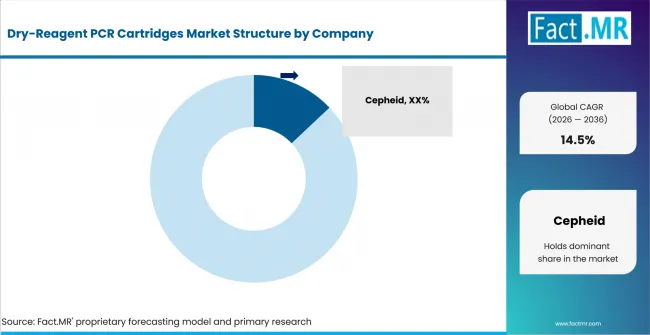
Cepheid and bioMérieux/BioFire lead through large installed cartridge PCR platforms.
Dry Reagent Pcr Cartridges Market Analysis By Company | Source: Fact.MR
Dry-reagent PCR cartridges are supplied by molecular diagnostics companies with closed cartridge systems. Cepheid leads through GeneXpert cartridges and a broad PCR test menu. bioMérieux/BioFire supports multiplex syndromic testing through FilmArray pouches.
Roche Diagnostics competes through cobas liat near-patient PCR assays. QIAGEN supports cartridge-based syndromic testing through QIAstat-Dx. Visby Medical is active in self-contained PCR devices for sexual health testing. Molbio Diagnostics supports chip-based PCR through Truenat and decentralized infectious disease testing.
Competition through 2036 will depend on assay menu breadth and cartridge reliability. Providers need dried chemistry that rehydrates consistently. The sample preparation layer matters because cartridge performance begins before amplification. The molecular quality controls layer also matters because cartridge workflows need reliable control material for clinical adoption.
Which companies are the key providers?
Cepheid and bioMérieux/BioFire are key providers. Roche Diagnostics and QIAGEN are also profiled. Visby Medical and Molbio Diagnostics complete the company set.
- Cepheid
- bioMérieux/BioFire Diagnostics
- Roche Diagnostics
- QIAGEN
- Visby Medical
- Molbio Diagnostics
Bibliography
- [1] Cepheid. (2025, May). Xpert® Xpress CoV-2 plus: Package insert. Cepheid.
- [2] U.S. Food and Drug Administration. (2024, December 5). BIOFIRE® FILMARRAY® Tropical Fever Panel: 510(k) summary. FDA.
- [3] U.S. Food and Drug Administration. (2024, May 10). QIAstat-Dx Respiratory Panel Plus: 510(k) summary. FDA.
- [4] Roche. (2025, January 22). Roche receives FDA clearance with CLIA waiver for cobas® liat molecular tests to diagnose sexually transmitted infections at the point of care. Roche.
- [5] Biofortuna. (2024, August 2). Lyophilized reagents in microfluidic cartridges. Biofortuna.
- [6] Visby Medical. (2025, March 28). Visby Medical receives landmark FDA De Novo authorization for first-ever OTC PCR test for sexual health. Visby Medical.
This Report Addresses
- Strategic intelligence on dry-reagent PCR cartridges across cartridge format and reagent format.
- Segment analysis covering Fully Integrated Sample-to-Answer Cartridges and Lyophilized PCR Beads.
- Regional outlook covering the United States, India, Germany, Switzerland, and China.
- Competitive analysis of Cepheid, bioMérieux/BioFire Diagnostics, Roche Diagnostics, QIAGEN, Visby Medical and Molbio Diagnostics.
- Technology assessment covering freeze-dried PCR chemistry, microfluidic cartridges and sample-to-answer workflows.
- Use case assessment covering respiratory panels, sexual health testing and decentralized TB programs.
- Primary interviews, provider checks and official source review support the forecast.
What does the dry-reagent PCR cartridges market cover?
Closed PCR cartridges that store stabilized assay chemistry before testing.
The dry-reagent PCR cartridges market covers disposable cartridges and pouches that contain dried PCR reagents for molecular testing. It includes sample-to-answer cartridges and cartridge-ready dried chemistry modules. The scope connects with point-of-care diagnostics because dry reagents help testing move closer to patients.
The market differs from liquid PCR reagent kits because chemistry is stored inside the cartridge before use. Users add a sample or processed extract, and the system rehydrates the assay chemistry during the run. This reduces cold-chain burden and lowers manual preparation work.
What is included in the scope?
PCR cartridges with lyophilized or air-dried reagent chemistry.
The scope includes real-time PCR cartridges and RT-PCR cartridges used for infectious disease testing. It covers multiplex syndromic pouches and single-use PCR chips. The scope includes PCR reagents when they are dried and preloaded inside a diagnostic cartridge.
The scope includes cartridges used in hospitals and point-of-care sites. It covers FDA-cleared and regionally approved cartridge systems. It also includes OEM cartridge assemblies when dry reagent modules are supplied for diagnostic platform developers.
What is excluded from the scope?
Liquid PCR kits and open-tube laboratory workflows.
The scope excludes liquid master mixes supplied outside cartridges. It excludes open PCR plates used only in central laboratory automation. It excludes sample collection swabs unless sold as part of a cartridge-based test kit. It also excludes antigen tests because they do not use PCR amplification.
How was the analysis built?
100+ sources, 40+ company portfolios, 25+ countries, 20+ interviews.
- Primary Research: Primary research includes interviews with molecular diagnostic product managers and cartridge manufacturing specialists. It includes input from hospital laboratory directors and point-of-care testing coordinators.
- Desk Research: Desk research reviews official FDA summaries and cartridge platform references. It covers dry reagent stability, cartridge design and microfluidics used in closed PCR systems.
- Market-Sizing and Forecasting: Forecasting uses PCR cartridge installed base and assay menu expansion. Consumable pull-through and decentralized testing adoption support the market assessment.
- Data Validation and Update Cycle: Forecasts are validated through provider checks and regulatory references. New cartridge clearances and syndromic panel launches help confirm market direction.
Segmentation
What is the report’s scope and coverage?
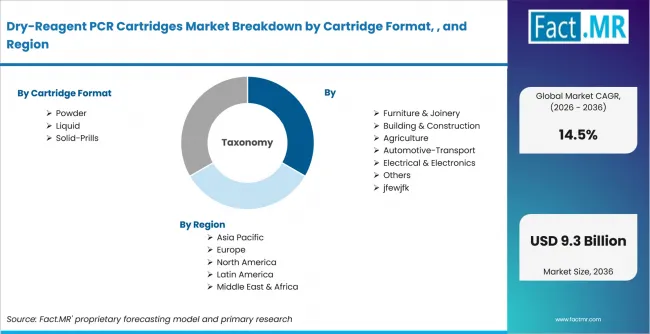
Dry Reagent Pcr Cartridges Market Breakdown By Cartridge Format, , And Region | Source: Fact.MR
| Attribute | Details |
|---|---|
| Quantitative Units | USD Billion in 2026 to USD Billion by 2036 at CAGR |
| Market Definition | Disposable PCR cartridges that store dried assay reagents for closed molecular testing workflows |
| Cartridge Format | Fully Integrated Sample-to-Answer Cartridges; Multiplex PCR Pouches; Micro-PCR Chips; Cartridge-Ready Reagent Chambers; Semi-Integrated PCR Cartridges |
| Reagent Format | Lyophilized PCR Beads and Pellets; Freeze-Dried Master Mix Chambers; Air-Dried Reagent Spots; Dried Primer-Probe Chambers; Desiccated Enzyme Modules |
| Assay Type | Infectious Disease PCR Assays; Respiratory Panels; Sexual Health Tests; Tuberculosis Tests; Antimicrobial Resistance Tests |
| Sample Type | Respiratory Samples; Stool Samples; Urine Samples; Blood and Plasma; Swabs and Lesion Samples |
| End Use | Hospital and Near-Patient Testing Sites; Reference Laboratories; Public Health Programs; Urgent Care Centers; Home and OTC Testing Channels |
| Regions Covered | North America; Western Europe; Asia Pacific; Latin America; Middle East and Africa |
| Countries Covered | United States; India; Germany; Switzerland; China |
| Key Companies Profiled | Cepheid; bioMérieux/BioFire Diagnostics; Roche Diagnostics; QIAGEN; Visby Medical; Molbio Diagnostics |
| Forecast Period | 2026 to 2036 |
| Approach | Hybrid top-down and bottom-up approach using cartridge installed base, assay menu expansion, consumable pull-through and provider validation |
Source: Fact.MR analysis. Updated Jun 26, 2026
How is the market segmented?
-
By Cartridge Format:
- Fully Integrated Sample-to-Answer Cartridges
- Multiplex PCR Pouches
- Micro-PCR Chips
- Cartridge-Ready Reagent Chambers
- Semi-Integrated PCR Cartridges
-
By Reagent Format:
- Lyophilized PCR Beads and Pellets
- Freeze-Dried Master Mix Chambers
- Air-Dried Reagent Spots
- Dried Primer-Probe Chambers
- Desiccated Enzyme Modules
-
By Assay Type:
- Infectious Disease PCR Assays
- Respiratory Panels
- Sexual Health Tests
- Tuberculosis Tests
- Antimicrobial Resistance Tests
-
By Sample Type:
- Respiratory Samples
- Stool Samples
- Urine Samples
- Blood and Plasma
- Swabs and Lesion Samples
-
By End Use:
- Hospital and Near-Patient Testing Sites
- Reference Laboratories
- Public Health Programs
- Urgent Care Centers
- Home and OTC Testing Channels
-
Region:
- North America
- United States
- Canada
- Europe
- Germany
- Switzerland
- United Kingdom
- France
- Netherlands
- Asia Pacific
- India
- China
- Japan
- South Korea
- Singapore
- Latin America
- Brazil
- Mexico
- Argentina
- Middle East & Africa
- UAE
- Saudi Arabia
- South Africa
- Israel
- North America
Frequently Asked Questions
Which cartridge format leads the Dry-Reagent PCR Cartridges Market?
Which reagent format leads the Dry-Reagent PCR Cartridges Market?
Which assay type leads the Dry-Reagent PCR Cartridges Market?
Which sample type leads the Dry-Reagent PCR Cartridges Market?
Which end use leads the Dry-Reagent PCR Cartridges Market?
Which country expands fastest in the Dry-Reagent PCR Cartridges Market?
How does India perform in the Dry-Reagent PCR Cartridges Market?
How does Germany perform in the Dry-Reagent PCR Cartridges Market?
How does Switzerland perform in the Dry-Reagent PCR Cartridges Market?
How does China perform in the Dry-Reagent PCR Cartridges Market?
China is set to record 13.8% CAGR through 2036 as hospitals and regional labs expand cartridge-based molecular testing.
What is the main restraint in the Dry-Reagent PCR Cartridges Market?
Why are lyophilized PCR beads important?
Why are sample-to-answer cartridges gaining adoption?
Who worked on this report


Preview the report firsthand - request a free sample
Free SampleGet the brochure for pricing and purchase details
Download PDF